
Marine Coatings Market Size, Demand & Growth by 2034
Coverage: By Resin Type (Epoxy, Polyurethane, Alkyd, Others); Product Type (Anti-corrosion coatings, Antifouling coatings, Others); Application (Cargo ships, Passenger ships, Boats, Others) , and Geography (North America, Europe, Asia Pacific, and South and Central America)
- Status : Data Released
- Report Code : TIPRE00021796
- Category : Chemicals and Materials
- No. of Pages : 150
- Available Report Formats :


- Last update date : July 13, 2026


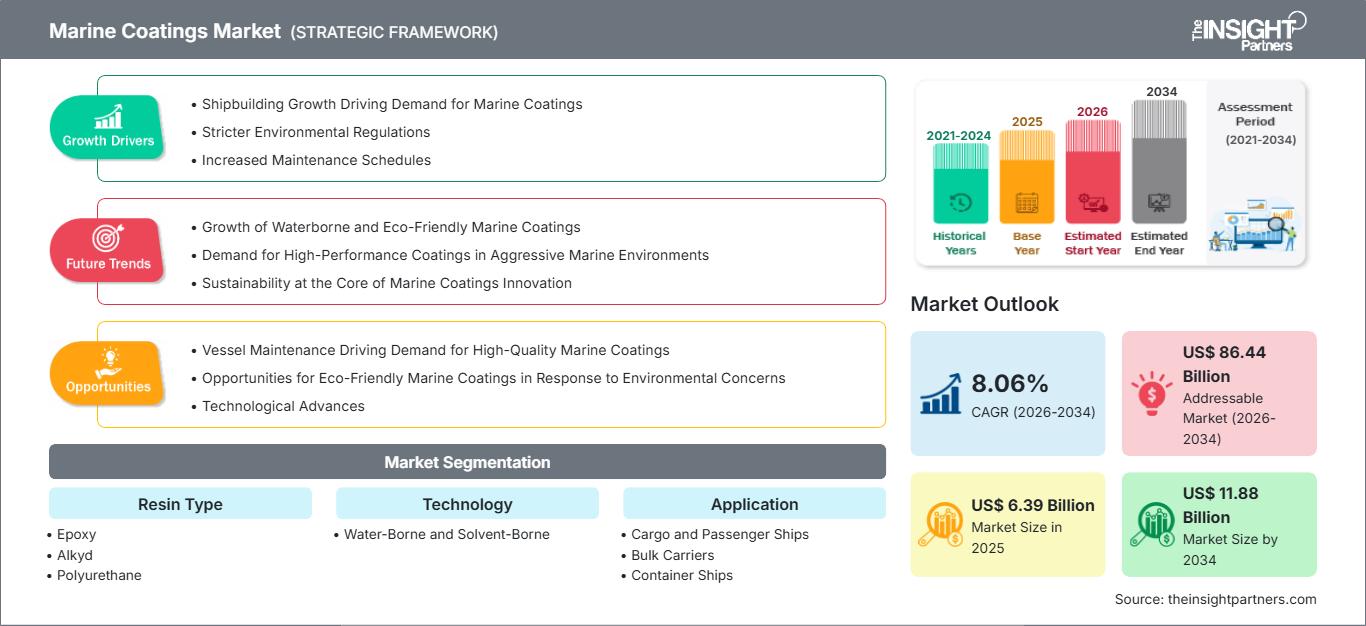
2025 Market Size
US$ 6.39 Bn
Base year value
2034 Forecast
US$ 11.88 Bn
Projected by 2034
CAGR 2026-2034
8.06 %
Growth rate
Addressable Market
US$ 86.44 Bn
(2026-2034)
The value of marine coatings market was estimated at US$ 6.39 Billion in 2025 and will attain a market value of US$ 11.88 Billion by 2034, recording a CAGR of 8.06% over the period of 2026–2034. The market is being driven by the growing ship building activities, increasing maintenance needs for old fleets and stringent environmental norms favoring the use of sophisticated coating technologies. Technological innovations in antifoulant and corrosion resistant coatings are aiding further growth of the industry in the long run.
In North America, the market is driven by naval upgrading programs, offshore oil & gas facilities and maintenance expenditure on commercial ships. The marine coatings market size in the region is projected to register a CAGR of about 6.8-7.4% up until 2034 due to growing fleet refurbishing programs and port infrastructure investments.
Marine Coatings Market Assessment and Insights
- North America: Accounted for 26–30% share in 2025 and is projected to grow at a CAGR of 6.8–7.4% during 2026–2034. Growth is supported by naval vessel upgrades, offshore infrastructure investments, and increasing maintenance cycles for commercial fleets operating across the Atlantic and Pacific coasts.
- US: Represented 72–76% of the North American market in 2025 and is expected to register a CAGR of 6.9–7.5% during 2026–2034 owing to defense shipbuilding, offshore energy assets, and strong demand for vessel maintenance coatings.
- Europe: Held 28–32% share in 2025 and is anticipated to grow at a CAGR of 7.2–7.8% during 2026–2034. Norway, Germany, the UK, Italy, and the Netherlands remain important contributors because of shipbuilding expertise, marine engineering capabilities, and environmental regulations.
- Asia Pacific: Accounted for 38–42% share in 2025 and is forecast to expand at a CAGR of 9.0–9.6% during 2026–2034. China, South Korea, Japan, and India continue to dominate regional demand through commercial shipbuilding, export activities, and expanding offshore projects.
- Largest Segment: Epoxy represented 42–46% market share in 2025 and is projected to grow at a CAGR of 7.8–8.4% during 2026–2034 because of superior corrosion protection, adhesion, and durability across marine environments.
- High Growth Segment: Water-Borne technology accounted for 32–36% market share in 2025 and is anticipated to register a CAGR of 9.4–10.0% during 2026–2034, supported by tightening VOC regulations and sustainability initiatives.
- Key companies analyzed in detail: PPG Industries, Inc.; Akzo Nobel N.V.; Hempel A/S; The Sherwin-Williams Company; Jotun A/S; Chugoku Marine Paints, Ltd.; Nippon Paint Holdings Co., Ltd.; Kansai Paint Co., Ltd.; Axalta Coating Systems Ltd.; BASF SE.
Source: The Insight Partners' analysis based on proprietary research, government publications, company annual reports, investor presentations, industry databases, and expert interviews.
The marine transportation industry has seen considerable technological evolution owing to the greater emphasis ship owners place on lifecycle optimization and regulatory compliance. Modern coating chemistry is capable of offering better corrosion protection, increased fouling management, and extended dry-dock periods. Technology-driven coating inspection, predictive maintenance technology, and eco-friendly coatings are redefining production techniques as companies invest further into studying low-emissions coating technologies for use in varied marine environments.
Growing demand is anticipated to be sustained by increased shipbuilding efforts in Asia Pacific, the development of offshore renewable energy sources, and the the renewal of naval forces worldwide. Legislation aimed at reducing emissions and fuel consumption is driving the adoption of advanced coating technologies. Manufacturers are also looking to expand operations in various regions and strengthen distribution channels.
Marine Coatings Market Report Scope
| Report Attribute | Details |
|---|---|
| Market size in 2025 | US$ 6.39 Billion |
| Market Size by 2034 | US$ 11.88 Billion |
| Global CAGR (2026 - 2034) | 8.06% |
| Historical Data | 2021-2024 |
| Forecast period | 2026-2034 |
Marine Coatings Market Analysis
The increase in global seaborne cargo volumes, ongoing modernization of naval fleets, and greater investment in offshore facilities will continue to drive the marine coatings industry globally. Marine coatings are integral to extending the vessel's useful life, reducing maintenance costs, and increasing efficiency by preventing hull fouling and corrosion. Stringent regulations are leading to adoption of more environmentally sustainable technologies with less emissions of VOCs, whereas the owners of vessels are increasingly looking at solutions that can extend the useful life of the vessel and reduce overall cost of operations.
Raw material suppliers, resins manufacturers, coating formulators, shipyards, classification societies, vessel owners/operators, and maintenance service providers form an extensively integrated value chain. The technological cooperation between the resin producers and coatings formulators is facilitating innovation in developing advanced coatings based on epoxy, polyurethane, and water-borne materials for harsher marine environments.
The level of competition is further increasing due to huge investments being made in innovation of products, technological service offerings, and geographical expansion of production facilities. Market analysis of marine coatings reveals that players such as PPG Industries, Inc., Akzo Nobel N.V., Hempel A/S, and Jotun A/S are continually improving their portfolios through environmentally friendly technologies, digitized inspection services, and customized marine coatings for commercial vessels, offshore installations, and navies. Performance and life cycle value are key competitive advantages.
Investments are increasingly being made in research related to bio-based ingredients, innovative antifouling technology, and smart coatings that can help in predictive maintenance. Firms such as The Sherwin-Williams Company, Chugoku Marine Paints, Ltd., Nippon Paint Holdings Co., Ltd., Kansai Paint Co., Ltd., Axalta Coating Systems Ltd., and BASF SE are expanding their regional technical centers and are partnering with shipyards and fleets for fast commercialization of advanced marine protection solutions.
● REPORT CUSTOMIZATION
Tailor This Report To Align With Your Specific Business Requirements
This report can be customized to align precisely with your business objectives, scope, and target markets. Customization options include tailored segmentation, geography, competitive analysis, and strategic insights to support informed decision-making.
Customize This Report →WHAT YOU CAN ADJUST
- ● Segmentations
- ● Geography
- ● Competitive Analysis
- ● Language Preferences
Marine Coatings Market: Strategic Insights
Regional Insights
North America Marine Coatings Market
North America accounted for 26–30% of the marine coatings market share in 2025 and is projected to register a CAGR of 6.8–7.4% during 2026–2034. Regional demand is supported by continuous investments in naval fleet modernization, commercial vessel maintenance, offshore oil and gas operations, and expanding port infrastructure. The United States and Canada continue allocating significant capital toward maritime security, creating stable demand for high-performance protective coating systems.
Environmental regulations issued by agencies such as the U.S. Environmental Protection Agency have accelerated adoption of low-VOC and water-borne coating technologies across commercial and defense marine applications. Growth is further supported by increasing dry-docking activities, offshore wind developments, and greater emphasis on extending vessel operating life while reducing maintenance frequency and fuel consumption through advanced antifouling technologies.
U.S. Marine Coatings Market
The U.S. represented 72–76% of the North American marine coatings market in 2025 and is expected to expand at a CAGR of 6.9–7.5% through 2034. Strong domestic shipbuilding capabilities, extensive naval procurement programs, and one of the world's largest commercial shipping infrastructures continue generating consistent demand for protective marine coatings across new-build and maintenance applications.
The larger coating suppliers have their research labs, manufacturing units, and technical service teams spread all across the nation to assist the shipyard and fleet companies. The growing trend of refitting support ships, naval vessels, and cargo vessels has led to increased use of high-quality epoxy and polyurethane coatings. These coatings help reduce corrosion and enhance durability and maintenance efficiency.
Europe Marine Coatings Market
Europe's marine coatings market share was 28-32%, while the CAGR for the period is predicted to be 7.2-7.8%. Europe enjoys advanced marine engineering, stringent regulations, and shipbuilding industry. Germany continues to be a key player due to its commercial shipbuilding activities, marine equipment manufacturing, and advancements in coating technologies.
UK continues to focus on fleet upgrade, installation of offshore renewable energy infrastructure, and maintenance of commercial vessels, providing a solid demand for protective coatings in shipyards and marine infrastructure. Growing sustainability measures have been driving the adoption of water-based and emission-free coating technologies.
Key players in the Europe marine coatings market include France, Italy, and Spain, which together provide a significant manufacturing base in the region with their cruise ship construction, naval engineering, and commercial shipping operations. Increased investments in infrastructure development at Mediterranean ports and in vessel renovation are driving demand for anti-fouling and corrosion-protection coating solutions.
APAC Marine Coatings Market
Asia Pacific accounted for 38–42% marine coatings market share in 2025 and is forecast to expand at a CAGR of 9.0–9.6% through 2034. China remains the regional leader, followed by South Korea and Japan, supported by their dominant global shipbuilding industries. India and Australia are also increasing investments in naval modernization and maritime infrastructure.
The government-led efforts towards developing domestic shipbuilding, export capabilities, and offshore energy production are making the region a strong market. Industrialization, growth of the commercial fleet, and repair capabilities make Asia Pacific a fast-growing regional market for the most sophisticated marine coatings.
Middle East & Africa Marine Coatings Market
The marine coatings market in Middle East & Africa is expected to register a CAGR of 7.4–8.0% during 2026–2034. Saudi Arabia and the United Arab Emirates continue investing in ports, offshore energy infrastructure, and logistics hubs, while South Africa remains an important center for ship repair and marine maintenance services.
Expansion of offshore oil and gas projects, maritime trade corridors, and coastal infrastructure is increasing demand for durable protective coating systems. Rising diversification investments and growing marine engineering activities across the Gulf region are expected to create additional opportunities for coating manufacturers over the forecast period.
Segmentation Analysis
Resin Type
The Resin Type segment is anticipated to expand at a CAGR of 8.1–8.7% during 2026–2034. The marine coatings market scope continues expanding as shipowners increasingly demand coating systems that offer superior corrosion resistance, mechanical durability, and extended maintenance intervals. Technological innovation in resin chemistry is enabling manufacturers to improve adhesion, chemical resistance, and long-term performance under harsh marine environments while supporting compliance with increasingly stringent environmental standards.
- Epoxy remains the dominant resin because of excellent corrosion protection, outstanding adhesion to steel substrates, and widespread adoption across ballast tanks, cargo holds, hulls, and offshore structures where long-term durability is essential.
- Alkyd coatings continue serving maintenance and decorative applications where ease of application, cost-effectiveness, and acceptable weather resistance remain important purchasing considerations for operators managing aging commercial fleets.
- Polyurethane coatings are increasingly selected for premium finishing applications because they provide excellent gloss retention, ultraviolet resistance, color stability, and long-term aesthetic performance for commercial and passenger vessels.
Technology
The Technology segment is projected to register a CAGR of 8.4–9.0% during the forecast period. Environmental regulations governing volatile organic compound emissions are encouraging manufacturers and vessel owners to transition toward sustainable coating technologies without compromising durability, corrosion resistance, or operational performance. Continuous investments in formulation development are improving application efficiency while reducing environmental impact across marine maintenance operations.
- Water-Borne coatings are witnessing accelerating adoption due to lower VOC emissions, regulatory compliance, improved workplace safety, and continuous technological improvements that enhance durability and corrosion resistance for marine applications.
- Solvent-Borne coatings continue maintaining significant market demand because of proven long-term performance, superior adhesion, and reliable protection under extreme marine operating conditions, particularly for offshore assets and heavy-duty commercial vessels.
Application
The Application segment is expected to grow at a CAGR of 8.3–8.9% through 2034. Growth is supported by increasing global seaborne trade, expanding naval procurement programs, and rising investments in offshore infrastructure. Vessel operators continue emphasizing lifecycle cost reduction through premium coating systems capable of minimizing maintenance downtime, improving fuel efficiency, and extending service life under challenging marine operating environments.
- Cargo and Passenger Ships represent a substantial demand base owing to continuous fleet maintenance, increasing passenger transportation, and stricter environmental regulations requiring high-performance protective coating systems.
- Bulk Carriers require durable corrosion-resistant coatings capable of withstanding abrasive cargo handling conditions, prolonged seawater exposure, and demanding operational environments throughout extended international shipping routes.
- Container Ships continue generating strong demand as operators prioritize fuel efficiency, lower maintenance costs, and improved hull performance through advanced antifouling technologies supporting high-frequency global trade operations.
- Offshore Vessels increasingly adopt premium protective coatings to withstand aggressive marine environments, chemical exposure, ultraviolet radiation, and mechanical stress associated with offshore oil, gas, and renewable energy operations.
Opportunity Snapshot
| Segment Name | Revenue Contribution | Trend Tag | Adoption Stage |
| Cargo and Passenger Ships | High | Fleet Renewal | Mature |
| Bulk Carriers | Medium | Hull Protection | Mature |
| Container Ships | High | Fuel Efficiency | Scaling |
| Offshore Vessels | Medium | Offshore Wind | Scaling |
Marine Coatings Market Growth Drivers and Impact Analysis
Stringent environmental regulations accelerating adoption of sustainable coatings
Stringent guidelines on VOC emissions, antifouling chemistry, and efficiency have greatly affected the evolution of coating technology in the marine industry. The regulation guidelines that have been put in place by bodies such as the International Maritime Organization, regional environmental regulation bodies, and national maritime administrations have made it necessary for the ship owners to employ coating materials that are both environmentally friendly and efficient. This is making it necessary to invest more in waterborne coating materials, advanced epoxy resins, and efficient antifouling coatings that require less biocides.
Growth in global shipbuilding and vessel maintenance activities
The bulk of international merchandise transportation is still carried out by commercial shipping and will therefore continue to create a steady need for new vessel construction and regular maintenance. The rise in shipbuilding activity in Asia Pacific, together with a higher number of dry dockings of aging fleets in Europe and North America, is helping to create a steady demand for protective marine coating products. There is a rising focus on coating materials that can help increase the time between maintenance operations and at the same time, minimize corrosion and fouling during the lifetime of the vessels. Other areas, such as offshore support vessels, military ship modernization, cruise liners, and cargo carriers, will help boost coating usage.
Expansion of offshore energy and marine infrastructure projects
The fast-paced construction of offshore oil and gas platforms, offshore production platforms, offshore wind farms, port structures, and coastal infrastructure is creating numerous market opportunities for innovative protective coatings. The above-named facilities operate in an extremely corrosive seawater environment, in which their structural stability is essential for safe operation and maintenance. Manufacturers create specialized coatings that withstand the effects of seawater, UV rays, wear, and chemical exposure throughout the extended service life. Various governments in Asia, Europe, and the Middle East continue investing money into the expansion of maritime infrastructures. With the rise in offshore renewable energy facilities worldwide, such coating solutions are likely to gain more importance in long-term investments.
Marine Coatings Market Future Trends
Digital coating inspection and predictive maintenance technologies
Digitalization is becoming an important differentiator across vessel maintenance strategies. Marine coatings market trends increasingly include the integration of coating inspection software, artificial intelligence, remote monitoring technologies, and predictive maintenance platforms that evaluate coating degradation before significant structural damage occurs. These technologies enable shipowners to optimize maintenance schedules, reduce operational downtime, improve coating performance evaluation, and extend asset life. Manufacturers are simultaneously expanding digital technical service capabilities, providing customers with real-time performance monitoring and lifecycle recommendations that strengthen long-term customer relationships while improving operational efficiency across commercial fleets.
Development of advanced low-friction and fuel-saving coating systems
Future innovation will increasingly focus on coating formulations capable of minimizing hydrodynamic resistance while maintaining long-term fouling protection. Research into silicone-based technologies, fluoropolymer coatings, and advanced hybrid resin systems is expected to improve vessel fuel efficiency while supporting international decarbonization objectives. Growing pressure to reduce greenhouse gas emissions will encourage shipping companies to adopt premium coating systems that deliver measurable operational savings throughout vessel lifecycles. Continuous material science innovation is expected to improve durability, application performance, and environmental compatibility across next-generation marine protective coating solutions.
Marine Coatings Market Opportunities
Growing investments in offshore renewable energy infrastructure
The continued expansion of offshore wind farms, floating substations, subsea structures, and marine transmission infrastructure presents an attractive long-term opportunity for coating manufacturers. Marine coatings market forecasts indicate that offshore renewable energy investments will continue increasing across Europe, Asia Pacific, and North America as governments pursue decarbonization targets and energy security objectives. Each offshore installation requires multiple protective coating layers capable of resisting corrosion, mechanical wear, and continuous seawater exposure over decades of operation. Manufacturers able to develop specialized offshore coating systems with extended maintenance intervals, improved environmental compliance, and enhanced lifecycle performance are expected to strengthen competitive positioning while capturing higher-value infrastructure projects worldwide.
Expansion into emerging maritime economies and regional ship repair hubs
Rapid development of commercial ports, ship repair facilities, and domestic shipbuilding industries across Southeast Asia, the Middle East, Africa, and Latin America is creating substantial investment potential. Growing regional trade volumes and increasing government support for maritime industries are encouraging expansion of local coating manufacturing, distribution networks, and technical service capabilities. Companies establishing regional production facilities can reduce logistics costs, improve delivery timelines, and strengthen relationships with local shipyards and fleet operators. Investment in localized technical expertise, customized product portfolios, and sustainable manufacturing capabilities will enable suppliers to benefit from long-term maritime infrastructure development while improving resilience against future supply chain disruptions.
Recent Developments
- July 2026: PPG (NYSE:PPG) announced that it has received a 2026 Green Chemistry Challenge Award from the American Chemical Society (ACS) Green Chemistry Institute. PPG was recognized in the Design of Safer Chemicals category for PPG SIGMAGLIDE® 2390 coating, a biocide-free, silicone-based fouling release technology that helps vessel owners and operators improve fuel efficiency, reduce emissions and avoid the release of antifoulants into marine environments.
- June 2026: AkzoNobel’s marine coatings brand, International, launched Intersleek 2120, a new silicone foul-release coating ideal for the operational and regulatory realities of modern fleets. Unveiled at Posidonia in Athens, Intersleek 2120 expands access to the proven silicone technology from International for vessel operators, delivering reliable, predictable performance aligned with day-to-day operating conditions.
Frequently Asked Questions

- Comprehensive Market Sizing and Forecast Analysis
- Detailed Segmentation Analysis
- In-Depth Market Dynamics Assessment
- Regional and Country-Level Insights
- Competitive Landscape and Company Benchmarking
- Strategic Business Intelligence
Recent Reports
Testimonials

The Insight Partners' SCADA System Market report is comprehensive, with valuable insights on current trends and future forecasts. The team was highly professional, responsive, and supportive throughout. We are very satisfied and highly recommend their services.
RAN KEDEM Partner, Reali Technologies LTDs
I requested a report on a very specific software market and the team produced the report in a few days. The information was very relevant and well presented. I then requested some changes and additions to the report. The team was again very responsive and I got the final report in less than a week.
JEAN-HERVE JENN Chairman, Future Analytica
We worked with The Insight Partners for an important market study and forecast. They gave us clear insights into opportunities and risks, which helped shape our plans. Their research was easy to use and based on solid data. It helped us make smart, confident decisions. We highly recommend them.
PIYUSH NAGPAL Sr. Vice President, High Beam Global
The Insight Partners delivered insightful, well-structured market research with strong domain expertise. Their team was professional and responsive throughout. The user-friendly website made accessing industry reports seamless. We highly recommend them for reliable, high-quality research services
YUKIHIKO ADACHI CEO, Deep Blue, LLC.
This is the first time I have purchased a market report from The Insight Partners.While I was unsure at first, I visited their web site and felt more comfortable to take the risk and purchase a market report.I am completely satisfied with the quality of the report and customer service. I had several questions and comments with the initial report, but after a couple of dialogs over email with their analyst I believe I have a report that I can use as input to our strategic planning process.Thank you so much for taking the extra time and making this a positive experience.I will definitely recommend your service to others and you will be my first call when we need further market data.
JOHN SUZUKI President and Chief Executive Officer, Board Director, BK Technologies
I wish to appreciate your support and the professionalism you displayed in the course of attending to my request for information regarding to infectious disease IVD market in Nigeria. I appreciate your patience, your guidance, and the fact that you were willing to offer a discount, which eventually made it possible for us to close a deal. I look forward to engaging The Insight Partners in the future, all thanks to the impression you have created in me as a result of this first encounter.
DR CHIJIOKE ONYIA MANAGING DIRECTOR, PineCrest Healthcare Ltd.Reason to Buy
- Informed Decision-Making
- Understanding Market Dynamics
- Competitive Analysis
- Identifying Emerging Markets
- Customer Insights
- Market Forecasts
- Risk Mitigation
- Boosting Operational Efficiency
- Strategic Planning
- Investment Justification
- Tracking Industry Innovations
- Aligning with Regulatory Trends





 Get Free Sample for