
Matting agents Market Size, Share & Trends by 2034
Coverage: by Material (Silica, Waxes, Thermoplastics, Others); Technology (Water based, Solvent based, Radiation cure and high solid, Others); Application (Industrial, Architectural, Leather, Wood, Printing Inks, Others) , and Geography (North America, Europe, Asia Pacific, and South and Central America)
- Status : Data Released
- Report Code : TIPRE00004866
- Category : Chemicals and Materials
- No. of Pages : 150
- Available Report Formats :


- Last update date : July 15, 2026


2025 Market Size
US$ 454.63 Mn
Base year value
2034 Forecast
US$ 721.7 Mn
Projected by 2034
CAGR 2026-2034
5.27 %
Growth rate
Addressable Market
US$ 5,336.24 Mn
(2026-2034)
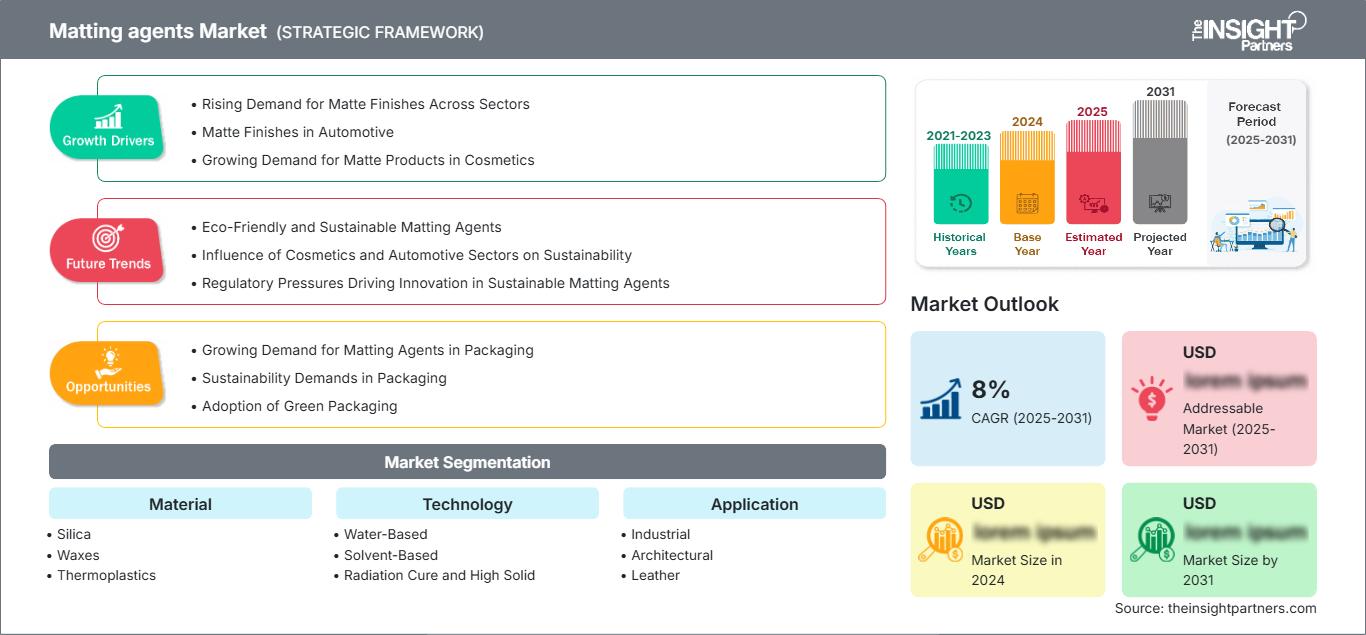
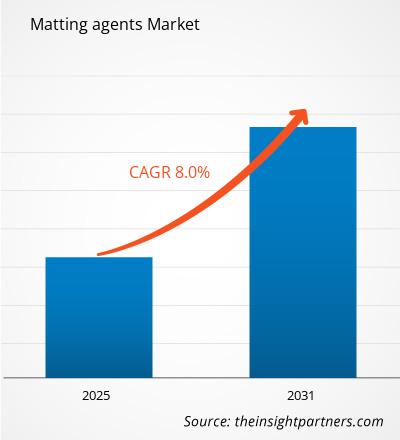
The global matting agents market size is expected to reach US$ 721.7 million in 2034 growing at a CAGR of 5.27% from US$ 454.63 million in 2025. The growing preference for high-end coatings with controlled gloss is boosting the market growth. The market is driven by constant development of coatings technology and sustainable raw materials in matting agents.
North America is expected to be one of the key regions in the matting agents market, which is dominated by the established coatings industry in the region along with strict environmental regulations. Rising investments in advanced water-based coating technology and improved scratch resistance properties along with transparency in coatings, are driving the market growth. The market is estimated to grow at a CAGR of 4.8–5.4% through 2034 in the region.
Matting agents Market Assessment and Insights
- North America: Supported by advanced coatings manufacturing, increasing demand for sustainable formulations, and strong industrial production, North America accounted for 28–31% share in 2025 and is projected to expand at a CAGR of 4.8–5.4% during 2026–2034.
- U.S.: The country remained the dominant regional market, representing 80–83% of North America in 2025, while registering a CAGR of 4.9–5.5% owing to strong demand from industrial coatings, wood finishes, and architectural applications.
- Europe: Europe accounted for 30–33% share in 2025, supported by Germany, Italy, France, and the UK. The regional market is projected to grow at a CAGR of 4.9–5.5% owing to sustainability-driven coating innovations.
- Asia Pacific: Rapid industrialization, expanding construction activities, and growing coatings production in China, India, Japan, and South Korea enabled the region to account for 32–35% share in 2025, growing at a CAGR of 6.0–6.6%.
- Largest Segment: Silica remained the leading material segment with a market share of 60–63% in 2025 and is anticipated to register a CAGR of 5.3–5.8% due to its excellent matting efficiency and compatibility.
- High Growth Segment: Water-Based technology accounted for 33–36% market share in 2025 and is projected to expand at a CAGR of 6.1–6.7%, supported by tightening environmental regulations and rising adoption of low-VOC coatings.
- Key companies analyzed in detail: Evonik Industries AG, Deuteron GmbH, Jinsha Precipitated Silica Manufacturing Co., Ltd., Thomas Swan & Co. Ltd., Lorama Group Inc., PQ Corporation, PPG Industries, Inc., Imerys S.A., W. R. Grace & Co., and ALTANA AG.
Source: The Insight Partners' analysis based on proprietary research, government publications, company annual reports, investor presentations, industry databases, and expert interviews.
Innovations in coating additives for specialties have evolved the specialty coatings additive market from silica-based products to those of superior clarity, abrasion resistance and controllable gloss reduction. Manufacturers are concentrating their efforts on surface-treated silica, wax-based additives, and multifunctional matting systems that can enhance coating aesthetics while preserving mechanical properties. This trend has increased the applicability of such products within high value coating applications.
Market growth in the future is predicted to be driven by increasing capital investment in eco-friendly coating technologies, increase in capacity within the Asia Pacific region and increased consumer demand for premium decorative finishes. Increasing popularity of water-based products, stricter volatile organic compounds and technological innovations within radiation curable coatings are some factors which will aid demand in the future.
Matting agents Market Report Scope
| Report Attribute | Details |
|---|---|
| Market size in 2025 | US$ 454.63 Million |
| Market Size by 2034 | US$ 721.7 Million |
| Global CAGR (2026 - 2034) | 5.27% |
| Historical Data | 2021-2024 |
| Forecast period | 2026-2034 |
Matting agents Market Analysis
Rising consumer preferences for superior-quality surface finishes, environmentally friendly coatings, and durable decorative solutions will help drive growth prospects in the matting agents market. Companies are integrating advanced matting additives to enhance scratch resistance, chemical stability, and gloss control without compromising overall coating performance. The trend towards sustainable coatings technology is another factor that is driving the demand for specialty additives suitable for low-volatile organic compounds (VOCs) and water-based formulations.
The supply chain includes raw material suppliers, specialty chemical producers, additive providers, coatings manufacturers, distributors, and end-user industries. Investments in advanced technologies for producing high-purity silica, dispersion techniques, and customized particle engineering have led to improved performance and supply stability. Expansion of production capacities in Asia and efficient supply sourcing efforts continue to boost supply chain stability despite irregular raw material supply.
The competitive landscape is still driven by technology, with the matting agents market analysis indicating continued investment in innovation, the geographical expansion of manufacturing plants, and sustainability practices. The leading players like Evonik Industries AG, ALTANA AG, PQ Corporation, Imerys S.A., PPG Industries, Inc., Deuteron GmbH, and Lorama Group Inc. are engaged in the development of innovative silica and polymer-based matting agents suited to meet changing customer requirements of the coatings industry.
Capacity expansion, partnerships with coating formulators, and R&D on low-emission coatings are the strategies being used by leading companies to gain a competitive edge. There will be increased focus on customization of matting agents for use in wood coatings, leather finishes, printing inks, and radiation-curable coatings.
● REPORT CUSTOMIZATION
Tailor This Report To Align With Your Specific Business Requirements
This report can be customized to align precisely with your business objectives, scope, and target markets. Customization options include tailored segmentation, geography, competitive analysis, and strategic insights to support informed decision-making.
Customize This Report →WHAT YOU CAN ADJUST
- ● Segmentations
- ● Geography
- ● Competitive Analysis
- ● Language Preferences
Matting agents Market: Strategic Insights
Regional Insights
North America Matting Agents Market
North America accounted for 28–31% of the global matting agents market share in 2025 and is anticipated to register a CAGR of 4.8–5.4% during 2026–2034. Demand is supported by mature coatings manufacturing, renovation activities, and increasing adoption of environmentally compliant coating technologies. Regulatory initiatives promoting reduced volatile organic compound emissions have accelerated the transition toward water-based and high-solid coating systems, increasing consumption of advanced matting agents that provide superior gloss control, abrasion resistance, and surface durability across industrial and architectural applications.
The US and Canada remain committed to advancing manufacturing, wood processing, furniture manufacturing, and infrastructure renovations; this drives consistent demand for specialty coating additives. There is ongoing expansion in the use of engineered silica additives, wax additives, and technologies that provide both scratch resistance and coating clarity. Commercial building renovations and premium decorative coating consumption will ensure continued growth in the market during the forecast period.
U.S. Matting Agents Market
The US holds about 80-83% share of the North American market in 2025, and will grow at a CAGR of 4.9-5.5% through 2034. There is high demand due to applications in architectural coatings, industrial equipment coatings, wooden furniture manufacturing, packaging inks, and transportation equipment coatings. Continuous investment in sustainable manufacturing, as well as new coating formulations, has led to increased demand for superior matting technology that enhances surface performance and adheres to ever-stricter environmental standards.
Leading companies such as Evonik Industries AG, PPG Industries, Inc., PQ Corporation, W. R. Grace & Co., and Lorama Group Inc. operate highly successful commercial businesses nationwide. The research and development work is currently focused on low-dust additives, improved dispersibility, and greater compatibility with aqueous formulations. Increased consumer preference for superior interior finishes and industrial coatings drives stable demand from OEM and after-market coating segments.
Europe Matting Agents Market
Europe accounted for 30–33% of the global matting agents market in 2025 and is expected to expand at a CAGR of 4.9–5.5% during the forecast period. Strong environmental legislation, technological innovation, and a mature coatings industry continue driving adoption of advanced matting technologies. Germany remains the largest regional market owing to its well-established automotive, industrial coatings, and specialty chemicals industries, which require high-performance additives that meet demanding quality and sustainability standards.
Specialty matting agents are used in the architectural coatings, wood finishing, and packaging sectors, which have witnessed increased demand for decorative low-gloss coatings.
Germany remains innovative and successful in producing specialty chemicals and making heavy investments in coating research. The demand for these specialty chemicals is driven by industrial, automotive, and high-grade furniture coatings, which require improved abrasion resistance and controlled gloss levels
In France, Italy, and Spain, there is a good presence in architectural coatings, leather finishes, furniture coatings, and industrial coatings. It is estimated that investments in eco-friendly coating technology and high-grade decorative coatings will sustain demand for these agents for years.
APAC Matting Agents Market
Asia Pacific represented 32–35% of the global market in 2025 and is forecast to record the highest CAGR of 6.0–6.6% during 2026–2034. China remains the largest producer and consumer owing to its extensive coatings manufacturing industry, while Japan and South Korea continue emphasizing high-performance specialty coatings for automotive, electronics, and industrial applications.
India and Australia are witnessing increasing consumption due to expanding construction activities, industrial manufacturing, and furniture production. Government support for domestic manufacturing, rising infrastructure investments, and increasing exports of coated products continue creating favorable opportunities for advanced matting agent suppliers throughout the region.
Middle East & Africa Matting Agents Market
The Matting Agents market in Middle East & Africa is expected to register a CAGR of 5.3–5.9% through 2034. Demand is supported by growing construction activities, industrial coatings, infrastructure development, and increasing investments in downstream manufacturing. Saudi Arabia remains the leading regional market, while the United Arab Emirates continues expanding demand through commercial real estate and industrial development projects.
South Africa serves as an important regional consumer because of its established paints and coatings industry supporting mining, infrastructure, and manufacturing sectors. Increasing industrial diversification, rising construction investments, and growing adoption of environmentally compliant coating technologies are expected to strengthen long-term demand for specialty matting additives across the broader Middle East and African markets.
Segmentation Analysis
Material
The Material segment is expected to expand at a CAGR of 5.2–5.8% during 2026–2034. Material selection depends on particle size distribution, transparency, ease of dispersion, scratch resistance, and compatibility with different coating systems. The matting agents market scope continues to broaden as coating manufacturers increasingly demand multifunctional additives that deliver consistent gloss reduction while maintaining mechanical performance, chemical resistance, and formulation stability across industrial and decorative applications.
- Silica: Silica is the most widely used matting material because of its excellent gloss reduction efficiency, high transparency, ease of formulation, and compatibility with solvent-based, water-based, and radiation-curable coating systems across multiple industries.
- Waxes: Wax-based matting agents provide enhanced surface slip, abrasion resistance, anti-blocking properties, and improved tactile performance. They are widely utilized in industrial coatings, wood finishes, and specialty printing applications requiring superior surface protection.
- Thermoplastics: Thermoplastic matting agents are increasingly adopted where excellent chemical resistance, durable texture, and controlled surface appearance are required. Their compatibility with specialized industrial coatings supports expanding use in premium performance applications.
Technology
The Technology segment is projected to register a CAGR of 5.5–6.1% during 2026–2034. Continuous innovation in coating chemistry, environmental regulations, and application requirements is driving the transition toward advanced coating technologies. Manufacturers are developing specialized matting agents optimized for different resin systems to improve dispersion, gloss consistency, and long-term coating durability while supporting sustainable manufacturing objectives.
- Water-Based: Water-based technologies continue experiencing the strongest demand because they support reduced volatile organic compound emissions, regulatory compliance, improved workplace safety, and growing adoption across architectural, industrial, and wood coating applications.
- Solvent-Based: Solvent-based coatings remain important for demanding industrial environments where superior chemical resistance, fast drying characteristics, and excellent substrate adhesion continue to be essential performance requirements.
- Radiation Cure: Radiation cure technologies are gaining wider acceptance because they enable rapid curing, improved production efficiency, enhanced scratch resistance, and lower energy consumption in high-value industrial and printing applications.
- High Solid: High-solid coating systems reduce solvent content while maintaining excellent coating performance and film build, making them increasingly attractive for industrial applications seeking compliance with evolving environmental regulations.
Application
The Application segment is anticipated to grow at a CAGR of 5.4–6.0% during 2026–2034. Demand is influenced by expanding construction activities, industrial manufacturing, premium furniture production, packaging, and decorative coating applications. Increasing emphasis on surface aesthetics, durability, and environmental compliance continues encouraging adoption of advanced matting technologies across diverse end-use industries.
- Industrial: Industrial coatings account for the largest application demand because manufacturers require consistent gloss control, abrasion resistance, and long-term durability for machinery, equipment, transportation components, and protective coating systems.
- Architectural: Architectural coatings increasingly utilize advanced matting agents to achieve premium decorative finishes with improved stain resistance, low reflectivity, and enhanced durability for residential and commercial construction projects.
- Leather: Leather finishing applications require controlled gloss levels while maintaining flexibility, abrasion resistance, and attractive surface aesthetics across footwear, automotive interiors, furniture upholstery, and fashion accessories.
- Wood: Wood coatings depend on matting agents to produce natural-looking finishes, improve scratch resistance, and enhance furniture appearance while preserving substrate texture in residential and commercial applications.
- Printing Inks: Printing inks increasingly incorporate specialty matting agents to achieve controlled surface appearance, improved print quality, enhanced rub resistance, and consistent visual performance across packaging, labels, and commercial printing products.
Opportunity Snapshot
| Segment Name | Revenue Contribution | Trend Tag | Adoption Stage |
| Industrial | High | Protective Coatings | Mature |
| Architectural | High | Low VOC | Scaling |
| Leather | Medium | Premium Finish | Mature |
| Wood | Medium | Furniture Coatings | Scaling |
| Printing Inks | Medium | Matte Packaging | Emerging |
Matting agents Market Growth Drivers and Impact Analysis
Increasing Demand for Sustainable and Low-VOC Coating Formulations
Regulations on volatile organic compound emissions worldwide are prompting the development of coatings using waterborne, radiation-curable, and high-solids systems. Highly advanced matting technologies will serve as a key component in achieving gloss control, opacity, and abrasion resistance, all of which must be achieved in an environmentally friendly coating system. Sustainable coatings are being embraced by construction companies, furniture firms, and automakers, without compromising product quality. Investments in specialty surface-treated silica and additives will help coating formulators achieve environmental requirements in North America, Europe, and Asia Pacific. It is estimated that this trend will generate a steady demand for matting technologies during the forecast period.
Growth in Construction and Industrial Manufacturing Activities
Rising investments in residential construction, commercial infrastructure, industrial equipment manufacturing, and furniture production continue supporting consumption of decorative and protective coatings. These applications require controlled surface appearance, improved abrasion resistance, and long-lasting durability that can be achieved through advanced matting additives. Expanding manufacturing activity across emerging Asian economies and increasing refurbishment of buildings in developed markets are generating consistent demand for architectural and industrial coatings. Manufacturers are responding by introducing engineered silica and polymer-based additives with enhanced dispersion properties, enabling coating producers to improve production efficiency while delivering premium surface finishes across diverse end-use applications.
Technological Advancements in Specialty Surface Additives
Continuous innovation in particle engineering, surface modification, and dispersion technologies is improving the performance of modern matting agents. Manufacturers are developing products that offer superior transparency, lower dust generation, improved sedimentation stability, and excellent compatibility with multiple resin systems. These advancements help coating formulators achieve uniform gloss reduction while preserving mechanical strength and weather resistance. Increased research into multifunctional additives capable of combining matting, scratch resistance, anti-blocking, and slip performance is expanding product value across industrial, wood, leather, and printing ink applications. Technology-driven product differentiation is expected to remain a key competitive advantage throughout the forecast period.
Matting agents Market Future Trends
Engineered Silica Technologies Continue Advancing Performance Standards
The matting agents market trends increasingly reflect demand for engineered silica materials offering improved transparency, enhanced dispersion, optimized particle morphology, and superior scratch resistance. Coating manufacturers are seeking additives that deliver consistent matte finishes while maintaining coating durability and process efficiency. Continued investment in advanced silica processing technologies is expected to expand product performance across architectural, industrial, and wood coatings. These innovations will enable suppliers to address evolving customer requirements for environmentally responsible formulations, premium aesthetics, and higher productivity in modern coating manufacturing environments.
Radiation-Curable Coatings Gain Wider Commercial Adoption
Growing adoption of ultraviolet and electron beam curing technologies is expected to increase demand for matting agents specifically designed for radiation-curable systems. These coating technologies offer rapid curing, lower energy consumption, improved manufacturing efficiency, and reduced emissions compared with conventional processes. As packaging, furniture, electronics, and industrial manufacturers increasingly adopt high-speed curing technologies, suppliers are expected to develop specialized additives capable of maintaining uniform gloss control while supporting enhanced productivity and coating performance.
Matting agents Market Opportunities
Expansion of High-Performance Additives in Emerging Coating Markets
Increasing industrialization and infrastructure development across Southeast Asia, Latin America, and the Middle East are creating substantial opportunities for suppliers of specialty coating additives. Matting agents market forecasts indicate sustained investment in architectural coatings, industrial equipment, wood finishes, and protective coatings as manufacturing output and urban construction continue to expand. Companies establishing local technical service centers, application laboratories, and regional distribution networks can strengthen customer relationships while reducing supply chain lead times. Product portfolios tailored to regional regulatory requirements and climatic conditions are expected to provide a competitive advantage, particularly in rapidly developing economies where demand for premium coating performance continues to increase.
Innovation in Multifunctional Surface Modification Solutions
Growing customer preference for additives capable of delivering multiple performance benefits presents a significant opportunity for manufacturers. Future product development is expected to focus on combining gloss reduction with scratch resistance, anti-blocking performance, slip enhancement, stain resistance, and improved chemical durability within a single formulation. Such multifunctional solutions reduce formulation complexity while improving manufacturing efficiency for coating producers. Strategic investment in research partnerships, pilot-scale testing facilities, and advanced material engineering can enable suppliers to differentiate their offerings and capture higher-value opportunities across industrial, architectural, leather, wood, and specialty printing applications.
Recent Developments
- May 2026: BASF’s Performance and Formulation Additives announced the launch of Efka® PX 4720, a new high‑performance dispersing agent designed for ultra‑matte, solvent‑free UV coating formulations, at the American Coatings Show 2026. Efka PX 4720 is developed using Controlled Free Radical Polymerization (CFRP) technology, enabling precisely defined acrylic block copolymers. This innovative structure delivers strong viscosity reduction, high matting efficiency, and excellent formulation stability, even at very high silica matting agent concentrations.
- April 2026: Bjørn Thorsen, a leading European distributor of specialty chemicals announced an expanded partnership with Silysiamont for the Baltic countries, the European specialist in synthetic silica. Silysia, micronized silica matting agents, will also be available in the Baltics and strengthens the portfolio in Bjørn Thorsen’s key regional markets.
Frequently Asked Questions

- Comprehensive Market Sizing and Forecast Analysis
- Detailed Segmentation Analysis
- In-Depth Market Dynamics Assessment
- Regional and Country-Level Insights
- Competitive Landscape and Company Benchmarking
- Strategic Business Intelligence
Recent Reports
Testimonials

The Insight Partners provided valuable market intelligence that supported our global go-to-market strategy. Their team was professional, responsive, and attentive to our feedback, providing thoughtful analysis and helpful methodological clarifications throughout the project.
Junmo Kim Chief Financial Officer (CFO), Enertech Co., Ltd.
The Insight Partners' SCADA System Market report is comprehensive, with valuable insights on current trends and future forecasts. The team was highly professional, responsive, and supportive throughout. We are very satisfied and highly recommend their services.
RAN KEDEM Partner, Reali Technologies LTDs
I requested a report on a very specific software market and the team produced the report in a few days. The information was very relevant and well presented. I then requested some changes and additions to the report. The team was again very responsive and I got the final report in less than a week.
JEAN-HERVE JENN Chairman, Future Analytica
We worked with The Insight Partners for an important market study and forecast. They gave us clear insights into opportunities and risks, which helped shape our plans. Their research was easy to use and based on solid data. It helped us make smart, confident decisions. We highly recommend them.
PIYUSH NAGPAL Sr. Vice President, High Beam Global
The Insight Partners delivered insightful, well-structured market research with strong domain expertise. Their team was professional and responsive throughout. The user-friendly website made accessing industry reports seamless. We highly recommend them for reliable, high-quality research services
YUKIHIKO ADACHI CEO, Deep Blue, LLC.
This is the first time I have purchased a market report from The Insight Partners.While I was unsure at first, I visited their web site and felt more comfortable to take the risk and purchase a market report.I am completely satisfied with the quality of the report and customer service. I had several questions and comments with the initial report, but after a couple of dialogs over email with their analyst I believe I have a report that I can use as input to our strategic planning process.Thank you so much for taking the extra time and making this a positive experience.I will definitely recommend your service to others and you will be my first call when we need further market data.
JOHN SUZUKI President and Chief Executive Officer, Board Director, BK Technologies
I wish to appreciate your support and the professionalism you displayed in the course of attending to my request for information regarding to infectious disease IVD market in Nigeria. I appreciate your patience, your guidance, and the fact that you were willing to offer a discount, which eventually made it possible for us to close a deal. I look forward to engaging The Insight Partners in the future, all thanks to the impression you have created in me as a result of this first encounter.
DR CHIJIOKE ONYIA MANAGING DIRECTOR, PineCrest Healthcare Ltd.Reason to Buy
- Informed Decision-Making
- Understanding Market Dynamics
- Competitive Analysis
- Identifying Emerging Markets
- Customer Insights
- Market Forecasts
- Risk Mitigation
- Boosting Operational Efficiency
- Strategic Planning
- Investment Justification
- Tracking Industry Innovations
- Aligning with Regulatory Trends





 Get Free Sample for