
Meat Processing Equipment Market Demand, Size & Forecast by 2034
Coverage: by Equipment Type (Cutting, Mixer and Grinder, Tenderizing, Filling, Dicing, Grinding, Smoking, Others); Meat Type (Beef, Mutton, Pork, Others) , and Geography (North America, Europe, Asia Pacific, and South and Central America)
- Status : Data Released
- Report Code : TIPRE00003894
- Category : Manufacturing and Construction
- No. of Pages : 150
- Available Report Formats :


- Last update date : July 20, 2026


2025 Market Size
US$ 11.66 Bn
Base year value
2034 Forecast
US$ 18.68 Bn
Projected by 2034
CAGR 2026-2034
5.38 %
Growth rate
Addressable Market
US$ 137.63 Bn
(2026-2034)
The Meat Processing Equipment Market is projected to expand from US$ 11.66 Billion in 2025 to US$ 18.68 Billion by 2034, registering a CAGR of 5.38% during 2026–2034. The demand for equipment is driven by meat throughput from industry, protein packaging, and increased productivity due to automation in beef, mutton, and pork processing operations. Equipment manufacturers are progressively matching cutting, grinding, filling, smoking, and dicing technologies with the needs of hygiene, yield management, and labor efficiency.
North America continues to be an important market due to upgrades in processing facilities to counteract labor shortages, inspection issues, and diverse formats of proteins. The Meat Processing Equipment Market size in the region is expected to advance at a 4.9%–5.3% CAGR through 2034, supported by equipment-only grants, automation adoption, and replacement of legacy cutting, mixing, and sanitation-intensive machinery in federally inspected facilities.
Meat Processing Equipment Market Assessment and Insights
- North America accounted for 29%–31% share in 2025 and is projected to grow at a 4.9%–5.3% CAGR between 2026–2034, supported by capacity expansion, automation retrofits, and inspection-ready equipment procurement.
- US represented 78%–82% of North America in 2025 and is expected to grow at a 4.8%–5.2% CAGR between 2026–2034, led by beef and pork plant modernization.
- Europe held 25%–27% share in 2025 and is forecast to grow at a 4.6%–5.0% CAGR between 2026–2034, with Germany, France, Italy, Spain, and the UK leading investments.
- Asia Pacific captured 30%–33% share in 2025 and is expected to grow at a 6.1%–6.6% CAGR between 2026–2034, driven by China, India, Japan, South Korea, and Australia.
- Largest Segment Cutting held 28%–31% market share in 2025 and is expected to register a 5.0%–5.4% CAGR between 2026–2034 as processors prioritize portion accuracy.
- High Growth Segment Filling held 10%–12% market share in 2025 and is projected to grow at a 6.2%–6.7% CAGR between 2026–2034, supported by sausage and prepared-meat formats.
- Key companies analyzed in detail: Biro Manufacturing Company, GEA Group Aktiengesellschaft, Heat and Control, Inc., Hobart, Illinois Tool Works Inc., JBT Marel Corporation, Key Technology, Marel Meat B.V., Sirman S.p.A., The Vollrath Company, L.L.C.
Source: The Insight Partners' analysis based on proprietary research, government publications, company annual reports, investor presentations, industry databases, and expert interviews.
From being single machines to being part of an overall line that includes cutting accuracy, process monitoring, automated material handling, and sanitation features, industrial meat processing technology has evolved. Processors are looking for machines that will minimize the giveaway of products, increase operator safety, and provide a system that allows for traceability of each production batch. The evolution of the industry is clearly evident as plants have started moving from manually operated systems to digitally controlled machines.
Future demand will increasingly come from mid-scale plants in the Asia Pacific, Latin America, and selective Middle Eastern markets where cold-chain investment and formal retail channels are expanding. Regulatory pressure on hygiene, waste reduction, and worker safety will continue to favor stainless-steel, clean-in-place, and sensor-enabled systems. The Meat Processing Equipment Market will also benefit from processor financing models that spread automation investment across multi-year capacity programs.
Meat Processing Equipment Market Report Scope
| Report Attribute | Details |
|---|---|
| Market size in 2025 | US$ 11.66 Billion |
| Market Size by 2034 | US$ 18.68 Billion |
| Global CAGR (2026 - 2034) | 5.38% |
| Historical Data | 2021-2024 |
| Forecast period | 2026-2034 |
Meat Processing Equipment Market Analysis
Market growth cycle demand is defined by increasing use of packaged meat products, increased standardization in food service operations, and processors' attempts to maximize the value of each carcass. Cutting, grinding, and stuffing equipment is becoming more important because of its impact on yield, labor content, and batch consistency. Meat packers are beginning to determine the payback on their capital investments through rework reduction, injury prevention, and better weight control.
The value chain incorporates stainless steel processing, controls engineering, blade assemblies, motors, sensors, sanitation equipment, and after-market services. The supply structure is still affected by the lead time on precise components and line integration to suit customer specifications. More processors are choosing suppliers that offer installation, training, validation, and service agreements in addition to cost-effective equipment.
Competition in the Meat Processing Equipment Market analysis environment is moderately consolidated, with global technology providers competing against specialist machinery makers. JBT Marel Corporation, GEA Group Aktiengesellschaft, Heat and Control, Inc., and Illinois Tool Works Inc. emphasize integrated automation, while Biro Manufacturing Company, Hobart, Sirman S.p.A., and The Vollrath Company, L.L.C. serve targeted cutting, grinding, and foodservice processing needs.
The investments are focused on automation systems, regional manufacturing facilities, and after-sales support infrastructures. The partnership between JBT Marel Corporation, through JBT and Marel, brings scale benefits to protein processing, whereas Key Technology’s sorting technologies enable process lines driven by quality. Positioning requires application engineering, hygienic design skills, digital uptime solutions, and plant capacity flexibility.
● REPORT CUSTOMIZATION
Tailor This Report To Align With Your Specific Business Requirements
This report can be customized to align precisely with your business objectives, scope, and target markets. Customization options include tailored segmentation, geography, competitive analysis, and strategic insights to support informed decision-making.
Customize This Report →WHAT YOU CAN ADJUST
- ● Segmentations
- ● Geography
- ● Competitive Analysis
- ● Language Preferences
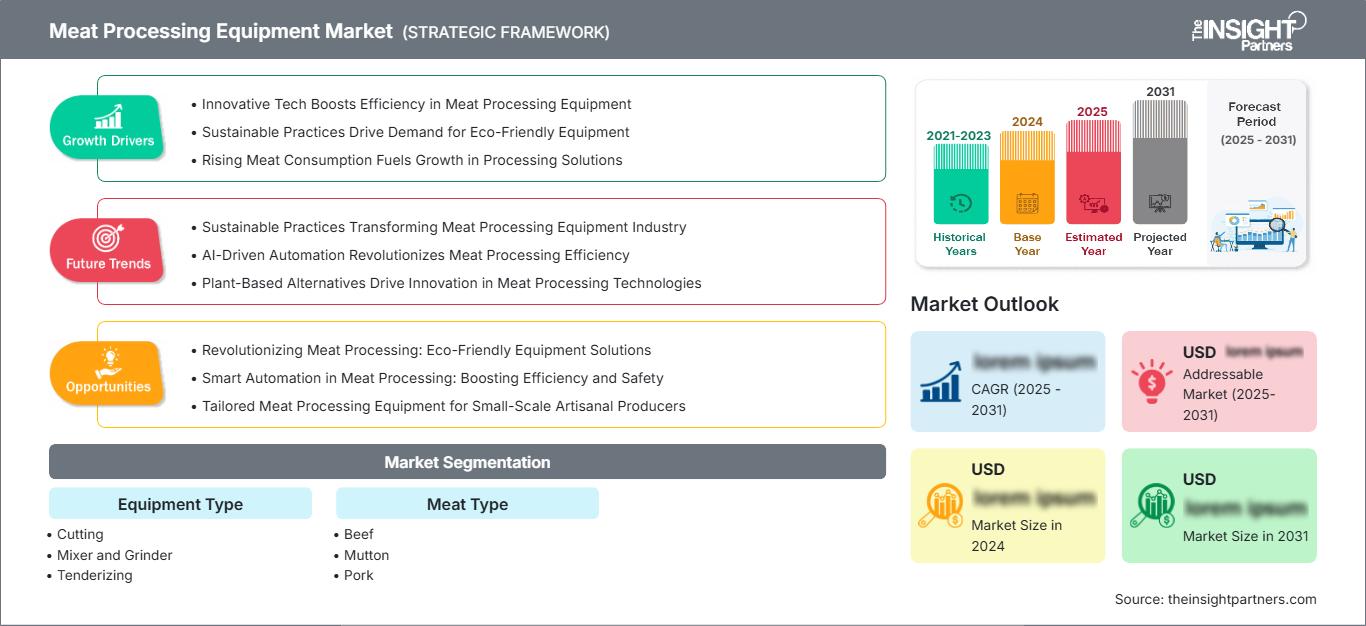
Meat Processing Equipment Market: Strategic Insights
Regional Insights
North America Meat Processing Equipment Market
North America accounted for 29%–31% Meat Processing Equipment Market share in 2025 and is expected to grow at a 4.9%–5.3% CAGR during 2026–2034. The region benefits from large-scale beef and pork processing, equipment-only funding pathways, and ongoing replacement of aging machinery with safer, more automated systems.
Automation is also becoming a practical response to labor shortages and line-speed variability. USDA programs supporting independent processing capacity have increased attention on inspection-ready layouts, while major processors continue investing in portion control, ergonomic handling, and sanitation efficiency. These factors keep the market resilient despite cyclical protein margins.
U.S. Meat Processing Equipment Market Market
The U.S. represented 78%–82% of North America in 2025 and is forecast to expand at a 4.8%–5.2% CAGR through 2034. Beef and pork processors remain central buyers, particularly for cutting, grinding, filling, and smoking systems that improve throughput consistency and retail pack standardization.
Company presence is broad, with Biro Manufacturing Company, Hobart, Illinois Tool Works Inc., Heat and Control, Inc., and JBT Marel Corporation supporting domestic processors. Application trends include high-speed slicing, ergonomic lifting, automated inspection, and modular retrofits for facilities seeking capacity gains without full greenfield replacement.
Europe Meat Processing Equipment Market Market
Europe held 25%–27% share in 2025 and is expected to grow at a 4.6%–5.0% CAGR through 2034, with Germany leading. The UK focuses on labor-saving deboning and retail-ready meat formats. Germany prioritizes hygienic engineering, traceability, and high-throughput pork processing, while France supports premium prepared-meat equipment.
Italy and Spain remain important for cured, smoked, and portioned meat production, creating demand for filling, smoking, and dicing systems. EU hygiene rules, HACCP-based controls, and machinery safety standards encourage investment in cleanable equipment. GEA Group Aktiengesellschaft, Sirman S.p.A., and JBT Marel Corporation remain visible suppliers across European processing networks.
APAC Meat Processing Equipment Market Market
APAC accounted for 30%–33% share in 2025 and is projected to grow at a 6.1%–6.6% CAGR during 2026–2034, making it the fastest regional opportunity. China remains the leading country, while India, Japan, South Korea, and Australia add demand through packaged meat, cold-chain expansion, and export-oriented processing.
Industrial policy, food processing incentives, and rising formal retail penetration are increasing equipment purchases. Localized production hubs, including new regional facilities by major suppliers, reduce service gaps and improve project economics. The market in APAC is therefore shifting from basic mechanization toward integrated, hygienic, and automated line solutions.
Middle East & Africa Meat Processing Equipment Market Market
The Middle East & Africa is forecast to grow at a 5.5%–6.0% CAGR during 2026–2034. Saudi Arabia leads regional investment, followed by the UAE, South Africa, and the rest of MEA markets, where hospitality, retail, and food-security strategies support meat processing capacity additions.
Energy availability, logistics infrastructure, and cold-chain development influence equipment selection. Processors are emphasizing smoking, filling, and grinding systems for value-added formats, while imported beef and mutton flows require reliable portioning and packaging preparation. Suppliers with service partnerships and training capability are better positioned in this region.
Segmentation Analysis
Equipment Type
Equipment Type is expected to grow at a 5.2%–5.6% CAGR during 2026–2034 as processors balance throughput, hygiene, yield control, and labor efficiency. The market scope across this segment is broad because every facility requires coordinated cutting, mixing, grinding, filling, smoking, dicing, and tenderizing systems to convert raw meat into consistent commercial formats.
- Cutting remains the largest equipment sub-segment because accurate portioning directly improves yield, pack consistency, and customer specification compliance across beef, pork, and mutton processing operations.
- Mixer and Grinder systems are essential for comminuted meat, sausages, patties, and prepared products where texture uniformity, ingredient distribution, and batch repeatability influence product quality.
- Tenderizing equipment supports value improvement in tougher cuts by enhancing eating quality, reducing preparation time, and enabling processors to serve foodservice and retail marinated meat formats.
- Filling systems are strategically important for sausages, portioned products, and ready-to-cook formats, with demand rising where processors diversify into higher-margin prepared meat offerings.
- Dicing equipment serves foodservice, frozen meals, and convenience products by delivering uniform cube sizes, controlled texture, and efficient preparation for downstream cooking or packaging lines.
- Grinding equipment supports high-volume minced meat and blended products, making durability, sanitation access, and temperature control key purchase criteria for industrial processors.
- Smoking systems address flavor development, preservation, and premiumization, particularly in cured meats, sausages, and regional specialty products, where process consistency supports brand reliability.
Meat Type
Meat Type is projected to expand at a 5.1%–5.5% CAGR during 2026–2034, reflecting differentiated processing needs across beef, mutton, and pork. Equipment selection varies by carcass size, fat composition, product form, and end-market use, but automation, hygiene validation, and yield optimization remain common priorities across the market.
- Beef requires robust cutting, tenderizing, grinding, and portioning equipment because carcass size, muscle variability, and premium cut management strongly influence processor margins.
- Mutton processing demand is supported by regional dietary preferences, halal-certified supply chains, and foodservice channels requiring consistent cutting, trimming, and value-added preparation.
- Pork remains equipment-intensive due to sausage, bacon, smoked meat, and minced product applications, creating steady demand for filling, smoking, grinding, and dicing systems.
Opportunity Snapshot
| Application | Revenue Contribution | Trend Tag | Adoption Stage |
| Beef | High | Yield Control | Mature |
| Mutton | Medium | Halal Lines | Scaling |
| Pork | High | Sausage Systems | Mature |
Meat Processing Equipment Market Growth Drivers and Impact Analysis
Automation Addresses Labor and Yield Pressures
Processors are using automation in cutting, grinding, and filling because there continue to be labor shortages and variations in performance due to the manual process. In meat processors, slight variations in trim and weight recovery will have an impact on profit margins that may add up when there are many thousands produced daily. Automation also means less repetitive stress among workers and makes for better staffing practices. The effect is most pronounced in areas where there are high costs for wages, delivery deadlines, and pack size requirements by retailers. Suppliers that specialize in such equipment will therefore have an advantage in winning over the competition.
Food Safety Compliance Drives Hygienic Equipment Replacement
This driver includes food safety regulations since the processers have to prove their ability to maintain cleanliness, contamination prevention, and traceable processes. As the EU’s hygiene regulations, HACCP systems, and the U.S. inspection laws require, there is pressure to upgrade old processing machines that cannot be sanitized or validated properly. The stainless steel material, smooth welding, no-tool accessibility, and clean-in-place system determine more of the purchasing specifications. This driver drives the demand for quality machines despite the fact that the processors delay their capacity expansion plans. The market gains since such expenditures are mandatory rather than discretionary ones.
Processed Meat Formats Expand Equipment Intensity
Increasingly, retail and foodservice users want products that are portioned, marinated, smoked, ground, and ready-to-cook, not just primal cuts or bulk cuts. Such products involve multiple operations, such as slicing, tenderization, mixing, stuffing, smoking, dicing, and grinding. Higher product complexity translates into the need for lines with modularity capable of handling changeover and maintaining sanitation levels and production speed. The effect on the marketplace means more equipment per kilogram of meat being processed. Companies that are equipped to handle changeover, recipe management, and geometric product uniformity will benefit greatly from this trend.
Meat Processing Equipment Market Future Trends
Sensor-Led Processing Intelligence
Sensor integration will become a defining element of Meat Processing Equipment Market trends as processors seek real-time visibility into temperature, throughput, blade condition, product dimensions, and cleaning status. Future systems will go from just being mechanically productive to evidence-based control, giving the managers room to make necessary adjustments on the production line before any loss of yield occurs or before any sanitation issues arise. Data collected from the machines will also aid in predictive maintenance and client audits. The companies that are able to provide interoperable controls and performance dashboards will be at an advantage because the processors want proof.
Regionalized Manufacturing and Service Hubs
The equipment providers are also required to locate production activities, parts storage, and application support close to the centers of high growth in meat processing. By doing so, equipment providers would be able to shorten the lead time in delivery, enhance commissioning of the equipment, and ensure that the sophisticated equipment can reach the medium-level meat processors. Such issues are especially pertinent for APAC and ME regions, where new installations require training and fast support. Eventually, localized support would become as important in the selection of vendors as the specifications of equipment.
Meat Processing Equipment Market Opportunities
Mid-Scale Plant Modernization Programs
Meat Processing Equipment Market forecast highlights significant potential for mid-scale processors to be considered a good investment because they are partially mechanized but still under the same pressure in terms of hygiene, staffing, and specifications from the customers just like big processors. Mid-scale processors may adopt financing arrangements and phased implementation to enable upgrades without extended downtime periods. Suppliers of products will realize potential by providing scalable cutting, grinding, and filling machines with associated training and servicing. This will be particularly important where there are government programs to support local processors and diversified sources by retail stores.
Value-Added Meat Product Lines
For processors moving towards sausages, smoking, dicing meat, marinade cuts, and ready-to-cook packages, the requirement is equipment that enables repeatable formulas and quick line changeovers. This makes room for fillers, smokers, tenderizers, and dicing machines that enable processors to go beyond the processing of commodities. The vendor can create differentiation through controls on formula settings, sanitation verification, and application testing, thus minimizing risks during new product launches. Greatest demand will come from those markets that have chilled retail, convenience cooking, and foodservice chains demanding consistent formats. The Meat Processing Equipment Market stands to gain margins as its customers innovate more.
Recent Developments
- September 2025: BT Marel inaugurated the Global Production Center (GPC) in Pune, India. This marks a significant milestone in the company’s commitment to serving the Indian and Asia-Pacific markets with world-class solutions.
- September 2025: The 23rd China International Meat Industry Exhibition (CIMIE 2025) concluded successfully in Xiamen on September 17, 2025. The exhibition covers entire meat industry chain that themed "Full Chain Synergy, Intelligent Innovation for the Future," comprehensively covers terminal products such as fresh meat, processed meat products, and deep-processed meat products, as well as all segments of the industrial chain, including slaughter equipment, processing machinery, packaging equipment and materials, food ingredients, cold chain logistics, and environmental protection equipment, creating a panoramic showcase of the meat industry ecosystem.
- 2025: DairyTech 2025 is expanding its scope by introducing a new exhibition sector titled "Equipment and Technologies for Meat Processing." This addition reflects the growing demand from exhibitors and visitors who operate in both the dairy and meat industries. The exhibition will showcase a wide range of meat processing solutions, including packaging equipment, storage systems, slicing and mincing machines, filling and clipping technologies, heat treatment equipment, ingredients, and complete production lines. Organizers also plan to host a dedicated conference for meat processing professionals, creating opportunities for knowledge sharing and business networking. Scheduled to take place from 21–23 January 2025 at Crocus Expo, Moscow, DairyTech 2025 aims to strengthen collaboration across the dairy and meat processing sectors while supporting innovation and market growth in Russia and the CIS region.
Frequently Asked Questions

- Comprehensive Market Sizing and Forecast Analysis
- Detailed Segmentation Analysis
- In-Depth Market Dynamics Assessment
- Regional and Country-Level Insights
- Competitive Landscape and Company Benchmarking
- Strategic Business Intelligence
Recent Reports
Testimonials

The Insight Partners' SCADA System Market report is comprehensive, with valuable insights on current trends and future forecasts. The team was highly professional, responsive, and supportive throughout. We are very satisfied and highly recommend their services.
RAN KEDEM Partner, Reali Technologies LTDs
I requested a report on a very specific software market and the team produced the report in a few days. The information was very relevant and well presented. I then requested some changes and additions to the report. The team was again very responsive and I got the final report in less than a week.
JEAN-HERVE JENN Chairman, Future Analytica
We worked with The Insight Partners for an important market study and forecast. They gave us clear insights into opportunities and risks, which helped shape our plans. Their research was easy to use and based on solid data. It helped us make smart, confident decisions. We highly recommend them.
PIYUSH NAGPAL Sr. Vice President, High Beam Global
The Insight Partners delivered insightful, well-structured market research with strong domain expertise. Their team was professional and responsive throughout. The user-friendly website made accessing industry reports seamless. We highly recommend them for reliable, high-quality research services
YUKIHIKO ADACHI CEO, Deep Blue, LLC.
This is the first time I have purchased a market report from The Insight Partners.While I was unsure at first, I visited their web site and felt more comfortable to take the risk and purchase a market report.I am completely satisfied with the quality of the report and customer service. I had several questions and comments with the initial report, but after a couple of dialogs over email with their analyst I believe I have a report that I can use as input to our strategic planning process.Thank you so much for taking the extra time and making this a positive experience.I will definitely recommend your service to others and you will be my first call when we need further market data.
JOHN SUZUKI President and Chief Executive Officer, Board Director, BK Technologies
I wish to appreciate your support and the professionalism you displayed in the course of attending to my request for information regarding to infectious disease IVD market in Nigeria. I appreciate your patience, your guidance, and the fact that you were willing to offer a discount, which eventually made it possible for us to close a deal. I look forward to engaging The Insight Partners in the future, all thanks to the impression you have created in me as a result of this first encounter.
DR CHIJIOKE ONYIA MANAGING DIRECTOR, PineCrest Healthcare Ltd.Reason to Buy
- Informed Decision-Making
- Understanding Market Dynamics
- Competitive Analysis
- Identifying Emerging Markets
- Customer Insights
- Market Forecasts
- Risk Mitigation
- Boosting Operational Efficiency
- Strategic Planning
- Investment Justification
- Tracking Industry Innovations
- Aligning with Regulatory Trends





 Get Free Sample for