
Medical Elastomers Market Share, Size & Demand by 2034
Medical Elastomers Market Size and Forecasts (2021–2034), Global and Regional Share, Trends, and Growth Opportunity Analysis Report Coverage : by Type (Thermoplastic Elastomer, Thermoset Elastomer); Application (Medical Tubes, Medical Bags, Catheters, Syringes, Implants, Gloves); and Geography (North America, Europe, Asia Pacific, and South and Central America)
- Status : Data Released
- Report Code : TIPRE00040477
- Category : Chemicals and Materials
- No. of Pages : 150
- Available Report Formats :


- Last update date : July 15, 2026


2025 Market Size
US$ 8.14 Bn
Base year value
2034 Forecast
US$ 13.96 Bn
Projected by 2034
CAGR 2026-2034
6.18 %
Growth rate
Addressable Market
US$ 100.06 Bn
(2026-2034)
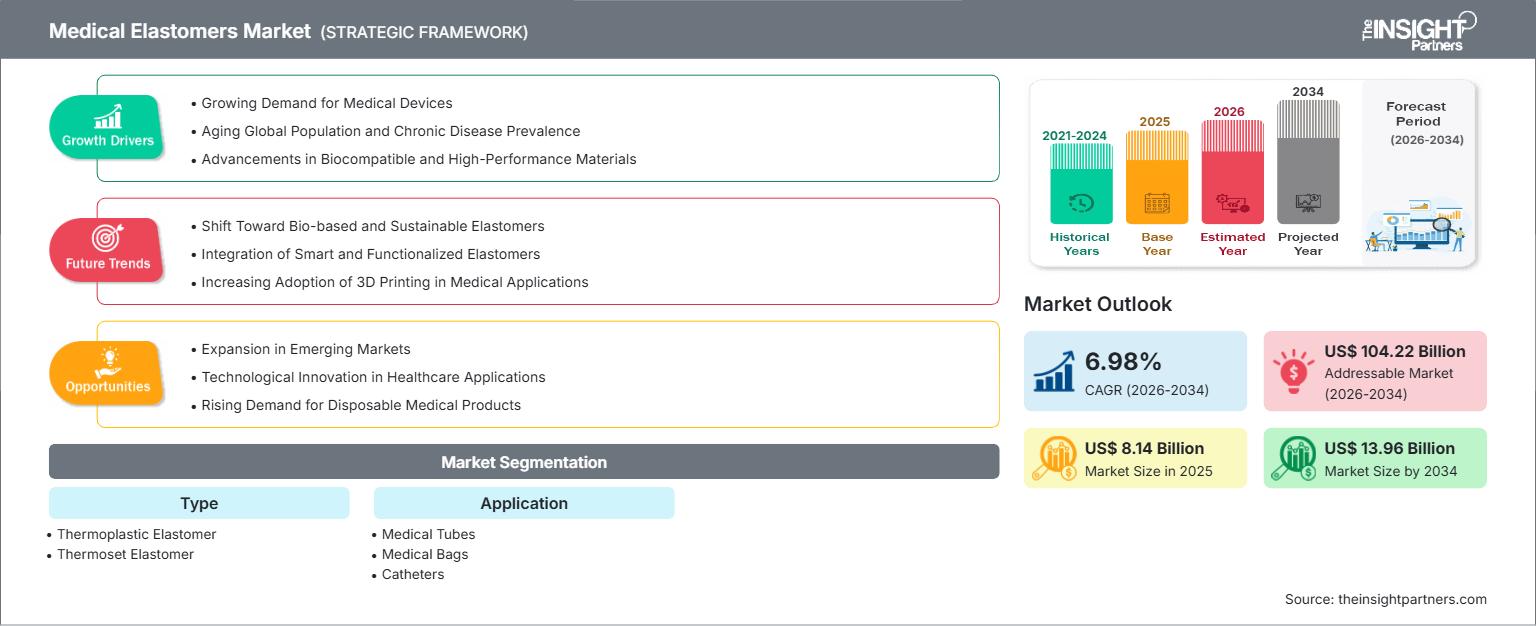
The Medical Elastomers market was valued at US$ 8.14 billion in 2025 and is expected to reach US$ 13.96 billion by 2034; it is estimated to record a CAGR of 6.18% during 2026-2034.
Medical Elastomers Market Assessment and Insights
- North America: Accounted for 34–36% of the medical elastomers market share in 2025 and is expected to grow at a 6.3–7.1% CAGR during 2026–2034. Strong medical device manufacturing capabilities, advanced healthcare infrastructure, and continuous product innovation support regional leadership.
- US: Represented 80–84% of North America in 2025 and is projected to expand at a 6.4–7.2% CAGR during 2026–2034. Demand is supported by extensive healthcare spending, robust medical technology production, and growing adoption of advanced elastomer materials.
- Europe: Held 28–30% share in 2025 and is anticipated to register a 6.5–7.3% CAGR during 2026–2034. Germany, France, the UK, Italy, and Spain remain leading markets due to strong healthcare manufacturing capabilities.
- Asia Pacific: Captured 25–27% share in 2025 and is expected to grow at a 7.8–8.6% CAGR during 2026–2034. China, Japan, India, and South Korea are key contributors supported by healthcare infrastructure expansion and medical device production growth.
- Largest Segment: Thermoplastic Elastomer accounted for 62–66% market share in 2025 and is projected to grow at a 7.1–7.9% CAGR during 2026–2034, supported by recyclability, processing efficiency, and increasing adoption in disposable medical products.
- High Growth Segment: Implants held 13–17% market share in 2025 and is anticipated to expand at a 8.2–9.0% CAGR during 2026–2034 owing to rising orthopedic, cardiovascular, and reconstructive procedures.
- Key companies analyzed in detail: BASF SE, Celanese Corporation, Dow Inc., Solvay SA, DuPont de Nemours, Inc., DSM Biomedical, Kraton Corporation, Trelleborg AB, Kuraray Co., Ltd., Teknor Apex Company, Momentive Performance Materials Inc., Avient Corporation, HEXPOL AB, Foster Corporation, and Biomerics, LLC.
Source: The Insight Partners' analysis based on proprietary research, government publications, company annual reports, investor presentations, industry databases, and expert interviews.
Progress made in the field of polymer engineering has improved greatly the performance characteristics of elastomers that are being used in the healthcare industry. Material manufacturers are paying more attention to materials that are highly biocompatible, resistant to sterilization processes, flexible, and stable chemically. Growing demand for minimally invasive devices, single-use products, and patient-specific healthcare solutions is driving the development of novel materials. Simultaneously, the regulation-driven trend toward safety and quality of the end-product contributes to the use of high-performing elastomers in critical medical applications.
Future market growth will be driven by growing investments in healthcare in emerging economies, increased medical device production, and innovations in the field of advanced polymers. The emergence of localized manufacturing capacities, beneficial healthcare policies, and increased demand for advanced medical devices will provide additional opportunities for material manufacturers. The increasing trend toward sustainable and recyclable healthcare materials is expected to affect future product development initiatives.
Medical Elastomers Market Report Scope
| Report Attribute | Details |
|---|---|
| Market size in 2025 | US$ 8.14 Billion |
| Market Size by 2034 | US$ 13.96 Billion |
| Global CAGR (2026 - 2034) | 6.18% |
| Historical Data | 2021-2024 |
| Forecast period | 2026-2034 |
Medical Elastomers Market Analysis
Medical elastomers market growth will be supported by high demand for flexible and biocompatible materials in various healthcare products. Increasing use of elastomers in medical tubes, catheters, syringes, implants and other disposable healthcare products has been enabled by properties such as durability, comfortable feel and sterilization capability of elastomers. Increased chronic disease incidence, surgeries and healthcare accessibility in the world will drive market growth in the future. Furthermore, there will be rising demand for materials that are able to meet strict regulatory and performance standards in the future.
Value chain includes raw material suppliers, polymer compounders, medical components manufacturers, medical devices manufacturers, healthcare providers and regulators. Continued adoption of thermoplastic elastomers has been facilitated by efficient processability and compatibility with modern manufacturing processes. Strategic partnership between material suppliers and medical devices manufacturers has facilitated development of application specific elastomers.
The medical elastomers market report demonstrates the presence of competitive dynamics influenced by innovations in the materials, regulatory expertise, and manufacturing capacity. Major players such as BASF SE, Celanese Corporation, Dow Inc., DuPont de Nemours, Inc., and DSM Biomedical are still making investments in innovative medical elastomers to improve their performance and conformity to health care requirements.
Investments in the industry remain oriented towards specialized compounds, sustainable materials, and innovative healthcare polymers. Such organizations as Trelleborg AB, Kuraray Co., Ltd., Teknor Apex Company, Avient Corporation, Foster Corporation, and Biomerics, LLC expand their manufacturing capacity and develop relationships with customers. It is expected that such actions will contribute to innovation, supply chain security, and competitive advantage.
● REPORT CUSTOMIZATION
Tailor This Report To Align With Your Specific Business Requirements
This report can be customized to align precisely with your business objectives, scope, and target markets. Customization options include tailored segmentation, geography, competitive analysis, and strategic insights to support informed decision-making.
Customize This Report →WHAT YOU CAN ADJUST
- ● Segmentations
- ● Geography
- ● Competitive Analysis
- ● Language Preferences
Medical Elastomers Market: Strategic Insights
Regional Insights
North America Medical Elastomers Market
North America accounted for 34–36% of the medical elastomers market share in 2025 and is projected to expand at a 6.3–7.1% CAGR during 2026–2034. Highly developed healthcare infrastructure, extensive medical device production, and huge investments made in innovation in the healthcare sector are the major strengths of this region. An increasing demand is observed in this region in terms of various end-use products like catheters, tubing systems, syringes, implants, and drug delivery devices that require the use of high-quality medical-grade elastomers.
The US and Canada are major sources of revenue generation in this region. Increased investment in healthcare spending, growth in number of outpatient surgeries, and rise in demand for minimally invasive medical devices are some of the key factors behind an increasing demand for materials used in this region. Preference for materials that do not contain latex and are biocompatible has spurred the adoption of advanced thermoplastic elastomers.
U.S. Medical Elastomers Market
The United States represented 80–84% of North American revenue in 2025 and is anticipated to register a 6.4–7.2% CAGR during 2026–2034. The nation will take advantage of its healthcare industry, medical technology industry, and high investments in R&D. Various medical applications such as diagnosis tools, surgery instruments, drug delivery apparatuses, catheters, and implants are using medical elastomers. The availability of medical equipment manufacturers plays an important role in ensuring continued demand for materials.
Healthcare organizations have been incorporating advanced equipment which uses materials that provide flexibility and can be easily sterilized. The rising cases of cardiovascular diseases, diabetes, and orthopedics disorders are increasing the demand for disposable and implantable medical devices. Furthermore, national manufacturing activities and resilience strategies are resulting in increased production of medical materials. It can be expected that future innovations and regulations will help maintain steady growth in the market.
Europe Medical Elastomers Market
Europe held 28–30% share in 2025 and is projected to grow at a 6.5–7.3% CAGR during 2026–2034. Germany continues to dominate the regional market owing to its superior medical technology manufacturing capabilities and well-established healthcare infrastructure. The UK has gained from the rising investment in healthcare innovations and medical materials, whereas France, Italy, and Spain have continued to boost demand through their growing healthcare services and medical device manufacturing operations.
The United Kingdom shows strong demand for elastomeric medical tubing, diagnostic equipment, and single-use healthcare products. Germany continues to dominate the market owing to its advanced manufacturing capabilities and robust exports of medical technologies. France, Italy, and Spain show considerable contribution to the demand on account of aging populations, increasing healthcare spending, and rising numbers of surgical procedures. Regulations stressing the need for patient safety and material quality continue to push the use of advanced medical elastomers in the region.
APAC Medical Elastomers Market
Asia Pacific captured 25–27% share in 2025 and is expected to register the fastest expansion at a 7.8–8.6% CAGR during 2026–2034. China is at the forefront of regional demand due to significant medical device manufacturing activities and health care infrastructure investments. Japan and South Korea have managed to retain their competitive positions with state-of-the-art health care technologies and the presence of a well-established medical industry.
In India and Australia, there has been a noticeable increase in the use of medical elastomers because of health care investments, growth in hospitals, and local device manufacturing. Government efforts towards health care advancement and local manufacturing are helping drive market growth.
Middle East & Africa Medical Elastomers Market
The Middle East & Africa market is anticipated to expand at a 6.1–6.9% CAGR during 2026–2034. Both Saudi Arabia and UAE will continue to fuel the regional demand by building more healthcare facilities and hospitals and adopting new medical technologies. Increasing investments in healthcare manufacturing will also contribute to the increase in material usage.
South Africa continues to be an important market in the region due to the rising demand for medical devices and the modernization of healthcare sector. Overall, the regional market is aided by the government investment in healthcare, population growth and better access to healthcare services.
Segmentation Analysis
Type
The Type segment is expected to expand at a 6.9–7.7% CAGR during 2026–2034. The medical elastomers market forecast within this segment continues to broaden as manufacturers increasingly prioritize materials offering flexibility, sterilization resistance, biocompatibility, and processing efficiency. Growing demand for advanced medical devices and disposable healthcare products supports adoption across both thermoplastic and thermoset elastomer categories. Material innovation and regulatory compliance remain important factors influencing purchasing decisions.
- Thermoplastic Elastomer: Represents the dominant product category due to ease of processing, recyclability, design flexibility, and suitability for medical tubing, syringe components, seals, and disposable healthcare applications.
- Thermoset Elastomer: Maintains importance in demanding healthcare environments requiring long-term durability, chemical resistance, thermal stability, and reliable performance in specialized medical and implantable applications.
Application
The Application segment is projected to register a 7.2–8.0% CAGR during 2026–2034. Demand growth is supported by increasing healthcare utilization, rising procedural volumes, and growing adoption of advanced medical devices worldwide. Elastomer materials are increasingly selected for applications requiring patient comfort, flexibility, sterilization compatibility, and long-term reliability. Expanding healthcare infrastructure and innovation in medical device design continue to support application diversification.
- Medical Tubes: Widely used in fluid management, respiratory therapy, and drug-delivery systems due to flexibility, kink resistance, biocompatibility, and sterilization compatibility.
- Medical Bags: Increasingly utilize advanced elastomer formulations to improve durability, transparency, flexibility, and patient safety while reducing dependence on traditional material systems.
- Catheters: Depend on high-performance elastomers for flexibility, patient comfort, navigation efficiency, and reliable clinical performance during minimally invasive procedures.
- Syringes: Elastomer components play critical roles in sealing performance, drug compatibility, and maintaining sterility throughout storage and administration processes.
- Implants: Growing utilization reflects increasing orthopedic, cardiovascular, reconstructive, and long-term therapeutic procedures requiring durable and biocompatible materials.
- Gloves: Demand remains supported by infection prevention requirements, healthcare worker safety initiatives, and continued emphasis on hygiene standards across medical facilities.
Opportunity Snapshot
| Application | Revenue Contribution | Trend Tag | Adoption Stage |
| Medical Tubes | High | Fluid Transfer | Mature |
| Medical Bags | Medium | PVC Replacement | Scaling |
| Catheters | High | Minimally Invasive | Mature |
| Syringes | High | Drug Delivery | Mature |
| Implants | Medium | Long-Term Care | Scaling |
| Gloves | High | Infection Control | Mature |
Medical Elastomers Market Growth Drivers and Impact Analysis
Rising Demand for Minimally Invasive Medical Procedures
There is a growing need for high-performance elastomer materials due to the increased use of minimally invasive procedures. Elastomers have been chosen for use in catheters, guidewires, drug delivery systems, and flexible tubings due to their flexibility, softness, durability, and compatibility with body tissues. Minimally invasive procedures have become popular among health facilities due to their reduced hospital stay duration, low infection risks, and improved recovery results. Medical device producers are increasingly making use of unique and specially produced elastomers due to the rising number of procedures around the world. There are growing opportunities for companies producing elastomers and healthcare material innovations.
Growth in Global Healthcare Expenditure and Infrastructure
Healthcare expenditure is still on an upward trajectory among both developed and developing nations, fueling the increased purchase of healthcare equipment and healthcare disposables. Hospitals, diagnostic centers, ambulatory surgeries, and specialty clinics are being built by governments and private healthcare companies. This in turn boosts the demand for syringes, medical pouches, gloves, tubings, and implants which are made of elastomers. Growing healthcare availability in Asia Pacific, Latin America, and some regions in the Middle East provides further avenues for material manufacturers. As healthcare infrastructures get updated and patient numbers grow, the demand for quality and regulatory-approved elastomers is anticipated to grow during the forecast period.
Transition Toward Latex-Free and Advanced Biocompatible Materials
There is an increasing preference among healthcare professionals for the use of non-latex materials in order to avoid the occurrence of allergic reactions in patients. This preference has spurred the development of thermoplastic elastomers and specialty medical grade materials which are capable of providing properties similar to those of existing materials, but with added benefits of biocompatibility. There is a growing emphasis on the safe choice of materials within the healthcare environment by regulatory agencies and health organizations as well. Advanced grades of medical elastomers, resistant to sterilization and chemicals, have been developed as a result.
Medical Elastomers Market Future Trends
Expansion of Sustainable and Recyclable Healthcare Materials
Sustainability has become a growing factor in medical elastomers market trends, with many of the industry players focusing on achieving their sustainability goals without neglecting the high quality and stringent performance requirements. Suppliers of material are developing recycling techniques for thermoplastics, low carbon emission production techniques, and other sustainable methods of producing feedstock. Healthcare institutions and manufacturers of equipment are assessing materials that can meet the sustainability goals without affecting their safety, sterility, and performance. With increasing regulatory focus on sustainability, advanced elastomers will see increased acceptance. Future suppliers of medical elastomers that balance environmental and clinical performance will gain competitive advantage.
Growing Integration of Advanced Polymer Engineering in Medical Devices
The application of advanced polymers will play a crucial role in changing the future development of products used in healthcare. The need for material with specific mechanical, durable, and comfort properties is constantly growing among medical device producers. Due to the progress achieved in material science, the development of elastomers that are specifically designed for wearables, implants, diagnostics, and new drug delivery systems becomes possible. Cooperation between healthcare companies and polymer manufacturers leads to continuous innovation cycles. In the future, innovations will be based on the formulations that will meet regulatory requirements and increase the performance of devices.
Medical Elastomers Market Opportunities
Expansion of Localized Medical Manufacturing Ecosystems
Medical Elastomers Predicted growth in opportunities is associated with the growth in regional manufacturing capacity and localization of supply chains in the healthcare industry. More governments and healthcare providers are recognizing the benefits of localized manufacturing of crucial medical items in order to improve supply chain resilience and reduce reliance on imports. This has encouraged more investment into local manufacturing facilities for medical devices, resulting in further demand for medical-grade elastomer materials. Material suppliers that have the capability of producing materials regionally, provide technical support, and are knowledgeable about regulations are in a better position to develop closer partnerships with healthcare manufacturers.
Development of High-Performance Materials for Implantable Devices
Greater demand for the use of medical implants is a lucrative business opportunity for elastomer suppliers. Materials that can provide consistent functionality despite the extreme conditions in which these implants must function are essential to orthopedic implants, cardiovascular devices, neuromodulators, and reconstructive medicine products. Businesses that have developed sophisticated biocompatible materials, sterilizable formulations, and engineering expertise are poised to reap the benefits of this trend. With more elderly patients and increased rates of chronic diseases, greater demand for implants is expected in the healthcare market. Those who comply with regulatory requirements and drive technological innovation will capitalize on this opportunity.
Recent Developments
- March 2026: Geon acquired Arkadia Plastics to expand medical polymer offerings. The deal strengthens Geon's Foster division with TPU and TPE formulations, marking the company's fifth acquisition since 2020 for healthcare growth.
- March 2026: Cinova Medical acquired Elastomer Technologies Inc. (ETI), a custom molder of liquid silicone rubber (LSR) and high-consistency gum rubbers service the medical device and life sciences markets. ETI is headquartered in Corona, Calif. and is an ISO 13485:2016-certified company that supports medical device manufacturers with molded and over-molded components. The company specializes in injection, transfer, and compression molding, complemented by elastomeric die-cutting services.
Frequently Asked Questions

- Comprehensive Market Sizing and Forecast Analysis
- Detailed Segmentation Analysis
- In-Depth Market Dynamics Assessment
- Regional and Country-Level Insights
- Competitive Landscape and Company Benchmarking
- Strategic Business Intelligence
Recent Reports
Testimonials

The Insight Partners provided valuable market intelligence that supported our global go-to-market strategy. Their team was professional, responsive, and attentive to our feedback, providing thoughtful analysis and helpful methodological clarifications throughout the project.
Junmo Kim Chief Financial Officer (CFO), Enertech Co., Ltd.
The Insight Partners' SCADA System Market report is comprehensive, with valuable insights on current trends and future forecasts. The team was highly professional, responsive, and supportive throughout. We are very satisfied and highly recommend their services.
RAN KEDEM Partner, Reali Technologies LTDs
I requested a report on a very specific software market and the team produced the report in a few days. The information was very relevant and well presented. I then requested some changes and additions to the report. The team was again very responsive and I got the final report in less than a week.
JEAN-HERVE JENN Chairman, Future Analytica
We worked with The Insight Partners for an important market study and forecast. They gave us clear insights into opportunities and risks, which helped shape our plans. Their research was easy to use and based on solid data. It helped us make smart, confident decisions. We highly recommend them.
PIYUSH NAGPAL Sr. Vice President, High Beam Global
The Insight Partners delivered insightful, well-structured market research with strong domain expertise. Their team was professional and responsive throughout. The user-friendly website made accessing industry reports seamless. We highly recommend them for reliable, high-quality research services
YUKIHIKO ADACHI CEO, Deep Blue, LLC.
This is the first time I have purchased a market report from The Insight Partners.While I was unsure at first, I visited their web site and felt more comfortable to take the risk and purchase a market report.I am completely satisfied with the quality of the report and customer service. I had several questions and comments with the initial report, but after a couple of dialogs over email with their analyst I believe I have a report that I can use as input to our strategic planning process.Thank you so much for taking the extra time and making this a positive experience.I will definitely recommend your service to others and you will be my first call when we need further market data.
JOHN SUZUKI President and Chief Executive Officer, Board Director, BK Technologies
I wish to appreciate your support and the professionalism you displayed in the course of attending to my request for information regarding to infectious disease IVD market in Nigeria. I appreciate your patience, your guidance, and the fact that you were willing to offer a discount, which eventually made it possible for us to close a deal. I look forward to engaging The Insight Partners in the future, all thanks to the impression you have created in me as a result of this first encounter.
DR CHIJIOKE ONYIA MANAGING DIRECTOR, PineCrest Healthcare Ltd.Reason to Buy
- Informed Decision-Making
- Understanding Market Dynamics
- Competitive Analysis
- Identifying Emerging Markets
- Customer Insights
- Market Forecasts
- Risk Mitigation
- Boosting Operational Efficiency
- Strategic Planning
- Investment Justification
- Tracking Industry Innovations
- Aligning with Regulatory Trends





 Get Free Sample for