
Metal Deactivator Market Demand, Size & Forecast by 2034
Coverage: by Metals (Copper, Aluminum, Alloys, Others); Formulation (Oil Based, Water Based); End-User Industry (Industrial, Automotive, Aviation, Food and Agriculture, Polymers, Others) , and Geography (North America, Europe, Asia Pacific, and South and Central America)
- Status : Data Released
- Report Code : TIPRE00008729
- Category : Chemicals and Materials
- No. of Pages : 150
- Available Report Formats :


- Last update date : July 22, 2026


2025 Market Size
US$ 1.34 Bn
Base year value
2034 Forecast
US$ 1.99 Bn
Projected by 2034
CAGR 2026-2034
4.46 %
Growth rate
Addressable Market
US$ 15.10 Bn
(2026-2034)
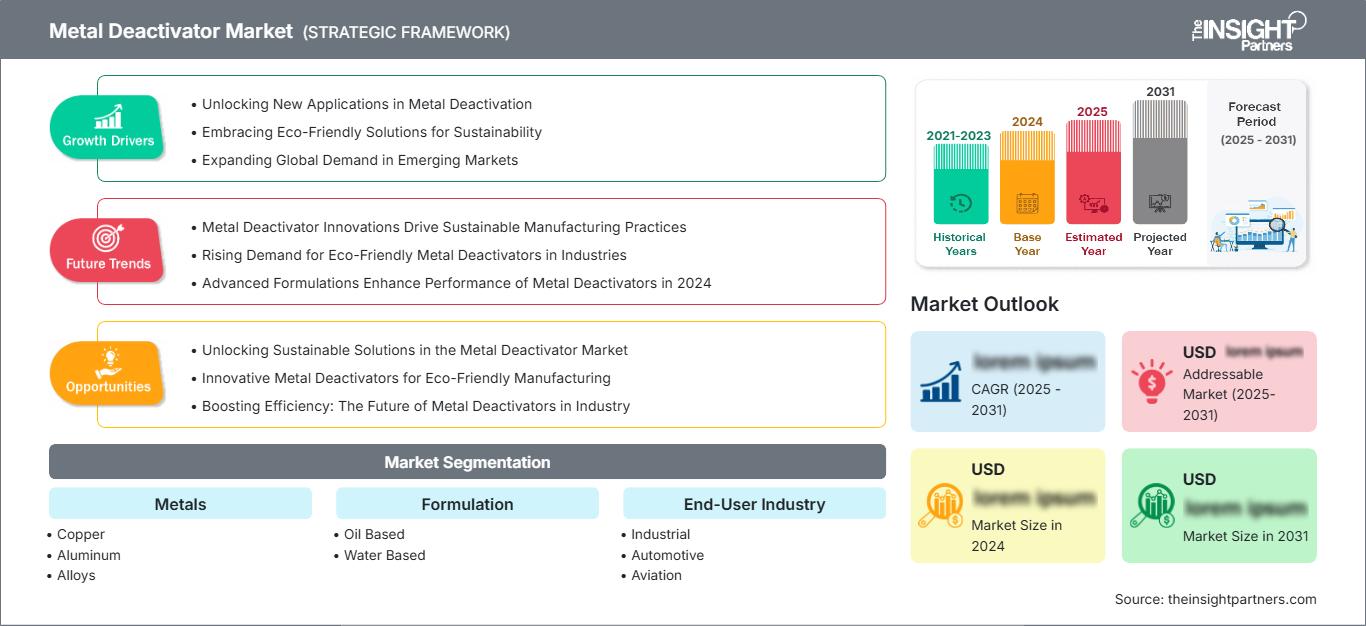
The metal deactivator market was valued at US$ 1.34 billion in 2025 and is projected to reach US$ 1.99 billion by 2034, registering a CAGR of 4.46% during 2026–2034. Market expansion is supported by increasing use of lubricant additives, fuel stabilization chemicals, and polymer protection solutions across industrial and transportation sectors. Growing requirements for oxidation control and metal-catalyzed degradation prevention continue to drive adoption across multiple end-use industries.
In North America, the metal deactivator market size is supported by a mature lubricant industry, extensive automotive manufacturing, and strong demand for fuel performance additives. The regional market is expected to grow at a CAGR of 4.0–4.6% through 2034. Rising emphasis on equipment reliability, extended lubricant life, and improved fuel stability continues to support consumption across industrial and transportation applications.
Metal Deactivator Market Assessment and Insights
- North America: Share in 2025 of 28–30%, growing at a CAGR of 4.0–4.6% during 2026–2034. Demand is driven by lubricant additives, industrial fluids, fuel treatment chemicals, and advanced manufacturing activities.
- US: Accounts for 79–82% of North American demand in 2025 and is projected to expand at a CAGR of 4.1–4.7%. Automotive fluids and industrial lubrication remain major application areas.
- Europe: Share in 2025 of 26–28%, growing at a CAGR of 3.9–4.5%. Germany, France, Italy, and the UK remain key consumers due to strong industrial and automotive sectors.
- Asia Pacific: Share in 2025 of 35–37%, growing at a CAGR of 5.2–5.8%. China, India, Japan, and South Korea continue to support demand through industrial expansion and manufacturing growth.
- Largest Segment: Industrial held a 39–42% market share in 2025 and is expected to grow at a CAGR of 4.5–5.1%, supported by machinery lubrication and equipment protection requirements.
- High Growth Segment: Water-based accounted for 32–35% market share in 2025 and is anticipated to expand at a CAGR of 5.3–5.9%, driven by environmental and safety considerations.
- Key companies analyzed in detail: BASF SE, Innospec Inc., Clariant AG, Vanderbilt Chemicals, LLC, The Lubrizol Corporation, ADEKA Corporation, Songwon Industrial Co., Ltd., Afton Chemical Corporation, Dorf Ketal Chemicals India Private Limited, and LANXESS AG.
Source: The Insight Partners' analysis based on proprietary research, government publications, company annual reports, investor presentations, industry databases, and expert interviews.
The area of product innovation has been concentrated on increasing oxidation stability, service life of the lubricant and better compatibility with industrial formulations. Modern metal deactivators are being used in lubricants, fuels, hydraulic fluids and polymers to reduce any deterioration caused by trace metals. Advancements in additive technology and formulation have increased efficiency in harsh operating conditions within the industry.
Future growth is anticipated due to industrial modernization, increased manufacturing operations in the Asia Pacific region and high demand for improved lubricating systems. Increasing regulations towards optimal use of resources and longevity of machinery are making end users turn towards advanced additive solutions. Opportunities are also rising in eco-friendly formulations and specialty industrial additives.
Metal Deactivator Market Report Scope
| Report Attribute | Details |
|---|---|
| Market size in 2025 | US$ 1.34 Billion |
| Market Size by 2034 | US$ 1.99 Billion |
| Global CAGR (2026 - 2034) | 4.46% |
| Historical Data | 2021-2024 |
| Forecast period | 2026-2034 |
Metal Deactivator Market Analysis
The metal deactivator market growth is primarily driven by increasing demand for lubricant stabilization and protection against metal-catalyzed oxidation. Metal ions such as copper and iron can accelerate degradation processes in fuels, lubricants, and polymers, reducing product performance and service life. Manufacturers increasingly utilize metal deactivators to maintain product quality, reduce maintenance requirements, and enhance operational efficiency across industrial and transportation applications.
The market value chain consists of specialty chemical producers, additive manufacturers, lubricant formulators, fuel treatment providers, distributors, and industrial end users. Demand continues to rise as industries seek longer equipment operating cycles and improved fluid performance. Growing industrial automation and advanced manufacturing activities are also contributing to increased additive consumption globally.
The metal deactivator market analysis indicates a competitive environment characterized by formulation innovation, technical support capabilities, and application-specific product development. Companies are focusing on multifunctional additive systems that combine oxidation resistance, corrosion protection, and enhanced performance characteristics. Strategic investments in specialty chemicals manufacturing continue to strengthen market competitiveness.
Major suppliers, including BASF SE, The Lubrizol Corporation, Clariant AG, Afton Chemical Corporation, Innospec Inc., and Songwon Industrial Co., Ltd., are investing in advanced additive technologies to address evolving customer requirements. Competitive differentiation increasingly depends on technical expertise, regulatory compliance, formulation efficiency, and the ability to serve diverse industrial sectors.
● REPORT CUSTOMIZATION
Tailor This Report To Align With Your Specific Business Requirements
This report can be customized to align precisely with your business objectives, scope, and target markets. Customization options include tailored segmentation, geography, competitive analysis, and strategic insights to support informed decision-making.
Customize This Report →WHAT YOU CAN ADJUST
- ● Segmentations
- ● Geography
- ● Competitive Analysis
- ● Language Preferences
Metal Deactivator Market: Strategic Insights
Regional Insights
North America Metal Deactivator Market
North America accounted for 28–30% of the metal deactivator market share in 2025 and is projected to expand at a CAGR of 4.0–4.6% through 2034. Demand is supported by a large industrial lubricant sector, extensive transportation infrastructure, and significant automotive manufacturing activity. The region continues to adopt advanced additive technologies to improve lubricant stability, reduce oxidation risks, and extend equipment operating life. Increasing investments in industrial maintenance programs further contribute to market demand.
The United States and Canada remain key consumers of metal deactivators across industrial machinery, fuel treatment, hydraulic fluids, and specialty chemical applications. Growing adoption of high-performance lubricants in manufacturing, mining, and energy sectors continues to support market expansion. Regulatory emphasis on operational efficiency and asset reliability is encouraging the use of advanced additive formulations. Furthermore, increasing investments in industrial automation and predictive maintenance strategies are expected to create additional demand for metal deactivators across multiple end-user industries during the forecast period.
U.S. Metal Deactivator Market
The United States represents 79–82% of North American demand and is anticipated to register a CAGR of 4.1–4.7% through 2034. Strong demand from automotive fluids, industrial lubricants, aviation fuels, and specialty chemical formulations continues to support consumption. The country benefits from an established lubricant manufacturing base and extensive industrial infrastructure requiring high-performance additive technologies.
Major industry participants, including The Lubrizol Corporation, Afton Chemical Corporation, Innospec Inc., and BASF SE, maintain strong commercial and technical operations within the country. Manufacturers increasingly seek additive solutions capable of improving fluid longevity and minimizing maintenance costs. Growth in renewable fuels, advanced manufacturing processes, and industrial modernization initiatives is expected to create additional opportunities. The increasing use of synthetic lubricants and specialty industrial fluids is also supporting long-term market development.
Europe Metal Deactivator Market
Europe accounted for 26–28% of global demand in 2025 and is projected to expand at a CAGR of 3.9–4.5% during the forecast period. Germany remains the leading market due to its strong automotive, machinery, and industrial manufacturing sectors. The country continues to utilize advanced additive systems to improve lubricant performance, support industrial productivity, and enhance equipment protection under demanding operating conditions.
The United Kingdom benefits from aviation, transportation, and industrial lubricant demand, while France maintains steady consumption through manufacturing and energy applications. Italy and Spain support market growth through machinery production, industrial maintenance activities, and expanding manufacturing sectors. Environmental regulations encouraging efficient resource utilization and longer equipment life cycles continue to promote additive adoption. The region's strong focus on industrial productivity and technological innovation is expected to sustain steady demand for metal deactivators.
APAC Metal Deactivator Market
Asia Pacific held 35–37% of global demand in 2025 and is expected to register a CAGR of 5.2–5.8% through 2034. China remains the largest regional market due to extensive manufacturing activity, industrial expansion, and growing lubricant consumption. India is emerging as a significant growth center supported by infrastructure development and industrial investment.
Japan and South Korea continue to utilize advanced additive technologies in automotive and industrial applications. Australia contributes through mining, industrial maintenance, and energy-related activities. Rapid industrialization and increasing machinery deployment continue to support regional demand.
Middle East & Africa Metal Deactivator Market
The Middle East & Africa market is projected to grow at a CAGR of 4.4–5.0% through 2034. Demand is supported by oil and gas operations, industrial development projects, and the increasing use of industrial lubricants across key manufacturing and energy sectors. Saudi Arabia remains the leading regional market due to its extensive industrial base, refining capacity, petrochemical investments, and large-scale energy sector activities, all of which contribute to steady demand within the Metal Deactivator Market.
The UAE continues to invest in industrial diversification, advanced manufacturing capabilities, and infrastructure development, supporting the adoption of specialty additives that enhance equipment reliability and fluid performance. South Africa contributes through its mining, industrial processing, and heavy equipment sectors, where metal deactivators help protect lubricants and fuels from degradation caused by metal contamination. Across the region, growing infrastructure investment, expanding industrial operations, and increasing maintenance requirements for critical equipment are expected to support future consumption and reinforce long-term growth in the Metal Deactivator Market.
Segmentation Analysis
Metals
The metals segment is projected to grow at a CAGR of 4.3–4.9% during 2026–2034. Different metals exhibit varying catalytic effects on oxidation processes, creating demand for specialized additive solutions. The Metal Deactivator Market forecast continues to strengthen as manufacturers develop targeted formulations capable of addressing metal-induced degradation across fuels, lubricants, and polymer systems.
- Copper – Represents a critical application area due to copper's strong catalytic influence on oxidation reactions in fuels, lubricants, and industrial fluids.
- Aluminum – Increasingly important in transportation and industrial systems where additive technologies support performance stability and material protection.
- Alloys – Widely utilized in industrial equipment and manufacturing systems, requiring advanced additive solutions to mitigate degradation mechanisms.
Formulation
The formulation segment is anticipated to register a CAGR of 4.7–5.3% through 2034. Product development is increasingly focused on balancing performance, environmental compliance, compatibility, and operational efficiency across end-use applications. These trends are contributing to innovation and product differentiation across the Metal Deactivator Market, as manufacturers develop advanced formulations tailored to evolving regulatory requirements and application-specific performance needs.
- Oil-based – Remains widely adopted due to strong compatibility with industrial lubricants, hydraulic fluids, greases, and fuel treatment formulations.
- Water-Based – Gains traction through environmental advantages, improved handling characteristics, and growing adoption across industrial applications.
End-User Industry
The end-user industry segment is expected to expand at a CAGR of 4.4–5.0% during the forecast period. Demand patterns are influenced by industrial activity, transportation requirements, equipment maintenance needs, and technological advancements in additive chemistry.
- Industrial – Largest demand contributor, supported by extensive use of lubricants, hydraulic systems, compressors, turbines, and manufacturing equipment.
- Automotive – Utilizes metal deactivators in engine oils, transmission fluids, and specialty automotive formulations to improve performance and durability.
- Aviation – Requires high-performance additive systems to maintain fuel stability and support safe, reliable aircraft operations.
- Food and Agriculture – Employs specialized formulations designed for equipment protection, machinery maintenance, and operational efficiency.
- Polymers – Use metal deactivators to improve material stability and minimize degradation during processing and long-term product use.
Opportunity Snapshot
| End-User Industry | Revenue Contribution | Trend Tag | Adoption Stage |
| Industrial | High | Asset Protection | Mature |
| Automotive | High | Synthetic Fluids | Scaling |
| Aviation | Medium | Fuel Stability | Scaling |
| Food and Agriculture | Medium | Equipment Reliability | Mature |
| Polymers | Low | Resin Protection | Emerging |
Metal Deactivator Market Growth Drivers and Impact Analysis
Rising demand for high-performance lubricants and industrial fluids
Lubricant suppliers, as well as their customers, need the formulation of lubricants that can provide prolonged service life, good oxidation stability, and reliable operation. The presence of metal particles in machinery systems can hasten fluid breakdown, which makes metal deactivators critical ingredients in modern lubricants. Sectors like manufacturing, mining, power generation, and heavy equipment continue to use high-end lubricants to cut maintenance expenses and increase output. The use of such additives will be needed by industries, especially where the efficiency of machinery depends on the stability of the fluid, as they look to optimize asset utilization and lifecycle management.
Growth of transportation fuels and specialty additive technologies
The need for enhanced additives in the transport industry remains to ensure fuel quality and its protection from any degradation. Metal ions, which may result from the process of refining, transportation, or storage, have a negative effect on fuel stability, but the use of metal deactivators is beneficial in such cases to increase shelf life. Aviation industry growth, development of commercial transport networks, and consumption of fuel in the emerging markets are the factors that promote the growth of this market. Fuel specialty products aimed at increasing performance and meeting regulations drive the market growth as well.
Expansion of polymer stabilization applications
Metal deactivators have a major part to play in stabilizing polymers since they reduce their degradation due to metallic residues. Increased need for durable plastic products in the automobile industry, electronics, and packaging sectors creates further prospects for additive companies. In current polymer blends, better thermal stability, color retention, and other characteristics have to be maintained. Metal deactivators assist in doing this, while at the same time helping in maintaining the quality and efficiency of the manufacturing process. The trend towards engineering polymers and specialty polymer blends is likely to increase additive consumption.
Metal Deactivator Market Future Trends
Development of environmentally responsible additive chemistries
The metal deactivator market trends increasingly reflect industry efforts to develop environmentally responsible additive technologies that maintain performance while reducing environmental impact. The manufacturers have been focusing on the development of new formulations that enhance biodegradability, decrease the presence of hazardous substances, and are in conformity with new standards of sustainability. The future product development is likely to emphasize the achievement of enhanced efficacy at low levels of application, ensuring compatibility with modern lubricants and fuels. The developments would help in meeting customer needs of sustainability and regulations. With an increasing inclination towards environmentally-friendly chemicals among industrial end-users, the demand for next-generation metal deactivators is anticipated to grow gradually during the forecast period.
Increasing integration into multifunctional additive packages
There is a developing practice of using metal deactivators in additive packages, which not only provide oxidation inhibition but also corrosion prevention, deposit control, and performance improvements as well. This follows the needs of customers to get more straightforward formulas and increase their performance efficiency. In this way, additive manufacturers develop additives that provide various advantages without increasing the complexity of the formula. Further improvements will focus on the additive's compatibility with synthetic oils, renewable fuels, and innovative industrial fluids.
Metal Deactivator Market Opportunities
Expansion opportunities across emerging industrial economies
The metal deactivator forecasts indicate substantial growth potential across emerging industrial economies where manufacturing output, infrastructure investment, and machinery deployment continue to increase. The markets in the Asia Pacific, the Middle East, and some Latin American countries are building up their production capacities and implementing better maintenance systems. It opens up a market potential for additives that can offer a cost-effective and technologically advanced solution. Businesses that make investments in manufacturing operations, technical support facilities, and logistics in those areas would be able to improve their competitiveness. Increasing recognition of the importance of optimizing lubricants and increasing equipment efficiency will drive demand in these fast-growing markets.
Specialty applications in renewable fuels and advanced polymers
Renewable fuels and high-performing polymer compounds offer significant growth potential for metal deactivators suppliers. The growing adoption of renewable energy sources in biofuels, sustainable aviation fuels, and advanced plastics is making it imperative for additives suppliers to have products that will handle the stability issues and degradation problems posed by these products. Additive technologies that have been customized for these new sectors offer greater revenue potential and future growth prospects for suppliers. Cooperation between fuel companies, polymer suppliers, and end-users will be necessary for the successful marketing of additives in these new fields.
Recent Developments
- December 2025: Halocarbon, a global leader in specialty fluorochemistry products, announced the addition of its metalworking fluids to the company’s InfinX product line. This realignment provides greater convenience and flexibility for customers, providing access to a broader range of sizes and enabling direct ordering from Halocarbon via the company’s e-commerce platform. Three different formulations are available, each compatible with standard minimum quantity lubrication (MQL) systems and most standard coolant delivery systems for seamless integration into existing CNC metalworking setups with no major changes to tooling, setup, or operator training.
- May 2025: Clariant announced that it would showcase its latest fully synthetic metalworking fluid technologies at Inter Lubric 2025 in Shanghai. The company highlighted new Hostagliss lubricant additives designed for water-based lubricant applications, supporting wear protection, oxidation control, and enhanced metalworking fluid performance. These solutions are directly relevant to metal deactivator applications used in industrial lubrication systems.
Frequently Asked Questions

- Comprehensive Market Sizing and Forecast Analysis
- Detailed Segmentation Analysis
- In-Depth Market Dynamics Assessment
- Regional and Country-Level Insights
- Competitive Landscape and Company Benchmarking
- Strategic Business Intelligence
Recent Reports
Testimonials

The Insight Partners provided valuable market intelligence that supported our global go-to-market strategy. Their team was professional, responsive, and attentive to our feedback, providing thoughtful analysis and helpful methodological clarifications throughout the project.
Junmo Kim Chief Financial Officer (CFO), Enertech Co., Ltd.
The Insight Partners' SCADA System Market report is comprehensive, with valuable insights on current trends and future forecasts. The team was highly professional, responsive, and supportive throughout. We are very satisfied and highly recommend their services.
RAN KEDEM Partner, Reali Technologies LTDs
I requested a report on a very specific software market and the team produced the report in a few days. The information was very relevant and well presented. I then requested some changes and additions to the report. The team was again very responsive and I got the final report in less than a week.
JEAN-HERVE JENN Chairman, Future Analytica
We worked with The Insight Partners for an important market study and forecast. They gave us clear insights into opportunities and risks, which helped shape our plans. Their research was easy to use and based on solid data. It helped us make smart, confident decisions. We highly recommend them.
PIYUSH NAGPAL Sr. Vice President, High Beam Global
The Insight Partners delivered insightful, well-structured market research with strong domain expertise. Their team was professional and responsive throughout. The user-friendly website made accessing industry reports seamless. We highly recommend them for reliable, high-quality research services
YUKIHIKO ADACHI CEO, Deep Blue, LLC.
This is the first time I have purchased a market report from The Insight Partners.While I was unsure at first, I visited their web site and felt more comfortable to take the risk and purchase a market report.I am completely satisfied with the quality of the report and customer service. I had several questions and comments with the initial report, but after a couple of dialogs over email with their analyst I believe I have a report that I can use as input to our strategic planning process.Thank you so much for taking the extra time and making this a positive experience.I will definitely recommend your service to others and you will be my first call when we need further market data.
JOHN SUZUKI President and Chief Executive Officer, Board Director, BK Technologies
I wish to appreciate your support and the professionalism you displayed in the course of attending to my request for information regarding to infectious disease IVD market in Nigeria. I appreciate your patience, your guidance, and the fact that you were willing to offer a discount, which eventually made it possible for us to close a deal. I look forward to engaging The Insight Partners in the future, all thanks to the impression you have created in me as a result of this first encounter.
DR CHIJIOKE ONYIA MANAGING DIRECTOR, PineCrest Healthcare Ltd.Reason to Buy
- Informed Decision-Making
- Understanding Market Dynamics
- Competitive Analysis
- Identifying Emerging Markets
- Customer Insights
- Market Forecasts
- Risk Mitigation
- Boosting Operational Efficiency
- Strategic Planning
- Investment Justification
- Tracking Industry Innovations
- Aligning with Regulatory Trends





 Get Free Sample for