
Metal Fabrication Equipment Market Size, Trends & Growth by 2034
Coverage: By Type (Cutting, Machining, Welding, Bending, Others); End-User (Oil and Gas, Automotive and Aviation, Power Plants, Chemicals and Mining, Construction, Others) , and Geography (North America, Europe, Asia Pacific, and South and Central America)
- Status : Data Released
- Report Code : TIPRE00014562
- Category : Manufacturing and Construction
- No. of Pages : 150
- Available Report Formats :


- Last update date : July 20, 2026


2025 Market Size
US$ 66.26 Bn
Base year value
2034 Forecast
US$ 89.21 Bn
Projected by 2034
CAGR 2026-2034
3.36 %
Growth rate
Addressable Market
US$ 706.05 Bn
(2026-2034)
The Metal Fabrication Equipment Market is projected to grow from US$ 66.26 Billion in 2025 to US$ 89.21 Billion by 2034, registering a CAGR of 3.36% during 2026–2034. Demand is supported by investment in cutting, machining, welding, and bending systems across oil and gas, automotive and aviation, power plants, chemicals and mining, and construction applications.
North America remains a technology-led demand center, with the Metal Fabrication Equipment Market size supported by reshoring, energy infrastructure upgrades, and automation programs in fabrication shops. Regional CAGR is estimated at 2.8–3.2% for 2026–2034, reflecting steady equipment replacement, robotic welding adoption, and demand for precision sheet metal processing in transport, construction, and industrial machinery supply chains.
Metal Fabrication Equipment Market Assessment and Insights
- North America accounted for 23–25% share in 2025 and is expected to grow at 2.8–3.2% CAGR between 2026–2034, supported by automation retrofits, energy assets, and aerospace fabrication.
- US represented 78–82% of North America in 2025 and is projected to grow at 2.9–3.3% CAGR between 2026–2034, led by domestic manufacturing capacity.
- Europe held 24–26% share in 2025 and is expected to grow at 2.6–3.0% CAGR between 2026–2034, with Germany, Italy, France, and the UK leading adoption.
- Asia Pacific captured 39–41% share in 2025 and is projected to grow at 3.8–4.3% CAGR between 2026–2034, led by China, Japan, South Korea, and India.
- Largest Segment Cutting held 32–35% market share in 2025 and is expected to grow at 3.4–3.8% CAGR between 2026–2034 due to laser and plasma upgrades.
- High Growth Segment Automotive and Aviation held 21–24% market share in 2025 and is projected to grow at 3.9–4.4% CAGR between 2026–2034.
- Key companies analyzed in detail: Bystronic AG, ESAB Corporation, DMG MORI CO., LTD., IPG Photonics Corporation, Jenoptik AG, Jet Edge, Inc., Jorgenson Machine Tools, Inc., Messer Cutting Systems GmbH, OMAX Corporation, and TRUMPF SE + Co. KG.
Source: The Insight Partners' analysis based on proprietary research, government publications, company annual reports, investor presentations, industry databases, and expert interviews.
Economic production is moving away from isolated machinery and into interconnected cell manufacturing with CNC technology, fiber laser cutting, robotic handling, and quality control systems. The industry is being affected by increased diversification in materials, where high-strength steels, aluminum, and alloy metals need more stringent tolerances. The manufacturers are changing out their old press machines, gas cutters, and welding stations for systems that cut down on scrap.
During the forecast period, the need for automation equipment is expected to widen to cover new manufacturing hubs, industrial estates, and energy transition projects. Focus by regulators on safety at work, energy efficiency, and reduced rework increases the likelihood that automated equipment would be a preferred choice. Manufacturers offering a combination of equipment, software, maintenance agreements, and application engineering services are well-placed to benefit from replacement demand.
Metal Fabrication Equipment Market Report Scope
| Report Attribute | Details |
|---|---|
| Market size in 2025 | US$ 66.26 Billion |
| Market Size by 2034 | US$ 89.21 Billion |
| Global CAGR (2026 - 2034) | 3.36% |
| Historical Data | 2021-2024 |
| Forecast period | 2026-2034 |
Metal Fabrication Equipment Market Analysis
Demand is anchored in the need for accurately fabricated structures, machinery frames, vehicle components, pressure vessels, and industrial assemblies. Metal Fabrication Equipment Market growth is increasingly tied to automation because customers must offset skilled-labor shortages while meeting tighter quality requirements. Cutting and welding equipment benefit from high utilization, while machining and bending systems gain traction where parts require repeatability and faster changeovers.
The industry is comprised of builders of machines, providers of laser sources, manufacturers of consumables, providers of software, integrators, distributors, and service providers. Supply dynamics continue to be driven by component availability, cycles of steel demand, and preference for modular machines by buyers. The equipment manufacturers stand out because of application testing, remote diagnostics, financing solutions, and training services.
Competitive intensity is moderate because leading suppliers combine global sales networks with specialized technology portfolios. Metal Fabrication Equipment Market analysis shows that Bystronic AG and TRUMPF SE + Co. KG compete strongly in sheet metal systems, while ESAB Corporation, IPG Photonics Corporation, Messer Cutting Systems GmbH, and OMAX Corporation strengthen welding, laser, cutting, and waterjet niches.
The focus of investments is gradually shifting towards digital workflows, automated machinery, and a services-based revenue model. DMG MORI CO., LTD., Jenoptik AG, Jet Edge, Inc., and Jorgenson Machine Tools, Inc. provide neighboring machining, laser, water jet, and distribution operations. The position of strategic importance now rests with software capabilities, spare parts support, training programs for operators, and performance improvement capabilities.
● REPORT CUSTOMIZATION
Tailor This Report To Align With Your Specific Business Requirements
This report can be customized to align precisely with your business objectives, scope, and target markets. Customization options include tailored segmentation, geography, competitive analysis, and strategic insights to support informed decision-making.
Customize This Report →WHAT YOU CAN ADJUST
- ● Segmentations
- ● Geography
- ● Competitive Analysis
- ● Language Preferences
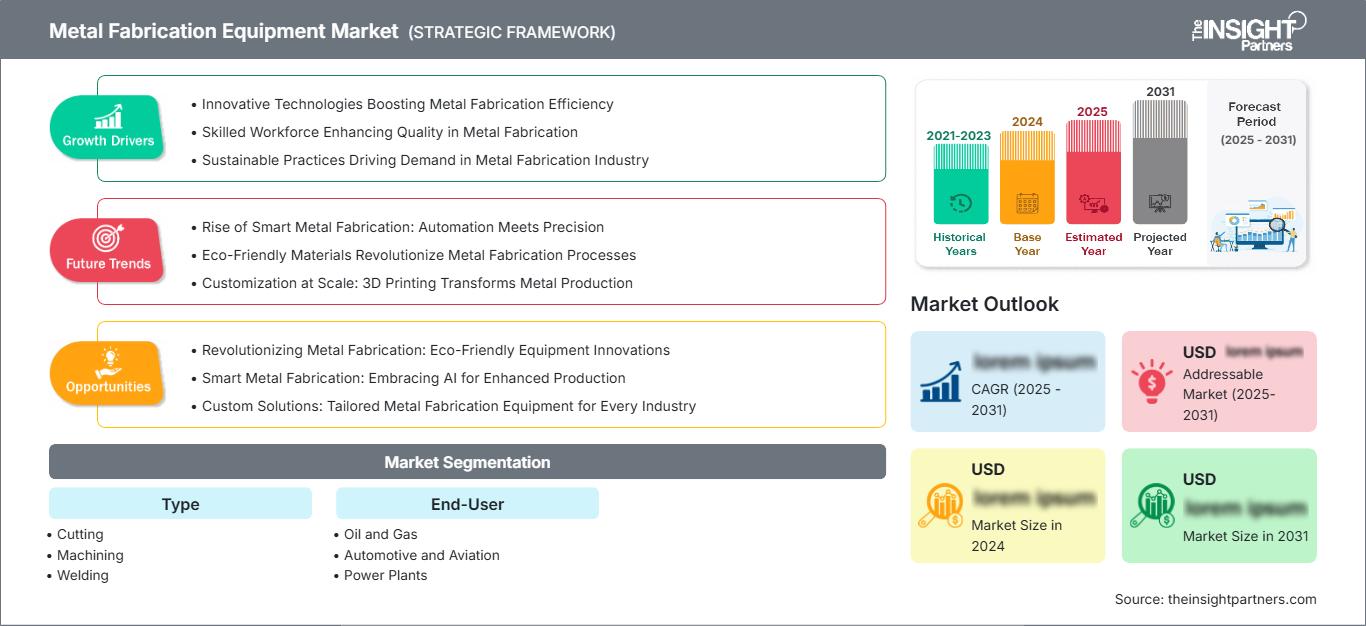
Metal Fabrication Equipment Market: Strategic Insights
Regional Insights
North America Metal Fabrication Equipment Market
North America accounted for 23–25% of global revenue in 2025 and is forecast to expand at 2.8–3.2% CAGR during 2026–2034. The Metal Fabrication Equipment Market share in the region reflects high equipment penetration, replacement of aging assets, and continued investment in aerospace, defense-adjacent machining, oilfield services, utility infrastructure, and commercial construction. Regional consumers value efficiency per worker, preventative maintenance, and improved safety in the production environment. With more reshoring and supply chain localization, there is greater emphasis on flexible machinery capable of running small batches. There is a rising tendency towards robotic welding cells, fiber laser cutting, and press brakes, owing to rising wages, lead-time pressures, and quality documentation needs.
U.S. Metal Fabrication Equipment Market
The U.S. represented 78–82% of North America in 2025 and is projected to post 2.9–3.3% CAGR through 2034. The demand is dominated by fabricators under contracts, auto parts manufacturers, aircraft parts manufacturers, energy industry machinery manufacturers, and steel construction manufacturers interested in faster production rates, traceability, and repeatability in their automated cutting, welding, bending, and machining systems. Company presence is strengthened through the distribution, demonstration, and servicing of machines provided by Bystronic AG, TRUMPF SE + Co. KG, ESAB Corporation, OMAX Corporation, and IPG Photonics Corporation. Application development includes heavy plate cutting for energy sector infrastructure, tube laser cutting for vehicle frameworks, and robotic welding for machinery frameworks, where consistent weld quality saves effort on rework.
Europe Metal Fabrication Equipment Market
Europe held 24–26% share in 2025 and is expected to grow at 2.6–3.0% CAGR between 2026–2034. Germany remains the leading country because of its machinery, automotive, and industrial engineering depth, while Italy supports demand through sheet metal machinery clusters and subcontract fabrication serving export-oriented manufacturing. The UK emphasizes aerospace, defense supply chains, and construction refurbishment, supporting precision cutting and welding investments. France benefits from power, transport, and industrial modernization programs. Spain and Italy add demand from automotive components, metal furniture, machinery, and building systems. Energy-efficiency rules encourage the replacement of older hydraulic and thermal systems with digitally controlled alternatives.
APAC Metal Fabrication Equipment Market
APAC accounted for 39–41% share in 2025 and is projected to grow at 3.8–4.3% CAGR through 2034. China leads regional demand, followed by Japan, South Korea, India, and Australia, supported by industrial capacity, automotive supply chains, electronics, energy assets, shipbuilding, and infrastructure fabrication. Policy support for manufacturing localization and capital goods upgrades strengthens the adoption of fiber lasers, CNC machining, and automated bending. India’s infrastructure pipeline, Southeast Asian industrial parks, and South Korea’s shipbuilding and battery ecosystem create equipment demand across both high-volume manufacturing and custom fabrication shops.
Middle East & Africa Metal Fabrication Equipment Market
The Middle East and Africa market is forecast to grow at a CAGR of 3.5–4.0% during 2026–2034, with Saudi Arabia leading regional demand due to ongoing investments in energy infrastructure, industrial diversification programs, and large-scale construction projects. The UAE, South Africa, and other MEA countries contribute through equipment purchases associated with oil and gas fabrication, industrial manufacturing zones, mining maintenance activities, and commercial construction development. Demand is further supported by refinery modernization, energy transition initiatives, modular construction projects, and local content policies that encourage domestic manufacturing and equipment procurement. Across the region, buyers typically prioritize rugged, reliable equipment capable of operating in challenging environments, while emphasizing strong after-sales service, spare parts availability, and operator training. These factors are particularly important because many project sites are geographically dispersed, and equipment uptime has a direct impact on project completion schedules, operational efficiency, and the overall performance of critical infrastructure and energy assets.
Segmentation Analysis
Type
Type is expected to grow at 3.2–3.7% CAGR during 2026–2034 as buyers select equipment around material thickness, tolerance, energy use, and labor availability. The market scope across type categories reflects a shift toward automated workflows where cutting, machining, welding, and bending are increasingly linked by software, handling systems, and inspection routines.
- Cutting remains the largest type because laser, plasma, oxy-fuel, and waterjet systems define upstream productivity, nesting efficiency, edge quality, and material utilization across sheet, plate, and tube fabrication.
- Machining supports precision finishing, hole making, milling, and tolerance-critical components, where fabricated assemblies require repeatable interfaces for automotive, aviation, energy, and industrial machinery applications.
- Welding is strategically important as robotic cells, power sources, consumables, and monitoring tools improve weld consistency, reduce rework, and address shortages of skilled manual welders.
- Bending demand is supported by press brakes, panel benders, and automated tool-change systems that help fabricators produce complex sheet metal parts with faster setup and improved angle accuracy.
End-User
End-User is projected to expand at 3.4–3.9% CAGR during 2026–2034 as fabrication demand spreads across energy, mobility, utilities, process industries, mining, and construction. Buyers evaluate equipment based on duty cycle, component size, safety compliance, and the ability to deliver documented quality for regulated or mission-critical assemblies.
- Oil and gas require heavy-duty cutting, welding, and machining systems for pipe racks, pressure vessels, offshore structures, and maintenance components where durability and inspection readiness are essential.
- Automotive and Aviation combine volume production with precision fabrication for lightweight structures, fixtures, frames, and components, making automation and repeatable quality central to supplier competitiveness.
- Power Plants depend on fabrication systems for boilers, ducts, structural supports, turbines, maintenance parts, and renewable energy assets, where reliability and dimensional consistency support long operating lives.
- Chemicals and Mining use fabrication equipment for tanks, conveyors, crushers, frames, and corrosion-resistant assemblies, with demand tied to maintenance cycles and capacity expansion projects.
- Construction relies on fabricated beams, stairs, façades, railings, rebar assemblies, and modular structures, making cutting, bending, and welding capacity important for schedule control.
Opportunity Snapshot
| End-User | Revenue Contribution | Trend Tag | Adoption Stage |
| Oil and Gas | High | Pipe Modules | Mature |
| Automotive and Aviation | High | Lightweight Parts | Scaling |
| Power Plants | Medium | Grid Assets | Scaling |
| Chemicals and Mining | Medium | Wear Parts | Mature |
| Construction | High | Modular Builds | Scaling |
Metal Fabrication Equipment Market Growth Drivers and Impact Analysis
Automation Investment to Offset Skilled Labor Constraints
Fabricators have been putting in substantial amounts of money into automated cutting systems, robotic welding systems, and digitally-controlled bending machines due to the growing skills shortage problem in their production process in several industries. Automated machinery enables manufacturers to decrease their dependence on manual setup and operator-driven processes while enhancing consistency, accuracy, and repeatability of fabricated products. Such machinery allows for more efficient production by means of multi-shift production capabilities, decreased amount of reworking, reduction of scrap creation, and error rate minimization in production. This, in its turn, leads to better overall equipment efficiency and delivery performance. The Metal Fabrication Equipment Market profits from this tendency because its customers get tangible ROI in the form of labor cost savings, faster cycle time, improved product quality, and more accurate scheduling. The mentioned tendency is especially noticeable in North America, Europe, Japan, and South Korea, where high labor costs, an aged workforce, and strict quality documentation practices prevail.
Infrastructure and Energy Projects Raising Heavy Fabrication Demand
Large-scale infrastructure development, refineries, power grids, mining and renewable energy projects have been the principal sources of growth in demand for metal fabrication equipment, since such projects necessitate large quantities of fabricated steel structures, tanks, process vessels, ductwork, piping, transmission towers, frames and other supporting components. The purchasing activity is expected to grow in correlation with growing production capacity of fabricating companies, contractors and local vendors who aim to comply with schedule demands, regulatory standards and local content requirements. Cutting, welding and plate processing equipment will see the greatest benefit from such an industry trend, since production of heavy plates, structural steel and pipe components requires high-capacity and reliable fabrication processes in order to meet project deadlines. Developing countries will invest in creation of industrial zones, manufacturing centers and transport networks, as well as various infrastructure development programs sponsored by the government in order to ensure long-term demand for fabrication capacity.
Precision Requirements in Mobility and Industrial Machinery
Lighter and modulated vehicles, aircraft, and machinery have led to tighter tolerances, increasing the need for laser cutters, computer numerical control machines, press brakes, and welds that can be inspected without further machining. Fabricators in such industries need to showcase the ability to produce parts with consistent quality in terms of materials and batches. Machine tools with built-in controllers, digital part history records, and automatic tolerance adjustment capabilities help fabricators to gain an edge over their competitors.
Metal Fabrication Equipment Market Future Trends
Connected Fabrication Cells Become Standard
Metal Fabrication Equipment Market trends point toward connected cells that integrate cutting, bending, welding, material handling, and inspection into coordinated production flows. Purchasing decisions in the future will take into account software compatibility, data acquisition, and remote serviceability, along with the performance of the machinery. Customers will expect their machines to provide information about their working, consumption of raw materials, maintenance requirements, and the quality of their output. The manufacturers who make the process of integration simple for smaller firms will get an edge.
Lower-Energy Machines Influence Replacement Cycles
Consumption of energy is likely to be an important factor for purchase decisions as the factories begin tracking carbon footprints and operational costs. Machines such as fiber lasers, servo-electric press brakes, fume extraction devices, and welding power sources consume less energy than old hydraulic and thermal machines. This tendency will affect procurement guidelines, more so those of the exporters who will need to satisfy their customers’ sustainability reporting needs.
Metal Fabrication Equipment Market Opportunities
Service-Led Modernization for Small and Mid-Sized Fabricators
Many smaller fabrication shops need automation but face capital, training, and integration constraints. Vendors can address this gap through financing, retrofit packages, application consulting, and subscription-based monitoring. Metal Fabrication Equipment Market Forecasts indicate that replacement demand will be strongest where buyers can prove fast payback through labor savings, reduced scrap, and higher throughput. Partnerships with distributors and local service providers can help equipment makers convert cautious buyers by reducing implementation risk and supporting operators after installation.
Localized Fabrication Capacity for Energy and Infrastructure
Industrial policy and project localization are creating opportunities for equipment suppliers in regions building refineries, grids, transport systems, mining assets, and modular buildings. Local fabricators need machines that process heavy plate, pipe, structural steel, and corrosion-resistant materials with dependable uptime. Vendors that combine rugged equipment, operator training, spare parts availability, and project-specific application support can win demand from contractors seeking regional supply resilience and faster execution on complex capital projects.
Recent Developments
- March 2026: XT LASER hosted its “Extreme Speed Breakthrough” product launch event at the Suncun Industrial Park. The event marked the official release of four strategic machines: the ultra-fast GPX Series, the zero-tailing THP Series tube cutter, the 30% more efficient Laser-Flame Composite Cutter, and the highly intelligent X-RAY Handheld Welder. Backed by industry experts and global clients, these innovations redefine efficiency in metal fabrication.
- September 2025: TRUMPF is presenting a new, completely redesigned version of its TruBend 3000 bending machine series, at Blechexpo 2025. The solution is particularly fast and precise, easy to program, and saves energy. With the new TruBend 3000 bending machine, the company’s offering users a technologically advanced all-round machine with which they can process around 85 percent of all components in sheet metal production.
- July 2025: Bystronic AG announced a non-exclusive partnership with SSAB to advance laser cutting and bending technologies using new materials for the sheet metal industry, including alloying concepts, recycled steel, and fossil-free steel.
Frequently Asked Questions

- Comprehensive Market Sizing and Forecast Analysis
- Detailed Segmentation Analysis
- In-Depth Market Dynamics Assessment
- Regional and Country-Level Insights
- Competitive Landscape and Company Benchmarking
- Strategic Business Intelligence
Recent Reports
Testimonials

The Insight Partners' SCADA System Market report is comprehensive, with valuable insights on current trends and future forecasts. The team was highly professional, responsive, and supportive throughout. We are very satisfied and highly recommend their services.
RAN KEDEM Partner, Reali Technologies LTDs
I requested a report on a very specific software market and the team produced the report in a few days. The information was very relevant and well presented. I then requested some changes and additions to the report. The team was again very responsive and I got the final report in less than a week.
JEAN-HERVE JENN Chairman, Future Analytica
We worked with The Insight Partners for an important market study and forecast. They gave us clear insights into opportunities and risks, which helped shape our plans. Their research was easy to use and based on solid data. It helped us make smart, confident decisions. We highly recommend them.
PIYUSH NAGPAL Sr. Vice President, High Beam Global
The Insight Partners delivered insightful, well-structured market research with strong domain expertise. Their team was professional and responsive throughout. The user-friendly website made accessing industry reports seamless. We highly recommend them for reliable, high-quality research services
YUKIHIKO ADACHI CEO, Deep Blue, LLC.
This is the first time I have purchased a market report from The Insight Partners.While I was unsure at first, I visited their web site and felt more comfortable to take the risk and purchase a market report.I am completely satisfied with the quality of the report and customer service. I had several questions and comments with the initial report, but after a couple of dialogs over email with their analyst I believe I have a report that I can use as input to our strategic planning process.Thank you so much for taking the extra time and making this a positive experience.I will definitely recommend your service to others and you will be my first call when we need further market data.
JOHN SUZUKI President and Chief Executive Officer, Board Director, BK Technologies
I wish to appreciate your support and the professionalism you displayed in the course of attending to my request for information regarding to infectious disease IVD market in Nigeria. I appreciate your patience, your guidance, and the fact that you were willing to offer a discount, which eventually made it possible for us to close a deal. I look forward to engaging The Insight Partners in the future, all thanks to the impression you have created in me as a result of this first encounter.
DR CHIJIOKE ONYIA MANAGING DIRECTOR, PineCrest Healthcare Ltd.Reason to Buy
- Informed Decision-Making
- Understanding Market Dynamics
- Competitive Analysis
- Identifying Emerging Markets
- Customer Insights
- Market Forecasts
- Risk Mitigation
- Boosting Operational Efficiency
- Strategic Planning
- Investment Justification
- Tracking Industry Innovations
- Aligning with Regulatory Trends





 Get Free Sample for