
Metal IBC Market Growth, Demand & Size by 2034
Coverage: By Material (Carbon Steel, Stainless Steel); End Use Industry (Industrial Chemicals, Petrochemicals and Lubricants, Pharmaceutical, Others) , and Geography (North America, Europe, Asia Pacific, and South and Central America)
- Status : Data Released
- Report Code : TIPRE00023880
- Category : Chemicals and Materials
- No. of Pages : 150
- Available Report Formats :


- Last update date : July 30, 2026


2025 Market Size
US$ 2.03 Bn
Base year value
2034 Forecast
US$ 2.79 Bn
Projected by 2034
CAGR 2026-2034
3.6 %
Growth rate
Addressable Market
US$ 21.90 Bn
(2026-2034)
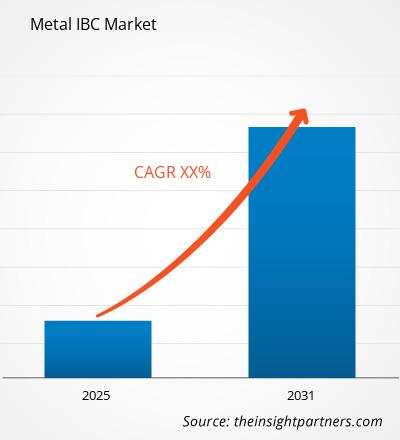
The Metal IBC market was valued at US$ 2.03 billion in 2025 and is expected to reach US$ 2.79 billion by 2034; it is estimated to record a CAGR of 3.6% during 2026-2034.
Metal IBC Market Assessment and Insights
- North America: Strong chemical manufacturing, pharmaceutical production, and stringent packaging regulations enabled the region to account for 29–33% share in 2025, while demand is projected to expand at a CAGR of 3.8–4.3% during 2026–2034.
- US: The country represented 78–82% of North America's market in 2025, supported by its large industrial chemicals and pharmaceutical sectors, and is expected to record a CAGR of 3.9–4.4%.
- Europe: Germany, France, Italy, the UK, and the Netherlands continue driving regional demand through advanced chemical processing and pharmaceutical manufacturing. Europe captured 27–31% share in 2025 and is forecast to grow at a CAGR of 3.7–4.2%.
- Asia Pacific: China, Japan, India, and South Korea remain key manufacturing and export hubs. Asia Pacific accounted for 30–34% share in 2025 and is anticipated to expand at a CAGR of 4.8–5.3%.
- Largest Segment: Industrial Chemicals remained the leading end-use industry with 44–48% market share in 2025, supported by large-scale storage and transportation requirements, while growing at a CAGR of 4.0–4.5%.
- High Growth Segment: Stainless Steel represented 38–42% market share in 2025 and is projected to register the fastest expansion at a CAGR of 4.8–5.3%, driven by pharmaceutical and high-purity chemical applications.
- Key companies analyzed in detail: THIELMANN, Time Technoplast Ltd., METANO IBC SERVICES, INC., Precision IBC, Hoover CS, Sharpsville Container Corporation, Snyder Industries, Titan IBC, Yenchen Machinery Co., Ltd., Automationstechnik GmbH.
Source: The Insight Partners' analysis based on proprietary research, government publications, company annual reports, investor presentations, industry databases, and expert interviews.
The trend towards reusability of industrial packaging material has significantly changed the competitive dynamics within the metal intermediate bulk container market. Companies have adopted automated welding, high-quality fabrication processes, robotic inspections systems, and sophisticated surface finishing methods to ensure quality and extended life of their products. The increasing use of stainless steel intermediate bulk containers and recycling activities for used containers have contributed positively to the circular economy and minimized packaging waste and costs.
The future growth potential of the market will be driven by industrial investments in Asia Pacific, the Middle East, and Latin America regions, where there is continuous addition of chemical manufacturing capabilities. The regulatory needs for handling hazardous materials and sustainable practices promoting reusable packaging along with modernization of pharmaceutical plants will provide opportunities for certified and highly efficient metal intermediate bulk containers.
Metal IBC Market Report Scope
| Report Attribute | Details |
|---|---|
| Market size in 2025 | US$ 2.03 Billion |
| Market Size by 2034 | US$ 2.79 Billion |
| Global CAGR (2026 - 2034) | 3.6% |
| Historical Data | 2021-2024 |
| Forecast period | 2026-2034 |
Metal IBC Market Analysis
Metal IBC market growth is facilitated by the rising production of industrial chemicals, specialty chemicals, lubricants, pharmaceuticals, and valuable process liquids which need safe storage and transportation. Metal IBCs offer excellent durability, corrosion resistance, and long service life relative to other types of packaging and are best suited to storing dangerous or pure products. Rising compliance with global transportation standards and increasing preference for reusable packaging are expected to underpin continuous growth in the market.
The value chain includes steel producers, component manufacturers, fabricators, inspection and certification services providers, logistics services providers, reconditioners, and industrial users. Carbon steel still accounts for a significant share of deliveries due to its mechanical strength and economical cost, while stainless steel is experiencing rising demand because of its corrosion resistance, easy washing ability, and application in pharmaceutical and food manufacturing.
The metal IBC market report shows competition through engineering competency, compliance with regulations, customizability, product durability, and after-sales services. THIELMANN, Hoover CS, Sharpsville Container Corporation, Time Technoplast Ltd., Precision IBC, and METANO IBC SERVICES, INC. are continuously improving their manufacturing technology and container repair services in order to increase client retention. Manufacturers are providing clients with customized container options that will meet their specific storage, transport, and handling needs in compliance with international safety standards.
Companies are improving regional manufacturing capacities to reduce lead time and to build up supply chain reliability. The investments in digital container asset tracking, RFID technology, preventive maintenance, and lifecycle management are assisting industrial clients to optimize their fleets and to comply with regulations. Strategic partnerships with chemical producers, pharmaceutical manufacturers, and logistics companies are continuously supporting the market competitiveness as well as sustainability initiatives.
● REPORT CUSTOMIZATION
Tailor This Report To Align With Your Specific Business Requirements
This report can be customized to align precisely with your business objectives, scope, and target markets. Customization options include tailored segmentation, geography, competitive analysis, and strategic insights to support informed decision-making.
Customize This Report →WHAT YOU CAN ADJUST
- ● Segmentations
- ● Geography
- ● Competitive Analysis
- ● Language Preferences
Metal IBC Market: Strategic Insights
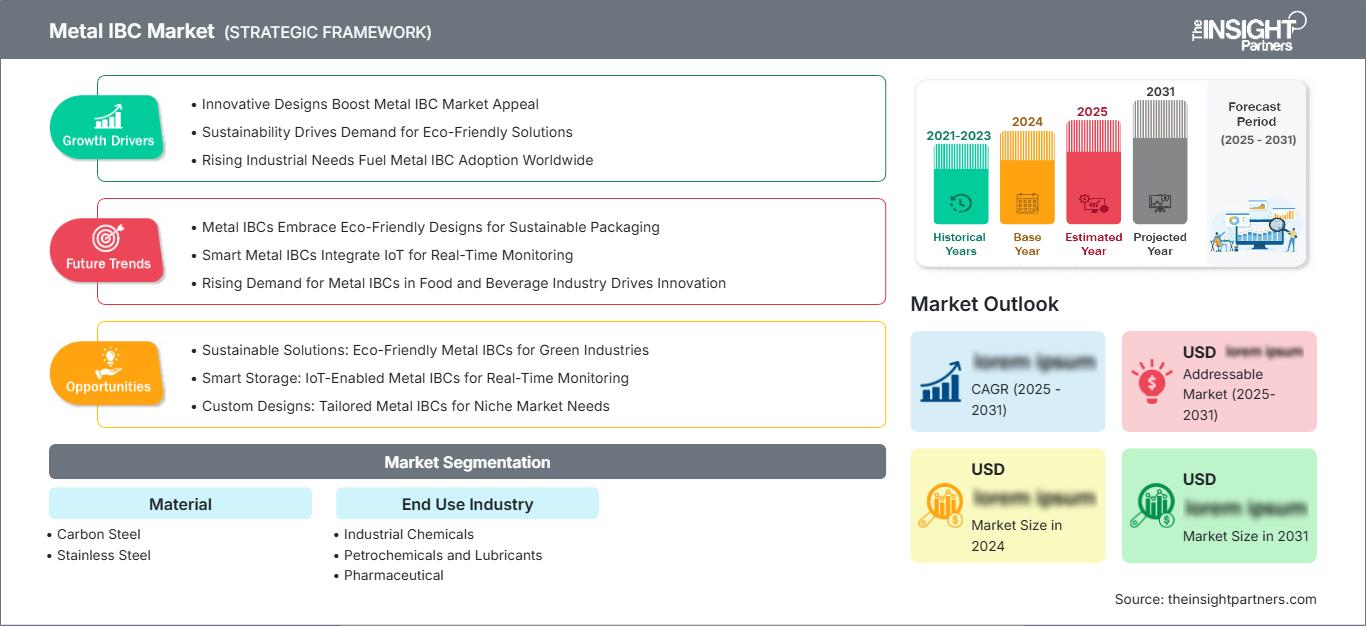
Regional Insights
North America Metal IBC Market
North America accounted for 29–33% of the metal IBC market share in 2025 and is projected to register a CAGR of 3.8–4.3% during 2026–2034. Demand is supported by well-established chemical manufacturing, pharmaceutical production, food ingredient processing, and petroleum industries that require durable bulk packaging for hazardous and high-value liquids. Regulations governing the transport of dangerous goods under the U.S. Department of Transportation and Transport Canada continue encouraging the use of certified reusable metal IBCs. Increasing adoption of circular packaging practices and container reconditioning services further strengthens market expansion.
The region also benefits from advanced logistics infrastructure and a mature industrial packaging ecosystem. Companies are investing in RFID-enabled container tracking, automated inspection systems, and refurbishment facilities to improve asset utilization and reduce lifecycle costs. Demand continues to rise from specialty chemical manufacturers and lubricant producers seeking long-lasting transport containers that comply with international UN packaging standards. Sustainability initiatives encouraging reusable packaging instead of single-use alternatives are expected to reinforce long-term regional growth.
U.S. Metal IBC Market
The US accounted for 78-82% of the North American market share in 2025 and is forecasted to grow at a CAGR of 3.9-4.4% during 2025-2034. Large industries in the country for industrial chemicals, pharmaceuticals, coatings, and petrochemicals are creating consistent demand for intermediate bulk containers that meet certification standards. Metal IBCs have been extensively used for transporting hazardous liquids, API products, solvents, lubricants, and other speciality chemicals that require good containment integrity.
Leading vendors such as Hoover CS, Sharpsville Container Corporation, Precision IBC, and Snyder Industries have strong manufacturing and servicing facilities across the country. Increasing investments in the domestic pharmaceutical manufacturing industry, increasing manufacture of speciality chemicals, and modernising of logistics industry are supporting this demand. Increasing focus on IBC refurbishment and digitalisation is enabling users to streamline their operations with reduced packaging waste and lower transportation costs.
Europe Metal IBC Market
Europe has captured 27–31% of the worldwide market share in 2025, and is estimated to register a CAGR of 3.7–4.2% during the forecast period. Germany is still leading among the regions with respect to the metal bulk containers owing to the presence of the huge chemical manufacturing base; the United Kingdom, France, Italy, and Netherlands are continuing to contribute through pharmaceutical manufacturing and industrial exports. Environmental rules and regulations along with the concept of circular economy have led to the increased use of reusable metal bulk containers.
Germany has an advantage owing to the presence of large chemical manufacturing firms, engineering capabilities, and logistics facilities that help to utilize stainless steel and carbon steel IBCs to a wider extent. The United Kingdom has advantages owing to the presence of strong pharmaceutical manufacturing firms as well as specialty chemicals exporters who require good reusable containers. Countries such as France, Italy, Spain, and the Netherlands are continuously increasing their demand owing to the manufacturing of industrial process goods, food ingredients, paints and coatings, and lubricants.
APAC Metal IBC Market
Asia-Pacific represented 30%-34% of the total market share in 2025 and is expected to witness the highest regional CAGR of 4.8%-5.3% during the forecast period. China is the biggest producer and consumer country, whereas, India, Japan, and South Korea continue to develop manufacturing and chemical export industries.
Government initiatives towards the development of manufacturing industries, pharmaceutical production, and specialty chemicals are continuously providing growth prospects for reusable industrial packaging products. Increasing chemical and industrial product exports, along with the improvement in logistics infrastructure and safety policies, have enhanced the demand for certified metal IBCs in the region.
Middle East & Africa Metal IBC Market
The market in the Middle East & Africa region will experience a CAGR of 4.2-4.7% from 2026 to 2034. Saudi Arabia is the largest consumer country in the region due to its strong petrochemical sector, and the UAE acts as a logistics and re-export base for industrial packaging needs.
South Africa continues to be an important consumer with mining chemicals, industrial processing, and manufacturing processes, and the Rest of MEA continues to derive value from diversification initiatives. Downstream investments in petrochemical capacity and infrastructure developments will help boost the uptake of metal intermediate bulk containers (IBCs).
Segmentation Analysis
Material
The Material segment is anticipated to grow at a CAGR of 4.2–4.7% during 2026–2034. Material selection depends on chemical compatibility, corrosion resistance, durability, operating environment, and total lifecycle cost. Carbon steel continues serving high-volume industrial applications because of its mechanical strength and affordability, whereas stainless steel is increasingly preferred for high-purity and corrosive products. The metal IBC market scope continues expanding as manufacturers develop application-specific container designs that improve operational safety, product integrity, and long-term reusability.
- Carbon Steel – Widely utilized across industrial chemicals, lubricants, and petrochemical applications owing to its excellent structural strength, durability, and cost-effectiveness for transporting hazardous and non-hazardous bulk liquids.
- Stainless Steel – Preferred for pharmaceutical manufacturing, specialty chemicals, food ingredients, and high-purity process fluids because of superior corrosion resistance, hygienic properties, and ease of cleaning between operational cycles.
End Use Industry
The End Use Industry segment is projected to register a CAGR of 4.3–4.8% throughout the forecast period. Industrial expansion, hazardous material regulations, and increasing preference for reusable packaging continue supporting demand across chemical processing, petroleum products, and pharmaceutical manufacturing. End users are increasingly investing in standardized, reusable IBC fleets that improve logistics efficiency while reducing packaging waste and overall transportation costs.
- Industrial Chemicals – Represents the largest end-use segment owing to extensive transportation and storage requirements for solvents, acids, specialty chemicals, coatings, and process liquids across global manufacturing industries.
- Petrochemicals and Lubricants – Metal IBCs provide safe transportation of oils, additives, process chemicals, and refined petroleum products requiring durable packaging capable of withstanding demanding industrial operating environments.
- Pharmaceutical – Demand continues increasing as pharmaceutical manufacturers require corrosion-resistant, hygienic, and validated stainless steel containers for transporting active ingredients, intermediates, and sensitive liquid formulations.
Opportunity Snapshot
| End Use Industry | Revenue Contribution | Trend Tag | Adoption Stage |
| Industrial Chemicals | High | Hazard Logistics | Mature |
| Petrochemicals and Lubricants | Medium | Bulk Fluids | Scaling |
| Pharmaceutical | High | Sterile Transport | Scaling |
Metal IBC Market Growth Drivers and Impact Analysis
Expansion of Global Chemical Manufacturing Capacity
Increasing investments in chemical production facilities across Asia Pacific, North America, and the Middle East continue supporting demand for certified bulk packaging solutions. Industrial and specialty chemicals require secure storage and transportation systems capable of handling corrosive and hazardous liquids while complying with international regulations. Metal IBCs offer superior durability, multiple reuse cycles, and lower lifecycle costs compared with disposable alternatives. Capacity additions in specialty chemicals, coatings, agrochemicals, and performance materials are encouraging manufacturers to expand production of standardized and customized containers. At the same time, stricter transportation safety requirements and greater emphasis on operational efficiency continue reinforcing long-term demand for certified intermediate bulk containers throughout global industrial supply chains.
Growing Preference for Reusable Industrial Packaging Solutions
Manufacturers across multiple industries are replacing single-use packaging with reusable systems to reduce waste generation, improve resource efficiency, and lower total operating costs. Metal IBCs support circular economy objectives through refurbishment, repair, recertification, and repeated utilization over extended service lives. Large chemical producers, lubricant manufacturers, and pharmaceutical companies increasingly evaluate packaging based on lifecycle performance rather than initial purchase price. This shift encourages greater adoption of stainless steel and carbon steel intermediate bulk containers while stimulating investments in refurbishment centers, inspection technologies, and digital asset management systems that improve fleet utilization and regulatory compliance.
Stringent Regulations for Hazardous Material Transportation
International regulations governing dangerous goods transportation continue driving adoption of certified metal intermediate bulk containers. Standards established by organizations such as the United Nations, ADR, RID, IMDG Code, and other national regulatory authorities require robust packaging capable of protecting workers, products, and the environment during transportation. Metal IBCs provide excellent impact resistance, leak prevention, and chemical compatibility for hazardous liquids transported across road, rail, sea, and industrial facilities. Continuous regulatory updates and increasing enforcement of packaging safety requirements encourage manufacturers to invest in higher-quality certified containers with enhanced inspection, traceability, and quality assurance capabilities.
Metal IBC Market Future Trends
Digital Lifecycle Management for Reusable Containers
The metal IBC market trends indicate growing adoption of RFID, QR code identification, IoT sensors, and cloud-based fleet management platforms that improve visibility throughout container lifecycles. Digital monitoring enables users to schedule maintenance, verify inspection history, optimize utilization rates, and strengthen regulatory compliance. Packaging suppliers are increasingly integrating smart tracking technologies into premium container portfolios to improve operational transparency and reduce logistics costs. As industrial supply chains become increasingly digitized, lifecycle management platforms are expected to become a standard feature for high-value reusable packaging assets.
Increasing Demand for High-Purity Stainless Steel Containers
Growth in pharmaceutical manufacturing, biotechnology production, and specialty chemical processing is expected to accelerate demand for stainless steel intermediate bulk containers. These industries require packaging systems offering excellent corrosion resistance, contamination control, and hygienic performance. Manufacturers continue improving surface finishing technologies, welding quality, and cleaning validation capabilities to address increasingly stringent production standards. Continuous innovation in stainless steel fabrication is expected to support broader adoption across industries handling sensitive and high-value liquid products.
Metal IBC Market Opportunities
Expansion of Refurbishment and Container Leasing Services
The metal IBC market forecasts suggest growing opportunities for companies offering refurbishment, inspection, leasing, and fleet management services alongside container manufacturing. Industrial customers increasingly prefer service-based packaging models that reduce capital expenditure while ensuring regulatory compliance and operational reliability. Investments in regional refurbishment centers, digital inspection systems, and predictive maintenance capabilities can generate recurring revenue streams while supporting circular economy initiatives. Companies capable of providing complete lifecycle solutions are expected to strengthen customer retention and improve long-term profitability.
Supplying Advanced Packaging for Pharmaceutical Manufacturing
Rapid expansion of pharmaceutical production across developed and emerging economies presents attractive opportunities for manufacturers specializing in stainless steel intermediate bulk containers. Growing production of active pharmaceutical ingredients, biologics, and specialty formulations requires packaging systems that satisfy strict hygiene and quality standards. Companies investing in precision fabrication, electropolished finishes, validated cleaning processes, and application-specific container designs are expected to benefit from increasing demand. Strategic partnerships with pharmaceutical manufacturers and contract development organizations can further strengthen long-term business growth.
Recent Developments
- April 2026: Mitsu Chem Plast Limited, an industrial packaging solutions provider, on Wednesday announced its entry into the Intermediate Bulk Container (IBC) segment, with plans to set up a fully automated manufacturing facility expected to be operational by the second quarter of FY2026–27. IBCs are used for storage and transportation of bulk liquids, semi-solids and solids across sectors including chemicals, pharmaceuticals, food and beverages, and agrochemicals. The company said the new facility will manufacture IBCs using integrated processes such as blow moulding and assembly.
- May 2025: Mauser Packaging Solutions introduced its new line of stainless steel intermediate bulk containers (IBCs). These corrosion-resistant IBC’s deliver unmatched durability and are engineered to last for years in service in the industrial chemical, agricultural chemical, food and beverage, coatings, and petroleum markets.
Frequently Asked Questions

- Comprehensive Market Sizing and Forecast Analysis
- Detailed Segmentation Analysis
- In-Depth Market Dynamics Assessment
- Regional and Country-Level Insights
- Competitive Landscape and Company Benchmarking
- Strategic Business Intelligence
Recent Reports
Testimonials

The Insight Partners provided valuable market intelligence that supported our global go-to-market strategy. Their team was professional, responsive, and attentive to our feedback, providing thoughtful analysis and helpful methodological clarifications throughout the project.
Junmo Kim Chief Financial Officer (CFO), Enertech Co., Ltd.
The Insight Partners' SCADA System Market report is comprehensive, with valuable insights on current trends and future forecasts. The team was highly professional, responsive, and supportive throughout. We are very satisfied and highly recommend their services.
RAN KEDEM Partner, Reali Technologies LTDs
I requested a report on a very specific software market and the team produced the report in a few days. The information was very relevant and well presented. I then requested some changes and additions to the report. The team was again very responsive and I got the final report in less than a week.
JEAN-HERVE JENN Chairman, Future Analytica
We worked with The Insight Partners for an important market study and forecast. They gave us clear insights into opportunities and risks, which helped shape our plans. Their research was easy to use and based on solid data. It helped us make smart, confident decisions. We highly recommend them.
PIYUSH NAGPAL Sr. Vice President, High Beam Global
The Insight Partners delivered insightful, well-structured market research with strong domain expertise. Their team was professional and responsive throughout. The user-friendly website made accessing industry reports seamless. We highly recommend them for reliable, high-quality research services
YUKIHIKO ADACHI CEO, Deep Blue, LLC.
This is the first time I have purchased a market report from The Insight Partners.While I was unsure at first, I visited their web site and felt more comfortable to take the risk and purchase a market report.I am completely satisfied with the quality of the report and customer service. I had several questions and comments with the initial report, but after a couple of dialogs over email with their analyst I believe I have a report that I can use as input to our strategic planning process.Thank you so much for taking the extra time and making this a positive experience.I will definitely recommend your service to others and you will be my first call when we need further market data.
JOHN SUZUKI President and Chief Executive Officer, Board Director, BK Technologies
I wish to appreciate your support and the professionalism you displayed in the course of attending to my request for information regarding to infectious disease IVD market in Nigeria. I appreciate your patience, your guidance, and the fact that you were willing to offer a discount, which eventually made it possible for us to close a deal. I look forward to engaging The Insight Partners in the future, all thanks to the impression you have created in me as a result of this first encounter.
DR CHIJIOKE ONYIA MANAGING DIRECTOR, PineCrest Healthcare Ltd.Reason to Buy
- Informed Decision-Making
- Understanding Market Dynamics
- Competitive Analysis
- Identifying Emerging Markets
- Customer Insights
- Market Forecasts
- Risk Mitigation
- Boosting Operational Efficiency
- Strategic Planning
- Investment Justification
- Tracking Industry Innovations
- Aligning with Regulatory Trends





 Get Free Sample for