
Metal Stamping Equipment Market Statistics, Trends, Size, Share, and Key Players by 2034
Coverage: by Product Type (Vehicle Stamping, Job Stamping, and Others); End-user Industry (Automotive, Aerospace, Consumer Electronics, Telecommunication, and Others), and Geography (North America, Europe, Asia Pacific, and South and Central America)
- Status : Data Released
- Report Code : TIPMC00002755
- Category : Manufacturing and Construction
- No. of Pages : 150
- Available Report Formats :


- Last update date : July 20, 2026


2025 Market Size
US$ 214.77 Bn
Base year value
2034 Forecast
US$ 300.44 Bn
Projected by 2034
CAGR 2026-2034
3.8 %
Growth rate
Addressable Market
US$ 2,339.99 Bn
(2026-2034)
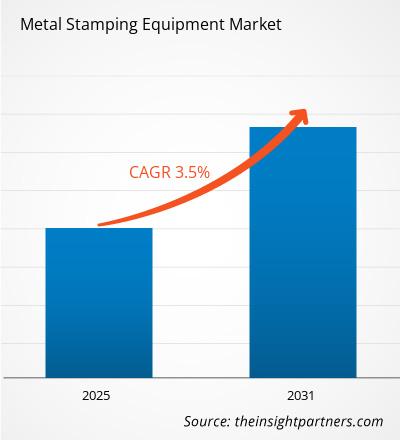
The Metal stamping equipment market was valued at US$ 214.77 Billion in 2025 and is projected to reach US$ 300.44 Billion by 2034, registering a CAGR of 3.8% from 2026 to 2034. Demand is supported by press modernization, tooling accuracy, and broader use of stamped metal components across automotive, aerospace, consumer electronics, and telecommunication manufacturing networks.
Across North America, the metal stamping equipment market size is shaped by reshoring, electric vehicle platform changes, and steady replacement of aging presses. Regional demand is estimated to expand at a CAGR range of 3.4–3.8% during 2026–2034, supported by tighter quality requirements, advanced high-strength steel usage, and automation investments across supplier plants serving U.S., Canadian, and Mexican production clusters.
Metal Stamping Equipment Market Assessment and Insights
- North America accounted for 28–31% share in 2025 and is growing at a CAGR between 2026–2034 of 3.4–3.8%, driven by EV body structures, defense aerospace parts, and press-line automation.
- US represented 76–80% of North America in 2025 and is growing at a CAGR between 2026–2034 of 3.5–3.9%, led by automotive stamping capacity upgrades.
- Europe held 22–25% share in 2025 and is growing at a CAGR between 2026–2034 of 3.0–3.4%, with Germany, France, Italy, Spain, and the UK anchoring precision production.
- Asia Pacific captured 36–39% share in 2025 and is growing at a CAGR between 2026–2034 of 4.2–4.6%, supported by China, Japan, South Korea, and India.
- Largest Segment Vehicle Stamping held 63–67% market share in 2025, with CAGR range 2026–2034 of 3.7–4.1%, reflecting high-volume automotive and commercial vehicle production.
- High Growth Segment Consumer Electronics held 14–17% market share in 2025, with CAGR range 2026–2034 of 4.5–4.9%, supported by compact enclosures and connector demand.
- Key companies analyzed in detail: American Industrial Company, Martinrea International Inc., Magna International Inc., Hayes Lemmerz International, Harvey Vogel Manufacturing Co., Haitong Metals, D and H Industries, Inc., Dongguan Fortuna Metal Stamping Company, thyssenkrupp AG, Alcoa Corporation.
Source: The Insight Partners' analysis based on proprietary research, government publications, company annual reports, investor presentations, industry databases, and expert interviews.
Manufacturing considerations have shifted from basic mechanical press capabilities to digitally controlled production lines, servo presses, progressive dies, and transfer machines for greater efficiency and accuracy. Within the Metal Stamping Equipment Market, customers consider factors such as total cost of production per stamped part, changeover time, energy usage, and material flexibility when considering aluminum, AHSS, and other alloys. This trend is most evident in automotive body-in-white assembly, electronics shield enclosures, aircraft brackets, and telecommunications infrastructure parts.
For the forecast period, investments will likely focus on Asian scale production, North American nearshoring and European modernization in relation to emissions and energy efficiency targets. Domestic manufacturing policy incentives, increased product tracking requirements and the replenishment of the backlog of aerospace orders contribute to the cycle of replacing equipment. Companies that can incorporate automation, simulation and predictive maintenance systems have an opportunity to win more profitable orders in light of labor shortages.
Metal Stamping Equipment Market Report Scope
| Report Attribute | Details |
|---|---|
| Market size in 2025 | US$ 214.77 Billion |
| Market Size by 2034 | US$ 300.44 Billion |
| Global CAGR (2026 - 2034) | 3.8% |
| Historical Data | 2021-2024 |
| Forecast period | 2026-2034 |
Metal Stamping Equipment Market Analysis
Demand is closely tied to vehicle output, aircraft build rates, connected device production, and telecom equipment fabrication. The Metal Stamping Equipment Market growth outlook reflects a shift toward stronger but lighter components, where repeatable forming accuracy matters as much as press tonnage. Automotive production data showing 96.4 million vehicles in 2025 supports recurring equipment needs in body, chassis, and structural stamping lines.
The supply structure continues to be affected by the availability of steel and aluminum, lead time of controllers, tool-making skills, and customer preferences for a complete turnkey solution. Equipment manufacturers are reacting to these challenges by developing modular press packages, fast die-setting solutions, and services. The supply chain includes press manufacturers, die manufacturers, automation system integrators, part stamping companies, and maintenance specialists.
The competitive environment is fragmented between global component groups, specialized stampers, and regional precision manufacturers. Metal Stamping Equipment Market analysis indicates that American Industrial Company, Martinrea International Inc., Magna International Inc., Harvey Vogel Manufacturing Co., and D and H Industries, Inc. compete through engineering depth, repeat quality, and proximity to customer platforms.
Positioning strategy is becoming more aligned with material expertise and process automation readiness. thyssenkrupp AG assists with the reorganization of the automotive technology company structure via specialized business units, while Alcoa Corporation emphasizes the relevance of aluminum in lightweight products. Dongguan Fortuna Metal Stamping Company and Haitong Metals offer additional choices for Asia-based supply, while Hayes Lemmerz International contributes its experience in wheels and formed metals.
● REPORT CUSTOMIZATION
Tailor This Report To Align With Your Specific Business Requirements
This report can be customized to align precisely with your business objectives, scope, and target markets. Customization options include tailored segmentation, geography, competitive analysis, and strategic insights to support informed decision-making.
Customize This Report →WHAT YOU CAN ADJUST
- ● Segmentations
- ● Geography
- ● Competitive Analysis
- ● Language Preferences
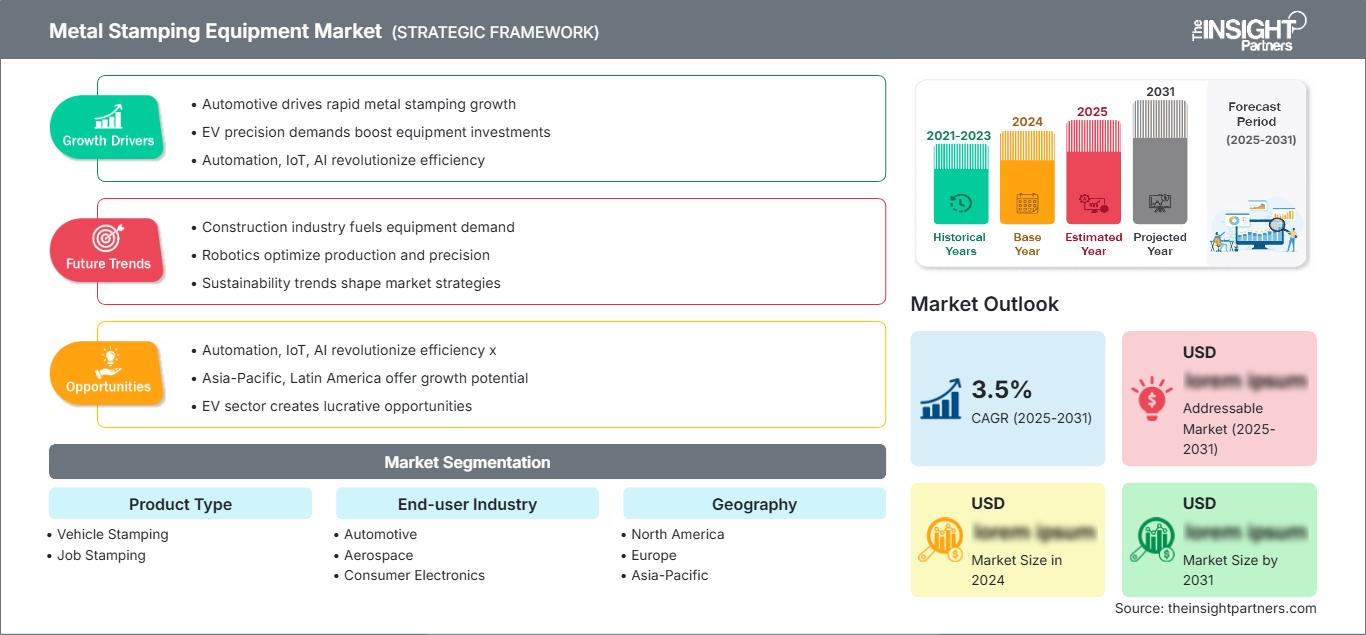
Metal Stamping Equipment Market: Strategic Insights
Regional Insights
North America Metal Stamping Equipment Market
North America accounted for 28–31% share in 2025 and is projected to grow at a CAGR of 3.4–3.8% from 2026 to 2034. The Metal Stamping Equipment Market share in the region is supported by U.S. automotive capacity, Mexican supplier integration, and Canadian precision manufacturing. Investment remains concentrated in servo presses, transfer presses, and automated feed systems for EV platforms.
Structural drivers include defense aircraft procurement, appliance repatriation, and telecommunications hardware associated with broadband infrastructure investments. Equipment purchasers favor availability, safety, die protection systems, and predictive maintenance. This is due to the fact that the installed base of this region is mature and replacement investment is often more common than new investments, particularly with higher tolerance requirements for aluminum and advanced high-strength steels.
U.S. Metal Stamping Equipment Market
The U.S. represented 76–80% of North America in 2025 and is forecast to expand at a CAGR of 3.5–3.9% during 2026–2034. Automotive, aerospace, appliances, and electronics parts providers are continually improving their stamping operations to meet stricter tolerances, labor availability challenges, and demands for domestically produced resilience in critical components.
The companies' reach extends to American Industrial Company, Harvey Vogel Manufacturing Co., D and H Industries, Inc., Martinrea International Inc., Magna International Inc., and Alcoa Corporation, providing support for tooling, materials, and stamped component systems. Trends in applications include battery trays, structural brackets, thermal management enclosures, aircraft fasteners, shield cans, and telecommunication mounting hardware, among others.
Europe Metal Stamping Equipment Market
Europe held 22–25% share in 2025 and is expected to grow at a CAGR of 3.0–3.4% from 2026 to 2034. Germany leads due to vehicle platforms, precision machinery, and supplier density. The UK benefits from aerospace and specialist automotive programs, while Germany emphasizes advanced steel forming, press automation, and tooling simulation.
France, Italy, and Spain contribute through automotive assembly, appliance manufacturing, and metalworking clusters. Energy costs and emissions targets encourage equipment that lowers scrap and power consumption. European buyers often prioritize compliance, traceability, and long service life, creating demand for presses with condition monitoring and flexible forming capability.
APAC Metal Stamping Equipment Market
APAC captured 36–39% share in 2025 and is forecast to grow at a CAGR of 4.2–4.6% during 2026–2034, making it the largest regional base. China leads through vehicle production, electronics manufacturing, and tooling scale, while Japan and South Korea sustain demand for high-precision automated presses.
India and Australia add momentum through industrial policy, infrastructure equipment, and supplier localization. The region benefits from strong component export networks, lower-cost manufacturing clusters, and EV supply-chain expansion. Buyers increasingly specify servo control, robotic transfer, and inline inspection to raise throughput while managing labor quality variation.
Middle East & Africa Metal Stamping Equipment Market
The Middle East and Africa are projected to grow at a CAGR of 3.1–3.5% from 2026 to 2034, led by Saudi Arabia and the UAE. Industrial diversification, energy infrastructure, fabrication yards, and transport investments create demand for durable formed components and localized metalworking capabilities.
South Africa remains the most established automotive stamping base, while the Rest of MEA supports construction, utility, and equipment manufacturing. Growth is gradual because heavy press investments require skilled maintenance, reliable power, and stable order pipelines. Suppliers offering training and service support gain an advantage.
Segmentation Analysis
Product Type
Product Type is expected to grow at a CAGR of 3.6–4.0% from 2026 to 2034. The Metal Stamping Equipment Market scope within product type reflects two operating models: captive vehicle stamping for large platforms and job stamping for diversified contract work. Adoption depends on press flexibility, die complexity, production volume, and the ability to handle multiple alloys without compromising repeatability.
- Vehicle Stamping dominates equipment demand because automotive platforms require large body panels, chassis structures, brackets, closures, and EV battery-related components produced at consistent volumes with strict dimensional control.
- Job Stamping serves diversified industrial buyers needing shorter runs, custom tooling, and multi-material capability, making flexible presses, quick die changes, and responsive engineering support strategically important.
End-user Industry
Metal Stamping Equipment Market forecast indicates that the end-user industry segment is expected to grow at a CAGR of 3.8–4.2% from 2026 to 2034. Automotive remains the demand anchor, but aerospace, consumer electronics, and telecommunication are raising specifications for lighter, smaller, and more reliable stamped parts. Equipment selection increasingly depends on precision, cleanliness, traceability, and the economics of automated high-volume production.
- Automotive requires high-tonnage and transfer presses for body panels, structural reinforcements, brackets, and EV-related assemblies, keeping replacement cycles steady across OEM and Tier 1 plants.
- Aerospace favors precision, traceability, and specialty alloys for brackets, clips, housings, and lightweight structures, making quality certification and repeatability critical in equipment selection.
- Consumer Electronics uses stamping for shield cans, frames, connectors, springs, and miniature housings, where fine tolerances, clean edges, and rapid tooling changes support product refresh cycles.
- Telecommunication depends on stamped enclosures, racks, shielding, connectors, and tower hardware, with infrastructure rollout and network densification supporting demand for durable formed metal parts.
Opportunity Snapshot
| End-user Industry | Revenue Contribution | Trend Tag | Adoption Stage |
| Automotive | High | EV Structures | Mature |
| Aerospace | Medium | Fleet Backlog | Scaling |
| Consumer Electronics | Medium | Mini Housings | Scaling |
| Telecommunication | Low | Network Hardware | Emerging |
Metal Stamping Equipment Market Growth Drivers and Impact Analysis
Vehicle Platform Redesign and Lightweighting
New vehicle platforms will be developed with an emphasis on battery protection, crash performance, body modularity, and reduced weight. These developments lead to an increased need for stamping presses capable of forming aluminum, AHSS, and reinforced parts in a consistent manner. Batteries, cross members, closure parts, and structural brackets have more forming requirements than conventional parts. Due to the production of vehicles in Asia and targeted reshoring in North America, the supplier companies have to strike a balance between cost and platform-specific dies. The effect is the continuous process of upgrading old mechanical presses as well as using servo press technology.
Automation to Address Labor and Quality Constraints
The availability of labor, the desire for safety, and inspections are forcing stampers to invest in feed lines, robot transfer, die protection, and inline measurement systems. The need for reduced human involvement and tolerance control through a lengthy manufacturing run is increasing in importance. Quality problems in stampings may affect the timing of OEM assemblies, meaning that the focus on automation for the stamping process is more about risk management than improving efficiency. The effect will be an increased market for press packages, which will include forming machinery, control, lubrication, and scrap handling. Companies with services and software will be able to earn ongoing revenues.
Aerospace and Electronics Supply Chain Recovery
Aerospace demand will see growth due to the need for newer planes, and electronics makers will continue to shrink components. Load factors in 2025 reached an all-time high for IATA as airlines continued to suffer from aircraft shortages. This supports future demand for component capacity and ensures that stamping machinery designed for clips, brackets, housing, shields, and precise frames will see growing demand since repeatable process and material efficiency will be vital. The effect is that more customers will need precision presses outside the automotive sector. Aerospace and electronics component suppliers can boost margins through quality processes, clean manufacturing, and tooling expertise for specialty metals.
Metal Stamping Equipment Market Future Trends
Digitally Connected Press Lines
Metal Stamping Equipment Market trends are moving toward presses that generate usable operating data for quality, maintenance, and production planning. Sensors on load, vibration, lubrication, die temperature, and part transfer can identify drift before defects reach the downstream assembly. Over time, connected lines will support digital twins that simulate die wear, cycle optimization, and energy consumption. The commercial effect will be a shift from equipment purchase alone to lifecycle performance contracts. Buyers will increasingly compare vendors on software usability, cybersecurity, and the ability to integrate press data with plant execution systems.
Flexible Forming for Multi-Material Parts
Designs of future equipment would have to account for different gauges, coatings, and alloys in reduced time cycles. The automotive and electronics clients would be going away from lengthy programs and into modular programs, which would entail quick tooling changeovers and process verification. The servo press, die design through simulations, and adaptive control systems would become increasingly relevant with the rise in part complexity. This could result in an advantage for the suppliers offering engineering, tooling, and automation integration of the press machines.
Metal Stamping Equipment Market Opportunities
Aftermarket Modernization of Installed Press Bases
Numerous stamping shops use dependable but dated stamping machines that are not controlled by state-of-the-art technology. A viable investment option is through retrofitting, as this will help firms experiencing capital constraints to benefit from improved performance and quality. Options available include upgrading the servo-feed, installing die protection devices, installing sophisticated lubricating equipment, automated scrap removal, guarding, and predictive maintenance units. Suppliers who can provide audit services, engineering, installation, training, and service agreements can generate income streams in the absence of selling new stamping machines. This is particularly applicable to North America and Europe, where increased production capacity is not the key issue.
Localized Supply for EV and Electronics Ecosystems
Incentives related to local production and the need for supply chain risk management will drive the stamping industry toward producing close to the assembly sites. EV platforms use battery housings, busbar supports, shieldings, brackets, and reinforcements, whereas electronics modules need precision components made from thin gauges. Equipment vendors should go after the greenfield and brownfield projects located near the centers of battery, automotive, and device manufacturing. The biggest success could be achieved by offering turnkey systems, minimizing the commissioning risks and enabling small companies to meet the OEM requirements.
Recent Developments
- January 2026: The 4th edition of Metal Forming Expo (MFE) is scheduled from 9–11 April 2026 at the Pune International Exhibition & Convention Center (PIECC), Moshi. The show will be held as a key pillar of India Production Technology Week (IPTW)—India’s most comprehensive manufacturing and engineering platform. Metal Forming Expo will showcase the latest sheet metal forming machines, forging, stamping, punching, and tube & pipe forming technologies, rolling, extrusion, and casting solutions, and other advanced machines that help manufacturers improve productivity, precision, and cost competitiveness in a rapidly evolving industrial landscape.
- October 2025: Cleveland-Cliffs Inc. announced that it has successfully completed a production trial in collaboration with a major automotive OEM, in which Cleveland-Cliffs’ exposed steel parts were stamped with no defects using the OEM’s existing aluminum-forming equipment. The trial marks a significant milestone in demonstrating that Cliffs steel can effectively replace aluminum in critical automotive applications without the need for costly retooling. This accomplishment is a breakthrough in the wake of recent major disruptions, presumably long-lasting, in the aluminum supply chain.
- February 2025: PINETTE PEI, a key player in industrial solutions for the stamping forming of composite materials, announces the commissioning of its large-scale stamping press, a revolutionary thermoplastic press in terms of size and performance. With 5 m x 2 m platens and a forming force of 30,000 kN (3,000 T), this press is the largest ever designed for stamping thermoplastic composites. It will play a key role in the next generation of the aerospace industry, where composite materials are essential for reducing weight, improving repairability and enhancing recyclability.
Frequently Asked Questions

- Comprehensive Market Sizing and Forecast Analysis
- Detailed Segmentation Analysis
- In-Depth Market Dynamics Assessment
- Regional and Country-Level Insights
- Competitive Landscape and Company Benchmarking
- Strategic Business Intelligence
Recent Reports
Testimonials

The Insight Partners' SCADA System Market report is comprehensive, with valuable insights on current trends and future forecasts. The team was highly professional, responsive, and supportive throughout. We are very satisfied and highly recommend their services.
RAN KEDEM Partner, Reali Technologies LTDs
I requested a report on a very specific software market and the team produced the report in a few days. The information was very relevant and well presented. I then requested some changes and additions to the report. The team was again very responsive and I got the final report in less than a week.
JEAN-HERVE JENN Chairman, Future Analytica
We worked with The Insight Partners for an important market study and forecast. They gave us clear insights into opportunities and risks, which helped shape our plans. Their research was easy to use and based on solid data. It helped us make smart, confident decisions. We highly recommend them.
PIYUSH NAGPAL Sr. Vice President, High Beam Global
The Insight Partners delivered insightful, well-structured market research with strong domain expertise. Their team was professional and responsive throughout. The user-friendly website made accessing industry reports seamless. We highly recommend them for reliable, high-quality research services
YUKIHIKO ADACHI CEO, Deep Blue, LLC.
This is the first time I have purchased a market report from The Insight Partners.While I was unsure at first, I visited their web site and felt more comfortable to take the risk and purchase a market report.I am completely satisfied with the quality of the report and customer service. I had several questions and comments with the initial report, but after a couple of dialogs over email with their analyst I believe I have a report that I can use as input to our strategic planning process.Thank you so much for taking the extra time and making this a positive experience.I will definitely recommend your service to others and you will be my first call when we need further market data.
JOHN SUZUKI President and Chief Executive Officer, Board Director, BK Technologies
I wish to appreciate your support and the professionalism you displayed in the course of attending to my request for information regarding to infectious disease IVD market in Nigeria. I appreciate your patience, your guidance, and the fact that you were willing to offer a discount, which eventually made it possible for us to close a deal. I look forward to engaging The Insight Partners in the future, all thanks to the impression you have created in me as a result of this first encounter.
DR CHIJIOKE ONYIA MANAGING DIRECTOR, PineCrest Healthcare Ltd.Reason to Buy
- Informed Decision-Making
- Understanding Market Dynamics
- Competitive Analysis
- Identifying Emerging Markets
- Customer Insights
- Market Forecasts
- Risk Mitigation
- Boosting Operational Efficiency
- Strategic Planning
- Investment Justification
- Tracking Industry Innovations
- Aligning with Regulatory Trends





 Get Free Sample for