
Metallic Stearates Market Growth, Size & Forecast by 2034
Coverage: by Form (Powder, Coarse Powder, Flakes, Pastilles and Prills, Granules, Others); Metal Group (Calcium Stearates, Aluminum Stearates, Magnesium Stearates, Zinc Stearates, Sodium Stearates, Others); Application (Polymers, Pharmaceutical, Food and Beverages, Building and Construction, Rubber, Ceramics, Textile, Paper, Others) , and Geography (North America, Europe, Asia Pacific, and South and Central America)
- Status : Data Released
- Report Code : TIPRE00009055
- Category : Chemicals and Materials
- No. of Pages : 150
- Available Report Formats :


- Last update date : August 07, 2026


2025 Market Size
US$ 4.99 Bn
Base year value
2034 Forecast
US$ 6.68 Bn
Projected by 2034
CAGR 2026-2034
3.29 %
Growth rate
Addressable Market
US$ 52.98 Bn
(2026-2034)
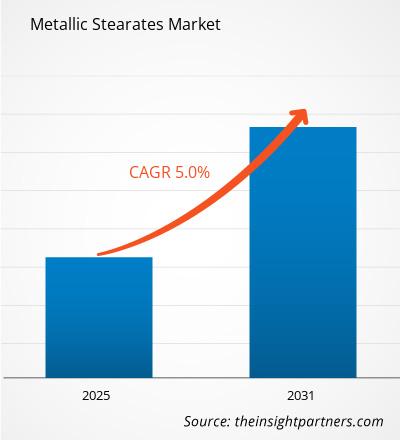
The metallic stearates market was valued at US$ 4.99 Billion in 2025 and is projected to reach US$ 6.68 Billion by 2034, registering a CAGR of 3.29% during 2026–2034. Metallic stearates are widely used as lubricants, release agents, stabilizers, acid scavengers, and hydrophobic additives across polymer processing, pharmaceuticals, rubber, paper, food, and construction industries. Continued industrial production, increasing demand for high-performance additives, and advancements in polymer processing technologies are expected to support sustained market expansion throughout the forecast period.
Driven by mature plastics manufacturing, stringent product quality standards, and growing pharmaceutical production, North America continues to represent a significant regional market. The metallic stearates market size across the region is supported by expanding demand for PVC stabilizers, engineering plastics, specialty rubber compounds, and pharmaceutical excipients. Increasing investments in sustainable polymer additives and advanced manufacturing technologies are expected to help the regional market register a CAGR of 2.9%–3.4% during 2026–2034.
Metallic Stearates Market Assessment and Insights
- North America: Accounted for 29%–31% share in 2025 and is expected to expand at a CAGR of 2.9%–3.4% during 2026–2034. Stable demand from polymer processing, pharmaceuticals, rubber manufacturing, and specialty chemicals continues to support long-term regional consumption.
- US: Represented 74%–77% of the North American market in 2025 and is projected to grow at a CAGR of 3.0%–3.5% during 2026–2034. Strong domestic polymer manufacturing, pharmaceutical production, and construction activities continue driving demand.
- Europe: Held 26%–28% share in 2025 and is anticipated to record a CAGR of 2.8%–3.3% during 2026–2034. Germany, Italy, France, and the UK remain major consumers owing to their advanced plastics, automotive, pharmaceutical, and specialty chemical industries.
- Asia Pacific: Captured 36%–39% share in 2025 and is forecast to witness the highest CAGR of 3.8%–4.4% during 2026–2034. China, India, Japan, and South Korea continue to lead regional demand through expanding polymer production, infrastructure investment, and industrial manufacturing.
- Largest Segment: Polymers accounted for approximately 40%–43% market share in 2025 and is expected to grow at a CAGR of 3.4%–3.8% during 2026–2034, supported by increasing production of PVC, polyolefins, and engineering plastics.
- High Growth Segment: Pharmaceutical represented 13%–16% market share in 2025 and is projected to register a CAGR of 4.3%–4.8% during 2026–2034, driven by increasing pharmaceutical manufacturing and growing demand for tablet lubricants and excipients.
- Key companies analyzed in detail: Baerlocher GmbH, Dover Chemical Corporation, FACI S.p.A., Peter Greven GmbH & Co. KG, Valtris Specialty Chemicals, Norac Additives LLC, James M. Brown Ltd., IRRH Specialty Chemicals Co., Ltd., Akrochem Corporation, and Sun Ace Kakoh (Pte.) Limited.
Source: The Insight Partners' analysis based on proprietary research, government publications, company annual reports, investor presentations, industry databases, and expert interviews.
Industrial development and evolving processing technologies have significantly influenced the metallic stearates market during the past decade. The current thrust by manufacturers is on purity, particle size distribution, thermal stability, and dispersion properties to satisfy application needs in sectors including plastics, pharmaceuticals, rubber, and construction. Advancements in technologies for continuous manufacturing and quality control systems have increased manufacturing efficiency while helping in adhering to strict regulations for environmental and industrial purposes in the developed nations.
Future growth in the market would be aided by rising demand for polymers in developing nations, modernization in pharmaceutical manufacturing, and the development of high-end industrial materials. Regulations emphasizing safe additives, better product consistency, and environmentally friendly manufacturing processes are driving the manufacturers to produce high-end metallic stearates, which are efficient and environmentally friendly. The process of industrialization in Asia Pacific and selected Middle Eastern nations is likely to provide new opportunities for manufacturers.
Metallic Stearates Market Report Scope
| Report Attribute | Details |
|---|---|
| Market size in 2025 | US$ 4.99 Billion |
| Market Size by 2034 | US$ 6.68 Billion |
| Global CAGR (2026 - 2034) | 3.29% |
| Historical Data | 2021-2024 |
| Forecast period | 2026-2034 |
Metallic Stearates Market Analysis
Growing polymer production, pharmaceutical manufacturing, and infrastructure development continue to support the metallic stearates market growth worldwide. The function of metallic stearates in providing lubrication, stabilization, mold release, anti-caking, and water repellent qualities is crucial for many industrial sectors. The rise in the output of PVC goods, engineering polymers, rubber blends, and pharmaceutical tablets has resulted in a higher demand for metallic stearates with the ability to boost efficiency, minimize machine wear, and improve end-product quality.
The chain starts with producers of fatty acids and metal compounds, and ends with those of metallic stearates and compounds, and further industrial customers. Vegetable oil and animal fat-based stearic acid is the key starting materials, while metal compounds are responsible for the resulting performance of the product. Advances in production technologies make it possible to provide high-purity products demanded by modern industries and pharmaceuticals.
Comprehensive metallic stearates market analysis indicates that competition increasingly depends on product quality, application expertise, technical support, and regulatory compliance rather than production volume alone. Baerlocher GmbH, Dover Chemical Corporation, Peter Greven GmbH & Co. KG, FACI S.p.A., and Valtris Specialty Chemicals continue investing in specialty formulations designed for advanced polymer stabilization, pharmaceutical processing, and high-performance industrial applications. Their focus on customized additive solutions strengthens long-term customer relationships across multiple industries.
Expansion strategies now pay more attention to regional production plants, laboratories, and joint product development initiatives with polymer compounders and pharmaceutical companies. Firms like Norac Additives LLC, James M. Brown Ltd., Akrochem Corporation, IRRH Specialty Chemicals Co., Ltd., and Sun Ace Kakoh (Pte.) Limited keeps improving its technical expertise in response to changing customer needs. This enables further innovation in dust-free formula development, pharmaceutical-grade purity, and sustainable manufacturing processes.
● REPORT CUSTOMIZATION
Tailor This Report To Align With Your Specific Business Requirements
This report can be customized to align precisely with your business objectives, scope, and target markets. Customization options include tailored segmentation, geography, competitive analysis, and strategic insights to support informed decision-making.
Customize This Report →WHAT YOU CAN ADJUST
- ● Segmentations
- ● Geography
- ● Competitive Analysis
- ● Language Preferences
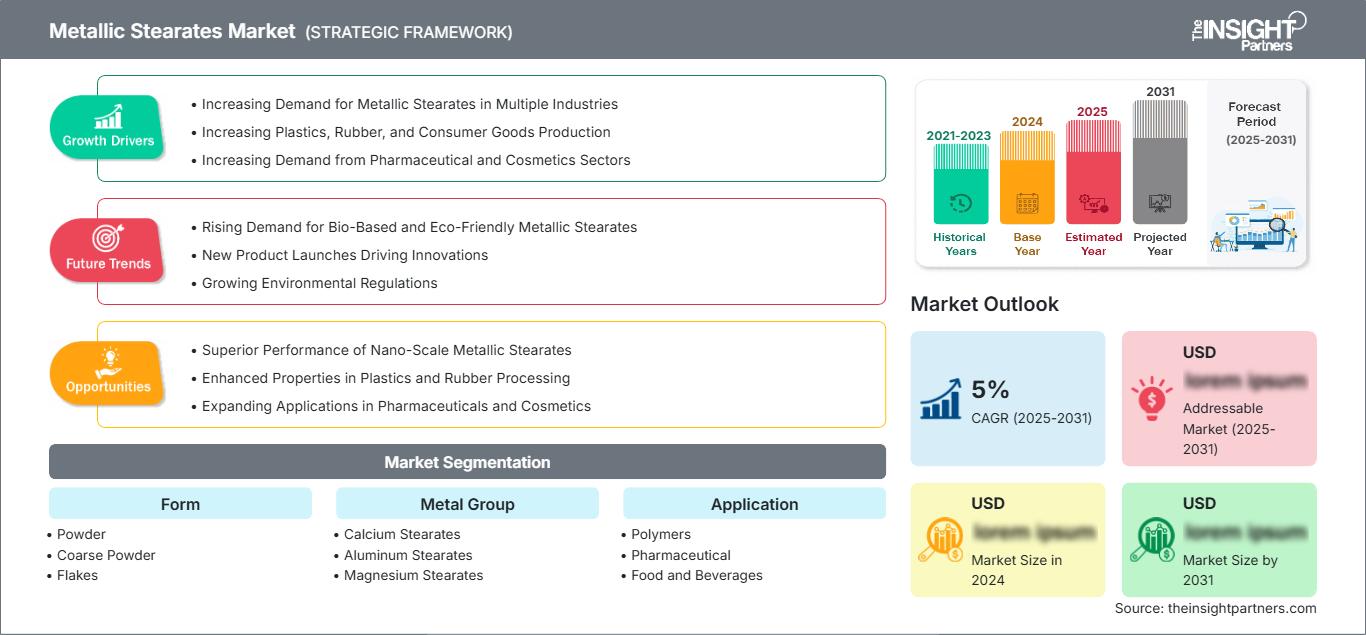
Metallic Stearates Market: Strategic Insights
Regional Insights
North America Metallic Stearates Market
North America accounted for 29%–31% of the global metallic stearates market share in 2025 and is projected to register a CAGR of 2.9%–3.4% during 2026–2034. The region benefits from well-established polymer processing, specialty chemicals, pharmaceutical manufacturing, and construction industries. Demand for the product is driven by the extensive usage of calcium and zinc stearates in the form of lubricants, acid absorbers, and mold release agents for PVC, engineering plastics, and rubber products. Investments in recyclable plastic applications, sustainable additives, and advanced compounding solutions enhance the regional demand for the product.
The United States is the key contributor, while Canada has consistent demand owing to packaging, healthcare, and industrial manufacturing. The role of Mexico is gradually growing for the manufacturing of plastics and automotive components, which increases the demand for metallic stearates in polymer compounding and rubber applications. Increasing production of medical devices and specialized construction materials will further boost the regional demand for the product.
U.S. Metallic Stearates Market
The United States represented 74%–77% of the North American market in 2025 and is expected to expand at a CAGR of 3.0%–3.5% through 2034. Robust domestic production of polymers, pharmaceuticals, rubber products, and construction materials continues to support market demand. Strong regulatory standards encourage manufacturers to adopt high-purity additives that improve product consistency and processing performance across industrial applications.
Amongst these companies are leaders like Dover Chemical Corporation and Norac Additives LLC, which have their manufacturing facilities well supported technologically within the nation. More investment in the areas of PVC processing, medical-grade excipients, engineering plastics, and specialty rubber compounds will continue to open up avenues for improved metallic stearates. Sustainable manufacturing processes and biodegradable materials will contribute to the positive prospects for the American market.
Europe Metallic Stearates Market
Europe held 26%–28% of the global market in 2025 and is forecast to record a CAGR of 2.8%–3.3% during 2026–2034. Germany remains the leading regional market because of its advanced plastics, automotive, and specialty chemicals industries. The UK demonstrates consistent demand from pharmaceutical manufacturing and polymer processing, while France, Italy, and Spain continue supporting consumption through construction materials, packaging, and industrial manufacturing.
Germany holds a solid position due to their continued investments in polymer additives and high-performance industrial materials. The UK enjoys the advantage of having its own pharmaceutical industry and production of specialty chemicals. On the other hand, France, Italy and Spain have considerable contributions with regard to plastics processing, paper manufacturing, ceramics and rubber uses. Local manufacturers focus on developing additive technologies that comply with environmental regulations as well as efficient energy systems.
APAC Metallic Stearates Market
Asia Pacific captured 36%–39% of global demand in 2025 and is projected to expand at a CAGR of 3.8%–4.4% during 2026–2034, making it the fastest-growing regional market. China leads regional consumption, followed by India, Japan, and South Korea due to rapid industrialization, expanding plastics production, and increasing infrastructure development.
Government support for domestic manufacturing, rising polymer production, and increasing pharmaceutical investments continue to strengthen market demand. Australia contributes through mining, construction, and industrial manufacturing, while Southeast Asian economies continue expanding plastics processing capacity, creating additional opportunities for metallic stearate suppliers.
Middle East & Africa Metallic Stearates Market
The Middle East & Africa is expected to register a CAGR of 3.1%–3.6% during 2026–2034. Saudi Arabia remains the largest market because of its petrochemical industry and expanding polymer manufacturing sector, followed by the UAE and South Africa, where construction activities and industrial production continue supporting additive consumption.
Increasing investments in downstream petrochemical production, infrastructure development, and industrial diversification are driving demand for polymer additives across the region. Growth in packaging materials, construction products, and rubber manufacturing is expected to create new opportunities for metallic stearate producers throughout the forecast period.
Segmentation Analysis
Form
The form segment is expected to register a CAGR of 3.2%–3.6% during 2026–2034. Product selection depends on processing requirements, material handling efficiency, storage characteristics, and dispersion performance. Powder remains the preferred form because of its ease of blending, consistent particle distribution, and compatibility with automated manufacturing systems. The metallic stearates market scope continues expanding as manufacturers introduce low-dust and free-flowing formulations that improve workplace safety and processing efficiency.
- Powder – The most widely used form owing to excellent dispersion characteristics, ease of handling, and compatibility with polymer compounding, pharmaceutical production, rubber processing, and construction material manufacturing.
- Coarse Powder – Preferred in applications requiring controlled dispersion and reduced airborne dust generation during processing, particularly within industrial polymer compounding and specialty chemical manufacturing facilities.
- Flakes – Used where improved handling, lower dust formation, and simplified storage are important. Flake products are increasingly adopted in large-scale industrial manufacturing operations.
- Pastilles and Prills – Offer superior flowability and accurate dosing during automated production processes, making them suitable for high-volume polymer, rubber, and specialty chemical manufacturing applications.
- Granules – Increasingly utilized for automated feeding systems because they improve material handling efficiency, reduce product loss, and provide consistent incorporation into industrial formulations.
Metal Group
The metal group segment is projected to grow at a CAGR of 3.3%–3.7% during 2026–2034. Selection depends on lubrication performance, thermal stability, water repellency, and compatibility with end-use formulations. Calcium and zinc stearates account for significant industrial demand because of their versatility across plastics, construction materials, pharmaceuticals, and rubber applications.
- Calcium Stearates – The largest product category due to extensive use as lubricants, acid scavengers, release agents, and water-repellent additives across plastics, construction materials, and rubber manufacturing.
- Aluminum Stearates – Primarily utilized as gelling agents, thickening agents, and waterproofing additives in coatings, lubricants, cosmetics, and specialty industrial formulations.
- Magnesium Stearates – Widely adopted in pharmaceutical tablet manufacturing as an efficient lubricant while also serving specialty applications in cosmetics and polymer processing.
- Zinc Stearates – Extensively used as release agents and processing aids in PVC, rubber, paints, and powder metallurgy because of their excellent lubrication properties.
- Sodium Stearates – Commonly incorporated into detergents, specialty chemicals, personal care products, and selected industrial formulations requiring emulsification and lubrication characteristics.
Application
The application segment is anticipated to expand at a CAGR of 3.3%–3.8% during 2026–2034. Demand continues to be driven by broad industrial adoption across plastics, pharmaceuticals, construction, ceramics, paper, textiles, and rubber manufacturing. Polymer applications dominate because metallic stearates improve processing efficiency, product quality, and production economics across numerous thermoplastic and thermoset materials.
- Polymers – The leading application owing to extensive use in PVC stabilization, engineering plastics, polyolefins, and masterbatch production, where metallic stearates improve lubrication and processing efficiency.
- Pharmaceutical – Demand continues increasing due to the widespread use of magnesium stearate and calcium stearate as tablet lubricants, anti-adherents, and excipients in oral solid dosage manufacturing.
- Food and Beverages – Metallic stearates are utilized in approved processing applications where lubrication, anti-caking performance, and manufacturing efficiency are required under applicable food safety regulations.
- Building and Construction – Used in cement additives, waterproofing materials, construction chemicals, and polymer-based building products to improve durability and moisture resistance.
- Rubber – Supports tire manufacturing, industrial rubber products, seals, and hoses by improving mold release, processing performance, and compound consistency.
- Ceramics – Used as lubricants and processing aids that improve molding efficiency and facilitate uniform material distribution during ceramic manufacturing.
- Textile – Incorporated into specialty textile processing formulations to improve lubrication, finishing quality, and manufacturing efficiency across selected applications.
- Paper – Utilized in paper coatings and specialty formulations to improve surface characteristics, water resistance, and process performance during paper manufacturing.
Opportunity Snapshot
| Application | Revenue Contribution | Trend Tag | Adoption Stage |
|---|---|---|---|
| Polymers | High | PVC Stabilizers | Mature |
| Pharmaceutical | Medium | Tablet Excipients | Scaling |
| Food and Beverages | Low | Processing Aids | Mature |
| Building and Construction | Medium | Waterproofing | Scaling |
| Rubber | Medium | Tire Compounding | Mature |
| Ceramics | Low | Mold Release | Emerging |
| Textile | Low | Fiber Finishing | Emerging |
| Paper | Low | Surface Coating | Scaling |
Metallic Stearates Market Growth Drivers and Impact Analysis
Rising polymer production strengthens demand for processing additives
The constant growth in the production of polymers continues to be the major driver that ensures the demand for metallic stearates globally. Producers of PVC, polyethylene, polypropylene, engineering plastics, and masterbatch find the use of calcium stearates and zinc stearates essential in enhancing lubricity, melt flow, release from molds, and stability during their production process. Other factors that increase the demand for metallic stearates include the rise in packaging, automobile parts, electric appliances, pipes, cables, and consumer goods. The investment in advanced compound technologies in industries has led to the increased demand for metallic stearates to enhance efficiency without causing wear in machinery.
Growth in pharmaceutical manufacturing increases excipient consumption
Expanding pharmaceutical production is creating sustained demand for high-purity magnesium and calcium stearates used as tablet lubricants and anti-adherents. Increasing healthcare expenditure, aging populations, and higher production of generic medicines continue to support excipient consumption globally. Pharmaceutical manufacturers require metallic stearates that comply with pharmacopeial specifications while maintaining excellent flowability and formulation consistency. Investments in modern tablet manufacturing facilities and continuous manufacturing technologies are encouraging suppliers to develop pharmaceutical-grade products with improved purity and traceability. These developments are expected to strengthen long-term demand from both established pharmaceutical producers and rapidly expanding contract manufacturing organizations.
Infrastructure development supports construction and industrial applications
Large-scale investments in commercial buildings, transportation infrastructure, water management systems, and industrial facilities continue to increase demand for construction materials containing metallic stearates. Calcium stearates are widely incorporated into cementitious products, waterproofing compounds, and concrete additives because of their moisture-resistant characteristics. Growth in urbanization across developing economies is also increasing demand for polymer-based construction products, cables, insulation materials, and engineered building components. Simultaneously, industrial expansion supports greater consumption across rubber, ceramics, paper, and specialty chemical manufacturing. These combined factors are expected to provide stable demand for metallic stearates throughout the forecast period despite moderate overall market growth.
Metallic Stearates Market Future Trends
Development of sustainable and bio-based additive technologies
The metallic stearates market trends increasingly reflect the industry's transition toward environmentally responsible production and renewable raw materials. Manufacturers are investing in bio-based stearic acid feedstocks, energy-efficient manufacturing processes, and lower-emission production technologies to comply with evolving environmental regulations. Customers across the polymer, pharmaceutical, and construction industries are also demanding additives that support product sustainability without compromising processing performance. Future product development is therefore expected to focus on improved purity, enhanced dispersion characteristics, and reduced environmental impact while maintaining compatibility with advanced polymer processing technologies and circular economy initiatives.
Greater emphasis on customized application-specific formulations
End users increasingly require metallic stearates tailored to specific manufacturing processes and performance requirements. Producers are responding by developing customized particle sizes, optimized surface characteristics, and application-specific formulations for polymers, pharmaceuticals, construction materials, and specialty chemicals. Digital quality monitoring and process automation are also improving manufacturing consistency and enabling tighter product specifications. These developments are expected to strengthen collaboration between additive suppliers and downstream manufacturers while encouraging greater innovation in specialty metallic stearate products designed for demanding industrial applications.
Metallic Stearates Market Opportunities
Expansion of specialty additive production in emerging economies
The metallic stearates market Forecasts indicate growing investment opportunities across Southeast Asia, India, the Middle East, and selected African economies where polymer production and industrial manufacturing continue expanding. International manufacturers can strengthen regional competitiveness by establishing local production facilities, expanding distribution networks, and collaborating with domestic polymer compounders and pharmaceutical producers. Regional manufacturing not only reduces logistics costs but also improves supply reliability and customer responsiveness. Companies capable of delivering technical support and customized formulations are expected to gain competitive advantages as industrial production capacity continues to increase across developing markets.
Innovation in high-purity pharmaceutical and food-grade products
Manufacturers have significant opportunities to expand their portfolios of pharmaceutical- and food-grade metallic stearates as regulatory requirements continue becoming more stringent worldwide. Investment in advanced purification technologies, enhanced quality assurance systems, and internationally recognized certifications will enable suppliers to address the increasing demand for premium excipients and processing additives. Strategic collaboration with pharmaceutical companies, food ingredient manufacturers, and contract development organizations can accelerate product commercialization while strengthening long-term customer relationships. Companies focusing on traceability, regulatory compliance, and consistent product quality are expected to capture higher-value opportunities across regulated end-use industries.
Recent Developments
- June 2026: The Baerlocher Group announced a significant organisational restructuring within the Group. The operational business of the current Baerlocher GmbH will be transferred to an independent entity. This company will operate as Baerlocher Germany GmbH & Co. KG and will be responsible for business in Europe. It is a wholly owned subsidiary of Baerlocher GmbH, which will focus on its holding function.
- September 2024: Valtris Specialty Chemicals and the Transfar Group announced further developments in their continued partnership. After the announcement in April 2024 of an exclusive technology license from Valtris Specialty Chemicals to Transfar Huayang in phenol-free over-based barium stabilisers, both parties have proceeded successfully in the first steps of bringing the technology into the Asian market.
Frequently Asked Questions

- Comprehensive Market Sizing and Forecast Analysis
- Detailed Segmentation Analysis
- In-Depth Market Dynamics Assessment
- Regional and Country-Level Insights
- Competitive Landscape and Company Benchmarking
- Strategic Business Intelligence
Recent Reports
Testimonials

The Insight Partners' SCADA System Market report is comprehensive, with valuable insights on current trends and future forecasts. The team was highly professional, responsive, and supportive throughout. We are very satisfied and highly recommend their services.
RAN KEDEM Partner, Reali Technologies LTDs
I requested a report on a very specific software market and the team produced the report in a few days. The information was very relevant and well presented. I then requested some changes and additions to the report. The team was again very responsive and I got the final report in less than a week.
JEAN-HERVE JENN Chairman, Future Analytica
We worked with The Insight Partners for an important market study and forecast. They gave us clear insights into opportunities and risks, which helped shape our plans. Their research was easy to use and based on solid data. It helped us make smart, confident decisions. We highly recommend them.
PIYUSH NAGPAL Sr. Vice President, High Beam Global
The Insight Partners delivered insightful, well-structured market research with strong domain expertise. Their team was professional and responsive throughout. The user-friendly website made accessing industry reports seamless. We highly recommend them for reliable, high-quality research services
YUKIHIKO ADACHI CEO, Deep Blue, LLC.
This is the first time I have purchased a market report from The Insight Partners.While I was unsure at first, I visited their web site and felt more comfortable to take the risk and purchase a market report.I am completely satisfied with the quality of the report and customer service. I had several questions and comments with the initial report, but after a couple of dialogs over email with their analyst I believe I have a report that I can use as input to our strategic planning process.Thank you so much for taking the extra time and making this a positive experience.I will definitely recommend your service to others and you will be my first call when we need further market data.
JOHN SUZUKI President and Chief Executive Officer, Board Director, BK Technologies
I wish to appreciate your support and the professionalism you displayed in the course of attending to my request for information regarding to infectious disease IVD market in Nigeria. I appreciate your patience, your guidance, and the fact that you were willing to offer a discount, which eventually made it possible for us to close a deal. I look forward to engaging The Insight Partners in the future, all thanks to the impression you have created in me as a result of this first encounter.
DR CHIJIOKE ONYIA MANAGING DIRECTOR, PineCrest Healthcare Ltd.Reason to Buy
- Informed Decision-Making
- Understanding Market Dynamics
- Competitive Analysis
- Identifying Emerging Markets
- Customer Insights
- Market Forecasts
- Risk Mitigation
- Boosting Operational Efficiency
- Strategic Planning
- Investment Justification
- Tracking Industry Innovations
- Aligning with Regulatory Trends





 Get Free Sample for