
Microfiltration Membranes Market Trends, Size & Growth by 2034
Microfiltration Membranes Market Size and Forecasts (2021 - 2034), Global and Regional Share, Trends, and Growth Opportunity Analysis Report Coverage : by Type (Fluorinated Polymers, Cellulosic, Polysulfones, Ceramic); Filtration Mode (Cross Flow and Direct Flow); Application (Water Treatment, Biopharmaceutical Processing, Food and Beverages, Chemical); and Geography (North America, Europe, Asia Pacific, and South and Central America)
- Status : Data Released
- Report Code : TIPRE00040288
- Category : Chemicals and Materials
- No. of Pages : 150
- Available Report Formats :


- Last update date : August 06, 2026


2025 Market Size
US$ 1.58 Bn
Base year value
2034 Forecast
US$ 3.29 Bn
Projected by 2034
CAGR 2026-2034
8.53 %
Growth rate
Addressable Market
US$ 21.89 Bn
(2026-2034)
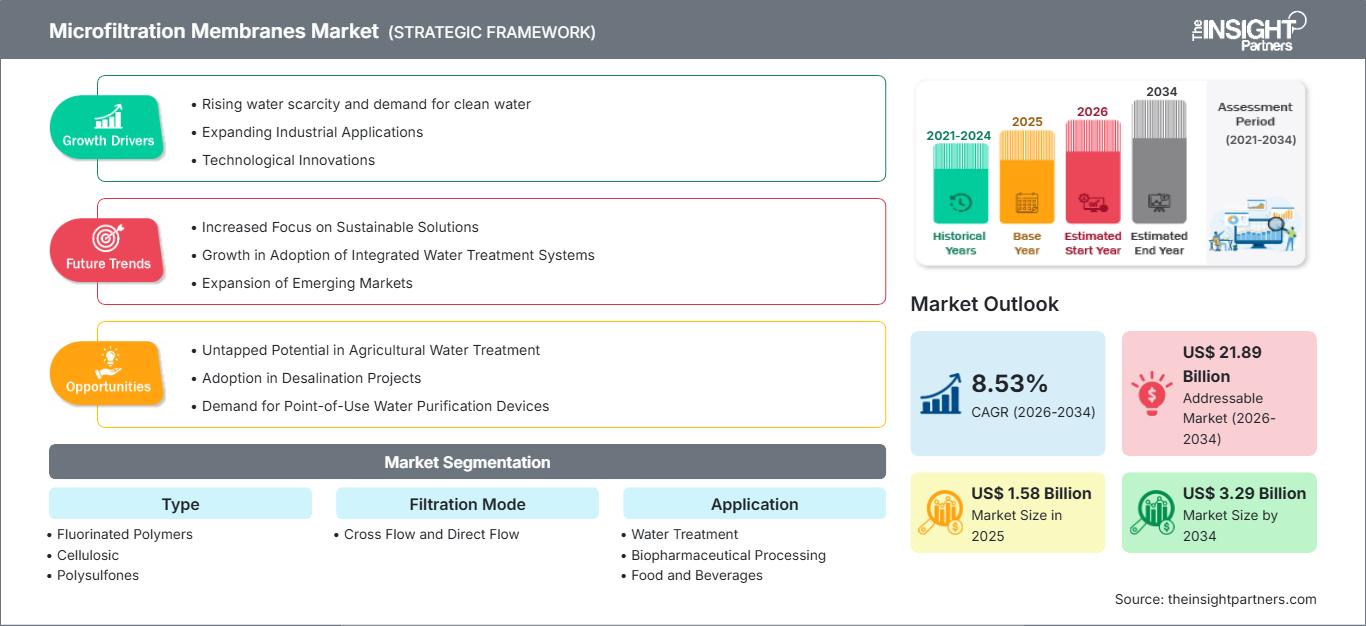
The microfiltration membranes market is estimated to be worth US$ 1.58 Billion in 2025 and is set to achieve US$ 3.29 Billion by 2034, growing at a CAGR of 8.53%. The market is experiencing healthy growth due to increasing demand for separation technology in water treatments, biopharmaceuticals, food processing, and industrial filtration applications. Innovation in membranes, membrane modules, and processes is aiding in increased adoption in both developed and developing markets.
Continuous investments in municipal water management facilities and pharmaceutical production facilities have helped North America maintain its stronghold in advanced membrane technology. Microfiltration membranes market size in North America is growing due to increasing adoption of high-performance filtration systems amid increasing demands for water quality, product purity, and regulation. High capital investments in wastewater reclamation and biologics production would help in achieving a regional CAGR of 8.0% to 8.6%.
Microfiltration Membranes Market Assessment and Insights
- North America: North America accounted for 31%–34% Microfiltration Membranes Market share in 2025 and is projected to register a CAGR of 8.0%–8.6% during 2026–2034. Strong investments in municipal water treatment, pharmaceutical manufacturing, and industrial process filtration continue supporting regional market expansion.
- U.S.: The U.S. represented 75%–79% of the North American market in 2025 and is expected to expand at a CAGR of 8.1%–8.7% during 2026–2034, supported by stringent environmental regulations and advanced biopharmaceutical manufacturing capacity.
- Europe: Europe captured 26%–29% share in 2025 and is anticipated to grow at a CAGR of 7.9%–8.5% during 2026–2034. Germany, France, the UK, and Italy remain major contributors owing to advanced industrial filtration and wastewater treatment infrastructure.
- Asia Pacific: Asia Pacific held 32%–35% share in 2025 and is forecast to register the fastest CAGR of 9.1%–9.7% during 2026–2034. China, Japan, South Korea, India, and Australia continue investing in industrial water treatment and life sciences manufacturing.
- Largest Segment: Application – Water Treatment accounted for 41%–45% market share in 2025 and is projected to grow at a CAGR of 8.4%–9.0% during 2026–2034, supported by increasing investments in potable water production and wastewater reuse.
- High Growth Segment: Application – Biopharmaceutical Processing represented 21%–25% share in 2025 and is expected to expand at a CAGR of 9.6%–10.2% during 2026–2034, driven by rising biologics production and sterile filtration requirements.
- Key companies analyzed in detail: Merck KGaA, Veolia, 3M Company, United Envirotech Ltd., Koch Separation Solutions, Pall Corporation, Asahi Kasei Corporation, Parker-Hannifin Corporation, Pentair plc, and Synder Filtration, Inc.
Source: The Insight Partners' analysis based on proprietary research, government publications, company annual reports, investor presentations, industry databases, and expert interviews.
There has been a lot of advancement in microfiltration membranes through developments in polymer science, ceramics membranes, and the design of modules. Membranes which have more fouling resistance and higher efficiency in permeability and durability are being developed by manufacturers for improved performance of industrial processes. Innovations in the design of hollow fiber, flat sheets, and tubular membranes have helped in expanding the range of applications of these membranes into water purification, pharmaceutical manufacturing, food processing, and specialty chemicals manufacturing.
Market growth in future would be achieved through increased spending on wastewater treatment, biologic manufacturing, and industrial sustainability. Water conservation policies, discharge regulations, and increased use of membranes in separation would help in accelerating commercial success in the market. There will continue to be innovations in ceramic membranes, surface modification, and efficient membranes for filtration.
Microfiltration Membranes Market Report Scope
| Report Attribute | Details |
|---|---|
| Market size in 2025 | US$ 1.58 Billion |
| Market Size by 2034 | US$ 3.29 Billion |
| Global CAGR (2026 - 2034) | 8.53% |
| Historical Data | 2021-2024 |
| Forecast period | 2026-2034 |
Microfiltration Membranes Market Analysis
Rising demands for high-quality water production, biologic products manufacturing, and sustainable industrial processes are driving the expansion of the microfiltration membranes market in various end-user industries. Microfiltration membranes allow for the effective removal of suspended solids, bacteria, yeasts, and other particulates while providing lower operating pressure in comparison with some other separation methods. Rising investments in municipal wastewater reuse, pharmaceutical production, milk processing, and industrial process optimization are creating a growing demand for membrane filtration systems that could help to increase the efficiency and comply with regulations.
The microfiltration membranes market includes membrane materials producers, modules manufacturers, filtration systems providers, engineering contractors, distributors, and end-users in municipal, industrial, food & beverage, and healthcare industries. Collaboration between membrane manufacturers, equipment producers, and automation providers is constantly increasing the efficiency of membrane systems and reducing maintenance needs. Circularity and resource efficiency are becoming increasingly important for water management.
The level of competitive rivalry in the microfiltration membranes market analysis is getting stronger since industry giants keep developing their product lines using innovations, acquisitions, and capacities enhancement. Merck KGaA, Pall Corporation, Koch Separation Solutions, Veolia, Asahi Kasei Corporation, and Pentair plc keep working on developing highly efficient membranes for pharmaceutical, water purification and other industrial applications. Parker-Hannifin Corporation, 3M Company, United Envirotech Ltd. and Synder Filtration, Inc. enhance their presence in the market through developing specialized filtration solutions and membrane engineering.
Trends in investment now include development of low fouling membrane materials, digital monitoring systems, automated cleaning systems and energy-saving filtration platforms. The capacities of the manufacturers are being expanded throughout Asia-Pacific while their capabilities for research and development are improving in North America and Europe. Use of artificial intelligence in process monitoring and predictive maintenance as well as membrane materials is expected to result in enhanced efficiency and lower costs.
● REPORT CUSTOMIZATION
Tailor This Report To Align With Your Specific Business Requirements
This report can be customized to align precisely with your business objectives, scope, and target markets. Customization options include tailored segmentation, geography, competitive analysis, and strategic insights to support informed decision-making.
Customize This Report →WHAT YOU CAN ADJUST
- ● Segmentations
- ● Geography
- ● Competitive Analysis
- ● Language Preferences
Microfiltration Membranes Market: Strategic Insights
Regional Insights
North America Microfiltration Membranes Market
North America had a market share of 31%–34% in 2025 and is predicted to record a CAGR of 8.0%–8.6% during 2026–2034. The region has a developed water infrastructure and strict environmental laws from the US Environmental Protection Agency, along with consistent capital investment in the pharmaceutical industry. Growing adoption of membrane water recovery systems in municipalities and industries will drive equipment replacement and growth. The microfiltration membrane market share holds the largest share among the developed regions due to extensive application in drinking water purification, dairy processing, biotech applications, and semiconductor manufacturing.
The US and Canada have been increasing investment in decentralized water treatment, industrial water recycling, and advanced biologic production facilities. Growing demand for purified process water from electronic production industries, along with federal investment for wastewater upgrades, drives the market forward. Membrane companies have been developing digital monitoring systems that enhance the filtration process and reduce energy usage and maintenance costs in industrial filtration systems.
U.S. Microfiltration Membranes Market
The United States had 75%-79% of the North American market in 2025 and is expected to grow at a rate of 8.1%-8.7% CAGR between 2026 and 2034. Robust investments in drug formulation, manufacturing of biologics, municipal wastewater treatment, and food processing ensure continued adoption of membrane filtration technology. Regulatory emphasis on water reuse, contamination prevention, and product quality has fueled membrane replacement in several industries.
Industry leaders such as Pall Corporation, Merck KGaA, Parker-Hannifin Corporation, Koch Separation Solutions, and 3M Company have substantial manufacturing, R&D, and service facilities in the region. Biopharmaceutical manufacturing is one of the most rapidly expanding applications due to the need for sterile filtration and clarification processes. Other areas driving the demand are semiconductor manufacturing, beverages processing, and industrial wastewater recycling due to increased efficiency along with decreased water use and chemical use.
Europe Microfiltration Membranes Market
Europe was responsible for 26% to 29% of the total market in 2025 and is expected to exhibit a CAGR of 7.9% to 8.5% during 2026-2034. Germany is at the forefront in the region due to its sophisticated pharmaceutical manufacturing capability, industrial water treatment, and engineering skills. The constant emphasis on sustainable manufacturing and circular water management drives increased installation of membranes in the municipal and industrial markets.
UK is continuously growing in terms of advanced wastewater recycling technologies and increased investments in life sciences manufacturing and food processing technologies. Germany is also leading in membrane engineering, industrial filtration equipment, and pharmaceutical process equipment. France, Italy, and Spain together boost the demand in the region by contributing in food processing, winemaking, specialty chemical, and municipal modernization. The implementation of stricter EU water quality norms and industrial discharge norms keeps driving the adoption of high-end membrane filtration systems.
APAC Microfiltration Membranes Market
Asia Pacific held 32%–35% of the global market in 2025 and is anticipated to register the highest CAGR of 9.1%–9.7% during 2026–2034. China leads regional demand, followed by Japan, South Korea, India, and Australia, supported by rapid industrialization, expanding pharmaceutical production, and increasing investment in municipal water treatment infrastructure.
Government initiatives promoting wastewater recycling, industrial water conservation, and environmental compliance continue encouraging membrane adoption throughout the region. Growing investments in biotechnology, electronics manufacturing, and food processing further strengthen long-term demand for advanced microfiltration systems capable of delivering reliable process performance and improved resource efficiency.
Middle East & Africa Microfiltration Membranes Market
The Middle East & Africa market is projected to expand at a CAGR of 8.4%–9.0% during 2026–2034. Saudi Arabia leads regional adoption through significant desalination, industrial water treatment, and wastewater reuse investments, while the United Arab Emirates continues expanding advanced municipal water infrastructure to improve long-term water security.
South Africa remains an important market owing to mining, food processing, and municipal water treatment requirements. Growing investments in industrial diversification, sustainable water management, and environmental infrastructure across the Rest of MEA are expected to increase deployment of advanced membrane filtration technologies throughout the forecast period.
Segmentation Analysis
Type
The Type segment is expected to register a CAGR of 8.3%–8.9% during 2026–2034. Material selection significantly influences filtration efficiency, chemical resistance, operating temperature, durability, and maintenance requirements. The microfiltration membranes market scope continues to expand as manufacturers develop advanced polymeric and ceramic membranes that deliver improved permeability, lower fouling rates, and longer service life for demanding industrial, pharmaceutical, and water treatment applications.
- Fluorinated Polymers – Widely adopted for aggressive chemical environments due to their excellent chemical resistance, thermal stability, and long operational life. They are extensively used in pharmaceutical manufacturing, electronics, and specialty chemical processing where high purity is essential.
- Cellulosic – Preferred for laboratory filtration, beverage clarification, and selected pharmaceutical applications because of their hydrophilic properties, low protein binding, and cost-effective performance in moderate operating environments requiring reliable particulate removal.
- Polysulfones – Among the most extensively used membrane materials owing to their excellent mechanical strength, broad chemical compatibility, and resistance to microbial contamination. They are widely utilized across water treatment and biopharmaceutical processing facilities.
- Ceramic – Increasingly adopted for high-temperature, abrasive, and chemically aggressive industrial applications. Superior durability, extended service life, and resistance to membrane fouling make ceramic membranes attractive for demanding industrial separation processes.
Filtration Mode
The Filtration Mode segment is anticipated to expand at a CAGR of 8.5%–9.1% during 2026–2034. Selection of filtration mode depends on feed characteristics, recovery efficiency, fouling tendencies, and operational costs. Technological improvements in membrane module design and automated cleaning systems continue improving process efficiency while minimizing downtime across industrial and municipal filtration facilities.
- Cross Flow – Dominates industrial installations because continuous tangential flow minimizes membrane fouling, extends membrane lifespan, and supports consistent filtration performance during large-scale pharmaceutical, food processing, and wastewater treatment operations.
- Direct Flow – Commonly used for applications involving relatively low suspended solids and smaller batch processing requirements. The configuration provides operational simplicity, lower capital investment, and effective particulate removal for laboratory and selected industrial applications.
Application
The Application segment is projected to record a CAGR of 8.8%–9.4% during 2026–2034. Expanding demand for clean water, biologics manufacturing, food safety, and industrial process optimization continues driving membrane adoption across diverse industries. Continuous improvements in membrane performance and regulatory compliance further support long-term market expansion.
- Water Treatment – Represents the largest application due to increasing investments in drinking water purification, wastewater reuse, desalination pretreatment, and industrial water recycling. Membrane technologies improve water quality while reducing chemical consumption and operational costs.
- Biopharmaceutical Processing – Experiencing the fastest expansion as biologics manufacturing, vaccine production, and sterile filtration requirements continue increasing globally. High-purity separation and contamination control remain critical throughout pharmaceutical manufacturing processes.
- Food and Beverages – Used extensively for beverage clarification, dairy processing, microbial stabilization, and ingredient purification. Membrane filtration improves product quality, extends shelf life, and supports compliance with increasingly stringent food safety standards.
- Chemical – Supports separation, catalyst recovery, process water treatment, and product purification across specialty chemicals and industrial manufacturing. Improved chemical compatibility and process efficiency continue strengthening membrane adoption within the chemical industry.
Opportunity Snapshot
| Application | Revenue Contribution | Trend Tag | Adoption Stage |
|---|---|---|---|
| Water Treatment | High | Water Reuse | Mature |
| Biopharmaceutical Processing | High | Biologics | Scaling |
| Food and Beverages | Medium | Beverage Purification | Mature |
| Chemical | Medium | Process Recovery | Scaling |
Microfiltration Membranes Market Growth Drivers and Impact Analysis
Stringent Water Quality Regulations and Wastewater Reuse Initiatives
Governments worldwide continue implementing stricter regulations governing drinking water quality, industrial wastewater discharge, and environmental sustainability. Organizations such as the World Health Organization and national environmental agencies increasingly encourage advanced membrane technologies to improve water treatment efficiency while reducing contaminants. Municipal utilities and industrial facilities are investing in modern filtration infrastructure to support water reuse, reduce freshwater consumption, and comply with evolving environmental standards. These investments continue creating sustained demand for high-performance microfiltration membranes capable of delivering reliable separation efficiency, lower operating costs, and long operational life across municipal, industrial, and commercial water treatment facilities.
Expansion of Global Biopharmaceutical Manufacturing Capacity
Rapid growth in biologics, biosimilars, vaccines, and cell therapy manufacturing has significantly increased demand for sterile filtration technologies. Microfiltration membranes are essential for clarification, microbial removal, media filtration, and product purification throughout pharmaceutical production. Increasing investment in biomanufacturing facilities across North America, Europe, and Asia Pacific is accelerating deployment of advanced membrane systems capable of maintaining product quality while meeting stringent regulatory requirements. Continued expansion of pharmaceutical production capacity is expected to generate sustained demand for high-performance membrane technologies throughout the forecast period.
Increasing Industrial Demand for Energy-Efficient Separation Technologies
Industries are replacing conventional filtration methods with membrane-based separation systems to reduce energy consumption, improve process efficiency, and minimize chemical usage. Food processing, specialty chemicals, electronics manufacturing, and mining increasingly rely on microfiltration technologies for product recovery, wastewater recycling, and process optimization. Continuous innovation in membrane materials, module configurations, and automated cleaning technologies enables higher throughput while lowering maintenance requirements. These operational advantages continue strengthening market adoption across diverse industrial sectors seeking sustainable and cost-effective filtration solutions.
Microfiltration Membranes Market Future Trends
Development of Sustainable and High-Performance Membrane Materials
Growing emphasis on sustainability is encouraging manufacturers to develop recyclable, low-fouling, and energy-efficient membrane materials with extended service life. Microfiltration membranes market trends indicate increasing investment in ceramic membranes, advanced fluoropolymers, and surface-modified polymeric membranes that improve permeability while reducing cleaning frequency. Research institutions and membrane manufacturers are also focusing on nanostructured coatings and bio-inspired membrane surfaces to enhance contaminant removal efficiency. These innovations are expected to lower lifecycle costs, improve operational reliability, and support wider adoption across water treatment, pharmaceutical manufacturing, food processing, and industrial separation applications over the coming decade.
Integration of Smart Filtration and Digital Process Monitoring
Digital transformation is reshaping industrial filtration systems through the integration of sensors, artificial intelligence, and predictive maintenance platforms. Advanced monitoring solutions enable continuous assessment of membrane fouling, pressure differentials, flow rates, and filtration efficiency, allowing operators to optimize system performance in real time. Automated cleaning schedules and predictive diagnostics reduce operational downtime while extending membrane lifespan. As Industry 4.0 adoption accelerates across water utilities, pharmaceutical manufacturing, and food processing facilities, intelligent membrane systems are expected to become an increasingly important competitive differentiator for technology providers.
Microfiltration Membranes Market Opportunities
Expansion of Water Reuse and Industrial Recycling Infrastructure
Governments and industrial operators are increasingly investing in wastewater recycling and circular water management to address freshwater scarcity and regulatory compliance. Microfiltration membranes market Forecasts indicate significant opportunities for manufacturers supplying advanced membrane modules for municipal treatment plants, industrial water recycling facilities, and decentralized treatment systems. Rapid urbanization, stricter discharge regulations, and growing investment in sustainable infrastructure across Asia Pacific, the Middle East, and Latin America are expected to support long-term equipment demand. Companies capable of offering integrated filtration systems, digital monitoring platforms, and lower lifecycle operating costs will be well positioned to secure large-scale infrastructure projects and long-term service agreements.
Rising Demand from Biologics and Advanced Pharmaceutical Manufacturing
The continued expansion of biologics, vaccines, plasma-derived therapies, and cell and gene therapy manufacturing presents substantial opportunities for membrane technology suppliers. Pharmaceutical manufacturers increasingly require highly reliable sterile filtration systems capable of maintaining product purity while supporting large-scale commercial production. Investment in single-use manufacturing technologies and flexible production facilities is also increasing demand for advanced microfiltration solutions. Companies developing membranes with improved protein recovery, higher throughput, and enhanced contamination control capabilities are expected to benefit from expanding pharmaceutical manufacturing capacity across North America, Europe, and Asia Pacific.
Recent Developments
- May 2026: Cerafiltec announced the reactivation and strengthening of its strategic partnership with Korea-based SI Membranes, Inc., marking an important milestone in the company’s continued growth and expansion across the Asian market. As part of the renewed collaboration, SI Membranes, Inc. has invested in Cerafiltec’s test and piloting equipment, demonstrating strong confidence in Cerafiltec’s advanced ceramic membrane technology and reaffirming its long-term commitment to joint business development. This enhanced cooperation establishes a stronger and more structured foundation for both companies to accelerate market growth and business opportunities in Korea.
- April 2026: Ion Exchange (India) Ltd, a leading provider of total water and environment management solutions globally, and MANN+HUMMEL, a world leader in filtration technology and intelligent separation solutions, announced a strategic technology transfer and manufacturing collaboration for the production of advanced PVDF Ultrafiltration (UF) membranes with integrated UltraSKID systems, and subsequently a strategic technology transfer of Membrane Bio Reactor (MBR) solutions to India.
Frequently Asked Questions

- Comprehensive Market Sizing and Forecast Analysis
- Detailed Segmentation Analysis
- In-Depth Market Dynamics Assessment
- Regional and Country-Level Insights
- Competitive Landscape and Company Benchmarking
- Strategic Business Intelligence
Recent Reports
Testimonials

The Insight Partners' SCADA System Market report is comprehensive, with valuable insights on current trends and future forecasts. The team was highly professional, responsive, and supportive throughout. We are very satisfied and highly recommend their services.
RAN KEDEM Partner, Reali Technologies LTDs
I requested a report on a very specific software market and the team produced the report in a few days. The information was very relevant and well presented. I then requested some changes and additions to the report. The team was again very responsive and I got the final report in less than a week.
JEAN-HERVE JENN Chairman, Future Analytica
We worked with The Insight Partners for an important market study and forecast. They gave us clear insights into opportunities and risks, which helped shape our plans. Their research was easy to use and based on solid data. It helped us make smart, confident decisions. We highly recommend them.
PIYUSH NAGPAL Sr. Vice President, High Beam Global
The Insight Partners delivered insightful, well-structured market research with strong domain expertise. Their team was professional and responsive throughout. The user-friendly website made accessing industry reports seamless. We highly recommend them for reliable, high-quality research services
YUKIHIKO ADACHI CEO, Deep Blue, LLC.
This is the first time I have purchased a market report from The Insight Partners.While I was unsure at first, I visited their web site and felt more comfortable to take the risk and purchase a market report.I am completely satisfied with the quality of the report and customer service. I had several questions and comments with the initial report, but after a couple of dialogs over email with their analyst I believe I have a report that I can use as input to our strategic planning process.Thank you so much for taking the extra time and making this a positive experience.I will definitely recommend your service to others and you will be my first call when we need further market data.
JOHN SUZUKI President and Chief Executive Officer, Board Director, BK Technologies
I wish to appreciate your support and the professionalism you displayed in the course of attending to my request for information regarding to infectious disease IVD market in Nigeria. I appreciate your patience, your guidance, and the fact that you were willing to offer a discount, which eventually made it possible for us to close a deal. I look forward to engaging The Insight Partners in the future, all thanks to the impression you have created in me as a result of this first encounter.
DR CHIJIOKE ONYIA MANAGING DIRECTOR, PineCrest Healthcare Ltd.Reason to Buy
- Informed Decision-Making
- Understanding Market Dynamics
- Competitive Analysis
- Identifying Emerging Markets
- Customer Insights
- Market Forecasts
- Risk Mitigation
- Boosting Operational Efficiency
- Strategic Planning
- Investment Justification
- Tracking Industry Innovations
- Aligning with Regulatory Trends





 Get Free Sample for