
Methyl Diphenyl Diisocyanate Market Trends, Demand & Growth by 2034
Coverage: By Form (Pure MDI, Polymeric MDI); Application (Polyurethane products, Elastomers, Binders, Rigid foams, Polyurethane foams, Others) , and Geography (North America, Europe, Asia Pacific, and South and Central America)
- Status : Data Released
- Report Code : TIPRE00024142
- Category : Chemicals and Materials
- No. of Pages : 150
- Available Report Formats :


- Last update date : August 13, 2026


2025 Market Size
US$ 28.9 Bn
Base year value
2034 Forecast
US$ 47.47 Bn
Projected by 2034
CAGR 2026-2034
5.67 %
Growth rate
Addressable Market
US$ 346.17 Bn
(2026-2034)
The methyl diphenyl diisocyanate market was valued at US$ 28.9 Billion in 2025 and is projected to reach US$ 47.47 Billion by 2034, registering a CAGR of 5.67% during 2026–2034. Growing consumption of polyurethane materials across construction, automotive, electronics, appliances, refrigeration, and industrial manufacturing continues to strengthen demand. Expanding investments in energy-efficient insulation, lightweight mobility solutions, and advanced polymer technologies are supporting production capacity additions while reinforcing long-term market expansion across both developed and emerging economies.
Across North America, the methyl diphenyl diisocyanate market size continues to benefit from rising investments in residential renovation, commercial construction, and energy-efficient insulation systems. The regional market is expected to expand at a CAGR ranging between 5.1% and 5.6% during 2026–2034, supported by stringent building efficiency regulations, increasing polyurethane consumption in automotive manufacturing, and ongoing modernization of cold-chain infrastructure throughout the United States and Canada.
Methyl Diphenyl Diisocyanate Market Assessment and Insights
- North America: Accounted for 33–36% share in 2025 and is anticipated to expand at a CAGR of 5.1–5.6% during 2026–2034, supported by strong construction activity, established polyurethane manufacturing, and growing investments in energy-efficient buildings.
- U.S.: Represented 79–82% of the North American market in 2025 and is projected to grow at a CAGR of 5.2–5.7% during 2026–2034, driven by automotive production, insulation demand, and advanced industrial manufacturing.
- Europe: Held 24–27% share in 2025 and is forecast to register a CAGR of 4.9–5.4% during 2026–2034. Germany, France, Italy, and the UK remain leading consumers owing to mature automotive, construction, and industrial sectors.
- Asia Pacific: Captured 31–34% share in 2025 and is expected to witness the highest CAGR of 6.2–6.8% during 2026–2034, led by China, India, Japan, and South Korea through expanding manufacturing and infrastructure investments.
- Largest Segment: Polyurethane products accounted for 40–44% market share in 2025 and are anticipated to expand at a CAGR of 5.8–6.2% during 2026–2034, supported by broad industrial applications and sustainable construction initiatives.
- High Growth Segment: Rigid foams represented 21–24% market share in 2025 and are projected to grow at a CAGR of 6.4–6.9% during 2026–2034, owing to rising adoption in refrigeration, cold storage, and high-performance insulation.
- Key companies analyzed in detail: Dow Inc., Covestro AG, BASF SE, DuPont de Nemours, Inc., Sumitomo Chemical Co., Ltd., Merck KGaA, Wanhua Chemical Group Co., Ltd., Tokyo Chemical Industry Co., Ltd. (TCI), Dhalop Chemicals, Jilin Connell Chemical Industry Co., Ltd.
Source: The Insight Partners' analysis based on proprietary research, government publications, company annual reports, investor presentations, industry databases, and expert interviews.
The development of the methyl diphenyl diisocyanate industry has been characterized by developments in polyurethane chemistry and manufacturing efficiency and environmental compliance. Contemporary production techniques are designed to be highly efficient in their use of raw materials, to automate the production processes, reduce emissions, and deliver products that maintain consistent quality to cater to the demands of industries. Capacity enhancement projects in Asia and the establishment of fully integrated manufacturing units in North America and Europe have continued to bolster supply reliability while promoting the use of the material for various polyurethane applications including in construction, transportation, refrigeration, electronics, and industrial machinery manufacturing.
As we move forward, manufacturers are increasingly looking at emerging economies where industrialization, urbanization, and investment in infrastructure are fueling polyurethane demand. Environmental concerns regarding energy efficiency of buildings and reduced emission in construction materials have fueled further investments in the production of methyl diphenyl diisocyanate.
Methyl Diphenyl Diisocyanate Market Report Scope
| Report Attribute | Details |
|---|---|
| Market size in 2025 | US$ 28.9 Billion |
| Market Size by 2034 | US$ 47.47 Billion |
| Global CAGR (2026 - 2034) | 5.67% |
| Historical Data | 2021-2024 |
| Forecast period | 2026-2034 |
Methyl Diphenyl Diisocyanate Market Analysis
Increased demand for energy efficient buildings, light weight auto parts, refrigerators, and insulating materials has led to increased demand of methyl diphenyl diisocyanate globally. Increased usage of polyurethanes has altered the value chain due to increased backward integration by manufacturers, improved sourcing of raw materials, and increasing production capacity. Increased investments in manufacturing and logistics technology have ensured easy availability of the products and minimized inefficiencies in major consumers.
Feedstocks availability, environmental regulations, logistics infrastructure, and investments in manufacturing have been significant elements influencing supply. Manufacturers have been able to increase production efficiency through use of process control technologies, energy management systems, and chemical complex. Increased cooperation between feedstocks suppliers and manufacturers of polyurethanes has led to improved long term procurement strategies.
The level of competition in the methyl diphenyl diisocyanate market report is defined by the presence of global players in addition to specialized suppliers catering to niche industrial requirements. Dow Inc., Covestro AG, BASF SE, Wanhua Chemical Group Co., Ltd., and Sumitomo Chemical Co., Ltd. continue with investments in production efficiency, sustainability, and geographic expansion. On the other hand, Merck KGaA, Tokyo Chemical Industry Co., Ltd., Dhalop Chemicals, Jilin Connell Chemical Industry Co., Ltd., and DuPont de Nemours, Inc. increase their presence in the market through specialization and innovations in their product range.
Investments are being made in capacity upgrades, emission reductions, circular economy activities, and collaboration for downstream polyurethane manufacturing. Suppliers are also looking at enhancing their geographic presence in order to overcome the risk of logistics in addition to remaining responsive to changes in demand from industries. Innovations in polyurethane manufacturing and sustainable practices can be expected to continue through the forecast period.
● REPORT CUSTOMIZATION
Tailor This Report To Align With Your Specific Business Requirements
This report can be customized to align precisely with your business objectives, scope, and target markets. Customization options include tailored segmentation, geography, competitive analysis, and strategic insights to support informed decision-making.
Customize This Report →WHAT YOU CAN ADJUST
- ● Segmentations
- ● Geography
- ● Competitive Analysis
- ● Language Preferences
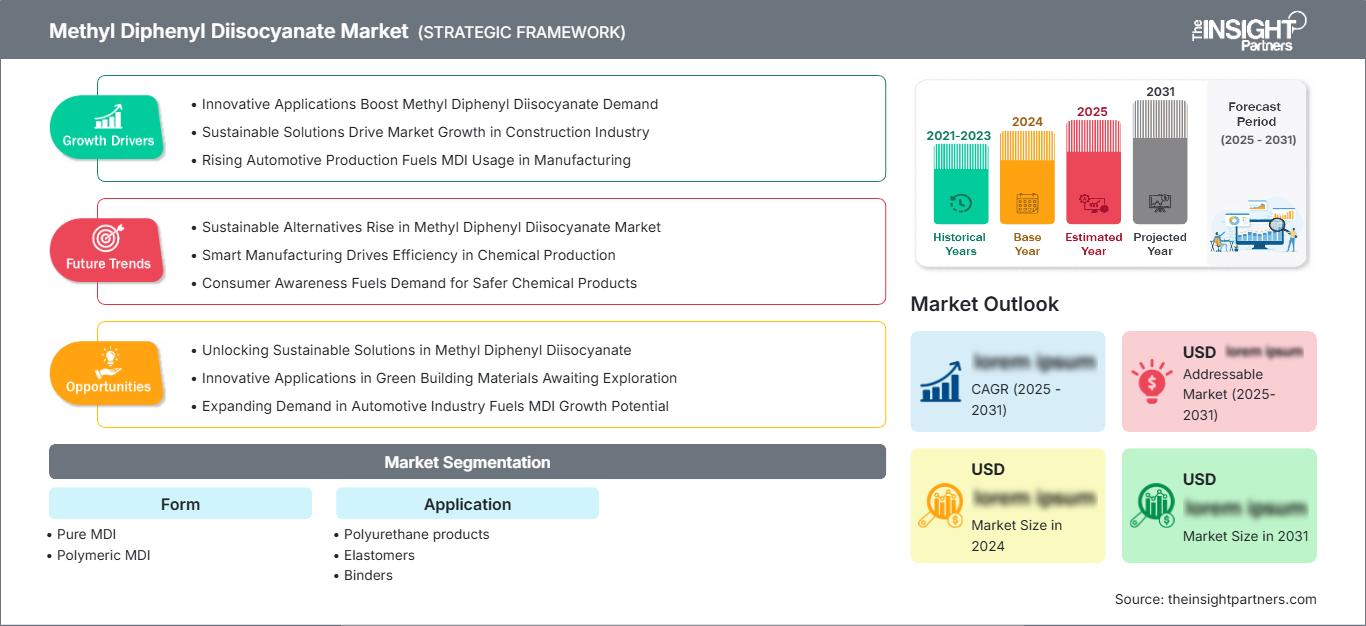
Methyl Diphenyl Diisocyanate Market: Strategic Insights
Regional Insights
North America Methyl Diphenyl Diisocyanate Market
North America held a 33% to 36% market share of the total global methyl diphenyl diisocyanate market share in 2025 and is anticipated to grow with a CAGR of 5.1% to 5.6% from 2026 to 2034. Demand from residential construction, commercial structures, auto manufacturing, refrigeration units, and industrial insulation keeps driving consumption in the region. Energy-efficient building programs launched by the federal government and various states have seen a rise in polyurethane insulation installation, thereby stimulating demand for methyl diphenyl diisocyanate.
Manufacturing companies in North America are continually striving toward process optimization and sustainable production methods. Availability of raw material, improved logistics and supply chains, along with effective downstream polyurethane production, will keep the region's position strong. Increasing renovations, modernization of cold chain facilities, and investments in manufacturing electric vehicles are likely to fuel the growth of the region.
U.S. Methyl Diphenyl Diisocyanate Market
The US held 79-82% share in the North America market in 2025 and is projected to witness a CAGR of 5.2-5.7% during 2025-2034. Factors such as the well-developed polyurethane manufacturing industry, developed construction industry, and well-established automotive sector are propelling the demand for methyl diphenyl diisocyanate in the country. The increasing adoption of performance-based insulation products in commercial and residential projects is adding impetus to the local demand.
Key companies like Dow Inc. and Covestro AG have established production facilities in the country and hence, are meeting the needs of their downstream customers. Continuous investments in electric vehicles, refrigeration systems, appliances and industrial machinery will help create new applications of methyl diphenyl diisocyanate. Increased focus on sustainable buildings and energy conservation norms will add to the demand of polyurethanes in different industrial segments.
Europe Methyl Diphenyl Diisocyanate Market
Europe contributed 24–27% to the global market share in 2025 and is estimated to record a CAGR of 4.9–5.4% between 2026 and 2034. Strong environmental regulations, use of energy-efficient building materials, and presence of well-established automotive and industrial manufacturing industries will sustain regional demand. Germany is the largest market due to its highly developed industry of processing polyurethane and automotive parts and industrial machinery.
There is sustained demand in the UK due to the renovation of commercial buildings, cold-chain logistics, and manufacturing industries, with increased investments in low-carbon infrastructure promoting the use of polyurethane insulation. In the case of France, Italy, and Spain, growing construction activities, production of furniture, refrigeration equipment, and adhesives support high regional consumption. Growing investments in sustainable buildings and the circular economy are likely to drive regional demand for methyl diphenyl diisocyanate through the forecast period.
APAC Methyl Diphenyl Diisocyanate Market
Asia Pacific captured 31–34% of the global market in 2025 and is forecast to grow at a CAGR of 6.2–6.8% during 2026–2034, making it the fastest-growing regional market. China remains the largest producer and consumer, followed by Japan, South Korea, and India, supported by expanding construction, automotive manufacturing, electronics production, and appliance industries.
Government supported industrialization initiatives, rising urbanization trends, and continuous development of infrastructure are boosting regional demand for polyurethanes. Demand from Australia is rising due to commercial construction and industrial uses in mining sector.
Middle East & Africa Methyl Diphenyl Diisocyanate Market
The Middle East & Africa market is expected to expand at a CAGR of 5.4–5.9% during 2026–2034, supported by rising infrastructure development, industrial diversification, and investments in energy-efficient buildings. Saudi Arabia leads regional demand through expanding petrochemical integration and construction projects, while the UAE continues investing in commercial infrastructure and cold-chain logistics.
It is still a significant market due to its industries that manufacture and the construction being done in the country. Many other countries in the area are slowly building up their use of polyurethane through modernization of infrastructure, refrigeration, and industrialization.
Segmentation Analysis
Form
The Form segment is anticipated to register a CAGR of 5.6–6.0% during 2026–2034. The methyl diphenyl diisocyanate market scope continues expanding as manufacturers optimize formulations to address varying performance requirements across insulation, elastomers, adhesives, coatings, and specialty polyurethane systems. Product selection is largely influenced by processing characteristics, viscosity requirements, curing performance, and compatibility with downstream manufacturing operations across multiple industrial applications.
- Pure MDI: Pure MDI is extensively utilized in specialty polyurethane elastomers, coatings, adhesives, and high-performance engineering applications where superior mechanical properties, controlled reactivity, and formulation consistency are essential for advanced industrial manufacturing.
- Polymeric MDI: Polymeric MDI represents the dominant commercial product owing to its extensive utilization in rigid polyurethane foam manufacturing, insulation panels, refrigeration systems, construction materials, and composite products requiring excellent thermal performance and structural strength.
Application
The Application segment is expected to grow at a CAGR of 5.9–6.4% during 2026–2034. Continuous innovation in polyurethane chemistry, increasing industrial automation, and rising demand for lightweight, durable, and energy-efficient materials continue expanding application diversity. Manufacturers are also developing specialized formulations to address evolving performance requirements across transportation, construction, industrial equipment, and consumer products.
- Polyurethane products: This sub-segment maintains the largest market position because polyurethane materials are widely used across construction, automotive, furniture, footwear, electronics, insulation, coatings, adhesives, and numerous industrial manufacturing applications.
- Elastomers: Polyurethane elastomers continue gaining adoption in wheels, rollers, seals, industrial machinery, mining equipment, and automotive components owing to their exceptional abrasion resistance, flexibility, durability, and load-bearing performance.
- Binders: Growing infrastructure development and engineered wood production support increasing utilization of polyurethane binders in particleboard, oriented strand board, composite panels, and specialized construction materials requiring enhanced structural integrity.
- Rigid foams: Demand continues increasing as rigid polyurethane foams provide excellent thermal insulation for commercial buildings, residential construction, refrigeration equipment, cold storage facilities, pipelines, and industrial insulation systems.
- Polyurethane foams: Flexible polyurethane foams remain essential across furniture, bedding, automotive seating, packaging, and cushioning applications where comfort, resilience, lightweight properties, and long service life are critical purchasing considerations.
Opportunity Snapshot
| Application | Revenue Contribution | Trend Tag | Adoption Stage |
|---|---|---|---|
| Polyurethane products | High | Building Insulation | Mature |
| Elastomers | Medium | Lightweight Parts | Scaling |
| Binders | Medium | Engineered Wood | Scaling |
| Rigid foams | High | Cold Chain | Scaling |
| Polyurethane foams | High | Comfort Materials | Mature |
Methyl Diphenyl Diisocyanate Market Growth Drivers and Impact Analysis
Expansion of Global Energy-Efficient Construction Standards
Growing emphasis on reducing building energy consumption has significantly increased the adoption of advanced insulation materials across residential, commercial, and industrial construction projects. Building efficiency regulations implemented throughout North America, Europe, and several Asia Pacific economies continue encouraging greater use of rigid polyurethane insulation manufactured using methyl diphenyl diisocyanate. Rising investments in green buildings, urban redevelopment, and high-performance construction materials are strengthening long-term demand. Improved thermal insulation contributes to lower energy consumption and reduced greenhouse gas emissions throughout a building's operational life. Continuous modernization of construction practices and stricter building codes are therefore expected to reinforce market expansion while encouraging manufacturers to develop higher-performance polyurethane systems with improved sustainability characteristics.
Increasing Lightweight Material Adoption in Automotive Manufacturing
Automotive manufacturers continue replacing conventional materials with lightweight polyurethane components to improve fuel efficiency, extend electric vehicle driving range, and reduce overall vehicle weight. Methyl diphenyl diisocyanate plays a vital role in manufacturing seating systems, structural insulation, acoustic materials, interior panels, and numerous molded polyurethane components. Growing production of passenger vehicles, commercial vehicles, and electric mobility platforms across China, the United States, Germany, Japan, and India continues supporting long-term material demand. Vehicle manufacturers are simultaneously focusing on enhanced passenger comfort, thermal insulation, and durability, encouraging further innovation in polyurethane technologies and strengthening opportunities for methyl diphenyl diisocyanate producers throughout the automotive value chain.
Growth of Cold Chain and Refrigeration Infrastructure
Rapid expansion of food processing, pharmaceutical logistics, vaccine distribution, and temperature-controlled warehousing is accelerating investments in refrigeration infrastructure worldwide. High-performance rigid polyurethane insulation manufactured using methyl diphenyl diisocyanate offers superior thermal efficiency while reducing operating energy requirements for refrigerated storage and transportation. Developing economies are investing heavily in modern cold-chain networks to minimize food losses and improve healthcare logistics. Simultaneously, increasing consumer demand for frozen foods, processed foods, and temperature-sensitive pharmaceutical products continues driving refrigeration equipment manufacturing. These structural developments are expected to generate sustained long-term consumption across industrial insulation and cold-storage applications.
Methyl Diphenyl Diisocyanate Market Future Trends
Integration of Low-Emission and Circular Polyurethane Technologies
Manufacturers are increasingly investing in low-emission production technologies and circular polyurethane solutions to align with evolving sustainability objectives. Greater adoption of bio-based feedstocks, recycled polyols, and energy-efficient production processes is expected to reduce lifecycle emissions while maintaining product performance. These innovations are encouraging downstream industries to adopt more sustainable insulation, automotive, and industrial materials. The methyl diphenyl diisocyanate market trends indicate that companies prioritizing process efficiency, carbon reduction, and circular manufacturing strategies will strengthen their competitive positioning as environmental regulations become more stringent across major consuming regions.
Digital Manufacturing and Smart Chemical Production
The integration of artificial intelligence, predictive maintenance, digital twins, and advanced process automation is transforming methyl diphenyl diisocyanate manufacturing. Smart production facilities enable improved process control, enhanced product consistency, lower energy consumption, and reduced operational downtime. Digital supply chain management also improves inventory planning and procurement efficiency, minimizing disruptions caused by feedstock volatility. As chemical manufacturers continue investing in Industry 4.0 technologies, operational productivity and manufacturing flexibility are expected to improve significantly, enabling producers to respond more effectively to changing customer requirements and regional demand patterns.
Methyl Diphenyl Diisocyanate Market Opportunities
Expansion of Polyurethane Manufacturing in Emerging Economies
Rapid industrialization across Southeast Asia, India, the Middle East, and selected Latin American countries is creating attractive investment opportunities for polyurethane manufacturers. Expanding construction activity, automotive production, appliance manufacturing, and infrastructure development are increasing regional consumption of methyl diphenyl diisocyanate. According to methyl diphenyl diisocyanate market Forecasts, continued investments in integrated production facilities and localized supply chains are expected to reduce import dependence while improving supply security. Companies establishing manufacturing partnerships, distribution networks, and regional technical service centers can strengthen customer relationships and capture long-term demand from high-growth industrial sectors.
Advanced High-Performance Polyurethane Applications
Continuous innovation in specialty polyurethane formulations presents opportunities across electric vehicles, renewable energy infrastructure, aerospace components, industrial machinery, and advanced electronics. Manufacturers are increasingly developing customized methyl diphenyl diisocyanate formulations that deliver improved durability, flame resistance, thermal insulation, and mechanical strength. Rising investments in battery manufacturing, lightweight transportation systems, and high-performance industrial equipment are expected to expand application diversity. Companies focusing on research collaborations, specialty product development, and value-added technical services can improve margins while addressing evolving performance requirements across premium industrial applications worldwide.
Recent Developments
- July 2026: Covestro announced an investment program for MDI (methylene diphenyl diisocyanate) intended to expand its position in the global MDI market and strengthen long-term supply security for customers worldwide. The program includes preparations for construction of a new 660-kiloton annual MDI production plant at Covestro's integrated site in Shanghai, China, with commissioning planned for the end of this decade.
- February 2026: BASF increased the prices for its Lupranate MDI (Methylene Diphenyl Diisocyanate) basic products by $200 per metric ton in ASEAN countries.
Frequently Asked Questions

- Comprehensive Market Sizing and Forecast Analysis
- Detailed Segmentation Analysis
- In-Depth Market Dynamics Assessment
- Regional and Country-Level Insights
- Competitive Landscape and Company Benchmarking
- Strategic Business Intelligence
Recent Reports
Testimonials

The Insight Partners' SCADA System Market report is comprehensive, with valuable insights on current trends and future forecasts. The team was highly professional, responsive, and supportive throughout. We are very satisfied and highly recommend their services.
RAN KEDEM Partner, Reali Technologies LTDs
I requested a report on a very specific software market and the team produced the report in a few days. The information was very relevant and well presented. I then requested some changes and additions to the report. The team was again very responsive and I got the final report in less than a week.
JEAN-HERVE JENN Chairman, Future Analytica
We worked with The Insight Partners for an important market study and forecast. They gave us clear insights into opportunities and risks, which helped shape our plans. Their research was easy to use and based on solid data. It helped us make smart, confident decisions. We highly recommend them.
PIYUSH NAGPAL Sr. Vice President, High Beam Global
The Insight Partners delivered insightful, well-structured market research with strong domain expertise. Their team was professional and responsive throughout. The user-friendly website made accessing industry reports seamless. We highly recommend them for reliable, high-quality research services
YUKIHIKO ADACHI CEO, Deep Blue, LLC.
This is the first time I have purchased a market report from The Insight Partners.While I was unsure at first, I visited their web site and felt more comfortable to take the risk and purchase a market report.I am completely satisfied with the quality of the report and customer service. I had several questions and comments with the initial report, but after a couple of dialogs over email with their analyst I believe I have a report that I can use as input to our strategic planning process.Thank you so much for taking the extra time and making this a positive experience.I will definitely recommend your service to others and you will be my first call when we need further market data.
JOHN SUZUKI President and Chief Executive Officer, Board Director, BK Technologies
I wish to appreciate your support and the professionalism you displayed in the course of attending to my request for information regarding to infectious disease IVD market in Nigeria. I appreciate your patience, your guidance, and the fact that you were willing to offer a discount, which eventually made it possible for us to close a deal. I look forward to engaging The Insight Partners in the future, all thanks to the impression you have created in me as a result of this first encounter.
DR CHIJIOKE ONYIA MANAGING DIRECTOR, PineCrest Healthcare Ltd.Reason to Buy
- Informed Decision-Making
- Understanding Market Dynamics
- Competitive Analysis
- Identifying Emerging Markets
- Customer Insights
- Market Forecasts
- Risk Mitigation
- Boosting Operational Efficiency
- Strategic Planning
- Investment Justification
- Tracking Industry Innovations
- Aligning with Regulatory Trends





 Get Free Sample for