
Methyl Glucose Market Growth, Share & Trends by 2034
Coverage: by Form (Liquid, Powder); End-Use (Skincare Products, Hair Care Products, Baby Care Lotions, Cosmetics, Others) , and Geography (North America, Europe, Asia Pacific, and South and Central America)
- Status : Data Released
- Report Code : TIPRE00011253
- Category : Chemicals and Materials
- No. of Pages : 150
- Available Report Formats :


- Last update date : August 13, 2026


2025 Market Size
US$ 133.42 Mn
Base year value
2034 Forecast
US$ 184.5 Mn
Projected by 2034
CAGR 2026-2034
3.67 %
Growth rate
Addressable Market
US$ 1,444.14 Mn
(2026-2034)
The global Methyl Glucose market was valued at US$ 133.42 million in 2025 and is expected to reach US$ 184.5 million by 2034; it is estimated to record a CAGR of 3.67% during 2026-2034.
Methyl Glucose Market Assessment and Insights
- North America: Accounted for 31–34% share in 2025 and is anticipated to expand at a CAGR of 3.9–4.4% during 2026–2034, supported by strong demand for sustainable cosmetic ingredients, premium skincare products, and advanced formulation technologies.
- U.S.: Represented 81–84% of the North American market in 2025 and is projected to grow at a CAGR of 4.0–4.5% during 2026–2034, driven by robust personal care manufacturing, ingredient innovation, and consumer preference for naturally derived formulations.
- Europe: Held 27–30% share in 2025 and is forecast to register a CAGR of 3.8–4.2% during 2026–2034. Germany, France, Italy, and the UK remain leading consumers owing to mature cosmetic manufacturing and strict sustainability regulations.
- Asia Pacific: Captured 32–35% share in 2025 and is expected to witness the highest CAGR of 4.8–5.3% during 2026–2034, led by China, Japan, South Korea, and India through expanding cosmetics production and rising disposable income.
- Largest Segment: Skincare Products accounted for 44–48% market share in 2025 and are anticipated to expand at a CAGR of 4.3–4.7% during 2026–2034, supported by increasing demand for moisturizing, skin-conditioning, and clean beauty formulations.
- High Growth Segment: Hair Care Products represented 20–23% market share in 2025 and are projected to grow at a CAGR of 4.9–5.4% during 2026–2034, driven by sulfate-free formulations, scalp care innovation, and botanical ingredient adoption.
- Key companies analyzed in detail: Foshan Hytop New Material Co., Ltd., Guangzhou Tinci Materials Technology Co., Ltd., Hangzhou FandaChem Co., Ltd., Hangzhou TIM Chemicals Co., Ltd., Hefei TNJ Chemical Industry Co., Ltd., Kalichem S.r.l., Reachin Chemicals Co., Ltd., SMA Collaboratives, LLC, Wuhan Fortuna Chemical Co., Ltd., Xi'an Health Biochem Technology Co., Ltd.
Source: The Insight Partners' analysis based on proprietary research, government publications, company annual reports, investor presentations, industry databases, and expert interviews.
Owing to constant innovations in cosmetic chemistry, methyl glucose has been successfully turned from being a specialized cosmetic product ingredient to a versatile and essential bio-based raw material. The use of methyl glucose-based derivatives becomes more widespread for improving moisturizing, emulsifying, stability and sensory properties and ensuring compliance with environmental regulations. Thanks to the improvements in production processes and stable supply of carbohydrate raw materials, commercialization of methyl glucose has become easier.
Market growth will depend on such factors as renewable chemicals, green manufacturing, and naturally derived specialty ingredients. New cosmetic manufacturing centers emerging in Asia Pacific and Latin America will create the new demand; the trend to substitute petrochemical-based products with biodegradable ingredients will further stimulate it.
Methyl Glucose Market Report Scope
| Report Attribute | Details |
|---|---|
| Market size in 2025 | US$ 133.42 Million |
| Market Size by 2034 | US$ 184.5 Million |
| Global CAGR (2026 - 2034) | 3.67% |
| Historical Data | 2021-2024 |
| Forecast period | 2026-2034 |
Methyl Glucose Market Analysis
Increasing consumer preference for natural cosmetics and bio-based personal care ingredients is driving market expansion of methyl glucose both in developed and developing countries. Manufacturers of cosmetics are utilizing methyl glucose derivatives in their formulations, which require good moisturizing, stability of emulsions, and low toxicity of ingredients used. The growing need for sulfate-free skincare products, luxury facial creams, lotions, and multi-purpose cosmetic formulations is fueling demand along the entire value chain of the cosmetics industry.
Demand will be sustained by the presence of renewable carbohydrate raw materials and increasing investments in the manufacture of special cosmetic ingredients. Manufacturers are enhancing their production process to meet global standards set for cosmetics. Increased collaboration between producers of cosmetic ingredients, cosmetic brands, and contract formulators is driving adoption of advanced bio-based ingredients.
The competitive intensity associated with the methyl glucose market report is further rising due to the increased efforts of the specialty chemical companies that are producing natural cosmetic ingredients. Foshan Hytop New Material Co., Ltd., Guangzhou Tinci Materials Technology Co., Ltd., Kalichem S.r.l., Hefei TNJ Chemical Industry Co., Ltd., and SMA Collaboratives, LLC are making continued efforts in product formulations and quality improvement, as well as technical support services. On the other hand, Hangzhou TIM Chemicals Co., Ltd., Hangzhou FandaChem Co., Ltd., Reachin Chemicals Co., Ltd., Wuhan Fortuna Chemical Co., Ltd., and Xi’an Health Biochem Technology Co., Ltd. have been enhancing their global activities through distribution partnerships and ingredient solutions.
Investment trends in the sector include the use of sustainable technologies and feedstocks, product certification, and regulatory compliance with international cosmetic industry standards. Technical support services are also being improved by companies to facilitate formulators for high-end cosmetic products.
● REPORT CUSTOMIZATION
Tailor This Report To Align With Your Specific Business Requirements
This report can be customized to align precisely with your business objectives, scope, and target markets. Customization options include tailored segmentation, geography, competitive analysis, and strategic insights to support informed decision-making.
Customize This Report →WHAT YOU CAN ADJUST
- ● Segmentations
- ● Geography
- ● Competitive Analysis
- ● Language Preferences
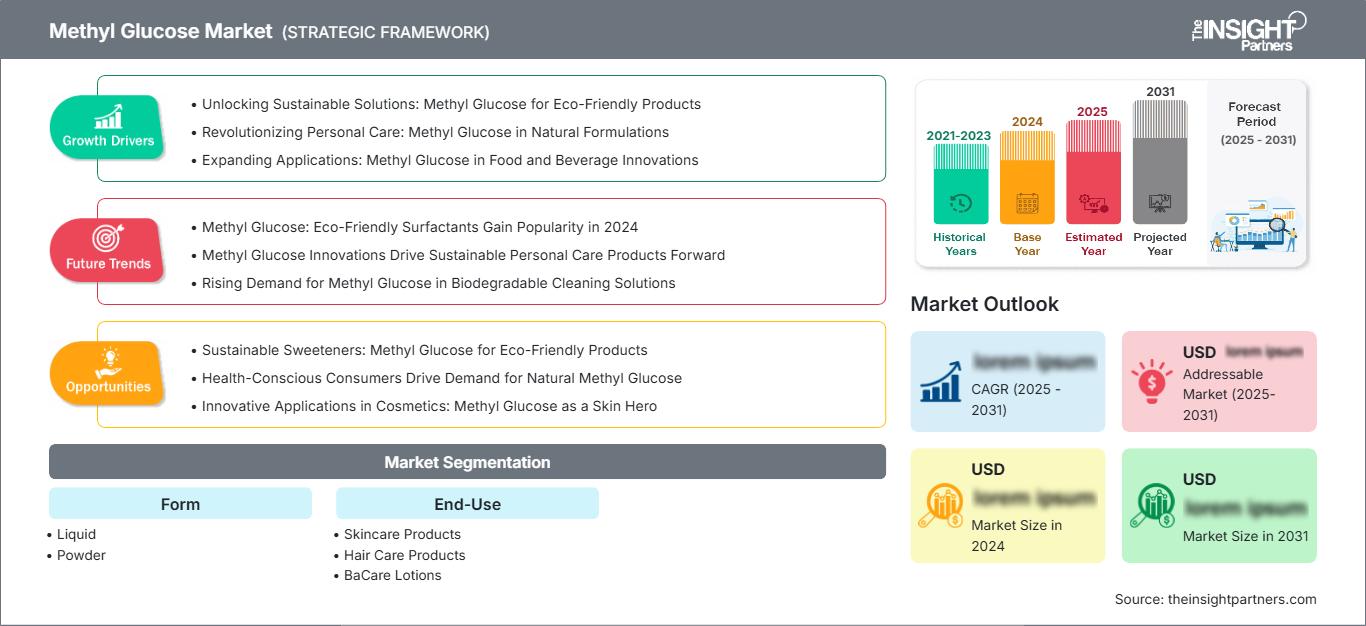
Methyl Glucose Market: Strategic Insights
Regional Insights
North America Methyl Glucose Market
North America accounted for 31–34% of the global methyl glucose market share in 2025 and is projected to expand at a CAGR of 3.9–4.4% during 2026–2034. Consumer demand for naturally derived personal care products, premium skincare formulations, and environmentally responsible cosmetic ingredients continues supporting regional market growth. Regulatory oversight of cosmetic ingredients and increasing investments in sustainable product innovation encourage manufacturers to incorporate renewable multifunctional ingredients into new product development.
Additionally, the region enjoys robust research capability, a presence of well-known cosmetics producers, and increasing demand for premium moisturizing ingredients. Increasing demand for clean-beauty products, vegan products, and biodegradable cosmetic ingredients keeps pushing ingredient suppliers to increase production capabilities and technical collaboration with personal care brands.
U.S. Methyl Glucose Market
The USA held a 81-84% share of the North American market in 2025 and is projected to exhibit a CAGR of 4.0-4.5% from 2026 to 2034. The matured cosmetics industry, high expenditure of consumers on premium skincare, and flourishing environment for innovation in product formulation have been contributing to steady demand for ingredients from the region.
Top players in the specialty ingredient industry have robust distribution networks and work closely with cosmetic manufacturers to come up with unique formulations. The growth of prestige skincare products, scalp wellness products, multi-benefit moisturizers, and anti-aging cosmetics continues to offer growth prospects for the methyl glucose ingredient suppliers in the domestic personal care industry.
Europe Methyl Glucose Market
Europe represented 27–30% of the global market in 2025 and is estimated to grow at a CAGR of 3.8–4.2% between 2026 and 2034. Europe boasts stringent regulations of cosmetics, high levels of consumer knowledge about ingredient labeling, and extensive use of natural formulation ingredients. Germany leads the region owing to its strong personal care manufacturing industry, followed by France, which functions as an international center for premium cosmetics and skincare formulations.
The United Kingdom sees continued steady consumption of beauty products that carry clean-labels and dermatologically tested formulations. Both Italy and Spain see significant contribution to the region through growing cosmetic exports and rising production of premium personal care formulations. Constant innovations in natural emulsifiers, moisturizers, and multi-functional cosmetic ingredients will continue driving regional demand, while supportive regulatory policies towards biodegradable and eco-friendly ingredients will boost the growth of the market in the long term..
APAC Methyl Glucose Market
Asia Pacific captured 32–35% of the global market in 2025 and is expected to record the fastest CAGR of 4.8–5.3% during 2026–2034. China leads regional consumption owing to its extensive cosmetic ingredient manufacturing base, while Japan and South Korea remain innovation centers for premium skincare formulations. India is emerging as a rapidly expanding consumer market because of rising disposable income and increasing demand for personal care products.
Specialty chemical manufacture, developing local cosmetic brands, and exporting are ways in which the government is continually boosting production capacities in the region. Australia makes its contribution by the rising demands for natural cosmetics.
Middle East & Africa Methyl Glucose Market
The Middle East & Africa market is projected to expand at a CAGR of 4.1–4.6% during 2026–2034, supported by rising consumer spending on personal care products and increasing investment in premium cosmetic retail channels. Saudi Arabia leads regional demand, followed by the United Arab Emirates, where international beauty brands continue expanding their product portfolios.
South Africa continues to be the major producer of cosmetics in Sub-Saharan Africa, providing ingredients for producers within the region and country. The rest of the MEA countries have been experiencing steady growth due to increasing knowledge about beauty and accessibility of quality skincare and hair products.
Segmentation Analysis
Form
The Form segment is expected to grow at a CAGR of 4.0–4.4% during 2026–2034. The methyl glucose market scope continues expanding as manufacturers develop formulations that satisfy diverse viscosity, stability, and application requirements across personal care products. Selection between liquid and powder forms depends on formulation compatibility, manufacturing efficiency, storage requirements, and desired product performance, enabling suppliers to address a broad spectrum of cosmetic applications.
- Liquid: Liquid methyl glucose is extensively used in creams, facial serums, lotions, cleansers, and emulsions because it offers excellent formulation compatibility, ease of processing, uniform dispersion, and enhanced moisturizing performance in premium skincare products.
- Powder: Powder methyl glucose is preferred for dry cosmetic formulations, concentrated ingredient blends, and customized manufacturing processes requiring extended shelf life, convenient transportation, and flexible formulation development for specialty applications.
End-Use
The End-Use segment is projected to register a CAGR of 4.2–4.7% during 2026–2034. Expanding consumer demand for gentle, naturally derived, and multifunctional cosmetic ingredients continues driving adoption across multiple personal care categories. Manufacturers increasingly incorporate methyl glucose into innovative formulations that improve moisturization, sensory attributes, product stability, and overall skin compatibility while meeting clean beauty expectations.
- Skincare Products: This sub-segment represents the largest application because methyl glucose enhances moisturization, skin conditioning, emulsion stability, and sensory performance across facial creams, moisturizers, anti-aging products, cleansers, and specialized dermatological formulations.
- Hair Care Products: Demand continues increasing as manufacturers develop sulfate-free shampoos, conditioners, scalp treatments, hair masks, and styling products incorporating naturally derived moisturizing ingredients that improve softness and manageability.
- Body Care Lotions: Body care lotions utilize methyl glucose to improve hydration, spreadability, formulation stability, and long-lasting skin conditioning while supporting premium positioning through naturally derived ingredient claims.
- Cosmetics: Decorative cosmetics increasingly incorporate methyl glucose to enhance texture, product stability, moisture retention, and skin feel in foundations, primers, BB creams, and multifunctional beauty formulations.
Opportunity Snapshot
| End-Use | Revenue Contribution | Trend Tag | Adoption Stage |
|---|---|---|---|
| Skincare Products | High | Clean Beauty | Mature |
| Hair Care Products | Medium | Scalp Wellness | Scaling |
| Body Care Lotions | Medium | Deep Hydration | Scaling |
| Cosmetics | High | Hybrid Beauty | Mature |
Methyl Glucose Market Growth Drivers and Impact Analysis
Growing Consumer Preference for Naturally Derived Cosmetic Ingredients
Customers have become more attentive to personal care formulations with eco-friendly and skin-friendly ingredients, thus motivating cosmetic makers to use nature-based alternatives instead of harmful synthetic additives. Methyl glucose allows manufacturers to formulate versatile products with moisturizing, emulsifying, and skin conditioning properties with the support of the clean label marketing. Increasing demand for transparency and sustainable ingredients has started to influence buying behavior in high-end and budget products. Regulatory institutions are promoting safe cosmetic formulas contributing to the promotion of this trend. Therefore, new opportunities for ingredient producers will arise in case of their ability to provide quality products with sustainability and compliance with international standards.
Expansion of Premium Skincare and Dermatological Formulations
Premium skincare continues outperforming many other personal care categories as consumers prioritize hydration, skin barrier protection, anti-aging, and sensitive-skin solutions. Methyl glucose supports these formulations by improving product texture, moisture retention, and formulation stability without compromising skin compatibility. Dermatologist-recommended skincare products increasingly utilize naturally derived multifunctional ingredients to meet consumer expectations for safety and performance. Growing investments by global cosmetic brands in premium skincare innovation are therefore expected to strengthen ingredient demand while encouraging suppliers to expand technical support and customized formulation capabilities.
Increasing Regulatory Emphasis on Sustainable Personal Care Products
Governments and regulatory organizations continue strengthening environmental and safety standards for cosmetic ingredients, encouraging manufacturers to adopt renewable raw materials and biodegradable formulations. Methyl glucose aligns with these industry requirements because it is derived from carbohydrate feedstocks and offers favorable environmental characteristics compared with certain petrochemical alternatives. Cosmetic manufacturers are increasingly incorporating sustainable ingredient portfolios into product development strategies to strengthen brand positioning and comply with changing regulatory expectations. This transition is expected to generate consistent long-term demand for naturally derived multifunctional cosmetic ingredients across global personal care markets.
Methyl Glucose Market Future Trends
Rising Adoption of Biotechnology and Green Chemistry
Manufacturers are increasingly incorporating biotechnology and green chemistry into cosmetic ingredient production to improve sustainability, reduce carbon emissions, and enhance raw material traceability. The methyl glucose market trends indicate that renewable feedstocks, enzymatic synthesis, and low-energy manufacturing processes will become more prominent as cosmetic companies strengthen environmental commitments. These innovations are expected to improve product consistency, reduce environmental impact, and support compliance with evolving international sustainability standards. Companies investing in greener production technologies are likely to strengthen their competitive positioning while addressing growing demand for environmentally responsible personal care ingredients.
Development of Multifunctional Cosmetic Ingredients
Cosmetic manufacturers are increasingly seeking multifunctional ingredients capable of delivering moisturization, emulsification, conditioning, and formulation stability within a single raw material. Methyl glucose is well positioned to benefit from this transition because it simplifies formulation development while supporting premium product claims. Future innovation is expected to focus on combining naturally derived ingredients with enhanced sensory characteristics, improved stability, and compatibility with active cosmetic compounds. This trend will encourage ingredient manufacturers to expand research capabilities and develop customized solutions for evolving skincare, hair care, and cosmetic applications.
Methyl Glucose Market Opportunities
Expansion Across Emerging Personal Care Markets
Rapid urbanization, rising disposable incomes, and increasing beauty awareness across Asia Pacific, Latin America, and the Middle East are creating attractive opportunities for cosmetic ingredient suppliers. According to methyl glucose market Forecasts, manufacturers establishing localized distribution networks, regulatory support capabilities, and formulation laboratories will be well positioned to capitalize on growing regional demand. International cosmetic brands are also expanding production facilities in these regions, increasing procurement of sustainable specialty ingredients. Long-term investments in technical services, customer partnerships, and regional manufacturing are expected to strengthen competitiveness while reducing supply chain risks.
Innovation in High-Performance Clean Beauty Formulations
The transition toward premium clean beauty products presents significant opportunities for ingredient manufacturers developing multifunctional, naturally derived formulation components. Methyl glucose can support next-generation moisturizers, microbiome-friendly skincare, sensitive-skin products, hybrid cosmetics, and advanced hair care solutions requiring excellent stability and skin compatibility. Companies investing in application laboratories, collaborative research, and customized formulation development will be better positioned to address evolving consumer preferences. Strategic partnerships with cosmetic manufacturers and contract formulators can further accelerate commercialization while expanding participation in premium personal care product categories.
Recent Developments
- May 2026: Ahmedabad-based Sanstar Limited (Sanstar), a leading corn-based specialty products and ingredient solutions company, entered into two definitive agreements with the $7.2 billion US-based multi-national Ingredion Incorporated (NYSE: INGR) for a strategic partnership aimed at accelerating growth in India's specialty ingredients sector, subject to requisite shareholder and other applicable approvals.
- January 2026: Riddhi Siddhi Gluco Biols Ltd. (RSGBL), a publicly listed company on the Bombay Stock Exchange (BSE), signed an Asset Purchase Agreement (APA) to acquire the assets of Cargill India Pvt. Ltd.’s (CIPL) Starch & Sweeteners business in Davangere, Karnataka. The deal includes the acquisition of land, manufacturing facilities, warehouses, and corn silos that provide integrated storage infrastructure supporting the corn wet milling operations, subject to the terms and conditions of the APA and obtaining of customary approvals.
Frequently Asked Questions

- Comprehensive Market Sizing and Forecast Analysis
- Detailed Segmentation Analysis
- In-Depth Market Dynamics Assessment
- Regional and Country-Level Insights
- Competitive Landscape and Company Benchmarking
- Strategic Business Intelligence
Recent Reports
Testimonials

The Insight Partners' SCADA System Market report is comprehensive, with valuable insights on current trends and future forecasts. The team was highly professional, responsive, and supportive throughout. We are very satisfied and highly recommend their services.
RAN KEDEM Partner, Reali Technologies LTDs
I requested a report on a very specific software market and the team produced the report in a few days. The information was very relevant and well presented. I then requested some changes and additions to the report. The team was again very responsive and I got the final report in less than a week.
JEAN-HERVE JENN Chairman, Future Analytica
We worked with The Insight Partners for an important market study and forecast. They gave us clear insights into opportunities and risks, which helped shape our plans. Their research was easy to use and based on solid data. It helped us make smart, confident decisions. We highly recommend them.
PIYUSH NAGPAL Sr. Vice President, High Beam Global
The Insight Partners delivered insightful, well-structured market research with strong domain expertise. Their team was professional and responsive throughout. The user-friendly website made accessing industry reports seamless. We highly recommend them for reliable, high-quality research services
YUKIHIKO ADACHI CEO, Deep Blue, LLC.
This is the first time I have purchased a market report from The Insight Partners.While I was unsure at first, I visited their web site and felt more comfortable to take the risk and purchase a market report.I am completely satisfied with the quality of the report and customer service. I had several questions and comments with the initial report, but after a couple of dialogs over email with their analyst I believe I have a report that I can use as input to our strategic planning process.Thank you so much for taking the extra time and making this a positive experience.I will definitely recommend your service to others and you will be my first call when we need further market data.
JOHN SUZUKI President and Chief Executive Officer, Board Director, BK Technologies
I wish to appreciate your support and the professionalism you displayed in the course of attending to my request for information regarding to infectious disease IVD market in Nigeria. I appreciate your patience, your guidance, and the fact that you were willing to offer a discount, which eventually made it possible for us to close a deal. I look forward to engaging The Insight Partners in the future, all thanks to the impression you have created in me as a result of this first encounter.
DR CHIJIOKE ONYIA MANAGING DIRECTOR, PineCrest Healthcare Ltd.Reason to Buy
- Informed Decision-Making
- Understanding Market Dynamics
- Competitive Analysis
- Identifying Emerging Markets
- Customer Insights
- Market Forecasts
- Risk Mitigation
- Boosting Operational Efficiency
- Strategic Planning
- Investment Justification
- Tracking Industry Innovations
- Aligning with Regulatory Trends





 Get Free Sample for