
Methyl Methacrylate Market Trends, Demand & Growth by 2034
Coverage: by Production Type (Chemical Synthesis, Recycling and Reclaiming); Application (Adhesives and Sealants, Industrial Paints and Coating, Inks); Feedstock (Acetone, Ethylene, Methanol, Isobutylene, Others) , and Geography (North America, Europe, Asia Pacific, and South and Central America)
- Status : Data Released
- Report Code : TIPRE00012646
- Category : Chemicals and Materials
- No. of Pages : 150
- Available Report Formats :


- Last update date : November 12, 2026


2025 Market Size
US$ 10.17 Bn
Base year value
2034 Forecast
US$ 17.51 Bn
Projected by 2034
CAGR 2026-2034
6.23 %
Growth rate
Addressable Market
US$ 125.34 Bn
(2026-2034)
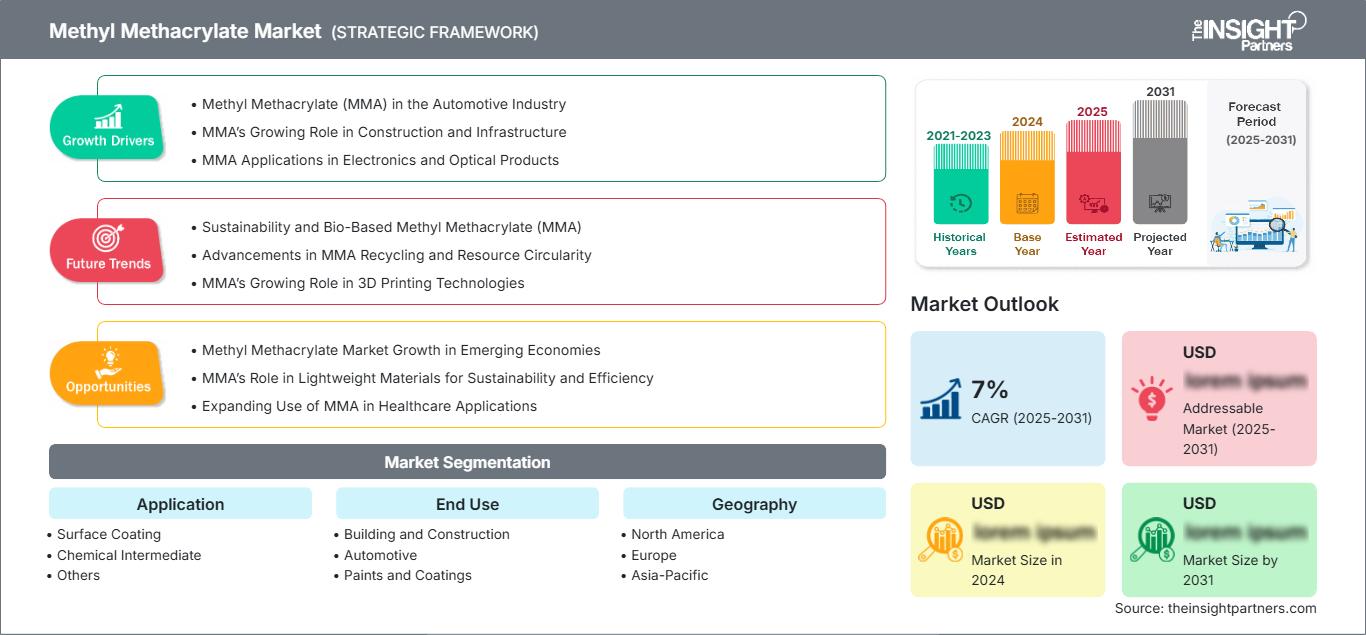
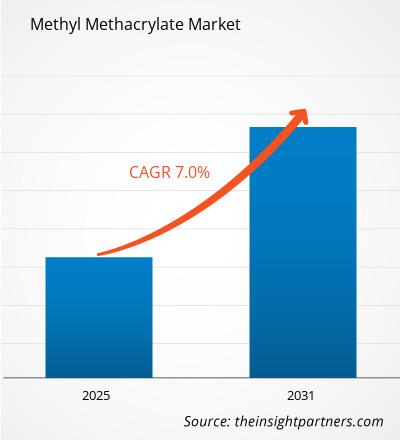
The methyl methacrylate market is experiencing sustained demand from industries requiring durable, transparent, weather-resistant, and versatile acrylic materials. The market was valued at US$ 10.17 Billion in 2025 and is projected to reach US$ 17.51 Billion by 2034, expanding at a CAGR of 6.23% during 2026–2034. Demand is supported by construction activity, automotive material innovation, surface protection requirements, and the expanding use of polymethyl methacrylate in industrial and consumer applications. Production economics, feedstock availability, and downstream manufacturing capacity will influence market development throughout the forecast period.
North America remains an important market because of its established chemical manufacturing infrastructure, advanced automotive industry, and demand for high-performance materials in construction and industrial applications. The region is expected to expand at an estimated CAGR of ~6% through 2034, supported by replacement demand for durable acrylic materials and the continuing need for specialty coatings. Investments in efficient production processes, supply-chain resilience, and lower-impact manufacturing methods may strengthen regional competitiveness. The methyl methacrylate market size in North America will also depend on construction investment, industrial production, and the ability of suppliers to manage fluctuations in feedstock and energy costs.
Methyl Methacrylate Market Assessment and Insights
Regional Outlook
- North America: ~22% of the global methyl methacrylate market in 2025 | ~6% CAGR through 2034. Market position: North America represents an established demand center supported by chemical production, automotive manufacturing, and industrial coatings. Its market position reflects mature downstream industries and opportunities to improve material performance and production efficiency.
- US: ~80% of North American market revenue in 2025 | ~6% CAGR through 2034. Market position: The US accounts for most North American demand through its extensive manufacturing base, established construction sector, and automotive supply chain. Domestic production capabilities and customer access support supplier competitiveness.
- Europe: ~20% of the global market in 2025 | ~5% CAGR through 2034. Market position: Europe has a developed chemical industry and demand for durable materials. Germany is the leading country in Europe in this assessment, supported by its industrial base, automotive manufacturing, and established specialty-chemical supply chains.
- Asia Pacific: ~54% of the global market in 2025 | ~8% CAGR through 2034. Market position: Asia Pacific is the largest and fastest-growing region, benefiting from substantial chemical manufacturing capacity, construction activity, and downstream polymer processing. China leads the region through its large production base and extensive industrial customer network.
Segment Outlook
- Chemical Intermediate: ~42% share in 2025 | ~6% CAGR through 2034. Market position: Chemical intermediate applications support demand by linking MMA production with downstream polymer and specialty-material manufacturing. Their importance reflects the compound's role as a foundational input for multiple industrial value chains.
- Building and Construction: ~31% share in 2025 | ~7% CAGR through 2034. Market position: Construction demand benefits from the need for durable, lightweight, weather-resistant materials. Acrylic glazing, architectural components, protective applications, and related polymer products support continued consumption as building activity and renovation requirements evolve.
Competitive Coverage
Arkema Group, BASF SE, DuPont, Evonik Industries AG, Kowa India Pvt. Ltd., LG Chem, NIPPON SHOKUBAI CO., LTD., S.K. Panchal and Co., Shanghai Huayi Group Corp. Ltd., Sumitomo Chemical Co., Ltd.
Methodology
The Insight Partners follows Data Collection & Secondary Research, Primary Research, Data Analysis, and Data Triangulation & Final Review to validate market estimates and insights.
Source: The Insight Partners' analysis based on proprietary research, government publications, company annual reports, investor presentations, industry databases, and expert interviews.
Methyl methacrylate is an organic monomer of use primarily in the manufacture of acrylic polymers and other methacrylate resins. Methyl methacrylate finds use due to the optical transparency, durability, surface properties, and processability that its derivatives offer. Manufacturers produce the monomer through well-established chemical processes, but downstream processors use it to produce materials for applications such as construction, transport, and others. Factors affecting the competitiveness of methyl methacrylate production include technology, availability of raw materials, production runs, and balance between regional supply and demand. Thus, the market for methyl methacrylate is dependent not only on the chemistry behind the monomer’s production but also on the characteristics required by products derived from it.
The methyl methacrylate market development until 2034 will be driven by improvements in production technology, changes in regional production trends, and attempts to mitigate feedstock price risks. Asia-Pacific is set to exert influence on global supply/demand balance through large manufacturing capacity and the presence of polymer industry in the region. North America and Europe will maintain their dependency on established industrial demand but adapt to rising energy prices and environmental considerations as well as competition from abroad. Possible alternatives include the production of methyl methacrylate and the recycling of acrylic materials.
Methyl Methacrylate Market Report Scope
| Report Attribute | Details |
|---|---|
| Market size in 2025 | US$ 10.17 Billion |
| Market Size by 2034 | US$ 17.51 Billion |
| Global CAGR (2026 - 2034) | 6.23% |
| Historical Data | 2021-2024 |
| Forecast period | 2026-2034 |
Methyl Methacrylate Market Analysis
The increase in demand in the methyl methacrylate market is associated with the performance of the downstream industries which apply acrylic polymers, coatings, and chemicals derived from the same. The construction industry demands transparent panels, architectural structures, and durable surfaces, whereas the automotive industry makes use of acrylic derivatives wherever optical performance and aesthetics become critical issues. Furthermore, chemical producers also require MMA as an intermediate in order to produce polymer materials and specialty formulations. The correlation between the production of monomer and its subsequent processing makes the MMA market dependent on the level of manufacturing activities and inventories as well as the buying behavior of the end customers.
The value chain in the methyl methacrylate market involves inputs such as feedstocks and processing inputs, followed by the production process of synthesizing monomers, purifying them, storing them, and distributing them before the final step of polymerizing or converting them. Manufacturers have to align the utilization of their facilities with maintenance, transportation and customer needs. The international nature of MMA means that cost variations in various regions could affect the import and prices of MMA. Manufacturers that have efficient factories, consistent feedstock supply, technical assistance, and closeness to customers will be able to cope with cyclical challenges better than others.
Positioning in competition is influenced by production scale, manufacturing efficiency, consistency of products, customer relations, and flexibility to meet varying requirements downstream. Methyl methacrylate competitive analysis reveals that well-established chemical firms have competitive advantage through integrated business processes and extensive customer relations. The regional companies may gain an edge from close connections to downstream demand centers and logistics. The Arkema Group and BASF SE firms operate in wider value chain of acrylic and specialty chemicals industries, while LG Chem, Sumitomo Chemical Co., Ltd., and Shanghai Huayi Group Corp. Ltd. have expertise in chemical manufacturing. DuPont and Evonik Industries AG are among firms with materials expertise.
Decisions regarding investment in the methyl methacrylate market involve balancing the issue of whether to invest in new capacity versus the enhancement of existing capacities. While investments in new facilities would yield advantages of scale and process efficiency, they would also result in increased sensitivity to demand risk and excess capacity in the region. Debottlenecking, reliability, logistics, energy efficiency, and product quality could be the focus of producers. Cooperation with downstream manufacturers may help in identifying demand and qualify the products. NIPPON SHOKUBAI CO., LTD., Kowa India Pvt. Ltd., and S.K. Panchal and Co. are operating in an overall competitive environment.
● REPORT CUSTOMIZATION
Tailor This Report To Align With Your Specific Business Requirements
This report can be customized to align precisely with your business objectives, scope, and target markets. Customization options include tailored segmentation, geography, competitive analysis, and strategic insights to support informed decision-making.
Customize This Report →WHAT YOU CAN ADJUST
- ● Segmentations
- ● Geography
- ● Competitive Analysis
- ● Language Preferences
Methyl Methacrylate Market: Strategic Insights
Regional Insights
North America Methyl Methacrylate Market
The methyl methacrylate market forecast shows that North America accounts for an estimated ~22% of global revenue in 2025 and is projected to record a CAGR of ~6% through 2034. The region enjoys benefits from having an existing chemical industry, industrial distribution networks, and customers in industries including automotive, construction, and coatings. The U.S. is the main regional market, while Canada is part of this region through construction, manufacturing, and industrial applications. This is because customer proximity and logistics have remained vital for this industry as MMA customers require standard materials. Factors such as energy costs, maintenance costs, and competition from imported materials continue to be considered when setting the operating rate and business deals.
Demand in this region will continue to relate to renovations, automobile production, and industrial investments. Suppliers will distinguish themselves using technical support, reliability of their supplies, and cooperation with the downstream industries. Economics of scale will continue being relevant as this will determine their competitive advantage over imported materials. North American producers will also consider their efficiency in the process of production and emission performance. Growth will be constant but not uniform as construction activity, consumer spending, and inventory level will vary on different occasions.
U.S. Methyl Methacrylate Market
The United States represents an estimated ~80% of North American market revenue in 2025 and is projected to grow at a CAGR of ~6% through 2034. Its location is determined by the level of domestic chemical production and diversification of industrial customer base. Demand is ensured by automobile production, construction, coating, and polymer transformation. The existence of well-established chemical firms and distributors helps in providing customers with access, however, competitiveness is determined by the efficiency of facilities, product standards, and cost of transportation. Local manufacturers should also take into account maintenance period and the volatility of industrial purchasing.
Automotive and construction uses lead to different patterns of demand. Optical properties, durability, and processability are important for automotive customers while weather-resistance, appearance, and service life are preferred by construction customers. Coating and intermediary use provide MMA demand with connection to manufacturing operations. Reliable distribution, support, and proper inventory management can help suppliers develop closer relations with customers and especially if production stoppage will impact downstream processes. Future development of the market will be affected by utilization rates of manufacturing plants, building construction, and competitiveness of local supply with foreign material.
Europe Methyl Methacrylate Market
Europe represents an estimated ~20% of the global market in 2025 and is expected to record a CAGR of ~5% through 2034. The region has established chemical production, industrial processing, and end-user markets, but demand conditions vary by country and sector. Germany emerges as the leader among the European nations in this ranking owing to its automotive industry and industrial manufacturing industry. While France and the UK add value through construction, specialty chemicals, and downstream manufacturing, Italy and Spain offer market demand through construction materials, coatings, and industrial applications. Technical qualifications and solid distribution networks help the region to benefit from its existing infrastructure, yet mature end markets impede volume growth.
The structure of industries in Germany favors the emergence of Germany as a leading hub for automotive materials and chemical conversions. France enjoys the advantages of construction activities and application in special materials, whereas the UK has industrial and construction-based applications due to its existing distribution channels. There is a potential for acrylics in both manufacturing and renovation sectors in Italy, whereas in Spain, there is a demand for construction-based materials due to durability considerations.
Costs for energy consumption, plant operation efficiencies, and imports of MMA would influence local economies. Environmental considerations and focus on efficiency of manufacturing could drive manufacturers to invest in upgrading their factories and better use resources and look into more efficient processes. Nevertheless, investments should be justified by stable demand from consumers and lower production costs. European manufacturers will have to find the right balance between differentiation and reliability of supplies.
APAC Methyl Methacrylate Market
Asia Pacific accounts for an estimated ~54% of the global market in 2025 and is projected to expand at a CAGR of ~8% through 2034, making it the largest and fastest-growing region. China is the leading country in Asia Pacific, supported by its large chemical production base, extensive downstream polymer manufacturing, and broad industrial customer network. Japan and South Korea contribute established chemical expertise and advanced manufacturing, while India offers demand potential from infrastructure development, industrial expansion, and rising use of engineered materials. Australia contributes through construction and selected industrial applications.
Regional supply growth, investment in chemical facilities, and demand from polymer processors shape the competitive environment. China influences international trade flows as capacity additions alter the balance between domestic consumption and export availability. Japan and South Korea benefit from established industrial systems, while India's infrastructure and manufacturing development may support incremental consumption. Policy priorities related to industrial development and manufacturing localization can affect investment decisions, although the impact on MMA depends on project economics, downstream utilization, and feedstock availability.
Middle East & Africa Methyl Methacrylate Market
The Middle East and Africa region is expected to record a modeled CAGR of ~7% through 2034. Its development reflects construction investment, infrastructure modernization, industrial diversification, and the gradual expansion of downstream chemical demand. Saudi Arabia and the United Arab Emirates have substantial infrastructure and industrial development programs, while South Africa supports demand through construction, manufacturing, and established distribution networks. Saudi Arabia is a significant regional candidate for industrial demand growth, although the relative market positions of individual countries depend on local consumption, imports, and downstream conversion capacity.
Energy and petrochemical infrastructure can support investment in chemical value chains, but MMA competitiveness also requires suitable production technology, reliable feedstock supply, technical expertise, and access to end users. The UAE's logistics capabilities can facilitate regional distribution, while Saudi Arabia's industrial diversification objectives may create opportunities for downstream manufacturing. South Africa and the rest of MEA present more fragmented demand conditions, where import access and distributor coverage are important. Regional growth will depend on project execution, construction activity, and the development of stable industrial customers.
Segmentation Analysis
Application
Application-based demand reflects the role of methyl methacrylate as a versatile chemical input across polymer manufacturing and formulated industrial products. Buyers evaluate product consistency, conversion efficiency, purity, and compatibility with downstream processes when selecting supply. The methyl methacrylate market scope includes established applications as well as developing uses that require specific material characteristics. Application demand is expected to evolve with industrial production and investment in downstream processing. Chemical intermediate applications are modeled to expand at a CAGR of ~6% during 2026–2034, reflecting the continuing need for MMA in manufacturing value chains.
- Surface Coating: MMA-derived materials contribute to coating formulations that require weatherability, adhesion, surface protection, and visual consistency. Demand depends on construction maintenance, industrial equipment protection, and the performance requirements of coated products, with formulation choices influenced by durability and processing characteristics.
- Chemical Intermediate: This application connects monomer production with downstream chemical synthesis and polymer conversion. Its importance arises from the role of MMA as a feedstock for materials with distinct performance properties, making consistent quality, dependable availability, and compatibility with established manufacturing processes important purchasing criteria.
- Others: Additional applications encompass specialized uses that do not fall within the principal categories. Demand depends on specific product requirements and the ability of manufacturers to demonstrate technical suitability, maintain quality consistency, and supply economically viable material at the required specification.
End Use
End-use demand reflects the performance requirements and purchasing cycles of industries that incorporate MMA-based products into finished goods and industrial systems. Adoption depends on material durability, optical quality, processing characteristics, and the cost of competing solutions. Building and construction is modeled to grow at a CAGR of ~7% during 2026–2034, supported by demand for durable architectural materials and renovation-related applications. The methyl methacrylate market will also depend on how manufacturers balance the technical advantages of acrylic materials against cost, design requirements, and alternative materials across customer industries.
- Building and Construction: Acrylic materials are used in glazing, panels, architectural components, and related products requiring weather resistance and visual clarity. Demand is influenced by new construction, renovation, building design specifications, and the service-life expectations of commercial and residential projects.
- Automotive: Automotive applications value lightweight construction, surface appearance, durability, and resistance to outdoor exposure. MMA-based materials can support selected lighting, glazing-related, coating, and component applications, while adoption depends on qualification requirements, vehicle design, manufacturing economics, and compatibility with established production processes.
- Paints and Coatings: Coatings manufacturers use MMA-derived materials to achieve targeted film properties, adhesion, weather resistance, and appearance. Purchasing decisions depend on formulation performance, substrate compatibility, application conditions, and the ability to deliver consistent results across industrial and architectural coating systems.
- Others: Other end uses cover applications outside the named customer industries. Demand may emerge from specialized manufactured goods and niche industrial products, with adoption governed by specific performance requirements, cost considerations, availability of suitable formulations, and customer qualification processes.
Opportunity Snapshot
| End Use | Revenue Contribution | Trend Tag | Adoption Stage |
| Building and Construction | High | Acrylic Glazing | Mature |
| Automotive | Medium | Lightweight Components | Scaling |
| Paints and Coatings | High | Weather Protection | Mature |
| Others | Low | Specialty Applications | Emerging |
Methyl Methacrylate Market Growth Drivers and Impact Analysis
Increasing Demand for Durable Acrylic Materials
Construction demand supports consumption of MMA-derived materials because building owners, architects, and manufacturers require components that combine appearance with durability and manageable maintenance. Acrylic materials can provide optical clarity, weather resistance, and design flexibility in selected glazing, panel, and architectural applications. Renovation activity also supports replacement demand when older materials no longer meet performance or appearance requirements. For producers, this demand creates opportunities to develop stable relationships with sheet manufacturers, fabricators, and construction-product suppliers. However, the effect is not uniform across all applications: purchasing depends on local building activity, material prices, design specifications, and the availability of substitutes. Suppliers that maintain consistent quality and reliable delivery are better positioned to serve projects where material failure or delays can increase total installation costs.
Expanding Automotive Applications
Automotive manufacturers continually assess materials according to weight, durability, appearance, optical performance, and production efficiency. MMA-derived materials can serve selected applications in vehicle components, lighting-related products, coatings, and other polymer systems where their characteristics fit engineering requirements. The commercial impact depends on qualification procedures, design cycles, manufacturing volumes, and the cost of alternative materials. A material may offer technical benefits yet fail to gain adoption if it requires expensive processing changes or cannot meet established durability standards. Producers and downstream processors can improve their position by collaborating with component manufacturers early in product development. Consistent specifications, documented performance, and dependable supply are particularly important when customers need to maintain repeatable production quality across vehicle platforms.
Growing Industrial Demand for High-Performance Polymers
The connection between MMA production and downstream chemical conversion creates demand across multiple industrial value chains. Polymer manufacturers require suitable monomer quality and dependable delivery to maintain production schedules, product consistency, and operating efficiency. Integrated chemical operations may benefit from shared infrastructure, coordinated feedstock procurement, and optimized logistics, while independent processors can compete through specialization and customer service. Supply disruptions or abrupt feedstock cost increases can affect conversion margins and purchasing behavior, encouraging manufacturers to monitor inventories and diversify suppliers where technically feasible. The impact on the market depends on plant utilization, the availability of alternative supply, and downstream order visibility. Producers that coordinate maintenance and production planning with customers can reduce avoidable interruptions and improve asset utilization.
Methyl Methacrylate Market Future Trends
Advances in Sustainable MMA Production
Environmental considerations are likely to encourage greater evaluation of lower-impact MMA production and improved recovery of acrylic materials. Process developers and chemical manufacturers can investigate alternative feedstocks, energy-efficient operations, emissions reduction, and recycling routes that recover useful material from acrylic waste. Chemical recycling is especially relevant where recovered streams can be converted into feedstock suitable for demanding applications, although technical performance, collection logistics, and processing costs remain important constraints. These methyl methacrylate market trends could change investment priorities by placing greater emphasis on life-cycle performance alongside conventional measures such as yield, operating cost, and product quality. Commercial adoption will depend on the ability to demonstrate consistent recovered-material quality and establish viable supply chains rather than on sustainability objectives alone.
Increasing Adoption of Advanced Acrylic Materials
Future production patterns may increasingly reflect differences in regional capacity, feedstock economics, customer proximity, and trade flows. New capacity in Asia Pacific can influence export availability and prices elsewhere, while mature markets may prioritize plant efficiency, supply reliability, and targeted investment rather than unrestricted capacity expansion. Buyers may respond by broadening qualified supplier networks, negotiating more flexible supply arrangements, and maintaining inventory strategies suited to their operating requirements. Producers will need to distinguish structural demand growth from temporary inventory rebuilding when assessing investment proposals. Better forecasting, coordinated maintenance, and closer communication with downstream customers may help reduce the commercial effects of abrupt changes in availability. Regional competitiveness will remain dependent on the delivered cost and suitability of material for specific customer applications.
Methyl Methacrylate Market Opportunities
Investment in Low-Carbon Production Technologies
Suppliers can pursue growth by strengthening distribution and technical partnerships in markets where construction, manufacturing, and downstream polymer conversion are expanding. India and selected Southeast Asian markets warrant attention because local customer development can support a broader base of demand beyond established industrial centers. An effective entry strategy should begin with application qualification, customer mapping, import and logistics assessment, and evaluation of the most appropriate commercial supply model. Partnerships with local distributors and processors may lower the cost of market access while improving responsiveness to customer specifications. Methyl Methacrylate Forecasts provide a basis for assessing the potential direction of demand, but investment decisions should still account for local purchasing power, competing materials, capacity utilization, and the risk that new supply may outpace downstream consumption.
Expansion into Emerging End-Use Applications
Producers can evaluate targeted investments that improve existing assets before committing to major capacity additions. Opportunities include process optimization, maintenance planning, energy management, improved quality control, and logistics systems that reduce avoidable production losses. Where technical and economic conditions support it, recycling partnerships may offer access to recovered acrylic feedstock and create differentiated material options for customers. Investment screening should compare capital requirements with expected operating benefits, product qualification costs, feedstock availability, and the ability to secure long-term buyers. Collaboration with downstream manufacturers can help establish quality specifications and clarify the value of recycled or lower-impact materials. A staged approach, beginning with technical validation and pilot-scale assessment, can limit execution risk while producing evidence for larger commercial decisions.
Recent Developments
- March 2025: Sumitomo Chemical began selling its polymer material polymethyl methacrylate (PMMA) made from methyl methacrylate (MMA) monomer produced through chemical recycling. LG Display Co., Ltd. of South Korea and Nissan Motor Co., Ltd. of Japan have decided to use this chemically-recycled material for their products. Sumitomo Chemical will accelerate the implementation of chemical recycling in the MMA supply chain as an industry leader.
- August 2026: Valterra Platinum and Shanghai Pujing Chemical Technology Co., Ltd. (“Pujing Chemical”) signed a collaboration agreement to support the scale-up and further development of an innovative methyl methacrylate (MMA) production process based on a proprietary palladium-enabled catalyst system. The collaboration aims to advance a technology platform designed to support the evolving needs of China’s MMA industry.
Frequently Asked Questions

- Comprehensive Market Sizing and Forecast Analysis
- Detailed Segmentation Analysis
- In-Depth Market Dynamics Assessment
- Regional and Country-Level Insights
- Competitive Landscape and Company Benchmarking
- Strategic Business Intelligence
Recent Reports
Testimonials

The Insight Partners provided valuable market intelligence that supported our global go-to-market strategy. Their team was professional, responsive, and attentive to our feedback, providing thoughtful analysis and helpful methodological clarifications throughout the project.
Junmo Kim Chief Financial Officer (CFO), Enertech Co., Ltd.
The Insight Partners' SCADA System Market report is comprehensive, with valuable insights on current trends and future forecasts. The team was highly professional, responsive, and supportive throughout. We are very satisfied and highly recommend their services.
RAN KEDEM Partner, Reali Technologies LTDs
I requested a report on a very specific software market and the team produced the report in a few days. The information was very relevant and well presented. I then requested some changes and additions to the report. The team was again very responsive and I got the final report in less than a week.
JEAN-HERVE JENN Chairman, Future Analytica
We worked with The Insight Partners for an important market study and forecast. They gave us clear insights into opportunities and risks, which helped shape our plans. Their research was easy to use and based on solid data. It helped us make smart, confident decisions. We highly recommend them.
PIYUSH NAGPAL Sr. Vice President, High Beam Global
The Insight Partners delivered insightful, well-structured market research with strong domain expertise. Their team was professional and responsive throughout. The user-friendly website made accessing industry reports seamless. We highly recommend them for reliable, high-quality research services
YUKIHIKO ADACHI CEO, Deep Blue, LLC.
This is the first time I have purchased a market report from The Insight Partners.While I was unsure at first, I visited their web site and felt more comfortable to take the risk and purchase a market report.I am completely satisfied with the quality of the report and customer service. I had several questions and comments with the initial report, but after a couple of dialogs over email with their analyst I believe I have a report that I can use as input to our strategic planning process.Thank you so much for taking the extra time and making this a positive experience.I will definitely recommend your service to others and you will be my first call when we need further market data.
JOHN SUZUKI President and Chief Executive Officer, Board Director, BK Technologies
I wish to appreciate your support and the professionalism you displayed in the course of attending to my request for information regarding to infectious disease IVD market in Nigeria. I appreciate your patience, your guidance, and the fact that you were willing to offer a discount, which eventually made it possible for us to close a deal. I look forward to engaging The Insight Partners in the future, all thanks to the impression you have created in me as a result of this first encounter.
DR CHIJIOKE ONYIA MANAGING DIRECTOR, PineCrest Healthcare Ltd.Reason to Buy
- Informed Decision-Making
- Understanding Market Dynamics
- Competitive Analysis
- Identifying Emerging Markets
- Customer Insights
- Market Forecasts
- Risk Mitigation
- Boosting Operational Efficiency
- Strategic Planning
- Investment Justification
- Tracking Industry Innovations
- Aligning with Regulatory Trends





 Get Free Sample for