
Micro-Irrigation Systems Market Demand, Share & Growth by 2034
Coverage: by Type (Microsprinkler, Drip); End User (Farmers, Industrial Users, Others) , and Geography (North America, Europe, Asia Pacific, and South and Central America)
- Status : Data Released
- Report Code : TIPRE00012546
- Category : Manufacturing and Construction
- No. of Pages : 150
- Available Report Formats :


- Last update date : July 20, 2026


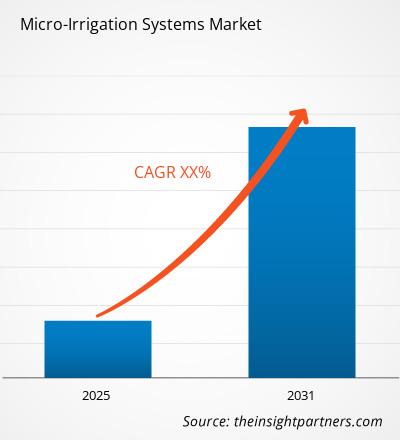
2025 Market Size
US$ 13.3 Bn
Base year value
2034 Forecast
US$ 32.14 Bn
Projected by 2034
CAGR 2026-2034
10.30 %
Growth rate
Addressable Market
US$ 201.74 Bn
(2026-2034)
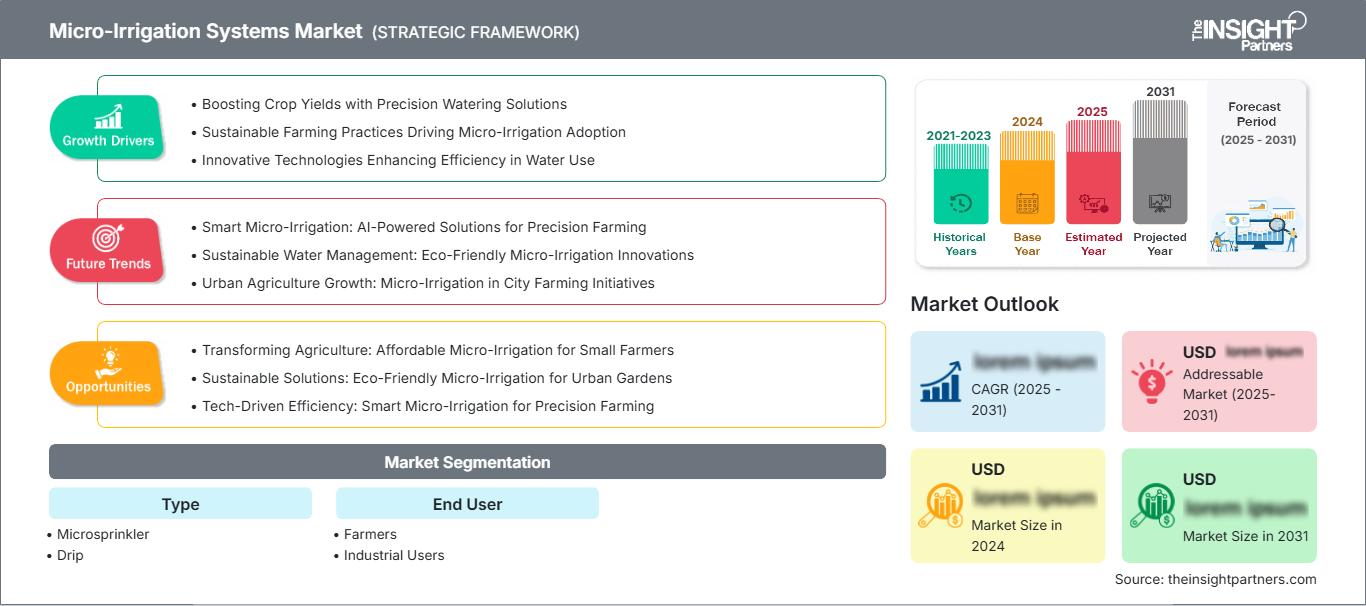
The Micro-Irrigation Systems Market is projected to grow from US$ 13.3 Billion in 2025 to US$ 32.14 Billion by 2034, registering a CAGR of 10.30% during 2026–2034. Demand is being shaped by water scarcity, precision agriculture adoption, protected cultivation, and rising pressure to improve farm productivity without increasing freshwater withdrawals.
Across North America, adoption is expected to expand at a CAGR of 8.8–9.6% as growers invest in automation, fertigation, and water-efficient equipment. The Micro-Irrigation Systems Market size in the region is supported by drought management policies, high-value crop acreage, and replacement of legacy sprinkler infrastructure with digitally monitored drip and microsprinkler platforms.
Micro-Irrigation Systems Market Assessment and Insights
- North America held 24–27% share in 2025 and is expected to grow at an 8.8–9.6% CAGR between 2026–2034, driven by orchard irrigation upgrades, drought response programs, and automation-led water savings.
- US represented 78–82% of North America in 2025 and is projected to grow at an 8.7–9.5% CAGR between 2026–2034, supported by specialty crops.
- Europe accounted for 18–21% share in 2025 and is expected to grow at a 7.8–8.6% CAGR between 2026–2034, led by Spain, Italy, France, and Germany.
- Asia Pacific held 39–42% share in 2025 and is projected to grow at an 11.2–12.4% CAGR between 2026–2034, with China and India leading subsidized adoption.
- Largest Segment Drip held 58–62% market share in 2025 and is expected to grow at a 10.4–11.2% CAGR between 2026–2034 due to water efficiency.
- High Growth Segment Farmers held 68–72% market share in 2025 and are expected to grow at an 10.8–11.8% CAGR between 2026–2034 through subsidy-led uptake.
- Key companies analyzed in detail: EPC Industries Limited, Hunter Industries Incorporated, Irritec S.p.A., Jain Irrigation Systems Limited, Lindsay Corporation, Nelson Irrigation Corporation, Netafim Limited, Rivulis Irrigation Ltd., The Toro Company, and T-L Irrigation Co.
Source: The Insight Partners' analysis based on proprietary research, government publications, company annual reports, investor presentations, industry databases, and expert interviews.
From being a specialized technology for particular crops to becoming one of the primary tools for water productivity for those farms that experience unreliable rains and dwindling water tables, micro-irrigation has become an essential agricultural solution. This change has been reflected through the development of emitters into pressure-compensating drippers, filters, fertigation injectors, and web-connected irrigation systems.
The future of the industry is expected to be defined by the growth in Asia, the Middle East, and drought areas in the Americas, where there are increasingly restrictive policies governing the allocation of water. It is also anticipated that government funding, carbon-friendly agriculture practices, and commercial horticulture will stimulate demand for irrigation solutions.
Micro-Irrigation Systems Market Report Scope
| Report Attribute | Details |
|---|---|
| Market size in 2025 | US$ 13.3 Billion |
| Market Size by 2034 | US$ 32.14 Billion |
| Global CAGR (2026 - 2034) | 10.30% |
| Historical Data | 2021-2024 |
| Forecast period | 2026-2034 |
Micro-Irrigation Systems Market Analysis
The Micro-Irrigation Systems Market growth is supported by the need to raise crop output while reducing water withdrawals. FAO-linked water-efficiency benchmarks and national programs, such as India’s Per Drop More Crop scheme, show why farms are moving from flood irrigation to precise root-zone delivery. Demand is strongest in orchards, vegetables, vineyards, nurseries, and protected cultivation, where yield losses from moisture stress are costly.
Polymer suppliers, emitter suppliers, filters, distributors, agronomists, installation technicians, and digital irrigation systems are some components of the value chain. Positive supply chain dynamics include standardization of tubes, pressure regulation, and controllers' compatibility. But the uptake still relies heavily on funding, installation, water filtration, and education of farmers.
As per the competitive analysis, the competitive rivalry will focus on product quality, distribution networks, agronomy support, and digital irrigation technology. Netafim Limited, Jain Irrigation Systems Limited, Rivulis Irrigation Ltd., and Irritec S.p.A. focus on the drip irrigation system, while Hunter Industries Incorporated, Nelson Irrigation Corporation, The Toro Company, Lindsay Corporation, EPC Industries Limited, and T-L Irrigation Co. concentrate on sprinkler systems, controllers, and field irrigation solutions.
Investment is moving toward local manufacturing, AI-supported fertigation, remote monitoring, and dealership service capacity. Strategic positioning increasingly favors companies that can combine hardware with agronomic recommendations, maintenance support, and financing partnerships. This is especially important in subsidy-driven markets where procurement quality and after-sales performance influence repeat demand.
● REPORT CUSTOMIZATION
Tailor This Report To Align With Your Specific Business Requirements
This report can be customized to align precisely with your business objectives, scope, and target markets. Customization options include tailored segmentation, geography, competitive analysis, and strategic insights to support informed decision-making.
Customize This Report →WHAT YOU CAN ADJUST
- ● Segmentations
- ● Geography
- ● Competitive Analysis
- ● Language Preferences
Micro-Irrigation Systems Market: Strategic Insights
Regional Insights
North America Micro-Irrigation Systems Market
North America represented 24–27% share in 2025, with an 8.8–9.6% CAGR expected through 2034. The Micro-Irrigation Systems Market share is anchored in California, the Pacific Northwest, Mexico’s export horticulture corridors, and Canadian greenhouse clusters. Drought exposure, labor constraints, and crop insurance sensitivity are encouraging growers to replace broad irrigation with controlled drip and microsprinkler systems. Regional adoption is increasingly tied to automation, fertigation, and water accounting. Specialty crop producers value uniform application because almonds, grapes, berries, vegetables, and nursery crops respond directly to moisture precision. Suppliers also benefit from replacement cycles because emitters, filters, and control valves require periodic upgrades in hard-water operating conditions.
U.S. Micro-Irrigation Systems Market
The U.S. accounted for 78–82% of North America in 2025 and is expected to post an 8.7–9.5% CAGR during 2026–2034. Adoption is strongest in high-value crops where irrigation scheduling affects grade, size, and packout. Western drought rules and groundwater regulation are moving growers toward metered, zone-based systems. The company's base is well established. The Toro Company, Hunter Industries Incorporated, Nelson Irrigation Corporation, Lindsay Corporation, and T-L Irrigation Co. support domestic channels. At the same time, Netafim Limited and Rivulis Irrigation Ltd. serve specialty growers through dealer and project networks. Applications are expanding from orchards into vineyards, berries, nurseries, and controlled-environment farming.
Europe Micro-Irrigation Systems Market
Europe held 18–21% share in 2025 and is projected to grow at a 7.8–8.6% CAGR through 2034. Spain remains the leading country because water-stressed fruit, olive, vegetable, and vineyard areas require efficient delivery. Italy and France follow through with orchard modernization and protected crop adoption, while Germany contributes through equipment standards and greenhouse applications. The UK is smaller but relevant for horticulture, nurseries, and controlled-environment farms. Southern Europe’s demand is more structurally water-driven, with France, Italy, and Spain prioritizing irrigation scheduling as heat stress intensifies. EU water efficiency objectives and farm modernization grants support adoption, but fragmented landholding and permitting delays keep growth below Asia Pacific.
APAC Micro-Irrigation Systems Market
Asia Pacific accounted for 39–42% share in 2025 and is expected to grow at an 11.2–12.4% CAGR during 2026–2034. China leads regional revenue, while India records rapid adoption through subsidy support and broad smallholder outreach. Japan, South Korea, and Australia contribute through greenhouse, orchard, and water-scarce farming systems. Industrial users in food processing, landscaping, and mining rehabilitation are also adopting controlled irrigation. Policy-backed water conservation and higher-value crops make the region the central growth engine for the market.
Middle East & Africa Micro-Irrigation Systems Market
The Middle East and Africa are expected to grow at a 9.6–10.8% CAGR through 2034. Saudi Arabia leads regional demand as controlled agriculture, greenhouse farming, and food security investments expand under water-constrained conditions. The UAE supports high-technology greenhouse and landscape irrigation, while South Africa uses drip and microsprinklers for fruit exports and vineyards. Rest of MEA demand is linked to donor-funded agriculture, desalination-linked water management, and infrastructure projects where precise application reduces pumping energy and operating costs.
Segmentation Analysis
Type
Type is projected to grow at a 10.0–11.0% CAGR during 2026–2034. The market scope by type reflects two distinct buying logics: drip systems are selected for root-zone precision, while microsprinklers support orchards, nurseries, and cooling needs. Product selection depends on crop spacing, soil type, filtration quality, pressure availability, and maintenance capability.
- Microsprinkler demand is strongest in orchards, nurseries, and frost or heat management applications where wider wetting patterns, canopy cooling, and flexible placement support perennial crop productivity.
- Drip remains the largest type because it delivers water and nutrients directly to roots, lowers evaporation, and suits vegetables, vineyards, orchards, and protected cultivation.
End User
End User is projected to grow at a 10.5–11.5% CAGR during 2026–2034. Farmers dominate procurement because irrigation directly affects yields, input efficiency, and crop quality. Industrial users are increasing adoption in landscaping, greenhouse complexes, and process-adjacent water management, but farm-level demand remains larger because it is supported by subsidies and agronomic returns.
- Farmers represent the high-growth end user base as subsidies, drought risk, high-value crops, and yield improvement needs encourage installation across small, medium, and commercial farms.
- Industrial Users adopt systems for greenhouse estates, landscaping, mining rehabilitation, and institutional water management, where precise application supports compliance, operating efficiency, and measurable water savings.
Opportunity Snapshot
| End User | Revenue Contribution | Trend Tag | Adoption Stage |
| Farmers | High | Subsidy Uptake | Scaling |
| Industrial Users | Medium | Water Compliance | Emerging |
Micro-Irrigation Systems Market Growth Drivers and Impact Analysis
Water Scarcity Forces Precision Irrigation Investment
Water scarcity will be the most persistent market driver due to the fact that agriculture comprises the largest proportion of fresh water usage in many areas. In such an environment, the only choice that the growers have is to increase irrigation efficiency or decrease the area of land cultivated. Technologies like drip irrigation and micro-sprinklers provide a solution to this problem through the direct watering of plant roots, which results in a reduction of evaporating losses, runoff and unequal water distribution. These technologies allow growing the same volume of crops and providing the same quality of produce with significantly less water usage than other irrigation methods. This effect is especially evident when we speak about high-value crops, including orchards, vineyards, vegetables and greenhouse plants, since the shortage of water in their case results in a reduction of productivity and quality. This leads to the increased importance of the purchase of advanced filters, pressure regulators, fertilizer injection devices and sensors that monitor the irrigation process and optimize its performance.
Subsidies Reduce Payback Periods for Farmers
The government helps in promoting this technology by lowering the entry barrier through subsidies, thereby helping in reducing the cost factor. In India, there is the PDMC scheme, which has helped in covering millions of hectares under drip irrigation and sprinklers. With such a subsidy program, farmers have been encouraged to embrace this technology before being forced to do so through regulation. The effect on the market is that the subsidized vendors have to be able to conform to certain standards.
High-Value Crops Increase Return on System Upgrades
Crop economics strongly influence adoption within the Micro-Irrigation Systems Market because the technology delivers the strongest return on investment in high-value crops, where yield, quality, and resource efficiency have a direct impact on farm profitability. There is a direct correlation between water and nutrient management and crop sizing, consistency, and aesthetic qualities in fruit and nut trees, vegetables, vineyards, nurseries, and greenhouse crops, which improves their marketability and therefore increases the appeal of micro-irrigation technology in these sectors. By improving plant hydration and fertilizer absorption, micro-irrigation technology may increase productivity and product quality in fruit and vegetable operations. As consumers shift towards consuming fresh produce and require high-quality produce throughout the supply chain, there is an increasing willingness among producers to implement irrigation technology to achieve predictable results. This leads to the installation of micro-irrigation technologies as well as a continuous flow of orders for emitters, valves, filters, control units, and fertigation components.
Micro-Irrigation Systems Market Future Trends
AI-Enabled Fertigation and Irrigation Scheduling
Micro-Irrigation Systems Market trends are moving toward AI-enabled fertigation that combines soil moisture, crop stage, weather, and nutrient data into automated recommendations. The next competitive frontier will not be only emitter efficiency but decision quality. Platforms that convert field data into irrigation prescriptions can reduce fertilizer waste, prevent moisture stress, and simplify management for large farms. As connectivity improves, dealers may sell subscription-based agronomy services alongside hardware, creating recurring revenue and stronger customer retention.
Localized Manufacturing and Modular System Design
Localized production is anticipated to grow increasingly relevant, as government policies link agricultural modernization efforts with domestic manufacturing strengths. The setting up of regional production facilities allows for better meeting of the local content policies and increased product availability and responsiveness to the demand in the market. The modular nature of such systems also contributes to this trend by allowing for the provision of scalable systems that will meet the demands of smallholder and commercial farmers equally well. This practice allows minimizing freight costs, reducing delivery time, and providing more accessible spare parts and replacements that are essential for system's operation during growing season. In many developing or subsidizing countries, the purchasing decision not only depends on the cost of the equipment but also on the availability of installation services, maintenance and availability of parts and replacement. Therefore, a company with standardized, affordable products and a strong network of distribution, installation, and maintenance will gain more traction in the market.
Micro-Irrigation Systems Market Opportunities
Smallholder Financing Bundled with Installation Services
Micro-Irrigation Systems Market Forecasts indicate that financing will be as important as technology in unlocking demand. Smallholder farmers often recognize water-saving benefits but delay adoption because of upfront costs, uncertain subsidy timing, and maintenance concerns. Suppliers can capture opportunities by bundling equipment, installation, training, and seasonal payment plans through cooperatives, banks, and government channels. This approach reduces adoption friction and builds long-term service relationships. It also helps vendors differentiate beyond price in markets where low-cost components can undermine system reliability.
Industrial Water Efficiency Beyond Farm Applications
Industrial users represent an underpenetrated growth opportunity for the Micro-Irrigation Systems Market as water conservation, environmental compliance, and operating cost reduction become increasingly important across non-agricultural sectors. Organizations are under growing pressure to document water usage, meet sustainability targets, and improve resource efficiency, creating demand for precise irrigation technologies beyond traditional farming applications. Greenhouses, cityscapes, athletic facilities, mining restoration sites, and food processing plants can all profit from micro-irrigation systems, which can save water through efficient delivery while offering tangible results from proper water management. The attraction in this case stems from the fact that most of these potential customers need systems of high quality and professionalism that they are ready to buy at a cost that will help them achieve their goals. Vendors who have succeeded in developing irrigation technology suitable for industries and businesses can tap into higher-margin markets. The best prospects for them will include equipment that has the ability to measure performance using software and maintenance services.
Recent Developments
- June 2026: Orbia Advance Corporation, S.A.B. de C.V., Precision Agriculture business group Netafim announced the opening of a new manufacturing plant in Hermosillo, Sonora, Mexico. The facility expands Orbia Netafim’s global production capacity and improves service across North and Central America. The Hermosillo facility will be one of Orbia Netafim’s largest manufacturing plants and marks the company’s third production site in Mexico. The 30,000-square-meter facility meets growing demand for precision irrigation across the region. The plant features advanced automation designed to support consistent quality, efficiency and reliability, while enabling responsible manufacturing practices. It will primarily produce thin-wall drip irrigation solutions, with the future introduction of dedicated heavy-wall dripline production.
- February 2025: Orbia Advance Corporation’s S.A.B. de C.V., Precision Agriculture business Netafim, announced the launch of its patented Hybrid Dripline system, the world’s first and only integral dripline with a built-in outlet. Orbia Netafim’s Hybrid Dripline system simplifies irrigation operations with a pre-assembled outlet that eliminates some of the most labor-intensive tasks of greenhouse crop, orchard and vineyard care, like the need for manual hole-punching or fitting migration rings by maintaining a fixed dropping point, to accommodate different tree growth stages.
- July 2024: Rivulis collaborates with Phytech to represent a major step forward in sustainable farming. The partnership combines Rivulis’ global presence and leadership in micro irrigation products and solutions with Phytech’s cutting-edge real-time plant health and hydraulic monitoring and automation technology.
Frequently Asked Questions

- Comprehensive Market Sizing and Forecast Analysis
- Detailed Segmentation Analysis
- In-Depth Market Dynamics Assessment
- Regional and Country-Level Insights
- Competitive Landscape and Company Benchmarking
- Strategic Business Intelligence
Recent Reports
Testimonials

The Insight Partners provided valuable market intelligence that supported our global go-to-market strategy. Their team was professional, responsive, and attentive to our feedback, providing thoughtful analysis and helpful methodological clarifications throughout the project.
Junmo Kim Chief Financial Officer (CFO), Enertech Co., Ltd.
The Insight Partners' SCADA System Market report is comprehensive, with valuable insights on current trends and future forecasts. The team was highly professional, responsive, and supportive throughout. We are very satisfied and highly recommend their services.
RAN KEDEM Partner, Reali Technologies LTDs
I requested a report on a very specific software market and the team produced the report in a few days. The information was very relevant and well presented. I then requested some changes and additions to the report. The team was again very responsive and I got the final report in less than a week.
JEAN-HERVE JENN Chairman, Future Analytica
We worked with The Insight Partners for an important market study and forecast. They gave us clear insights into opportunities and risks, which helped shape our plans. Their research was easy to use and based on solid data. It helped us make smart, confident decisions. We highly recommend them.
PIYUSH NAGPAL Sr. Vice President, High Beam Global
The Insight Partners delivered insightful, well-structured market research with strong domain expertise. Their team was professional and responsive throughout. The user-friendly website made accessing industry reports seamless. We highly recommend them for reliable, high-quality research services
YUKIHIKO ADACHI CEO, Deep Blue, LLC.
This is the first time I have purchased a market report from The Insight Partners.While I was unsure at first, I visited their web site and felt more comfortable to take the risk and purchase a market report.I am completely satisfied with the quality of the report and customer service. I had several questions and comments with the initial report, but after a couple of dialogs over email with their analyst I believe I have a report that I can use as input to our strategic planning process.Thank you so much for taking the extra time and making this a positive experience.I will definitely recommend your service to others and you will be my first call when we need further market data.
JOHN SUZUKI President and Chief Executive Officer, Board Director, BK Technologies
I wish to appreciate your support and the professionalism you displayed in the course of attending to my request for information regarding to infectious disease IVD market in Nigeria. I appreciate your patience, your guidance, and the fact that you were willing to offer a discount, which eventually made it possible for us to close a deal. I look forward to engaging The Insight Partners in the future, all thanks to the impression you have created in me as a result of this first encounter.
DR CHIJIOKE ONYIA MANAGING DIRECTOR, PineCrest Healthcare Ltd.Reason to Buy
- Informed Decision-Making
- Understanding Market Dynamics
- Competitive Analysis
- Identifying Emerging Markets
- Customer Insights
- Market Forecasts
- Risk Mitigation
- Boosting Operational Efficiency
- Strategic Planning
- Investment Justification
- Tracking Industry Innovations
- Aligning with Regulatory Trends





 Get Free Sample for