Middle East & Africa Non-Emergency Medical Transportation Market Strategies, Top Players, Growth Opportunities, Analysis and Forecast by 2031
Middle East & Africa Non-Emergency Medical Transportation Market Size and Forecast (2021 - 2031), Regional Share, Trend, and Growth Opportunity Analysis Report Coverage: By Service Type (Private Pay Patient Transportation, Insurance Backed Patient Transportation, Courier Services, and Others), Facility (Intra-Facility and Inter-Facility), Application (Dialysis, Routine Doctor Visits, Mental Health Related Appointments, Rehabilitation, and Others), and End User (Hospitals and Clinics, Nursing Homes, Homecare Settings, MCO and State Agencies, Healthcare Payers, and Others)
Historic Data: 2021-2023 | Base Year: 2024 | Forecast Period: 2025-2031- Report Code : TIPRE00041645
- Category : Life Sciences
- No. of Pages : 192
- Available Report Formats :


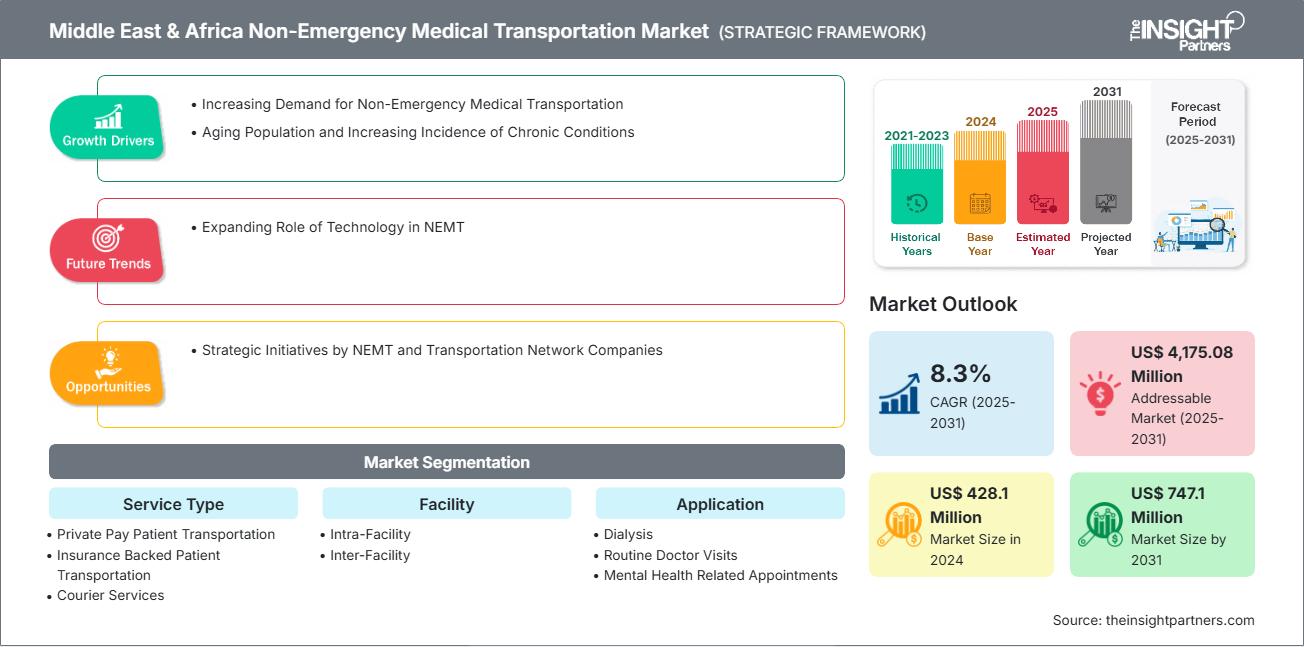
The Middle East and Africa Non-Emergency Medical Transportation Market size is expected to reach US$ 747.1 Million by 2031 from US$ 428.1 Million in 2024. The market is estimated to record a CAGR of 8.3% from 2025 to 2031.
Executive Summary and Middle East and Africa Non-Emergency Medical Transportation Market Analysis:
The Middle East & Africa non-emergency medical transportation (NEMT) market can be segmented into Saudi Arabia, South Africa, UAE and the Rest of the Middle East and Africa. The market is growing steadily, particularly due to the increasing number of people with chronic diseases like diabetes, cardiovascular diseases and respiratory disease and their need for regular medical appointments and transportation needs. Further, various government plans related to increased healthcare access and patient mobility support are compounding growth. Saudi Arabia is investing in enhanced healthcare infrastructure and public-private partnerships for patient transport improvements; the UAE is also enhancing public transportation patient transport services. South Africa is strengthening community healthcare systems for timely and safe transportation for elderly and disabled patients. Overall awareness of healthcare in the region, along with improvement in medical facilities and supportive government policy will lead to significant opportunities for NEMT providers in the future.
Customize This Report To Suit Your Requirement
Get FREE CUSTOMIZATIONMiddle East & Africa Non-Emergency Medical Transportation Market: Strategic Insights
-
Get Top Key Market Trends of this report.This FREE sample will include data analysis, ranging from market trends to estimates and forecasts.
Middle East and Africa Non-Emergency Medical Transportation Market Segmentation Analysis:
- By Service Type, the Middle East and Africa Non-Emergency Medical Transportation Market is segmented into Private Pay Patient Transportation, Insurance Backed Patient Transportation, Courier Services, and Others. Private Pay Patient Transportation held the largest share of the market in 2024.
- By Facility, the Middle East and Africa Non-Emergency Medical Transportation Market is segmented into Intra-Facility and Inter-Facility. Inter-Facility held a larger share of the market in 2024.
- By Application, the Middle East and Africa Non-Emergency Medical Transportation Market is segmented into Dialysis, Routine Doctor Visits, Mental Health Related Appointments, Rehabilitation, and Others. Mental Health Related Appointments held the largest share of the market in 2024.
- By End User, the Middle East and Africa Non-Emergency Medical Transportation Market is segmented into Hospitals and Clinics, Nursing Homes, Homecare Settings, MCO and State Agencies, Healthcare Payers, and Others. Hospitals and Clinics held the largest share of the market in 2024.
Middle East & Africa Non-Emergency Medical Transportation Market Report Scope
| Report Attribute | Details |
|---|---|
| Market size in 2024 | US$ 428.1 Million |
| Market Size by 2031 | US$ 747.1 Million |
| CAGR (2025 - 2031) | 8.3% |
| Historical Data | 2021-2023 |
| Forecast period | 2025-2031 |
| Segments Covered |
By Service Type
|
| Regions and Countries Covered |
Middle East and Africa
|
| Market leaders and key company profiles |
|
Middle East & Africa Non-Emergency Medical Transportation Market Players Density: Understanding Its Impact on Business Dynamics
The Middle East & Africa Non-Emergency Medical Transportation Market is growing rapidly, driven by increasing end-user demand due to factors such as evolving consumer preferences, technological advancements, and greater awareness of the product's benefits. As demand rises, businesses are expanding their offerings, innovating to meet consumer needs, and capitalizing on emerging trends, which further fuels market growth.

Middle East and Africa Non-Emergency Medical Transportation Market Outlook
Service providers and users are likely to benefit from the technologically advanced NEMT solutions in the coming years. States, brokers, MCOs, providers, drivers, and beneficiaries can focus on utilizing technologies, such as GPS tracking, electronic scheduling software in NEMT, artificial intelligence (AI), and data analytics, which are strengthening program integrity and improving on-time performance, along with customer satisfaction.
GPS data, usually collected through a smartphone or tablet in vehicles, documents the date, time, and location for each pickup and drop-off to determine the genuineness and authorization of trips. They can also be used to track real-time performance. Furthermore, more advanced GPS technology (real-time location monitoring) can allow brokers to track drivers who are likely to arrive late at the commuter's location and assign new ones without delay to ensure that the appointments are not missed. When coupled with a beneficiary-facing application, GPS capability can also provide riders with real-time information about estimated pickup times.
Integrating the newest route-building and GPS features into the process enhances transparency, which, in turn, promotes accountability. Additionally, digitizing rides positively impacts the overall quality of NEMT services. Soon, all NEMT rides will be completely digitized, and then essential metrics related to ride quality based on driving parameters and rider feedback can be monitored at both the individual ride level and aggregated at the transportation provider level. For transportation providers, this will streamline the entire process, reduce missed connections and ensuring that transportation availability meets patient demand effectively.
With the evolution of the NEMT sector, innovations such as AI and data analytics are leading to substantial enhancements in efficiency and reliability. AI will help streamline scheduling and routing processes, minimizing no-show rates and ensuring timely transportation. Meanwhile, data analytics will provide valuable insights for optimal resource allocation and strategic planning. These advancements will enable healthcare facilities to ensure reliable patient transport, improve appointment adherence, and ultimately achieve better health outcomes. In April 2025, Dubai's Roads & Transport Authority (RTA) announced a partnership with WeRide and Uber to start deploying autonomous taxis through the Uber platform. The goal is to launch trials this year, which will lead to commercial autonomous operations by 2026. This will improve accessibility, safety, and mobility options. This tech-driven deployment could be used for NEMT services, providing smoother and more efficient transport for patients with mobility issues or routine medical appointments. This integrated tech initiative shows a future trend and opportunity in the NEMT market.
Technological innovation also encourages transparent and dependable practices in NEMT, which is likely to boost NEMT services without compromising the newest standards. Hence, the growing use of technology in NEMT is expected to become a key trend in the market during the forecast period.
Middle East and Africa Non-Emergency Medical Transportation Market Country Insights
By country, the Middle East and Africa Non-Emergency Medical Transportation Market is segmented into Saudi Arabia, South Africa, the United Arab Emirates, and the Rest of Middle East and Africa. South Africa held the largest share in 2024.
The lack of timely access to healthcare results in missed appointments, which significantly contribute to avoidable morbidity and mortality, as well as inefficiencies in service delivery. In the absence of reliable and affordable public or private transport systems, a non-emergency patient transport (NEPT) service provides free/paid transportation to patients. According to Statistics South Africa, in 2022, approximately 5 million people in South Africa were 60 or older, which represented 9.2% of the total South African population. The non-emergency medical transportation providers offer transportation for individuals who are elderly or have a disability and have no means of transportation to non-urgent medical appointments or social outings. Emergency Medical Rescue Services has made significant progress with the implementation of the Planned Patient Transport program, which includes non-emergency referrals between hospitals and clinics to hospitals for indigent people with no other means of transport. Thus, an effective non-emergency patient transport system is essential for ensuring patient access to healthcare while also acknowledging the challenges of providing affordable and limited resources more broadly. South Africa's National Health Insurance has no provisions for non-emergency patient transport services. However, the country has made attempts to provide accessible transport programs, for example, the planned patient transportation program in the Northwest Department of Health and the Dial-a-Ride transport program in Cape Town. Thus, the increasing demand for non-emergency medical transportation is likely to favor the growth of the market.
Middle East and Africa Non-Emergency Medical Transportation Market Company Profiles
Some of the key players operating in the market include AMR, ABC Non-Emergency Medical Transportation, LLC, MTM, Inc., Xpress Transportation, CJ Medical Transportation, VERIDA, Elite Medical Transport, Acadian Ambulance Service, Crothall Healthcare, ModivCare, Ride Health, Roundtrip, Transdev, One Call, Medical Answering Services, LLC, Abba Medical Transportation, LLC, Able Medical Transportation, Inc., Life Ride, Stellar Transport, and Mobility Transportation Services, Inc.
These players are adopting various strategies such as expansion, product innovation, and mergers and acquisitions to provide innovative products to their consumers and increase their market share.
Middle East and Africa Non-Emergency Medical Transportation Market Research Methodology
The following methodology has been followed for the collection and analysis of data presented in this report:
Secondary Research
The research process begins with comprehensive secondary research, utilizing internal and external sources to gather qualitative and quantitative data for each market. Commonly referenced secondary research sources include, but are not limited to:
- Company websites, annual reports, financial statements, broker analyses, and investor presentations
- Industry trade journals and other relevant publications
- Government documents, statistical databases, and market reports
- News articles, press releases, and webcasts specific to companies operating in the market
Note:
All financial data included in the Company Profiles section has been standardized to US$. For companies reporting in other currencies, figures have been converted to US$ using the relevant exchange rates for the corresponding year.Primary Research
The Insight Partners conducts a significant number of primary interviews each year with industry stakeholders and experts to validate its data analysis and gain valuable insights. These research interviews are designed to:
- Validate and refine findings from secondary research
- Enhance the expertise and market understanding of the analysis team
- Gain insights into market size, trends, growth patterns, competitive dynamics, and future prospects
Primary research is conducted via email interactions and telephone interviews, encompassing various markets, categories, segments, and sub-segments across different regions. Participants typically include:
- Industry stakeholders: Vice Presidents, Business Development Managers, Market Intelligence Managers, and National Sales Managers
- External experts: Valuation specialists, research analysts, and key opinion leaders with industry-specific expertise

- Historical Analysis (2 Years), Base Year, Forecast (7 Years) with CAGR
- PEST and SWOT Analysis
- Market Size Value / Volume - Regional, Country
- Industry and Competitive Landscape
- Excel Dataset
Recent Reports
Testimonials

The Insight Partners' SCADA System Market report is comprehensive, with valuable insights on current trends and future forecasts. The team was highly professional, responsive, and supportive throughout. We are very satisfied and highly recommend their services.
RAN KEDEM Partner, Reali Technologies LTDs
I requested a report on a very specific software market and the team produced the report in a few days. The information was very relevant and well presented. I then requested some changes and additions to the report. The team was again very responsive and I got the final report in less than a week.
JEAN-HERVE JENN Chairman, Future Analytica
We worked with The Insight Partners for an important market study and forecast. They gave us clear insights into opportunities and risks, which helped shape our plans. Their research was easy to use and based on solid data. It helped us make smart, confident decisions. We highly recommend them.
PIYUSH NAGPAL Sr. Vice President, High Beam Global
The Insight Partners delivered insightful, well-structured market research with strong domain expertise. Their team was professional and responsive throughout. The user-friendly website made accessing industry reports seamless. We highly recommend them for reliable, high-quality research services
YUKIHIKO ADACHI CEO, Deep Blue, LLC.
This is the first time I have purchased a market report from The Insight Partners.While I was unsure at first, I visited their web site and felt more comfortable to take the risk and purchase a market report.I am completely satisfied with the quality of the report and customer service. I had several questions and comments with the initial report, but after a couple of dialogs over email with their analyst I believe I have a report that I can use as input to our strategic planning process.Thank you so much for taking the extra time and making this a positive experience.I will definitely recommend your service to others and you will be my first call when we need further market data.
JOHN SUZUKI President and Chief Executive Officer, Board Director, BK Technologies
I wish to appreciate your support and the professionalism you displayed in the course of attending to my request for information regarding to infectious disease IVD market in Nigeria. I appreciate your patience, your guidance, and the fact that you were willing to offer a discount, which eventually made it possible for us to close a deal. I look forward to engaging The Insight Partners in the future, all thanks to the impression you have created in me as a result of this first encounter.
DR CHIJIOKE ONYIA MANAGING DIRECTOR, PineCrest Healthcare Ltd.Reason to Buy
- Informed Decision-Making
- Understanding Market Dynamics
- Competitive Analysis
- Identifying Emerging Markets
- Customer Insights
- Market Forecasts
- Risk Mitigation
- Boosting Operational Efficiency
- Strategic Planning
- Investment Justification
- Tracking Industry Innovations
- Aligning with Regulatory Trends




 Get Free Sample For