
Mixer Wagons Market Growth, Size & Forecast by 2034
Coverage: By Mobility (Self-Propelled, Trailed); Capacity (Small, Medium, Large); Application (Agriculture, Zoos, Others) , and Geography (North America, Europe, Asia Pacific, and South and Central America)
- Status : Data Released
- Report Code : TIPRE00018579
- Category : Manufacturing and Construction
- No. of Pages : 150
- Available Report Formats :


- Last update date : July 24, 2026


2025 Market Size
US$ 902.39 Mn
Base year value
2034 Forecast
US$ 1,284.26 Mn
Projected by 2034
CAGR 2026-2034
4.00 %
Growth rate
Addressable Market
US$ 9,931.80 Mn
(2026-2034)
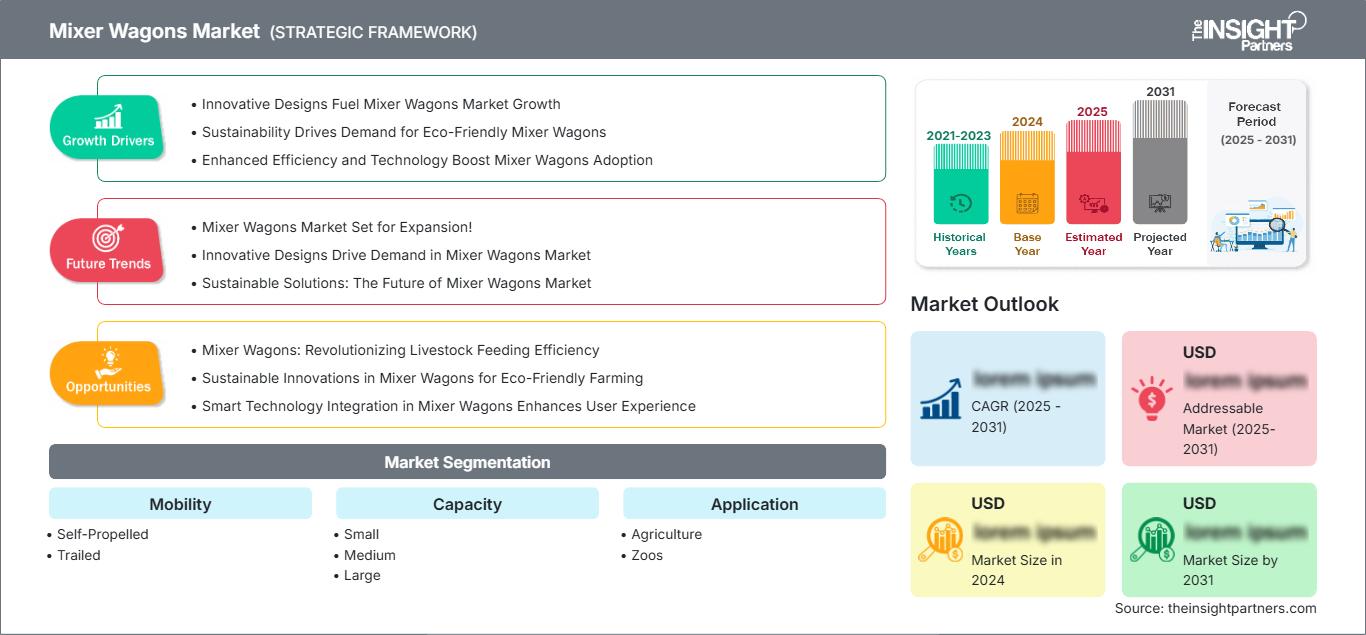
The Mixer Wagons Market size stood at US$ 902.39 Million in 2025 and is estimated to be at US$ 1,284.26 Million in 2034; with anticipated CAGR to be 4.00% during 2026-2034. The market demand is influenced by dairy herd consolidation, accurate ration, and shortage of labor, while manufacturers are continuously developing trailed and self-propelled mixer wagons to ensure accurate feed mixing in cattle, zoo, and exotic livestock operations.
In North America, the market growth is expected to range between 3.6% and 4.2% CAGR, driven by larger herds, increased feed costs, and the need for accurate rationing, among others. The market size of Mixer Wagons Market in North America is also driven by precision feeding technology, dealer network, and need to reduce the manual mixing of feeds due to labor shortages in dairy operations.
Mixer Wagons Market Assessment and Insights
- North America accounted for 31–34% share in 2025 and is expected to grow at a CAGR of 3.6–4.2% during 2026–2034, led by large dairy farms and mechanized feed management.
- US represented 72–76% of North America in 2025 and is projected to grow at a CAGR of 3.5–4.1% during 2026–2034, supported by herd consolidation.
- Europe held 29–32% share in 2025 and is expected to grow at a CAGR of 3.2–3.8% during 2026–2034, with Germany, France, Italy, Spain, and the UK leading adoption.
- Asia Pacific captured 22–25% share in 2025 and is projected to grow at a CAGR of 4.8–5.4% during 2026–2034, led by China, India, Japan, South Korea, and Australia.
- Largest Segment Agriculture held 88–92% market share in 2025 and is expected to grow at a CAGR of 3.8–4.4% during 2026–2034, reflecting daily feed demand.
- High Growth Segment Self-Propelled equipment held 24–28% market share in 2025 and is forecast to grow at a CAGR of 5.0–5.8% during 2026–2034.
- Key companies analyzed in detail: Alltech Farming Solutions Ltd., BvL Maschinenfabrik GmbH and Co. KG, DeLaval Inc., Faresin Industries S.p.A., Grupo Tatoma, KUHN SAS, Seko Industries Srl, SITREX S.p.A., Trioliet B.V., Valton Feeding Solutions Pty Ltd.
Source: The Insight Partners' analysis based on proprietary research, government publications, company annual reports, investor presentations, industry databases, and expert interviews.
The equipment used in the Mixer Wagons market has shifted from conventional mechanical mixing technology to advanced digital ration preparation, integrated weighing, and sturdier auger and tub designs. This has been prompted by the increasing trend of farms using the machine in the processing of silage, haylage, concentrates, minerals, and by-products in batches. There is growing emphasis on modular technology, resistant liners and dealer-based maintenance due to the direct impact of feed interruptions on milk production, livestock well-being, and manpower scheduling.
In the future, the emergence of dairy belts in Asia Pacific and the Middle East will drive adoption rates as farms shift from hand-mixing feed to total mixed rations. The investments made would focus on the use of medium and high capacity machines, self-propelled machinery, and advanced weighing systems.
Mixer Wagons Market Report Scope
| Report Attribute | Details |
|---|---|
| Market size in 2025 | US$ 902.39 Million |
| Market Size by 2034 | US$ 1,284.26 Million |
| Global CAGR (2026 - 2034) | 4.00% |
| Historical Data | 2021-2024 |
| Forecast period | 2026-2034 |
Mixer Wagons Market Analysis
The market growth is tied to intensifying dairy production, increased volatility of feed raw materials, and the demand for enhanced feed efficiency. The growth profile of the market is tied to OECD-FAO projections of an annual increase of 1.8% in global milk production to 2034, driven largely by increased productivity that elevates the importance of accurate feeding. Farms implementing TMR systems utilize mixer wagons to reduce sorting, ensure constant intake of dry matter and proper handling of multiple ingredients.
The supply chain consists of steel processing, auger manufacturing, weighing equipment, hydraulic equipment, conveyor belts, distributors, and aftersales support services. Market supply conditions are affected by steel prices, engine emission compliance expenses, and dealership spread in different regions. Customers evaluate capacity, discharge system, longevity of tubs, and aftersales services and not just the price, especially when deliveries occur multiple times per day.
The Mixer Wagons Market Competitive Analysis demonstrates fragmented, technology-specific competition. KUHN SAS and Trioliet B.V. compete via comprehensive trailed and self-propelled product lines, Faresin Industries S.p.A. via electric and digitized feeders. DeLaval Inc. integrates feeder machinery and automation in dairies, and BvL Maschinenfabrik GmbH & Co. KG, Seko Industries Srl, and SITREX S.p.A. excel in comprehensive regional portfolios.
Capital is being allocated to connected weighing and telematics, low-emission drive trains, and increased capacity to cut down on feeding cycles. The specialist positioning of Grupo Tatoma and Valton Feeding Solutions Pty Ltd. is advantageous for them due to the market niche of livestock feeding equipment, whereas that of Alltech Farming Solutions Ltd. enhances the role of consultancy in nutrition. Strategic positioning relies on distribution capabilities, reliability of products, capital allocation opportunities, and ability to provide services for both family and commercial dairies.
● REPORT CUSTOMIZATION
Tailor This Report To Align With Your Specific Business Requirements
This report can be customized to align precisely with your business objectives, scope, and target markets. Customization options include tailored segmentation, geography, competitive analysis, and strategic insights to support informed decision-making.
Customize This Report →WHAT YOU CAN ADJUST
- ● Segmentations
- ● Geography
- ● Competitive Analysis
- ● Language Preferences
Mixer Wagons Market: Strategic Insights
Regional Insights
North America Mixer Wagons Market
North America contributed 31-34% of 2025 revenue and is projected to grow at a 3.6-4.2% CAGR till 2034. North America Mixer Wagons Market share is impacted by the high level of mechanization, large scale of dairy herds, and robust service network. US and Canada producers resort more and more often to total mixed ration systems in order to improve feeding efficiency, reduce losses of components, and provide a stable production of milk solids.
The most significant replacement demand is observed in the cases when the farms modernize the old trailed machinery by replacing it with new more productive or self-propelled versions. Data on the dairy outlook by the USDA show that the operations are stable and productivity-oriented, where feeding accuracy is the key component of profitability. Dealer financing, mobile service, and parts supply contribute to the purchasing decision.
U.S. Mixer Wagons Market
The U.S. comprised 72-76% of North America revenue in 2025 and is expected to exhibit a 3.5-4.1% CAGR during 2026-2034. The demand is driven by dairy-producing states due to herd consolidation which requires repeatable preparation of ration. The preference for farms is on capacity, quick feed out, weighing and reliable support from dealers over less expensive machine options.
Visibility is achieved through a dealer network, demonstrations, and machine availability, either as imported products or locally supported. Agriculture represents a leading application segment, whereas zoos and animal parks use smaller machines for controlled feeding. The demand trend is more favorable to medium and large capacities since there is a desire to have fewer feedings, clean discharge and fewer labor hours per animal.
Europe Mixer Wagons Market
Europe’s 2025 market share was 29–32% and is anticipated to show a 3.2–3.8% CAGR until 2034 due to high demand in Germany, driven by advanced dairy facilities, excellent machine engineering, and efficient feeding practices. The UK market has been driven by labor pressures and feed-related cost considerations. This situation promotes trailed models along with some automation in large herds.
France, Italy, and Spain are three major regions where a wide installed base is maintained owing to the need for versatile feeding machinery at mixed livestock farms. Italy makes contributions to specialized manufacturing through Faresin Industries S.p.A., Seko Industries Srl, and SITREX S.p.A. Emissions, efficiency of feeding, and animal wellbeing continue to drive replacements in machinery in addition to the fragmentation of farms.
APAC Mixer Wagons Market
The APAC segment accounted for 22-25% of the market share in 2025 and is expected to witness the fastest growth, at a CAGR of 4.8-5.4%, during 2026-2034. China dominates the market owing to its large-scale dairy farms, genetics imports, and modern feed management practices. Other countries contributing to the growth include India, Japan, South Korea, and Australia due to dairy modernization and livestock productivity initiatives.
The key industrial drivers are commercial milk processing, contract farming, and increased awareness regarding consistent rations. Government policy on livestock productivity and food security favors mechanization, but price consciousness ensures that small- and mid-size facilities remain important. In Australia, the pasture-based operations adopt mixer wagons only during seasonal feed shortages whereas East Asia farms prefer smaller precision equipment.
Middle East & Africa Mixer Wagons Market
The Middle East and Africa will witness growth at a CAGR of 4.1–4.7% during 2026–2034 with Saudi Arabia at the forefront. The large dairy and camel farms in Saudi Arabia and UAE require consistent feed operations in harsh working environments due to which stable feed rations and robust equipment become necessary. South Africa creates market pull through demand from the commercial dairy and beef farms which use mechanized feeder technology.
Factors like energy consumption, the presence of generators, and servicing become important in purchase decisions, as farms conduct analyses based on these factors. Demand for the rest of the MEA continues to be project-based with integrated dairy farms, food security programs, and foreign equipment being some of the key drivers.
Segmentation Analysis
Mobility
Mobility is expected to grow at a 4.0–4.6% CAGR during 2026–2034 as buyers choose between lower-cost trailed units and productivity-focused self-propelled machines. The Mixer Wagons Market scope across mobility is shaped by herd size, feeding frequency, barn layout, operator availability, and the need to integrate loading, mixing, weighing, and distribution into predictable daily routines.
- Self-Propelled machines serve large farms that need integrated loading, mixing, and discharge in one platform. Demand is rising where labor savings, speed, and digital ration control justify higher capital expenditure.
- Trailed units remain the volume backbone because they match existing tractor fleets and offer flexible capacity choices. They are strategically important for medium farms balancing feed quality with controlled investment.
Capacity
Capacity is projected to expand at a 3.9–4.5% CAGR during 2026–2034 as farms align tub size with herd growth, ingredient density, and feeding cycles. Medium and large models gain preference where operators want fewer batches and faster distribution, while small models remain necessary for specialty barns, zoos, and smaller livestock holdings.
- Small capacity machines fit farms with limited herd sizes, narrow alleys, or specialty feeding tasks. They support precise ration preparation without requiring high tractor power or large storage areas.
- Medium capacity equipment addresses the broadest user base because it balances batch size, maneuverability, and cost. Demand is strongest among expanding dairy farms upgrading from manual or outdated feeding systems.
- Large capacity models are strategically important for commercial dairies and contractor feeding operations. They reduce batch frequency, improve labor productivity, and support centralized feed preparation for high-volume livestock systems.
Application
Application is forecast to grow at a 3.8–4.4% CAGR during 2026–2034, with agriculture remaining dominant because dairy and beef operations require daily ration preparation. Zoos represent a smaller but specialized application where controlled diets, ingredient consistency, and animal-specific feeding schedules support demand for compact, accurate, and easy-clean equipment.
- Agriculture dominates demand because dairy and beef farms use mixed rations daily. Equipment selection is driven by herd size, feed ingredient complexity, ration repeatability, and labor availability.
- Zoos use mixer wagons for controlled feed preparation across herbivores and specialty animals. Demand is niche but important where diet consistency, hygiene, and batch traceability support animal-care protocols.
Opportunity Snapshot
| Application | Revenue Contribution | Trend Tag | Adoption Stage |
| Agriculture | High | Precision Feeding | Mature |
| Zoos | Low | Diet Control | Emerging |
Mixer Wagons Market Growth Drivers and Impact Analysis
Rising Dairy Intensification and Larger Herd Operations
Dairy intensification is a key driver as larger dairy herds need to have repeatable feeding routines, precise rationing and lesser manual effort per unit. According to forecasts by the OECD-FAO which predicts growth of global milk production at the rate of 1.8% per year until 2034, increased productivity rather than increasing herds size will determine competitiveness in the future. Mixer Wagons: Market demand is positively impacted when dairies strive to produce more milk solids, avoid feed sorting, and maintain stable dry matter intake. It is especially noticeable in North America, Europe, China and India.
Feed Cost Pressure and Need for Ration Accuracy
The cost of feed ingredients constitutes a significant proportion of the operating costs within the dairy/beef system; even marginal gains in terms of feed ingredient usage would help the margins. Mixer wagons enable farmers to make consistent feed blends of silages, grains, minerals, and by-products, eliminating selective feeding and inconsistent nutrient intake. The effect on the market will be more evident where there are variations in the cost of feed ingredients and the farms employ nutritionists to fine tune the feed blends.
Labor Constraints and Daily Feeding Automation
Labor availability remains a structural constraint across commercial livestock operations, especially where feeding must occur every day regardless of weather, holidays, or staff turnover. Self-propelled and higher-capacity trailed equipment reduces manual handling, loader coordination, and repeated tractor movements. This driver reshapes procurement toward machines that shorten preparation time and simplify operator training. The impact is particularly relevant for farms expanding herd size without adding proportional labor. As wages rise and skilled operators remain scarce, automated weighing, faster loading, and clean discharge become decisive equipment-selection criteria.
Mixer Wagons Market Future Trends
Electrification of Self-Propelled Feeding Platforms
Electrification is becoming one of the clearest Mixer Wagons Market trends as producers compare fuel exposure, indoor emissions, noise, and maintenance intensity. Faresin Industries S.p.A. has demonstrated the direction with full-electric self-propelled systems using lithium batteries and independent electric motors for traction, mixing, milling, and hydraulics. Adoption will start in large dairies with predictable routes, access to charging, and renewable power. Over time, electric platforms could improve barn air quality, reduce service complexity, and support farms documenting lower operating emissions.
Connected Weighing and Feed Data Integration
Connected weighing will shift mixer wagons from standalone machines into data-generating feed management assets. Future systems are expected to link recipes, ingredient inventories, operator performance, dry matter adjustments, and animal output. This trend will matter because farms increasingly need evidence of feed efficiency, cost control, and sustainability performance. Suppliers that integrate hardware with software dashboards, remote diagnostics, and nutrition platforms can strengthen customer retention. The most valuable systems will translate daily feeding data into actionable decisions rather than simply recording batch weights.
Mixer Wagons Market Opportunities
Commercial Dairy Modernization in Asia Pacific
Asia Pacific provides a major investment opportunity as milk demand, herd productivity programs, and commercial dairy processing expand together. The Mixer Wagons Market Forecasts indicate the region will outpace mature markets, supported by China’s scaled farms, India’s gradual mechanization, and Australia’s seasonal feed supplementation needs. Suppliers can gain share by offering medium-capacity equipment, localized financing, durable service packages, and operator training. Success will depend on matching product complexity with farm readiness, because buyers need machines that improve ration quality without overwhelming maintenance capabilities.
Lifecycle Services and Retrofit Digital Kits
Lifecycle service offers an attractive opportunity because many farms operate mixer wagons for long periods and value uptime more than rapid replacement. Manufacturers and dealers can build recurring revenue through preventive maintenance, auger refurbishment, liner upgrades, weighing calibration, and retrofit digital kits. This approach is especially relevant in Europe and North America, where installed bases are large and farms seek incremental productivity gains. Service-led strategies also improve brand loyalty, create data touchpoints, and help suppliers defend margins when new equipment purchases slow during weak milk-price cycles.
Recent Developments
- July 2026: Trioliet introduces the Double Ended Differential Beam (DEDB) load cell weighing system for tandem-axle mixer wagons. From now, all tandem-axle mixer wagons will be equipped as standard with this new system. The advanced 5-point weighing system provides more accurate and reliable weight registration during feed loading and mixing.
- June 2026: The Belarusian mechanical engineering company Amkodor has presented a prototype of the self-propelled feed mixer wagon Amkodor IVS18S2 at Belagro 2026, BelTA has learned. The new product combines several operations: loading, grinding, mixing, and distribution of feed. The machine optimizes work by replacing a tractor, a mixer, and a loader.
- January 2026: Mack Trucks announced that a diverse lineup of vocational vehicles will be featured in Mack Booth No. C5108 Jan. 20-22 at World of Concrete 2026 at the Las Vegas Convention Center in Las Vegas, Nevada. A Mack Granite concrete mixer, Mack Granite volumetric mixer, Mack MD inline pumper and a Mack TerraPro concrete pumper will be showcased, demonstrating Mack’s comprehensive vocational offerings ranging from medium duty to heavy-duty Class 8 meeting the diverse needs of concrete industry customers.
Frequently Asked Questions

- Comprehensive Market Sizing and Forecast Analysis
- Detailed Segmentation Analysis
- In-Depth Market Dynamics Assessment
- Regional and Country-Level Insights
- Competitive Landscape and Company Benchmarking
- Strategic Business Intelligence
Recent Reports
Testimonials

The Insight Partners' SCADA System Market report is comprehensive, with valuable insights on current trends and future forecasts. The team was highly professional, responsive, and supportive throughout. We are very satisfied and highly recommend their services.
RAN KEDEM Partner, Reali Technologies LTDs
I requested a report on a very specific software market and the team produced the report in a few days. The information was very relevant and well presented. I then requested some changes and additions to the report. The team was again very responsive and I got the final report in less than a week.
JEAN-HERVE JENN Chairman, Future Analytica
We worked with The Insight Partners for an important market study and forecast. They gave us clear insights into opportunities and risks, which helped shape our plans. Their research was easy to use and based on solid data. It helped us make smart, confident decisions. We highly recommend them.
PIYUSH NAGPAL Sr. Vice President, High Beam Global
The Insight Partners delivered insightful, well-structured market research with strong domain expertise. Their team was professional and responsive throughout. The user-friendly website made accessing industry reports seamless. We highly recommend them for reliable, high-quality research services
YUKIHIKO ADACHI CEO, Deep Blue, LLC.
This is the first time I have purchased a market report from The Insight Partners.While I was unsure at first, I visited their web site and felt more comfortable to take the risk and purchase a market report.I am completely satisfied with the quality of the report and customer service. I had several questions and comments with the initial report, but after a couple of dialogs over email with their analyst I believe I have a report that I can use as input to our strategic planning process.Thank you so much for taking the extra time and making this a positive experience.I will definitely recommend your service to others and you will be my first call when we need further market data.
JOHN SUZUKI President and Chief Executive Officer, Board Director, BK Technologies
I wish to appreciate your support and the professionalism you displayed in the course of attending to my request for information regarding to infectious disease IVD market in Nigeria. I appreciate your patience, your guidance, and the fact that you were willing to offer a discount, which eventually made it possible for us to close a deal. I look forward to engaging The Insight Partners in the future, all thanks to the impression you have created in me as a result of this first encounter.
DR CHIJIOKE ONYIA MANAGING DIRECTOR, PineCrest Healthcare Ltd.Reason to Buy
- Informed Decision-Making
- Understanding Market Dynamics
- Competitive Analysis
- Identifying Emerging Markets
- Customer Insights
- Market Forecasts
- Risk Mitigation
- Boosting Operational Efficiency
- Strategic Planning
- Investment Justification
- Tracking Industry Innovations
- Aligning with Regulatory Trends





 Get Free Sample for