
Near-Eye Display Market 2026-2034 | Growth, Share & Forecast
Coverage: By Display Technology (OLED/Micro-OLED, LCD (TFT LCD/LCoS), MicroLED, DLP & Laser Beam Scanning (LBS), Others); Device Type (VR Headsets, AR Glasses, MR Devices, Smart Helmets & Eyewear); End User (Consumer Electronics, Defense & Aerospace, Automotive, Enterprise & Industrial, Healthcare, Education & Training); and Geography
- Status : Data Released
- Report Code : TIPRE00042200
- Category : Life Sciences
- No. of Pages : 150
- Available Report Formats :


- Last update date : January 14, 2026


2025 Market Size
US$ 3.12 Bn
Base year value
2034 Forecast
US$ 19.55 Bn
Projected by 2034
CAGR 2026-2034
22.62 %
Growth rate
Addressable Market
US$ 89.08 Bn
(2026-2034)
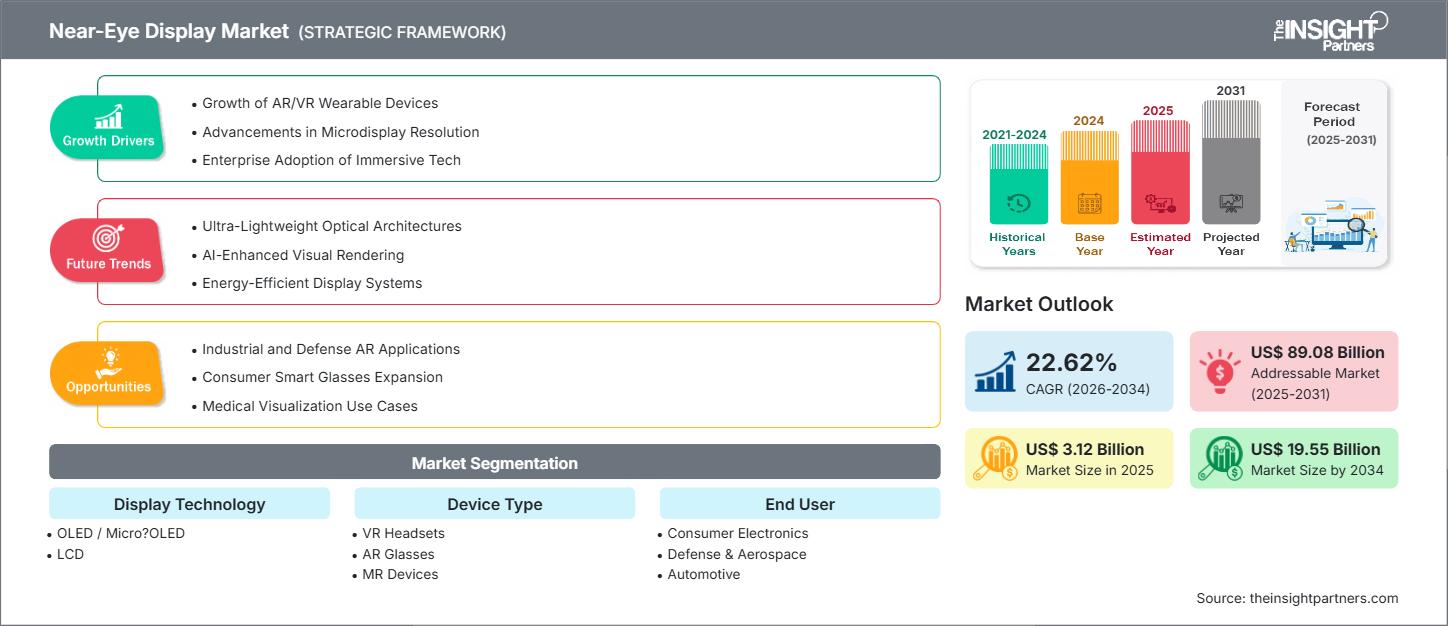
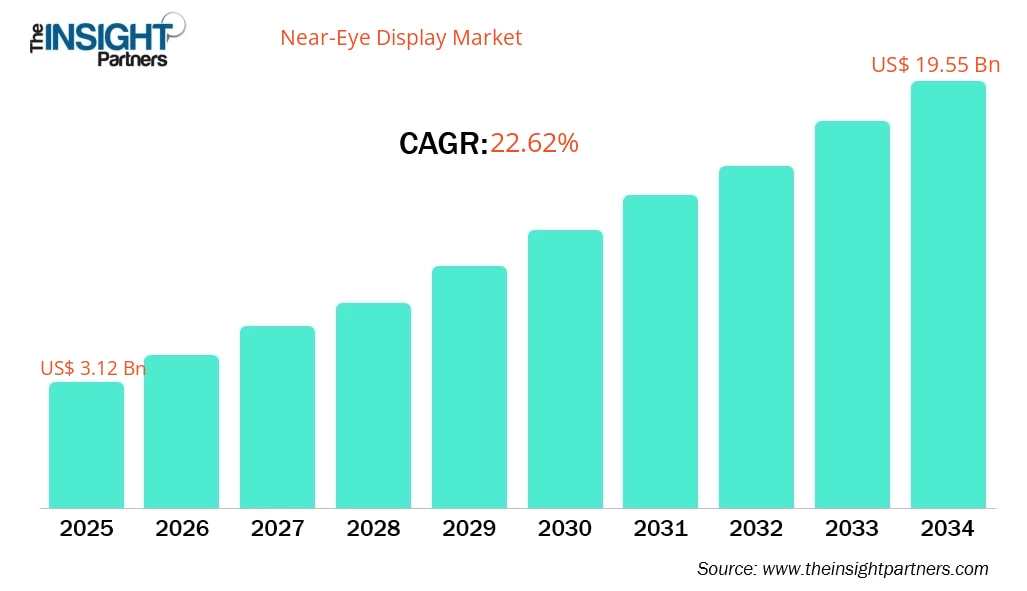
The near-eye display market size is expected to reach US$ 19.55 billion by 2034 from US$ 3.12 billion in 2025. The market is anticipated to register a CAGR of 22.62% during 2026–2034.
Near-Eye Display Market Analysis
The growing need for advanced technologies, primarily in the display area, to enhance user experiences of viewing objects as in the real world, especially in augmented reality (AR) and virtual reality (VR), is the primary driver for the near-eye display market. Improved displays in AR/VR are critical in industries that require high-resolution displays and interactive capabilities, particularly gaming, education, healthcare, automotive, and defense.
Near-Eye Display Market Overview
Advancements in display technologies, such as OLED, microLED, and OLED-on-Silicon (OLEDoS), make it possible to achieve high-resolution images for video and screens that are slim, lightweight, and valuable on scarce battery life; factors that are driving the growth of the near-eye display market. In addition, robust investments from technology companies, which create and do business by concentrating on next-gen displays in near-eye situations for consumer and employee purposes to increase their field of view, are further factors contributing to growing interest in the market.
Market Research Highlights
- Global market for Near-Eye Display was valued at US$ 3.12 Billion in 2025
- Annual market size is expected to reach US$ 19.55 Billion by 2034
- Total addressable market (TAM) during 2026-2034 is projected to reach approximately US$ 89.08 Billion
- Market is anticipated to register a CAGR of 22.62% during the forecast period
- The United States represents a key market, supported by Growth of AR/VR Wearable Devices, Advancements in Microdisplay Resolution, Enterprise Adoption of Immersive Tech, as well as evolving industry dynamics
- Market analysis covers North America, Europe, Asia-Pacific, South and Central America, Middle East and Africa, with growth evaluated across the forecast period
- Market opportunities such as Industrial and Defense AR Applications, Consumer Smart Glasses Expansion, Medical Visualization Use Cases are expected to influence market dynamics and addressable market
- Report profiles industry participants, including Sony Group Corporation- Japan, Seiko Epson Corporation- Japan, BOE Technology Group Co., Ltd.- China, SeeYA Technology Co., Ltd.- China, eMagin Corporation- United States, Kopin Corporation- United States, MICROOLED Technologies- France, HOLOEYE Photonics AG- Germany, LG Display- South Korea, Himax Technologies, Inc.- Taiwan, while analyzing competitive strategies and innovation developments
-
Source: The Insight Partners' analysis based on proprietary research, government publications, company annual reports, investor presentations, industry databases, and expert interviews.
● REPORT CUSTOMIZATION
Tailor This Report To Align With Your Specific Business Requirements
This report can be customized to align precisely with your business objectives, scope, and target markets. Customization options include tailored segmentation, geography, competitive analysis, and strategic insights to support informed decision-making.
Customize This Report →WHAT YOU CAN ADJUST
- ● Segmentations
- ● Geography
- ● Competitive Analysis
- ● Language Preferences
Near-Eye Display Market: Strategic Insights
-
Get Top Key Market Trends of this report.This FREE sample will include data analysis, ranging from market trends to estimates and forecasts.
Near-Eye Display Market Drivers and Opportunities
Market Drivers:
- Immersive Technology Demand: The increasing demand for immersive experiences is the primary driver as near-eye displays improve augmented reality, virtual reality, and mixed reality, which are primarily used in consumer electronics (gaming), healthcare, and defense. Increased adoption of immersive technologies translates to greater market potential and prompts technology investment for the overall enhancement of realistic visuals and interactivity.
- Advances in Display Technology: Innovations in OLEDoS, microOLED, and microLED technologies improve resolution, brightness, and power efficiency of near-eye displays. These advancements enable compact, lightweight devices with superior visual quality, accelerating acceptance in premium VR and AR headsets and smart glasses.
- Integration with Enabling Technologies: Integration with 5G, AI, and the Internet of Things improves responsiveness and connectivity affecting near-eye displays. Improved responsiveness and latency reduction in displays lead to real-time communication to transform processes such as remote assistance and live training, also contributing to the use of near-eye displays across multiple industries.
Market Opportunities:
- Expanding Sector Applications: Near-eye displays have future applications in gaming, healthcare, automotive, education, and telecommunications. The rising need for interactivity and immersive experiences is driving adoption and widening use cases. The potential for such broad applications creates new revenue opportunities and drives global growth, making near-eye displays an essential technology beyond entertainment.
- Technological Advancements: Ongoing innovations in microdisplay and optics technologies allow for increased resolutions, increased energy efficiency, and smaller, more convenient devices. The innovations support extended use and broader adoption, driving innovation in consumer and professional-grade near-eye display products, increasing market potential.
- Cost Reduction Initiatives: Advances in manufacturing and optical technology decrease expenses, making products more accessible and affordable. These advances allow market entry in developing countries and increased consumer acceptance globally, driving long-term market expansion.
Near-Eye Display Market Report Segmentation Analysis
The near-eye display market share is analyzed across various segments to provide a clearer understanding of its structure, growth potential, and emerging trends. Below is the standard segmentation approach used in most industry reports:
By Display Technology:
- OLED / Micro‑OLED: High-resolution, energy-efficient visuals utilizing organic LEDs; favored for AR/VR due to compact size, bright visuals, and low-power draw in wearable devices.
- LCD (TFT LCD / LCoS): Standard liquid crystal displays: relatively low cost, generally thicker and lower contrast than OLED or MicroLED displays.
- MicroLED: Emerging self-emissive display with high brightness, durability, and efficiency; ideal for AR glasses and premium near-eye applications.
- DLP & Laser Beam Scanning (LBS): Projection-based displays use micro-mirrors or lasers to create images, mostly for immersive headsets and simulation.
- Others: Displays that do not fall into one of the categories above: experimental, specialty, or niche type displays for specific commercial, industrial, or wearable applications.
By Device Type:
- VR Headsets: Fully immersive devices for gaming, entertainment, or training rely on head-mounted displays with high-resolution screens.
- AR Glasses: Wearable, smart glasses that project digital information onto to real-world view; consumer, industrial, and enterprise use.
- MR Devices: Merge virtual and real environments interactively; typically used for advanced training, simulation, and collaborative enterprise experiences.
- Smart Helmets & Eyewear: Protective gear with integrated near-eye displays; deployed in industrial, automotive, or military scenarios for real-time data.
By End User
- Consumer Electronics
- Defense & Aerospace
- Automotive
- Enterprise & Industrial
- Healthcare
- Education & Training
By Geography:
- North America
- Europe
- Asia-Pacific
- South & Central America
- Middle East & Africa
Near-Eye Display Market Report Scope
| Report Attribute | Details |
|---|---|
| Market size in 2025 | US$ 3.12 Billion |
| Market Size by 2034 | US$ 19.55 Billion |
| Global CAGR (2026 - 2034) | 22.62% |
| Historical Data | 2021-2024 |
| Forecast period | 2026-2034 |
| Segments Covered |
By Display Technology
|
| Regions and Countries Covered |
North America
|
| Market leaders and key company profiles |
|
Near-Eye Display Market Players Density: Understanding Its Impact on Business Dynamics
The Near-Eye Display Market is growing rapidly, driven by increasing end-user demand due to factors such as evolving consumer preferences, technological advancements, and greater awareness of the product's benefits. As demand rises, businesses are expanding their offerings, innovating to meet consumer needs, and capitalizing on emerging trends, which further fuels market growth.
Near-Eye Display Market Share Analysis by Geography
North America near-eye display industry dominated the market with a revenue share in 2025, driven by the strong innovation system that demands the ongoing improvements in display resolution, brightness, and reduced latency and errors. The market in Europe is witnessing steady growth over the forecast period, due to Europe’s strong focus on technological innovation and sustainability drives. The market in the Asia Pacific region is anticipated to register the highest growth over the forecast period.
The near-eye display market shows a different growth trajectory in each region due to factors such as advanced technology and digital fields in sectors such as healthcare, defense, and education. Below is a summary of market share and trends by region:
1. North America
- Market Share: Holds the highest market share, driven by early adoption of AR/VR technologies, strong government investments, especially in defense and healthcare.
- Key Drivers:
- The US has a high venture capital influx supporting innovation in wearable tech and XR devices.
- Strong consumer spending power; early adoption of AR/VR; presence of major technology firms & R&D
- Trends: Increasing telemedicine applications and immersive training environments bolstered by advanced head-mounted systems.
2. Europe
- Market Share: The growth of this region is due to technological innovation and a sustainability drive, the creation of energy-efficient, lightweight, and user-friendly near-eye display devices.
- Key Drivers:
- Drivers include government funding for AR/VR in healthcare, education, and defense sectors, alongside increasing commercialization of smart glasses and training applications.
- Trends: Healthcare AR applications and industrial adoption of near-eye displays in manufacturing and professional training.
3. Asia Pacific
- Market Share: The fastest-growing regional market led by enormous demand for consumer electronics, Government incentivization of this demand, and large-scale manufacturing.
- Key Drivers:
- Massive manufacturing base (China, Japan, Korea); growing consumer electronics; government push for digital/AR/VR tech.
- Trends: Focus on mobile-first economies, gaming ecosystem expansion, and strong adoption of immersive retail and virtual gaming experiences.
4. South and Central America
- Market Share: Emerging region with increasing digital infrastructure investments and rising interest in immersive entertainment.
- Key Drivers:
- Rising internet/tech infrastructure; growing interest in consumer AR/VR & industrial applications; regional government initiatives.
- Trends: Gradual adoption in education, entertainment, and enterprise segments, supported by improving network capabilities and increasing smartphone penetration.
5. Middle East and Africa
- Market Share: Emerging market due to increasing technological advancements and rising adoption of wearable devices.
- Key Drivers:
- The growing interest in augmented reality (AR) and virtual reality (VR), which heavily rely on near-eye displays for immersive experiences, is a primary growth factor.
- Trends: Growing focus on digital transformation and smart city projects in countries like the UAE and South Africa, boosting demand.
Near-Eye Display Market Players Density: Understanding Its Impact on Business Dynamics
The near-eye display market is witnessing intensified competition due to the presence of major global technology providers alongside emerging niche players and specialized startups. Companies are actively innovating to strengthen their market position and meet the growing demand for intelligent decision-making platforms across industries.
The competitive landscape is driving vendors to differentiate through:
- Businesses are investing in various types of display technologies, such as OLED-on-Silicon (OLEDoS), microLED, and advancements to microdisplays.
- Vendors are expanding their portfolios in all varieties of devices, such as head-mounted displays (HMD), augmented reality glasses, and mixed reality.
- New optics and manufacturing developments, other cost reductions, and scalability to provide near-eye display devices much less expensive and provide for faster deliveries.
Opportunities and Strategic Moves
- Expanding adoption across diverse sectors like gaming, healthcare, automotive, education, and defense due to rising demand for immersive experiences and interactive solutions.
- Forming strategic alliances with technology, content, and manufacturing partners to enhance integration, reduce costs, and speed market entry.
- Rising disposable incomes and urbanization are increasing consumer electronics adoption for portable, wearable AR/VR headsets and smart glasses.
Major Companies Operating in the Near-Eye Display Market Are:
- Sony Group Corporation- Japan
- Seiko Epson Corporation- Japan
- BOE Technology Group Co., Ltd.- China
- SeeYA Technology Co., Ltd.- China
- eMagin Corporation- United States
- Kopin Corporation- United States
- MICROOLED Technologies- France
- HOLOEYE Photonics AG- Germany
- LG Display- South Korea
- Himax Technologies, Inc.- Taiwan
Disclaimer: The companies listed above are not ranked in any particular order.
Near-Eye Display Market News and Recent Developments
- For instance, on May 29, 2025, - Himax Technologies, Inc. (Nasdaq: HIMX) (“Himax” or “Company”), a leading supplier and fabless manufacturer of display drivers and other semiconductor products, and Liqxtal Technology Inc. (“Liqxtal”), a subsidiary of Himax dedicated to developing various liquid crystal optical components with exceptional design expertise, jointly unveiled the industry’s first patented vision care display — the Liqxtal® Pro-Eye will be showcased at Medical Taiwan 2025, the premier medical and healthcare technology exhibition in the Asia-Pacific region taking place June 5 – 7 at the Taipei Nangang Exhibition Center, Hall 2.
- In November 2024, Fraunhofer Institute for Photonic Microsystems IPMS, in collaboration with HOLOEYE Photonics AG, developed a compact LCOS microdisplay with high refresh rates that enables improved optical modulation. This innovative microdisplay will be presented for the first time at the 31st International Display Workshops (IDW) 2024 in Sapporo, Japan.
- In September 2024, Sony Semiconductor Solutions Corporation (SSS) revealed the plan to launch the ECX350F, which is a 0.44 type Full HD resolution OLED Microdisplay that integrates the industry's smallest*1 5.1 µm pixels (approximately 5,000 ppi) with the industry's greatest*1 brightness level of up to 10,000 cd/m2.
- For instance, in June 2024, Kopin Corporation unveiled its new microdisplay, the Lightning 2, featuring a 2,000 × 2,000‑pixel resolution per eye. Engineered for lightweight AR and VR devices, it delivers high brightness while maintaining low power consumption, making it ideal for a wide range of applications.
Near-Eye Display Market Report Coverage and Deliverables
The "Near-Eye Display Market Size and Forecast (2026–2034)" report provides a detailed analysis of the market covering below areas:
- Near-Eye Display Market size and forecast at global, regional, and country levels for all the key market segments covered under the scope
- Near-Eye Display Market trends, as well as market dynamics such as drivers, restraints, and key opportunities
- Detailed PEST and SWOT analysis
- Near-Eye Display Market analysis covering key market trends, global and regional framework, major players, regulations, and recent market developments
- Industry landscape and competition analysis covering market concentration, heat map analysis, prominent players, and recent developments in the Near-Eye Display Market. Detailed company profiles
Frequently Asked Questions

- Comprehensive Market Sizing and Forecast Analysis
- Detailed Segmentation Analysis
- In-Depth Market Dynamics Assessment
- Regional and Country-Level Insights
- Competitive Landscape and Company Benchmarking
- Strategic Business Intelligence
Recent Reports
Testimonials

The Insight Partners provided valuable market intelligence that supported our global go-to-market strategy. Their team was professional, responsive, and attentive to our feedback, providing thoughtful analysis and helpful methodological clarifications throughout the project.
Junmo Kim Chief Financial Officer (CFO), Enertech Co., Ltd.
The Insight Partners' SCADA System Market report is comprehensive, with valuable insights on current trends and future forecasts. The team was highly professional, responsive, and supportive throughout. We are very satisfied and highly recommend their services.
RAN KEDEM Partner, Reali Technologies LTDs
I requested a report on a very specific software market and the team produced the report in a few days. The information was very relevant and well presented. I then requested some changes and additions to the report. The team was again very responsive and I got the final report in less than a week.
JEAN-HERVE JENN Chairman, Future Analytica
We worked with The Insight Partners for an important market study and forecast. They gave us clear insights into opportunities and risks, which helped shape our plans. Their research was easy to use and based on solid data. It helped us make smart, confident decisions. We highly recommend them.
PIYUSH NAGPAL Sr. Vice President, High Beam Global
The Insight Partners delivered insightful, well-structured market research with strong domain expertise. Their team was professional and responsive throughout. The user-friendly website made accessing industry reports seamless. We highly recommend them for reliable, high-quality research services
YUKIHIKO ADACHI CEO, Deep Blue, LLC.
This is the first time I have purchased a market report from The Insight Partners.While I was unsure at first, I visited their web site and felt more comfortable to take the risk and purchase a market report.I am completely satisfied with the quality of the report and customer service. I had several questions and comments with the initial report, but after a couple of dialogs over email with their analyst I believe I have a report that I can use as input to our strategic planning process.Thank you so much for taking the extra time and making this a positive experience.I will definitely recommend your service to others and you will be my first call when we need further market data.
JOHN SUZUKI President and Chief Executive Officer, Board Director, BK Technologies
I wish to appreciate your support and the professionalism you displayed in the course of attending to my request for information regarding to infectious disease IVD market in Nigeria. I appreciate your patience, your guidance, and the fact that you were willing to offer a discount, which eventually made it possible for us to close a deal. I look forward to engaging The Insight Partners in the future, all thanks to the impression you have created in me as a result of this first encounter.
DR CHIJIOKE ONYIA MANAGING DIRECTOR, PineCrest Healthcare Ltd.Reason to Buy
- Informed Decision-Making
- Understanding Market Dynamics
- Competitive Analysis
- Identifying Emerging Markets
- Customer Insights
- Market Forecasts
- Risk Mitigation
- Boosting Operational Efficiency
- Strategic Planning
- Investment Justification
- Tracking Industry Innovations
- Aligning with Regulatory Trends





 Get Free Sample for