
Non-woven Adhesives Market Share, Demand & Growth by 2034
Coverage: by Type (Styrenic Block Copolymers, Amorphous Poly Alpha Olefin, Ethylene Vinly Acetate); Application (Baby Care, Feminine Hygiene, Adult Incontinence, Medical, Others) , and Geography (North America, Europe, Asia Pacific, and South and Central America)
- Status : Data Released
- Report Code : TIPRE00005106
- Category : Chemicals and Materials
- No. of Pages : 150
- Available Report Formats :


- Last update date : November 02, 2026


2025 Market Size
US$ 3.52 Bn
Base year value
2034 Forecast
US$ 6.36 Bn
Projected by 2034
CAGR 2026-2034
7.67 %
Growth rate
Addressable Market
US$ 46.68 Bn
(2026-2034)
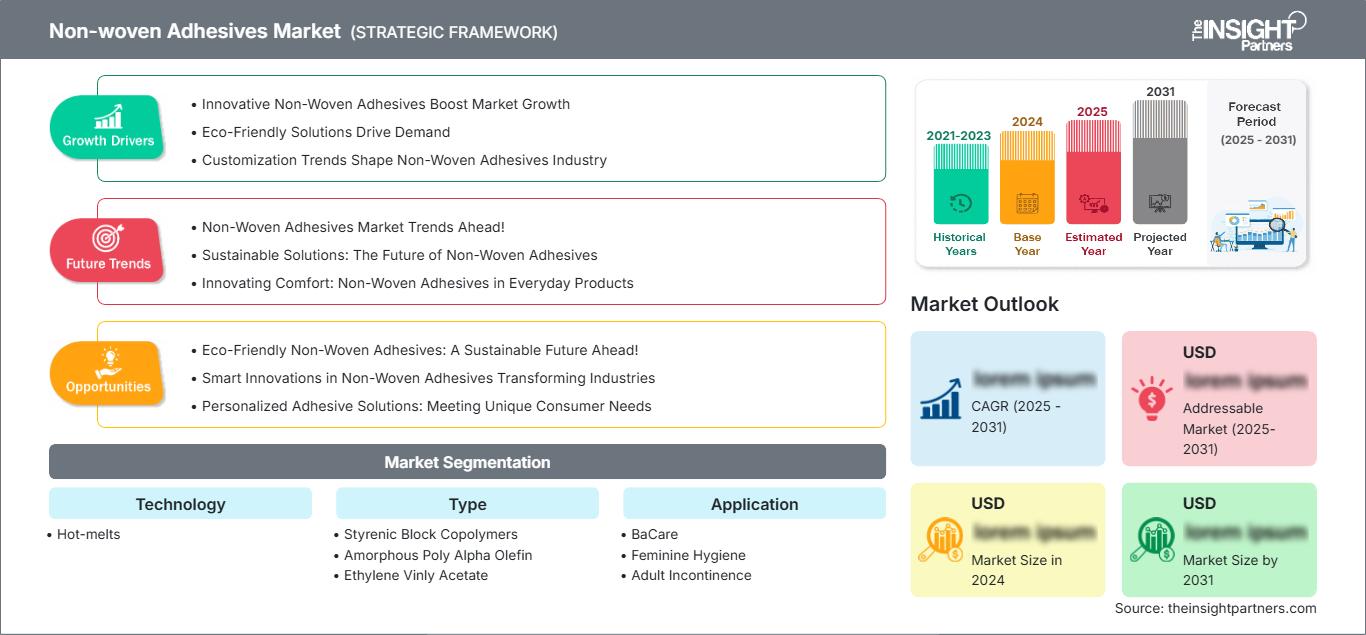
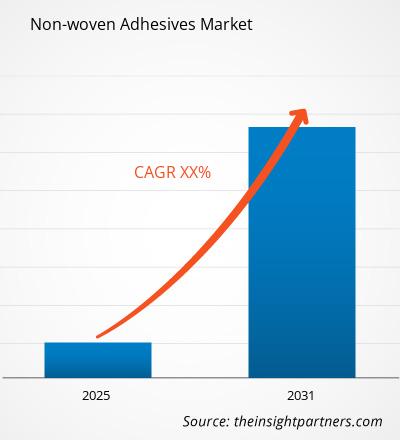
The non-woven adhesives market is projected to expand from US$ 3.52 Billion in 2025 to US$ 6.36 Billion by 2034, registering a CAGR of 7.67% during 2026–2034. The market refers to the adhesives that are used to bond nonwovens along with their substrates in the case of absorbent hygiene, medical, and personal care products. Growth will be driven by increasing demand for lighter constructions, comfort, better bonding, and adhesives suited to more automated converting operations.
North America non-woven adhesives market size is forecasted to remain a relatively mature but technically advanced region with a projected CAGR of 6.8% – 7.5% until 2034. Factors driving the nonwoven adhesives market in North America include the presence of established hygiene product manufacturing, high converting technology, and usage of low add-on and high-performance adhesive systems. Moreover, premium feminine care and adult incontinence products require good bonding strength, controlled peelability, minimal odor, and performance under moist conditions.
Non-woven Adhesives Market Assessment and Insights
- North America: The region is estimated to account for a 27–31% share in 2025 and grow at a 6.8–7.5% CAGR between 2026–2034, supported by established hygiene manufacturing and increasing demand for lightweight, high-performance adhesive systems.
- US: The US is estimated to represent 82–86% of North America's 2025 demand, growing at a 6.7–7.4% CAGR during 2026–2034 as premium hygiene products increasingly emphasize comfort, adhesion, and material efficiency.
- Europe: Europe is estimated to hold a 23–27% share in 2025 and expand at a 6.9–7.6% CAGR through 2034, with Germany, Italy, France, the UK, and Spain supported by advanced converting capabilities and sustainability requirements.
- Asia Pacific: Asia Pacific is estimated to command a 35–39% share in 2025 and grow at an 8.2–9.0% CAGR during 2026–2034, led by China, Japan, South Korea, and India, where hygiene-product capacity and disposable-product penetration continue expanding.
- Largest Segment: Application is expected to remain the largest segment, with a 58–63% market share in 2025 and a 7.3–7.9% CAGR between 2026–2034, driven by high-volume absorbent hygiene production.
- High Growth Segment: Medical applications are projected to represent 9–13% of demand in 2025 and grow at an 8.4–9.2% CAGR through 2034, reflecting demand for breathable, skin-compatible, sterilizable constructions.
- Key companies analyzed in detail: Avery Dennison Corporation, Cattie Adhesives Solutions LLC, Celanese Corporation, Eastman Chemical Company, ITW Dynatec Americas, Klebstoffwerke Collodin GmbH, Michelman, Inc., Nordson Corporation, Palmetto Adhesives Company, Inc., Sika Ireland Ltd., Henkel AG & Co. KGaA, and H.B. Fuller Company.
Source: The Insight Partners' analysis based on proprietary research, government publications, company annual reports, investor presentations, industry databases, and expert interviews.
As a result, the non-woven adhesives industry has transitioned from high add-on conventional bonding to precision hot melts and pressure-sensitive adhesives and formulations for thin substrates. Increasingly, manufacturers fine-tune viscosity, open time, elastic recovery, odor, and thermal stability in addition to bonding performance. Dispensing, patterning, and reduced application weights have become critical production factors in light of manufacturers’ efforts to save on materials without compromising product quality or consumer experience.
In the coming years, capital expenditure is expected to be spent on bio-based feedstocks, low temperature processes, precision dispensing, and new formulations that can withstand changes in hygiene product structures. Up-and-coming manufacturing regions such as India, Southeast Asia, and Latin America will become attractive locations for capacity expansion as disposable hygiene products become more prevalent. In addition, regulatory scrutiny over chemical ingredients, emissions, safety at work, and contact with foodstuffs will favor transparent formulation development and safer adhesive technologies.
Non-woven Adhesives Market Report Scope
| Report Attribute | Details |
|---|---|
| Market size in 2025 | US$ 3.52 Billion |
| Market Size by 2034 | US$ 6.36 Billion |
| Global CAGR (2026 - 2034) | 7.67% |
| Historical Data | 2021-2024 |
| Forecast period | 2026-2034 |
Non-woven Adhesives Market Analysis
The demand has a direct correlation to the production of baby diapers, feminine care products, adult incontinence products, and medical disposables. The expansion of non-woven adhesives market will be influenced by higher expectations with respect to softness, breathability, thinning, positioning, and bonding capability in a humid environment. This will make the adhesive suppliers focus more on lower add-on weight, compatibility with polypropylene and polyethylene, and speed of conversion.Demand is directly correlated with the manufacture of baby diapers, feminine care items, adult incontinence products, and medical disposables. Market expansion of non-woven adhesives is impacted by higher requirements for softness, breathability, thinning, secure positioning, and dependable bonding in a humid environment. Adhesive producers therefore compete on lower add-on weights, polypropylene and polyethylene compatibility, and reliability at faster conversion speeds.
Supply chain starts from the delivery of polymers, tackifiers, additives, plasticizers, and other specialty chemicals to the adhesive manufacturers. They then formulate them into hot melt or similar adhesives systems prior to delivery to hygiene product manufacturers and converters. Equipment suppliers can impact the final performance through melting, metering, spraying, slot coating, and temperature control. Fluctuation in raw material costs is a key concern because they have an impact on formulation economics.
The competition is made up of global adhesive suppliers, specialty formula companies, and precision dispensing technology suppliers. The adhesive-based personal care and medical applications company is represented by Avery Dennison Corporation, whereas Cattie Adhesives Solutions LLC is represented by specialty hygiene bonding adhesives. The Celanese Corporation and Eastman Chemical Company bring to the table polymer and specialty materials expertise, thus allowing for formulation integration in different adhesive products.
As per the non-woven adhesives market report, companies such as ITW Dynatec Americas, Nordson Corporation, and Palmetto Adhesives Company, Inc. cater to applications, dispensing, and hot melt technologies, whereas the other adhesive technologies come from the likes of Michelman, Inc., Sika Ireland Ltd., and Klebstoffwerke Collodin GmbH. Henkel AG & Co. KGaA and H.B. Fuller Company bolster the competitive environment with their large hygiene product ranges and formulation development capabilities.
● REPORT CUSTOMIZATION
Tailor This Report To Align With Your Specific Business Requirements
This report can be customized to align precisely with your business objectives, scope, and target markets. Customization options include tailored segmentation, geography, competitive analysis, and strategic insights to support informed decision-making.
Customize This Report →WHAT YOU CAN ADJUST
- ● Segmentations
- ● Geography
- ● Competitive Analysis
- ● Language Preferences
Non-woven Adhesives Market: Strategic Insights
Regional Insights
North America non-woven adhesives market
The non-woven adhesives market share of North America for 2025 is projected to be 27–31%, growing at a 6.8–7.5% CAGR up to 2034. High dominance of regional demand in the US is due to a strong disposable hygiene industry with advanced converting machinery and robust consumption of luxurious personal care items. Thinner materials, reliable attachment of elastic components, and precise adhesive depositing are currently of primary interest for manufacturers.
However, other requirements such as sustainability and efficiency are being considered as well. Hot melts with low melting temperature, decreased weight of deposits, as well as formulations that minimize odors and volatile emissions, are gaining popularity. Canada has a much smaller demand due to medical disposables and special hygiene products. Automation of production will be preferred with an emphasis on high speed and reduced use of adhesives and production waste.
U.S. non-woven adhesives Market
United States holds a market share of around 82-86% of North America's requirement in 2025 and is expected to expand at a CAGR of 6.7-7.4% through 2034. Existing players of hygiene products and converters drive continuous demand for adhesives in baby care, feminine hygiene, adult incontinence, and medical segments. Domestic procurement also shows preference to companies who can maintain consistency in specifications in different manufacturing facilities.
Some companies who possess this capability in adhesive or application technologies include Avery Dennison Corporation, Nordson Corporation, H.B. Fuller Company, Henkel AG & Co. KGaA, and Palmetto Adhesives Company, Inc. The growth is becoming more and more associated with advanced product structures that require good bonding but do not compromise on properties like softness, breathability, flexibility, or removal ease.
Europe non-woven adhesives Market
The European market is expected to account for 23–27% of the demand in 2025 and experience a CAGR of 6.9–7.6% through 2034. Germany will be the dominant market owing to its capability in converting machinery and chemical formulation. The UK, France, Italy, and Spain will add their share via their strong hygiene and medical product markets. More and more European demand will be driven by material efficiency, reduced emissions, and choice of sustainable chemicals.
Germany enjoys a strong technical expertise in the areas of adhesives, machinery, and nonwoven processing, making it a key center for the development of high performance chemistries. Italy can add its capability in machinery and hygiene products manufacture. France will leverage its expertise in personal care manufacturing, whereas the UK will keep its demand stable in the medical and feminine care categories. Spain will help add growth through the disposable hygiene products and automation sectors.
APAC non-woven adhesives Market
The APAC region is expected to lead with a 35%–39% market share in 2025, growing at a CAGR of 8.2%–9.0% till 2034. It is expected to be the fastest-growing region in the world owing to the fact that the largest market is China. The regions of Japan and South Korea focus on advanced materials and process accuracy. India and Australia provide growing prospects.
Increasing hygiene usage, urbanization, manufacturing within the region, and investing in converting capacity drive regional demand. China receives advantages owing to widespread diaper and feminine care manufacturing, whereas India is fast growing owing to growing disposable products consumption. The regions of Japan and South Korea focus on high-end performance. Australia is relatively small but highly technological.
Middle East & Africa non-woven adhesives Market
Middle East and Africa demand is smaller but increasingly supported by hygiene-product localization and healthcare investment. Saudi Arabia and the UAE are important regional markets, while South Africa provides the principal sub-Saharan manufacturing base. The region is expected to expand at approximately 7.2–8.0% CAGR through 2034.
The industrial diversification, state-of-the-art converting technology and investment in the manufacturing of consumer products help Saudi Arabia and the UAE. In South Africa, there is support of demand due to the presence of established personal care and medical product industry. The rest of MEA region is fragmented; however, growth in the penetration of disposable products provides opportunity for the converters in the region. Energy availability and petrochemical integration will help in accessing the adhesive materials.
Segmentation Analysis
Type
The Type segment is projected to expand at a 7.2–7.8% CAGR during 2026–2034. Styrenic block copolymers, amorphous poly alpha olefin, and ethylene vinyl acetate address different balances of tack, elasticity, thermal stability, cost, and substrate compatibility. Formulation selection increasingly depends on product architecture and converting conditions. The non-woven adhesives market scope therefore spans technologies selected according to bonding requirements rather than one universal adhesive chemistry.
- Styrenic Block Copolymers: These materials provide elasticity, tack, and strong bonding characteristics, making them important for elastic attachment and flexible hygiene constructions requiring repeated deformation without premature adhesive failure.
- Amorphous Poly Alpha Olefin: These systems offer strong thermal stability, low odor potential, and compatibility with lightweight structures, supporting applications where clean processing and controlled adhesive add-on are important.
- Ethylene Vinly Acetate: EVA-based systems remain relevant where cost efficiency, dependable hot-melt processing, and broad substrate compatibility are prioritized across established disposable-product manufacturing lines.
Application
The Application segment is forecast to grow at a 7.3–7.9% CAGR from 2026 to 2034. Baby-care products generate substantial adhesive consumption because high-volume diaper construction requires bonding across multiple nonwoven, film, elastic, and absorbent layers. Feminine hygiene and adult incontinence demand stronger positioning and moisture resistance, while medical uses emphasize skin compatibility, breathability, and sterilization.
- Baby Care: Baby-care products represent a high-volume application base, requiring construction, elastic, core, and positioning adhesives that maintain reliable performance across high-speed converting operations.
- Feminine Hygiene: Pad attachment and construction requirements emphasize secure positioning, clean removal, moisture resistance, and compatibility with different underwear fabrics and nonwoven substrates.
- Adult Incontinence: Products require durable bonding across larger structures and elastic components, with increasing emphasis on comfort, odor management, thinness, and secure fit during movement.
- Medical: Medical products demand specialized adhesives with controlled skin interaction, breathability, sterilization compatibility, and dependable adhesion for dressings, fixation devices, and disposable healthcare products.
Opportunity Snapshot
| Application | Revenue Contribution (High/Medium/Low) | Trend Tag | Adoption Stage |
|---|---|---|---|
| Baby Care | High | Thin Diapers | Mature |
| Feminine Hygiene | High | Secure Positioning | Mature |
| Adult Incontinence | Medium | Comfort Fit | Scaling |
| Medical | Medium | Skin Contact | Scaling |
Non-woven Adhesives Market Growth Drivers and Impact Analysis
Expansion of thinner and more comfortable hygiene products
Hygiene manufacturers are continuously redesigning products to improve softness, fit, absorbency, and consumer comfort while reducing material intensity. These changes increase the technical importance of adhesives because thinner substrates leave less tolerance for excessive adhesive penetration, stiffness, odor, or uneven coating. Suppliers that achieve reliable bonding at lower add-on levels can help converters reduce material consumption without compromising product integrity. The resulting shift supports demand for precise hot-melt formulations with controlled viscosity and optimized open time. It also increases the importance of dispensing equipment capable of maintaining stable patterns at high speeds. As product architectures become lighter and more complex, adhesive formulation and application increasingly function as integrated process decisions rather than independent purchasing categories.
Rising demand for adult and feminine hygiene products
Demographic aging, improved awareness of feminine health, and expanding availability of disposable personal-care products are broadening demand beyond traditional baby diapers. Adult-incontinence products increasingly emphasize discretion, mobility, and comfort, requiring reliable bonding across larger nonwoven structures and elastic components. Feminine-care products similarly require adhesives that prevent shifting while maintaining comfortable removal and compatibility with different underwear fabrics. These requirements create opportunities for suppliers offering specialized positioning, construction, and elastic-attachment formulations. Growth in premium product categories is particularly relevant because higher-value products can justify performance-oriented adhesive formulations even when their cost per kilogram is higher. Consequently, demand is moving toward adhesive solutions that deliver measurable product benefits rather than simply providing basic layer bonding.
Automation and precision dispensing in high-speed converting
Increasing production speeds make adhesive application accuracy a major determinant of manufacturing efficiency. Excess adhesive can raise material costs, create stringing and contamination, while insufficient coverage can produce delamination and product failures. Automated melters, flow monitoring, precision nozzles, and closed-loop dispensing therefore provide manufacturers with greater control over application weight and pattern consistency. This trend strengthens the connection between adhesive suppliers and equipment providers because formulation viscosity and application technology must be optimized together. High-speed converters are also seeking equipment that minimizes downtime during cleaning, maintenance, and product changeovers. As production becomes increasingly automated, suppliers able to provide both application expertise and formulation support can gain stronger positions in customer qualification programs.
Non-woven Adhesives Market Future Trends
Bio-based and lower-temperature adhesive formulations
Future product development is expected to increasingly combine renewable feedstocks with lower-temperature processing. Adhesive suppliers are exploring ways to reduce dependence on fossil-derived raw materials while preserving tack, peel strength, thermal stability, and aging performance. Lower application temperatures can also reduce energy consumption and thermal stress on equipment, creating operational benefits for converters. Bio-based content alone will not determine adoption because hygiene manufacturers must maintain strict performance and safety specifications. Instead, successful formulations will need to demonstrate comparable bonding, stable processing, low odor, and compatibility with existing machinery. Product qualification may increasingly include carbon-footprint information and raw-material traceability alongside conventional technical specifications. This non-woven adhesives market trend could gradually shift purchasing criteria toward lifecycle performance rather than adhesive price alone.
Digitalized adhesive application and process monitoring
Digital controls are expected to become more important as manufacturers seek predictable application quality across increasingly complex hygiene products. Sensors can monitor flow, pressure, temperature, and dispensing behavior, allowing operators to identify process deviations before they create significant scrap. Integration with manufacturing execution systems could enable production teams to correlate adhesive consumption with line speed, product configuration, and quality outcomes. Over time, predictive maintenance may also reduce downtime by identifying nozzle wear, filter loading, or melt-system instability. For adhesive suppliers, digitalization creates an opportunity to provide formulation and equipment guidance based on operating data rather than laboratory testing alone. Such systems could support tighter adhesive specifications and improve consistency across geographically dispersed manufacturing facilities.
Non-woven Adhesives Market Opportunities
Localized supply and formulation development in emerging markets
Emerging hygiene-manufacturing clusters offer an opportunity for adhesive suppliers to establish regional technical centers and localized supply networks. India, Southeast Asia, Latin America, and selected Middle Eastern markets are developing disposable-product capacity while seeking shorter lead times and more responsive technical support. Local formulation capability can reduce logistics exposure and enable suppliers to adapt adhesive performance to regional substrates, machinery, climate conditions, and product preferences. Companies can also strengthen relationships by supporting customer trials, line optimization, and qualification activities near production sites. Investment should prioritize scalable facilities capable of handling multiple hot-melt technologies and maintaining consistent quality. Regionalization would also help suppliers respond more quickly to raw-material disruptions and changing customer specifications.
Specialty adhesives for medical and premium hygiene applications
Medical and premium hygiene products provide an attractive opportunity for higher-value adhesive formulations because performance requirements are more demanding than basic construction bonding. Medical applications can require breathability, sterilization compatibility, controlled skin interaction, and extended wear, while premium hygiene products emphasize comfort, secure positioning, low odor, and reduced adhesive visibility. Suppliers can differentiate through application-specific formulations supported by testing and technical documentation. Certification capabilities and regulatory expertise can become important barriers to entry, particularly for medical applications. Strategic investment in application laboratories, skin-contact testing, and customer co-development can therefore support stronger margins than commodity-oriented adhesive sales. The non-woven adhesives market forecast is particularly relevant for suppliers seeking to diversify beyond high-volume standard hygiene construction adhesives.
Recent Developments
- June 10, 2026: Henkel announced carbon-neutral production at its Kurkumbh, India, and Gebkim, Türkiye, Adhesive Technologies sites. The facilities eliminated Scope 1 emissions through electrification and elimination of fossil fuels while using renewable electricity to address Scope 2 emissions. The development highlights increasing pressure on adhesive manufacturers to decarbonize production while maintaining supply reliability for industrial and hygiene customers.
- May 16, 2026: Bostik launched COLOR 3.0, a bio-based Hot Melt Wetness Indicator adhesive developed for diaper backsheets. It contains more than 50% bio-based content, is USDA-certified bio-based and AOX-free, and can be applied at substantially lower temperatures than conventional HMWI adhesives. Its compatibility with PE films and nonwoven layers makes it particularly relevant to absorbent hygiene converters.
Frequently Asked Questions

- Comprehensive Market Sizing and Forecast Analysis
- Detailed Segmentation Analysis
- In-Depth Market Dynamics Assessment
- Regional and Country-Level Insights
- Competitive Landscape and Company Benchmarking
- Strategic Business Intelligence
Recent Reports
Testimonials

The Insight Partners provided valuable market intelligence that supported our global go-to-market strategy. Their team was professional, responsive, and attentive to our feedback, providing thoughtful analysis and helpful methodological clarifications throughout the project.
Junmo Kim Chief Financial Officer (CFO), Enertech Co., Ltd.
The Insight Partners' SCADA System Market report is comprehensive, with valuable insights on current trends and future forecasts. The team was highly professional, responsive, and supportive throughout. We are very satisfied and highly recommend their services.
RAN KEDEM Partner, Reali Technologies LTDs
I requested a report on a very specific software market and the team produced the report in a few days. The information was very relevant and well presented. I then requested some changes and additions to the report. The team was again very responsive and I got the final report in less than a week.
JEAN-HERVE JENN Chairman, Future Analytica
We worked with The Insight Partners for an important market study and forecast. They gave us clear insights into opportunities and risks, which helped shape our plans. Their research was easy to use and based on solid data. It helped us make smart, confident decisions. We highly recommend them.
PIYUSH NAGPAL Sr. Vice President, High Beam Global
The Insight Partners delivered insightful, well-structured market research with strong domain expertise. Their team was professional and responsive throughout. The user-friendly website made accessing industry reports seamless. We highly recommend them for reliable, high-quality research services
YUKIHIKO ADACHI CEO, Deep Blue, LLC.
This is the first time I have purchased a market report from The Insight Partners.While I was unsure at first, I visited their web site and felt more comfortable to take the risk and purchase a market report.I am completely satisfied with the quality of the report and customer service. I had several questions and comments with the initial report, but after a couple of dialogs over email with their analyst I believe I have a report that I can use as input to our strategic planning process.Thank you so much for taking the extra time and making this a positive experience.I will definitely recommend your service to others and you will be my first call when we need further market data.
JOHN SUZUKI President and Chief Executive Officer, Board Director, BK Technologies
I wish to appreciate your support and the professionalism you displayed in the course of attending to my request for information regarding to infectious disease IVD market in Nigeria. I appreciate your patience, your guidance, and the fact that you were willing to offer a discount, which eventually made it possible for us to close a deal. I look forward to engaging The Insight Partners in the future, all thanks to the impression you have created in me as a result of this first encounter.
DR CHIJIOKE ONYIA MANAGING DIRECTOR, PineCrest Healthcare Ltd.Reason to Buy
- Informed Decision-Making
- Understanding Market Dynamics
- Competitive Analysis
- Identifying Emerging Markets
- Customer Insights
- Market Forecasts
- Risk Mitigation
- Boosting Operational Efficiency
- Strategic Planning
- Investment Justification
- Tracking Industry Innovations
- Aligning with Regulatory Trends





 Get Free Sample for