
Nonwoven Industrial Membrane Market Growth, Trends & Demand by 2034
Coverage: By Module (Plate and frame, Spiral wound, Hollow fiber, Tubular); Application (Wastewater treatment, Food and beverages, Chemical and biochemical, Pharmaceutical, Others.), and Geography (North America, Europe, Asia Pacific, and South and Central America)
- Status : Data Released
- Report Code : TIPRE00016543
- Category : Chemicals and Materials
- No. of Pages : 150
- Available Report Formats :


- Last update date : September 18, 2026


2025 Market Size
US$ 2.79 Bn
Base year value
2034 Forecast
US$ 6.61 Bn
Projected by 2034
CAGR 2026-2034
10.06 %
Growth rate
Addressable Market
US$ 41.80 Bn
(2026-2034)
The nonwoven industrial membrane market was valued at US$ 2.79 Billion in 2025 and is projected to reach US$ 6.61 Billion by 2034, expanding at a 10.06% CAGR from 2026 to 2034. The market comprises membrane supports and filter devices that are employed in water treatment, food production, chemical/biochemical processing, and pharmaceutical sectors depending on module design.
North America will continue to be one of the technically advanced markets because of wastewater reuse, water savings in industries, production of pharmaceuticals, and replacement of existing filters. The Nonwoven Industrial Membrane Market size in North America is also driven by stringent discharge standards and development of decentralized water treatment facilities along with low fouling and compactness of membranes.
Nonwoven Industrial Membrane Market Assessment and Insights
- North America: North America is expected to account for a 20–24% share in 2025, growing at a 9.0–10.0% CAGR between 2026–2034, supported by industrial wastewater reuse, pharmaceutical processing, membrane retrofits, and stricter treatment performance requirements.
- US: The US is projected to represent 76–80% of North America's 2025 share, advancing at a 9.1–10.1% CAGR between 2026–2034 as industrial water reuse and advanced wastewater infrastructure expand.
- Europe: Europe is estimated to hold a 22–26% share in 2025 and grow at a 8.8–9.8% CAGR between 2026–2034, led by Germany, France, the UK, Italy, and Spain through water efficiency and industrial discharge initiatives.
- Asia Pacific: Asia Pacific is estimated at 36–40% share in 2025, with a 10.8–11.8% CAGR between 2026–2034, led by China, Japan, South Korea, and India amid manufacturing expansion, water stress, and infrastructure investment.
- Largest Segment: Spiral wound modules are estimated at a 38–42% market share in 2025, with a 9.6–10.6% CAGR from 2026–2034, reflecting broad industrial and wastewater deployment.
- High Growth Segment: Pharmaceuticals are estimated at a 14–18% market share in 2025, expanding at a 11.5–12.5% CAGR from 2026–2034 on demand for high-purity process water and bioprocess filtration.
- Key companies analyzed in detail: Ahlstrom-Munksjö Oyj, Asahi Kasei Corporation, Berry Global Group, Inc., DuPont de Nemours, Inc., Exxon Mobil Corporation, Fitesa S.A., Freudenberg Filtration Technologies SE & Co. KG, Johns Manville, Mitsui Chemicals, Inc., Toray Industries, Inc.
Source: The Insight Partners' analysis based on proprietary research, government publications, company annual reports, investor presentations, industry databases, and expert interviews.
The process has developed into engineered membranes with capabilities of balancing permeation, mechanical strength, chemical stability, and fouling prevention. Nonwovens have become increasingly functional supports instead of just acting as reinforcements, while module design dictates pressure resistance, surface usage, cleaning needs, and replacement cycles. Such developments will help drive growth in the nonwoven industrial membranes market in tough applications of liquid separation.
Expansion in future will be seen in Asia Pacific, the Middle East, and stressed industrial regions where reuse is becoming economical. Growth areas of investment include modular processing, resource recovery, energy efficient separation, and manufacture. Increasing regulatory pressure on industrial discharge and water consumption will drive adoption, while pharma/biotech capacity expansion adds another source of demand for high-purity filtration configurations.
Nonwoven Industrial Membrane Market Report Scope
| Report Attribute | Details |
|---|---|
| Market size in 2025 | US$ 2.79 Billion |
| Market Size by 2034 | US$ 6.61 Billion |
| Global CAGR (2026 - 2034) | 10.06% |
| Historical Data | 2021-2024 |
| Forecast period | 2026-2034 |
Nonwoven Industrial Membrane Market Analysis
Nonwoven Industrial Membrane Market depends significantly on increased requirements for the recovery of industrial water, its purification and recycling. Value chain players include polymer and fiber producers, nonwoven manufacturers, membrane manufacturers, module manufacturers, system integrators, engineering contractors and industrial users of the systems. Material properties affect permeability, wettability, chemical compatibility and mechanical stability; hence, the importance of upstream formulation and manufacturing processes as key competitive factors.
There is an increasing tendency among consumers to prefer systems reducing overall water consumption rather than simply treating the waste effluents. In addition, food processors have a need for process water recovery, while chemical producers need separation of contaminants. Pharmaceutical producers are interested in reproducible high purity flows. Hence, competition occurs in terms of membrane life span, flux stability, cleanability, module density and system integration.
The Nonwoven Industrial Membrane Market Report of the nonwoven industrial membranes exhibits a fragmented competitive landscape where differentiation is driven by the membrane design, substrate design, applications know-how, and geographical availability. Ahlstrom-Munksjö Oyj and Freudenberg Filtration Technologies SE & Co. KG have their strengths in the engineered filtration media space whereas DuPont de Nemours, Inc., Asahi Kasei Corporation, and Toray Industries, Inc. integrate membranes into their separation technologies.
Strategic positioning is increasingly becoming dependent upon regional production and application-based development. The companies such as Berry Global Group, Inc., Fitesa S.A., Johns Manville, and Mitsui Chemicals, Inc. have their strengths in materials and engineered substrates respectively whereas Exxon Mobil Corporation has its strength in the polymers space, which can be applied to membrane based structures.
● REPORT CUSTOMIZATION
Tailor This Report To Align With Your Specific Business Requirements
This report can be customized to align precisely with your business objectives, scope, and target markets. Customization options include tailored segmentation, geography, competitive analysis, and strategic insights to support informed decision-making.
Customize This Report →WHAT YOU CAN ADJUST
- ● Segmentations
- ● Geography
- ● Competitive Analysis
- ● Language Preferences
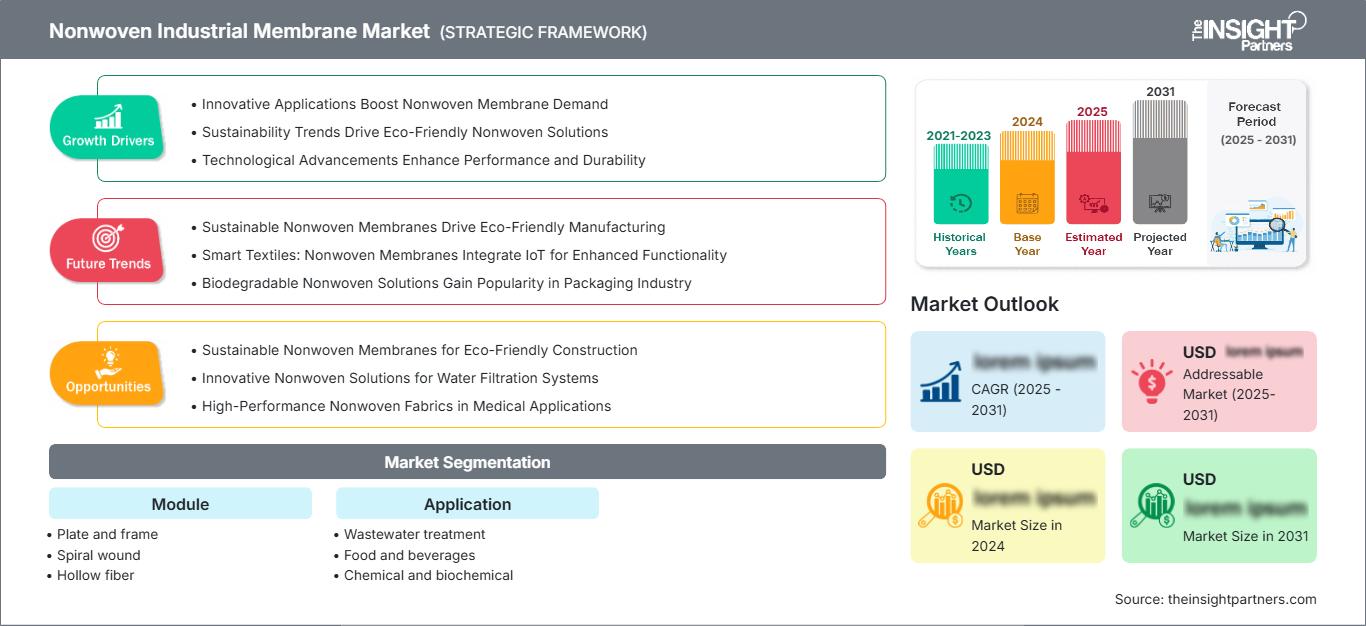
Nonwoven Industrial Membrane Market: Strategic Insights
Regional Insights
North America nonwoven industrial membrane market
North America is estimated to hold a 20–24% Nonwoven Industrial Membrane Market share in 2025, with growth of 9.0–10.0% CAGR from 2026–2034. The US dominates regional demand because industrial wastewater reuse, pharmaceutical manufacturing, food processing, and municipal water infrastructure require increasingly compact and efficient filtration. Canada contributes through mining, food processing, and water-treatment applications, while Mexico benefits from manufacturing and industrial water-management investment.
There is now an increasing tendency in regional demand for membrane technology with reduced operational costs and high recovery rate. Industrial plants are now considering the membrane replacement cycles along with energy utilization and cleaning needs. In 2025, the United States' market share in the North American region will be projected between 76 to 80%, along with the increasing technical support from regional vendors and membrane companies in other countries.
U.S. nonwoven industrial membrane Market
The US is estimated to represent 76–80% of North America's 2025 market, expanding at a 9.1–10.1% CAGR from 2026–2034. Industrial wastewater treatment, water reuse, food and beverage processing, and pharmaceutical production are key application areas. Large industrial operators increasingly consider membrane filtration as part of broader water-efficiency programs rather than isolated treatment equipment.
The presence of an established installed base drives demand for replacement as well as retrofit needs, whereas new installations provide scope for compact modules and better fouling resistance. DuPont de Nemours, Inc., Johns Manville, Berry Global Group, Inc., and several other filtration material manufacturers remain relevant in the market due to their offerings in membranes, substrates, or filtration systems. There are also demand drivers coming from semiconductors, biotech, and advanced manufacturing industries.
Europe nonwoven industrial membrane Market
Europe is estimated to account for a 22–26% share in 2025, growing at 8.8–9.8% CAGR from 2026–2034, with Germany remaining a leading market. UK, German, French, Italian, and Spanish industries increasingly emphasize water efficiency, resource recovery, and tighter industrial discharge management.
Germany has advantages in chemical, food, pharmaceutical, and industrial processing, which results in the need for effective separation. In the UK, demand is provided through wastewater treatment and industrial reuse of water programs. Food processing, chemicals, pharmaceuticals, and stressed industrial water in France, Italy, and Spain increase demand. European buyers analyze membranes based on lifecycle costs, energy consumption, and recovery of resources.
APAC nonwoven industrial membrane Market
Market share for APAC is expected to be around 36%-40% in 2025 and will continue to grow at CAGR 10.8%-11.8% between 2026 and 2034. China is the leading region regarding demand, followed by Japan, South Korea, India, and Australia. Growth factors include manufacturing growth, wastewater treatment in industries, and water shortage.
China has a strong capacity for industrial development and considerable investments in water treatment, Japan focuses on advanced separation efficiency. South Korea profits from its electronics and chemical industry development, India from industrial development and water infrastructure, and Australia from water reuse regulations. Development of regional policies and increased investments in efficient manufacturing should help maintain the nonwoven industrial membranes market.
Middle East & Africa nonwoven industrial membrane Market
Middle East and Africa is projected to expand at 9.4–10.4% CAGR from 2026–2034. Saudi Arabia and the UAE lead regional adoption through desalination, industrial water reuse, petrochemical processing, and infrastructure investment. South Africa represents an important African market because of industrial wastewater and water-security requirements.
While Saudi Arabia has huge potential for industrial diversification and water development projects, the United Arab Emirates has its desalination potential along with resource efficiency strategies. South Africa has focused on the water recycling processes in its mining and manufacturing operations. The rest of the MEA region is more project-oriented, with demands mainly in relation to the location of the industry or water scarcity zones.
Segmentation Analysis
Module
The Module segment is expected to expand at a 9.7–10.7% CAGR from 2026–2034. Configuration determines filtration area, pressure handling, cleaning efficiency, installation footprint, and replacement economics. Spiral-wound designs remain important for broad industrial deployment, while hollow-fiber and tubular architectures gain relevance where fouling characteristics or feed composition require specialized treatment. The nonwoven industrial membrane market scope therefore varies materially by module geometry and process conditions.
- Plate and frame: This configuration remains relevant where ease of access, inspection, and flexible membrane replacement are important. Its modular structure supports applications requiring frequent maintenance or specialized process configurations.
- Spiral wound: Spiral-wound modules provide high membrane area within compact footprints, supporting widespread adoption in industrial water treatment. Their established system architecture makes them attractive for standardized and scalable installations.
- Hollow fiber: Hollow-fiber modules offer high surface-area density and efficient packaging. They are particularly important where compact equipment, high filtration throughput, and controlled separation performance are priorities.
- Tubular: Tubular modules address challenging feeds containing higher solids or fouling loads. Their geometry facilitates cleaning and supports applications where robust hydraulic handling is more important than maximum packing density.
Application
The Application segment is forecast to grow at a 10.2–11.2% CAGR from 2026–2034. Application requirements determine membrane chemistry, module configuration, cleaning regime, and qualification criteria. Wastewater treatment provides broad volume demand, while pharmaceutical applications generate higher technical requirements. The nonwoven industrial membrane market increasingly favors application-specific products rather than universal membrane constructions.
- Wastewater treatment: Wastewater treatment represents a core demand center because industrial operators seek higher water recovery, lower discharge volumes, and improved compliance. Membrane systems support reuse and increasingly integrate with advanced treatment trains.
- Food and beverages: Food and beverage processors require reliable separation, hygienic operation, and controlled process-water quality. Membranes can support clarification, concentration, recovery, and water reuse while reducing dependence on conventional separation methods.
- Chemical and biochemical: Chemical and biochemical processing demands resistance to aggressive feeds, solvents, temperature variation, and fouling. Engineered membrane structures help manufacturers improve selectivity and recover valuable process streams.
- Pharmaceutical: Pharmaceutical applications prioritize reproducibility, high-purity water, contamination control, and validated process performance. Demand is supported by biologics manufacturing, pharmaceutical-water systems, and increasingly sophisticated downstream purification requirements.
Opportunity Snapshot
| Application | Revenue Contribution | Trend Tag | Adoption Stage |
| Wastewater treatment | High | Water Reuse | Mature |
| Food and beverages | Medium | Process Recovery | Scaling |
| Chemical and biochemical | High | Resource Recovery | Scaling |
| Pharmaceutical | Medium | High Purity | Scaling |
Nonwoven Industrial Membrane Market Growth Drivers and Impact Analysis
Industrial water reuse and tightening discharge requirements
Industrial water scarcity is shifting treatment priorities from one-time purification toward continuous recovery and reuse. Manufacturers in chemicals, food processing, pharmaceuticals, and metals increasingly need treatment systems that can recover water while controlling dissolved and suspended contaminants. Membrane-based processes can be integrated with biological treatment, reverse osmosis, and polishing stages, allowing operators to tailor treatment to site-specific requirements. The commercial impact extends beyond membrane replacement because higher recovery can reduce freshwater purchases, discharge volumes, and treatment-related operating costs. Regulations governing industrial effluent quality further encourage investment where conventional systems cannot consistently meet required parameters. As industrial sites become more water-constrained, membrane suppliers with strong fouling control, chemical resistance, and cleaning performance are positioned to capture retrofit and expansion opportunities.
Expansion of pharmaceutical and bioprocess manufacturing
Pharmaceutical and biotechnology production is increasing demand for filtration technologies capable of delivering controlled and repeatable process conditions. Biologics manufacturing requires high-purity water, separation, clarification, and virus-removal capabilities, creating opportunities for membrane structures engineered around narrow performance specifications. Qualification requirements also create higher barriers to substitution because suppliers must demonstrate consistent materials, manufacturing quality, and process reliability. This environment favors companies capable of combining nonwoven support structures with advanced membrane chemistry and module engineering. Expansion of manufacturing capacity in Asia Pacific, North America, and Europe should broaden the customer base for specialized membrane products. The impact is particularly significant for suppliers that can move beyond commodity filtration media and provide application-specific materials capable of meeting stringent pharmaceutical processing requirements.
Demand for compact and energy-efficient treatment systems
Industrial operators increasingly evaluate filtration investments through total lifecycle economics rather than initial equipment cost. Compact membrane modules can reduce installation footprints, while improved permeability and fouling resistance can lower pumping, cleaning, and replacement requirements. This becomes particularly important at facilities where land availability, labor costs, and energy consumption constrain treatment expansion. Modular architectures also allow capacity to be added incrementally, reducing the need for oversized initial installations. Suppliers are responding by improving membrane surface utilization, module packing density, pretreatment integration, and cleaning compatibility. Digital monitoring is further enabling operators to identify performance deterioration before severe fouling occurs. These developments increase the addressable opportunity for engineered nonwoven membrane structures because performance improvements can generate measurable operating savings over the membrane's service life.
Nonwoven Industrial Membrane Market Future Trends
Advanced anti-fouling membrane architectures
Future membrane development in the Nonwoven Industrial Membrane Market Trends is expected to focus increasingly on controlling fouling at the material and module level. Surface modification, hydrophilic treatments, optimized pore structures, and composite nonwoven supports can improve resistance to organic deposits, oils, proteins, and suspended solids. Rather than maximizing initial permeability alone, manufacturers are likely to optimize stable flux over longer operating periods. This approach can reduce cleaning frequency and extend replacement intervals, improving lifecycle economics. Application-specific substrate engineering should become more common as wastewater compositions become increasingly complex. Suppliers may also combine membrane performance data with digital monitoring to predict fouling and optimize cleaning schedules. These developments should favor companies with capabilities spanning polymers, fibers, membrane chemistry, converting, and module engineering, allowing performance improvements to be designed across the complete filtration architecture.
Integrated membrane systems for circular water management
The next phase of adoption is expected to involve integrated treatment trains rather than standalone membrane units. Industrial facilities increasingly combine ultrafiltration, microfiltration, reverse osmosis, membrane bioreactors, evaporation, and resource-recovery technologies according to water chemistry and recovery targets. Such integration can allow wastewater streams to be separated into reusable water, concentrated contaminants, and recoverable materials. System designers are therefore likely to prioritize compatibility between membrane stages, pretreatment equipment, sensors, and downstream processes. Nonwoven membrane structures can benefit where robust pretreatment and intermediate filtration are needed before tighter separation stages. As industrial customers pursue minimal liquid discharge and closed-loop water systems, membrane suppliers with broad process knowledge will have opportunities to participate earlier in plant design and influence long-term technology selection.
Nonwoven Industrial Membrane Market Opportunities
Localized manufacturing in high-growth industrial regions
Manufacturers can capture regional opportunities by establishing production, converting, or technical-support capabilities closer to customers in Asia Pacific and other water-stressed markets. Localization can shorten lead times, reduce logistics exposure, and improve responsiveness to application-specific requirements. China and India offer particularly attractive conditions because industrial manufacturing, pharmaceutical production, and water infrastructure are expanding simultaneously. Japan and South Korea provide additional opportunities for advanced membrane development linked to electronics, chemicals, and high-purity processing. Regional production can also support customization of module dimensions, substrate characteristics, and filtration performance without requiring lengthy international supply chains. Strategic partnerships with engineering companies and treatment-system integrators could strengthen market access while reducing customer qualification barriers. Suppliers that combine localized service with globally standardized quality systems can establish differentiated positions in these expanding markets.
High-value membrane solutions for resource recovery
Resource recovery offers a second opportunity in the Nonwoven Industrial Membrane Market Forecast beyond conventional wastewater treatment. Industrial operators increasingly seek to recover water, salts, chemicals, nutrients, and other valuable components from process streams rather than treating them solely as waste. Membrane systems can act as selective separation stages within these recovery processes, particularly when integrated with crystallization, concentration, or polishing technologies. Chemical and biochemical producers may benefit from recovering process ingredients, while food processors can capture useful streams and reduce disposal costs. Pharmaceutical manufacturers can also use advanced filtration to improve process yields and reduce material losses. Suppliers should therefore evaluate membrane performance according to recovery economics, not only contaminant rejection. Products designed for difficult feeds, high concentration factors, and repeated cleaning could command greater value and support longer-term customer relationships.
Recent Developments
- May 14, 2026: Integrated Water Services, Inc. completed its acquisition of Complete Filtration Resources, strengthening its process filtration and industrial wastewater capabilities. The transaction combines membrane bioreactor and aeration technologies with specialized filtration expertise, particularly for food and beverage customers. The companies highlighted modular treatment, wastewater reuse, digital monitoring, and lifecycle services as strategic areas of expansion.
- November 4, 2025: PPG Industries, Inc. introduced an ultrafiltration antifouling membrane for difficult industrial wastewater applications. The spiral-wound element is designed for oily and contaminated streams and uses a proprietary composite material without intentionally added PFAS. PPG stated that the technology can reduce fouling, maintenance requirements, and downtime while supporting industrial water reuse.
Frequently Asked Questions

- Comprehensive Market Sizing and Forecast Analysis
- Detailed Segmentation Analysis
- In-Depth Market Dynamics Assessment
- Regional and Country-Level Insights
- Competitive Landscape and Company Benchmarking
- Strategic Business Intelligence
Recent Reports
Testimonials

The Insight Partners' SCADA System Market report is comprehensive, with valuable insights on current trends and future forecasts. The team was highly professional, responsive, and supportive throughout. We are very satisfied and highly recommend their services.
RAN KEDEM Partner, Reali Technologies LTDs
I requested a report on a very specific software market and the team produced the report in a few days. The information was very relevant and well presented. I then requested some changes and additions to the report. The team was again very responsive and I got the final report in less than a week.
JEAN-HERVE JENN Chairman, Future Analytica
We worked with The Insight Partners for an important market study and forecast. They gave us clear insights into opportunities and risks, which helped shape our plans. Their research was easy to use and based on solid data. It helped us make smart, confident decisions. We highly recommend them.
PIYUSH NAGPAL Sr. Vice President, High Beam Global
The Insight Partners delivered insightful, well-structured market research with strong domain expertise. Their team was professional and responsive throughout. The user-friendly website made accessing industry reports seamless. We highly recommend them for reliable, high-quality research services
YUKIHIKO ADACHI CEO, Deep Blue, LLC.
This is the first time I have purchased a market report from The Insight Partners.While I was unsure at first, I visited their web site and felt more comfortable to take the risk and purchase a market report.I am completely satisfied with the quality of the report and customer service. I had several questions and comments with the initial report, but after a couple of dialogs over email with their analyst I believe I have a report that I can use as input to our strategic planning process.Thank you so much for taking the extra time and making this a positive experience.I will definitely recommend your service to others and you will be my first call when we need further market data.
JOHN SUZUKI President and Chief Executive Officer, Board Director, BK Technologies
I wish to appreciate your support and the professionalism you displayed in the course of attending to my request for information regarding to infectious disease IVD market in Nigeria. I appreciate your patience, your guidance, and the fact that you were willing to offer a discount, which eventually made it possible for us to close a deal. I look forward to engaging The Insight Partners in the future, all thanks to the impression you have created in me as a result of this first encounter.
DR CHIJIOKE ONYIA MANAGING DIRECTOR, PineCrest Healthcare Ltd.Reason to Buy
- Informed Decision-Making
- Understanding Market Dynamics
- Competitive Analysis
- Identifying Emerging Markets
- Customer Insights
- Market Forecasts
- Risk Mitigation
- Boosting Operational Efficiency
- Strategic Planning
- Investment Justification
- Tracking Industry Innovations
- Aligning with Regulatory Trends





 Get Free Sample for