
North America Antimicrobial Coating Market Analysis and Forecast by Size, Share, Growth, Trends 2031
Coverage: By Material (Silver, Copper, Titanium Dioxide, and Others) and Application (Healthcare, HVAC, Mold Remediation, Building and Construction, Food and Beverages, and Others)
- Status : Published
- Report Code : TIPRE00041917
- Category : Chemicals and Materials
- No. of Pages : 122
- Available Report Formats :


- Last update date : March 10, 2026


2024 Market Size
US$ 2,514.3 Mn
Base year value
2031 Forecast
US$ 5,118.3 Mn
Projected by 2031
CAGR 2025-2031
10.7 %
Growth rate
Addressable Market
US$ 26,980.05 Mn
(2025-2031)
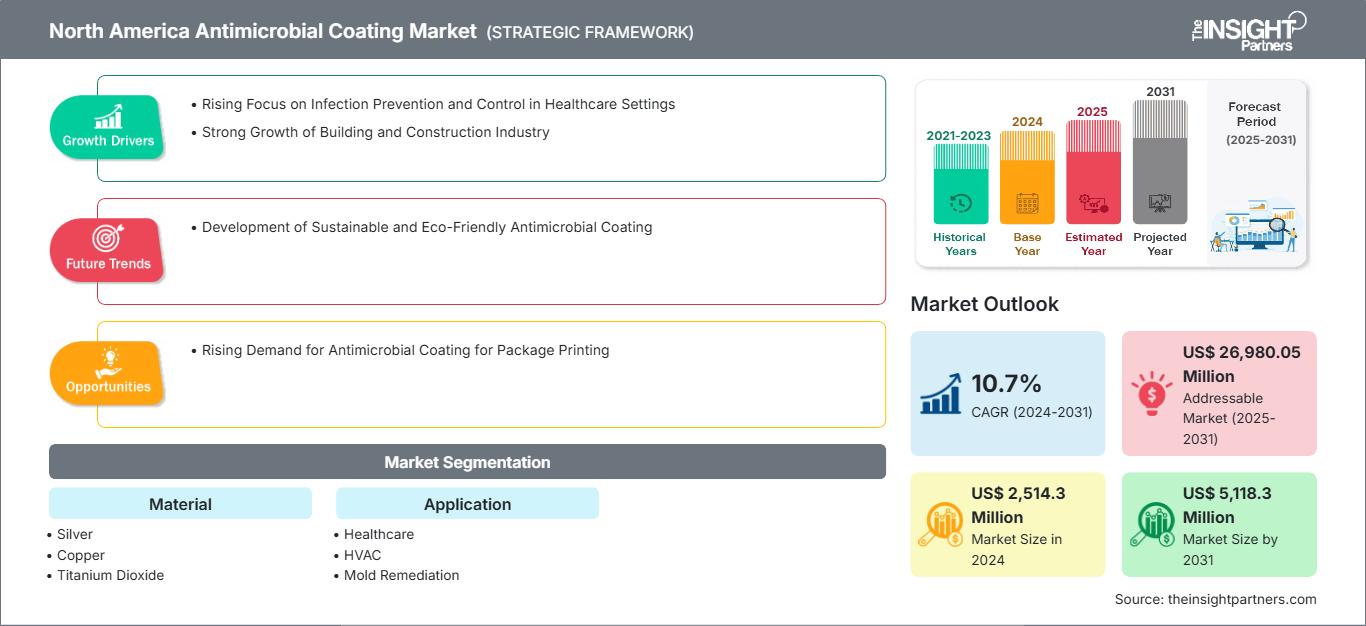
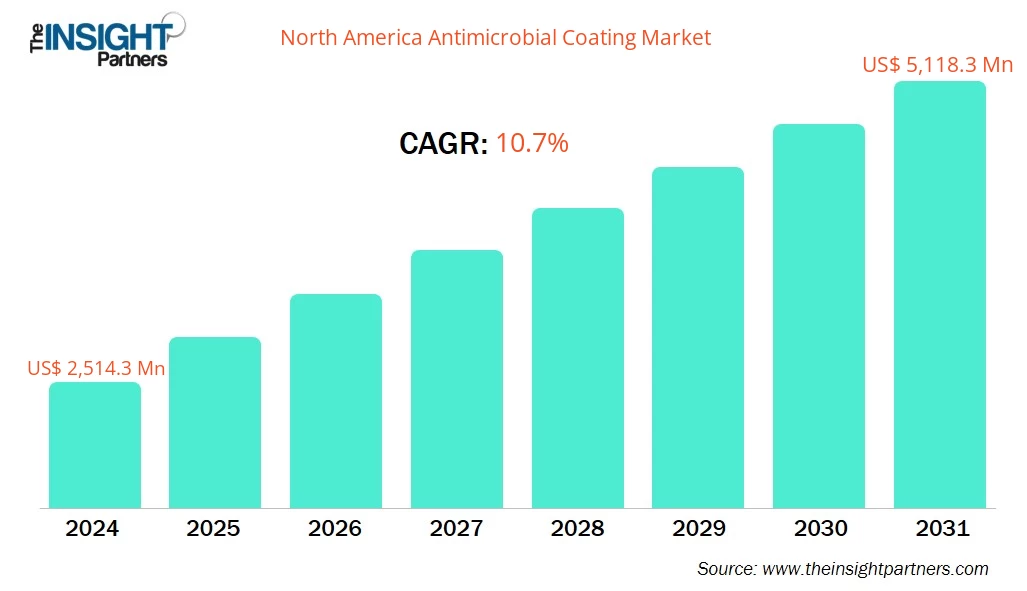
The North America Antimicrobial Coating Market size is expected to reach US$ 5,118.3 Million by 2031 from US$ 2,514.3 Million in 2024. The market is estimated to record a CAGR of 10.7% from 2024 to 2031.
Executive Summary and North America Antimicrobial Coating Market Analysis:
The antimicrobial coating market in North America is experiencing significant growth, driven by increasing awareness of hygiene and infection control across various industries. The healthcare sector remains a key driver of the antimicrobial coating market in North America, as hospitals and medical facilities increasingly adopt these coatings to reduce the risk of healthcare-associated infections (HAIs). According to the American Hospital Association (AHA), health spending in the US increased by 4.1% in 2022 to US$ 4.5 trillion or US$ 13,493 per capita. HAIs pose a significant challenge in medical facilities, leading to prolonged hospital stays, increased healthcare costs, and severe health complications. Hospitals and clinics have been incorporating antimicrobial coating in medical devices, surgical instruments, hospital beds, and high-tech surfaces to mitigate these risks. Further, the construction industry is witnessing a growing adoption of antimicrobial coating. With urbanization and rising concerns over indoor air quality, builders and architects are incorporating antimicrobial coating in paints, HVAC systems, and flooring materials to inhibit mold and bacterial growth. These coatings improve the durability of building materials and contribute to a healthier indoor environment. The growing trend of smart and sustainable buildings has propelled the demand for antimicrobial coating in residential and commercial spaces.
● REPORT CUSTOMIZATION
Tailor This Report To Align With Your Specific Business Requirements
This report can be customized to align precisely with your business objectives, scope, and target markets. Customization options include tailored segmentation, geography, competitive analysis, and strategic insights to support informed decision-making.
Customize This Report →WHAT YOU CAN ADJUST
- ● Segmentations
- ● Geography
- ● Competitive Analysis
- ● Language Preferences
North America Antimicrobial Coating Market: Strategic Insights
-
Get Top Key Market Trends of this report.This FREE sample will include data analysis, ranging from market trends to estimates and forecasts.
North America Antimicrobial Coating Market Segmentation Analysis:
- By Material, the North America Antimicrobial Coating Market is segmented into Silver, Copper, Titanium Dioxide, and Others. Silver held the largest share of the market in 2024.
- By Application, the North America Antimicrobial Coating Market is segmented into Healthcare, HVAC, Mold Remediation, Building and Construction, Food and Beverages, and Others. Healthcare held the largest share of the market in 2024.
North America Antimicrobial Coating Market Report Scope
| Report Attribute | Details |
|---|---|
| Market size in 2024 | US$ 2,514.3 Million |
| Market Size by 2031 | US$ 5,118.3 Million |
| CAGR (2024 - 2031) | 10.7% |
| Historical Data | 2021-2023 |
| Forecast period | 2025-2031 |
| Segments Covered |
By Material
|
| Regions and Countries Covered |
North America
|
| Market leaders and key company profiles |
|
North America Antimicrobial Coating Market Players Density: Understanding Its Impact on Business Dynamics
The North America Antimicrobial Coating Market is growing rapidly, driven by increasing end-user demand due to factors such as evolving consumer preferences, technological advancements, and greater awareness of the product's benefits. As demand rises, businesses are expanding their offerings, innovating to meet consumer needs, and capitalizing on emerging trends, which further fuels market growth.
North America Antimicrobial Coating Market Outlook
Healthcare settings can contribute to the spread of various infections, harming health workers, patients, and visitors. According to the World Health Organization, out of every 100 patients in acute-care hospitals, 7 patients in high-income countries and 15 patients in low- and middle-income countries will acquire at least one healthcare-associated infection (HAI) during their hospital stay, respectively. In addition, on average, the cause of death of one in every ten affected patients is HAI. Newborns and people in intensive care are particularly at high risk of getting infected. A new report from WHO shows that 70% of those infections can be prevented if good hand hygiene and other cost-effective practices are followed. As a result, infection prevention and control has become an important aspect of modern healthcare practices. Many countries have an appointed infection prevention and control (IPC) focal point, along with a dedicated budget for IPC and curriculum for front-line healthcare workers training. With the help of this budget, healthcare authorities are developing national IPC guidelines and a national program or plan for HAI surveillance and establishing hand hygiene compliance as a key national indicator. Several nations across the globe are demonstrating strong engagement and progress in scaling up actions to establish minimum requirements and core components of IPC programs. Further, there is an increasing awareness regarding the importance of hygiene and sterilization practices. Healthcare facilities are adopting advanced measures to prevent the spread of pathogens. Antimicrobial coatings offer a continuous and passive layer of protection against harmful microorganisms. These coatings are increasingly incorporated into medical equipment and healthcare furnishings for infection prevention and control. Thus, focus on infection prevention and control in healthcare settings fuels the antimicrobial coating market growth.
North America Antimicrobial Coating Market Country Insights
By country, the North America Antimicrobial Coating Market is segmented into the United States, Canada, and Mexico. The United States held the largest share in 2024.
The antimicrobial coating market in the US is driven by the rising demand from various end-use industries, such as healthcare, building and construction, food and beverages, and HVAC. The food and beverages industry is one of the largest industries in the US. According to the US Department of Commerce, there were ~41,080 food and beverage processing plants in the US in 2021. Stringent food safety regulations enforced by agencies such as the Food and Drug Administration (FDA) and the US Department of Agriculture (USDA) require food manufacturers to maintain high levels of hygiene to prevent contamination. As a result, antimicrobial coating are widely used in food packaging, processing equipment, storage facilities, and transportation surfaces to enhance food safety and extend shelf life. Thus, growing consumer awareness regarding foodborne illnesses is driving the demand for these coatings in the industry. Furthermore, the country has a well-established healthcare system; however, it also faces significant challenges related to HAIs. To mitigate these risks, hospitals and healthcare facilities increasingly use antimicrobial coating on medical devices, surgical instruments, hospital beds, and high-touch surfaces such as door handles and countertops.
North America Antimicrobial Coating Market Company Profiles
Some of the key players operating in the market include Cupron Inc., ALISTAGEN Corp, Fiberlock Technologies, PPG Industries Inc., Akzo Nobel NV, Nano-Care Deutschland AG, The Sherwin-Williams Co, Specialty Coating Systems Inc, and CytaCoat AB.
These players are adopting various strategies such as expansion, product innovation, and mergers and acquisitions to provide innovative products to their consumers and increase their market share.
North America Antimicrobial Coating Market Research Methodology
The following methodology has been followed for the collection and analysis of data presented in this report:
Secondary Research
The research process begins with comprehensive secondary research, utilizing internal and external sources to gather qualitative and quantitative data for each market. Commonly referenced secondary research sources include, but are not limited to:
- Company websites, annual reports, financial statements, broker analyses, and investor presentations
- Industry trade journals and other relevant publications
- Government documents, statistical databases, and market reports
- News articles, press releases, and webcasts specific to companies operating in the market
Note:
All financial data included in the Company Profiles section has been standardized to US$. For companies reporting in other currencies, figures have been converted to US$ using the relevant exchange rates for the corresponding year.Primary Research
The Insight Partners conducts a significant number of primary interviews each year with industry stakeholders and experts to validate its data analysis and gain valuable insights. These research interviews are designed to:
- Validate and refine findings from secondary research
- Enhance the expertise and market understanding of the analysis team
- Gain insights into market size, trends, growth patterns, competitive dynamics, and future prospects
Primary research is conducted via email interactions and telephone interviews, encompassing various markets, categories, segments, and sub-segments across different regions. Participants typically include:
- Industry stakeholders: Vice Presidents, Business Development Managers, Market Intelligence Managers, and National Sales Managers
- External experts: Valuation specialists, research analysts, and key opinion leaders with industry-specific expertise

- Comprehensive Market Sizing and Forecast Analysis
- Detailed Segmentation Analysis
- In-Depth Market Dynamics Assessment
- Regional and Country-Level Insights
- Competitive Landscape and Company Benchmarking
- Strategic Business Intelligence
Recent Reports
Testimonials

The Insight Partners provided valuable market intelligence that supported our global go-to-market strategy. Their team was professional, responsive, and attentive to our feedback, providing thoughtful analysis and helpful methodological clarifications throughout the project.
Junmo Kim Chief Financial Officer (CFO), Enertech Co., Ltd.
The Insight Partners' SCADA System Market report is comprehensive, with valuable insights on current trends and future forecasts. The team was highly professional, responsive, and supportive throughout. We are very satisfied and highly recommend their services.
RAN KEDEM Partner, Reali Technologies LTDs
I requested a report on a very specific software market and the team produced the report in a few days. The information was very relevant and well presented. I then requested some changes and additions to the report. The team was again very responsive and I got the final report in less than a week.
JEAN-HERVE JENN Chairman, Future Analytica
We worked with The Insight Partners for an important market study and forecast. They gave us clear insights into opportunities and risks, which helped shape our plans. Their research was easy to use and based on solid data. It helped us make smart, confident decisions. We highly recommend them.
PIYUSH NAGPAL Sr. Vice President, High Beam Global
The Insight Partners delivered insightful, well-structured market research with strong domain expertise. Their team was professional and responsive throughout. The user-friendly website made accessing industry reports seamless. We highly recommend them for reliable, high-quality research services
YUKIHIKO ADACHI CEO, Deep Blue, LLC.
This is the first time I have purchased a market report from The Insight Partners.While I was unsure at first, I visited their web site and felt more comfortable to take the risk and purchase a market report.I am completely satisfied with the quality of the report and customer service. I had several questions and comments with the initial report, but after a couple of dialogs over email with their analyst I believe I have a report that I can use as input to our strategic planning process.Thank you so much for taking the extra time and making this a positive experience.I will definitely recommend your service to others and you will be my first call when we need further market data.
JOHN SUZUKI President and Chief Executive Officer, Board Director, BK Technologies
I wish to appreciate your support and the professionalism you displayed in the course of attending to my request for information regarding to infectious disease IVD market in Nigeria. I appreciate your patience, your guidance, and the fact that you were willing to offer a discount, which eventually made it possible for us to close a deal. I look forward to engaging The Insight Partners in the future, all thanks to the impression you have created in me as a result of this first encounter.
DR CHIJIOKE ONYIA MANAGING DIRECTOR, PineCrest Healthcare Ltd.Reason to Buy
- Informed Decision-Making
- Understanding Market Dynamics
- Competitive Analysis
- Identifying Emerging Markets
- Customer Insights
- Market Forecasts
- Risk Mitigation
- Boosting Operational Efficiency
- Strategic Planning
- Investment Justification
- Tracking Industry Innovations
- Aligning with Regulatory Trends





 Get Free Sample for