North America Frozen Vegetables Market Size, Share, Trends & Forecast 2025-2031
North America Frozen Vegetables Market Size and Forecast (2021 - 2031), Regional Share, Trend, and Growth Opportunity Analysis Report Coverage: By Type (Corn Cob, Sweet Corn Kernels, Green Peas, Baby Corn, Carrot, Cauliflower, Green Beans, Spinach, Broccoli, Onions, Brussel Sprouts, Mixed Vegetables, Okra, and Others), Category (Organic and Conventional), End User (Food Processing, Food Retail [Supermarkets and Hypermarkets, Convenience Stores, Online Retail, Others], and Foodservice [Cafes, Quick-Service Restaurants, Fast-Casual Restaurants, and Others]), and Country
Historic Data: 2021-2023 | Base Year: 2024 | Forecast Period: 2025-2031- Status : Published
- Report Code : TIPRE00020106
- Category : Food and Beverages
- No. of Pages : 195
- Available Report Formats :


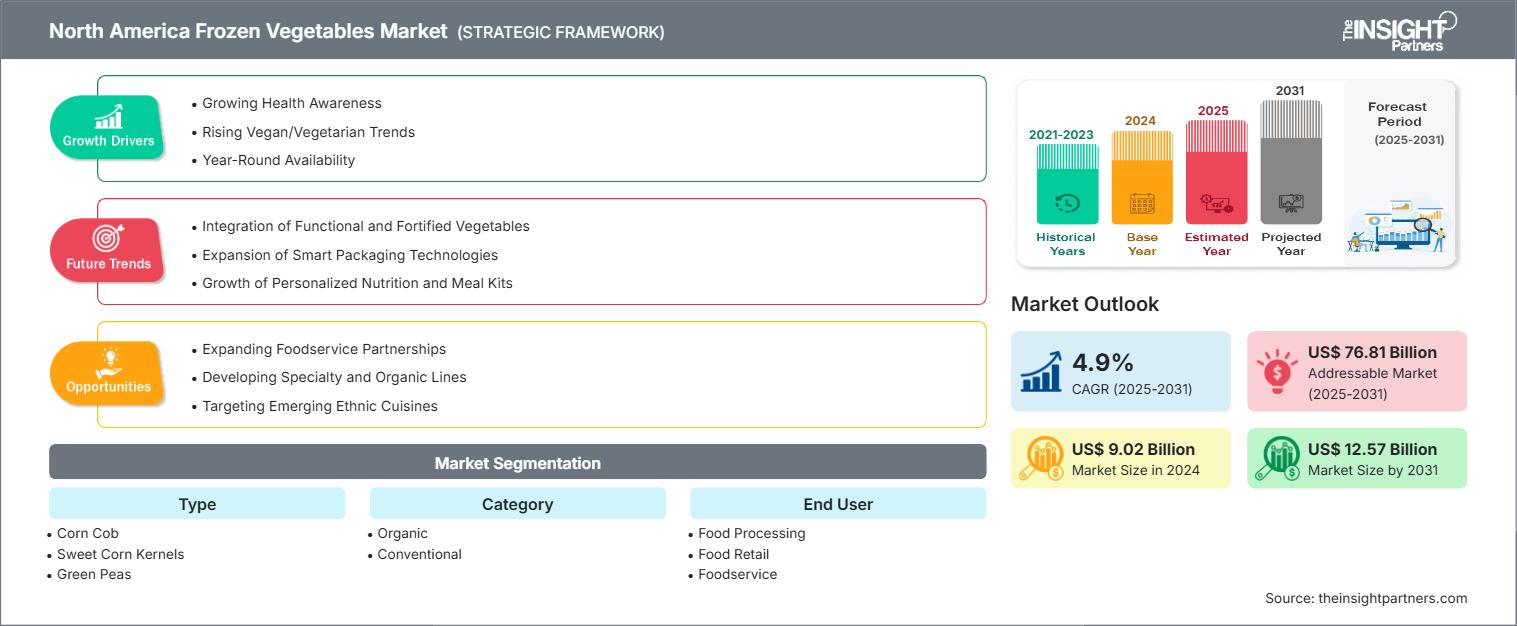
The North America frozen vegetables market size is projected to grow from US$ 9.02 billion in 2024 to US$ 12.57 billion by 2031; the market is expected to register a CAGR of 4.9% during 2025–2031.
North America Frozen Vegetables Market Analysis
Frozen vegetables have a broad scope of application and play a crucial role in food processing, serving as essential ingredients in a wide range of products, from frozen meals to baked goods. In the food retail sector, stores stock shelves with various frozen vegetables to meet consumer demand for convenient and nutritious options. In food service, businesses such as restaurants and catering companies depend on frozen vegetables to simplify food preparation, ensure consistent quality, and offer diverse menu choices. The versatility, convenience, and long shelf life of frozen vegetables make them indispensable for these sectors, helping them meet customer needs and optimize their operations.
North America Frozen Vegetables Market Overview
Frozen vegetables have their temperature reduced and maintained below the freezing point for storage and transportation until they are ready to eat. Frozen vegetables include corn, peas, broccoli, cauliflower, carrots, and beans. These vegetables undergo several processing steps. In producing frozen vegetables, fresh vegetables are first harvested, briefly cooked in boiling water, and then quickly frozen to preserve their flavor, texture, and nutrients. Freezing is considered one of the best methods of preserving food as it maintains the product's shelf life, taste, and nutritional value. Freezing stops the growth of microorganisms and slows down the chemical and enzymatic reactions in food. In the food processing application, frozen vegetables offer several advantages, such as cost efficiency, convenience, variety, flexibility, flavor retention, nutrient retention, and extended shelf life.
Customize This Report To Suit Your Requirement
Get FREE CUSTOMIZATIONNorth America Frozen Vegetables Market: Strategic Insights
-
Get Top Key Market Trends of this report.This FREE sample will include data analysis, ranging from market trends to estimates and forecasts.
North America Frozen Vegetables Market Drivers and Opportunities
Market Drivers:
- Growing Health Awareness: Consumers prefer nutritious, preservative-free vegetables for healthier diets and lifestyles.
- Rising Vegan/Vegetarian Trends: An increase in plant-based diets boosts the demand for diverse frozen vegetable options.
- Year-Round Availability: Frozen products ensure access to seasonal vegetables throughout the year.
- Technological Advances: Improved freezing methods retain nutrition, texture, and flavor, attracting consumers.
- Rising Demand for Convenience: Frozen vegetables offer quick, easy meal prep without washing or chopping.
Market Opportunities:
- Expanding Foodservice Partnerships: Collaborating with restaurants and cafeterias to increase frozen vegetable usage
- Developing Specialty and Organic Lines: Offering organic, non-GMO, and specialty vegetable options to capture niche markets
- Targeting Emerging Ethnic Cuisines: Introducing frozen vegetables catering to diverse cultural food preferences
- Leveraging Functional Food Trends: Adding vitamins or probiotics to frozen veggies for enhanced health benefits
- Promoting Meal Kits and Ready Meals: Including frozen vegetables in convenient, healthy meal kits for consumers
North America Frozen Vegetables Market Report Segmentation Analysis
The North America frozen vegetables market is divided into different segments to give a clearer view of how it works, its growth potential, and the latest trends. Below is the standard segmentation approach used in industry reports:
By Type:
- Corn Cob: Frozen corn cobs consist of whole ears of corn that are harvested, blanched (briefly boiled), and then quickly frozen to preserve their flavor and texture.
- Sweet Corn Kernels: Frozen sweet corn kernels are harvested at their peak ripeness, blanched to preserve their color and nutrients, and quickly frozen to maintain their natural quality.
- Green Peas: Frozen green peas are preserved to maintain their freshness and nutritional value. They are convenient ingredients used in various dishes, such as soups, stews, curries, and salads.
- Baby Corn: Frozen baby corn is a type of cereal grain obtained from early-harvested corn plants. It is also known as the immature version of regular corn and is harvested when the corn silks are about 2–3 inches long.
- Carrot: Frozen carrots are ready-to-cook vegetables. They are washed, cut, and frozen to preserve their flavor, aroma, and nutritional value.
- Cauliflower: Frozen cauliflower is known as a convenient and affordable meal, as it is easier to prepare.
- Green Beans: Frozen green beans are a convenient vegetable option that can be added to different types of meals. They are easier to prepare.
- Spinach: Frozen spinach is a highly nutritious vegetable prepared from fresh spinach by the process of sorting, washing, blanching, and flash freezing.
- Broccoli: Frozen broccoli is a rich source of vitamins, minerals, fiber, and antioxidants. It is first separated into florets and kept in a freezer bag.
- Onions: Onions are peeled and cut into pieces before being frozen. Frozen onions help reduce waste, which is a cost-effective and sustainable option compared to fresh onions.
- Brussels Sprouts: Frozen Brussels sprouts are prepared by freezing to maintain their nutrients and extend shelf life.
- Mixed Vegetables: Frozen mixed vegetables are a blend of different vegetables that are harvested, cleaned, chopped, and frozen to preserve their freshness and nutrients.
- Okra: Frozen okra is fresh okra that has been harvested, washed, trimmed, and frozen to preserve its flavor, texture, and nutrients, including vitamins C and K, folate, and fiber.
- Others: The other types of frozen vegetables are butternut squash, lima beans, etc.
By Category:
- Organic: Organic frozen vegetables are produced without synthetic pesticides, fertilizers, genetically modified organisms (GMOs), or irradiation.
- Conventional: Conventional frozen vegetables are produced using traditional farming methods that might involve synthetic pesticides, fertilizers, and other agricultural chemicals.
By End User:
- Food Processing: Frozen vegetables offer convenience and consistency to food manufacturers, eliminating the need for time-consuming preparation methods such as washing, peeling, and chopping.
- Food Retail: In the food retail industry, supermarkets, grocery stores, and specialty food stores provide frozen vegetables to meet consumer demand for convenient and nutritious options.
- Foodservice: The foodservice industry relies on frozen vegetables as versatile ingredients in various culinary applications across restaurants, cafes, catering services, and institutional kitchens.
By Country:
- US
- Canada
- Mexico
The US recorded the largest share in the North America frozen vegetables market, owing to the growing demand from the foodservice industry.
North America Frozen Vegetables Market Report Scope
| Report Attribute | Details |
|---|---|
| Market size in 2024 | US$ 9.02 Billion |
| Market Size by 2031 | US$ 12.57 Billion |
| CAGR (2025 - 2031) | 4.9% |
| Historical Data | 2021-2023 |
| Forecast period | 2025-2031 |
| Segments Covered |
By Type
|
| Regions and Countries Covered |
North America
|
| Market leaders and key company profiles |
|
North America Frozen Vegetables Market Players Density: Understanding Its Impact on Business Dynamics
The North America Frozen Vegetables Market is growing rapidly, driven by increasing end-user demand due to factors such as evolving consumer preferences, technological advancements, and greater awareness of the product's benefits. As demand rises, businesses are expanding their offerings, innovating to meet consumer needs, and capitalizing on emerging trends, which further fuels market growth.
North America Frozen Vegetables Market Players Density: Understanding Its Impact on Business Dynamics
High Market Density and Competition
Competition is intense due to the presence of established players such as General Mills Inc., Goya Foods Inc., Alasko Food Inc., Seneca Foods Corp, Hanover Foods, B&G Foods Inc., Mantab Food Group Inc., Nortera, Twin City Foods (TCF), and Rubicon Food Products Limited (Shana Foods).
The high level of competition urges companies to stand out by offering:
- Innovative product offering
- Sustainable and ethical sourcing
- Competitive pricing models
- Strong customer support and easy integration
Opportunities and Strategic Moves
- Focusing on research and development activities to distinguish themselves in the market
- Expanding global footprint and capabilities through acquisitions of food manufacturing companies
- Expanding product portfolio with the launch of innovative meal kits
Major Companies operating in the North America frozen vegetables market are:
- General Mills Inc
- Goya Foods Inc
- Alasko Food Inc
- Seneca Foods Corp
- Hanover Foods
- B&G Foods Inc
- Mantab Food Group Inc
- Nortera
- Twin City Foods (TCF)
- Rubicon Food Products Limited (Shana Foods)
Disclaimer: The companies listed above are not ranked in any particular order.
Other companies analyzed during the course of research:
- Birds Eye (Nomad Foods)
- Greenyard
- Conagra Brands
- McCain Foods
- Crop's NV
- Simplot Global Food, LLC
- Nature's Touch
- Aaravi International
- BC Frozen Foods
- ABC Fruits
North America Frozen Vegetables Market News and Recent Developments
- B&G Foods, Inc – Mergers and Acquisitions In May 2022, B&G Foods, Inc. announced the acquisition of the frozen vegetable manufacturing operations of Growers Express, LLC. Growers Express is an industry innovator that manufactures, produces, packages, and sells frozen vegetable products, primarily Green Giant Riced Veggies and Green Giant Veggie Spirals. The purchased assets include inventory, equipment, a sublease for a portion of a manufacturing facility in Yuma, Arizona, and a lease for a warehouse facility in San Luis, Arizona.
North America Frozen Vegetables Market Report Coverage and Deliverables
The "North America Frozen Vegetables Market Size and Forecast (2021–2031)" report provides a detailed analysis of the market covering the following areas:
- North America frozen vegetables market size and forecast at the regional and country levels for all the key market segments covered under the scope
- North America frozen vegetables market trends, as well as market dynamics such as drivers, restraints, and key opportunities
- Detailed Porter's five forces and SWOT analysis
- North America frozen vegetables market analysis covering key market trends, regional framework, major players, regulations, and recent market developments
- Industry landscape and competition analysis covering market concentration, heat map analysis, prominent players, and recent developments for the North America frozen vegetables market
- Detailed company profiles
Frequently Asked Questions

- Historical Analysis (2 Years), Base Year, Forecast (7 Years) with CAGR
- PEST and SWOT Analysis
- Market Size Value / Volume - Regional, Country
- Industry and Competitive Landscape
- Excel Dataset
Recent Reports
Testimonials

The Insight Partners' SCADA System Market report is comprehensive, with valuable insights on current trends and future forecasts. The team was highly professional, responsive, and supportive throughout. We are very satisfied and highly recommend their services.
RAN KEDEM Partner, Reali Technologies LTDs
I requested a report on a very specific software market and the team produced the report in a few days. The information was very relevant and well presented. I then requested some changes and additions to the report. The team was again very responsive and I got the final report in less than a week.
JEAN-HERVE JENN Chairman, Future Analytica
We worked with The Insight Partners for an important market study and forecast. They gave us clear insights into opportunities and risks, which helped shape our plans. Their research was easy to use and based on solid data. It helped us make smart, confident decisions. We highly recommend them.
PIYUSH NAGPAL Sr. Vice President, High Beam Global
The Insight Partners delivered insightful, well-structured market research with strong domain expertise. Their team was professional and responsive throughout. The user-friendly website made accessing industry reports seamless. We highly recommend them for reliable, high-quality research services
YUKIHIKO ADACHI CEO, Deep Blue, LLC.
This is the first time I have purchased a market report from The Insight Partners.While I was unsure at first, I visited their web site and felt more comfortable to take the risk and purchase a market report.I am completely satisfied with the quality of the report and customer service. I had several questions and comments with the initial report, but after a couple of dialogs over email with their analyst I believe I have a report that I can use as input to our strategic planning process.Thank you so much for taking the extra time and making this a positive experience.I will definitely recommend your service to others and you will be my first call when we need further market data.
JOHN SUZUKI President and Chief Executive Officer, Board Director, BK Technologies
I wish to appreciate your support and the professionalism you displayed in the course of attending to my request for information regarding to infectious disease IVD market in Nigeria. I appreciate your patience, your guidance, and the fact that you were willing to offer a discount, which eventually made it possible for us to close a deal. I look forward to engaging The Insight Partners in the future, all thanks to the impression you have created in me as a result of this first encounter.
DR CHIJIOKE ONYIA MANAGING DIRECTOR, PineCrest Healthcare Ltd.Reason to Buy
- Informed Decision-Making
- Understanding Market Dynamics
- Competitive Analysis
- Identifying Emerging Markets
- Customer Insights
- Market Forecasts
- Risk Mitigation
- Boosting Operational Efficiency
- Strategic Planning
- Investment Justification
- Tracking Industry Innovations
- Aligning with Regulatory Trends




 Get Free Sample For