
North America Industrial Dust Collector Market Share & Trends 2034
Coverage: By Product Type (Cartridge Dust Collectors, Baghouse Dust Collectors, Cyclone Dust Collectors, Wet Dust Collectors, Electrostatic Precipitators, Others), Service Type (Installation and Commissioning Services, Maintenance and Repair Services, Filter Replacement and Cleaning Services, Retrofit and Upgradation Services, Inspection and Testing Services), Dust Collection Method (Dry Dust Collection, Wet Dust Collection), Mobility (Portable Dust Collectors, Fixed Dust Collectors), End-User Industry (Metalworking Industry, Wood Working Industry, Mining, Aerospace and Defense, Automotive, Pharmaceuticals, Construction and Infrastructure, Food and Beverage, Others), and Country (US, Canada, Mexico)
- Status : Published
- Report Code : TIPRE00044088
- Category : Manufacturing and Construction
- No. of Pages : 205
- Available Report Formats :


- Last update date : October 07, 2026


2025 Market Size
US$ 2,826.46 Mn
Base year value
2034 Forecast
US$ 4,680.95 Mn
Projected by 2034
CAGR 2026-2034
5.8 %
Growth rate
Addressable Market
US$ 34,080.46 Mn
(2026-2034)
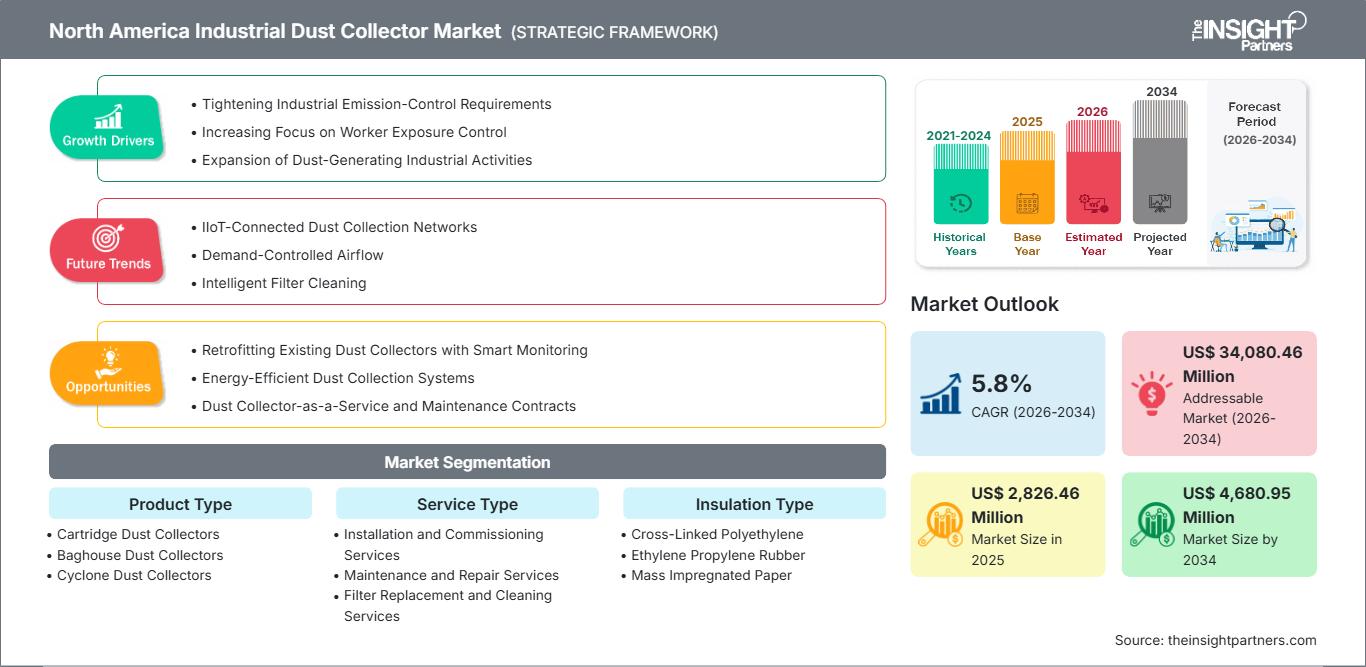
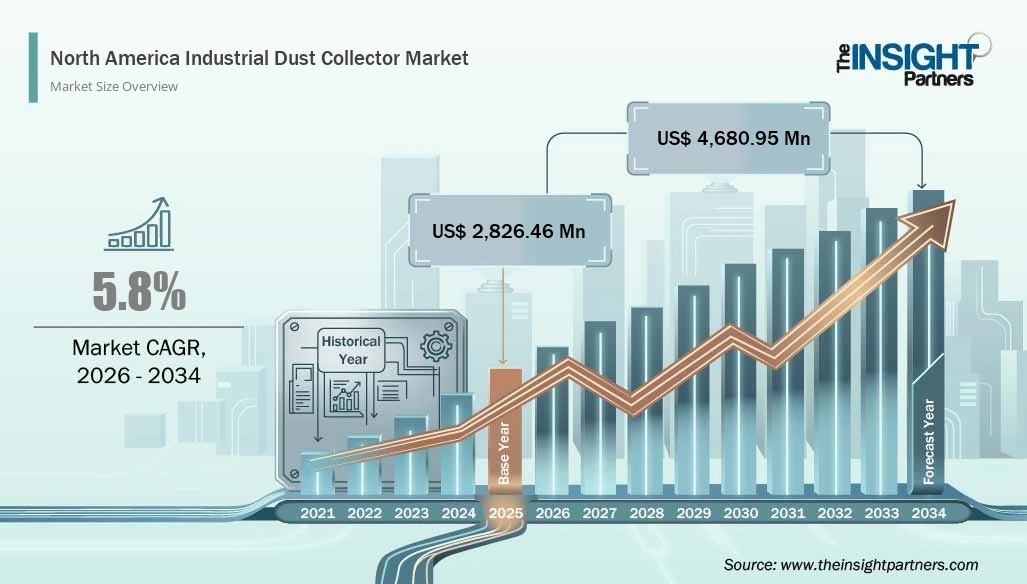
The North America Industrial Dust Collector Market was valued at US$ 2,826.46 Million in 2025 and is projected to reach US$ 4,680.95 Million by 2034, expanding at a CAGR of 5.8% over the forecast period. This market encompasses engineered systems and aftermarket services designed to capture, filter, and contain industrial particulate matter across manufacturing, processing, and heavy industrial operations. The scope includes product types such as cartridge, baghouse, cyclone, wet, and electrostatic precipitator systems, along with installation, maintenance, filter replacement, retrofit, and testing services delivered across dry and wet collection methods in both portable and fixed configurations.
The North America Industrial Dust Collector Market size reflects a mature but regulation-driven demand environment where replacement, retrofit, and service revenue increasingly complement new equipment installations. The North America Industrial Dust Collector Market CAGR of ~5.8% through 2034 is underpinned by combustible dust safety enforcement, tightening particulate emission standards, and the expansion of battery and electric vehicle material production that introduces new explosion-proof collection requirements.
North America Industrial Dust Collector Market Assessment and Insights
- North America: ~30% 2025 global share and ~5.8% 2026-2034 CAGR. The leadership within this region is structural rather than cyclical due to the size of the installed base of industrial capacity, regulation of combustible dust and air quality, as well as the number of original equipment manufacturing and service providers present within the region. This leads to an environment where compliance drives replacement and retrofits and generates steady income regardless of greenfield capital expenditure reductions.
- U.S.: ~83% share of North America in 2025 and ~5.8% CAGR. The dominance of the country is attributed to the dense presence of industries, especially metal working, food production, and chemicals, in addition to regulations from the government and state, which make dust collection an unavoidable cost of operation. Construction of batteries and semiconductors also contributes to the need for efficient dust collectors.
- Largest Segment: Dry Dust Collection with ~64% share of the North Market for America Industrial Dust Collector in 2025. Dry Collection wins due to its wide range of applications in baghouses, cartridge collectors, cyclones and dry ESPs, high efficiency of filtration without wastewater production, and the ability to operate continuously in heavy industries such as cement manufacturing, steel production, mining and food processing. Growth is driven by its wide installed base and range of industrial applications, but the technology is well developed and faces slow substitution by wet systems in combustible/hazardous dust handling.
- High Growth Segment: Cartridge Dust Collectors with ~8.0% 2026-2034 CAGR. Rapid adoption is due to reduced footprint sizes, enhanced filter efficiency for fine particulates, and decreased installation complexity that fits metal machining, pharmaceuticals, and food processing plants. This market has the advantage of constant advancements in media technology that increase filter life and decrease air consumption.
- Key companies analyzed in detail: Donaldson Company, Inc.; Camfil; Atlas Copco AB; American Air Filter Company, Inc.; Airflow Systems, Inc.; CECO Environmental Corp.; Parker Hannifin Corporation; Baghouse.com; RoboVent; Rodrigue Métal.
Source: The Insight Partners' analysis based on proprietary research, government publications, company annual reports, investor presentations, industry databases, and expert interviews.
In the North America Industrial Dust Collector Market, there is a transition taking place in the purchase process from an equipment-based approach to one of overall air quality management. Facility managers are assessing dust collection systems based on cost of ownership considerations in terms of filter media life span, compressed air usage, efficiency and risk of non-compliance with applicable regulations. As such, the after-market component in the purchase process is becoming more important for equipment manufacturers as they try to eliminate any down time and avoid enforcement action.
The forward-looking dynamics up to 2034 suggest a trend towards more advanced technologies and local supply chains. The digital monitoring system, which can assess differential pressure, filter condition, and airflow performance, is going to transition from luxury to standard in big facilities. At the same time, the rise in production of battery materials and automotive electric components in the USA and Canada is resulting in the need for explosion-proof and skid-mounted solutions for combustible metal dusts. Together with ongoing NFPA 660 and particulate emissions regulation, these trends indicate a path towards stable growth.
North America Industrial Dust Collector Market Report Scope
| Report Attribute | Details |
|---|---|
| Market size in 2025 | US$ 2,826.46 Million |
| Market Size by 2034 | US$ 4,680.95 Million |
| CAGR (2026 - 2034) | 5.8% |
| Historical Data | 2021-2024 |
| Forecast period | 2026-2034 |
North America Industrial Dust Collector Market Analysis
Need for dust collection equipment in North America is mainly driven by non-discretionary demand which comes from regulatory compliance issues and safety concerns instead of any increase in production volume. The process involves first performing a dust hazard assessment to determine whether there are any combustible or respirable particulates in order to design the system accordingly.
For metalworking, woodworking, and food processing industries, the preferred choice is localized collection at the source to avoid fugitive dust buildup, whereas for cement, mining, and power production, the need is for centralized systems that can manage constant high volumes of dust. Such requirements create a value chain for the different stakeholders where the OEMs, filter media producers, system integrators, and service providers earn their separate margin pools, and services being the most predictable revenue source.
The dynamics of supply within the North America Industrial Dust Collector Market are a result of a combination of local manufacturing and imports of components. The leading OEM companies have established North American facilities for manufacturing dust collectors, housing units, and filter cartridges, while specific media and electronic components may be sourced globally. Imports of steel and filtration media are subject to tariffs and this has prompted some players in the market to establish local suppliers.
Strategic investments made for the North America Industrial Dust Collector Market study suggest that portfolio diversification and capability expansion are the way forward. Donaldson has been making strategic investments in connected filters, which use sensor data to schedule maintenance, while Camfil's Gold Series III release highlights their commitment towards innovation in filter media, which results in increased servicing intervals and decreased energy use. On the other hand, Parker Hannifin's DustHog product range caters to applications requiring handling of dusts and fumes, which are not explosive, through plug-and-play systems, which make installation easy. Meanwhile, CECO Environmental has been undertaking acquisitions in order to increase its target market in both industrial water and air quality applications.
● REPORT CUSTOMIZATION
Tailor This Report To Align With Your Specific Business Requirements
This report can be customized to align precisely with your business objectives, scope, and target markets. Customization options include tailored segmentation, geography, competitive analysis, and strategic insights to support informed decision-making.
Customize This Report →WHAT YOU CAN ADJUST
- ● Segmentations
- ● Geography
- ● Competitive Analysis
- ● Language Preferences
North America Industrial Dust Collector Market: Strategic Insights
Regional Insights
North America Industrial Dust Collector Market
North America Industrial Dust Collector Market shares have been dominated by the United States, the main source of earnings in the region, followed by Canada and Mexico. A regulatory landscape has further strengthened the position of the market in the region with mandatory operation rules related to the process of dust collection applicable for almost all kinds of industrial activities. The NFPA 660 standard that combined six old dust standards into one and became effective from December 2024 made compliance easier for businesses and, at the same time, increased the importance of dust hazard analysis.
The supply side in North America is characterized by a mature yet evolving supply chain network. There is strength among domestic suppliers in baghouses and cartridge filtration technology, while international players have gained significant foothold in the region as a result of acquisition and production expansion strategies. North America has a very active aftermarket industry, with filter maintenance operations accounting for an increasing proportion of overall revenue due to aging installations and attempts to prolong equipment life. In addition, the after-sales market serves as a protective measure against lower capital investments and as a source of repeat contacts to promote new technologies.
U.S. Industrial Dust Collector Market
The U.S. Industrial Dust Collector Market accounted for approximately ~83% of North America revenue in 2025 and is projected to grow at ~5.8% CAGR through 2034. The country's market is distinguished by the breadth of its industrial demand base, spanning metalworking and welding operations, food and beverage processing, pharmaceutical manufacturing, wood products, and heavy industries including cement and steel. Each of these sectors presents distinct dust characteristics and regulatory drivers, creating demand for a diverse range of collection technologies and service capabilities.
Company presence in the U.S. market is strong, with Donaldson, Camfil, Parker Hannifin, CECO Environmental, and AAF International having a footprint in manufacturing, distribution, and services in several states. Application dynamics have undergone slight changes in recent times, with the manufacture of battery materials and electric vehicle components adding a new dimension to the demand for explosion proof cartridge and baghouse systems that can process metallic dusts. Increasing attention from regulators to respirable crystalline silica in fabrication and construction applications adds another layer of opportunities within the U.S. market space. Enforcement activity in the U.S. market is the distinguishing feature compared to peer markets, in that regulation is translated to expenditures in a more consistent fashion.
Segmentation Analysis
Product Type
- Cartridge Dust Collectors: Compact, media-based systems using pleated filter elements for high-efficiency fine particulate capture. Projected to grow at ~8.0% CAGR from 2026 to 2034, driven by metalworking, pharmaceutical, and food processing demand. Smaller footprints and easier maintenance favor adoption over larger baghouse systems.
- Baghouse Dust Collectors: Fabric filter systems designed for high-volume, high-temperature, and heavy dust-loading applications. Expected to grow at ~4.3% CAGR through 2034, with demand concentrated in cement, steel, mining, and power generation. Substantial installed base sustains recurring filter and maintenance revenue.
- Cyclone Dust Collectors: Use centrifugal force for coarse particle pre-separation, often deployed as standalone units or pre-cleaners. Growth remains moderate due to mature technology and competition from higher-efficiency alternatives. Demand persists in woodworking, grain handling, and abrasive or high-temperature applications.
- Wet Dust Collectors: Water-based scrubbing systems handling combustible, sticky, hot, or hazardous particulate streams. Projected to grow at ~6.8% CAGR from 2026 to 2034, supported by combustible dust safety requirements. Preferred where dry collection presents deflagration risks, including aluminum and titanium dust applications.
- Electrostatic Precipitators (ESPs): Use electrical charging and collection plates for high-volume gas stream particulate removal. Expected to grow at ~5.7% CAGR through 2034, concentrated in power generation, cement, and steel. High upfront costs limit smaller facility adoption, but remain essential for large-scale emission control.
- Others: Specialized filtration technologies including inertial separators, hybrid systems, and application-specific collectors. Growth remains moderate and tied to niche applications requiring custom engineering. Includes emerging hybrid systems combining multiple collection principles.
Service Type
- Installation and Commissioning Services: Encompasses system installation, ductwork integration, electrical connections, and performance verification. Demand is closely tied to new equipment sales and capital project cycles.
- Maintenance and Repair Services: Covers preventive maintenance, fan and motor servicing, pulse-jet system adjustment, and emergency repairs. Recurring contracts provide revenue stability and create opportunities for service providers to identify upgrade and retrofit needs.
- Filter Replacement and Cleaning Services: Includes filter media replacement, cleaning, and disposal. Demand is predictable and driven by operating hours, dust loading, and filter life specifications. Suppliers with proprietary media technologies often capture premium pricing in this sub-segment.
- Retrofit and Upgradation Services: Involves modifying existing collectors to improve efficiency, add monitoring capabilities, or meet updated regulatory standards. This sub-segment is growing as operators seek to extend equipment life rather than replace complete systems.
- Inspection and Testing Services: Encompasses airflow testing, emission measurement, filter integrity testing, and dust hazard analysis support. Regulatory compliance and insurance requirements drive demand, particularly for older installations.
Dust Collection Method
- Dry Dust Collection: Dominates the market through baghouse, cartridge, cyclone, and dry ESP configurations. Preferred for most industrial applications where dust is non-combustible or where explosion protection can be engineered through venting and isolation.
- Wet Dust Collection: Preferred for combustible, sticky, or high-temperature particulate streams where dry filtration presents safety or operational challenges. Growth is supported by combustible dust safety requirements and applications in metal finishing and chemical processing.
Mobility
- Portable Dust Collectors: Designed for point-of-source extraction, temporary operations, and smaller workshops where centralized systems are impractical. Demand is driven by flexibility requirements and construction or maintenance applications.
- Fixed Dust Collectors: Represent the largest installed base, serving continuous industrial operations requiring centralized collection and permanent infrastructure. Fixed systems dominate in cement, mining, steel, and large manufacturing facilities.
End-User Industry
- Metalworking Industry: A major demand source for cartridge and portable collectors used in welding, grinding, cutting, and machining operations. Worker safety and fine metal particulate control drive adoption.
- Wood Working Industry: Requires cyclones and baghouses for sawdust and wood particle collection. Combustible dust risks and furniture production activity sustain demand.
- Mining: Uses large baghouse and cyclone systems for drilling, crushing, and material handling operations. Project cycles and commodity prices influence spending patterns.
- Aerospace and Defense: Demands high-precision filtration for composite processing, metal finishing, and precision machining. Contamination control and worker safety requirements are stringent.
- Automotive: Encompasses welding, grinding, and battery manufacturing applications. Electric vehicle production introduces new combustible metal dust challenges.
- Pharmaceuticals: Requires high-efficiency cartridge and containment systems for powder handling, API production, and tablet manufacturing. GMP and contamination control standards drive specification.
- Construction and Infrastructure: Uses portable and temporary dust collection for concrete cutting, demolition, and material handling. Silica dust regulations influence adoption.
- Food and Beverage: Requires collection for flour, grain, spice, and other combustible food dusts. Hygiene standards and explosion protection are primary considerations.
- Others: Includes chemicals, plastics, electronics, textiles, and other applications with specialized dust collection requirements.
Opportunity Snapshot
| End-User Industry | Revenue Contribution | Trend Tag | Adoption Stage |
| Metalworking Industry | High | Source Capture | Mature |
| Wood Working Industry | Medium | Combustible Risk | Mature |
| Mining | High | Project Cyclical | Mature |
| Aerospace and Defense | Medium | Precision Filtration | Scaling |
| Automotive | High | Battery Materials | Scaling |
| Pharmaceuticals | Medium | Containment Driven | Scaling |
| Construction and Infrastructure | Medium | Silica Focus | Emerging |
| Food and Beverage | High | Explosion Safety | Mature |
| Others | Low | Niche Applications | Mature |
North America Industrial Dust Collector Market Growth Drivers and Impact Analysis
Combustible Dust Safety Enforcement
The harmonization of NFPA combustible dust standards into NFPA 660 has created a clearer but more consistently enforced regulatory framework for facilities handling combustible particulate solids. The standard requires dust hazard analyses for processes generating combustible dust and mandates protective measures including explosion venting, isolation, and suppression. This regulatory clarity has converted combustible dust safety from a discretionary risk management exercise into a compliance obligation with defined technical requirements, stimulating demand for explosion-rated collectors, isolation devices, and hazard analysis services. Facilities that previously deferred upgrades now face documented compliance expectations that translate into equipment and service spending.
Particulate Emission Standards and Air Quality Regulation
Federal and state air quality regulations continue to tighten allowable particulate emissions from industrial sources, particularly for fine particulate matter and hazardous air pollutants. The U.S. Environmental Protection Agency's periodic review of particulate matter national ambient air quality standards maintains pressure on industrial sources to demonstrate compliance through effective dust collection and monitoring. For facilities in non-attainment areas or subject to maximum achievable control technology standards, dust collection systems are critical compliance infrastructure. This regulatory environment supports replacement of aging systems, upgrades to higher-efficiency filtration media, and investment in continuous monitoring capabilities that document performance.
Expansion of Battery and Electric Vehicle Material Production
The growth of domestic battery material and electric vehicle component manufacturing introduces a new category of dust collection demand characterized by combustible metal dusts, stringent contamination control, and explosion protection requirements. Cathode and anode material production, cell assembly, and battery recycling generate fine metal and chemical particulates that require explosion-proof collectors with HEPA-grade filtration and static-dissipative construction. This emerging application segment favors suppliers capable of engineering integrated solutions that combine capture, filtration, and safety systems, and is contributing to the growth of cartridge and hybrid collector configurations in North America.
North America Industrial Dust Collector Market Future Trends
Integration of Digital Monitoring and Predictive Maintenance
Dust collection systems are increasingly being equipped with sensor arrays that monitor differential pressure, airflow, filter integrity, and compressed air consumption in real time. These data streams enable predictive maintenance scheduling that reduces unplanned downtime and extends filter life by replacing media based on condition rather than fixed intervals. The trend is moving from premium industrial installations toward broader adoption as sensor costs decline and operators recognize the operational and compliance benefits of continuous performance documentation. Suppliers that can integrate monitoring hardware with analytics platforms and service networks are positioning themselves for higher-value engagements.
Filter Media Advancements Extending Service Intervals
Ongoing development in filter media technology, including nanofiber coatings, PTFE membranes, and advanced pleat geometries, is extending filter life and reducing pressure drop across collection systems. These improvements reduce operating costs through lower compressed air consumption for pulse cleaning and less frequent filter replacement. For operators, the economic case for premium media is strengthened by reduced maintenance labor requirements and fewer production interruptions for filter changes. The trend favors suppliers with proprietary media capabilities and is gradually shifting competition from equipment price toward total cost of ownership performance.
Modular and Skid-Mounted System Configurations
The demand for faster installation and phased commissioning is driving growth in modular and skid-mounted dust collector configurations, particularly for battery material and specialty chemical facilities. These systems are factory-assembled and tested before shipment, reducing on-site labor requirements and commissioning timelines. Modular designs also facilitate capacity expansion by adding collection modules as production volumes increase. This trend is most pronounced in new facility construction and is influencing product development priorities among major suppliers.
North America Industrial Dust Collector Market Opportunities
Battery Manufacturing Dust Control Solutions
The rapid expansion of battery material and electric vehicle component production in the United States and Canada represents a significant opportunity for dust collection suppliers capable of engineering explosion-proof, high-efficiency systems for combustible metal and chemical dusts. Target customers include cathode and anode material producers, cell manufacturers, and battery recycling facilities. The unmet need is for integrated solutions that combine capture, filtration, explosion protection, and monitoring in configurations that support phased commissioning and capacity expansion. Suppliers with demonstrated experience in combustible metal dust applications and the ability to provide local service support are best positioned to capture this opportunity. Strategic actions include developing application-specific product configurations, building relationships with battery manufacturers and engineering firms, and investing in service technician training for explosion protection systems.
Retrofit and Performance Upgrade Programs for Aging Installed Base
The substantial installed base of aging baghouse and cartridge collectors across North American industrial facilities presents an opportunity for suppliers to offer structured retrofit and performance upgrade programs. Target customers include cement, steel, food processing, and wood products facilities operating collectors that are more than 15 years old. The unmet need is for cost-effective upgrades that improve filtration efficiency, reduce energy consumption, and add monitoring capabilities without requiring complete system replacement. Suppliers can capture this opportunity through assessment services that document existing system performance, proposals that quantify energy and maintenance savings from upgrades, and financing or service agreement structures that align with customer capital planning cycles. The opportunity is particularly attractive because retrofit projects typically have shorter sales cycles and lower customer acquisition costs than new equipment installations.
Recent Developments
- September 2026: AAF International, a member of the Daikin Group and global leader in air filtration solutions, introduced the AstroCel III Aero, a lightweight, high-efficiency V-bank HEPA filter designed as an alternative to traditional metal-frame HEPA filters. The AstroCel III Aero pairs AstroCel filtration performance with a modern, high-performance polymer frame, giving facility teams dependable particulate control, high airflow capacity, and easier installation.
- May 2026: Camfil introduced Stat-Safe filter cartridges that use a patented antistatic urethane to dissipate static charges and the buildup of static electricity within a dust collector. Unlike conventional grounding approaches that rely on clips, wires or fabric swatches, the Stat-Safe design uses antistatic urethane as the adhesive that secures the filter pan to the media pack. Because the static-dissipative mechanism is built into the cartridge construction and cannot break off during operation, the filters provide nearly fail-safe static dissipation performance.
- October 2024: Donaldson Company, Inc., a leading worldwide provider of innovative filtration solutions announced the opening of their newest distribution center in Olive Branch, Mississippi. This new facility will further strengthen Donaldson's ability to meet growing customer demand in the mobile solutions aftermarket business, including the heavy-duty trucking, construction, mining, and agricultural equipment sectors. Moreover, this new facility will benefit the company to develop industrial filters and help customers to receive products when needed.
Frequently Asked Questions

- Comprehensive Market Sizing and Forecast Analysis
- Detailed Segmentation Analysis
- In-Depth Market Dynamics Assessment
- Regional and Country-Level Insights
- Competitive Landscape and Company Benchmarking
- Strategic Business Intelligence
Recent Reports
Testimonials

The Insight Partners provided valuable market intelligence that supported our global go-to-market strategy. Their team was professional, responsive, and attentive to our feedback, providing thoughtful analysis and helpful methodological clarifications throughout the project.
Junmo Kim Chief Financial Officer (CFO), Enertech Co., Ltd.
The Insight Partners' SCADA System Market report is comprehensive, with valuable insights on current trends and future forecasts. The team was highly professional, responsive, and supportive throughout. We are very satisfied and highly recommend their services.
RAN KEDEM Partner, Reali Technologies LTDs
I requested a report on a very specific software market and the team produced the report in a few days. The information was very relevant and well presented. I then requested some changes and additions to the report. The team was again very responsive and I got the final report in less than a week.
JEAN-HERVE JENN Chairman, Future Analytica
We worked with The Insight Partners for an important market study and forecast. They gave us clear insights into opportunities and risks, which helped shape our plans. Their research was easy to use and based on solid data. It helped us make smart, confident decisions. We highly recommend them.
PIYUSH NAGPAL Sr. Vice President, High Beam Global
The Insight Partners delivered insightful, well-structured market research with strong domain expertise. Their team was professional and responsive throughout. The user-friendly website made accessing industry reports seamless. We highly recommend them for reliable, high-quality research services
YUKIHIKO ADACHI CEO, Deep Blue, LLC.
This is the first time I have purchased a market report from The Insight Partners.While I was unsure at first, I visited their web site and felt more comfortable to take the risk and purchase a market report.I am completely satisfied with the quality of the report and customer service. I had several questions and comments with the initial report, but after a couple of dialogs over email with their analyst I believe I have a report that I can use as input to our strategic planning process.Thank you so much for taking the extra time and making this a positive experience.I will definitely recommend your service to others and you will be my first call when we need further market data.
JOHN SUZUKI President and Chief Executive Officer, Board Director, BK Technologies
I wish to appreciate your support and the professionalism you displayed in the course of attending to my request for information regarding to infectious disease IVD market in Nigeria. I appreciate your patience, your guidance, and the fact that you were willing to offer a discount, which eventually made it possible for us to close a deal. I look forward to engaging The Insight Partners in the future, all thanks to the impression you have created in me as a result of this first encounter.
DR CHIJIOKE ONYIA MANAGING DIRECTOR, PineCrest Healthcare Ltd.Reason to Buy
- Informed Decision-Making
- Understanding Market Dynamics
- Competitive Analysis
- Identifying Emerging Markets
- Customer Insights
- Market Forecasts
- Risk Mitigation
- Boosting Operational Efficiency
- Strategic Planning
- Investment Justification
- Tracking Industry Innovations
- Aligning with Regulatory Trends





 Get Free Sample for