
Nucleating and Clarifying Agents Market Size, Share & Forecast by 2034
Coverage: by Form (Powder, Granules, Liquid); Polymer (Polypropylene, Polyethylene, Polyethylene Terephthalate, Others); Application (Packaging, Consumer Products, Automotive, Electronics, Others) , and Geography (North America, Europe, Asia Pacific, and South and Central America)
- Status : Data Released
- Report Code : TIPRE00008123
- Category : Chemicals and Materials
- No. of Pages : 150
- Available Report Formats :


- Last update date : September 22, 2026


2025 Market Size
US$ 447.22 Mn
Base year value
2034 Forecast
US$ 784.43 Mn
Projected by 2034
CAGR 2026-2034
6.44 %
Growth rate
Addressable Market
US$ 5,570.73 Mn
(2026-2034)
The nucleating and clarifying agents market was valued at US$ 447.22 Million in 2025 and is projected to reach US$ 784.43 Million by 2034, expanding at a CAGR of 6.44% during 2026–2034. The growth will be facilitated by the increased use of polypropylene in transparent packaging, lightweight automotive parts, consumer goods, and electronics due to better crystallinity, stiffness, cycling efficiency, and optical properties, which provide more utility value to polymer additives.
North America nucleating and clarifying agents market size is expected to have a CAGR of 5.8%-6.5% in the period between 2023 and 2034 due to the demand for lightweight packaging and sophisticated polypropylene parts. Growth in the market would be fueled by the use of recycled polypropylene, food-contact requirements, and investment in high-speed injection molding and thermoforming lines of converters.
Nucleating and Clarifying Agents Market Assessment and Insights
- North America: North America held a 24–28% share in 2025 and is projected to grow at a 5.8–6.5% CAGR between 2026–2034, supported by advanced packaging, food-contact applications, automotive lightweighting, and increasing use of recycled polypropylene.
- US: The US represented 80–84% of North American demand in 2025 and is expected to expand at a 5.7–6.4% CAGR between 2026–2034, supported by packaging innovation and domestic polymer processing capacity.
- Europe: Europe accounted for a 22–26% share in 2025 and is projected to register a 5.5–6.2% CAGR during 2026–2034. Germany, Italy, France, the UK, and Spain support demand through packaging, automotive, and circular-plastics initiatives.
- Asia Pacific: Asia Pacific represented a 39–43% share in 2025 and is expected to grow at a 7.0–7.7% CAGR between 2026–2034. China, Japan, India, South Korea, and Southeast Asia benefit from packaging conversion, consumer goods production, and automotive manufacturing.
- Largest Segment: Polypropylene accounted for a 68–72% market share in 2025 and is expected to expand at a 6.6–7.2% CAGR during 2026–2034 because of extensive additive use for crystallization and transparency.
- High Growth Segment: Electronics accounted for a 9–13% market share in 2025 and is projected to grow at a 7.1–7.8% CAGR during 2026–2034 as lightweight, dimensionally stable polymer components gain adoption.
- Key companies analyzed in detail: ADEKA CORPORATION; BASF SE; HPLA Group; Imerys Group; Milliken & Company; New Japan Chemical Co., Ltd.; Plastiblends India Limited; Avient Corporation; Polyvel Inc.; Zibo Rainwell Co., Ltd.
Source: The Insight Partners' analysis based on proprietary research, government publications, company annual reports, investor presentations, industry databases, and expert interviews.
The trend in nucleating and clarifying additives market is going to be in multifunctional additives that provide for crystallization improvements, optical quality improvements, increase in rigidity, dimensional stability, and improvement of processing. Development of new products is focused on reduced loading, better dispersion, contact with food, and compatibility with recycled polypropylene. Milliken, ADEKA, and Avient continue to offer solutions for clarity, nucleation, cycle time reductions, and processing improvements for injection molding, thermoforming, and thin-wall technologies.
Future growth of the market will be driven by the combination of circular economy of packaging, lightweighting, and substitution of polymers. In terms of geographic markets, Asia-Pacific region is set for growing volumes due to growing production of packaging and consumer goods, while North America and Europe will focus on compatibility with recycling, regulations compliance, and improvement of processability. Investment is also going into high-performance clarifiers and nucleators to enable reduction in additive loading.
Nucleating and Clarifying Agents Market Report Scope
| Report Attribute | Details |
|---|---|
| Market size in 2025 | US$ 447.22 Million |
| Market Size by 2034 | US$ 784.43 Million |
| Global CAGR (2026 - 2034) | 6.44% |
| Historical Data | 2021-2024 |
| Forecast period | 2026-2034 |
Nucleating and Clarifying Agents Market Analysis
The nucleating and clarifying agents market growth for nucleating and clarifying additives is intimately tied with polypropylene consumption, since nucleators help in achieving faster crystallization and clarifiers form smaller crystals, which result in less light scattering. The value chain includes feedstocks for additives and minerals; formulation and synthesis of additives; masterbatches and resin compounding; conversion; and fabrication of finished parts. Competitive differentiation in this industry occurs via dispersion, heat stability, dosage effectiveness, compliance, and performance.
The main driver of demand for nucleating and clarifying additives will be packaging, since there is demand for clear PP containers, thin walls, closures, trays, and thermoforms with high clarity and fast crystallization properties. Increased demand for automotive applications requiring greater stiffness and dimensional stability, as well as electronics applications demanding light weight with controlled shrinkage, is adding to the demand. The supply will remain confined to specialized additive manufacturers and plastics producers having their own nucleating technology.
Positioning in the nucleating and clarifying agents market Report is getting to be more about technological differentiation than just volumes of additives used. Milliken has diversified into Millad and Hyperform products, whereas ADEKA has introduced TRANSPAREX and its ADK STAB line of products. Avient has Hiformer NuAge and Clearview technologies, whereas BASF is involved in the wider world of polymer and additives interactions. Imerys offers mineral additive knowledge and capabilities, providing a competitive framework that covers organic clarifiers, phosphorus-based nucleators, mineral nucleators, and formulation-based systems.
Investment is becoming more oriented towards production capacity, lower dose technologies, and sustainability-enabled performance capabilities. ADEKA is setting up production capacity for its new TRANSPAREX product, and Milliken has increased its commercial capacity of its latest clarifier line. New Japan Chemical, Plastiblends India, Polyvel, HPLA Group, and Zibo Rainwell bring additional regional and specialist supply alternatives.
● REPORT CUSTOMIZATION
Tailor This Report To Align With Your Specific Business Requirements
This report can be customized to align precisely with your business objectives, scope, and target markets. Customization options include tailored segmentation, geography, competitive analysis, and strategic insights to support informed decision-making.
Customize This Report →WHAT YOU CAN ADJUST
- ● Segmentations
- ● Geography
- ● Competitive Analysis
- ● Language Preferences
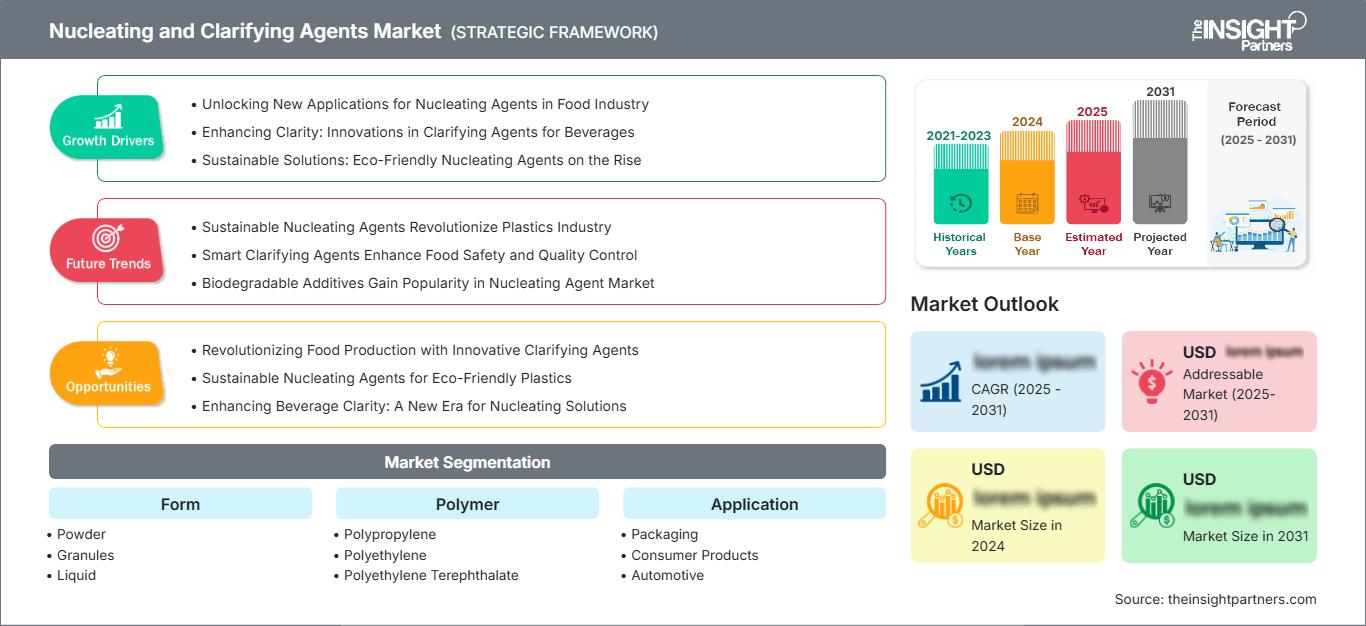
Nucleating and Clarifying Agents Market: Strategic Insights
Regional Insights
North America nucleating and clarifying agents market
The nucleating and clarifying agents market share of North America was estimated between 24-28% in 2025 and it is anticipated to grow at the CAGR of 5.8-6.5% during 2025-2034. The United States remains the leading regional player, driven by packaging conversion technology, production of PP, food contact, and automotive applications. Canada and Mexico add to the growth via food packaging, consumer goods, and manufacturing chains.
Increasing demands within the region are driven by growing usage of recycled PP and demands for uniformity in transparent packaging. Clarifiers which are compatible with recycled feeds allow simplification of formulations without compromising optical properties. Automotive converters also use nucleated PP to increase stiffness and process efficiency. Investments into high-end additives, therefore, are associated with lightweighting, productivity, recyclability, and value-added PP applications.
U.S. nucleating and clarifying agents Market
The US constituted 80–84% of North American consumption in 2025 and is expected to register CAGR of 5.7–6.4% till 2034. High packaging conversion, food contact needs, and automotive polymer replacement drive additive demand. Milliken and Avient have robust technical offerings for the benefit of PP converters and compounders.
Application trends point towards transparent rigid packaging, thin wall molding, and recycled PP. Milliken uses its clarifier technologies to tackle lower loading and better processability issues, while Avient provides nucleating agents that help in controlling crystallinity and cycles. Increased stiffness and heat deflection property of automotive parts also aid additive demand from this end-use application.
Europe nucleating and clarifying agents Market
The region accounted for 22-26% in 2025 and is expected to expand at a 5.5-6.2% CAGR till 2034. Germany is the leading country, driven by the demand from automotive manufacturing, packaging converters, and expertise in polymer processing. Other European countries contributing include Italy, France, the United Kingdom, and Spain with applications in consumer goods, food packaging, and industrial plastics.
There is also German industry which requires nucleated PP because of the requirements for the stiffness, dimensional stability and formability of materials. Clarified PP can be used by packaging converters in Germany because of its stiffness. In addition, there is also Italy as one of the countries in Europe which has plastics converting industry which includes packaging and consumer goods.
APAC nucleating and clarifying agents Market
APAC had a market share of 39–43% in 2025 and was expected to expand at a 7.0–7.7% CAGR during the forecast period until 2034. China dominates the regional consumption followed by Japan, India, South Korea, and Australia. Packaging and consumer goods production, along with automotive manufacturing, are driving regional demand.
China’s extensive PP processing industries create a large volume of additive usage whereas Japan focuses on developing advanced grades of PP and its molding process. India is focusing on packaging and automotive polymer processing while South Korea integrates electronics and automotive manufacturing with specialty chemicals. Resource efficiency and recycling policies are creating increased interest in additives with recycled PP performance.
Middle East & Africa nucleating and clarifying agents Market
The Middle East and Africa are estimated to account for around 8-12% of global demand in 2025 and are forecast to experience 4.5-5.2% CAGR. While Saudi Arabia and the UAE enjoy benefits of petrochemical integration and packaging production, South Africa enjoys a well-developed plastics conversion base.
The demand in the region is expected to remain concentrated in packaging applications, consumer goods, and polymer conversions. The benefits enjoyed by Saudi Arabia include petrochemical integration along with integrated polypropylene production. The UAE has an established position in terms of packaging production and industrial manufacturing. South Africa dominates the regional conversion market.
Segmentation Analysis
Form
The Form segment in the nucleating and clarifying agents market is projected to grow at a 6.1–6.7% CAGR during 2026–2034. Powder remains important for additive formulation and masterbatch production, while granules offer handling and dosing advantages. Liquid forms provide opportunities where precise metering and dispersion are prioritized. The form selected depends on polymer compatibility, processing method, additive concentration, and converter equipment.
- Powder: Powdered nucleators and clarifiers remain widely used because they provide high active concentration and flexibility in compounding. They are particularly suitable for masterbatch production and customized polymer formulations.
- Granules: Granular formats improve handling, feeding consistency, and automated dosing. They are relevant for converters seeking easier incorporation into production lines while reducing dust and handling complexity.
- Liquid: Liquid additives support controlled metering and can simplify formulation in selected polymer systems. Their strategic importance increases where processors prioritize dosing accuracy, dispersion, and reduced handling requirements.
Polymer
The Polymer segment in the nucleating and clarifying agents market is expected to expand at a 6.5–7.1% CAGR during 2026–2034. Polypropylene remains dominant because nucleation directly influences crystallization, stiffness, transparency, shrinkage, and molding productivity. Polyethylene and PET provide additional opportunities where controlled crystallization, barrier performance, and processing characteristics create value. The market scope therefore extends beyond PP while remaining strongly PP-centric.
- Polypropylene: PP represents the core application base because nucleators accelerate crystallization and clarifiers improve transparency. Demand spans packaging, consumer products, automotive parts, and electronics requiring efficient molding and balanced properties.
- Polyethylene: PE applications increasingly involve specialized additive formulations that improve processing and performance. Demand is supported by films, containers, and rigid packaging where material efficiency and controlled morphology are important.
- Polyethylene Terephthalate: PET applications focus on controlled crystallization and processing behavior, particularly where dimensional stability, optical characteristics, and conversion efficiency influence bottle, packaging, and specialty-product performance.
Application
The Application segment in the nucleating and clarifying agents market is forecast to register a 6.7–7.3% CAGR during 2026–2034. Packaging remains the largest outlet because clarity and cycle efficiency directly affect production economics. Consumer products benefit from improved aesthetics and stiffness, automotive applications from lightweighting, and electronics from dimensional stability and controlled processing. The application scope is therefore expanding with PP substitution and functionalization.
- Packaging: Packaging remains the dominant application because clarified PP supports transparent containers, trays, caps, closures, and thermoformed structures. Nucleation also enables faster crystallization and improved productivity in high-volume conversion.
- Consumer Products: Consumer products use clarified and nucleated PP for storage containers, housewares, appliances, and recreational products. Appearance, stiffness, dimensional consistency, and processing efficiency determine additive selection.
- Automotive: Automotive applications use nucleated PP to improve stiffness, heat-deflection performance, dimensional control, and lightweighting. These properties support interior, exterior, and under-the-hood components where polymer substitution can reduce component mass.
- Electronics: Electronics applications require dimensional stability, controlled shrinkage, surface quality, and reliable processing. Nucleated PP can support housings, components, and packaging where consistent geometry and appearance are essential.
Opportunity Snapshot
| Application | Revenue Contribution | Trend Tag | Adoption Stage |
| Packaging | High | Clear Packaging | Mature |
| Consumer Products | Medium | Houseware Clarity | Scaling |
| Automotive | Medium | Lightweight PP | Scaling |
| Electronics | Low | Precision Molding | Emerging |
Nucleating and Clarifying Agents Market Growth Drivers and Impact Analysis
Rising Demand for Transparent Polypropylene Packaging
Translucent PP is growing in significance in applications where converters desire a balance of transparency, strength, light weight, heat resistance, and processability. Clarifiers change the way crystallization occurs so that PP can have much higher levels of translucency while retaining its other qualities. The result is an application space in rigid food packaging, storage packaging, trays, cups, and other translucent forms of packaging. There is further demand created from the push to move away from multi-material construction that is not as compatible towards mono-material construction in PP packaging. Another reason why lower additive dosages are more strategic is because they can help bring down the cost of formulating and enable better recycling. It is clear that this is a significant trend among brand owners who are focused on efficiency and recyclability.
Pressure to Reduce Processing Time and Energy Consumption
It is becoming more common for manufacturers to consider the influence of polymer additives on the economy of manufacturing as opposed to the properties of the finished part. Nucleants facilitate the crystallization of PP, enabling the molded part to become stable in terms of dimensions at a faster rate and possibly decreasing the cooling period. Faster crystallization enables higher production rates without making any significant alterations in equipment, especially in the case of injection molding and thermoforming processes. These benefits are essential given the constraints of rising energy costs and productivity goals. Consequently, additives that offer processing benefits gain more importance technologically among both resin manufacturers and converters. It is not just the packaging industry but also the automotive, consumer goods, and electronics sectors that are seeking higher productivity from their molding equipment while retaining dimension accuracy.
Expansion of Lightweight Polymer Components in Automotive Manufacturing
Engineered plastics continue to replace certain metallic parts in cars to aid in light weighting, facilitate manufacturing processes, and achieve fuel economy or electric vehicle goals. Nucleated PP could be useful in this process, since it will help to increase stiffness, heat deflection capability, and dimensional stability while permitting thinner parts. This requires additive solutions that would sustain mechanical capabilities at reduced resin levels. Examples of parts that would benefit from these materials include interior parts, battery-related parts, trim systems, air management parts, and certain exterior parts. The opportunity is very applicable especially when there is need for greater stiffness at lower resin content levels. The use of additives that consistently perform well in all types of PP resins and processing methods could help in promoting the use of these additives by automotive compounders.
Nucleating and Clarifying Agents Market Future Trends
Low-Dose Clarification and Recycled PP Compatibility
The nucleating and clarifying agents market trends are moving toward highly efficient clarifiers capable of achieving strong optical performance at lower additive concentrations. This direction is important because lower loading can reduce formulation cost, minimize additive carryover, and improve compatibility with recycling systems. Next-generation technologies are also being engineered to perform consistently when virgin and post-consumer recycled PP are combined. Such compatibility can support greater flexibility in resin sourcing and reduce the need for separate production streams. Product development will increasingly focus on migration behavior, food-contact suitability, thermal stability, and retention of clarity after repeated processing. These requirements will encourage suppliers to develop clarifiers with narrower performance variability and stronger compatibility across PP grades. Over time, low-dose technologies should gain preference where transparency, sustainability, and production efficiency must be achieved simultaneously.
Integration of Nucleation with Advanced Polymer Formulation
Future formulations are likely to combine nucleation with multiple performance functions rather than treating the additive as a standalone crystallization modifier. Compounders can integrate nucleating technology with impact modification, reinforcement, antistatic systems, processing aids, and recycled-resin stabilization to produce application-specific PP grades. This approach allows converters to target stiffness, impact balance, shrinkage, optical quality, and cycle efficiency within one formulation. Digital formulation tools and improved characterization of crystallization behavior should also make additive selection more precise. Instead of optimizing additive dosage solely through trial-and-error processing, producers can increasingly use material data to match nucleator chemistry with resin morphology and molding conditions. The result will be more customized additive packages for thin-wall packaging, automotive parts, electronics housings, and consumer products. Suppliers with formulation expertise will therefore gain importance alongside producers of individual additive molecules.
Nucleating and Clarifying Agents Market Opportunities
Capacity Expansion for Next-Generation Clarifiers
The strongest investment opportunity in the nucleating and clarifying agents market trends lies in expanding manufacturing capacity for advanced clarifiers that provide high transparency at reduced loading. Recent investments by leading suppliers demonstrate that demand is moving beyond conventional clarifier grades toward higher-efficiency technologies. Dedicated production can improve supply reliability, support regional customer qualification, and shorten delivery times for converters. South Korea, China, India, and Southeast Asia are attractive locations because of their large polymer-processing industries and strong packaging manufacturing bases. Producers can further differentiate by establishing local technical centers that support formulation development, regulatory testing, and converter trials. Capacity investments should prioritize flexible manufacturing assets capable of supporting multiple additive chemistries and grades. Such infrastructure can reduce dependence on a single product while enabling suppliers to respond to changing demand for recycled-content-compatible and food-contact-approved formulations.
Application-Specific Additive Masterbatch Development
A second opportunity involves developing application-specific masterbatches that simplify additive dosing for converters. Masterbatch formats can combine nucleators or clarifiers with compatible carrier resins, enabling more accurate addition and reducing handling complexity. Packaging converters can benefit from grades optimized for thin-wall injection molding, thermoforming, food contact, or recycled PP. Automotive customers may require formulations optimized for stiffness and dimensional stability, while electronics producers may prioritize controlled shrinkage and appearance. Suppliers can create value by combining additive selection with processing guidance rather than selling a commodity additive alone. Regional masterbatch production can also improve responsiveness to smaller customers that cannot justify direct handling of concentrated additives. As formulation complexity rises, application-focused masterbatch solutions should become an increasingly important route to market for specialty additive producers.
Recent Developments
- February 5, 2026: Milliken highlighted its next-generation Millad ClearX 9000 clarifying technology, designed to provide ultra-clear PP transparency at reduced additive loading while improving processing efficiency, reducing waste, and enabling faster changeovers.
- February 5, 2026: At Interpack 2026, Milliken showcased Hyperform HPN nucleating agents, emphasizing faster cycle times, improved optical clarity, lower haze, and isotropic shrinkage for injection molding and thin-wall PP applications.
Frequently Asked Questions

- Comprehensive Market Sizing and Forecast Analysis
- Detailed Segmentation Analysis
- In-Depth Market Dynamics Assessment
- Regional and Country-Level Insights
- Competitive Landscape and Company Benchmarking
- Strategic Business Intelligence
Recent Reports
Testimonials

The Insight Partners provided valuable market intelligence that supported our global go-to-market strategy. Their team was professional, responsive, and attentive to our feedback, providing thoughtful analysis and helpful methodological clarifications throughout the project.
Junmo Kim Chief Financial Officer (CFO), Enertech Co., Ltd.
The Insight Partners' SCADA System Market report is comprehensive, with valuable insights on current trends and future forecasts. The team was highly professional, responsive, and supportive throughout. We are very satisfied and highly recommend their services.
RAN KEDEM Partner, Reali Technologies LTDs
I requested a report on a very specific software market and the team produced the report in a few days. The information was very relevant and well presented. I then requested some changes and additions to the report. The team was again very responsive and I got the final report in less than a week.
JEAN-HERVE JENN Chairman, Future Analytica
We worked with The Insight Partners for an important market study and forecast. They gave us clear insights into opportunities and risks, which helped shape our plans. Their research was easy to use and based on solid data. It helped us make smart, confident decisions. We highly recommend them.
PIYUSH NAGPAL Sr. Vice President, High Beam Global
The Insight Partners delivered insightful, well-structured market research with strong domain expertise. Their team was professional and responsive throughout. The user-friendly website made accessing industry reports seamless. We highly recommend them for reliable, high-quality research services
YUKIHIKO ADACHI CEO, Deep Blue, LLC.
This is the first time I have purchased a market report from The Insight Partners.While I was unsure at first, I visited their web site and felt more comfortable to take the risk and purchase a market report.I am completely satisfied with the quality of the report and customer service. I had several questions and comments with the initial report, but after a couple of dialogs over email with their analyst I believe I have a report that I can use as input to our strategic planning process.Thank you so much for taking the extra time and making this a positive experience.I will definitely recommend your service to others and you will be my first call when we need further market data.
JOHN SUZUKI President and Chief Executive Officer, Board Director, BK Technologies
I wish to appreciate your support and the professionalism you displayed in the course of attending to my request for information regarding to infectious disease IVD market in Nigeria. I appreciate your patience, your guidance, and the fact that you were willing to offer a discount, which eventually made it possible for us to close a deal. I look forward to engaging The Insight Partners in the future, all thanks to the impression you have created in me as a result of this first encounter.
DR CHIJIOKE ONYIA MANAGING DIRECTOR, PineCrest Healthcare Ltd.Reason to Buy
- Informed Decision-Making
- Understanding Market Dynamics
- Competitive Analysis
- Identifying Emerging Markets
- Customer Insights
- Market Forecasts
- Risk Mitigation
- Boosting Operational Efficiency
- Strategic Planning
- Investment Justification
- Tracking Industry Innovations
- Aligning with Regulatory Trends





 Get Free Sample for