
Odor Control System Market Size, Share & Demand by 2034
Coverage: by Type (Chemical Odor Control System, Activated Carbon Odor Control System, Biological Odor Control System); Application (Food and Beverages , Chemical and Petrochemical, Waste Treatment Facilities, Power and Energy, Cement, Mining and Metal, Others) , and Geography (North America, Europe, Asia Pacific, and South and Central America)
- Status : Data Released
- Report Code : TIPRE00012415
- Category : Manufacturing and Construction
- No. of Pages : 150
- Available Report Formats :


- Last update date : July 30, 2026


2025 Market Size
US$ 6.04 Bn
Base year value
2034 Forecast
US$ 7.99 Bn
Projected by 2034
CAGR 2026-2034
3.16 %
Growth rate
Addressable Market
US$ 63.71 Bn
(2026-2034)
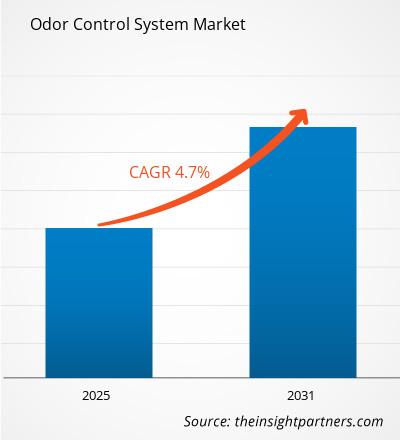
The global Odor Control System market was valued at US$ 6.04 billion in 2025 and is expected to reach US$ 7.99 billion by 2034; it is estimated to record a CAGR of 3.16% during 2026-2034.
Odor Control System Market Assessment and Insights
- North America accounted for 31–34% share in 2025 and is projected to grow at a CAGR of 3.2–3.8% during 2026–2034, led by wastewater rehabilitation, refinery controls, and food processing compliance.
- US represented 76–80% of North America in 2025 and is expected to grow at a CAGR of 3.1–3.7% through 2034, supported by municipal odor ordinances.
- Europe held 24–27% share in 2025 and is forecast to grow at a CAGR of 3.0–3.5% during 2026–2034, with Germany, the UK, France, Italy, and Spain leading adoption.
- Asia Pacific captured 28–31% share in 2025 and is expected to expand at a CAGR of 4.1–4.8% during 2026–2034 as China, India, Japan, South Korea, and Australia expand wastewater and industrial controls.
- Largest Segment Chemical Odor Control System held 37–40% market share in 2025 and is projected to grow at a CAGR of 3.0–3.6% during 2026–2034.
- High Growth Segment Biological Odor Control System held 25–28% market share in 2025 and is expected to grow at a CAGR of 4.2–4.9% during 2026–2034.
- Key companies analyzed in detail: Anguil Environmental Systems, Inc.; CECO Environmental Corp.; Dürr CTS GmbH; Xylem Inc.; Evoqua Water Technologies LLC; ECS Environmental Solutions; BioAir Solutions, LLC; Purafil, Inc.; ERG Air Pollution Control Ltd.; Monroe Environmental Corp.; KCH Engineered Systems; Tholander Ablufttechnik GmbH.
Source: The Insight Partners' analysis based on proprietary research, government publications, company annual reports, investor presentations, industry databases, and expert interviews.
Technology choice is witnessing the shift from the neutralization stage method towards hybrid configurations consisting of wet scrubbing, activated carbon, biofiltration, and digital control. In situations involving changing inlet concentration levels, chemical systems are expected to continue playing an important role, whereas biological systems are increasingly gaining popularity when there is a requirement for reduced reagent consumption. There will be changes in production trends as manufacturers start modularizing their fiberglass reinforced equipment, assembling skids, and developing corrosion-resistant fans, ducts, and vessels for quick installations in wastewater, food, beverage, chemical, petrochemical, cement, mining, and metals plants.
The upcoming demand is expected to center around urban wastewater networks, highly energy-consuming industrial complexes, and plants under higher nuisance odor limits. Investments will be made in Odor Control Systems offering reduction of life-cycle cost, chemical storage capacity, and auditability of operational efficiency. Geographically, Asia Pacific and the Middle East will require centralized sewage treatment, refinery expansion, and food processing plants; whereas North America and Europe will focus on retrofits, activated carbon optimization, and biofiltration systems.
Odor Control System Market Report Scope
| Report Attribute | Details |
|---|---|
| Market size in 2025 | US$ 6.04 Billion |
| Market Size by 2034 | US$ 7.99 Billion |
| Global CAGR (2026 - 2034) | 3.16% |
| Historical Data | 2021-2024 |
| Forecast period | 2026-2034 |
Odor Control System Market Analysis
Growth in Odor Control Systems Market is driven by demand from three sources: municipal sewage, process exhaust, and community-oriented industrial activities. Municipal waste treatment plants must constantly monitor hydrogen sulfide levels to protect their concrete structures, pumps, electrical systems, and people, while the food and beverages sector demands odor suppression during rendering, fermenting, roasting, frying, and effluent treatment. In addition, the chemicals and petrochemical industries provide demand for custom-built scrubbers and oxidizers, where there are volatile compounds that need to be captured under control.
The supply chain comprises media providers, chemical suppliers, ducts and fan manufacturers, system integrators, automation equipment providers, and service providers. Supply factors include the availability of activated carbon, fiberglass manufacturing, chemicals supply, and permits. Buyers are increasingly concerned with removal efficiencies, pressure drops, chemical consumption, serviceability, and monitoring instead of the price of the equipment alone.
Competitive analysis of the Odor Control System Market reveals a fragmented environment, where globally available pollution control systems are competing with dedicated biofilters, scrubbers and carbon manufacturers. While Anguil Environmental Systems, Inc., CECO Environmental Corp., Dürr CTS GmbH and Xylem Inc. offer comprehensive solutions, their competitors like BioAir Solutions, LLC, ECS Environmental Solutions, Purafil, Inc. and ERG Air Pollution Control Ltd. rely on application specific designs.
Modular units, biological finishing, remote monitoring systems, and low energy consumption solutions are seen as the key investment trends. CECO Environmental Corp. focuses on fully-integrated industrial air systems, Xylem Inc. integrates vapor and liquid phase treatment technologies, and Dürr CTS GmbH expands thermal and sorptive air pollution control. Strategic positioning becomes increasingly dependent on after-sales support, media replacements, local fabrication, and documentation assistance.
● REPORT CUSTOMIZATION
Tailor This Report To Align With Your Specific Business Requirements
This report can be customized to align precisely with your business objectives, scope, and target markets. Customization options include tailored segmentation, geography, competitive analysis, and strategic insights to support informed decision-making.
Customize This Report →WHAT YOU CAN ADJUST
- ● Segmentations
- ● Geography
- ● Competitive Analysis
- ● Language Preferences
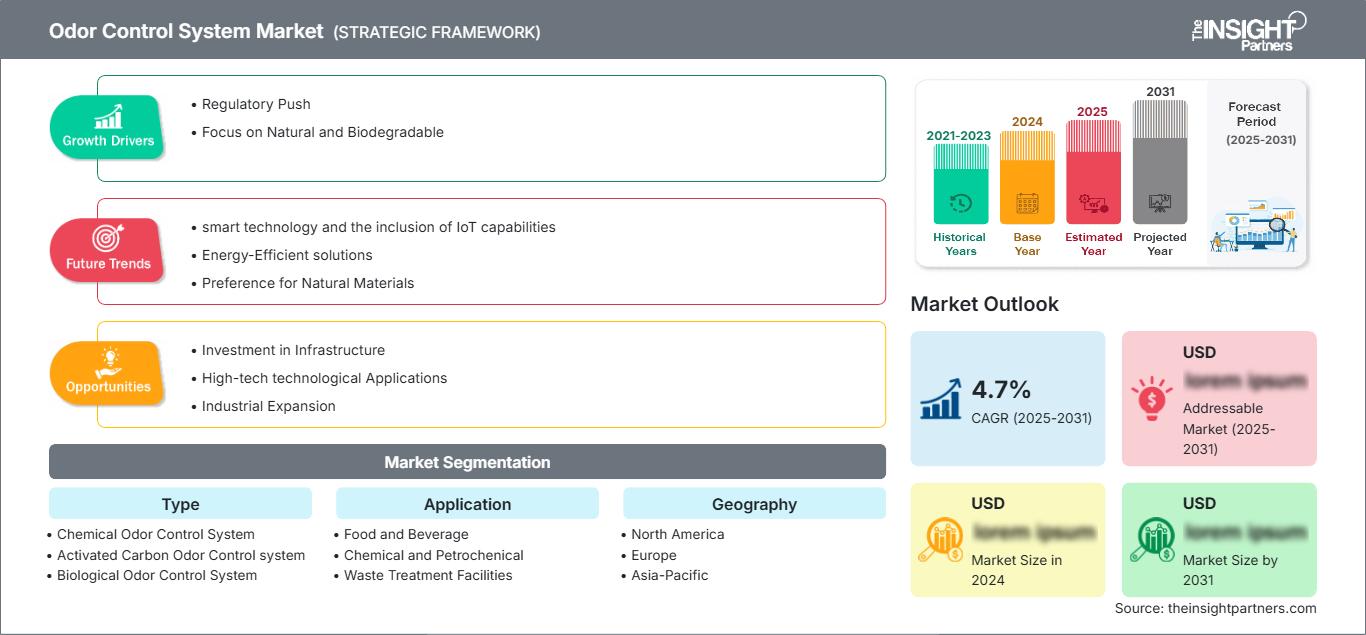
Odor Control System Market: Strategic Insights
Regional Insights
North America Odor Control System Market
North America held 31–34% Odor Control System Market share in 2025 and is expected to grow at a CAGR of 3.2–3.8% during 2026–2034. Municipal wastewater treatment remains the largest demand base, supported by sewer rehabilitation, pump station odor mitigation, and neighborhood complaint management. Industrial demand comes from food processing, chemical manufacturing, refining, and metals facilities.
Procurement patterns favor lifecycle efficiency because many installations operate continuously in corrosive environments. Activated carbon systems are selected for compact footprints and polishing duty, while biological systems are increasingly used where operators seek lower chemical handling. Regional suppliers also benefit from service contracts covering media changeouts, fan maintenance, instrumentation checks, and compliance records for odor-sensitive permits.
U.S. Odor Control System Market
The USA occupied 76% - 80% share of North America in 2025 and is expected to register a CAGR of 3.1% - 3.7% from 2026 to 2034. The major demand factors include municipal collection systems, head works, biosolids, rendering plants, beverages, and petrochemical regions. Wide presence of companies includes Anguil Environmental Systems, Inc., CECO Environmental Corp., Xylem Inc., and Monroe Environmental Corp. in national operations.
Major application trends include greater use of remote monitoring, chemical dosing optimization, and hybrid biofilters-carbon system installations. The utilities tend to go for designs which will deal with both odor problem and corrosion. The industries prefer those systems which guarantee maximum uptime and permits. Growing application area is food and beverages due to variable recipe, cleaning cycle, wastewater load, and volume of production seasonally.
Europe Odor Control System Market
Europe has a market share of 24–27% in 2025 and is anticipated to grow at a CAGR of 3.0–3.5% for 2026–2034. Germany has the highest position in this region with chemical processing, municipal WWTP upgrades, and good industrial permitting practices. The UK focuses on water utility spending, combined sewer overflow management, and reducing odor complaints near densely populated catchments.
France, Italy, and Spain add to this market via food processing, cement, WWTP, and refineries applications. European clients prefer noiseless fans, corrosion-proof systems, energy-efficient designs, and removal efficacy documentation. Companies like Dürr CTS GmbH, ERG Air Pollution Control Ltd., and Tholander Ablufttechnik GmbH are favored for their process engineering abilities, while those with local service networks have an edge for retrofits.
APAC Odor Control System Market
APAC had a 28-31% share in 2025 and is expected to register a CAGR of 4.1-4.8% between 2026 and 2034. The region is the fastest growing regional base due to dominance by China in industrial wastewater, chemical parks, and urban sewage facilities. India contributes to increasing demand for increased treatment capacities and tighter regulation of industrial estates.
Japan, South Korea, and Australia generate demand for robust, small-sized systems in the municipal, food, mining, and metal industries. The regulatory aspects include urban sanitation, regulation of industrial emissions, and reduction of public nuisance. More buyers ask for modular equipment that can easily scale in several facilities or industrial estates.
Middle East & Africa Odor Control System Market
Middle East & Africa market is forecast to register a CAGR of 3.4%-4.0% over 2026-2034. Saudi Arabia is one of the major countries, driven by refining, petrochemical, municipal wastewater, and new city construction projects. The UAE contributes from desalination wastewater recovery, food processing plants, and hotel odor control applications.
Rest of MEA contributes from mining, metal production, cement production, and municipal water treatment plants. Extreme climatic conditions make the need for corrosion resistance, media life, and enclosed equipment design high. Growth in energy sector investments drives the demand for scrubber, activated carbon systems, and package biological treatment systems.
Segmentation Analysis
Type
Type is expected to grow at a CAGR of 3.4–4.0% during 2026–2034 as users select technologies according to odor chemistry, airflow, humidity, temperature, and footprint. The Odor Control System Market scope across type is widening because many projects combine primary treatment with polishing media to handle variable loads. Chemical systems suit shock loads, activated carbon supports compact polishing, and biological systems offer lower reagent reliance.
- Chemical Odor Control System remains the largest type because scrubbers handle high hydrogen sulfide, ammonia, and acid gas loads in wastewater, petrochemical, and industrial exhaust applications.
- Activated Carbon Odor Control system is preferred for compact installations, polishing duty, intermittent emissions, and retrofit projects where operators need predictable removal with limited water or chemical infrastructure.
- Biological Odor Control System is gaining strategic importance as utilities and industrial plants pursue lower reagent handling, reduced operating cost, and stable treatment of biodegradable odor compounds.
Application
Application is projected to grow at a CAGR of 3.5–4.1% during 2026–2034, with waste treatment facilities remaining the anchor demand area. Industrial applications are becoming more technically diverse because odor sources differ by raw material, process temperature, organic loading, and local receptors. Buyers increasingly request systems that balance removal efficiency, footprint, reagent handling, power use, and service accessibility.
- Food and Beverage demand is linked to rendering, fermentation, roasting, frying, effluent treatment, and cleaning cycles, where odor control protects surrounding communities and operating permits.
- Chemical and Petrochenical facilities require engineered systems for sulfides, ammonia, solvents, and mixed VOC streams, making reliability, corrosion resistance, and compliance documentation central to purchasing.
- Waste Treatment Facilities represent the most consistent application base because collection networks, headworks, sludge handling, and biosolids operations generate continuous odor and corrosion risks.
- Cement plants use odor control where alternative fuels, raw material variability, and nearby communities increase scrutiny of process exhaust and nuisance emissions.
- Mining and Metal facilities adopt systems for process ventilation, wastewater areas, acid gases, and localized nuisance control, especially where operations are close to settlements.
Opportunity Snapshot
| Application | Revenue Contribution | Trend Tag | Adoption Stage |
| Food and Beverage | Medium | Process Odors | Scaling |
| Chemical and Petrochenical | High | VOC Control | Mature |
| Waste Treatment Facilities | High | Sewer Corrosion | Mature |
| Cement | Medium | Alt Fuels | Scaling |
| Mining and Metal | Low | Acid Gases | Emerging |
Odor Control System Market Growth Drivers and Impact Analysis
Wastewater Infrastructure Renewal and Corrosion Control
Municipal wastewater operators are prioritizing odor control because hydrogen sulfide affects both public perception and asset integrity. Odor Control System Market demand rises when utilities rehabilitate headworks, force mains, pump stations, equalization basins, and sludge handling areas. The real-world impact is wider specification of covered tanks, vapor extraction, chemical scrubbers, biofilters, and carbon polishers in capital programs. Corrosion prevention strengthens the investment case because untreated sulfide can shorten concrete and equipment life. Utilities also need auditable operating data to manage complaints, verify permit compliance, and justify service contracts. This driver supports recurring aftermarket revenue through media replacement, chemical supply, fan maintenance, and monitoring upgrades.
Industrial Emission Compliance Near Urban Communities
Industrial sites increasingly operate beside residential, commercial, and logistics zones, making odor nuisance a business continuity issue rather than only an environmental concern. Food and beverage plants, chemical processors, refineries, cement facilities, and metal operations face complaints even when regulated pollutant mass emissions are within permit limits. This pushes buyers toward engineered capture, ventilation balancing, and treatment systems that address low-threshold odor compounds. The market impact is strongest in retrofits because existing plants need compact equipment that can fit constrained spaces. Suppliers with application engineering, duct design, commissioning expertise, and service response gain an advantage when operators must resolve recurring complaints quickly.
Shift Toward Lifecycle-Cost-Based Procurement
Procurement decisions are moving beyond equipment price as operators account for media life, chemical consumption, pressure drop, fan power, wastewater discharge, access requirements, and downtime risk. This favors suppliers able to model operating cost and provide service-backed performance guarantees. In the Odor Control System Market, lifecycle evaluation also encourages hybrid designs, such as biological treatment followed by activated carbon polishing, where each stage is optimized for a specific load profile. The impact is a more consultative sales process, longer design engagement, and stronger demand for remote diagnostics. Vendors that combine equipment, consumables, controls, and maintenance can capture higher recurring value.
Odor Control System Market Future Trends
Digital Odor Monitoring Becomes Part of Standard Packages
Odor Control System Market trends indicate that treatment equipment will increasingly be sold with sensors, dashboards, and service analytics rather than as standalone hardware. Continuous monitoring of hydrogen sulfide, airflow, humidity, pressure drop, and media condition will help operators identify breakthrough risk before complaints occur. This will be particularly valuable for distributed sewer networks and multi-site industrial groups, where manual inspection is costly. Over the forecast period, digital packages can shift vendor differentiation toward uptime assurance, dosing optimization, and documented performance. The trend also supports outcome-based service models because suppliers can remotely verify whether treatment targets are being met.
Biological and Hybrid Systems Gain Design Priority
Future system designs will give greater weight to biological and hybrid treatment where odor chemistry is compatible and sites can support humidification, nutrient control, and media management. Biological units reduce dependence on bulk chemicals, while carbon or dry media polishing can manage residual compounds and intermittent peaks. This direction fits municipal sustainability goals and industrial decarbonization plans because lower chemical logistics and reduced combustion needs can improve environmental profiles. Suppliers will need stronger microbiology knowledge, commissioning support, and seasonal performance modeling. Adoption will be gradual, but hybrid configurations are likely to become preferred for complex wastewater and food processing applications.
Odor Control System Market Opportunities
Retrofit Programs for Aging Treatment Plants
Retrofit demand offers a practical opportunity because many wastewater and industrial plants were designed before current odor expectations, urban encroachment, and service-level reporting requirements. Odor Control System Market Forecasts point to steady spending on compact covers, ducting, packaged scrubbers, carbon vessels, and biofilter upgrades that avoid full plant redesign. Vendors can target this opportunity by developing modular packages that fit constrained footprints, minimize shutdowns, and integrate with existing blowers or control rooms. Strong aftermarket teams can also convert installed-base audits into phased upgrade programs. The most attractive projects will combine odor reduction, corrosion control, worker safety, and complaint mitigation.
Industrial Parks and Shared Utility Infrastructure
Industrial parks create an opportunity for centralized or shared odor treatment strategies, especially where food processors, chemical units, waste handlers, and wastewater assets operate in close proximity. Developers can reduce permitting risk by designing odor capture and treatment infrastructure into common utilities rather than leaving every tenant to install isolated systems. This approach is relevant in Asia Pacific and the Middle East, where new industrial zones and treatment plants are being built together. Equipment suppliers can partner with engineering firms to standardize modular systems, monitoring protocols, and maintenance contracts. Shared infrastructure can improve compliance consistency and lower unit operating cost.
Recent Developments
- October 2025: Microban International announced the launch of EcoFresh, a cutting-edge odor-control technology that captures a wide spectrum of body, environmental and other offensive odorants. Developed with active and outdoor enthusiasts in mind, this comprehensive technology targets and captures odors on the surface of and within treated fabrics, delivering powerful odor reduction and lasting freshness, even in challenging environments.
- 2025: Struktol showcases new odor control technology for recycled materials at K 2025. STRUKTOL Plastic Additives for Odor & VOC Control can help eliminate odors (mask and/or neutralize) and reduce volatiles.
- February 2025: The Chilean Ministry of Environment has made significant progress in odour regulation throughout 2024, with plans to continue this momentum into 2025. The new odour emission regulation for the fishing industry has been approved by the Council of Ministers for Sustainability and Climate Change. This regulation will specifically target 23 fishmeal and fish oil plants, predominantly located in the Biobío region, and 9 fish feed plants, mostly in the Los Lagos region.
Frequently Asked Questions

- Comprehensive Market Sizing and Forecast Analysis
- Detailed Segmentation Analysis
- In-Depth Market Dynamics Assessment
- Regional and Country-Level Insights
- Competitive Landscape and Company Benchmarking
- Strategic Business Intelligence
Recent Reports
Testimonials

The Insight Partners' SCADA System Market report is comprehensive, with valuable insights on current trends and future forecasts. The team was highly professional, responsive, and supportive throughout. We are very satisfied and highly recommend their services.
RAN KEDEM Partner, Reali Technologies LTDs
I requested a report on a very specific software market and the team produced the report in a few days. The information was very relevant and well presented. I then requested some changes and additions to the report. The team was again very responsive and I got the final report in less than a week.
JEAN-HERVE JENN Chairman, Future Analytica
We worked with The Insight Partners for an important market study and forecast. They gave us clear insights into opportunities and risks, which helped shape our plans. Their research was easy to use and based on solid data. It helped us make smart, confident decisions. We highly recommend them.
PIYUSH NAGPAL Sr. Vice President, High Beam Global
The Insight Partners delivered insightful, well-structured market research with strong domain expertise. Their team was professional and responsive throughout. The user-friendly website made accessing industry reports seamless. We highly recommend them for reliable, high-quality research services
YUKIHIKO ADACHI CEO, Deep Blue, LLC.
This is the first time I have purchased a market report from The Insight Partners.While I was unsure at first, I visited their web site and felt more comfortable to take the risk and purchase a market report.I am completely satisfied with the quality of the report and customer service. I had several questions and comments with the initial report, but after a couple of dialogs over email with their analyst I believe I have a report that I can use as input to our strategic planning process.Thank you so much for taking the extra time and making this a positive experience.I will definitely recommend your service to others and you will be my first call when we need further market data.
JOHN SUZUKI President and Chief Executive Officer, Board Director, BK Technologies
I wish to appreciate your support and the professionalism you displayed in the course of attending to my request for information regarding to infectious disease IVD market in Nigeria. I appreciate your patience, your guidance, and the fact that you were willing to offer a discount, which eventually made it possible for us to close a deal. I look forward to engaging The Insight Partners in the future, all thanks to the impression you have created in me as a result of this first encounter.
DR CHIJIOKE ONYIA MANAGING DIRECTOR, PineCrest Healthcare Ltd.Reason to Buy
- Informed Decision-Making
- Understanding Market Dynamics
- Competitive Analysis
- Identifying Emerging Markets
- Customer Insights
- Market Forecasts
- Risk Mitigation
- Boosting Operational Efficiency
- Strategic Planning
- Investment Justification
- Tracking Industry Innovations
- Aligning with Regulatory Trends





 Get Free Sample for