
Oil and Gas Processing Seals Market Size, Share & Growth by 2034
Coverage: by Material (Metal, Elastomer, Seal Face Material, Others); Seal Type (Single Seal, Double Seal); Application (Upstream, Midstream, Downstream) , and Geography (North America, Europe, Asia Pacific, and South and Central America)
- Status : Data Released
- Report Code : TIPRE00007190
- Category : Manufacturing and Construction
- No. of Pages : 150
- Available Report Formats :


- Last update date : July 30, 2026


2025 Market Size
US$ 7.05 Bn
Base year value
2034 Forecast
US$ 9.41 Bn
Projected by 2034
CAGR 2026-2034
3.25 %
Growth rate
Addressable Market
US$ 74.71 Bn
(2026-2034)
The Oil And Gas Processing Seals market size is estimated to rise from US$ 7.05 billion in 2025 to US$ 9.41 billion by 2034, at a CAGR of 3.25%. This demand comes from the need to avoid leaks and ensure process integrity and uptime in equipment functioning under pressure, high temperature, and chemical attack conditions.
For North America, market size is driven by shale oil and gas, liquefied natural gas infrastructure development, refineries operations management, and rising demands on methane emissions control. It is expected that the region will expand at a CAGR of 3.0–3.4% during 2026–2034 period.
Oil and Gas Processing Seals Market Assessment and Insights
- North America accounted for 30–33% share in 2025 and is projected to grow at a CAGR of 3.0–3.4% during 2026–2034, supported by shale output, LNG terminals, and refinery reliability spending.
- US represented 78–82% of North America in 2025 and is expected to grow at a CAGR of 3.1–3.5% during 2026–2034, led by Gulf Coast processing assets.
- Europe held 21–24% share in 2025 and is forecast to grow at a CAGR of 2.6–3.0% during 2026–2034, with Germany, the UK, France, Italy, and Spain leading demand.
- Asia Pacific captured 27–30% share in 2025 and is set to grow at a CAGR of 3.7–4.1% during 2026–2034, driven by China, India, Japan, South Korea, and Australia.
- Largest Segment Downstream applications held 44–48% market share in 2025, with CAGR of 3.0–3.4% during 2026–2034 due to refinery and petrochemical seal replacement.
- High Growth Segment Midstream applications held 24–28% market share in 2025, with CAGR of 3.8–4.2% during 2026–2034 as LNG, gas processing, and pipeline compression expand.
- Key companies analyzed in detail: DuPont de Nemours, Inc., Flowserve Corporation, Freudenberg SE, John Crane, M. Barnwell Services Limited, Parker-Hannifin Corporation, Precision Polymer Engineering Limited, Saint-Gobain S.A., Techno AD Ltd., and Trelleborg AB
Source: The Insight Partners' analysis based on proprietary research, government publications, company annual reports, investor presentations, industry databases, and expert interviews.
The evolution of technology in oil and gas processing seals has shifted from conventional elastomers to polymers, dry gas seals, faceless operation, and advanced metal seal designs. End-users today select their seals based on their lifecycle cost effectiveness, emissions efficiency, MTBR, and tolerance to sour gases, aromatic liquids, heavy crude oil, and multiphase pipeline conditions.
According to the oil and gas processing seals market forecast, investment prospects will be brightest in areas where hydrocarbon processing is still needed but where there are stricter standards for safety and the environment. New refining complexes, gas monetization schemes, and brownfield developments in the Asia Pacific region and the Middle East are examples of situations that require special seals with lower emissions, simplified maintenance and compressor, pump, valve, mixer and separator protection.
Oil and Gas Processing Seals Market Report Scope
| Report Attribute | Details |
|---|---|
| Market size in 2025 | US$ 7.05 Billion |
| Market Size by 2034 | US$ 9.41 Billion |
| Global CAGR (2026 - 2034) | 3.25% |
| Historical Data | 2021-2024 |
| Forecast period | 2026-2034 |
Oil and Gas Processing Seals Market Analysis
Oil and gas processing seals demand is dependent on reliability-driven investment decisions rather than capacity expansions alone. Refineries, LNG facilities, and the upstream industry are increasing the time between equipment overhauls and minimizing leakage incidents, thus driving up the need for seals that can tolerate increased shaft speeds, thermal cycles, vibrations, and harsh fluids.
The value chain consists of raw materials providers, seal manufacturers, rotating equipment original equipment manufacturers (OEMs), distributors, service centers, and plant maintenance personnel. Supplier dynamics benefit companies with qualification information, regional service capabilities, and API compliant seals due to the demands of critical facilities.
Competitive positioning is driven by materials science, field service coverage, and the relationship between rotating equipment reliability programs. John Crane and Flowserve Corporation are fierce competitors in mechanical and dry gas seals, and DuPont de Nemours, Inc., Freudenberg SE, and Trelleborg AB increase demand by using innovative platforms of elastomers and polymers.
Parker-Hannifin Corporation, Saint-Gobain S.A., Precision Polymer Engineering Limited, Techno AD Ltd., and M. Barnwell Services Limited provide for specialized needs by means of engineering of sealing products, distribution capabilities, and application knowledge. The strategic investments are aimed at developing low-emission seals, fast refurbishing, local inventories, and seals for LNG, sour services, and high-pressure pipelines.
● REPORT CUSTOMIZATION
Tailor This Report To Align With Your Specific Business Requirements
This report can be customized to align precisely with your business objectives, scope, and target markets. Customization options include tailored segmentation, geography, competitive analysis, and strategic insights to support informed decision-making.
Customize This Report →WHAT YOU CAN ADJUST
- ● Segmentations
- ● Geography
- ● Competitive Analysis
- ● Language Preferences
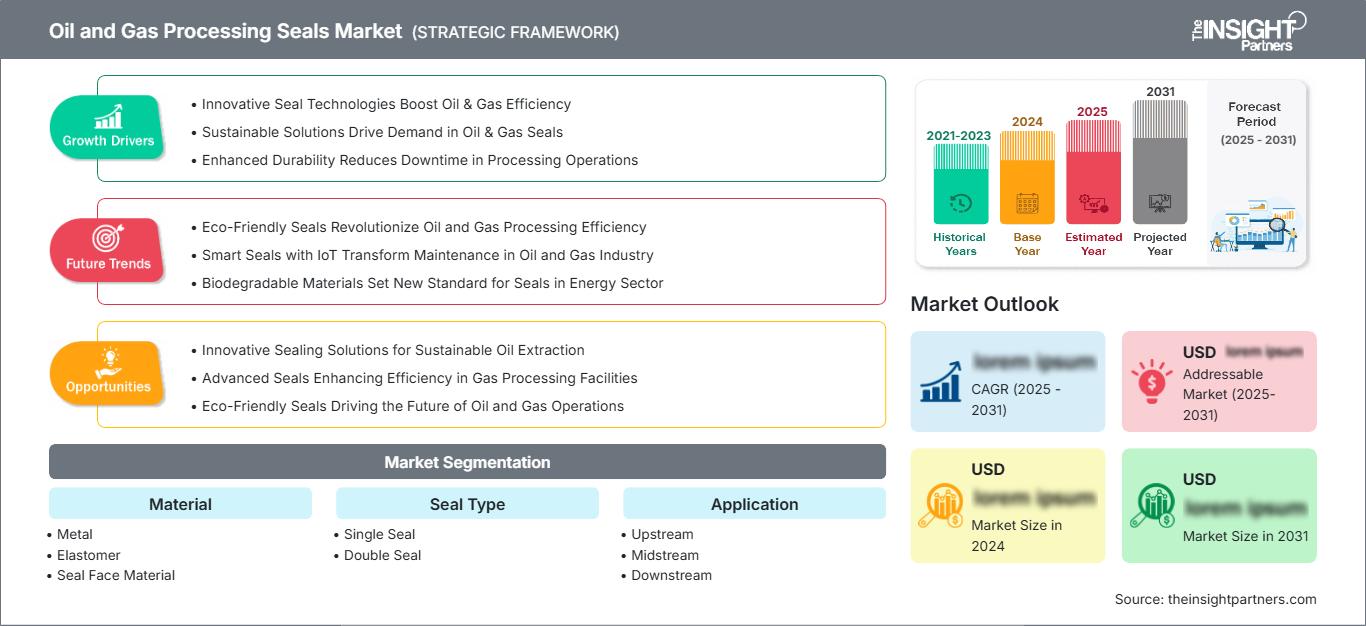
Oil and Gas Processing Seals Market: Strategic Insights
Regional Insights
North America oil and gas processing seals market
North America represented 30–33% of global demand in 2025, with a CAGR range of 3.0–3.4% expected during 2026–2034. The oil and gas processing seals market share in the region reflects shale production, LNG liquefaction, pipeline compression, and refinery turnaround cycles.
Seal demand is reinforced by methane reduction initiatives, sour gas handling, and high utilization of Gulf Coast processing assets. Operators prioritize double seals, dry gas seals, and elastomer upgrades where leak containment and unplanned downtime carry significant safety, environmental, and financial consequences.
U.S. oil and gas processing seals market
In 2025, the US contributed between 78% and 82% of North America, while growth is expected at 3.1%–3.5% CAGR between 2026 and 2034. Refineries on the Gulf Coast, petrochemical complexes, ethane pipelines, and LNG export facilities constitute an extensive installed base for premium sealing solutions.
Company presence is largely determined by service centers, original equipment manufacturer links, and maintenance providers of pumps, compressors, valves, and mixers. Seals are increasingly applied in multi-phase liquids, gas compression under pressure, and corrosive applications based on the need for reliability documentation.
Europe oil and gas processing seals market
Europe is a 21–24% market in 2025, and it will experience a growth rate of 2.6–3.0% CAGR during 2026–2034. Germany is at the forefront of industrial application due to integration in the chemical industry and refineries. The UK is providing support in the area of offshore and North Sea maintenance. Contributions by France, Italy, and Spain are provided by refining, petrochemicals, and gas network development.
Procurement in this region focuses on compliance, reduction in emission, and performance of the materials. The market receives an impetus from the European emphasis on asset efficiency, compressor upgrade and seal replacement projects.
APAC oil and gas processing seals market
The Asia Pacific segment held 27-30% market share in 2025 and is expected to register a 3.7-4.1% CAGR growth rate during 2026-2034. Leading countries in the region include China, owing to its refineries and petrochemical industry, and India due to downstream development and gas distribution infrastructure.
In Japan, South Korea, and Australia, LNG imports, chemical processing, and offshore platforms require maintenance to ensure continued consumption. Policies favoring energy security and industrialization will promote the adoption of higher quality sealing solutions to increase uptime and minimize leakage.
Middle East & Africa oil and gas processing seals market
The Middle East & Africa region is expected to register a 3.3–3.7% CAGR from 2026 through 2034. Saudi Arabia dominates the region with the growth dependent on upstream, downstream, refining, petrochemical, and gas processing mega projects. The UAE contributes LNG, storage, and downstream reliability considerations.
South Africa and the Rest of MEA produce the replacement market for refineries, terminals, and pipelines. Difficult operational conditions, abrasive nature of sand, high temperatures, and difficult maintenance logistics form key purchase criteria.
Segmentation Analysis
Material
Material is projected to grow at 3.1–3.5% CAGR during 2026–2034 as buyers balance chemical resistance, thermal stability, and lifecycle cost. The oil and gas processing seals market scope across materials is widening as sour service, heavy crude, LNG, and high-pressure applications require validated elastomers, metals, and seal face combinations.
- Metal seals are preferred for high-temperature, high-pressure, and corrosive environments where dimensional stability, extrusion resistance, and long service life outweigh higher initial procurement costs.
- Elastomer seals remain essential for dynamic and static applications requiring flexibility, compression recovery, and compatibility with hydrocarbons, sour gas, steam, and process chemicals.
- Seal Face Material selection is critical in pumps and compressors because carbon, silicon carbide, and tungsten carbide combinations influence friction, wear, leakage, and thermal shock resistance.
Seal Type
Seal Type is expected to grow at 3.2–3.6% CAGR during 2026–2034. Selection depends on leakage tolerance, fluid volatility, safety classification, and maintenance strategy. Double seal adoption is rising in hazardous services, while single seals remain relevant in lower-risk equipment where cost, simplicity, and proven reliability guide purchasing.
- Single Seal configurations serve standard pumps, mixers, and utility systems where operating conditions are controlled and leakage risk can be managed through routine monitoring.
- Double Seal systems are strategically important for toxic, flammable, abrasive, or volatile fluids because barrier fluids and tandem designs improve containment and reliability.
Application
Application is forecast to grow at 3.3–3.7% CAGR during 2026–2034, with demand determined by asset intensity and operating severity. Downstream leads through large installed equipment bases, midstream expands fastest on gas infrastructure, and upstream maintains demand through harsh drilling, production, and subsea environments.
- Upstream demand is linked to drilling, production, subsea systems, and enhanced recovery, where seals must withstand pressure cycling, sour fluids, sand, and remote maintenance constraints.
- Midstream seals support pipelines, LNG, gas processing, storage, and compression, making reliability essential where phase changes, vibration, and continuous operation influence total cost.
- Downstream applications dominate installed demand across refineries and petrochemical plants, where pumps, compressors, valves, and reactors require scheduled replacement and compliance-oriented sealing upgrades.
Opportunity Snapshot
| Application | Revenue Contribution | Trend Tag | Adoption Stage |
| Upstream | Medium | Sour Service | Scaling |
| Midstream | Medium | LNG Compression | Scaling |
| Downstream | High | Refinery Turnarounds | Mature |
Oil and Gas Processing Seals Market Growth Drivers and Impact Analysis
Emission Control and Leak Prevention
Emissions reduction targets have increased the technical barometer for seals in pumps, compressors, valves, and pipeline networks. Programs to manage methane emissions and volatile organic compounds convert leaks into an operational risk, rather than just maintenance risk. The oil and gas processing seal markets will benefit from operators switching out old seals for double seals, dry gas seals, and high-performance elastomers for containment purposes. This is most impactful in assets that process natural gas, produce liquefied natural gas, and refining operations where the cost of downtime, fines, safety incidents, and reputation risk can be higher than the cost of the seals themselves.
Reliability Spending in Aging Processing Assets
Many refineries, terminals, and gas facilities continue to run well-developed rotating equipment that is still economically valuable. Rather than installing a whole new system, investments are being made in making the equipment more reliable, performing condition monitoring, and seal upgrading through scheduled maintenance. This contributes to a consistent flow of replacement because the seals are wear parts that face pressure, vibration, high temperatures, and harsh chemicals. Suppliers who can offer field analysis, remanufacturing, and redesigning of the seals receive preference in the market.
Expansion of Gas Processing and LNG Infrastructure
Development in natural gas processing, liquefaction, regasification, and compression operations has increased the need for seals which can be used under cryogenic conditions, high-pressure gas service, and phase change conditions. Leakage management and reliable performance are necessary for compressors and pumps used in such applications since an unexpected shutdown will impact supply agreements for long periods of time. This is one of the factors which will boost the market for oil and gas processing seals through new constructions and retrofitting projects which include dry gas seals, tandem arrangements, and appropriate face materials.
Oil and Gas Processing Seals Market Future Trends
Digitally Supported Seal Reliability Programs
Oil and gas processing seals market trends will be towards digital diagnosis systems which take into account seal condition, process information, vibrations, and maintenance history. Reliability services are expected to be provided by vendors for their existing fleets of seals, enabling operators to predict leaks, wear, and heat issues prior to failures. Such a trend will make customers switch from transactional replacements to lifetime contracts. Maintenance-limited facilities will appreciate dashboard capabilities, maintenance history, and spare parts plans as they allow for minimizing emergency maintenance, proper safety planning, and audited reliability.
Materials Designed for Lower-Carbon Processing Routes
Future seal development will be influenced by hydrogen blending, carbon capture, renewable fuels, and lower-carbon petrochemical routes that introduce different compatibility demands. Materials will need to handle smaller molecules, new solvent systems, higher purity requirements, and changing temperature profiles. The oil and gas processing seals market is therefore expected to see more qualification testing around permeation, rapid gas decompression, and chemical resistance. Vendors with broad material libraries and testing infrastructure will be better positioned to support hybrid energy assets without compromising safety or uptime.
Oil and Gas Processing Seals Market Opportunities
Localized Service Hubs Near Processing Clusters
Manufacturers can capture value by placing repair, testing, and inventory hubs near refining corridors, LNG terminals, and upstream basins. Local presence reduces downtime, accelerates refurbishment, and gives operators access to application engineering during turnarounds. The oil and gas processing seals market rewards suppliers that combine global qualification standards with regional responsiveness. Investment in mobile service teams, stocked critical spares, and failure analysis capabilities can convert emergency replacements into recurring service relationships while reducing customer risk during high-utilization operating periods.
Seal Upgrades for Methane and VOC Compliance
Regulatory attention on methane and volatile organic compounds creates an opportunity for suppliers to position seals as compliance-enabling components. Operators need practical retrofit pathways that improve containment without requiring full equipment replacement. The oil and gas processing seals market can benefit from engineered upgrade kits, documented leakage performance, and service support during audits. Companies that offer clear economic cases, including reduced product loss, lower maintenance callouts, and improved inspection readiness, will be well placed to win projects across gas plants, refineries, terminals, and pipeline compressor stations.
Recent Developments
- September 2025: John Crane launched the Type 8628VL mechanical seal for ethane and ethylene pipelines, using spiral groove non-contacting technology and tandem seal faces to manage liquid, vapor, and supercritical phase changes in Gulf Coast pipeline applications.
- October 2025: Parker-Hannifin Corporation presented sealing solutions for oil and gas at ADIPEC 2025 alongside technologies for leak path reduction, corrosion mitigation, and diversified energy operations, reinforcing its positioning across conventional and emerging energy infrastructure.
- June 2025: John Crane announced the launch of the Type 93AX Coaxial Separation Seal – a next generation dry gas sealing solution engineered to help customers reduce emissions, improve equipment reliability, and lower operational costs. These seals are developed to address customers’ pain points across the energy and process industries, including oil and gas, power generation and clean energy.
Frequently Asked Questions

- Comprehensive Market Sizing and Forecast Analysis
- Detailed Segmentation Analysis
- In-Depth Market Dynamics Assessment
- Regional and Country-Level Insights
- Competitive Landscape and Company Benchmarking
- Strategic Business Intelligence
Recent Reports
Testimonials

The Insight Partners' SCADA System Market report is comprehensive, with valuable insights on current trends and future forecasts. The team was highly professional, responsive, and supportive throughout. We are very satisfied and highly recommend their services.
RAN KEDEM Partner, Reali Technologies LTDs
I requested a report on a very specific software market and the team produced the report in a few days. The information was very relevant and well presented. I then requested some changes and additions to the report. The team was again very responsive and I got the final report in less than a week.
JEAN-HERVE JENN Chairman, Future Analytica
We worked with The Insight Partners for an important market study and forecast. They gave us clear insights into opportunities and risks, which helped shape our plans. Their research was easy to use and based on solid data. It helped us make smart, confident decisions. We highly recommend them.
PIYUSH NAGPAL Sr. Vice President, High Beam Global
The Insight Partners delivered insightful, well-structured market research with strong domain expertise. Their team was professional and responsive throughout. The user-friendly website made accessing industry reports seamless. We highly recommend them for reliable, high-quality research services
YUKIHIKO ADACHI CEO, Deep Blue, LLC.
This is the first time I have purchased a market report from The Insight Partners.While I was unsure at first, I visited their web site and felt more comfortable to take the risk and purchase a market report.I am completely satisfied with the quality of the report and customer service. I had several questions and comments with the initial report, but after a couple of dialogs over email with their analyst I believe I have a report that I can use as input to our strategic planning process.Thank you so much for taking the extra time and making this a positive experience.I will definitely recommend your service to others and you will be my first call when we need further market data.
JOHN SUZUKI President and Chief Executive Officer, Board Director, BK Technologies
I wish to appreciate your support and the professionalism you displayed in the course of attending to my request for information regarding to infectious disease IVD market in Nigeria. I appreciate your patience, your guidance, and the fact that you were willing to offer a discount, which eventually made it possible for us to close a deal. I look forward to engaging The Insight Partners in the future, all thanks to the impression you have created in me as a result of this first encounter.
DR CHIJIOKE ONYIA MANAGING DIRECTOR, PineCrest Healthcare Ltd.Reason to Buy
- Informed Decision-Making
- Understanding Market Dynamics
- Competitive Analysis
- Identifying Emerging Markets
- Customer Insights
- Market Forecasts
- Risk Mitigation
- Boosting Operational Efficiency
- Strategic Planning
- Investment Justification
- Tracking Industry Innovations
- Aligning with Regulatory Trends





 Get Free Sample for