
Oil and Gas Pumps Market Growth, Trends & Forecast by 2034
Coverage: by Type (Centrifugal Pump, Cryogenic Pump, Positive Displacement Pump); Application (Upstream, Midstream, Downstream) , and Geography (North America, Europe, Asia Pacific, and South and Central America)
- Status : Data Released
- Report Code : TIPRE00006047
- Category : Manufacturing and Construction
- No. of Pages : 150
- Available Report Formats :


- Last update date : August 05, 2026


2025 Market Size
US$ 9.03 Bn
Base year value
2034 Forecast
US$ 14.5 Bn
Projected by 2034
CAGR 2026-2034
5.40 %
Growth rate
Addressable Market
US$ 106.69 Bn
(2026-2034)
Oil and Gas Pumps Market held a value of US$ 9.03 Billion in 2025 and is predicted to witness a rise to US$ 14.5 Billion by 2034, registering a CAGR of 5.40% between 2026 and 2034. Demand for these products is influenced by the continuous flow of hydrocarbons, reliable refinery operation, LNG facilities, and the replacement of outdated pump equipment in upstream, midstream, and downstream sectors.
North American market players will see growth at a CAGR of 4.9 – 5.4%, due to optimization of shale basins, addition of LNG facilities in the Gulf Coast, and refinement of refineries. Oil and Gas Pumps Market size in North America is driven by pipeline integrity, increased produced-water management, and digital monitoring pumps that minimize unexpected downtime in vital energy infrastructure.
Oil and Gas Pumps Market Assessment and Insights
- North America represented 30–33% share in 2025 and is growing at a CAGR between 2026–2034 of 4.9–5.4%, led by shale operations, LNG terminals, and pipeline renewal.
- US accounted for 73–76% of North America in 2025 and is growing at a CAGR between 2026–2034 of 5.0–5.5%, driven by Permian and Gulf Coast demand.
- Europe held 17–20% share in 2025 and is growing at a CAGR between 2026–2034 of 4.1–4.6%, with Germany, the UK, France, Italy, and Spain leading refinery and petrochemical upgrades.
- Asia Pacific captured 25–28% share in 2025 and is growing at a CAGR between 2026–2034 of 5.8–6.4%, supported by China, India, Japan, South Korea, and Australia.
- Largest Segment Centrifugal Pump held 52–56% market share in 2025, with a CAGR range of 4.8–5.3% during 2026–2034 because of broad refinery and pipeline use.
- High Growth Segment Cryogenic Pump held 12–15% market share in 2025, with a CAGR range of 6.1–6.8% during 2026–2034 amid LNG and low-temperature fluid investments.
- Key companies analyzed in detail: Alfa Laval AB, Baker Hughes Company, Flowserve Corporation, Ingersoll Rand Inc., Grundfos Holding A/S, HMS Group, KSB SE and Co. KGaA, LEWA GmbH, SCHMITT - Kreiselpumpen GmbH and Co. KG, and The Weir Group plc.
Source: The Insight Partners' analysis based on proprietary research, government publications, company annual reports, investor presentations, industry databases, and expert interviews.
Operational demands have shifted from conventional liquid transportation into engineered pump solutions which have higher tolerance to pressure, changing viscosity, sour services, and corrosive media. The Oil and Gas Pumps Market has matured due to hydraulic fracturing, offshore tiebacks, liquefaction of LNG, and increasing sophistication of refineries, where dependability and seal effectiveness are primary criteria for purchase decisions. Present-day pumps are selected based on their lifetime costs, material compatibility, remote control, and adherence to improved safety guidelines.
Further growth will come in corridors of gas processing, LNG-related port operations, and refining centers which require energy efficiency and predictable maintenance needs. Investments in the Asia Pacific, Middle East, and North America regions will help replace old equipment and specify improved pumps. Requirements for reduced methane emissions, safety, and emissions management will drive the adoption of condition monitoring, improved sealing, and lower-energy-consumption pumps.
Oil and Gas Pumps Market Report Scope
| Report Attribute | Details |
|---|---|
| Market size in 2025 | US$ 9.03 Billion |
| Market Size by 2034 | US$ 14.5 Billion |
| Global CAGR (2026 - 2034) | 5.40% |
| Historical Data | 2021-2024 |
| Forecast period | 2026-2034 |
Oil and Gas Pumps Market Analysis
The Oil and Gas Pumps Market growth is based on hydrocarbons logistics rather than exploration. Data on the IEA oil market suggests that activities regarding the supply of crude oil, NGLs, refining, and trading will continue until 2030, making pump systems essential for the energy security. Midstream companies demand reliable systems for their pipelines and terminals, while downstream plants require corrosion resistant pumps for refining, chemical, and fuel production.
The factors affecting the supply chain still include castings, special alloys, mechanical seals, motors, and capabilities of aftermarket services. Pump manufacturers are now localizing service capabilities as the cost of downtime is substantial for offshore, LNG, and refinery operations. The market comprises engineering, procurement and construction contractors, national oil companies, pipeline companies, refiners, and rotating equipment professionals working together on specifications.
The Oil and Gas Pumps Market report identifies competitive positioning through reliability, installed base, application engineering, and proximity of service. Flowserve Corporation, KSB SE and Co. KGaA, The Weir Group plc, and Grundfos Holding A/S are competitors in the use of industrial pump lines, whereas Baker Hughes Company, Alfa Laval AB, LEWA GmbH, and SCHMITT - Kreiselpumpen GmbH and Co. KG have special competencies in energy and process applications.
Strategic positioning is becoming more reliant on digital monitoring and retrofits, as well as application packages for LNG, subsea, refinery, and produced water pumps. The trend towards consolidation points to an interest in cryogenic and molecule-handling technologies, as well as investments in service centers that increase reaction time for strategic assets. Energy savings, reliability, and regulatory compliance will protect margins in specified tenders.
● REPORT CUSTOMIZATION
Tailor This Report To Align With Your Specific Business Requirements
This report can be customized to align precisely with your business objectives, scope, and target markets. Customization options include tailored segmentation, geography, competitive analysis, and strategic insights to support informed decision-making.
Customize This Report →WHAT YOU CAN ADJUST
- ● Segmentations
- ● Geography
- ● Competitive Analysis
- ● Language Preferences
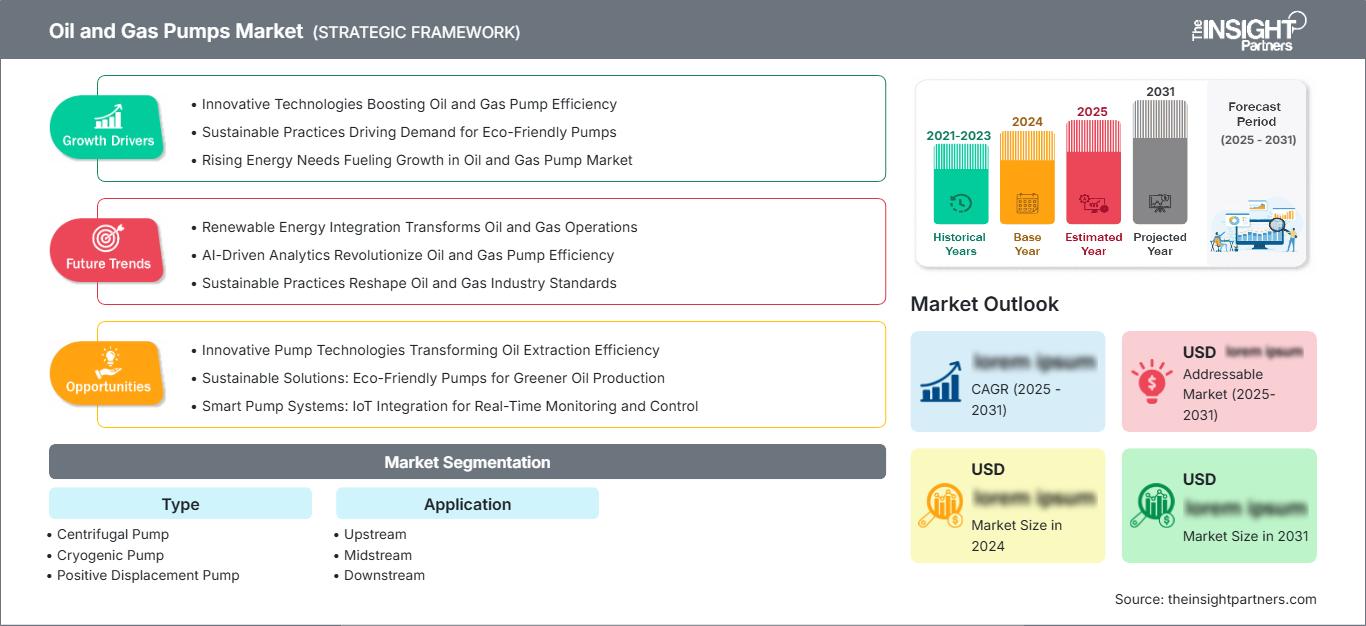
Oil and Gas Pumps Market: Strategic Insights
Regional Insights
North America Oil and Gas Pumps Market
North America was projected to have a revenue market share of 30-33% of 2025, and will grow at a 4.9-5.4% CAGR due to shale productivity, LNG export capacity expansion, refinery throughput, and pipeline maintenance. The North American Oil and Gas Pumps Market share will be driven by the extensive network services, quick equipment replacement, and the need for high pressure pump systems for produced water and crude oil transportation.
The operators in North America favor pumps with predictive maintenance, low leakage, and those which can handle abrasive or sour fluids. The USA is leading in regional buying of the pumps, while Canada supports the market through its oil sands industry, natural gas processing, and pipeline integrity programs.
U.S. Oil and Gas Pumps Market
The United States had an estimated share of 73–76% of North America in 2025 and is expected to exhibit a growth rate of 5.0–5.5% CAGR over the forecast period. The demand is high in the Permian Basin production, Gulf Coast LNG and refining operations, and crude pipelines.
The trends in applications suggest that midstream and downstream investments will become more reliant on reliability, emissions control, and throughput. The LNG facilities need cryogenic and transfer pumps, whereas the refineries require centrifugal and positive displacement pumps for feed, cooling, dosing, and product transfer operations. There is also a need for the asset owners to enhance the monitoring systems in order to decrease maintenance intervention and downtime.
Europe Oil and Gas Pumps Market
Europe had 17–20% share in 2025 and expected to grow by CAGR of 4.1–4.6%. The UK contributes to offshore maintenance as well as replacement demand related to subsea, while Germany dominates in process-engineering equipment acquisitions in refining, petrochemical, and gas handling segments. Selection of equipment is focused on energy efficiency, leakage prevention, and meeting tough safety regulations.
France, Italy, and Spain participate through refinery upgrades, construction of LNG receiving facilities, and terminals refurbishment. Local manufacturers and engineering companies include KSB SE and Co. KGaA, Alfa Laval AB, LEWA GmbH, and SCHMITT - Kreiselpumpen GmbH and Co. KG. Maturity of assets portfolio of Europe makes aftermarket and retrofit activities more valuable than greenfield pumps.
APAC Oil and Gas Pumps Market
In 2025, Asia Pacific had 25-28% share and will register the highest CAGR of 5.8-6.4% in the coming years. China is leading the procurement by its investment in refining, petrochemical plants, and LNG imports. While India is contributing through demand for pipelining and city gas, as well as increased refinery capacity.
Japan and South Korea have been focusing on high-end specifications of the pumps in LNG operations, energy systems due to shipbuilding, and petrochemicals for reliability. Australia has been emphasizing upstream gas and LNG, which needs reliable pumps for its remote locations.
Middle East & Africa Oil and Gas Pumps Market
The Middle East and Africa will experience growth of 5.6-6.2% CAGR due to the investments by national oil companies in the upstream capacity, gas processing and downstream diversification. Saudi Arabia dominates the regional market due to investments in the upstream, petrochemical, and water handling sectors. The UAE also supports the growth of the market through LNG, refining, and terminals.
South Africa provides modest demand due to investments in the refining facilities, storage, and industrial energy facilities. Markets in Rest of MEA region require investments in pipelines, terminals, and field developments. The difficult operating conditions in the region lead to increased use of durable materials, local services, and sand pumps.
Segmentation Analysis
Type
Type is expected to register a 5.2–5.7% CAGR during 2026–2034 as buyers match pump architecture to flow rate, pressure, viscosity, temperature, and fluid composition. The Oil and Gas Pumps Market scope across type categories remains broad because LNG, refining, drilling, pipeline, and chemical injection applications require different hydraulic performance and materials.
- Centrifugal Pump remains the largest sub-segment because it offers continuous flow, broad capacity ranges, and reliable operation in refineries, pipelines, cooling systems, crude transfer, and water circulation.
- Cryogenic Pump is strategically important for LNG liquefaction, storage, regasification, and low-temperature gas handling, where thermal stability, sealing performance, and safety assurance determine project acceptance.
- Positive Displacement Pump serves high-pressure, metering, dosing, viscous-fluid, and chemical-injection duties, making it essential for upstream stimulation, refinery additives, lubrication systems, and precise flow control.
Application
Application is forecast to advance at a 5.3–5.8% CAGR during 2026–2034 as pump demand spreads across production, transport, and processing assets. Upstream requires rugged fluid handling, midstream emphasizes uninterrupted transfer, and downstream focuses on efficiency, process reliability, and safety. The segment benefits from brownfield upgrades and new gas infrastructure.
- Upstream demand is linked to drilling support, artificial lift systems, produced-water management, enhanced recovery, and offshore operations where abrasion resistance and high-pressure reliability affect field economics.
- Midstream applications require dependable pipeline, terminal, storage, and compression-support pumping, with asset owners prioritizing uptime, energy efficiency, leak prevention, and remote condition monitoring.
- Downstream remains process-intensive, using pumps for crude distillation, product transfer, cooling, dosing, and petrochemical integration where reliability and materials compatibility protect refinery margins.
Opportunity Snapshot
| Application | Revenue Contribution | Trend Tag | Adoption Stage |
| Upstream | Medium | Field Recovery | Scaling |
| Midstream | High | Pipeline Integrity | Mature |
| Downstream | High | Refinery Retrofit | Mature |
Oil and Gas Pumps Market Growth Drivers and Impact Analysis
LNG and Gas Infrastructure Expansion
There will be higher need for cryogenic pumps due to increased liquid natural gas trade, gas processing, and LNG terminal development. There will be need for pumps that can run at low temperature levels, and which will offer effective seal and reliable flows. Such developments will favor companies capable of offering cryogenic engineering, test, and services close to coastal centers of energy. There is strong market impact in the U.S. Gulf Coast, Qatar-based logistics chains, Australia, China, India, Japan, and South Korea due to the importance of gas security and industrial fuel switch.
Refinery Modernization and Process Reliability
Refineries are upgrading pumps to support higher complexity, tighter product specifications, and improved energy performance. Pumps used in crude units, hydroprocessing, cooling water, product transfer, and chemical dosing are being assessed for efficiency, seal performance, and resistance to corrosive streams. Because unplanned outages can interrupt entire process trains, buyers increasingly evaluate total lifecycle cost rather than purchase price alone. This creates replacement and retrofit demand for centrifugal and positive displacement pumps, particularly in mature refining markets where operators aim to extend asset life while meeting stricter environmental and operational standards.
Digital Maintenance and Asset Efficiency
Connected sensors, vibration analytics, and predictive maintenance platforms are changing pump procurement from mechanical replacement to performance assurance. Operators want early warning of cavitation, seal wear, bearing issues, and abnormal pressure conditions, especially in remote pipelines, offshore assets, and continuous refineries. Digital maintenance reduces inspection uncertainty and helps maintenance teams schedule interventions before failures escalate. The impact is commercial as well as operational because suppliers can bundle pumps, monitoring, service contracts, and spare parts into recurring revenue models, strengthening customer retention and improving installed-base monetization.
Oil and Gas Pumps Market Future Trends
Smart Pump Packages for Critical Energy Assets
The Oil and Gas Pumps Market trends will increasingly center on packaged systems that combine pumps, drives, sensors, controls, and analytics. Instead of purchasing stand-alone equipment, operators will prefer integrated solutions validated for specific duties such as LNG transfer, pipeline boosting, or refinery circulation. This trend should improve standardization, shorten commissioning time, and create clearer accountability for performance. Suppliers with digital platforms and application engineering will be positioned to win complex projects where uptime, energy consumption, and safety documentation are central selection criteria.
Materials Innovation for Harsh-Service Operations
The Oil and Gas Pumps Market forecast indicates that future projects will place greater emphasis on metallurgy, coatings, elastomers, and seal systems capable of handling sour gas, sand, high salinity, low temperatures, and abrasive produced water. Harsh-service materials will become important as operators extend production from mature fields, develop offshore assets, and process more complex crude slates. This trend favors manufacturers that can validate durability through testing, certifications, and field references. It also supports premium pricing where pump failure would create safety, environmental, or production risks.
Oil and Gas Pumps Market Opportunities
Aftermarket Services and Installed-Base Optimization
Aftermarket services offer a practical growth route because the installed pump base across refineries, pipelines, terminals, and production facilities is large and aging. Suppliers can expand through inspection, seal replacement, impeller upgrades, vibration diagnostics, and energy audits. The opportunity is strongest where operators face downtime penalties but lack internal rotating-equipment capacity. By combining parts availability, local repair centers, and remote monitoring, manufacturers can convert one-time equipment sales into long-term service relationships with more predictable revenue and stronger customer dependence.
Localized Manufacturing and Energy Corridor Partnerships
Regional content rules, supply-chain resilience goals, and faster service expectations create opportunities for localized assembly, testing, and maintenance partnerships. Energy corridors in the U.S. Gulf Coast, Middle East, India, and Southeast Asia are particularly attractive for suppliers that can align with EPC contractors and national oil companies. Local presence can reduce lead times, improve tender competitiveness, and support compliance with procurement preferences. Strategic partnerships also help global manufacturers adapt designs to local operating conditions and service practices.
Recent Developments
- August 2025: Jereh Group made a strong impact at the 25th China International Petroleum & Petrochemical Technology and Equipment Exhibition (cippe 2025) in Beijing, with the theme “Innovating a Sustainable Future”. Jereh showcased its latest advancements in oil & gas, new energy regeneration, offshore engineering, and AI-driven digital transformation. At the exhibition, Jereh introduced its revolutionary AI-R FRAC smart fracturing system, the first fully integrated AI-driven solution for fracturing operations. Combining eight key modules—including intelligent decision-making, predictive maintenance, real-time safety monitoring, and closed-loop mixing—this system significantly enhances efficiency and reduces risks. Field data confirms 100% accuracy in pressure anomaly detection, a 97.8% success rate in pump failure prediction, and a 36% improvement in overall wellsite productivity.
- July 2025: July 2025: Cummins Inc. announce the launch of its new Fuel System designed specifically to meet the diverse needs of non-road, off-highway applications. This latest innovation from Cummins Components and Software (CCS), promises to deliver unparalleled performance, scalability, and integration, setting a new standard in fuel system technology. The system has the potential to be applied across other engine ratings with minor fuel system tailoring on the pump, injector, and rail. Furthermore, the system’s adaptable design enables it to be used in other industrial sectors.
- February 2025: Kirloskar Ebara Pumps Limited (KEPL), successfully participated in India Energy Week 2025, the nation’s premier event for the oil and gas sector from 11-14 February 2025. The company has always been on enhancing operational efficiency through smart technology, as evident in its energy-efficient line of products, including the Lowest Life-cycle Cost (LLCTM) Pump, KirloSmart Fire, state-of-the-art IoT-based remote monitoring system, and End Suction Process Pump KPD.
Frequently Asked Questions

- Comprehensive Market Sizing and Forecast Analysis
- Detailed Segmentation Analysis
- In-Depth Market Dynamics Assessment
- Regional and Country-Level Insights
- Competitive Landscape and Company Benchmarking
- Strategic Business Intelligence
Recent Reports
Testimonials

The Insight Partners provided valuable market intelligence that supported our global go-to-market strategy. Their team was professional, responsive, and attentive to our feedback, providing thoughtful analysis and helpful methodological clarifications throughout the project.
Junmo Kim Chief Financial Officer (CFO), Enertech Co., Ltd.
The Insight Partners' SCADA System Market report is comprehensive, with valuable insights on current trends and future forecasts. The team was highly professional, responsive, and supportive throughout. We are very satisfied and highly recommend their services.
RAN KEDEM Partner, Reali Technologies LTDs
I requested a report on a very specific software market and the team produced the report in a few days. The information was very relevant and well presented. I then requested some changes and additions to the report. The team was again very responsive and I got the final report in less than a week.
JEAN-HERVE JENN Chairman, Future Analytica
We worked with The Insight Partners for an important market study and forecast. They gave us clear insights into opportunities and risks, which helped shape our plans. Their research was easy to use and based on solid data. It helped us make smart, confident decisions. We highly recommend them.
PIYUSH NAGPAL Sr. Vice President, High Beam Global
The Insight Partners delivered insightful, well-structured market research with strong domain expertise. Their team was professional and responsive throughout. The user-friendly website made accessing industry reports seamless. We highly recommend them for reliable, high-quality research services
YUKIHIKO ADACHI CEO, Deep Blue, LLC.
This is the first time I have purchased a market report from The Insight Partners.While I was unsure at first, I visited their web site and felt more comfortable to take the risk and purchase a market report.I am completely satisfied with the quality of the report and customer service. I had several questions and comments with the initial report, but after a couple of dialogs over email with their analyst I believe I have a report that I can use as input to our strategic planning process.Thank you so much for taking the extra time and making this a positive experience.I will definitely recommend your service to others and you will be my first call when we need further market data.
JOHN SUZUKI President and Chief Executive Officer, Board Director, BK Technologies
I wish to appreciate your support and the professionalism you displayed in the course of attending to my request for information regarding to infectious disease IVD market in Nigeria. I appreciate your patience, your guidance, and the fact that you were willing to offer a discount, which eventually made it possible for us to close a deal. I look forward to engaging The Insight Partners in the future, all thanks to the impression you have created in me as a result of this first encounter.
DR CHIJIOKE ONYIA MANAGING DIRECTOR, PineCrest Healthcare Ltd.Reason to Buy
- Informed Decision-Making
- Understanding Market Dynamics
- Competitive Analysis
- Identifying Emerging Markets
- Customer Insights
- Market Forecasts
- Risk Mitigation
- Boosting Operational Efficiency
- Strategic Planning
- Investment Justification
- Tracking Industry Innovations
- Aligning with Regulatory Trends





 Get Free Sample for