
Oil Free Compressor Market Trends, Demand & Growth by 2034
Coverage: By Type (Reciprocating (Piston) Compressor, Rotary Compressor, Centrifugal Compressor); Product Type (Stationary , Portable); Industry (Chemical, Power Generation, Food and Beverages, Pharmaceuticals, Electrical and Electronics, Oil and Gas, Automotive, Others) , and Geography (North America, Europe, Asia Pacific, and South and Central America)
- Status : Data Released
- Report Code : TIPRE00017929
- Category : Manufacturing and Construction
- No. of Pages : 150
- Available Report Formats :


- Last update date : August 05, 2026


2025 Market Size
US$ 17.04 Bn
Base year value
2034 Forecast
US$ 27.34 Bn
Projected by 2034
CAGR 2026-2034
5.40 %
Growth rate
Addressable Market
US$ 201.33 Bn
(2026-2034)
The oil free compressor market stood at US$ 17.04 Billion in 2025 and is expected to reach US$ 27.34 Billion by 2034, increasing at a CAGR of 5.40% from 2026 to 2034. The market demand is driven by contamination sensitive manufacturing, energy efficient compressed air systems, and purity considerations in food & beverages, pharmaceuticals, electronics, chemicals, automotive, power generation, and oil & gas industries.
In North America, replacement cycles are expected to result in a compounded annual growth rate between 5.1-5.6%. Replacement needs, along with the modernization of older lubricated compressors and oil-free compressors that can be digitally monitored. Oil Free Compressor Market Size in North America is bolstered by validation processes in the pharmaceutical industry, Class 0 air applications, and energy management initiatives.
Oil Free Compressor Market Assessment and Insights
- North America accounted for 27–30% share in 2025 and is growing at a CAGR of 5.1–5.6% during 2026–2034, supported by FDA-aligned manufacturing, electronics cleanrooms, and efficiency-driven compressor replacement.
- US represented 78–82% of North America in 2025 and is growing at a CAGR of 5.2–5.7% during 2026–2034 as pharma and food processors expand validated air systems.
- Europe held 24–27% share in 2025 and is growing at a CAGR of 4.8–5.3% during 2026–2034, led by Germany, the UK, France, Italy, and Spain.
- Asia Pacific captured 31–34% share in 2025 and is growing at a CAGR of 5.8–6.4% during 2026–2034, led by China, Japan, South Korea, India, and Australia.
- Largest Segment Rotary Compressor held 45–48% market share in 2025, with a CAGR of 5.5–6.0% during 2026–2034 due to continuous-duty industrial adoption.
- High Growth Segment Pharmaceuticals held 12–15% market share in 2025, with a CAGR of 6.2–6.8% during 2026–2034 as sterile manufacturing expands.
- Key companies analyzed in detail: Atlas Copco AB, Aerzener Maschinenfabrik GmbH, BOGE KOMPRESSOREN Otto Boge GmbH & Co. KG, Chicago Pneumatic, ELGi Equipments Limited, Ingersoll Rand Inc., KAESER KOMPRESSOREN SE, Kobe Steel, Ltd., MultiAir Italia S.r.l., and Quincy Compressor LLC.
Source: The Insight Partners' analysis based on proprietary research, government publications, company annual reports, investor presentations, industry databases, and expert interviews.
The technological advancements have transformed the oil free compressors business model from a compliance-based buying cycle to production-based investing cycle. The rotary screw and centrifugal compressors are now available with variable speed drive, improved coatings, water injection stage, and controllers to ensure low energy intensity while maintaining the ISO 8573-1 Class 0 air quality. Trends in production include localization of manufacturing, increased servicing, and lifecycle management services along with the compressor purchasing process to reduce any chances of downtime.
Investments in the future will be done in Asia Pacific industrial belts, North American reshoring projects, and European decarbonization policies. Headwinds from regulations about food safety, pharmaceutical validation, and emissions have pushed companies towards adoption of oil-free technologies. The future geographies will favor packaged and easy to maintain compressors whereas the current geographies will prefer digital services and energy recovery technology.
Oil Free Compressor Market Report Scope
| Report Attribute | Details |
|---|---|
| Market size in 2025 | US$ 17.04 Billion |
| Market Size by 2034 | US$ 27.34 Billion |
| Global CAGR (2026 - 2034) | 5.40% |
| Historical Data | 2021-2024 |
| Forecast period | 2026-2034 |
Oil Free Compressor Market Analysis
The market growth of oil free compressors depends on the growing need for verified contamination-free compressed air that would not affect any processes where an oil contamination may affect batches, wafers, coatings or a sterile line. Food and beverage industry, pharmaceutical companies, electronics and automotive paint rooms have begun treating their compressed air as a primary utility rather than as a secondary one.
The supply chain has become more connected as compressor OEMs, air treatment companies, distributors and aftermarket services specialists work closely together. Energy is the most significant part of the total lifecycle costs in the compressed air system and therefore buyers prefer buying variable speed, heat recovery, remote monitoring and preventive maintenance packages.
The oil free compressor market report suggests a highly concentrated competition for high capacity and regulated applications. Atlas Copco AB, Ingersoll Rand Inc., KAESER KOMPRESSOREN SE and Kobe Steel, Ltd compete with each other, whereas AERZEN, BOGE, ELGi, Chicago Pneumatic, MultiAir Italia and Quincy Compressor cater to specialized and regional requirements.
Positioning has evolved beyond the level of hardware capabilities. Suppliers are focusing on networked controls, analytics throughout product lifecycles, local availability of spare parts, and acquisitions to enhance channel penetration. As buyers begin to assess the compressor systems on the basis of their air quality, energy efficiency, response time, and footprint size, aftermarket services become crucial for differentiation.
● REPORT CUSTOMIZATION
Tailor This Report To Align With Your Specific Business Requirements
This report can be customized to align precisely with your business objectives, scope, and target markets. Customization options include tailored segmentation, geography, competitive analysis, and strategic insights to support informed decision-making.
Customize This Report →WHAT YOU CAN ADJUST
- ● Segmentations
- ● Geography
- ● Competitive Analysis
- ● Language Preferences
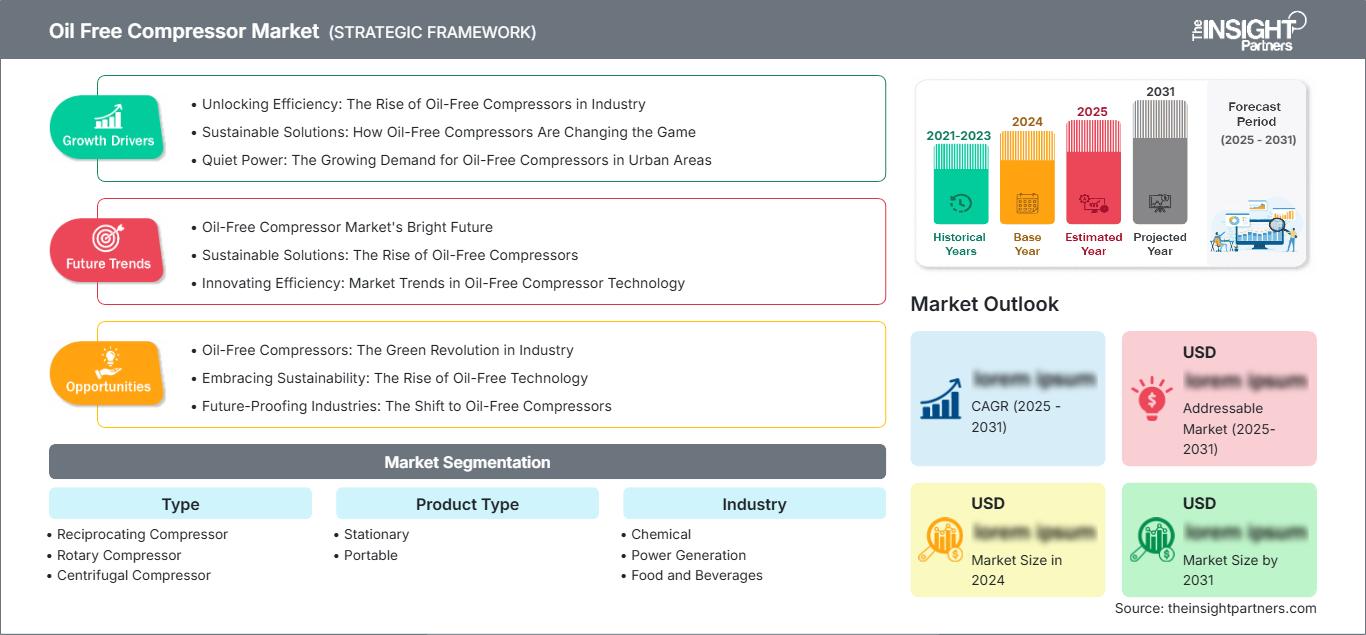
Oil Free Compressor Market: Strategic Insights
Regional Insights
North America oil free compressor market
North America accounted for 27–30% of 2025 revenue and is expected to grow at a CAGR of 5.1–5.6% through 2034. The region’s oil free compressor market share reflects strong adoption in pharmaceuticals, packaged food, medical devices, automotive finishing, and electronics manufacturing.
Investments will be made in relation to plant upgrading, proven air systems, and energy efficiency. The main factors are the repatriation of high-tech manufacturing, tighter contamination controls, and the replacement of aged fixed-speed compressors by digitalized rotary and centrifugal machines.
U.S. Oil Free Compressor Market
In 2025, the country accounted for 78-82% share of North America, and is anticipated to grow at CAGR of 5.2-5.7% between 2026 and 2034. Major applications are validated pharmaceutical production, aseptic packaging, food processing, semiconductor utility systems, and special automotive paint systems.
There is substantial company representation in the form of Atlas Copco AB, Ingersoll Rand Inc., KAESER KOMPRESSOREN SE, Chicago Pneumatic, and Quincy Compressor LLC through their direct sales, distribution, and services. There is a preference for rotary oil-free compressors in plant air, and centrifugal compressor in utility air.
Europe Oil Free Compressor Market
In 2025, Europe occupied a market share of 24-27%, which is expected to increase at a CAGR of 4.8-5.3% from 2026 to 2034. This segment is driven by demand in Germany due to applications in automobiles, chemical, and machinery manufacturing. The UK is supported by pharmaceutical manufacturing, food processing, and retrofits in matured industries for energy efficiency.
The other major markets in the region include France, Italy, and Spain with demand in packaged foods, cosmetics, electronics, and industrial gases. Decarbonization efforts by the European Union and audit programs for compressed air are helping drive sales in oil-free variable speed packages.
APAC Oil Free Compressor Market
APAC shares 31%-34% in 2025 and is projected to have a CAGR of 5.8%-6.4% till 2034, thereby becoming the most dominant region. The region enjoys economies of scale due to China’s electronics, chemicals, electric vehicle production, and industrial estates.
Japan and South Korea give priority to highly reliable compressors for semiconductors, batteries, and precision machining. India is increasing the demand via pharmaceuticals, food processing, and infrastructure-related manufacturing, while Australia generates demand from mining service, energy-related projects, and industrial maintenance operations.
Middle East & Africa Oil Free Compressor Market
Growth in the Middle East and Africa region is expected to be in the range of 4.7–5.2%, CAGR 2026-2034. Growth in Saudi Arabia is driven by petrochemical plants, energy generation, and industrial expansion projects that need clean air technologies.
Adoption of UAE will be facilitated through food processing, logistics and health care industries. On the other hand, South Africa contributes through mining, chemical, and packaging. The rest of MEA region’s growth will depend on particular projects in the areas of energy and manufacturing industries.
Segmentation Analysis
Type
Type is expected to grow at a CAGR of 5.3–5.9% during 2026–2034. The oil free compressor market scope across compressor type reflects a balance between continuous-duty rotary platforms, high-pressure reciprocating units, and large-flow centrifugal systems. Selection depends on purity class, pressure profile, duty cycle, energy intensity, and the ability to integrate monitoring and air treatment.
- Reciprocating Compressor systems remain relevant for intermittent and high-pressure applications, especially where compact design, serviceability, and reliable clean air matter more than continuous high-volume output.
- Rotary Compressor platforms dominate continuous industrial air supply because they balance efficiency, footprint, and reliability, making them suitable for food, pharmaceutical, electronics, and automotive facilities.
- Centrifugal Compressor units serve large-volume utilities, petrochemicals, power, and process industries where high airflow, lower vibration, and centralized clean-air generation support plant-wide operations.
Product Type
Product Type is projected to grow at a CAGR of 5.0–5.6% during 2026–2034. Stationary systems lead because regulated production lines require uninterrupted, validated compressed air. Portable units remain important for maintenance, construction-adjacent industrial work, and temporary clean-air needs, particularly where mobility reduces project downtime.
- Stationary compressors support centralized plant utilities, offering higher capacity, better monitoring integration, and stronger suitability for validated production environments requiring stable pressure and quality.
- Portable compressors address temporary or distributed air demand, helping maintenance teams, field service providers, and project sites access oil-free air without permanent installation.
Industry
Industry is forecast to grow at a CAGR of 5.6–6.2% during 2026–2034. Demand is highest where contamination risk, process uptime, and energy consumption directly affect product quality and operating cost. Pharmaceuticals, food and beverages, electronics, and chemicals are increasingly specifying certified oil-free air as part of facility design.
- Chemical producers use oil-free air for process control, conveying, and instrumentation where contamination could affect product consistency, catalyst handling, or downstream quality assurance.
- Power Generation facilities rely on clean compressed air for controls, maintenance, and auxiliary systems, with efficiency upgrades supporting lower operating cost and improved reliability.
- Food and Beverages manufacturers prioritize oil-free air for packaging, aeration, bottling, and contact-adjacent processes where hygiene, traceability, and product safety are critical purchasing factors.
- Pharmaceuticals require validated clean-air systems for tablet coating, fermentation, packaging, and sterile operations, making compressor reliability and documentation central to procurement decisions.
- Electrical and Electronics production uses oil-free air in cleanrooms, component handling, and precision assembly where microscopic contamination can reduce yield or damage sensitive devices.
- Oil and Gas operators apply oil-free compression in instrumentation, nitrogen generation support, gas processing, and refinery utilities where reliability and safety requirements remain stringent.
- Automotive plants use oil-free systems in painting, pneumatic tools, battery manufacturing, and assembly lines where air quality influences finish quality and production continuity.
Opportunity Snapshot
| Industry | Revenue Contribution | Trend Tag | Adoption Stage |
| Chemical | High | Process Air | Mature |
| Power Generation | Medium | Plant Utilities | Scaling |
| Food and Beverages | High | Hygienic Air | Mature |
| Pharmaceuticals | High | Sterile Lines | Scaling |
| Electrical and Electronics | High | Cleanrooms | Scaling |
| Oil and Gas | Medium | Refinery Air | Mature |
| Automotive | Medium | Paint Quality | Scaling |
Oil Free Compressor Market Growth Drivers and Impact Analysis
Rising need for contamination-free industrial air
In the sectors of pharmaceuticals, food and beverages, electronics, and medical devices, the compressed air requirements have been increasingly strict due to the fact that any amount of oil carryover could affect the product quality, batch approval, or yield in the cleanroom. The Class 0 according to ISO 8573-1 standard has hence become an important purchasing criterion instead of being just a premium choice. The effect of such a trend can be seen in the new production lines, where oil-free compressors are installed during design phase instead of adding them post-implementation.
Energy efficiency pressure across compressed air systems
The use of compressed air represents one of the most electricity-consuming industrial services. Today, a number of factories carry out audits of leaks, air pressure, and compressor loads in order to decrease costs of operations. Oil-free systems featuring adjustable speed drive, efficient airends, thermal energy recovery, and control systems can allow adjusting the amount of produced compressed air to customer needs. From a commercial perspective, it means moving from the principle of the lowest initial cost to lifecycle value, especially in factories that operate around the clock.
Expansion of high-purity manufacturing capacity
Investments into semiconductor, battery, biologics, processed food, and specialty chemical plants across the globe are leading to increasing usage of clean compressed air equipment. These plants will need a redundancy in compressor train systems, air quality validation, and maintenance schedule prior to starting operations. This leads to increased demand for engineered packages than individual machines. Aftermarket sales are also positively affected by this driver because high purity facilities need serviced maintenance and spare parts.
Oil Free Compressor Market Future Trends
Connected compressor rooms become standard
Oil free compressor market trends point toward compressor rooms managed as connected energy assets rather than isolated machines. Sensors, cloud dashboards, and predictive algorithms will increasingly optimize pressure bands, maintenance timing, and load sharing across multiple units. As industrial teams face skilled technician shortages, remote diagnostics will become a core procurement requirement. The next competitive frontier will be the ability to combine machine data, service response, and energy reporting into auditable performance records for regulated and sustainability-focused facilities.
Heat recovery and low-carbon plant utilities
Future procurement will increasingly link oil-free compression with plant decarbonization. Heat recovery modules can reuse compressor waste heat for process water, space heating, or adjacent utilities, improving overall energy productivity. As manufacturers report Scope 2 emissions and pursue lower electricity intensity, compressor packages that document recovered energy and integrate with building management systems will gain preference. This trend should support premium configurations and create service opportunities around audits, controls upgrades, and verified energy performance.
Oil Free Compressor Market Opportunities
Lifecycle service contracts for regulated industries
Suppliers can capture higher-margin opportunities by packaging oil-free compressors with validation support, scheduled maintenance, air quality documentation, and guaranteed response times. Pharmaceutical, food, electronics, and medical device plants value continuity because compressed air failures can delay release, stop filling lines, or reduce cleanroom yield. Contract models that bundle parts, monitoring, and audit-ready records can strengthen customer retention and smooth revenue cycles. This opportunity favors companies with dense service coverage, trained technicians, and digital platforms that convert operating data into actionable maintenance decisions.
Localized packages for emerging industrial corridors
Emerging manufacturing corridors in India, Southeast Asia, the Middle East, and parts of Africa create demand for reliable, serviceable, and cost-optimized oil-free packages. Localized assembly, standard spare parts, and distributor training can reduce lead times and improve buyer confidence. Investors should target modular systems that scale from single-line facilities to larger plants as production grows. The opportunity is strongest where food processing, pharmaceuticals, packaging, and electronics are expanding but maintenance infrastructure remains uneven.
Recent Developments
- April 2026: Garrett Motion Inc. unveils its breakthrough oil-free centrifugal compressor technology for HVAC systems at AHR Expo 2026 in Las Vegas (February 2-4) and announces an ambitious roadmap to launch the industry’s first such compressor portfolio covering cooling demands from 7 to 500 Tons (25 to 1,750 kWc).
- July 2025: Atlas Copco AB — expanded its oil-free compressor range with new ZR/ZT 30-55 FLX, ZR/ZT 30-50 VSD+, ZT 200-355 VSD+, and ZR 200-315 models, emphasizing lower energy use, smaller footprints, higher airflow, and improved specific energy performance for regulated industries —
- March 2025: Atlas Copco AB — announced that Kyungwon Machinery Industry Co., Ltd., a Korean manufacturer of oil-injected and oil-free screw and scroll air compressors, would become part of the group, adding 126 employees and broadening technology access for food, automotive, and semiconductor customers.
Frequently Asked Questions

- Comprehensive Market Sizing and Forecast Analysis
- Detailed Segmentation Analysis
- In-Depth Market Dynamics Assessment
- Regional and Country-Level Insights
- Competitive Landscape and Company Benchmarking
- Strategic Business Intelligence
Recent Reports
Testimonials

The Insight Partners provided valuable market intelligence that supported our global go-to-market strategy. Their team was professional, responsive, and attentive to our feedback, providing thoughtful analysis and helpful methodological clarifications throughout the project.
Junmo Kim Chief Financial Officer (CFO), Enertech Co., Ltd.
The Insight Partners' SCADA System Market report is comprehensive, with valuable insights on current trends and future forecasts. The team was highly professional, responsive, and supportive throughout. We are very satisfied and highly recommend their services.
RAN KEDEM Partner, Reali Technologies LTDs
I requested a report on a very specific software market and the team produced the report in a few days. The information was very relevant and well presented. I then requested some changes and additions to the report. The team was again very responsive and I got the final report in less than a week.
JEAN-HERVE JENN Chairman, Future Analytica
We worked with The Insight Partners for an important market study and forecast. They gave us clear insights into opportunities and risks, which helped shape our plans. Their research was easy to use and based on solid data. It helped us make smart, confident decisions. We highly recommend them.
PIYUSH NAGPAL Sr. Vice President, High Beam Global
The Insight Partners delivered insightful, well-structured market research with strong domain expertise. Their team was professional and responsive throughout. The user-friendly website made accessing industry reports seamless. We highly recommend them for reliable, high-quality research services
YUKIHIKO ADACHI CEO, Deep Blue, LLC.
This is the first time I have purchased a market report from The Insight Partners.While I was unsure at first, I visited their web site and felt more comfortable to take the risk and purchase a market report.I am completely satisfied with the quality of the report and customer service. I had several questions and comments with the initial report, but after a couple of dialogs over email with their analyst I believe I have a report that I can use as input to our strategic planning process.Thank you so much for taking the extra time and making this a positive experience.I will definitely recommend your service to others and you will be my first call when we need further market data.
JOHN SUZUKI President and Chief Executive Officer, Board Director, BK Technologies
I wish to appreciate your support and the professionalism you displayed in the course of attending to my request for information regarding to infectious disease IVD market in Nigeria. I appreciate your patience, your guidance, and the fact that you were willing to offer a discount, which eventually made it possible for us to close a deal. I look forward to engaging The Insight Partners in the future, all thanks to the impression you have created in me as a result of this first encounter.
DR CHIJIOKE ONYIA MANAGING DIRECTOR, PineCrest Healthcare Ltd.Reason to Buy
- Informed Decision-Making
- Understanding Market Dynamics
- Competitive Analysis
- Identifying Emerging Markets
- Customer Insights
- Market Forecasts
- Risk Mitigation
- Boosting Operational Efficiency
- Strategic Planning
- Investment Justification
- Tracking Industry Innovations
- Aligning with Regulatory Trends





 Get Free Sample for