
Oilfield Equipment Market Size, Share & Trends by 2034
Coverage: by Type of Equipment (Production Machinery, Drilling Equipment, and Pumps & Valves, and Others), Application (Onshore and Offshore), and Geography (North America, Europe, Asia Pacific, and South and Central America)
- Status : Data Released
- Report Code : TIPMC00002533
- Category : Manufacturing and Construction
- No. of Pages : 150
- Available Report Formats :


- Last update date : August 05, 2026


2025 Market Size
US$ 141.6 Bn
Base year value
2034 Forecast
US$ 180.67 Bn
Projected by 2034
CAGR 2026-2034
2.74 %
Growth rate
Addressable Market
US$ 1,462.38 Bn
(2026-2034)
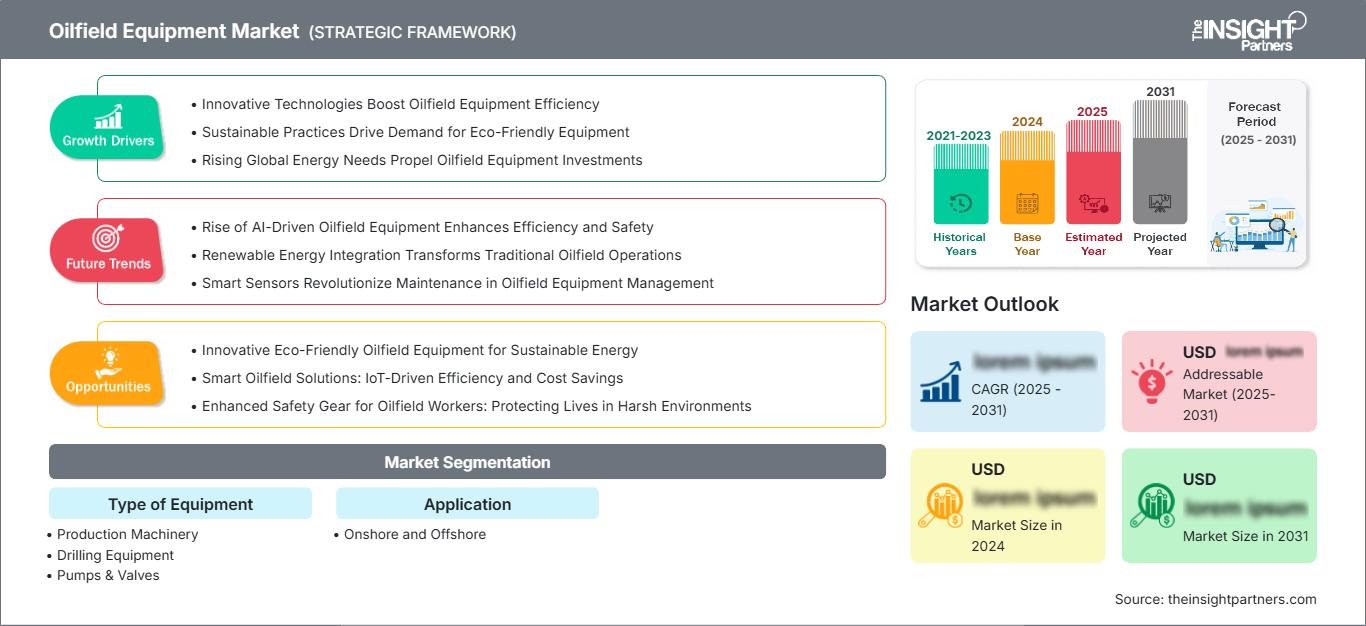
Oilfield Equipment Market will increase from US$ 141.6 Billion in 2025 to US$ 180.67 Billion in 2034 at a CAGR of 2.74% during 2026-2034 period. Demand for oilfield equipment is influenced by conservative upstream investment, decline management, sanctioning of offshore projects, and upgrading of aged surface and sub-surface equipment in mature and new hydrocarbon regions.
In North America, demand for Oilfield Equipment Market will be driven by improvements in shale productivity, operations in Gulf of Mexico, and replacement of oilfield equipment, where the region is anticipated to grow at a CAGR of 2.3-2.7% during 2026-2034 period. Drilling systems, electric fracturing fleets, artificial lift equipment, and emission reduction equipment are among priorities for operators in order to maintain the production levels without adding rigs.
Oilfield Equipment Market Assessment and Insights
- North America accounted for 31–34% share in 2025 and is expected to grow at a CAGR of 2.3–2.7% between 2026–2034, driven by shale optimization, offshore maintenance, and replacement demand.
- US represented 78–82% of North America in 2025 and is projected to expand at a CAGR of 2.2–2.6% between 2026–2034, led by Permian productivity and Gulf projects.
- Europe held 14–17% share in 2025 and is forecast to grow at a CAGR of 2.0–2.4% between 2026–2034, with Norway, the UK, and Germany leading specialized offshore demand.
- Asia Pacific captured 20–23% share in 2025 and is expected to record a CAGR of 3.1–3.5% between 2026–2034, supported by China, India, Australia, and Southeast Asian offshore activity.
- Largest Segment Production Machinery held 42–46% market share in 2025 and is expected to grow at a CAGR of 2.4–2.8% during 2026–2034 due to asset integrity needs.
- High Growth Segment Offshore held 30–34% market share in 2025 and is projected to grow at a CAGR of 3.0–3.4% during 2026–2034 on subsea and deepwater investment.
- Key companies analyzed in detail: Oil States International, Inc.; SLB; Parker Wellbore Company; Halliburton Company; Seventy Seven Energy Inc.; Baker Hughes Company; Superior Energy Services, Inc.; Tenaris S.A.; Aker Solutions ASA; and Sulzer Ltd.
Source: The Insight Partners' analysis based on proprietary research, government publications, company annual reports, investor presentations, industry databases, and expert interviews.
Migration of technology is changing procurement strategies in the Oilfield Equipment Market, as companies switch from capitalization spending to a reliability-based approach and automation. Drilling equipment has been integrated with rotary steering, monitoring, and automation of the rig itself, whereas production equipment is being adapted for artificial lift, corrosion protection, methane management, and reliable maintenance. This is a reflection of a market with fewer rigs that have higher production thanks to longer laterals, optimized completions, and digital field coordination.
Going forward, the wave of investments will not be confined to North American unconventional resources but spread to offshore Brazil, Guyana, the Middle East, India, and Southeast Asia. The regulatory emphasis on emissions reduction, well integrity, and flaring management will be advantageous for equipment manufacturers that specialize in valves, pumps, completion packages, and production equipment equipped with monitoring capabilities. Thus, the Oilfield Equipment Market should continue growing consistently, driven by productivity, safety and replacement needs.
Oilfield Equipment Market Report Scope
| Report Attribute | Details |
|---|---|
| Market size in 2025 | US$ 141.6 Billion |
| Market Size by 2034 | US$ 180.67 Billion |
| Global CAGR (2026 - 2034) | 2.74% |
| Historical Data | 2021-2024 |
| Forecast period | 2026-2034 |
Oilfield Equipment Market Analysis
Oilfield Equipment Market Growth Drivers are based on the ability to compensate natural decline rates, sustain production from mature fields, and enable selected development projects in new fields. According to the IEA, the majority of upstream capital expenditure goes into replacing falling production at existing fields, thus stimulating demand for pumps, valves, drilling equipment, wellhead equipment, and production equipment. The supply situation is tight, as operators prefer equipment with lower downtime and higher efficiency per well.
Today, the ability to create value will be largely based on integration between operators, oilfield services companies, engineering firms, and specialized equipment manufacturers. A connected ecosystem includes steel tubing, pressure control, subsea equipment, elastomers, digital controls, and service workshops. It has become a priority for procurement departments to deliver reliable equipment capable of operating in aftermarket, as its breakdown can interrupt production schedules.
Oilfield Equipment Market Analysis reveals an oligopoly market characterized by diversification among oilfield service providers and engineering experts. The SLB, Halliburton Company, and Baker Hughes Company are pitted against each other through the use of technology, international service networks, and digital drilling technologies, while Tenaris S.A., Oil States International, Inc., Aker Solutions ASA, and Sulzer Ltd. position themselves via tubulars, offshore systems, pumps, and rotating equipment requiring maintenance.
The strategic positioning is now moving towards recurring revenue models, service packages, and equipment solutions for low emission operations. Parker Wellbore Company and Superior Energy Services, Inc. are still vulnerable to drilling and well service activities, while Baker Hughes Company and Aker Solutions ASA take advantage of subsea, liquefied natural gas projects, and offshore projects.
● REPORT CUSTOMIZATION
Tailor This Report To Align With Your Specific Business Requirements
This report can be customized to align precisely with your business objectives, scope, and target markets. Customization options include tailored segmentation, geography, competitive analysis, and strategic insights to support informed decision-making.
Customize This Report →WHAT YOU CAN ADJUST
- ● Segmentations
- ● Geography
- ● Competitive Analysis
- ● Language Preferences
Oilfield Equipment Market: Strategic Insights
Regional Insights
North America Oilfield Equipment Market
The North America market held 31–34% market share in 2025 and is projected to grow at a CAGR of 2.3–2.7% between 2026 and 2034. The Oilfield Equipment Market share of the region is a consequence of its substantial installed base of shale wells, the productivity of the Permian formation, and the developments in the offshore Gulf of Mexico.
There is a need for more automation in the operations. Companies are acquiring electric fracturing units, drilling hardware, artificial lift equipment, and pressure control equipment to maintain production levels without increasing the number of rigs. This is corroborated by the EIA statistics that indicate the increase in production levels despite low rig counts. Even with the stabilization of commodity prices, production continues.
U.S. Oilfield Equipment Market
The U.S. accounted for 78%-82% of North America in 2025 and is anticipated to grow at a CAGR of 2.2%-2.6% until 2034. Demand is focused on the Permian, Eagle Ford, Haynesville, Appalachia, and Gulf of Mexico basins, where longer laterals, high-pressure pumps, and automated drilling tools are used by companies to extract the maximum resources. Major players in the industry include SLB, Halliburton Company, Baker Hughes Company, Tenaris S.A., and Oil States International, Inc.
Trends in application vary between basins. In onshore, pumps, valves, production equipment, artificial lift, and drilling equipment are important, while in offshore operations, subsea equipment, intervention equipment, and special safety equipment are needed. The Oilfield Equipment Market of the country is driven by capital discipline, but demand from LNG gas and power industry ensures that wells continue to be developed.
Europe Oilfield Equipment Market
Europe accounted for 14–17% share in 2025 and is expected to grow at a CAGR of 2.0–2.4% during 2026–2034, with Norway the leading country. The UK remains important because North Sea brownfield redevelopment, decommissioning-adjacent services, and subsea maintenance require specialized equipment, intervention tools, and production optimization systems.
The contribution from Germany comes through the processes of manufacturing, valves, engineered pumps, and industrial supply chains and not through big upstream resources. The contribution from France, Italy, and Spain includes engineering, offshore operations, and the demand for the Mediterranean infrastructure. Norway still makes the highest contributions from its offshore projects that contribute towards purchasing subsea and production equipment.
APAC Oilfield Equipment Market
The APAC region had a 20-23% share in 2025 and will grow at a CAGR of 3.1-3.5% between 2026 and 2034 due to increased efforts towards exploration and production activities in China and India and offshore production and LNG-linked upstream activities in Australia.
The demand from Japan and South Korea will be driven by shipbuilding, offshore construction, and subsea sectors in these countries. The focus of policy on energy security and local production is promoting investment in drilling equipment, pumps, valves, and production equipment. The Oilfield Equipment Market in APAC region is witnessing opportunities due to brownfield activities in Southeast Asia.
Middle East & Africa Oilfield Equipment Market
Middle East & Africa is projected to grow at a CAGR of 2.8–3.2% during 2026–2034, led by Saudi Arabia. The region’s demand reflects large-scale conventional fields, gas development, enhanced recovery, and infrastructure-led upstream spending in Saudi Arabia, the UAE, and Qatar.
SA and the rest of MEA make contributions through offshore explorations, refinery-related facilities, and selective gas projects. National oil companies give priority to reliable equipment, local content, and services. The Oilfield Equipment Market gains from stable field maintenance programs and investments in energy security by major oil-producing countries.
Segmentation Analysis
Type of Equipment
Type of Equipment is expected to grow at a CAGR of 2.5–2.9% during 2026–2034. The Oilfield Equipment Market scope across this segment includes production machinery, drilling equipment, and pumps and valves used across exploration, development, completion, production, and intervention workflows. Demand is strongest where operators are replacing aging assets, upgrading pressure-control capability, and integrating digital condition monitoring into field equipment.
- Production Machinery remains the largest equipment category, supported by artificial lift, separation, surface processing, and wellsite production systems required to maintain output from mature and unconventional assets.
- Drilling Equipment demand is linked to high-spec rigs, directional drilling, rotary steerable systems, and automation tools that improve drilling efficiency while reducing nonproductive time.
- Pumps & Valves are strategically important because they support pressure control, fluid movement, safety, and reliability across drilling, stimulation, production, and offshore operating environments.
Application
Application is projected to grow at a CAGR of 2.6–3.0% during 2026–2034. Onshore applications dominate installed equipment demand because shale, tight oil, conventional fields, and workover programs require recurring replacement of pumps, valves, drilling tools, and production systems. Offshore applications are expanding faster as deepwater and subsea projects require higher-value equipment packages, engineering support, and long-cycle maintenance commitments.
- Onshore accounts for the larger installed base, with demand driven by pad drilling, artificial lift, well intervention, and production optimization across shale and mature conventional basins.
- Offshore represents the higher-growth application, supported by subsea tiebacks, deepwater developments, floating production systems, and premium equipment designed for safety-critical environments.
Opportunity Snapshot
| Application | Revenue Contribution | Trend Tag | Adoption Stage |
| Onshore | High | Pad Efficiency | Mature |
| Offshore | Medium | Subsea Tiebacks | Scaling |
Oilfield Equipment Market Growth Drivers and Impact Analysis
Replacement of Aging Production Assets
Field operators are extending production from mature reservoirs, which increases demand for replacement pumps, valves, artificial lift systems, separators, and pressure-control components. As wells age, corrosion, sand production, flow assurance issues, and declining reservoir pressure raise maintenance intensity. Equipment suppliers benefit when operators prioritize reliability upgrades instead of large greenfield expansions. The impact is strongest in North America, Europe, and the Middle East, where existing infrastructure is extensive and production continuity is commercially critical. This driver supports stable spending even in moderate oil price environments because unplanned downtime directly affects cash flow, safety performance, and regulatory compliance across producing assets.
Offshore Project Sanctioning and Subsea Redevelopment
Offshore developments require high-value equipment packages, long engineering cycles, and rigorous reliability standards, making them a durable demand source for the Oilfield Equipment Market. Subsea production systems, drilling tools, pumps, valves, riser components, and intervention equipment are needed as operators develop deepwater fields and connect smaller discoveries to existing hubs. Brazil, Guyana, the Gulf of Mexico, West Africa, and parts of Asia Pacific are important demand centers. The market impact is significant because offshore procurement generates higher revenue per project than many onshore programs and supports aftermarket services over long asset lives. Suppliers with proven subsea engineering and local execution capacity gain a strategic advantage.
Automation and Efficiency in Drilling Operations
Operators are using automation to improve well placement, reduce nonproductive time, and maintain production with fewer rigs. Automated drilling systems, rotary steerable tools, digital monitoring, and remote operations centers are becoming procurement priorities as labor availability, safety expectations, and well complexity increase. The impact on equipment demand is qualitative as well as quantitative because buyers are shifting from standalone hardware toward integrated systems with sensors, software, and service support. This driver strengthens margins for technology-led suppliers and encourages partnerships between drilling contractors, service firms, and equipment manufacturers. It also supports more consistent demand when rig counts fluctuate.
Oilfield Equipment Market Future Trends
Digitalized Asset Integrity Platforms
Oilfield Equipment Market trends are moving toward digitalized asset integrity platforms that combine sensors, predictive analytics, and maintenance planning for pumps, valves, drilling equipment, and production machinery. Over the forecast period, operators will increasingly require equipment that can report condition, pressure, vibration, corrosion risk, and operating history. This will shift competition from hardware delivery toward lifecycle performance assurance. Suppliers able to connect installed equipment with analytics and service workflows can reduce failure risk, optimize maintenance visits, and build recurring revenue models. The trend is especially relevant for offshore and remote onshore assets where repair logistics are costly and downtime has significant production consequences.
Lower-Emission Field Equipment Design
Equipment specifications are expected to incorporate stricter emissions, leak detection, electrification, and energy-efficiency requirements. Operators are likely to favor low-leak valves, electric or hybrid power systems, methane-ready monitoring, and production machinery designed to reduce flaring and fugitive emissions. This transition will not eliminate hydrocarbon equipment demand, but it will reshape product development and procurement scoring. Manufacturers with certified low-emission components, digital reporting capability, and retrofit offerings can capture replacement opportunities in regulated markets. The trend also supports demand from national oil companies seeking to protect export competitiveness as buyers and financiers scrutinize upstream carbon intensity.
Oilfield Equipment Market Opportunities
Integrated Offshore Equipment Packages
Offshore operators are seeking integrated packages that combine subsea production systems, valves, pumps, controls, and long-term service support. This creates an investment opportunity for suppliers that can coordinate engineering, manufacturing, installation readiness, and aftermarket execution across multi-year project timelines. Oilfield Equipment Market Forecasts indicate that offshore applications will outpace the broader market, making package-based contracting attractive for companies with deepwater credentials. The opportunity is strongest where smaller fields can be tied back to existing infrastructure, reducing project breakevens while still requiring high-specification equipment. Suppliers can improve win rates by offering standardized modules, local content plans, and reliability-backed service agreements.
Aftermarket Services for Mature Onshore Basins
Mature onshore basins offer a large, recurring opportunity in inspection, repair, remanufacturing, spare parts, and equipment upgrades. Operators focused on capital discipline often prefer extending asset life rather than replacing entire systems, creating demand for certified refurbishment of pumps, valves, wellheads, and production machinery. Service networks close to producing basins can capture margin-rich work while reducing customer downtime. The opportunity is particularly relevant in the U.S., Canada, the Middle East, and parts of Asia where production infrastructure is extensive. Companies that combine field service, digital diagnostics, and parts availability can create defensible recurring revenue streams.
Recent Developments
- June 2026: Baker Hughes Company announced it would deliver subsea production systems for Azule Energy’s Greater PAJ development, reinforcing its offshore equipment position in high-value subsea projects and supporting demand for engineered production systems, controls, and lifecycle services in deepwater oil and gas developments.
- May 2026: Baker Hughes announced Tuesday a major contract extension with Petrobras to provide integrated solutions for well construction across Brazil’s Santos Basin. Baker Hughes will expand the company’s comprehensive well construction operations in several of the basin’s oilfields. The company’s advanced portfolio – including the AutoTrak rotary steerable system, cutting-edge logging-while-drilling tools, and Dynamus extended-life drill bits – will be deployed across the construction portfolio of deepwater wells, enabling efficient access to subsurface reservoirs and supporting the ongoing development of Brazil's pre-salt oil & gas resources.
- March 2025: Innospec Oilfield Services has announced the launch of its LaZuli product line, a suite of three chemical solutions designed and certified for use in deepwater subsea production. These products represent a significant advancement, offering enhanced production, improved flow assurance, and extended equipment life in the challenging deepwater environment.
Frequently Asked Questions

- Comprehensive Market Sizing and Forecast Analysis
- Detailed Segmentation Analysis
- In-Depth Market Dynamics Assessment
- Regional and Country-Level Insights
- Competitive Landscape and Company Benchmarking
- Strategic Business Intelligence
Recent Reports
Testimonials

The Insight Partners provided valuable market intelligence that supported our global go-to-market strategy. Their team was professional, responsive, and attentive to our feedback, providing thoughtful analysis and helpful methodological clarifications throughout the project.
Junmo Kim Chief Financial Officer (CFO), Enertech Co., Ltd.
The Insight Partners' SCADA System Market report is comprehensive, with valuable insights on current trends and future forecasts. The team was highly professional, responsive, and supportive throughout. We are very satisfied and highly recommend their services.
RAN KEDEM Partner, Reali Technologies LTDs
I requested a report on a very specific software market and the team produced the report in a few days. The information was very relevant and well presented. I then requested some changes and additions to the report. The team was again very responsive and I got the final report in less than a week.
JEAN-HERVE JENN Chairman, Future Analytica
We worked with The Insight Partners for an important market study and forecast. They gave us clear insights into opportunities and risks, which helped shape our plans. Their research was easy to use and based on solid data. It helped us make smart, confident decisions. We highly recommend them.
PIYUSH NAGPAL Sr. Vice President, High Beam Global
The Insight Partners delivered insightful, well-structured market research with strong domain expertise. Their team was professional and responsive throughout. The user-friendly website made accessing industry reports seamless. We highly recommend them for reliable, high-quality research services
YUKIHIKO ADACHI CEO, Deep Blue, LLC.
This is the first time I have purchased a market report from The Insight Partners.While I was unsure at first, I visited their web site and felt more comfortable to take the risk and purchase a market report.I am completely satisfied with the quality of the report and customer service. I had several questions and comments with the initial report, but after a couple of dialogs over email with their analyst I believe I have a report that I can use as input to our strategic planning process.Thank you so much for taking the extra time and making this a positive experience.I will definitely recommend your service to others and you will be my first call when we need further market data.
JOHN SUZUKI President and Chief Executive Officer, Board Director, BK Technologies
I wish to appreciate your support and the professionalism you displayed in the course of attending to my request for information regarding to infectious disease IVD market in Nigeria. I appreciate your patience, your guidance, and the fact that you were willing to offer a discount, which eventually made it possible for us to close a deal. I look forward to engaging The Insight Partners in the future, all thanks to the impression you have created in me as a result of this first encounter.
DR CHIJIOKE ONYIA MANAGING DIRECTOR, PineCrest Healthcare Ltd.Reason to Buy
- Informed Decision-Making
- Understanding Market Dynamics
- Competitive Analysis
- Identifying Emerging Markets
- Customer Insights
- Market Forecasts
- Risk Mitigation
- Boosting Operational Efficiency
- Strategic Planning
- Investment Justification
- Tracking Industry Innovations
- Aligning with Regulatory Trends





 Get Free Sample for