
Optical Brighteners Market Size, Share & Demand by 2034
Coverage: By Chemical Type (Triazine-Stilbenes, Coumarins, Imidazolines, Diazoles, Benzoxazolines); Application (Paper, Detergents and Soaps, Fabrics, Synthetics and Plastics), and Geography (North America, Europe, Asia Pacific, and South and Central America)
- Status : Data Released
- Report Code : TIPRE00014807
- Category : Chemicals and Materials
- No. of Pages : 150
- Available Report Formats :


- Last update date : October 26, 2026


2025 Market Size
US$ 2.35 Bn
Base year value
2034 Forecast
US$ 3.96 Bn
Projected by 2034
CAGR 2026-2034
5.97 %
Growth rate
Addressable Market
US$ 28.58 Bn
(2026-2034)
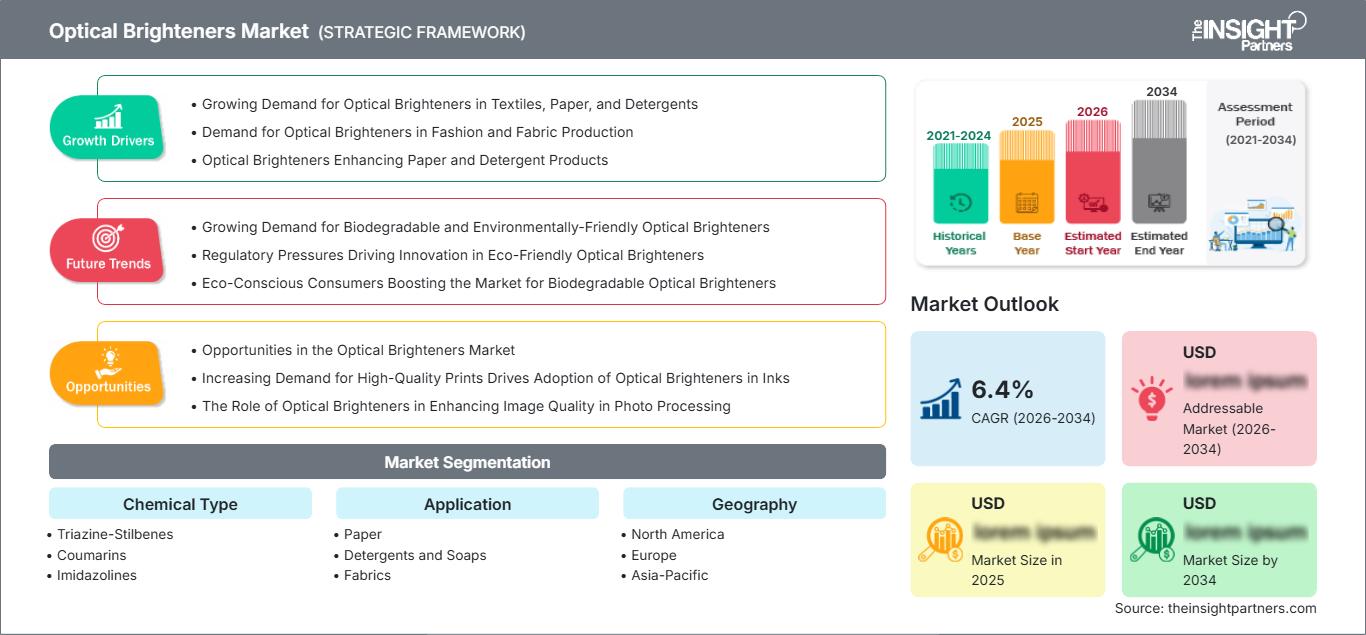
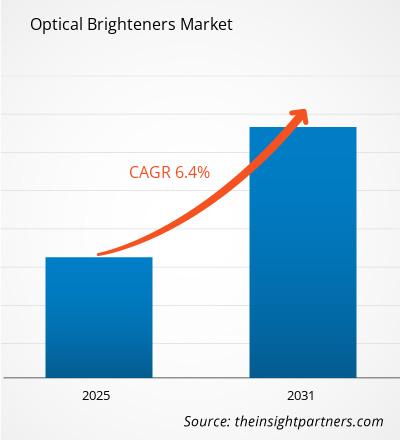
The optical brighteners market was valued at US$ 2.35 billion in 2025 and is projected to reach US$ 3.96 billion by 2034, expanding at a CAGR of 5.97% during 2026–2034. The market covers fluorescent whitening agents that enhance perceived whiteness and brightness by converting ultraviolet radiation into visible blue-violet light across paper, detergents and soaps, fabrics, and synthetic and plastic products, with demand shaped by formulation performance, substrate compatibility, processing conditions, and regulatory requirements.
North America accounted for an estimated 23% of the Optical Brighteners Market Size in 2025 and is projected to grow at a 5.50% CAGR through 2034. Demand is supported by established detergent formulation, specialty paper, packaging, and polymer-processing industries. Recent US paper-sector capacity restructuring and continued investment in packaging and tissue production provide a relevant downstream signal, while formulators increasingly prioritize optical performance under changing lighting and sustainability requirements.
Optical Brighteners Market Assessment and Insights
- North America: Estimated at 23% of global demand in 2025 with a 5.50% CAGR through 2034, the region benefits from established detergent, paper, coatings, and plastics industries and sophisticated specialty-chemical distribution networks.
- U.S.: The U.S. represented an estimated 74% of North American demand in 2025 and is projected to grow at 5.40% CAGR, supported by detergent formulation, packaging, tissue, specialty paper, and polymer applications.
- Europe: Europe represented an estimated 25% of the global market in 2025 and is projected to grow at 5.60% CAGR, led by Germany, France, Italy, the UK, and Spain, with sustainability and chemical-compliance requirements differentiating purchasing decisions.
- Asia Pacific: Asia Pacific represented an estimated 38% of the global market in 2025 and is projected to grow at 6.50% CAGR, led by China, Japan, South Korea, and India, where textile processing, paper manufacturing, detergents, and plastics support broad consumption.
- Largest Segment: Paper is the largest application segment and is projected to grow at a 6.10% CAGR through 2034 because optical brighteners remain integral to achieving high visual brightness in coated, uncoated, and specialty paper grades.
- High Growth Segment: Synthetics and Plastics is projected to grow at a 6.70% CAGR through 2034 as polymer processors seek improved whiteness, reduced yellowing, and consistent appearance across increasingly engineered plastic products.
- Key companies analyzed in detail: 3V Sigma S.p.A.; Archroma; Aron Universal Limited; Catexel; Clariant AG; Keystone Aniline Corporation; RUDOLF GmbH; Teh Fong Min International Co., Ltd.; Kyung-In Synthetic Corporation; Everlight Chemical Industrial Corporation.
Source: The Insight Partners' analysis based on proprietary research, government publications, company annual reports, investor presentations, industry databases, and expert interviews.
There is a shift in preference from conventional fluorescent brighteners to tailor-made formulations that have been enhanced in terms of solubility, affinity to substrate, temperature stability, washability, and compatibility with concentrated systems. There has been a growth in the precision in adding brighteners in wet end, size press, and coatings in the paper industry whereas there are also needs for detergent formulators in formulations that are effective in powder, liquid, capsule, and cold formulations. Efficient formulations and changing light environment performance will be among the top trends in 2025-2026.
During 2025–2034, there will be growth in commercialization of new products in emerging textile, paper, detergent, and plastics manufacturing centers of Asia, although the Europe and North America regions will remain significant for high-performance formulations. The capital investments will be focused on flexible manufacturing, purification, formulation, and support of applications rather than commodity manufacturing alone. Regulatory requirements for chemicals, waste water treatment, labels, and material compatibility will increase the need for local compliance capabilities. There will also be the rise of supply chain localization due to customers’ needs for short delivery and availability of specialty chemicals.
Optical Brighteners Market Report Scope
| Report Attribute | Details |
|---|---|
| Market size in 2025 | US$ 2.35 Billion |
| Market Size by 2034 | US$ 3.96 Billion |
| Global CAGR (2026 - 2034) | 5.97% |
| Historical Data | 2021-2024 |
| Forecast period | 2026-2034 |
Optical Brighteners Market Analysis
The most important factor here is the need to enhance whiteness without changing the physical properties of the base material. Paper mills employ optical brighteners to enhance brightness in paper grades where the natural coloration of fibers, fillers, and coating formulations is the determining factor. Detergent companies employ optical brighteners to neutralize any yellowing of fabrics during washing operations. High affinity and wash fastness are necessary for textile processes while plastics need brightening agents which can withstand thermal processes. This creates a value chain that starts with aromatic and heterocyclic intermediate chemicals through manufacture and formulation up to the addition of optical brighteners in paper, detergent, textile, and polymer industries.
Trends in the industry favor suppliers who are able to tailor the chemical structure and formulations to different substrates. Stilbene chemistry remains important due to its performance on cellulosic substrates, whereas benzoxazole and coumarin chemistries are useful alternatives for synthetic fibers, plastics, coatings, and other specialty markets. Buyers begin to look at brightness along with properties such as migration, staining, light stability, compatibility, dosage levels, and environmental impact. This means that competition shifts from merely having the chemicals available to offering technical service, formulation support, regulatory documentation, and delivery.
The competitive intensity mentioned in the Optical Brighteners Market Report is generated from a combination of global specialty chemicals companies as well as optical brightener companies. While 3V Sigma has unique product ranges for the following applications: Paper, Home care, Coatings, Plastic; Archroma is engaged in optical brightening solutions, as well as other textile and specialty chemicals products. In the case of Clariant, the emphasis is placed on formulation expertise and specialty ingredients, while Teh Fong Min has specialized in the development of stilbenic optical brighteners. Catexel gains its competitive advantage in home care from the acquisition of former BASF Optical Brightener business.
Increasing investments are made into high purity, formulation versatility, regulatory compliance, and performance under specific applications rather than non-differentiated volume. Suppliers are positioning themselves according to low temperature washing, concentrated detergents, sustainable textile processing, and polymers with regulated optical properties. This drives the competitive edge to the suppliers with integrated R&D capabilities, application labs, regional technical services, and flexible manufacturing facilities. Those suppliers that have already qualified their customers and completed regulatory paperwork benefit from this situation as changing optical brighteners involves formulation evaluation, substrate evaluation, validation, and quality control.
● REPORT CUSTOMIZATION
Tailor This Report To Align With Your Specific Business Requirements
This report can be customized to align precisely with your business objectives, scope, and target markets. Customization options include tailored segmentation, geography, competitive analysis, and strategic insights to support informed decision-making.
Customize This Report →WHAT YOU CAN ADJUST
- ● Segmentations
- ● Geography
- ● Competitive Analysis
- ● Language Preferences
Optical Brighteners Market: Strategic Insights
Regional Insights
North America Optical Brighteners Market
North America had an approximate Optical Brighteners Market share of 23% of the world market in 2025 and is expected to grow at a rate of 5.50% CAGR up to 2034. Demand will come from the use of the brighteners in household and industrial detergents, tissue and specialty papers, coating applications, packaging, and polymers. United States is the largest market in the region owing to the large number of chemical and consumer goods producers there.
The supply base in the region is made up of multinational producers of speciality chemicals along with the dedicated colorants manufacturers. Restructuring of the paper industry is shifting the usage base to the extent that packaging and tissue applications are more resilient compared to printing writing grades of papers. Thus, there is demand for brighteners suitable for new grades of paper and coating systems.
U.S. Optical Brighteners Market
The United States represented approximately 74% of North America demand in 2025 and is expected to exhibit growth at a 5.40% CAGR until 2034. Demand is broken out into detergents, tissue, packaging, specialty paper, plastics, coatings, and certain textile end-uses. Domestic paper production is still significant; however, structural shifts have led to higher demand for packaging and tissue.
The distinguishing feature is the high level of sophistication in both formulations as well as the downstream customer base. Brightener compounds must function reliably within highly concentrated laundry formulations, industrial cleaners, polymer systems, and current generation paper coating processes. Supplier rivalry thus increasingly relies upon technical expertise and compatibility within formulations. In addition, domestic chemical manufacturing and specialty distribution channels minimize dependency on specific imports.
Europe Optical Brighteners Market
Europe accounted for an estimated 25% of the global market in 2025 and is expected to grow at a 5.60% CAGR till 2034. Germany is the largest regional market, driven by chemicals, detergents, paper, and industrial processing applications. France and Italy are important sources of textile, consumer, and specialty chemicals demand, while the UK and Spain add value via detergent, paper, packaging, and textile applications.
European procurement relies heavily on chemical compliance, sustainability, wastewater concerns, and transparency. Germany has a preference for high-performance specialty chemicals and industrial process controls, while Italy and Spain continue to be very much entrenched in their textiles processing business. The French have kept up their broad array of detergent, paper, and consumer goods applications, while the British continue to excel in their specialty chemical formulations, especially in the well-developed markets for household cleaning products. As a result, there will be preference for more value-added products, offering consistent brightness, reduced dosages, and sustainable properties.
APAC Optical Brighteners Market
Asia Pacific represented an estimated 38% of the global market in 2025 and is projected to grow at a 6.50% CAGR through 2034, making it the largest and fastest-growing regional market. China leads regional demand through its extensive textile, paper, detergent, plastics, and chemical manufacturing base.
In Japan and South Korea, there is an emphasis on the performance of specialty formulations and consistency, whereas in India, there are advantages due to the growing manufacturing of detergents, textiles, paper, and plastics. Australia, on the other hand, is a relatively smaller market that is technologically advanced, with most of the demand in the area coming from specialty formulations and finished products.
Middle East & Africa Optical Brighteners Market
Middle East and Africa represented an estimated 6% of the global market in 2025 and are projected to grow at a 5.00% CAGR through 2034. Saudi Arabia and the UAE are supported by expanding consumer-product manufacturing, chemical investment, and regional distribution infrastructure, while South Africa provides a diversified base of detergents, paper, textiles, and plastics.
The area is more import-dependent compared to Asia, Europe, and North America, providing opportunities for distribution and regional blending activities. Industrial localization initiatives in Gulf countries could facilitate specialized chemicals storage as well as downstream blending. In Africa, demand is highly correlated with detergent, textile, packaging, and paper consumption. Market growth is hampered by logistical issues, fluctuating currencies, and manufacturing facilities.
South & Central America Optical Brighteners Market
South and Central America represented an estimated 8% of the global market in 2025 and are projected to grow at a 5.80% CAGR through 2034. Brazil dominates regional consumption because of its large detergent, pulp and paper, textile, and plastics industries. Argentina contributes through detergents, paper, and textile manufacturing.
The integration of pulp and paper operations in Brazil provides a unique edge in terms of applications. Meanwhile, the large consumer base in Brazil is a driver for the use of detergents. Countries such as Argentina, and those within South and Central America in general, are still reliant on specialty chemical imports. Hence, local stock, technical service, and supply will continue to be key competitive elements.
Segmentation Analysis
Chemical Type
The chemical type segment in the Optical Brighteners Market covers Triazine-Stilbenes, Coumarins, Imidazolines, Diazoles, and Benzoxazolines. The segment is projected to expand at differentiated rates according to substrate compatibility and formulation requirements, with Triazine-Stilbenes remaining structurally important because of their strong performance in paper, detergents, and cellulosic textiles. Increasing synthetic-fiber and polymer demand is supporting alternative chemistries with greater thermal and substrate compatibility.
- Triazine-Stilbenes: Widely used fluorescent whitening chemistry with strong affinity for cellulose-based substrates. Paper mills and detergent formulators value its brightness efficiency, water compatibility, and established formulation performance.
- Coumarins: Provide intense fluorescence and are suited to selected detergents, synthetic materials, coatings, and specialty formulations. Their performance profile supports applications requiring strong visual effects and formulation flexibility.
- Imidazolines: Serve specialized brightening requirements where chemical compatibility and substrate interaction are important. Adoption is influenced by formulation stability and the ability to achieve targeted optical effects without compromising processing performance.
- Diazoles: Provide brightening performance across selected polymeric, textile, and industrial applications. Their role is supported by demand for heat-resistant and application-specific formulations where conventional chemistries may have limitations.
- Benzoxazolines: Increasingly relevant for synthetic fibers, plastics, coatings, and polymer systems requiring thermal stability. Their compatibility with polymer processing creates opportunities as engineered plastics applications broaden.
Application
The application segment covers Paper, Detergents and Soaps, Fabrics, and Synthetics and Plastics. Application demand is determined by substrate chemistry, processing conditions, brightness specifications, and regulatory requirements. Paper remains the largest application, while Synthetics and Plastics is expected to show the strongest expansion as optical appearance becomes increasingly important across engineered polymer products.
- Paper: Optical brighteners improve apparent whiteness in coated and uncoated grades and can be incorporated at wet-end, size-press, or coating stages. Performance depends on fiber affinity, shade control, and process-water chemistry.
- Detergents and Soaps: Brighteners counteract fabric yellowing and enhance perceived whiteness after laundering. Formulators prioritize solubility, formulation stability, low-temperature performance, staining control, and compatibility with concentrated liquid and powder systems.
- Fabrics: Textile processors use brighteners across cellulosic and synthetic fibers to achieve targeted white shades. Adoption depends on substantivity, wash fastness, light fastness, bleaching compatibility, and process-specific application conditions.
- Synthetics and Plastics: Brighteners compensate for inherent yellow tones in polymers and support visual consistency in molded, extruded, and coated products. Thermal stability, dispersion, migration behavior, and compatibility with polymer matrices drive product selection.
Opportunity Snapshot
| Application | Revenue Contribution | Trend Tag | Adoption Stage |
| Paper | High | Brightness Control | Mature |
| Detergents and Soaps | High | Wash Performance | Mature |
| Fabrics | Medium | Fiber Whitening | Mature |
| Synthetics and Plastics | Medium | Polymer Aesthetics | Scaling |
Optical Brighteners Market Growth Drivers and Impact Analysis
Rising Demand for High-Brightness Paper and Packaging Grades
Paper producers are increasingly balancing brightness, opacity, printability, filler loading, and recycled-fiber content as product portfolios shift toward packaging, tissue, coated papers, and specialty grades. Optical brighteners help compensate for the inherent color limitations of fibers and selected recycled furnish while supporting targeted visual specifications. The market mechanism runs from changing paper-grade requirements to greater use of controlled brightener addition across wet-end, size-press, and coating operations. This favors suppliers offering substrate-specific chemistry, fluorescence control, and stable performance across variable process-water conditions. The strategic implication is sustained demand for higher-efficiency formulations, particularly where mills seek to maintain visual quality while optimizing fiber and mineral inputs.
Growth of Concentrated and Low-Temperature Laundry Formulations
Detergent manufacturers are reformulating products around concentrated powders, liquids, capsules, and lower-temperature wash cycles that place greater demands on ingredient solubility, stability, deposition, and compatibility. Optical brighteners must function effectively alongside surfactants, enzymes, bleaching systems, polymers, fragrances, and other specialty ingredients without creating staining or formulation instability. The mechanism therefore shifts demand toward highly soluble and formulation-compatible brighteners capable of maintaining whiteness under reduced washing temperatures. As consumers and regulators favor resource-efficient laundering, suppliers with application laboratories and flexible liquid and solid product formats can capture formulation opportunities. The implication is stronger demand for performance-adjusted brighteners rather than undifferentiated commodity grades.
Expansion of Synthetic Fiber and Polymer Processing
Synthetic fibers and polymers require optical brighteners with different performance characteristics from conventional cellulosic applications, particularly where elevated processing temperatures, hydrophobic substrates, and long-term appearance stability are involved. Textile producers increasingly process polyester, polyamide, and blended fibers, while plastics converters seek consistent whiteness and reduced yellowing in engineered products, films, coatings, and molded components. This creates a demand chain from polymer growth to specialized brightener chemistry and application testing. Benzoxazole, coumarin, and selected nonionic systems can address requirements that differ from conventional paper and detergent formulations. The implication is faster diversification of the product mix and greater value placed on thermal stability, dispersion, and substrate compatibility.
Optical Brighteners Market Future Trends
Shift Toward Lighting-Independent Whiteness Performance
Optical appearance in the Optical Brighteners Market Trends is increasingly being evaluated under LED-heavy retail, household, and industrial lighting rather than relying exclusively on ultraviolet-rich environments. Traditional fluorescent brighteners depend on UV excitation, which can make perceived whiteness vary with lighting conditions. Newer formulations and complementary whitening technologies are therefore being developed to provide more consistent visual appearance across indoor and outdoor environments. Detergent brands, textile manufacturers, and packaging producers are affected because consumers increasingly evaluate product appearance under modern lighting. The likely implication is a broader formulation strategy combining fluorescent whitening with controlled color balance, anti-yellowing chemistry, and substrate-specific optical design.
Greater Emphasis on Sustainable and Regulatory-Compatible Formulations
Chemical suppliers are increasingly developing brighteners around lower environmental burden, improved formulation efficiency, and clearer regulatory documentation. Textile and detergent customers are particularly sensitive to chemical restrictions, wastewater treatment, biodegradability considerations, and substance transparency, while polymer applications increasingly require attention to migration and recycling compatibility. This is encouraging suppliers to optimize synthesis, purification, dosage efficiency, and formulation carriers rather than simply maximize fluorescence. The affected competitive dimension is therefore shifting from molecular performance alone toward lifecycle and compliance attributes. Suppliers capable of supporting customer audits, documentation, and formulation redesign will gain greater relevance in regulated markets.
Optical Brighteners Market Opportunities
Specialty Brighteners for Recycled and High-Filler Paper
Paper mills using recycled fiber, mineral fillers, and alternative furnish face greater variability in baseline whiteness and fluorescence behavior. This creates an opportunity for suppliers to develop brighteners and fluorescence-control systems tailored to recycled packaging, tissue, and specialty paper grades. The strongest target markets are China, India, Europe, and North America, where paper producers are balancing resource efficiency with visual quality. The principal barrier is maintaining brightness without excessive fluorescence, shade instability, or process disruption. Suppliers can address this through application-specific formulations, optimized addition points, and technical services that integrate brightener selection with filler, fiber, and coating chemistry.
High-Performance Brighteners for Synthetic Fibers and Plastics
Growth in polyester, polyamide, polypropylene, PVC, and other engineered polymer applications creates room for brighteners designed for high-temperature processing, controlled dispersion, and durable appearance. Textile producers, compounders, film manufacturers, and molded-product converters are the primary target customers. Asia Pacific offers the strongest manufacturing opportunity because of its concentration of textile and polymer processing, while European and North American customers can support higher-specification products. The major barrier in the Optical Brighteners Market forecast is maintaining optical performance without migration, staining, thermal degradation, or interference with downstream processing. Suppliers can benefit through customized grades, masterbatch-compatible formats, and application testing.
Frequently Asked Questions

- Comprehensive Market Sizing and Forecast Analysis
- Detailed Segmentation Analysis
- In-Depth Market Dynamics Assessment
- Regional and Country-Level Insights
- Competitive Landscape and Company Benchmarking
- Strategic Business Intelligence
Recent Reports
Testimonials

The Insight Partners provided valuable market intelligence that supported our global go-to-market strategy. Their team was professional, responsive, and attentive to our feedback, providing thoughtful analysis and helpful methodological clarifications throughout the project.
Junmo Kim Chief Financial Officer (CFO), Enertech Co., Ltd.
The Insight Partners' SCADA System Market report is comprehensive, with valuable insights on current trends and future forecasts. The team was highly professional, responsive, and supportive throughout. We are very satisfied and highly recommend their services.
RAN KEDEM Partner, Reali Technologies LTDs
I requested a report on a very specific software market and the team produced the report in a few days. The information was very relevant and well presented. I then requested some changes and additions to the report. The team was again very responsive and I got the final report in less than a week.
JEAN-HERVE JENN Chairman, Future Analytica
We worked with The Insight Partners for an important market study and forecast. They gave us clear insights into opportunities and risks, which helped shape our plans. Their research was easy to use and based on solid data. It helped us make smart, confident decisions. We highly recommend them.
PIYUSH NAGPAL Sr. Vice President, High Beam Global
The Insight Partners delivered insightful, well-structured market research with strong domain expertise. Their team was professional and responsive throughout. The user-friendly website made accessing industry reports seamless. We highly recommend them for reliable, high-quality research services
YUKIHIKO ADACHI CEO, Deep Blue, LLC.
This is the first time I have purchased a market report from The Insight Partners.While I was unsure at first, I visited their web site and felt more comfortable to take the risk and purchase a market report.I am completely satisfied with the quality of the report and customer service. I had several questions and comments with the initial report, but after a couple of dialogs over email with their analyst I believe I have a report that I can use as input to our strategic planning process.Thank you so much for taking the extra time and making this a positive experience.I will definitely recommend your service to others and you will be my first call when we need further market data.
JOHN SUZUKI President and Chief Executive Officer, Board Director, BK Technologies
I wish to appreciate your support and the professionalism you displayed in the course of attending to my request for information regarding to infectious disease IVD market in Nigeria. I appreciate your patience, your guidance, and the fact that you were willing to offer a discount, which eventually made it possible for us to close a deal. I look forward to engaging The Insight Partners in the future, all thanks to the impression you have created in me as a result of this first encounter.
DR CHIJIOKE ONYIA MANAGING DIRECTOR, PineCrest Healthcare Ltd.Reason to Buy
- Informed Decision-Making
- Understanding Market Dynamics
- Competitive Analysis
- Identifying Emerging Markets
- Customer Insights
- Market Forecasts
- Risk Mitigation
- Boosting Operational Efficiency
- Strategic Planning
- Investment Justification
- Tracking Industry Innovations
- Aligning with Regulatory Trends





 Get Free Sample for