
Organic Coagulant Market Size, Demand & Growth by 2034
Organic Coagulant Market Size and Forecasts (2021 - 2034), Global and Regional Share, Trends, and Growth Opportunity Analysis Report Coverage : by Type (Polyamine, Polydamac); Application (Textile, Food and Beverage, Pulp and Paper, Chemicals and Fertilizers, Oil and Gas, Mining and Mineral Processing); and Geography (North America, Europe, Asia Pacific, and South and Central America)
- Status : Data Released
- Report Code : TIPRE00040439
- Category : Chemicals and Materials
- No. of Pages : 150
- Available Report Formats :


- Last update date : October 26, 2026


2025 Market Size
US$ 2.18 Bn
Base year value
2034 Forecast
US$ 6.01 Bn
Projected by 2034
CAGR 2026-2034
11.93 %
Growth rate
Addressable Market
US$ 35.95 Bn
(2026-2034)
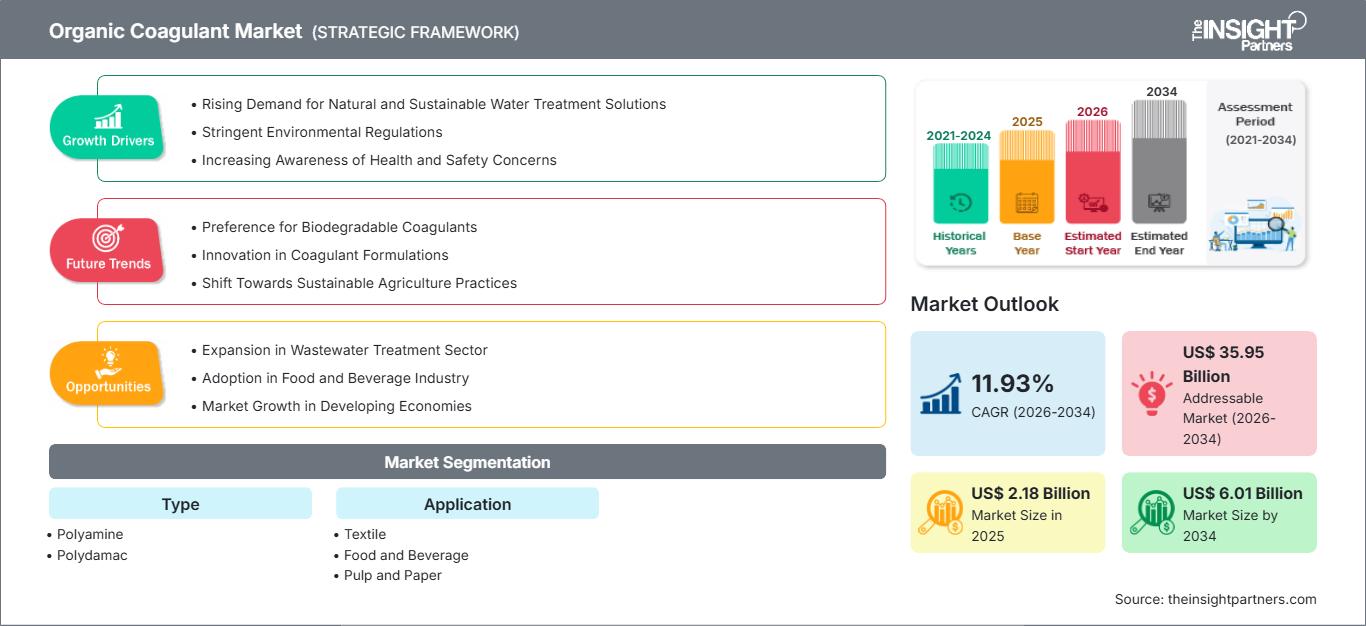
The organic coagulant market was valued at US$ 2.18 Billion in 2025 and is projected to reach US$ 6.01 Billion by 2034, registering a 11.93% CAGR from 2026 to 2034. The market covers cationic organic coagulants used to destabilize suspended and dissolved contaminants in water and wastewater treatment, primarily across Polyamine and Polydamac types and applications including Textile, Food and Beverage, Pulp and Paper, Chemicals and Fertilizers, Oil and Gas, and Mining and Mineral Processing. Polyamine and PolyDADMAC chemistries are increasingly selected where low sludge generation, rapid charge neutralization, color removal, and compatibility with downstream filtration or flocculation are important operating requirements.
North America represents a mature but technically sophisticated demand center, supported by industrial wastewater reuse, stricter discharge requirements, mining-water treatment, and investment in water-intensive manufacturing. The organic coagulant market size in the region is supported by strong chemical-treatment infrastructure and established supplier networks, while the regional market is estimated at ~24% of global demand in 2025 and is expected to expand at ~10.6% CAGR during 2026-2034. A notable current signal is the increasing integration of chemical treatment with digital monitoring, predictive water management, and specialized treatment for emerging contaminants, encouraging suppliers to compete on treatment performance and service capability rather than chemical supply alone.
Organic Coagulant Market Assessment and Insights
- North America: The region accounts for ~24% of the global market in 2025 and is expected to grow at ~10.6% CAGR. Mature industrial water infrastructure, wastewater-reuse projects, and demand from oil and gas, mining, food processing, and pulp and paper underpin its position. The implication is a market increasingly oriented toward customized chemistry, application services, and process optimization.
- U.S.: The U.S. represents ~80% of North American demand in 2025 and is projected to grow at ~10.4% CAGR. Industrial wastewater compliance, water reuse, semiconductor and manufacturing investment, and treatment requirements for produced water support demand. Suppliers with local production, technical service teams, and regulatory-compliant formulations have an advantage in procurement-intensive accounts.
- Europe: Europe represents ~22% of global demand in 2025 and is expected to expand at ~10.8% CAGR, with Germany, France, Italy, and the UK forming important demand centers. Its principal differentiator is the combination of stringent environmental requirements, water-efficiency targets, advanced industrial wastewater treatment, and increasing emphasis on resource recovery and lower environmental footprints.
- Asia Pacific: APAC holds ~40% of the global market in 2025 and is projected to grow at ~13.5% CAGR, led by China, India, Japan, and South Korea. Rapid industrialization, textile processing, pulp and paper production, mining, chemicals manufacturing, and water-stressed industrial clusters create sustained demand for high-efficiency organic treatment chemistry.
- Largest Segment: PolyDADMAC is the largest main segment and is expected to grow at ~12.1% CAGR. Its broad compatibility with clarification, filtration, color removal, sludge conditioning, and industrial wastewater treatment supports extensive adoption across applications with variable feed-water characteristics.
- High Growth Segment: Oil and Gas is the high-growth application segment, with an estimated ~12.6% CAGR. Produced-water treatment, oil-water separation, suspended-solids removal, and increasingly stringent water-management requirements are encouraging operators to use tailored organic coagulant formulations.
- Key companies analyzed in detail: Kemira Oyj, SNF Group, BASF SE, Veolia Environnement S.A., Ecolab Inc., Kurita Water Industries Ltd., Baker Hughes Company, Solenis, USALCO LLC, and Buckman.
Source: The Insight Partners' analysis based on proprietary research, government publications, company annual reports, investor presentations, industry databases, and expert interviews.
Organic coagulants have developed from straightforward chemical addition into customized applications involving coagulation, flocculation, clarification, filtration, dewatering, and process monitoring techniques. Polyamines and PolyDADMAC come in handy whenever regular inorganic coagulants cause high levels of sludge generation, formation of metal salts, or high dosage levels. Kemira and Solenis, for instance, stock a variety of chemicals involving both polyamine and PolyDADMAC. This is because of the importance of matching molecule design and chemical charges to water chemistry and separation.
Moreover, buyer considerations have moved on to total economic efficiency of the treatment process. For industries, the amount of chemicals used, sludge handling and disposal, efficiency of filtration, water recycling, stability of the process, and need for manpower intervention are increasingly taken into consideration as opposed to the price of the coagulant alone. This has brought about a need for companies that can perform jar tests, optimization of dosages, on-site trials, and complete treatment processes. The textile industry requires color removal, while the pulp and paper industry requires anionic-trash control, retention, and clarification of their effluents.
During the period from 2020 through 2034, market development will be characterized by the increasing focus on water reuse, industrial localization, and treatment of more complicated wastewater streams. The key region for market expansion will remain the Asia Pacific because manufacturing expansion will go in tandem with the increased need to lower freshwater use and increase effluent treatment quality. India and Southeast Asia have special relevance for suppliers who can localize their formulations and provide technical and logistical support.
Also, capital expenditures will be allocated on treatment systems which will incorporate chemical conditioning along with membranes, advanced clarification, digital controls, and water recovery systems. Regulations related to emerging contaminants will support such trends although the use of organic coagulants will be mostly a part of treatment trains instead of a stand-alone solution. Supply chain localization becomes strategic because of the growing demand for consistency of chemistry, fast technical support, and stable delivery near treatment sites.
Organic Coagulant Market Report Scope
| Report Attribute | Details |
|---|---|
| Market size in 2025 | US$ 2.18 Billion |
| Market Size by 2034 | US$ 6.01 Billion |
| Global CAGR (2026 - 2034) | 11.93% |
| Historical Data | 2021-2024 |
| Forecast period | 2026-2034 |
Organic Coagulant Market Analysis
Organic Coagulant Market growth will depend on the increasing sophistication of wastewater streams. An example of a wastewater from a textile mill could be a flow comprising dyes, suspended solids, auxiliaries, and varying organic loads. As a result, the coagulant requirements become those that can fast neutralize particle charge and help in separating particles. Similarly, in case of mining, the requirement would be to work with water streams that have finely dispersed mineral particles, whereas in oil and gas operations, the technology will need to function in presence of hydrocarbons and high levels of dissolved salts.
The value chain for the product includes intermediates, formulation components, polymerization/blending, quality control, packaging, distribution, and application assistance. The performance of the product depends on its charge density, molecular structure, concentration, viscosity, pH, interaction with flocculants and inorganic coagulants. As a result, competition in terms of formulation capabilities and customer trials is an important component apart from scale-based. Kemira's product line for organic coagulants is based on polyamines and PolyDADMAC coagulants. On the other hand, Solenis offers organic coagulants along with blends and inorganic products.
The competitive positioning of the market is becoming more influenced by integration with water management services. Ecolab and Veolia offer both chemical and treatment know-how together with monitoring, engineering, and operations services, which allows for capturing more valuable customer relationships. The same strategy is applied by Kurita, integrating chemicals, equipment, and water management know-how. Specialists in polymers like SNF focus more on the polymer chemistry and applications, while suppliers such as Buckman have strong positions in pulp and paper and industrial water treatment. Therefore, the Organic Coagulant Market Report of organic coagulants suggests focusing on technical services, digital monitoring, application engineering, and service presence locally.
Moreover, investments are becoming more focused on proximity and circular water management. Recent deals in industrial water services show that established chemical suppliers try to create customer relationships based on recurring treatment operations and not just selling chemicals.
● REPORT CUSTOMIZATION
Tailor This Report To Align With Your Specific Business Requirements
This report can be customized to align precisely with your business objectives, scope, and target markets. Customization options include tailored segmentation, geography, competitive analysis, and strategic insights to support informed decision-making.
Customize This Report →WHAT YOU CAN ADJUST
- ● Segmentations
- ● Geography
- ● Competitive Analysis
- ● Language Preferences
Organic Coagulant Market: Strategic Insights
Regional Insights
North America Organic Coagulant Market
North America accounted for ~24% of the Organic Coagulant Market Share in 2025 and is anticipated to expand at ~10.6% CAGR. North America has well-established industrial wastewater infrastructure and an extensive installed base of treatment facilities catering to chemicals, food processing, pulp and paper, oil & gas, and mining industries. Demand is being driven more by water reuse and increased operational controls compared to clarification alone.
The United States accounts for majority of the regional demand due to higher demands of water treatment and availability of suppliers' infrastructure in the country. Ecolab, Veolia, Kemira, Kurita, BASF, and USALCO offer different packages of chemicals, equipment, technical support, and treatment solutions. Canada supports the market through mining, oil & gas, pulp & paper, and municipal segments; however, the cold operating environment of the country makes chemical selection critical.
U.S. Organic Coagulant Market
North America represents about 80% of total demand and is expected to grow at ~10.4% CAGR. Industrial water reuse, treatment of produced water, food and beverages processing water, and pulp and paper wastewaters are among the main demand drivers. There is a growing interest in treatment systems which require less chemicals while ensuring compliance with discharge standards and filtration processes.
The key point is the integration of chemistry with field services. Recently made investments in process monitoring and water solutions by leading water treatment providers raise the importance of timely process information. In this situation, the ability of suppliers to vary dosing depending on influent conditions and incorporate organic coagulants into other processes becomes an advantage.
Europe Organic Coagulant Market
Europe represents ~22% of global demand and is projected to grow at ~10.8% CAGR. Germany is an important industrial treatment center because of its chemicals, manufacturing, pulp and paper, and wastewater infrastructure. France benefits from municipal and industrial water-treatment activity and the presence of major water-technology providers. Italy has a significant industrial base spanning textiles, food processing, chemicals, and manufacturing, creating diverse demand for clarification and wastewater treatment.
Efficiency of resource use, management of chemicals, use of treated water, and regulatory compliance form a core focus area for European buyers. Other distinctive features of the European market include the presence of reliable suppliers and technologically advanced buyers who assess the sludge generation and process efficiency of treatment.
APAC Organic Coagulant Market
APAC accounts for ~40% of global demand and is forecast to grow at ~13.5% CAGR, making it the most important expansion region. China is the largest demand center because of its large textile, chemicals, pulp and paper, mining, and manufacturing industries. India is another major growth market, supported by industrial wastewater investment, textile processing, chemicals production, and expanding water-reuse requirements. Japan and South Korea provide more mature demand associated with advanced manufacturing and high-quality process-water requirements.
China combines substantial domestic polymer production with extensive downstream consumption, while India offers opportunities for localized manufacturing and distribution. Japan and South Korea place greater emphasis on high-purity industrial water and process stability. Across APAC, the strongest commercial opportunity is the transition from basic chemical dosing toward integrated treatment systems that optimize water recovery and operating costs.
Middle East & Africa Organic Coagulant Market
The Middle East and Africa represent a smaller but strategically relevant demand center because water scarcity, desalination, industrial wastewater treatment, mining, and oil and gas activities require reliable separation chemistry. Gulf markets favor treatment solutions linked to water reuse and industrial process-water management, while South Africa and other mining economies create demand for mineral-processing wastewater treatment. Local inventory and technical support remain important because treatment chemicals must be delivered reliably to remote industrial sites.
South & Central America Organic Coagulant Market
South and Central America offer opportunities around mining, pulp and paper, food processing, oil and gas, and municipal wastewater treatment. Brazil is particularly relevant because of its diversified industrial base and large pulp and paper and mining sectors. Mexico provides an important manufacturing and industrial-water market, while Chile and Peru create specialized demand linked to mining and mineral processing. Supplier differentiation depends heavily on local technical service and dependable distribution.
Segmentation Analysis
Type
Polyamine is projected to expand at ~11.7% CAGR. Polyamines are widely used for charge neutralization, turbidity reduction, color removal, and treatment of biological or industrial wastewater. Their ability to complement inorganic coagulants and flocculants supports adoption where customers seek lower sludge generation and improved clarification.
- Polyamine: Used to destabilize suspended and colloidal material; industrial wastewater and biological-treatment streams are important demand sources. Its relatively broad operating flexibility supports customized formulations.
- Polydamac: PolyDADMAC is used as a primary or secondary coagulant, filtration aid, color-removal chemistry, and treatment additive. Its strong cationic character supports rapid charge neutralization and makes it particularly relevant to industrial wastewater and paper applications.
PolyDADMAC is the largest type segment and is expected to grow at ~12.1% CAGR. Its broad application base, rapid reaction characteristics, and compatibility with downstream flocculation support its leading position.
Application
- Textile: Expected to grow at ~10.8% CAGR. Dye removal, suspended-solids control, and wastewater reuse support demand. Buyers increasingly require formulations that address variable dye loads and color chemistry.
- Food and Beverage: Expected to grow at ~10.9% CAGR. High organic loading and stringent wastewater requirements support coagulation before biological treatment, flotation, or filtration.
- Pulp and Paper: Expected to grow at ~11.5% CAGR. Process-water recycling, fiber and filler management, wastewater clarification, and sludge conditioning support continued adoption.
- Chemicals and Fertilizers: Expected to grow at ~12.2% CAGR. Complex effluents and variable chemical compositions favor application-specific polymers and treatment programs.
- Oil and Gas: Expected to grow at ~12.6% CAGR. Produced-water treatment, oil-water separation, and solids removal create strong demand for tailored organic coagulant systems.
- Mining and Mineral Processing: Expected to grow at ~12.4% CAGR. Mineral slurries, process-water recycle, and wastewater clarification require polymers optimized for high solids loading and challenging water chemistry.
Opportunity Snapshot
| Application | Revenue Contribution | Trend Tag | Adoption Stage |
|---|---|---|---|
| Textile | High | Color removal | Mature |
| Food and Beverage | Medium | Water reuse | Scaling |
| Pulp and Paper | High | Process recycling | Mature |
| Chemicals and Fertilizers | High | Effluent complexity | Scaling |
| Oil and Gas | High | Produced water | Scaling |
| Mining and Mineral Processing | High | Water recovery | Scaling |
Organic Coagulant Market Growth Drivers and Impact Analysis
Expansion of Industrial Water Reuse
Industrial water scarcity is pushing manufacturers to treat and recycle wastewater rather than rely exclusively on freshwater intake. Organic coagulants support the front end of these treatment trains by removing suspended and colloidal contaminants before filtration, biological treatment, membranes, or other polishing steps. As reuse systems become more complex, buyers increasingly value consistent performance across changing influent conditions. This expands the addressable role of polyamines and PolyDADMAC beyond conventional clarification.
Increasing Complexity of Industrial Effluents
Industrial wastewater increasingly contains combinations of suspended solids, dyes, oils, organic matter, and dissolved contaminants that are difficult to treat with a single chemistry. Textile, mining, chemicals, and oil and gas facilities therefore require formulation and dosage optimization according to specific water characteristics. This complexity supports higher-value specialty coagulants and encourages suppliers to provide testing and technical services alongside chemical products.
Stricter Discharge and Water-Quality Requirements
Environmental requirements are increasing the operational consequences of inadequate wastewater treatment. Industrial customers must manage treatment performance while controlling sludge, energy consumption, and freshwater use. Organic coagulants can support lower residual solids and improved separation when properly matched with downstream treatment. The resulting demand is less price-driven and more closely connected with compliance risk and total operating cost.
Organic Coagulant Market Future Trends
Digitalized Coagulant Dosing and Process Control
The organic coagulant market trends are increasingly influenced by digital water management. Sensors, online turbidity measurements, automated dosing, predictive analytics, and centralized monitoring can enable treatment plants to respond to fluctuating influent quality rather than relying solely on fixed chemical dosing. This shift affects suppliers because product value becomes linked to measurable process performance and data-supported optimization.
Movement Toward Lower-Sludge Treatment
Industrial operators are placing greater emphasis on the downstream cost of sludge handling, dewatering, transport, and disposal. Organic coagulants can be selected to improve solids capture while reducing dependence on metal-based treatment chemistry in suitable applications. Suppliers are consequently developing treatment packages in which coagulation chemistry is evaluated together with flocculation and dewatering performance.
Integration of Chemistry with Water-Technology Services
Chemical suppliers and water-treatment companies are increasingly integrating products with engineering, monitoring, treatment operations, and resource-recovery solutions. This changes purchasing behavior from periodic chemical procurement toward longer-term performance contracts. Companies with both formulation capabilities and application-service infrastructure are positioned to capture this shift, particularly among large industrial accounts.
Organic Coagulant Market Opportunities
Localized High-Performance Treatment in APAC
A major opportunity in the Organic Coagulant Market Forecast lies in localized production and technical service for textile, chemicals, mining, and food-processing customers across India, China, and Southeast Asia. Customers need formulations adapted to local water chemistry, variable wastewater loads, and treatment-system configurations, while supply reliability can be challenging outside major industrial clusters. Suppliers can differentiate through regional laboratories, application testing, local inventory, and customized polyamine or PolyDADMAC formulations.
Integrated Treatment Programs for Oil and Gas
Oil and gas operators represent an attractive opportunity for suppliers able to integrate organic coagulants into produced-water and oily-water treatment programs. The unmet need is not simply chemical separation but stable performance under changing oil loading, salinity, suspended solids, and operating conditions. Suppliers can expand their position by combining formulation expertise with field testing, dosage optimization, monitoring, and treatment-process engineering.
Recent Developments
- August 4, 2026: Kemira Oyj - Kemira completed the acquisition of REPUR S.r.l., an Italy-based provider of activated-carbon reactivation services for municipal and industrial water treatment. The transaction strengthens Kemira's sustainable water-treatment portfolio and supports circular treatment models in which spent carbon is regenerated rather than replaced. The move broadens Kemira's water-solutions platform beyond conventional chemical supply.
- April 22, 2026: Ecolab Inc. - Ecolab introduced Water Navigator IQ, an AI-enabled platform designed to provide enterprise-level visibility into water performance, predictive insights, and coordinated water-management decisions. The development strengthens the link between treatment chemistry, operational monitoring, and digital optimization, increasing the importance of suppliers that can combine chemical programs with data-driven water-efficiency services.
Frequently Asked Questions

- Comprehensive Market Sizing and Forecast Analysis
- Detailed Segmentation Analysis
- In-Depth Market Dynamics Assessment
- Regional and Country-Level Insights
- Competitive Landscape and Company Benchmarking
- Strategic Business Intelligence
Recent Reports
Testimonials

The Insight Partners provided valuable market intelligence that supported our global go-to-market strategy. Their team was professional, responsive, and attentive to our feedback, providing thoughtful analysis and helpful methodological clarifications throughout the project.
Junmo Kim Chief Financial Officer (CFO), Enertech Co., Ltd.
The Insight Partners' SCADA System Market report is comprehensive, with valuable insights on current trends and future forecasts. The team was highly professional, responsive, and supportive throughout. We are very satisfied and highly recommend their services.
RAN KEDEM Partner, Reali Technologies LTDs
I requested a report on a very specific software market and the team produced the report in a few days. The information was very relevant and well presented. I then requested some changes and additions to the report. The team was again very responsive and I got the final report in less than a week.
JEAN-HERVE JENN Chairman, Future Analytica
We worked with The Insight Partners for an important market study and forecast. They gave us clear insights into opportunities and risks, which helped shape our plans. Their research was easy to use and based on solid data. It helped us make smart, confident decisions. We highly recommend them.
PIYUSH NAGPAL Sr. Vice President, High Beam Global
The Insight Partners delivered insightful, well-structured market research with strong domain expertise. Their team was professional and responsive throughout. The user-friendly website made accessing industry reports seamless. We highly recommend them for reliable, high-quality research services
YUKIHIKO ADACHI CEO, Deep Blue, LLC.
This is the first time I have purchased a market report from The Insight Partners.While I was unsure at first, I visited their web site and felt more comfortable to take the risk and purchase a market report.I am completely satisfied with the quality of the report and customer service. I had several questions and comments with the initial report, but after a couple of dialogs over email with their analyst I believe I have a report that I can use as input to our strategic planning process.Thank you so much for taking the extra time and making this a positive experience.I will definitely recommend your service to others and you will be my first call when we need further market data.
JOHN SUZUKI President and Chief Executive Officer, Board Director, BK Technologies
I wish to appreciate your support and the professionalism you displayed in the course of attending to my request for information regarding to infectious disease IVD market in Nigeria. I appreciate your patience, your guidance, and the fact that you were willing to offer a discount, which eventually made it possible for us to close a deal. I look forward to engaging The Insight Partners in the future, all thanks to the impression you have created in me as a result of this first encounter.
DR CHIJIOKE ONYIA MANAGING DIRECTOR, PineCrest Healthcare Ltd.Reason to Buy
- Informed Decision-Making
- Understanding Market Dynamics
- Competitive Analysis
- Identifying Emerging Markets
- Customer Insights
- Market Forecasts
- Risk Mitigation
- Boosting Operational Efficiency
- Strategic Planning
- Investment Justification
- Tracking Industry Innovations
- Aligning with Regulatory Trends





 Get Free Sample for