
Organic Face Care Ingredients Market Size, Growth & Trends by 2034
Coverage: by Product Type (Surfactants, Emollients, Active Ingredients, Sugar Polymers, Preservatives, Others); Application (Face Wash, Cleansing Wipes, Skin-Whitening Creams, Anti-Aging Creams, Others), and Geography (North America, Europe, Asia Pacific, and South and Central America)
- Status : Data Released
- Report Code : TIPRE00013058
- Category : Chemicals and Materials
- No. of Pages : 150
- Available Report Formats :


- Last update date : October 26, 2026


2025 Market Size
US$ 6.18 Bn
Base year value
2034 Forecast
US$ 9.33 Bn
Projected by 2034
CAGR 2026-2034
4.68 %
Growth rate
Addressable Market
US$ 70.40 Bn
(2026-2034)
The organic face care ingredients market was valued at US$ 6.18 Billion in 2025 and is projected to reach US$ 9.33 Billion by 2034, registering a CAGR of 4.68% from 2026 to 2034. The market covers ingredient systems used to formulate facial cleansing, treatment, brightening, and age-management products, segmented by Product Type into Surfactants, Emollients, Active Ingredients, Sugar Polymers, and Preservatives, and by Application into Face Wash, Cleansing Wipes, Skin-Whitening Creams, and Anti-Aging Creams. Demand increasingly depends on whether an ingredient can combine natural or bio-based origin with formulation stability, sensory performance, efficacy substantiation, and regulatory acceptability.
North America remains an important high-value market supported by sophisticated facial-care formulation capabilities, established specialty-ingredient distribution, and demand for multifunctional ingredients that can simplify formulations. The organic face care ingredients market size is reinforced by the region's premium skincare positioning and continued movement toward bio-based, traceable, and clinically substantiated ingredients. The region is estimated to account for ~24% of global demand in 2025 and is projected to grow at ~4.4% CAGR through 2034. The US represents the core demand center, while Canada contributes through natural and clean beauty formulation activity. Ingredient suppliers increasingly differentiate through documentation covering natural-origin content, biodegradability, sourcing, and efficacy rather than relying only on commodity ingredient pricing.
Organic Face Care Ingredients Market Assessment and Insights
- North America: North America accounts for ~24% of global organic face care ingredients demand in 2025 and is expected to grow at ~4.4% CAGR. Mature facial-care formulation infrastructure and premiumization support demand for high-performance natural-origin ingredients. This gives suppliers opportunities to sell differentiated actives, mild surfactants, and multifunctional formulation systems rather than only basic raw materials.
- U.S.: The US represents ~82% of North American demand and is projected to expand at ~4.5% CAGR. Strong demand for sensitive-skin, anti-aging, brightening, and clean-label facial products encourages formulators to evaluate ingredients through efficacy, sensory performance, sustainability credentials, and compatibility with increasingly sophisticated claims strategies.
- Europe: Europe represents ~30% of global demand and is expected to grow at ~4.6% CAGR. France, Germany, Italy, and the UK form important centers of cosmetic formulation, ingredient innovation, and finished-product manufacturing. The principal differentiator is the region's strong regulatory and sustainability environment, which raises the importance of ingredient safety documentation, INCI compliance, traceability, and substantiated environmental claims.
- Asia Pacific: APAC represents ~35% of global demand and is forecast to grow at ~5.4% CAGR. China, Japan, South Korea, and India are central to the regional market because of their large skincare industries, formulation capabilities, and rapidly changing consumer preferences. Regional manufacturers increasingly seek ingredients that combine natural positioning with high efficacy and compatibility with lightweight, multifunctional facial formulations.
- Largest Segment: Active Ingredients is the largest main segment and is projected to grow at ~5.1% CAGR. Higher-value actives support anti-aging, brightening, skin-barrier, soothing, and hydration claims, allowing formulators to differentiate finished products beyond basic cleansing or texture characteristics.
- High Growth Segment: Sugar Polymers is projected to record the fastest growth at ~6.0% CAGR. Their ability to provide rheology modification, film formation, texture enhancement, and formulation functionality while supporting natural-origin positioning makes them increasingly relevant to clean-label facial products.
- Key companies analyzed in detail: Ashland Inc.; BASF SE; Cargill, Incorporated; Clariant AG; Croda International Plc; Evonik Industries AG; Gattefossé SAS; The Lubrizol Corporation; The AGRANA Group; Symrise AG.
Source: The Insight Partners' analysis based on proprietary research, government publications, company annual reports, investor presentations, industry databases, and expert interviews.
Face care ingredient competition in the organic sector has transitioned beyond just substituting synthetics with organic counterparts to competing on equivalent or improved formulation performance. There is now a trend of requiring surfactants and emollients to be gentle cleansers and provide an after feel without compromising the renewable or organic identity. As far as actives go, there has been a move towards proven mechanisms including skin barrier physiology, skin pigmentation, sensitization, oxidation, and aging. The suppliers are now formulating blends of ingredients as concepts rather than offering raw materials, which helps cosmetics producers save time.
Examples of recent activities highlight the trends mentioned above. In 2025, BASF launched a range of natural-based personal care ingredients that include a renewable-feedstock betaine for cleansing products. Evonik focused on biosurfactants, vegan collagen, ceramides, and enzymatic production of emollients. Croda increased the number of actives and developed its ceramide product portfolio while Clariant integrated Lucas Meyer Cosmetics to offer all personal care ingredients under Clariant Beauty brand. These examples prove that organic ingredient competition increasingly revolves around biotechnology, traceable feedstocks, efficacy and formulation support.
Until 2034, it is expected that supply chains will continue becoming more regional for feedstock, biotech platforms, and processing expertise. Asia stands out in particular because suppliers will be setting up their manufacturing capacity and technical capabilities to cater to the needs of the local skincare market. This can be seen in the case of Croda's growing manufacturing and development footprint in India and China respectively.
Regulatory factors will also affect formulation choices. Cosmetic legislation in Europe continues changing based on restrictions, ingredient labeling, safety assessment, and environmental considerations. Any changes in the nomenclature or regulation of certain ingredients make suppliers with full regulatory dossiers and reformulation skills more valuable. In such a manner, commercialization of organic face care ingredients is dependent upon their natural origin, technical capabilities, safety information, and substantiation of claims.
Organic Face Care Ingredients Market Report Scope
| Report Attribute | Details |
|---|---|
| Market size in 2025 | US$ 6.18 Billion |
| Market Size by 2034 | US$ 9.33 Billion |
| Global CAGR (2026 - 2034) | 4.68% |
| Historical Data | 2021-2024 |
| Forecast period | 2026-2034 |
Organic Face Care Ingredients Market Analysis
The growth of organic face care ingredient supply chains is dependent upon the interplay between consumer desire for natural skincare ingredients and the requirement for formulators to maintain product efficacy. For instance, it is impossible to market a facial cleanser as being natural if the surfactant system provides a poor foaming effect, high levels of tightness, or a lack of stability in the formulation. This leads to the development of mild surfactants, biobased emulsion systems, natural rheology modifiers, and preservatives that make it possible to enhance natural or sustainable claims.
In terms of the value chain, there are a number of starting points that include agricultural raw materials, fermentation, botanical raw material or oleochemicals. These are then processed into ingredients that are formulated and tested. There is a need for feedstock consistency since botanical extracts and naturally sourced ingredients can differ depending on the growing conditions, harvesting, processing methods, and geographical source.
The requirements of the applications also affect purchasing decisions. Facial wash producers highlight mild surfactancy, foaming, rinse-off, and sensitivity compatibility of their products. Emollients, delivery, preservatives, stability, and sensory properties are more important for cream and treatment manufacturers. As a result, this diversification opens up opportunities for niche producers to compete via their formulation capabilities and application-based systems, rather than trying to beat other firms in ingredient costs alone.
There is another indication of the competitive environment in the organic face care ingredients market report. Global ingredient producers compete with specialist producers using technology platforms, formulation laboratories, sustainability data, and regional applications support. For instance, BASF is focused on surfactants, polymers, emulsifiers, and actives of natural origin. Evonik specializes in biotechnology and sustainable specialties. Croda unites Beauty Care and Beauty Actives capabilities. And Clariant has diversified its portfolio by integrating Lucas Meyer Cosmetics. The feedstock capabilities of Cargill's nature-derived ingredients and Gattefossé's plant-derived lipids and cosmetic actives show how important it is.
More investments have been channeled into biotech, sustainability, and active ingredients. Suppliers are now also making investments in providing data packages that make it possible for brands to prove skin and sustainability claims. The equation has changed in that even an ingredient from a supplier whose price is higher by just a little will still be considered due to the benefits mentioned above.
● REPORT CUSTOMIZATION
Tailor This Report To Align With Your Specific Business Requirements
This report can be customized to align precisely with your business objectives, scope, and target markets. Customization options include tailored segmentation, geography, competitive analysis, and strategic insights to support informed decision-making.
Customize This Report →WHAT YOU CAN ADJUST
- ● Segmentations
- ● Geography
- ● Competitive Analysis
- ● Language Preferences
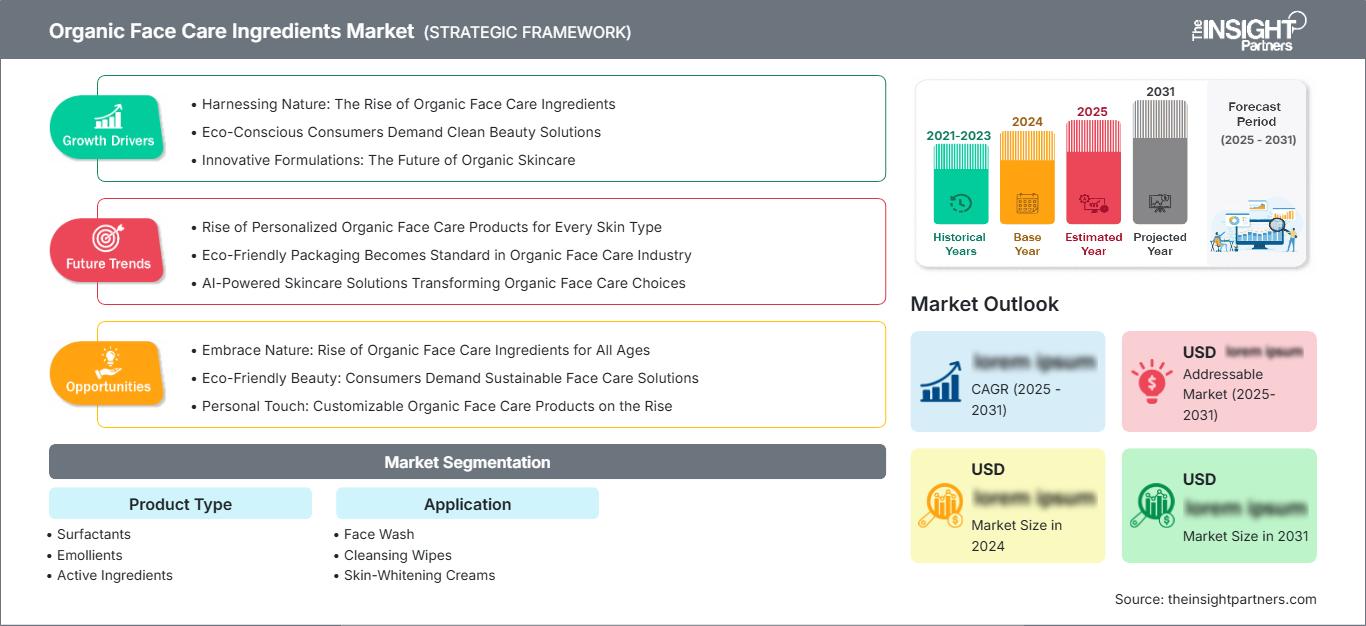
Organic Face Care Ingredients Market: Strategic Insights
Regional Insights
North America Organic Face Care Ingredients Market
North America contributes ~24% of worldwide face care ingredients consumption and will witness growth at ~4.4% CAGR. The continent already has an established ecosystem for facial care ingredients manufacturing, along with growing demand for high-quality, clean-label, sensitive skin, and effectiveness-based products. Ingredient procurement today is more inclined towards proving natural origin, biodegradable nature, sustainable sourcing, and performance.
US Organic Face Care Ingredients Market
US represents ~82% of total North American consumption and is anticipated to grow at ~4.5% CAGR. Applications of the product include anti-aging creams, facial cleansers, whitening products, and formulations for sensitive skin. Some of the major companies in the country catering to the US organic face care ingredients market include Ashland, BASF, Croda, Evonik, and Lubrizol.
US formulators focus on clinical efficacy of ingredients, sensory performance, clean label positioning, and sustainability criteria while evaluating the ingredients.
Europe Organic Face Care Ingredients Market
Europe represents ~30% of global demand and is forecasted to grow by ~4.6% CAGR. France represents an important location for cosmetic research, formulation, and valuable active ingredients, whereas Germany represents a combination of chemical manufacturing along with specialty ingredients for personal care products. Italy represents an important manufacturing and formulation location for cosmetics, and the UK is an important location for premium skincare and innovations in ingredients.
Regulation in Europe results in a very strong focus on safety of the ingredients as well as documentation. Cosmetic products regulation requires a safety assessment prior to the launch of the product in the market, and the continuous updates to ingredients bans and label regulations increase reformulation.
APAC Organic Face Care Ingredients Market
APAC accounts for ~35% of Organic Face Care Ingredients Market Share and is projected to experience ~5.4% CAGR. China is the biggest demand center in the region and is driven by its diverse cosmetics manufacturing capacity as well as product innovation. Japan is the driver of advanced skincare science and premium facial care brands, whereas South Korea drives the region with quick-to-market skincare innovations, formulating and ingredients. India is gaining traction with domestic beauty manufacturing, increasing skincare demand, and local ingredient production.
Ingredient systems are getting more tuned up to Asian skin-care needs, like lightweight products, efficacious active ingredients, mild cleansers, brightening ingredients, and barrier-care formulations. Technical service and manufacturing localization is increasingly becoming a competitive edge.
Middle East & Africa Organic Face Care Ingredients Market
MEA may be a niche market but has some potential through premium skincare products, climate-specific formulations, and more beauty manufacturing activities. Markets in the Gulf region have a preference for high-performing facial care products, while South Africa acts as a base for manufacturing and distribution. High temperatures, dry climate, and consumer preference for premium skincare products necessitate formulation needs in the form of moisturization, barrier enhancement, stability, and sensory performance.
South & Central America Organic Face Care Ingredients Market
SCA has benefited from the substantial cosmetics industry in Brazil, presence of abundant resources of botanics in the country, and the country’s expertise in natural beauty products. Brazil also acts as an important platform for developing the ingredients on the basis of regional botanicals. Argentina, Colombia, and Chile have contributed to the market through growth of skincare and personal care markets. Requirement for ingredients in the region is important for botanical actives, natural emollients, surfactants, and multifunctional ingredients.
Segmentation Analysis
Product Type
The organic face care ingredients market scope by product type comprises Surfactants, Emollients, Active Ingredients, Sugar Polymers, and Preservatives. These ingredient categories serve different formulation functions, ranging from cleansing and moisturization to skin conditioning, targeted treatment, texture modification, and product stability.
- Surfactants: Used primarily in facial cleansing formulations to remove sebum, dirt, makeup, and other impurities from the skin. Demand is supported by the growing preference for mild, plant-derived cleansing systems and sulfate-free or naturally derived formulations. Organic surfactants are particularly relevant to face washes and other rinse-off products designed for sensitive or environmentally conscious consumers.
- Emollients: Provide skin-softening, moisturizing, and conditioning properties while improving the sensory characteristics of facial formulations. Plant-derived oils, butters, esters, and other organic emollient systems are increasingly incorporated into creams and lotions to support moisturization and barrier care. Their use spans anti-aging, skin-whitening, and general facial-care formulations.
- Active Ingredients: Include organic botanical extracts, vitamins, natural antioxidants, botanical oils, and other functional ingredients designed to provide targeted skin benefits. This category is important for anti-aging, brightening, soothing, hydration, and skin-repair formulations. Growing consumer interest in ingredient transparency and naturally derived functional claims supports demand for organic actives.
- Sugar Polymers: Used as functional ingredients for thickening, film formation, stabilization, moisturization, and texture enhancement. Their compatibility with natural and organic formulation concepts makes them relevant to facial creams, gels, cleansers, and other personal care products. Demand is supported by formulators seeking alternatives to conventional synthetic polymers.
- Preservatives: Help maintain product stability and protect water-containing facial formulations from microbial contamination during storage and use. Organic and naturally derived preservation systems are increasingly considered as brands seek formulations aligned with clean-label and natural-product positioning. Their adoption depends on efficacy, regulatory compatibility, formulation pH, and compatibility with other ingredients.
Application
- Face Wash is the largest application segment, supported by the widespread use of facial cleansing products in daily skincare routines. Organic surfactants, emollients, botanical actives, and naturally derived preservation systems are incorporated to provide effective cleansing while maintaining skin comfort and moisture balance. The expansion of sulfate-free, plant-based, and sensitive-skin formulations supports continued ingredient demand.
- Cleansing Wipes represent a specialized application segment. Organic face care ingredients are used to provide cleansing efficacy, moisturization, skin conditioning, and formulation stability in pre-moistened wipes. Demand is influenced by convenience-oriented skincare consumption, although sustainability concerns surrounding disposable wipes encourage manufacturers to explore biodegradable substrates and more environmentally compatible formulations.
- Skin-Whitening Creams are expected to maintain significant demand in markets where skin-brightening and pigmentation-management products are widely consumed. Organic active ingredients, botanical extracts, emollients, and antioxidants are incorporated to support brightening and skin-tone-evening formulations. Increasing consumer preference for naturally derived ingredients is encouraging brands to develop botanical-based alternatives to certain conventional brightening ingredients.
- Anti-Aging Creams are projected to register strong growth as consumers increasingly seek preventive and corrective facial skincare. Organic active ingredients, antioxidants, emollients, botanical extracts, and sugar polymers are used to support formulations targeting wrinkles, fine lines, skin elasticity, hydration, and overall skin appearance. Premiumization and demand for multifunctional natural skincare products further support ingredient consumption in this application.
Opportunity Snapshot
| Application | Revenue Contribution | Trend Tag | Adoption Stage |
|---|---|---|---|
| Face Wash | High | Gentle cleansing | Mature |
| Cleansing Wipes | Medium | Convenience & natural cleansing | Scaling |
| Skin-Whitening Creams | Medium | Botanical brightening | Scaling |
| Anti-Aging Creams | High | Natural actives & skin rejuvenation | Scaling |
Organic Face Care Ingredients Market Growth Drivers and Impact Analysis
Consumer preference for natural yet high-performance facial formulations
Natural positioning is no longer sufficient when an ingredient compromises foam, texture, stability, efficacy, or sensory quality. Consumers increasingly expect facial products to combine natural-origin credentials with visible results. This pushes brands toward ingredient systems that can satisfy several requirements simultaneously, increasing demand for multifunctional surfactants, emollients, polymers, and actives. Suppliers that can demonstrate renewable sourcing while maintaining formulation performance are therefore better positioned to capture premium formulation programs.
Expansion of evidence-based active skincare
Anti-aging, barrier care, brightening, and sensitive-skin products increasingly depend on measurable cosmetic benefits. Ingredient suppliers are responding with clinical, ex vivo, and in vitro testing that connects ingredient mechanisms with consumer-visible outcomes. This raises the value of specialized active ingredients and creates opportunities for suppliers that can provide claim-substantiation packages rather than only technical specifications.
Shift toward biodegradable and biotechnology-enabled ingredients
Fermentation, enzymatic processing, biotechnology-derived actives, and bio-based polymers are expanding the range of ingredients that can meet sustainability objectives. Evonik's biosurfactant and enzymatic-emollient activities demonstrate how process technology can affect both ingredient performance and environmental profile. The implication is that sustainability is increasingly embedded in ingredient production technology rather than treated solely as a downstream marketing attribute.
Organic Face Care Ingredients Market Future Trends
Biotechnology becomes a mainstream ingredient-development platform
Biotechnology is moving beyond niche actives into surfactants, polymers, lipids, and preservation systems. Fermentation and enzymatic processing can create ingredients with controlled functionality while reducing dependence on conventional petrochemical pathways. For facial-care formulators, this creates new routes to natural-origin ingredients with improved consistency and specialized performance. The organic face care ingredients market trends therefore increasingly connect biotechnology with both sustainability and formulation differentiation.
Barrier health and skin longevity reshape active-ingredient development
The focus of skincare is broadening from conventional anti-aging claims toward skin longevity, barrier resilience, hydration retention, and protection from environmental stressors. Ceramides, biomimetic materials, peptides, botanical actives, and microbiome-compatible technologies are becoming more relevant. Suppliers are consequently developing ingredient platforms that address multiple biological pathways instead of relying on a single cosmetic benefit.
Ingredient traceability becomes part of formulation value
Brands are increasingly expected to demonstrate where botanical, agricultural, and bio-based feedstocks originate and how they are processed. Traceability can affect retailer acceptance, environmental claims, certification, and consumer trust. Ingredient suppliers with documented sourcing chains and consistent quality systems can therefore create value beyond the chemical functionality of the raw material.
Organic Face Care Ingredients Market Opportunities
Localized natural active platforms for Asian skincare
A significant opportunity exists in developing regionally adapted botanical and biotechnology-derived actives for China, Japan, South Korea, and India. Facial-care brands in these markets require high-efficacy ingredients compatible with lightweight textures, brightening, sensitive-skin, barrier-care, and anti-aging concepts. Suppliers can differentiate through localized testing, culturally relevant botanical sourcing, rapid formulation support, and regional regulatory expertise. The organic face care ingredients market Forecasts therefore favors suppliers that can combine global technology with localized development capabilities.
Multifunctional natural systems for simplified formulations
Formulators face pressure to reduce ingredient complexity while maintaining product performance. Ingredients that simultaneously provide emolliency, preservation support, sensory modification, stabilization, or skin benefits can reduce formulation complexity and improve sustainability narratives. This creates whitespace for suppliers to develop multifunctional systems targeted at facial creams, cleansers, and treatment products where performance and label simplicity must coexist.
Recent Developments
- April 8, 2026: Evonik Industries AG introduced new beauty and personal-care ingredients at in-cosmetics Global 2026, including a biobased biodegradable film former, a sustainably sourced ester oil, a natural W/O emulsifier, and a glycolipid-ceramide system. The portfolio highlights the convergence of biotechnology, sustainable formulation, and skin-barrier performance.
- October 15, 2025: BASF SE launched Ameriflor Calm, a botanical active designed for sensitive skin and sourced from regenerative organic certified farms. The ingredient addresses redness, skin-barrier support, and environmental stress while being manufactured at a site powered by renewable electricity.
Frequently Asked Questions

- Comprehensive Market Sizing and Forecast Analysis
- Detailed Segmentation Analysis
- In-Depth Market Dynamics Assessment
- Regional and Country-Level Insights
- Competitive Landscape and Company Benchmarking
- Strategic Business Intelligence
Recent Reports
Testimonials

The Insight Partners provided valuable market intelligence that supported our global go-to-market strategy. Their team was professional, responsive, and attentive to our feedback, providing thoughtful analysis and helpful methodological clarifications throughout the project.
Junmo Kim Chief Financial Officer (CFO), Enertech Co., Ltd.
The Insight Partners' SCADA System Market report is comprehensive, with valuable insights on current trends and future forecasts. The team was highly professional, responsive, and supportive throughout. We are very satisfied and highly recommend their services.
RAN KEDEM Partner, Reali Technologies LTDs
I requested a report on a very specific software market and the team produced the report in a few days. The information was very relevant and well presented. I then requested some changes and additions to the report. The team was again very responsive and I got the final report in less than a week.
JEAN-HERVE JENN Chairman, Future Analytica
We worked with The Insight Partners for an important market study and forecast. They gave us clear insights into opportunities and risks, which helped shape our plans. Their research was easy to use and based on solid data. It helped us make smart, confident decisions. We highly recommend them.
PIYUSH NAGPAL Sr. Vice President, High Beam Global
The Insight Partners delivered insightful, well-structured market research with strong domain expertise. Their team was professional and responsive throughout. The user-friendly website made accessing industry reports seamless. We highly recommend them for reliable, high-quality research services
YUKIHIKO ADACHI CEO, Deep Blue, LLC.
This is the first time I have purchased a market report from The Insight Partners.While I was unsure at first, I visited their web site and felt more comfortable to take the risk and purchase a market report.I am completely satisfied with the quality of the report and customer service. I had several questions and comments with the initial report, but after a couple of dialogs over email with their analyst I believe I have a report that I can use as input to our strategic planning process.Thank you so much for taking the extra time and making this a positive experience.I will definitely recommend your service to others and you will be my first call when we need further market data.
JOHN SUZUKI President and Chief Executive Officer, Board Director, BK Technologies
I wish to appreciate your support and the professionalism you displayed in the course of attending to my request for information regarding to infectious disease IVD market in Nigeria. I appreciate your patience, your guidance, and the fact that you were willing to offer a discount, which eventually made it possible for us to close a deal. I look forward to engaging The Insight Partners in the future, all thanks to the impression you have created in me as a result of this first encounter.
DR CHIJIOKE ONYIA MANAGING DIRECTOR, PineCrest Healthcare Ltd.Reason to Buy
- Informed Decision-Making
- Understanding Market Dynamics
- Competitive Analysis
- Identifying Emerging Markets
- Customer Insights
- Market Forecasts
- Risk Mitigation
- Boosting Operational Efficiency
- Strategic Planning
- Investment Justification
- Tracking Industry Innovations
- Aligning with Regulatory Trends





 Get Free Sample for