
Organic Peroxide Market Growth, Size & Forecast by 2034
Coverage: by Type (Diacyl, Ketone, Percarbonates, Dialkyl, Hydroperoxides, Peroxyketals, Peroxyesters); Application (Chemicals and Plastics, Coatings, Adhesives and Elastomers, Paper and Textiles, Detergents, Personal Care, Others) , and Geography (North America, Europe, Asia Pacific, and South and Central America)
- Status : Data Released
- Report Code : TIPRE00005109
- Category : Chemicals and Materials
- No. of Pages : 150
- Available Report Formats :


- Last update date : October 26, 2026


2025 Market Size
US$ 2.34 Bn
Base year value
2034 Forecast
US$ 3.51 Bn
Projected by 2034
CAGR 2026-2034
4.61 %
Growth rate
Addressable Market
US$ 26.56 Bn
(2026-2034)
The organic peroxide market was valued at US$ 2.34 Billion in 2025 and is projected to reach US$ 3.51 Billion by 2034, registering a 4.61% CAGR from 2026 to 2034. The market covers organic peroxide chemistries used as radical initiators, curing agents, crosslinking agents, polymer modifiers, and reaction promoters across Type and Application categories. Type includes Diacyl, Ketone, Percarbonates, Dialkyl, Hydroperoxides, Peroxyketals, and Peroxyesters, while applications span Chemicals and Plastics, Coatings, Adhesives and Elastomers, Paper and Textiles, Detergents, and Personal Care.
North America represents a mature but technically important demand center, supported by polymer processing, thermoset composites, elastomers, specialty coatings, and domestic chemical manufacturing. The organic peroxide market size in the region is supported by established peroxide handling infrastructure, application-development capabilities, and demand for controlled polymer modification. The region is estimated to account for ~22% of global demand in 2025 and is expected to expand at ~4.0% CAGR through 2034. The US remains the principal regional consumption and manufacturing base, while Mexico strengthens its role as a localized production and supply platform. Recent capacity investment in Mexico illustrates the continuing emphasis on regional supply security for temperature-sensitive peroxide products.
Organic Peroxide Market Assessment and Insights
- North America: North America accounts for ~22% of the global market in 2025 and is projected to grow at ~4.0% CAGR through 2034. Mature polymer, rubber, composites, and coatings industries provide a stable consumption base, while localized manufacturing reduces dependence on long-distance movement of temperature-sensitive products. The implication is a relatively resilient market with greater emphasis on specialty grades, technical service, and supply reliability.
- U.S.: The US represents ~78% of North American demand and is projected to expand at ~3.9% CAGR. Demand is anchored by plastics, elastomers, composite materials, coatings, and polymer modification, with suppliers such as United Initiators and Vanderbilt Chemicals maintaining established product and technical-service capabilities. Vanderbilt's VAROX portfolio covers crosslinking and vis-breaking applications for elastomers and polyolefins, illustrating the importance of application-specific formulations.
- Europe: Europe represents ~28% of the global market and is expected to grow at ~4.2% CAGR. Germany, Italy, France, and the Netherlands are important through specialty chemical manufacturing, polymer processing, composites, and technical formulation capabilities. The principal differentiator is the region's stringent approach to chemical safety, transportation, storage, and formulation, which encourages investment in safer handling systems and lower-exposure product formats.
- Asia Pacific: APAC accounts for ~42% of the market and is expected to grow at ~5.2% CAGR. China, Japan, India, and South Korea are central to regional demand because of their polymer, electronics, automotive, renewable-energy, and chemical-processing industries. Localized production is increasingly important, with major producers expanding Chinese capacity and application-development infrastructure.
- Largest Segment: Chemicals and Plastics is the largest main application segment, with an estimated ~4.5% CAGR. Its leadership reflects the extensive use of organic peroxides in polymerization, controlled-rheology processing, polymer modification, and production of thermoplastics and thermoset materials. The breadth of polymer applications gives this segment the most diversified demand base.
- High Growth Segment: Adhesives and Elastomers is the high-growth main application segment, with an estimated ~5.2% CAGR. Demand benefits from peroxide crosslinking in elastomers, high-performance adhesive systems, automotive components, cable materials, and composite applications where thermal resistance and mechanical durability are increasingly important.
- Key companies analyzed in detail: AKPA Chemicals; Arkema; Chinasun Specialty Products Co., Ltd.; MPI Chemie B.V.; NOF Corporation; Novichem Sp. z o.o.; PERGAN GmbH; United Initiators GmbH; Vanderbilt Chemicals, LLC; and Nouryon Chemicals Holding B.V. The supplied AkzoNobel entity is represented by Nouryon, reflecting the current ownership and operating structure of the former AkzoNobel Specialty Chemicals business. Nouryon maintains a broad organic peroxide portfolio under brands including Trigonox, Butanox, Laurox, and Perkadox.
Source: The Insight Partners' analysis based on proprietary research, government publications, company annual reports, investor presentations, industry databases, and expert interviews.
Organic peroxide products have developed from conventional initiation supply to engineered peroxide systems tailored to application, where thermal decomposition characteristics, amount of active oxygen, half-life, stability, composition and decomposition residue are adapted to the particular polymerization process. Organic peroxides decompose and release free radicals, thereby enabling manufacturers to regulate polymerization, crosslinking, curing and polymer modification. NOF's approach to selecting organic peroxides for processes, for instance, focuses on half-life, activation energy, active oxygen, diluent choice, and decomposition products.
There has been an expansion in the diversity of organic peroxides offered as liquid, paste, powder, granular, diluted and temperature-controlled types. This trend is especially significant for thermoset composites, silicone and synthetic rubbers, polyethylene, polypropylene, PVC, acrylic polymers and speciality polymer systems. United Initiators, for instance, offers organic peroxides that include hydroperoxides, ketone peroxides, peresters, percarbonates, dialkyl peroxides, perketals, and diacyl peroxides.
Development will be affected by localized manufacturing, improved formulations, polymer recycling, and better curing techniques. The significance of China will be enhanced due to the peroxide manufacturing companies bringing their manufacturing and technology capabilities together within the region. Nouryon recently declared an organic peroxides innovation center in Tianjin that will operate in 2026, whereas the Arkema's Changshu organic peroxide expansion was concluded in 2025.
Another avenue for commercialization will be energy-transition applications. Organic peroxides help in the crosslinked polyethylene that is used for high-voltage and ultra-high voltage cables, while peroxide cured polymers are used in renewable energy equipment and photovoltaic applications. Simultaneously, the processing of recycled polymers is generating demands for peroxide based modification technologies that can revive processability and performance in recycled polypropylene.
Organic Peroxide Market Report Scope
| Report Attribute | Details |
|---|---|
| Market size in 2025 | US$ 2.34 Billion |
| Market Size by 2034 | US$ 3.51 Billion |
| Global CAGR (2026 - 2034) | 4.61% |
| Historical Data | 2021-2024 |
| Forecast period | 2026-2034 |
Organic Peroxide Market Analysis
Organic Peroxide Market expansion is tied closely to the development of monomers and resins into higher-value materials. An increase in the production of polymers leads to the need for initiation, and further increases in performance lead to the need for crosslinking, curing and rheology adjustment. Hence, the organic peroxide consumption is less dependent on one specific end-use industry than many specialty additives. Demand from plastics and thermoset composite applications is the basis of the demand, whereas rubber, coatings, adhesives and specialty materials add more depth to applications. Organic peroxides are seen by Arkema as initiators of thermoplastic, curing agents for thermoset, crosslinking agents for elastomer and polymers.
The value chain starts with peroxide precursors, formulation, synthesis in controlled environment, dilution/stabilization, storage at controlled temperatures, packaging, transport and distribution. The nature of the products dictates that supply chain management is unusually critical. Temperature of storage, tendency for self-accelerating decomposition, contamination issues, compatibility with packaging and classification for transport all have direct impact on logistics cost and customer qualification. Hence, buyer evaluation includes more than price criteria and established producers with technical capability and regional distribution have advantages.
Competitive positioning involves a mix of a global manufacturing presence and specialized formulation capabilities. Nouryon, Arkema, and United Initiators offer broad product portfolios including multiple peroxide grades and polymer applications. PERGAN, NOF, Chinasun, MPI Chemie, Novichem, AKPA, and Vanderbilt use specialization in formulation, regional manufacturing and application knowledge to differentiate. PERGAN, for instance, manufactures its peroxides in Germany and the US and offers formulations of peroxides for polymerization, curing and crosslinking applications.
Producers are investing closer to the Organic Peroxide Market Report. The capacity expansions in China and Mexico suggest that producers are focusing on regional production safety and not central manufacturing alone. The capacity expansion by Arkema in Changshu is noteworthy in this context as the plant meets polymer and renewable energy needs in Asia, while Nouryon is expanding its production as well as developing technology in China.
● REPORT CUSTOMIZATION
Tailor This Report To Align With Your Specific Business Requirements
This report can be customized to align precisely with your business objectives, scope, and target markets. Customization options include tailored segmentation, geography, competitive analysis, and strategic insights to support informed decision-making.
Customize This Report →WHAT YOU CAN ADJUST
- ● Segmentations
- ● Geography
- ● Competitive Analysis
- ● Language Preferences
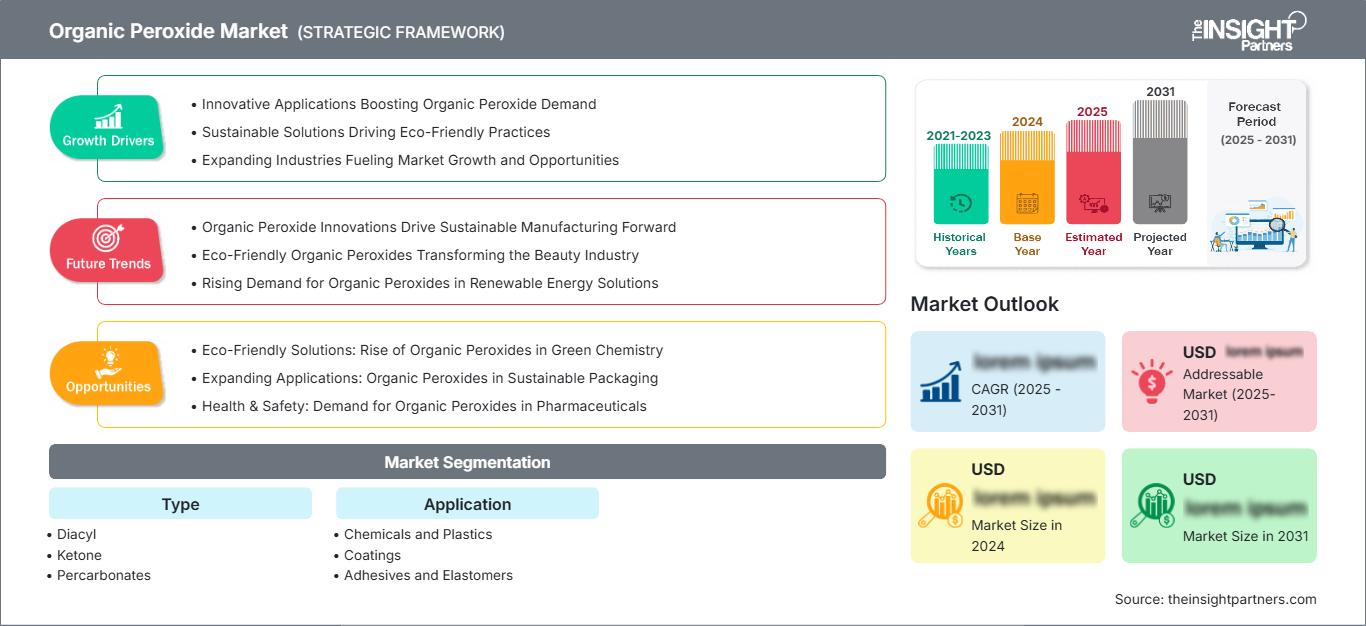
Organic Peroxide Market: Strategic Insights
Regional Insights
North America Organic Peroxide Market
North America represents ~22% of Organic Peroxide Market Share and is projected to grow at ~4.0% CAGR. The region has a mature polymer and chemical-processing base, but replacement of conventional materials with higher-performance plastics and elastomers continues to support peroxide applications. Composite manufacturing, automotive materials, cable insulation, construction products, and industrial rubber remain relevant demand channels.
The United States is the leading consumer in the region owing to the vast capacity for plastics and rubber processing and specialty chemicals distribution in the region. Mexico is also growing as an important production base. The former organic peroxide activities of AkzoNobel in Mexico have changed with the specialty-chemicals format of Nouryon, among others.
U.S. Organic Peroxide Market
The US represents ~78% of North American consumption and is expected to grow at ~3.9% CAGR. The market benefits from demand across thermoplastics, elastomers, composites, adhesives, coatings, and specialty polymer processing. Vanderbilt's VAROX products demonstrate the continued role of peroxide crosslinking in EPDM, EPM, PE, NBR, EVA, silicone, and polypropylene applications.
A differentiating factor is the depth of technical qualification required for peroxide products. Buyers must account for decomposition temperature, storage requirements, formulation compatibility, and process conditions, encouraging long-term supplier relationships rather than frequent switching based solely on unit price.
Europe Organic Peroxide Market
Europe represents ~28% of the demand globally and is projected to grow at ~4.2% CAGR. Germany plays an important role as both the manufacturing and technology center, facilitated by specialty chemicals, auto production, rubber, plastics, and composites. PERGAN manufactures products from German production plants and boasts product lines related to polymerization, curing, and crosslinking.
France continues to be a key player through production of specialty chemicals and advanced materials, whereas Italy makes its contributions through plastics, rubber, composites, and processing of industrial chemicals. The Netherlands is a key center for specialty chemicals and distribution, such as the peroxide business of MPI Chemie. Safe handling, transport, and storage of the product are crucial factors for the buyers in Europe.
APAC Organic Peroxide Market
APAC is the largest regional market, representing ~42% of global demand and growing at ~5.2% CAGR. China leads the region because of its enormous polymer-processing base, chemical manufacturing infrastructure, composites production, and expanding renewable-energy supply chain. Chinasun manufactures organic peroxides in Jiangsu and supplies products for polymerization and crosslinking applications.
Japan remains an important technology and specialty-material market. NOF produces organic peroxides in Japan and operates overseas production capabilities, while its portfolio serves plastics, rubber, automotive materials, and other advanced applications.
India is becoming increasingly relevant because of polymer-processing expansion, automotive manufacturing, infrastructure, and specialty chemical localization. South Korea adds demand from advanced polymer, electronics, automotive, and chemical industries. The regional outlook therefore combines high downstream demand with continued localization of peroxide production, technical support, and application development.
Middle East & Africa Organic Peroxide Market
MEA remains a smaller market but has strategic relevance through polymer production, construction materials, plastics conversion, coatings, and infrastructure development. Demand is concentrated around countries with established petrochemical and plastics industries. Turkey also has relevance as a manufacturing and distribution base for peroxide suppliers serving Europe, Asia, and the Middle East.
South & Central America Organic Peroxide Market
SCA represents a smaller but steadily developing share of the global organic peroxide market, supported by growth in plastics processing, rubber manufacturing, composites, construction materials, coatings, and specialty chemical applications. Brazil accounts for a significant portion of regional demand due to its large industrial base, polymer-processing capacity, automotive manufacturing, infrastructure activity, and established chemical distribution network. Argentina, Colombia, and Chile also contribute to regional consumption through plastics conversion, rubber products, construction materials, and industrial manufacturing.
Brazil is especially noteworthy due to the increasing demand for organic peroxides required for the synthesis, modification, cross-linking, and polymerization processes for polyethylene, polypropylene, PVC, elastomer, and composite materials. At the same time, this region will benefit from the increasing use of light-weighted plastic and composite materials in the construction, automotive, electrical, and consumer goods industries. Nevertheless, when comparing with North America, Europe, and APAC regions, SCA is relatively more reliant on the supply of specialty chemicals and their distribution.
The development of the regional market is expected to be driven by the increased manufacturing of higher-performance polymers, composites, and rubber materials in Brazil. In addition to the aforementioned factors, the proximity to the producers of raw materials, secure delivery and transportation of peroxides, and the compliance with the handling of the hazardous materials become important competitive advantages.
Segmentation Analysis
Type
The organic peroxide market scope by type comprises Diacyl, Ketone, Percarbonates, Dialkyl, Hydroperoxides, Peroxyketals, and Peroxyesters. Different decomposition profiles make these chemistries suitable for distinct polymerization, curing, and crosslinking windows.
- Diacyl: Widely used where controlled radical generation is required, including silicone rubber, thermoset curing, and polymer initiation. Their established use in specialty formulations supports steady industrial demand.
- Ketone: Important in room-temperature or low-temperature curing systems, particularly unsaturated polyester and vinylester resin applications. Their adoption is closely linked to composite manufacturing practices.
- Percarbonates: Used as initiators in selected polymerization processes where specific decomposition characteristics are required. Formulation stability and temperature control influence adoption.
- Dialkyl: Important for high-temperature crosslinking, polymer modification, elastomers, and polyolefins. Demand benefits from applications requiring durable networks and controlled rheology.
- Hydroperoxides: Serve as initiators, curing components, and chemical intermediates. Their versatility supports use across polymer and specialty chemical processes.
- Peroxyketals: Provide tailored decomposition behavior for polymerization and crosslinking applications. Selection depends strongly on processing temperature and reaction kinetics.
- Peroxyesters: Used where rapid or controlled radical generation is required in polymerization and curing. Formulation and temperature stability remain important purchasing criteria.
Application
- Chemicals and Plastics is the largest main application, growing at ~4.5% CAGR. The segment includes polymerization initiators, controlled-rheology systems, polymer modifiers, and peroxide-based processing chemistry. Broad exposure to PE, PVC, PP, acrylics, styrenics, and thermosets gives this application the most diversified demand base.
- Coatings, Adhesives and Elastomers is projected to grow at ~4.9% CAGR. Organic peroxides support curing and crosslinking in elastomeric and adhesive systems, while growing performance requirements in automotive, construction, cables, and industrial components increase demand for thermally stable formulations.
- Paper and Textiles is expected to grow at ~3.6% CAGR. Demand is more selective and linked to specialty polymer and functional-material applications rather than commodity peroxide consumption. Hygiene-related polymer materials provide an additional use pathway.
- Detergents is expected to expand at ~3.3% CAGR. The segment is comparatively specialized and depends on peroxide chemistry used in selected formulation and processing applications.
- Personal Care is projected to grow at ~4.1% CAGR. Demand is associated with specialty chemical applications where peroxide chemistry contributes to controlled synthesis or formulation performance, although the application remains smaller than plastics and elastomer-related uses.
Opportunity Snapshot
| Application | Revenue Contribution | Trend Tag | Adoption Stage |
| Chemicals and Plastics | High | Polymerization | Mature |
| Coatings, Adhesives and Elastomers | High | Crosslinking | Scaling |
| Paper and Textiles | Medium | Specialty curing | Scaling |
| Detergents | Low | Formulation | Mature |
| Personal Care | Low | Specialty synthesis | Emerging |
Organic Peroxide Market Growth Drivers and Impact Analysis
Expansion of polymer processing and engineered plastics
Organic peroxide demand follows polymer conversion activity because peroxide initiators and modifiers influence molecular structure, processing behavior, and final material properties. Growth in engineering plastics, polyolefin modification, PVC, acrylics, and thermoset composites therefore expands the addressable application base. The mechanism is particularly strong where manufacturers need precise control over polymer molecular weight, melt behavior, curing rate, or crosslink density.
Growth of peroxide-crosslinked elastomers and cable materials
Automotive components, industrial rubber, electrical insulation, and energy infrastructure require materials that retain mechanical properties at elevated temperatures. Peroxide crosslinking creates carbon-carbon bonds within polymer networks and can provide improved heat-aging and compression-set performance. This supports demand for dialkyl and related peroxide systems in elastomer and polyolefin applications.
Recycling-driven polymer modification
The need to increase recycled-content use is creating a new demand pathway for peroxide technology. Recycled polypropylene can experience molecular-weight and processing-property deterioration during repeated thermal histories. Peroxide-based modification can help restore selected rheological and performance characteristics, allowing recyclers and compounders to target applications previously dominated by virgin material. Nouryon's recent commercialization of a peroxide technology specifically designed for recycled polypropylene illustrates this transition.
Higher emphasis on safe handling and regulatory compliance
Organic peroxides require controlled storage, transportation, and handling because certain formulations can undergo self-accelerating decomposition. This makes safety engineering an important competitive factor. Producers are therefore developing safer formulations, improved packaging, technical training, and application-specific delivery systems. Arkema's NeatCure development demonstrates how formulation innovation is being used to address handling and regulatory requirements while maintaining curing performance.
Organic Peroxide Market Future Trends
Localized peroxide manufacturing and application centers
The organic peroxide market trends increasingly favor regional manufacturing combined with local technical support. Producers are investing near large polymer clusters because temperature-sensitive products are costly and operationally complex to transport. China's growing role illustrates this shift, with manufacturing expansions increasingly accompanied by application-development infrastructure. Nouryon's planned Tianjin innovation center and Arkema's expanded Changshu capacity demonstrate how supply and technical capabilities are being colocated closer to customers.
Peroxide technologies designed for circular polymers
Recycling is changing the function of peroxide chemistry from conventional polymer initiation and crosslinking toward property restoration and processing optimization. This trend will affect recyclers, compounders, and polymer processors as recycled materials become more technically demanding. Products that selectively modify degraded polymer chains without compromising downstream processing will gain importance.
Safer solid and formulated peroxide systems
Product design is shifting toward formulations that reduce dust, improve dosing consistency, and simplify safe handling. Granular systems and optimized formulations can reduce operator exposure while improving process control. This trend is especially relevant in elastomer, thermoset, and polymer-processing plants where peroxide dosing directly affects curing kinetics and production stability.
Energy infrastructure as a specialty demand channel
Organic peroxides used in crosslinked polyethylene are becoming more strategically relevant as electrical networks expand and renewable power generation requires higher-voltage transmission infrastructure. NOF identifies peroxide-based crosslinked polyethylene applications for high-voltage and ultra-high-voltage wires associated with wind and solar power transmission.
Organic Peroxide Market Opportunities
Peroxide systems for recycled polyolefin performance restoration
A significant opportunity in the Organic Peroxide Market forecast exists in peroxide formulations designed specifically for recyclers and compounders processing mechanically recycled polypropylene and related polyolefins. The target customer base includes recyclers, masterbatch producers, automotive compounders, packaging manufacturers, and consumer-goods processors. The unmet need is consistent performance from variable recycled feedstocks. Suppliers that combine peroxide chemistry with dosing guidance and application testing can move beyond commodity supply toward higher-value technical partnerships. Asia Pacific and North America are particularly attractive because of their large plastics-processing bases and increasing circular-material requirements.
Localized specialty peroxide solutions for advanced composites
Composite producers require peroxide systems that provide predictable curing while maintaining production speed, surface quality, and mechanical performance. Opportunities exist in wind-energy components, transportation composites, infrastructure repair, and specialty molded products. Regional production in Asia and North America can reduce temperature-controlled logistics complexity while allowing suppliers to customize formulations for local resin systems. Companies with application laboratories and rapid formulation support can use this gap to compete against broader suppliers on technical responsiveness rather than scale alone.
Recent Developments
- May 6, 2026: Nouryon Chemicals Holding B.V. introduced Perkadox PM-60ST-GR, a new organic peroxide technology designed to restore performance in recycled polypropylene. The product targets recyclers, compounders, and processors serving packaging, automotive, and consumer-goods applications and strengthens peroxide chemistry's role in circular plastics rather than conventional polymer production alone.
- April 21, 2026: Arkema highlighted the completion of its Luperox organic peroxide capacity expansion in Changshu, China, strengthening localized supply for polymer and specialty-material customers across Asia. The company also linked the expanded regional network with technical support for changing demand in advanced materials and renewable-energy applications.
Frequently Asked Questions

- Comprehensive Market Sizing and Forecast Analysis
- Detailed Segmentation Analysis
- In-Depth Market Dynamics Assessment
- Regional and Country-Level Insights
- Competitive Landscape and Company Benchmarking
- Strategic Business Intelligence
Recent Reports
Testimonials

The Insight Partners provided valuable market intelligence that supported our global go-to-market strategy. Their team was professional, responsive, and attentive to our feedback, providing thoughtful analysis and helpful methodological clarifications throughout the project.
Junmo Kim Chief Financial Officer (CFO), Enertech Co., Ltd.
The Insight Partners' SCADA System Market report is comprehensive, with valuable insights on current trends and future forecasts. The team was highly professional, responsive, and supportive throughout. We are very satisfied and highly recommend their services.
RAN KEDEM Partner, Reali Technologies LTDs
I requested a report on a very specific software market and the team produced the report in a few days. The information was very relevant and well presented. I then requested some changes and additions to the report. The team was again very responsive and I got the final report in less than a week.
JEAN-HERVE JENN Chairman, Future Analytica
We worked with The Insight Partners for an important market study and forecast. They gave us clear insights into opportunities and risks, which helped shape our plans. Their research was easy to use and based on solid data. It helped us make smart, confident decisions. We highly recommend them.
PIYUSH NAGPAL Sr. Vice President, High Beam Global
The Insight Partners delivered insightful, well-structured market research with strong domain expertise. Their team was professional and responsive throughout. The user-friendly website made accessing industry reports seamless. We highly recommend them for reliable, high-quality research services
YUKIHIKO ADACHI CEO, Deep Blue, LLC.
This is the first time I have purchased a market report from The Insight Partners.While I was unsure at first, I visited their web site and felt more comfortable to take the risk and purchase a market report.I am completely satisfied with the quality of the report and customer service. I had several questions and comments with the initial report, but after a couple of dialogs over email with their analyst I believe I have a report that I can use as input to our strategic planning process.Thank you so much for taking the extra time and making this a positive experience.I will definitely recommend your service to others and you will be my first call when we need further market data.
JOHN SUZUKI President and Chief Executive Officer, Board Director, BK Technologies
I wish to appreciate your support and the professionalism you displayed in the course of attending to my request for information regarding to infectious disease IVD market in Nigeria. I appreciate your patience, your guidance, and the fact that you were willing to offer a discount, which eventually made it possible for us to close a deal. I look forward to engaging The Insight Partners in the future, all thanks to the impression you have created in me as a result of this first encounter.
DR CHIJIOKE ONYIA MANAGING DIRECTOR, PineCrest Healthcare Ltd.Reason to Buy
- Informed Decision-Making
- Understanding Market Dynamics
- Competitive Analysis
- Identifying Emerging Markets
- Customer Insights
- Market Forecasts
- Risk Mitigation
- Boosting Operational Efficiency
- Strategic Planning
- Investment Justification
- Tracking Industry Innovations
- Aligning with Regulatory Trends





 Get Free Sample for