
Ozone Generator Market Trends, Size & Forecast by 2034
Coverage: by Type (Ultraviolet Generators, Cold Plasma Generators, Corona Discharge Generators, Electrolytic Generators, Others); Application (Wastewater Treatment, Aquaculture, Swimming Pool, Laboratory and Medical, Potable Water Treatment, Others); Industry (Textile, Automotive, Construction, Food and Beverages, Semiconductors, Paper and Pulp, Pharmaceutical and Healthcare), and Geography (North America, Europe, Asia Pacific, and South and Central America)
- Status : Data Released
- Report Code : TIPRE00013173
- Category : Manufacturing and Construction
- No. of Pages : 150
- Available Report Formats :


- Last update date : August 05, 2026


2025 Market Size
US$ 1.45 Bn
Base year value
2034 Forecast
US$ 2.52 Bn
Projected by 2034
CAGR 2026-2034
6.33 %
Growth rate
Addressable Market
US$ 17.96 Bn
(2026-2034)
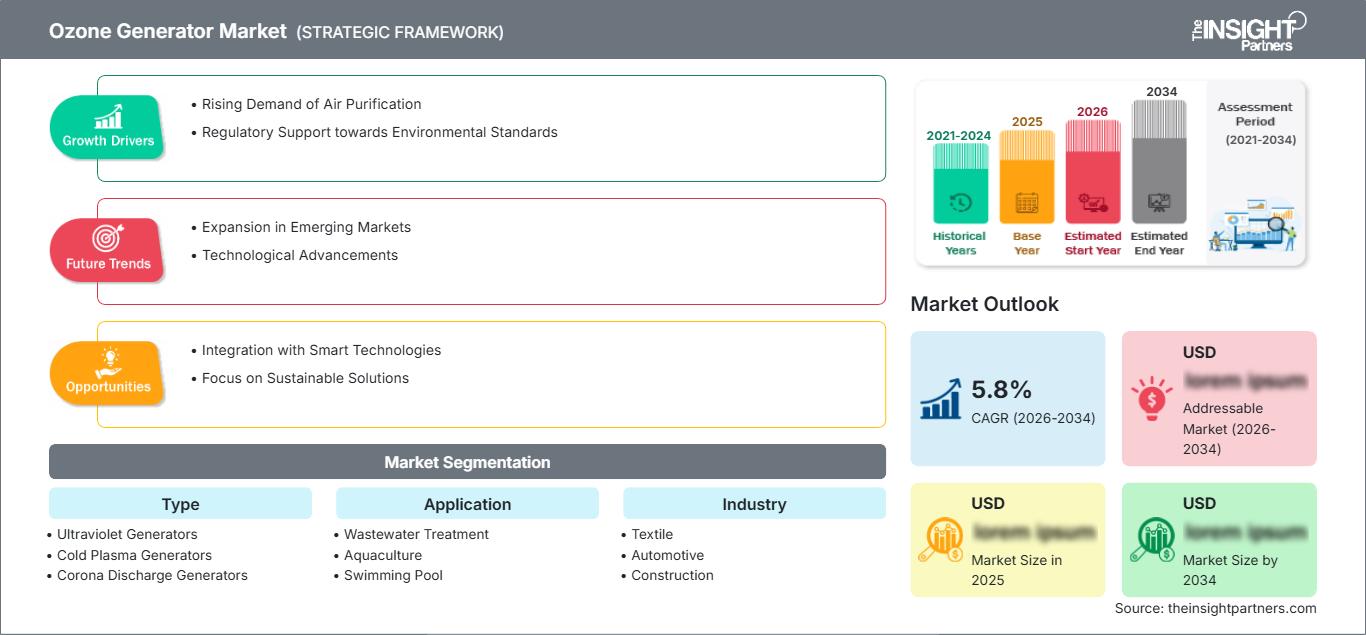
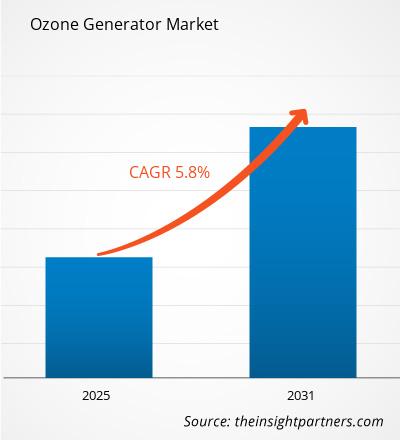
The Ozone Generator Market size stood at US$ 1.45 Billion in 2025 and it is estimated to expand up to US$ 2.52 Billion by 2034 with a CAGR of 6.33% during the forecast period. The growth in this market will be driven by industrial wastewater recycling, regulatory policies regarding discharge, and ozone oxidation process in various municipal, food processing, pharmaceutical, semiconductor, and healthcare industries.
Within North America region, investments in new infrastructure in water treatment plants, hygiene in indoor facilities, and advanced manufacturing processes are expected to drive a CAGR of 5.9-6.6% until 2034. The global Ozone Generator Market size is supported by utility upgrades, EPA-based water quality compliance requirements, food industry's sanitization methods, and increased usage of residue-free oxidation processes in hospitals and laboratories.
Ozone Generator Market Assessment and Insights
- North America accounted for 31–33% share in 2025 and is growing at a CAGR of 5.9–6.6% during 2026–2034, supported by municipal water upgrades, food safety compliance, and healthcare disinfection demand.
- US represented 78–82% of North America in 2025 and is growing at a CAGR of 5.8–6.4% through 2034, led by utilities, laboratories, and industrial reuse projects.
- Europe held 25–27% share in 2025 and is growing at a CAGR of 5.5–6.2% during 2026–2034, with Germany, the UK, France, Italy, and Spain leading adoption.
- Asia Pacific captured 28–30% share in 2025 and is growing at a CAGR of 7.0–7.8% during 2026–2034, led by China, Japan, South Korea, India, and Australia.
- Largest Segment wastewater treatment held 34–38% market share in 2025 and is expanding at a CAGR of 6.1–6.8% during 2026–2034.
- High Growth Segment laboratory and medical applications held 8–11% market share in 2025 and are expanding at a CAGR of 7.4–8.2% during 2026–2034.
- Key companies analyzed in detail: BiOzone Corporation, Corotec Corporation, Mitsubishi Electric Corporation, Oxyzone Pty Ltd., Ozone Solutions Inc., Ozonetech AB, Primozone Production AB, SUEZ, Sun-Belt USA, and Toshiba Corporation.
Source: The Insight Partners' analysis based on proprietary research, government publications, company annual reports, investor presentations, industry databases, and expert interviews.
Innovation in the Ozone Generator Market is moving away from basic air-fed models towards more advanced technologies such as corona discharge, cold plasma, and electrolysis, which provide better performance in terms of stability, energy efficiency, and automation. Production trends include the development of modularized generators for decentralization of wastewater treatment facilities, aquafarms, semiconductor manufacturing, and medical applications, along with the servicing of electrodes, oxygen concentrators, and other monitoring equipment.
On a future-oriented note, emerging markets are likely to seek ozone treatment facilities in cases where traditional chlorination is challenged by issues of by-products formation, odor management, and resistant microorganisms. The areas for investments in the market include Asia Pacific industrial sites, Middle East wastewater reuse applications, and Europe tertiary treatment upgrade projects.
Ozone Generator Market Report Scope
| Report Attribute | Details |
|---|---|
| Market size in 2025 | US$ 1.45 Billion |
| Market Size by 2034 | US$ 2.52 Billion |
| Global CAGR (2026 - 2034) | 6.33% |
| Historical Data | 2021-2024 |
| Forecast period | 2026-2034 |
Ozone Generator Market Analysis
Growth in the Ozone Generator market is driven by demand for advanced oxidation in wastewater treatment, drinking water finishing, food contact disinfection, and high purity applications in industry. UN-Water found that only 27% of industrial wastewater was properly treated in reporting nations during 2024, highlighting the regulatory compliance issue that fosters the use of ozone generators in discharge settings.
The eco-system is comprised of ozone generator manufacturers, oxygen supply components suppliers, system integrators, municipal engineering companies, and users. The supply-side dynamics are influenced by electrode materials, dielectric tubes, power units, and monitoring instruments. Life-cycle costs, safety, precision of results, and system's compatibility with ultra-violet radiation, filtration, or hydrogen peroxide processes are becoming an important criteria for end-users.
The Ozone Generator Market report reveals a moderate level of fragmentation and rivalry between multinational providers of infrastructure solutions and specialized equipment producers. On one hand, Mitsubishi Electric Corporation, Toshiba Corporation, and SUEZ have strong technical background and access to clients. On the other hand, Ozone Solutions Inc., Ozonetech AB, Primozone Production AB, and Corotec Corporation are more oriented on special solutions.
Current investment trends are oriented towards modular systems, low-energy consumption corona discharge machines, remote monitoring solutions, and advanced oxidation solutions for removing micropollutants from water resources. Current strategies rely on specialized applications: BiOzone Corporation and Sun-Belt USA provide compact disinfection solutions; Oxyzone Pty Ltd. provides solutions for regional industrial customers; and large companies invest in water infrastructure projects.
● REPORT CUSTOMIZATION
Tailor This Report To Align With Your Specific Business Requirements
This report can be customized to align precisely with your business objectives, scope, and target markets. Customization options include tailored segmentation, geography, competitive analysis, and strategic insights to support informed decision-making.
Customize This Report →WHAT YOU CAN ADJUST
- ● Segmentations
- ● Geography
- ● Competitive Analysis
- ● Language Preferences
Ozone Generator Market: Strategic Insights
Regional Insights
North America Ozone Generator Market
The North American region had a market share of 31–33% in 2025 and is expected to have a CAGR of 5.9-6.6% from 2026 to 2034. The region has aging municipal water infrastructure, food sanitation requirements, and hospital hygiene improvements that facilitate ozone disinfection applications in controlled environments.
The North American Ozone Generator Market share is fueled by robust engineering procurement capabilities, presence of system integrators, and the requirement of residue-free oxidation in industrial water reuse applications. Replacement cycles will come from US utility companies and Canadian food producers while incremental demand will come from Mexico in industrial parks and beverages production.
U.S. Ozone Generator Market
North America is comprised by 78-82% of the U.S., which has a CAGR of 5.8-6.4% during 2025 to 2034. The applications include municipal waste water treatment, potable water polishing, laboratory sterilization, recirculation in aquaculture, and food and beverage sanitation due to regulatory requirements and reduction of residuals in purchase decisions.
The companies operate across a wide range, including Ozone Solutions Inc., Corotec Corporation, Sun-Belt USA, and BiOzone Corporation, for domestic applications, and Mitsubishi Electric Corporation, Toshiba Corporation, and SUEZ, for infrastructure and industrial applications. There is an increasing trend in usage in high-purity applications and automation of the disinfection systems.
Europe Ozone Generator Market
Share of Europe was 25–27% in 2025, and the region is growing at CAGR of 5.5–6.2% between 2026–2034. Germany is leading regional application through municipal tertiary treatment, pharmaceutical water systems, and premium-grade manufacturing. UK is developing projects for water utility upgrade and odor control, especially where discharge monitoring becomes an incentive for ozone oxidation technology.
Demands from France, Italy, and Spain arise because of food processing, bottled water production, aquaculture, and pool sanitizing for tourism. The companies Ozonetech AB and Primozone Production AB have their capabilities while SUEZ has its utility expertise. Europe Market works under the conditions of sustainability, reduction in chemicals, and resilient water infrastructure.
APAC Ozone Generator Market
Asia Pacific accounted for 28–30% share in 2025 and is expected to grow at a CAGR of 7.0–7.8% during 2026–2034. China is the leading country due to municipal wastewater expansion, electronics manufacturing, and stricter industrial discharge enforcement.
Semiconductor and healthcare use by Japan and South Korea; potable water, aquaculture and food processing uses from India and Australia. Toshiba Corporation and Mitsubishi Electric Corporation contribute to technological expertise in the region, and focus on water reutilization promotes further usage of market.
Middle East & Africa Ozone Generator Market
MEA & Africa region exhibits adoption CAGR of 6.4% to 7.1% from 2026 to 2034. Saudi Arabia emerges as the market leader in the region owing to the water reuse through desalination, industrial parks and hospitality applications, while UAE utilizes ozone systems for pools, potable water purification, and premium applications.
South Africa and Rest of MEA exhibit selective adoption through mining water treatment, municipal sanitation, and food & beverage processing applications. High energy cost impacts the adoption of ozone generator system, which in turn, highlights the significance of corona discharge and oxygen-fed ozone generator systems.
Segmentation Analysis
Type
Type is expected to grow at a CAGR of 6.0–6.8% during 2026–2034 as buyers shift toward higher-output, energy-efficient systems. The Ozone Generator Market scope across type categories is defined by ozone concentration, feed gas quality, maintenance intensity, installation footprint, and suitability for municipal, medical, and industrial operating conditions.
- Ultraviolet Generators serve compact and low-output disinfection needs where safety, simplicity, and limited ozone concentration are preferred, particularly in small laboratories, pools, and localized air or water treatment.
- Cold Plasma Generators are gaining attention for controlled ozone production, lower thermal load, and suitability in sensitive air and surface treatment environments requiring stable output and compact equipment design.
- Corona Discharge Generators remain the dominant technology for high-capacity water and wastewater treatment because they deliver strong ozone yield, scalable operation, and favorable cost-performance in industrial systems.
- Electrolytic Generators are used where ozone must be produced directly in water, reducing gas handling requirements and supporting ultrapure water, medical, and niche high-sanitation applications.
Application
Application is projected to grow at a CAGR of 6.2–7.0% during 2026–2034, driven by demand for oxidation, deodorization, microbial inactivation, and chemical reduction. Wastewater treatment remains the largest application, while laboratory and medical uses show stronger momentum because ozone supports validated disinfection in compact equipment environments.
- Wastewater Treatment leads adoption as utilities and industries address color removal, odor control, pathogen reduction, and emerging contaminant oxidation while limiting dependence on chlorine-based treatment chemicals.
- Aquaculture uses ozone to improve water clarity, reduce pathogen loads, and support recirculating aquaculture systems where water reuse and biological stability are strategic operating priorities.
- Swimming Pool demand is supported by premium facilities and public pools seeking lower chloramine formation, improved water quality, and reduced odor without eliminating residual disinfection requirements.
- Laboratory and Medical applications rely on compact ozone systems for surface, equipment, and water disinfection where rapid oxidation and low chemical residue are valued.
- Potable Water Treatment adoption is concentrated in utilities and bottled water plants requiring taste, odor, color, and microbial control while meeting strict drinking-water quality expectations.
Industry
Industry is expected to expand at a CAGR of 6.1–6.9% during 2026–2034 as ozone systems penetrate sectors requiring water quality, odor control, and residue-sensitive sanitation. Adoption differs by industry, with semiconductors and pharmaceuticals prioritizing ultrapure water, while textiles, food processing, and pulp applications emphasize effluent quality and process hygiene.
- Textile manufacturers use ozone for color removal, bleaching support, and wastewater treatment as brands and regulators pressure suppliers to reduce chemical loads and improve effluent quality.
- Automotive applications include paint-shop water treatment, component cleaning, odor control, and process-water reuse where manufacturers seek lower chemical consumption and compliant discharge operations.
- Construction demand is linked to commercial pools, building water systems, and site water reuse projects where sanitation, odor reduction, and operational reliability influence equipment selection.
- Food and Beverages facilities adopt ozone for produce washing, bottle rinsing, surface sanitation, and process-water treatment where residue control and microbial reduction are critical.
- Semiconductors use ozone in ultrapure water and surface preparation processes requiring exceptional contaminant control, stable dosing, and compatibility with high-value precision manufacturing environments.
- Paper and Pulp producers apply ozone for bleaching support, color reduction, and effluent treatment, especially where mills pursue lower chlorine chemistry and improved wastewater profiles.
- Pharmaceutical and Healthcare users rely on ozone for water systems, equipment sanitation, and controlled disinfection where validation, documentation, and residue minimization shape procurement decisions.
Opportunity Snapshot
| Application | Revenue Contribution | Trend Tag | Adoption Stage |
| Wastewater Treatment | High | Water Reuse | Mature |
| Aquaculture | Medium | RAS Systems | Scaling |
| Swimming Pool | Medium | Chloramine Control | Mature |
| Laboratory and Medical | Medium | Validated Disinfection | Scaling |
| Potable Water Treatment | High | Taste Control | Mature |
| Others | Low | Niche Oxidation | Emerging |
Ozone Generator Market Growth Drivers and Impact Analysis
Wastewater Compliance and Water Reuse Mandates
Compliance for wastewater is a key factor, since the plants need to ensure that treatment of the wastewater will provide solutions for pathogens, color, odors, and new pollutants without introducing additional persistent chemical by-products. According to UN-Water, the 2024 update on the status of wastewater indicated poor reporting and only 27% of industrial wastewater safe for the environment from those reporting countries, highlighting the investment gap. The impact of the ozone system is evident in helping to address these gaps through biological processes, filtration, and advanced oxidation processes.
Industrial Shift Toward Chemical-Reduced Disinfection
Industrial customers are looking at disinfection techniques which can minimize storage of chemical compounds, minimize hazards to workers handling chemicals and prevent any residuals in the water processing process. Since ozone reverts back to oxygen after oxidation, it is preferred for use in food & beverage, pharmaceuticals, semiconductor and aquaculture industries. The Ozone Generator Market gets a boost when buyers consider their cost of compliance, sanitation verification and wastewater treatment costs as whole and not just their machine purchase cost.
Expansion of High-Purity Manufacturing and Healthcare Uses
High-purity manufacturing and healthcare environments create demand for precise, documented, and residue-sensitive disinfection. Semiconductor fabs require water quality control that supports yield protection, while pharmaceutical and healthcare users prioritize validated sanitation and microbial risk reduction. Ozone’s role is expanding from standalone disinfection into process-integrated oxidation, surface treatment, and ultrapure water loops. Market impact is visible in premium equipment specifications, higher sensor content, and stronger preference for suppliers with validation support. This shifts competition away from commodity generators toward engineered systems with monitoring, redundancy, and application-specific operating protocols.
Ozone Generator Market Future Trends
Smart Ozone Control Platforms
Ozone Generator Market trends are moving toward sensor-led control platforms that adjust ozone output according to oxidation-reduction potential, dissolved ozone, flow rate, and contaminant load. Future systems will increasingly use predictive maintenance to monitor dielectric condition, compressor health, and oxygen feed quality before performance declines. This trend will matter most in decentralized plants, aquaculture, hospitals, and food facilities where operators need consistent disinfection without specialized technical staff. Suppliers that package hardware with analytics, alarms, and remote service access can improve uptime and convert equipment sales into recurring service revenue.
Hybrid Advanced Oxidation Systems
Hybrid advanced oxidation systems combining ozone with ultraviolet light, hydrogen peroxide, or catalytic media are expected to gain relevance as utilities target pharmaceuticals, pesticides, color compounds, and difficult organic residues. These configurations extend ozone beyond standard disinfection into contaminant transformation and polishing. The trend should support higher-value installations because system design requires dosing optimization, reaction chambers, monitoring, and safety controls. It also favors suppliers with process engineering capabilities and pilot-testing support, particularly in Europe, Japan, South Korea, and North America where regulatory scrutiny of micropollutants continues to increase.
Ozone Generator Market Opportunities
Modular Systems for Emerging Water Infrastructure
Modular ozone systems offer an actionable opportunity in cities and industrial zones that need faster deployment than conventional centralized infrastructure. Containerized units can serve small municipalities, food parks, aquaculture clusters, and remote healthcare facilities with scalable capacity. Ozone Generator Market Forecasts point to stronger demand where buyers need phased capital spending, repeatable installation, and reduced chemical logistics. Suppliers can differentiate by offering pre-engineered packages, serviceable components, financing options, and operator training. This opportunity is especially attractive in Asia Pacific, the Middle East, and parts of Africa where water reuse and industrial expansion are advancing together.
Application-Specific Validation for Regulated Industries
Regulated industries create a margin-enhancing opportunity for suppliers that provide documented performance rather than generic ozone output. Pharmaceutical, healthcare, semiconductor, and food processing buyers need validation protocols, microbial reduction evidence, materials compatibility, and integration with quality systems. Equipment providers can capture value through application testing, qualification documentation, monitoring software, and service agreements. This approach reduces buyer risk and shortens adoption cycles because procurement teams can align ozone systems with audit requirements. The opportunity also supports premium positioning for specialist manufacturers able to translate oxidation chemistry into repeatable, regulator-ready operating practices.
Recent Developments
- May 2026: Faraday Ozone unveiled a new high-efficiency ozone generator product line at IFAT Munich, supporting the growing demand for advanced water treatment, oxidation and micropollutant removal applications. The official unveiling took place during the exhibition, where the company engaged with utilities, engineering firms, industrial users and distribution partners.
- May 2025: RainHarvest Systems has released new ozone generator product lines. The Pro series ozone generators are engineered for demanding applications and deliver ozone by venturi side stream injections to achieve precise dosing and maximum output. The generators are available in three sizes and produce up to 30 grams of ozone per hour.
- September 2024: Triogen by BIO-UV Group has delivered 16 ozone units including one of the company’s new PPO3 ozone generators to Scottish salmon farms in 2024. The ozone generators were manufactured at the Triogen facility in East Kilbride, near Glasgow. This order follows on from the performance success of the Triogen ozone generation units installed at fish farms over the past decade.
Frequently Asked Questions

- Comprehensive Market Sizing and Forecast Analysis
- Detailed Segmentation Analysis
- In-Depth Market Dynamics Assessment
- Regional and Country-Level Insights
- Competitive Landscape and Company Benchmarking
- Strategic Business Intelligence
Recent Reports
Testimonials

The Insight Partners provided valuable market intelligence that supported our global go-to-market strategy. Their team was professional, responsive, and attentive to our feedback, providing thoughtful analysis and helpful methodological clarifications throughout the project.
Junmo Kim Chief Financial Officer (CFO), Enertech Co., Ltd.
The Insight Partners' SCADA System Market report is comprehensive, with valuable insights on current trends and future forecasts. The team was highly professional, responsive, and supportive throughout. We are very satisfied and highly recommend their services.
RAN KEDEM Partner, Reali Technologies LTDs
I requested a report on a very specific software market and the team produced the report in a few days. The information was very relevant and well presented. I then requested some changes and additions to the report. The team was again very responsive and I got the final report in less than a week.
JEAN-HERVE JENN Chairman, Future Analytica
We worked with The Insight Partners for an important market study and forecast. They gave us clear insights into opportunities and risks, which helped shape our plans. Their research was easy to use and based on solid data. It helped us make smart, confident decisions. We highly recommend them.
PIYUSH NAGPAL Sr. Vice President, High Beam Global
The Insight Partners delivered insightful, well-structured market research with strong domain expertise. Their team was professional and responsive throughout. The user-friendly website made accessing industry reports seamless. We highly recommend them for reliable, high-quality research services
YUKIHIKO ADACHI CEO, Deep Blue, LLC.
This is the first time I have purchased a market report from The Insight Partners.While I was unsure at first, I visited their web site and felt more comfortable to take the risk and purchase a market report.I am completely satisfied with the quality of the report and customer service. I had several questions and comments with the initial report, but after a couple of dialogs over email with their analyst I believe I have a report that I can use as input to our strategic planning process.Thank you so much for taking the extra time and making this a positive experience.I will definitely recommend your service to others and you will be my first call when we need further market data.
JOHN SUZUKI President and Chief Executive Officer, Board Director, BK Technologies
I wish to appreciate your support and the professionalism you displayed in the course of attending to my request for information regarding to infectious disease IVD market in Nigeria. I appreciate your patience, your guidance, and the fact that you were willing to offer a discount, which eventually made it possible for us to close a deal. I look forward to engaging The Insight Partners in the future, all thanks to the impression you have created in me as a result of this first encounter.
DR CHIJIOKE ONYIA MANAGING DIRECTOR, PineCrest Healthcare Ltd.Reason to Buy
- Informed Decision-Making
- Understanding Market Dynamics
- Competitive Analysis
- Identifying Emerging Markets
- Customer Insights
- Market Forecasts
- Risk Mitigation
- Boosting Operational Efficiency
- Strategic Planning
- Investment Justification
- Tracking Industry Innovations
- Aligning with Regulatory Trends





 Get Free Sample for