
Packaging Equipment Market Trends, Demand & Growth by 2034
Coverage: by Type (Labeling Machines, Tape Machines, Conveyors, Filling Machines, Sealers, Strapping/Bundling Machines, Wrapping Machines, Others); End-User (Food and Beverage, Medical, Home and Personal Care, Industrial, Others) , and Geography (North America, Europe, Asia Pacific, and South and Central America)
- Status : Data Released
- Report Code : TIPRE00004043
- Category : Manufacturing and Construction
- No. of Pages : 150
- Available Report Formats :


- Last update date : August 04, 2026


2025 Market Size
US$ 64.02 Bn
Base year value
2034 Forecast
US$ 82.98 Bn
Projected by 2034
CAGR 2026-2034
2.92 %
Growth rate
Addressable Market
US$ 667.20 Bn
(2026-2034)
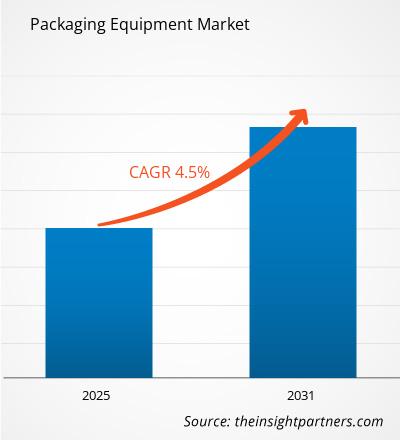
The global Packaging Equipment market was valued at US$ 64.02 billion in 2025 and is expected to reach US$ 82.98 billion by 2034; it is estimated to record a CAGR of 2.92% during 2026-2034.
Packaging Equipment Market Assessment and Insights
- North America accounted for 28–30% share in 2025 and is projected to grow at 2.8–3.4% CAGR during 2026–2034, led by automation retrofits, food safety compliance, and replacement demand.
- US represented 78–82% of North America in 2025 and is expected to advance at 2.9–3.5% CAGR, supported by high-speed food and beverage lines.
- Europe held 24–26% share in 2025 and is forecast to grow at 2.6–3.2% CAGR, with Germany, Italy, France, and the UK leading machinery modernization.
- Asia Pacific captured 34–36% share in 2025 and is expected to rise at 3.8–4.5% CAGR, driven by China, India, Japan, and South Korea.
- Largest Segment Food and Beverage held 42–45% market share in 2025 and is projected to grow at 3.2–3.8% CAGR, reflecting high-volume packaged consumption.
- High Growth Segment Medical held 15–18% market share in 2025 and is forecast to grow at 4.0–4.8% CAGR, supported by sterile and serialized packaging.
- Key companies analyzed in detail: Aagard Group, LLC; All Packaging Machinery Corporation; ARPAC LLC; Syntegon Technology GmbH; Douglas Machine Inc.; Duravant LLC; Garvey Corporation; KHS GmbH; Krones AG; and Sidel Group.
Source: The Insight Partners' analysis based on proprietary research, government publications, company annual reports, investor presentations, industry databases, and expert interviews.
The packaging equipment market has moved from being single stand-alone mechanical equipment to packaging cells that consist of filling, sealing, labeling, coding, inspection, and end of line machinery. Suppliers are now focusing on providing faster changeovers, higher up-time analytics, hygienic design, energy efficiency, and faster service rather than simply offering faster speeds.
In the coming years, with the rise of manufacturing clusters in countries like India, South East Asia, the Gulf regions, and Mexico, there is likely to be a growing demand for medium-speed and fully automated equipment. Positive regulatory factors concerning traceability, recyclable packaging and worker safety will drive investments in sensors, robotics and validation ready machines. The market is likely to gain from these developments.
Packaging Equipment Market Report Scope
| Report Attribute | Details |
|---|---|
| Market size in 2025 | US$ 64.02 Billion |
| Market Size by 2034 | US$ 82.98 Billion |
| Global CAGR (2026 - 2034) | 2.92% |
| Historical Data | 2021-2024 |
| Forecast period | 2026-2034 |
Packaging Equipment Market Analysis
Increased manufacturing of packaged foods, beverage line diversification, pharmaceutical regulations, and personal care product range increase are key elements in the market. Manufacturers require equipment that helps reduce giveaway, ensures shelf life, and operates well even in absence of labor. Upstream components such as motors, PLCs, sensors, stainless steel, pneumatic systems, and servo drives will affect lead times while the end-users judge their equipment based on its cost of ownership, sanitization, changeovers, and serviceability.
The supply chain dynamics are still dictated by the expertise available in the region and customized solutions for different clients. European and Japanese companies continue dominating the precision fillers and beverage lines segments while their North American counterparts provide competitive offerings in secondary packaging, cartoning systems, conveyor systems, and integration. The industry is gradually shifting towards lifecycle revenues through spare parts, remote diagnostics, and maintenance services contracts.
In the Packaging Equipment Market report, the industry is found to be fragmented and technologically differentiated. The firms Krones AG, KHS GmbH, Sidel Group, and Syntegon Technology GmbH focus on high-speed beverage, food, and healthcare packaging systems, whereas firms such as Aagard Group, LLC, Douglas Machine Inc., Garvey Corporation, Duravant LLC, All Packaging Machinery Corporation, and ARPAC LLC cater to flexible automation, conveying, shrink wrapping, and case handling solutions.
Increasing investments are being made in robotic packaging equipment, artificial intelligence-based inspection systems, and small footprint packing lines to save on real estate and utility usage. Positioning is based on installed base servicing capability, machine integration capabilities, and recycling films, light bottles, and sterile containers. With capital expenditure normalization, firms that have consultative engineering and digital service platforms are expected to benefit from better value opportunities.
● REPORT CUSTOMIZATION
Tailor This Report To Align With Your Specific Business Requirements
This report can be customized to align precisely with your business objectives, scope, and target markets. Customization options include tailored segmentation, geography, competitive analysis, and strategic insights to support informed decision-making.
Customize This Report →WHAT YOU CAN ADJUST
- ● Segmentations
- ● Geography
- ● Competitive Analysis
- ● Language Preferences
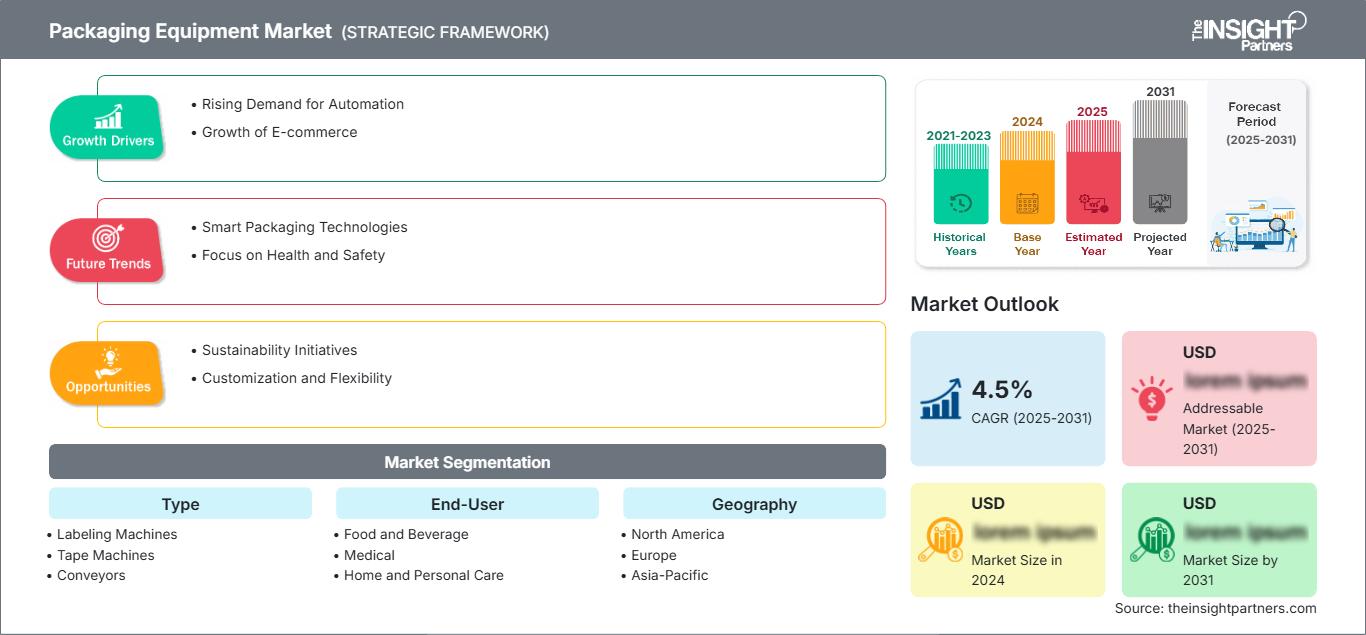
Packaging Equipment Market: Strategic Insights
Regional Insights
North America Packaging Equipment Market
North America held a market share of 28-30% in 2025 and is expected to register a growth of 2.8-3.4% CAGR in the period 2026-2034. The North America Packaging Equipment Market Share includes a mature market with replacement demand, rising labor costs, and regulations for food, beverages, and healthcare packaging. High demand is recorded for filling lines, hygienic conveyors, sealers, and secondary packaging solutions.
There is an emphasis on automation in order to support fast time-to-market and compliance. Continued investments in end-of-line robotic solutions, case packing, and labeling technologies from North American manufacturing companies including the US and Canada for food, beverage, healthcare, and consumer packaged goods will boost growth.
U.S. Packaging Equipment Market
The United States made up between 78%-82% of the region's population in 2025 and is anticipated to expand at a CAGR of 2.9%-3.5% up to 2034. The drivers behind the demand are substantial manufacturing centers of packaged food, beverage, medical devices, and personal care products. Firms including Aagard Group, LLC, Douglas Machine Inc., Garvey Corporation, and Duravant LLC will enjoy local access to engineering and services.
The future of applications includes flexible automation, vision inspection, serialization, and line balancing. In case of food industries, washdown capable machines are a necessity, and in beverages, fast filling and labeling systems are needed. Lastly, in medical applications, seal integrity and validation capability are crucial.
Europe Packaging Equipment Market
Europe had market share of 24–26%, and is anticipated to grow at 2.6–3.2% CAGR from 2026 to 2034. Germany leads due to expertise in machinery engineering, beverage equipment manufacturing, and export oriented nature. Europe's contribution comes from food processing, cosmetics, pharmaceutical industries, and private label packaging industries.
The United Kingdom is focused on automation for labor efficiency and retailers' pack variation requirements. Germany leads in precision filling, labeling and inspection systems, as provided by Krones AG, KHS GmbH, and Syntegon Technology GmbH. France, Italy, and Spain have equal demand in dairy, beverages, pharmaceutical and personal care products with sustainable guidelines increasing machinery compatibility with recyclable substrates.
APAC Packaging Equipment Market
Share of APAC was 34–36% in 2025, which is expected to increase at a CAGR of 3.8–4.5%, thus, leading the charge. Demand in the region is dominated by China, while Japan and South Korea focus on precise automation, and India increases production in food & beverages and pharmaceutical packaging.
Policies of industries, exportation, and consumption are driving investments towards automation technologies. Australia is adding to this demand through sectors like packaged foods, dairy products, and health care. Cost effective and scalable systems which provide access and flexibility will have many chances in the region.
Middle East & Africa Packaging Equipment Market
The Middle East & Africa region is expected to witness a 3.1%–3.8% CAGR between 2025 and 2034, led by investments in Saudi Arabia. The reasons include food security initiatives, need for bottled water, and downstream petrochemical packaging.
The UAE focuses on logistics-related food & beverage packaging, whereas South Africa accounts for demand due to retail food, personal care, and industrial applications. Profits from energy and investments in infrastructure provide opportunities for modernization, although imports and services are still significant in the decision-making process of the market.
Segmentation Analysis
Type
Type is expected to grow at 3.1–3.7% CAGR during 2026–2034 as producers combine primary, secondary, and end-of-line systems into synchronized production flows. The Packaging Equipment Market scope across machine types is widening because buyers need assets that handle recyclable materials, faster changeovers, integrated inspection, and data capture without compromising hygiene or uptime.
- Labeling Machines support brand differentiation, regulatory information, and traceability needs, especially for beverages, personal care, and pharmaceuticals where high-speed coding accuracy influences compliance and shelf presentation.
- Tape Machines remain important in corrugated case sealing, e-commerce fulfillment, and industrial packaging because they provide consistent closure quality, reduced manual effort, and predictable consumable use.
- Conveyors function as the line backbone, linking fillers, sealers, inspection units, and palletizers while improving throughput balance, accumulation control, and operational safety across automated facilities.
- Filling Machines serve high-value applications in beverages, dairy, sauces, pharmaceuticals, and chemicals where dosing precision, contamination control, and container flexibility directly affect product quality.
- Sealers are critical for shelf-life protection, tamper evidence, and leak prevention across flexible packs, trays, pouches, and medical packages requiring validated closure performance.
- Strapping/Bundling Machines provide load stability for cartons, bottles, cans, and industrial goods, supporting warehouse efficiency, pallet integrity, and reduced transport damage.
- Wrapping Machines address shrink, stretch, flow, and overwrap formats, helping producers improve visual appeal, multipack handling, and protection during distribution.
End-User
End-User is projected to grow at 3.3–3.9% CAGR during 2026–2034, led by packaged consumption, healthcare compliance, and industrial product safety. Food and beverage remains the largest segment, while medical applications show faster adoption of sterile, serialized, and tamper-evident formats. Equipment selection increasingly reflects material compatibility, cleanability, and validation documentation.
- Food and Beverage dominates demand as processors require high-speed filling, sealing, labeling, and wrapping systems that protect freshness, support retail-ready packs, and reduce contamination risks.
- Medical requires validated sealing, sterile handling, serialization, and inspection systems, making equipment reliability and documentation essential for regulated pharmaceutical, diagnostic, and medical device packaging.
- Home and Personal Care uses flexible, bottle, tube, and carton formats where visual quality, fragrance protection, dosing accuracy, and rapid SKU changes influence equipment investment.
- Industrial demand is tied to chemicals, hardware, components, and bulk goods that require durable filling, bundling, strapping, and wrapping systems for safe distribution.
Opportunity Snapshot
| End-User | Revenue Contribution | Trend Tag | Adoption Stage |
| Food and Beverage | High | Hygienic Lines | Mature |
| Medical | Medium | Sterile Packs | Scaling |
| Home and Personal Care | Medium | Format Flex | Scaling |
| Industrial | Medium | Load Stability | Mature |
| Others | Low | Niche Packs | Emerging |
Packaging Equipment Market Growth Drivers and Impact Analysis
Automation Becomes a Labor and Quality Imperative
Shortages of trained staff have led to increased automation in processes such as filling, conveying, case packing, labeling, and palletizing. Automation helps decrease repetitive manual operations, improves speed uniformity, and reduces errors in highly regulated and high production environments. The economic effect is most pronounced in situations where the manufacturer experiences wage increases, labor turnover, and late shipment penalties from retailers. Machine manufacturers who provide user-friendly interfaces, remote assistance, and predictive diagnosis are better poised as consumers tend to judge machinery based on uptime and labor reduction as well as cost.
Sustainability Rules Reshape Machine Specifications
There is a trend in the packaging industry where manufacturers are developing their designs based on recycling, mono-material films, lighter weight packaging and less secondary packaging. Such innovations require machinery that will be able to handle thin substrates, different types of adhesives, different stiffness, and narrow sealing window. market will be directly impacted by such changes since switching to a new material may have an impact on the efficiency of the existing machinery.
Regulated Packaging Needs Drive Validation-Ready Systems
Medical, pharmaceutical, nutraceutical, and premium food producers require evidence that packs are sealed, coded, traceable, and contamination controlled. This pushes demand for vision systems, checkweighers, serialization interfaces, and documented change-control features. The impact extends beyond machine sales because validation, training, calibration, and service contracts become part of the buying decision. Suppliers with cleanroom-compatible designs and strong documentation capabilities can shorten customer qualification cycles and improve project win rates in regulated applications.
Packaging Equipment Market Future Trends
Software-Defined Packaging Lines
Packaging Equipment Market trends will increasingly center on software-defined line control, where machines exchange production data, self-adjust parameters, and flag maintenance needs before failures occur. Digital twins and recipe management will reduce commissioning time for new formats, while machine learning will improve defect detection in labels, seals, and fill levels. This shift favors suppliers that can integrate mechanical engineering with secure connectivity, analytics, and lifecycle service models across multi-vendor production environments.
Compact Modular Cells for Shorter Runs
Brand owners are moving toward smaller batches, seasonal packs, private-label variants, and localized assortments. Future machinery platforms will therefore emphasize modular cells that can be rearranged, upgraded, or redeployed with limited engineering disruption. Compact cells will help plants conserve floor space and shorten product launch cycles. Suppliers that standardize modules for filling, sealing, inspection, and secondary packaging can improve customer flexibility while protecting margin through repeatable engineering.
Packaging Equipment Market Opportunities
Service-Led Revenue Models for Installed Bases
Large installed bases create an opportunity to expand beyond equipment sales into spare parts, audits, upgrades, remote monitoring, and operator training. Customers want measurable uptime improvement without replacing entire lines, especially in mature markets where capital budgets are selective. Vendors can package service contracts around predictive maintenance, energy optimization, and material change validation. This approach improves recurring revenue while helping producers extend asset life and maintain regulatory compliance.
Emerging Market Automation for Mid-Speed Lines
Emerging producers often need reliable mid-speed machinery before moving to fully automated mega-lines. India, Southeast Asia, the Gulf, and parts of Africa offer demand for filling, sealing, wrapping, and labeling platforms that balance cost, durability, and service access. Suppliers that localize training, stock critical spares, and simplify controls can win first-time automation buyers. Partnerships with regional integrators will be important for commissioning, maintenance, and application customization.
Recent Developments
- January 2026: Amcor will welcome visitors at the International Production & Processing Expo (IPPE) 2026, Jan. 27–29 at the Georgia World Congress Center in Atlanta. In booth C38139 Amcor will showcase flexible packaging solutions for fresh and processed protein, in both the retail and foodservice categories.
- August 2025: Baumer will be showcasing new, smart solutions for applications ranging from tank storage to packaging at drinktec 2025.
- March 2025: The DIGI/TERAOKA Group will showcase an innovative lineup of packaging, labeling, and software systems designed to optimize efficiency, extend product shelf life, reduce waste, enhance data management and reduce labor burdens at IFFA 2025, to be held in Frankfurt, Germany from May 3rd to 8th, 2025.
Frequently Asked Questions

- Comprehensive Market Sizing and Forecast Analysis
- Detailed Segmentation Analysis
- In-Depth Market Dynamics Assessment
- Regional and Country-Level Insights
- Competitive Landscape and Company Benchmarking
- Strategic Business Intelligence
Recent Reports
Testimonials

The Insight Partners' SCADA System Market report is comprehensive, with valuable insights on current trends and future forecasts. The team was highly professional, responsive, and supportive throughout. We are very satisfied and highly recommend their services.
RAN KEDEM Partner, Reali Technologies LTDs
I requested a report on a very specific software market and the team produced the report in a few days. The information was very relevant and well presented. I then requested some changes and additions to the report. The team was again very responsive and I got the final report in less than a week.
JEAN-HERVE JENN Chairman, Future Analytica
We worked with The Insight Partners for an important market study and forecast. They gave us clear insights into opportunities and risks, which helped shape our plans. Their research was easy to use and based on solid data. It helped us make smart, confident decisions. We highly recommend them.
PIYUSH NAGPAL Sr. Vice President, High Beam Global
The Insight Partners delivered insightful, well-structured market research with strong domain expertise. Their team was professional and responsive throughout. The user-friendly website made accessing industry reports seamless. We highly recommend them for reliable, high-quality research services
YUKIHIKO ADACHI CEO, Deep Blue, LLC.
This is the first time I have purchased a market report from The Insight Partners.While I was unsure at first, I visited their web site and felt more comfortable to take the risk and purchase a market report.I am completely satisfied with the quality of the report and customer service. I had several questions and comments with the initial report, but after a couple of dialogs over email with their analyst I believe I have a report that I can use as input to our strategic planning process.Thank you so much for taking the extra time and making this a positive experience.I will definitely recommend your service to others and you will be my first call when we need further market data.
JOHN SUZUKI President and Chief Executive Officer, Board Director, BK Technologies
I wish to appreciate your support and the professionalism you displayed in the course of attending to my request for information regarding to infectious disease IVD market in Nigeria. I appreciate your patience, your guidance, and the fact that you were willing to offer a discount, which eventually made it possible for us to close a deal. I look forward to engaging The Insight Partners in the future, all thanks to the impression you have created in me as a result of this first encounter.
DR CHIJIOKE ONYIA MANAGING DIRECTOR, PineCrest Healthcare Ltd.Reason to Buy
- Informed Decision-Making
- Understanding Market Dynamics
- Competitive Analysis
- Identifying Emerging Markets
- Customer Insights
- Market Forecasts
- Risk Mitigation
- Boosting Operational Efficiency
- Strategic Planning
- Investment Justification
- Tracking Industry Innovations
- Aligning with Regulatory Trends





 Get Free Sample for