
Paper Marking Machine Market Size, Demand & Growth by 2034
Coverage: By Machine Type (Specialty Paper Machine, Graphic Paper Machine, Packaging Paper Machine, and Tissue Paper Making Machines), Type (Semi-Automatic and Fully Automatic), Application (Industrial and Commercial), , and by Geography (North America, Europe, Asia Pacific, and South and Central America)
- Status : Data Released
- Report Code : TIPRE00008296
- Category : Manufacturing and Construction
- No. of Pages : 150
- Available Report Formats :


- Last update date : August 04, 2026


2025 Market Size
US$ 19.04 Bn
Base year value
2034 Forecast
US$ 31.85 Bn
Projected by 2034
CAGR 2026-2034
5.88 %
Growth rate
Addressable Market
US$ 230.51 Bn
(2026-2034)
The Paper Marking Machine Market is valued at US$ 19.04 Billion in 2025 and expected to grow and touch US$ 31.85 Billion by 2034, registering a CAGR of 5.88% during the forecast period 2026-2034. Drivers include investments in capacities meeting packaging standards, automation of paper converting lines, and modernization of facilities for tissue, graphic, specialty, and industrial papers manufacturing.
North America continues to be a technology-driven market, where the CAGR for growth is estimated to range between 4.9%-5.4% during the forecast period 2026-2034. Upgrading of aging converting machines, stringent quality standards, and faster packaging line speeds are some of the factors impacting procurement decisions. Growth of the Paper Marking Machine Market size in North America is driven by the need for traceable and waste-free production, meeting the needs of packaging, hygiene, and commercial printing operations.
Paper Marking Machine Market Assessment and Insights
- North America accounted for 28–31% share in 2025 and is projected to grow at a 4.9–5.4% CAGR during 2026–2034, supported by packaging automation, mill upgrades, and quality assurance investments.
- US represented 72–75% of North America in 2025 and is expected to expand at a 5.0–5.5% CAGR through 2034, led by commercial printing and packaging conversion.
- Europe held 24–27% share in 2025 and is forecast to grow at a 4.4–4.9% CAGR, with Germany, the UK, France, Italy, and Spain supporting equipment replacement.
- Asia Pacific captured 34–38% share in 2025 and is projected to grow at a 6.4–6.9% CAGR, led by China, India, Japan, South Korea, and Australia.
- Largest Segment Packaging Paper Machine held 38–42% market share in 2025 and is expected to grow at a 6.1–6.6% CAGR due to corrugated and paperboard demand.
- High Growth Segment Fully Automatic systems held 46–50% market share in 2025 and are projected to grow at a 6.8–7.3% CAGR as mills prioritize labor-light operations.
- Key companies analyzed in detail: Alpha Napkin Machines, Aman Impex, Beston Machinery Paper Machine, GreenLand Enterprises, NSK Ltd., Parason, Rajshree Enterprise, S. L. Paper Machines LLP, Seiko Epson Corporation, and Unique Fluid Controls.
Source: The Insight Partners' analysis based on proprietary research, government publications, company annual reports, investor presentations, industry databases, and expert interviews.
In machine acquisition, reliability has evolved into a combination of forming, drying, inspection, and marking controls. Paper manufacturers are focusing on achieving high levels of uptime, reduced trim waste, and fast grade changeovers. Data collected in Europe for the year 2025 indicated that packaging and paperboard production remained steady while there was a decline in graphic papers.
For the future, new manufacturers from Asia and the Middle East are expected to adopt machines with increased capacity with the rise in the consumption of consumer packages, e-commerce deliveries, and hygiene products. The regulatory need for recycle-able paper products along with the energy efficiency programs adopted in industries have forced customers to opt for machines with digital control and monitoring features.
Paper Marking Machine Market Report Scope
| Report Attribute | Details |
|---|---|
| Market size in 2025 | US$ 19.04 Billion |
| Market Size by 2034 | US$ 31.85 Billion |
| Global CAGR (2026 - 2034) | 5.88% |
| Historical Data | 2021-2024 |
| Forecast period | 2026-2034 |
Paper Marking Machine Market Analysis
Growth in the Paper Marking Machine market comes from converters who wish to gain better output identification, defect reduction, and increased line speed performance. There is the greatest need where packaging and tissue grades have the need for rapid batching, print registration, and automatic handling. Industry statistics show that packaging grades are more durable than graphic grades, thus providing a rationale for investment in machines that work on board, tissue and speciality papers.
The supply chain is affected by component availability, precision controls, bearing and drive systems, and servicing. Makers of marking machinery with strong engineering skills and installation capabilities in different regions are more competitive since customers look at life cycle productivity and not just the price of the machine. This includes a combination of paper mills, converters, consumables makers, automation and maintenance companies.
The Paper Marking Machine Market report reveals that the market features fragmentation where regional experts battle with general machinery and components suppliers. Parason and S. L. Paper Machines LLP are aided by experience with mill machinery, and NSK Ltd. aids in precision motion needs. Seiko Epson Corporation comes with knowledge in printhead and marking technology, and Indian experts cater to cost-sensitive semi-automatic plants.
Funding is taking place in segments such as modularization, predictive maintenance abilities, and automation customization. Alpha Napkin Machines, Aman Impex, GreenLand Enterprises, Rajshree Enterprise, Beston Machinery Paper Machine, and Unique Fluid Controls give priority to machinery that can work in specific applications as well as spare parts and plant level integration. Factors like serviceability, energy efficiency, adaptability with inspection technology, and upgradation to packaging line technology will definitely emerge as differentiation factors.
● REPORT CUSTOMIZATION
Tailor This Report To Align With Your Specific Business Requirements
This report can be customized to align precisely with your business objectives, scope, and target markets. Customization options include tailored segmentation, geography, competitive analysis, and strategic insights to support informed decision-making.
Customize This Report →WHAT YOU CAN ADJUST
- ● Segmentations
- ● Geography
- ● Competitive Analysis
- ● Language Preferences
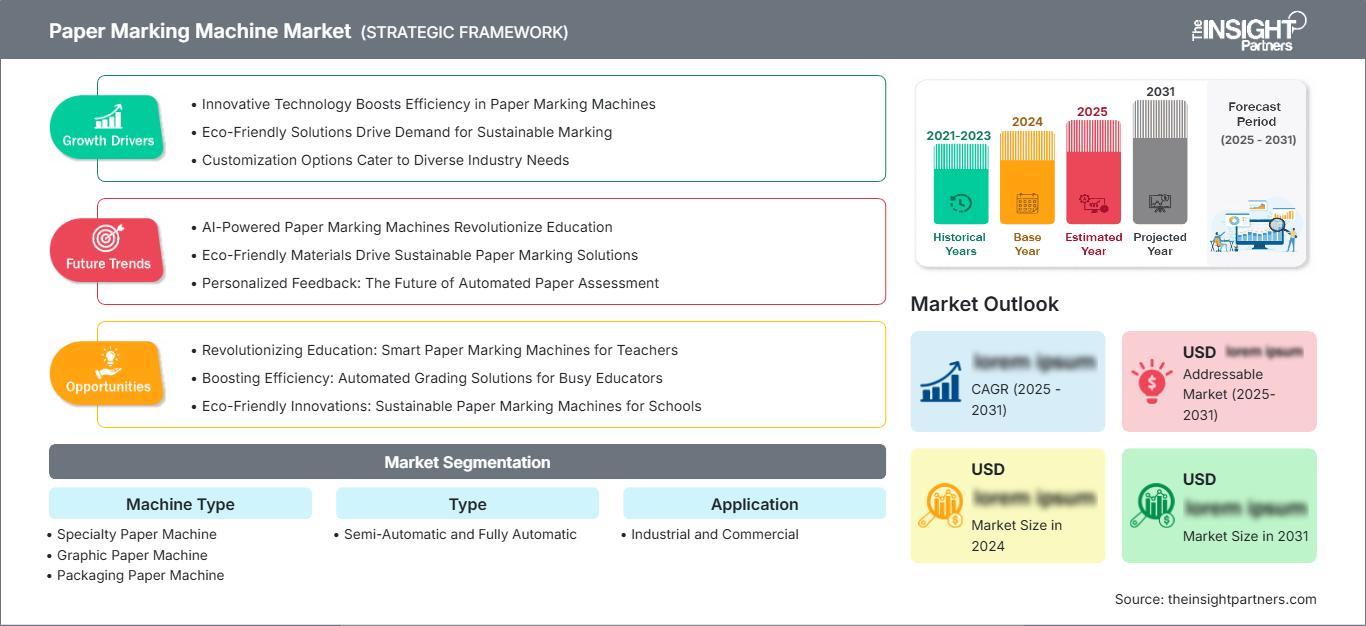
Paper Marking Machine Market: Strategic Insights
Regional Insights
North America Paper Marking Machine Market
North America was seen having a market share of 28–31% in 2025, while growth is anticipated at a CAGR of 4.9–5.4% from 2026 to 2034. Automation-enabled replacement needs, packaging, and tissue line upgrades are expected to benefit the North American market. Users have been looking for ways to reduce downtime, mark consistently, and use inspection equipment.
The Market in North America enjoys a strong presence in establishments specializing in packaging for e-commerce, foodservice boards, hygiene papers, and short-run commercial products. The market is being driven by skilled service ecosystems and automated purchase behavior. Energy costs and labor issues are driving the need for completely automatic machines.
U.S. Paper Marking Machine Market
The U.S. held a share of 72–75% of North America in 2025, and it is expected to achieve a CAGR of 5.0–5.5% during the period 2026-2034. The requirement is highest from packaging converters, tissue manufacturers, and commercial printers requiring high-speed identification and batch traceability. Install base replacement is important due to the need to convert old lines into digital.
The market is influenced by the presence of manufacturers of components, machinery importers, and integrators who cater to the maintenance requirements of the mills. Industrial applications are more common since there is a need for rugged marking and alignment in the manufacturing of corrugated board, paperboard packaging, and hygiene applications. There are more commercial applications due to the use of automation in short-run print shops.
Europe Paper Marking Machine Market
Europe accounted for a 24–27% share in 2025 and is estimated to grow at a CAGR of 4.4–4.9%. Germany is at the top of regional demand due to its base in paper, packaging, and machinery that allows for high-level automation. The UK is growing due to the demand for the upgrades of the packaging converters into retail-ready packages.
France, Italy, and Spain make contributions in food packaging, tissue conversion, and specialty paper applications. There is a steady supply in packaging and tissue production, and the decrease in graphic papers in Europe. This creates a push toward flexible machinery. Hence, the market in Europe is driven by sustainability, circular materials, and modernization of facilities amid high costs of labor and energy.
APAC Paper Marking Machine Market
APAC market registered a market share of 34-38% in 2025 and is forecasted to grow at a CAGR of 6.4-6.9%, becoming the largest regional market for demand. China is the biggest country market due to mass paperboard production, while India is aided by its demand for packaging papers, education-driven paper usage, and hygienic products' growing demand.
The Japanese and Korean markets pay much attention to accuracy, automation, and uniformity, while Australia focuses on commercial and industrial applications of paper. Manufacturing and export packaging and waste management policies favor equipment deployment. Growth of the region's Paper Marking Machine Market is also driven by additional capacities for packaging papers and tissue converting.
Middle East & Africa Paper Marking Machine Market
The Middle East & Africa market is anticipated to experience a CAGR of 5.3-5.8% for 2026-2034. Saudi Arabia and UAE are driving demand on the back of investments in packaging, logistics, and retail infrastructure. South Africa serves as the anchor country for the adoption of the industry in the region, with the Rest of MEA region relying on import substitution and converting capabilities.
Paper production facilities that require heavy energy consumption are motivating buyers to invest in solutions that boost productivity per kilowatt and minimize rejects. Foodservice packaging, tissue manufacturing, and commercial printing are some of the demand categories where investments make sense.
Segmentation Analysis
Machine Type
Machine Type is projected to grow at a 5.7–6.2% CAGR during 2026–2034. The Paper Marking Machine Market scope across this segment reflects distinct operating needs in packaging, graphic, specialty, and tissue production. Buyers prioritize machine compatibility with paper grades, output speed, surface quality, and the ability to support automated quality checks without disrupting forming or converting workflows.
- Specialty Paper Machine demand is supported by thermal, label, security, and technical papers where consistent marking, substrate sensitivity, and defect traceability are critical for premium applications.
- Graphic Paper Machine adoption is more replacement-led as print volumes soften, but commercial printers still invest in accurate marking to support short runs and quality consistency.
- Packaging Paper Machine remains the largest sub-segment as corrugated board, cartons, and recyclable packaging require high-speed identification, batch control, and dependable finishing integration.
- Tissue Paper Making Machines gain importance through hygiene demand, with converters seeking machines that preserve softness, support high output, and reduce downtime in wrapping and finishing.
Type
Type is expected to expand at a 5.9–6.4% CAGR during 2026–2034. Equipment selection depends on production scale, labor availability, capital discipline, and integration requirements. Semi-automatic systems remain practical for smaller converters, while fully automatic machines are gaining share as paper producers seek repeatability, lower operator dependence, real-time monitoring, and faster grade changeovers.
- Semi-Automatic machines serve cost-sensitive mills and smaller commercial users that need controlled marking performance without committing to fully integrated digital production architecture.
- Fully Automatic machines are favored by high-volume converters because they reduce manual intervention, improve line synchronization, and support predictive maintenance across continuous production environments.
Application
Application is projected to grow at a 5.8–6.3% CAGR during 2026–2034. Industrial users dominate because large paper and packaging lines need dependable marking under continuous throughput conditions. Commercial users are expanding adoption where customized print runs, branded packaging, and shorter production cycles make automated accuracy more valuable than manual inspection.
- Industrial applications lead revenue contribution as mills, converters, and packaging plants require high-speed equipment that supports traceability, uptime, and reduced rejection rates.
- Commercial applications grow through print shops, branded packaging providers, and small converters that need flexible marking systems for varied jobs and faster turnaround cycles.
Opportunity Snapshot
| Application | Revenue Contribution | Trend Tag | Adoption Stage |
| Industrial | High | Line Automation | Scaling |
| Commercial | Medium | Short Runs | Emerging |
Paper Marking Machine Market Growth Drivers and Impact Analysis
Packaging Capacity Modernization
Packaging producers are replacing slower marking and finishing equipment as corrugated, cartonboard, and paper-based mailer demand rises. The impact is practical: mills need systems that mark consistently at higher line speeds while reducing rejected sheets and roll waste. As brand owners move toward recyclable substrates, converters must handle more paper grades without losing identification accuracy. This driver supports investment in packaging paper machines, especially where retail-ready packaging, e-commerce fulfillment, and foodservice formats require clear batch control and traceability.
Automation to Offset Labor and Quality Constraints
Labor availability and inspection consistency remain operational challenges for paper converters. Automated marking systems reduce dependence on manual adjustments, improve repeatability, and allow operators to monitor larger portions of the line. Fully automatic machines also support faster setup during product changeovers, which is valuable for mills handling multiple grades or customer-specific specifications. The result is a measurable reduction in downtime risk and a stronger business case for upgrading from semi-automatic systems in high-volume industrial facilities.
Energy Efficiency and Waste Reduction Priorities
Paper manufacturing is energy-intensive, so equipment purchases increasingly consider output quality per unit of energy consumed. Machines that reduce misalignment, rejected output, and repeated runs directly support sustainability and cost objectives. This matters in regions facing high power prices, carbon reporting pressure, or stricter industrial efficiency requirements. Buyers are therefore evaluating marking equipment not only as production hardware but also as part of a broader yield-management strategy that improves profitability and supports compliance with customer sustainability expectations.
Paper Marking Machine Market Future Trends
Sensor-Based Process Intelligence
Paper Marking Machine Market trends point toward sensor-enabled systems that detect alignment drift, ink or marking inconsistency, vibration, and surface defects before they become production losses. Future machines are likely to combine real-time data capture with operator dashboards and predictive maintenance alerts. This will help mills shift from reactive repair to planned intervention. The trend is particularly relevant for packaging and tissue lines, where continuous operation and product hygiene standards leave limited tolerance for defects.
Flexible Machines for Mixed Paper Grades
Converters are moving toward equipment that can handle multiple paper grades, thicknesses, and surface finishes without extensive mechanical reconfiguration. Future demand will favor modular marking platforms with faster calibration, recipe-based settings, and compatibility with recycled or lightweight substrates. This flexibility will be important as brands diversify packaging formats and mills balance tissue, specialty, and packaging orders. Suppliers that simplify grade switching while maintaining output quality should gain stronger access to mid-sized and export-oriented converters.
Paper Marking Machine Market Opportunities
Industrial Packaging Line Upgrades in Emerging Economies
Emerging economies offer strong opportunities as converters shift from manual or semi-automatic equipment to integrated production lines. Paper Marking Machine Market Forecasts indicate that investment will be concentrated in industrial packaging facilities serving consumer goods, food distribution, and e-commerce channels. Suppliers can capture demand by offering scalable systems, local service support, and financing-friendly configurations. The most attractive opportunities are in plants where marking accuracy directly reduces customer returns, packaging waste, and downtime during high-volume production cycles.
Service-Led Revenue Models for Installed Base Modernization
A large installed base of older paper and converting machines creates an opportunity for retrofit kits, maintenance contracts, and digital upgrade packages. Suppliers can strengthen margins by bundling calibration, spare parts, remote diagnostics, and operator training with equipment sales. This approach is especially relevant in North America and Europe, where replacement cycles are disciplined and mills seek productivity gains without full-line rebuilds. Service-led models also improve customer retention by linking machine performance to measurable uptime outcomes.
Recent Developments
- February 2025: PRAKASH GROUP participated in 16th Printpack, Noida – 2025 event to showcase products such as in-press, post-press, finishing, converting, digital & signage and packaging machines, packaging materials, printing & publishing, paper and paper products, logistics & transportation industries and allied products.
- November 2024: Videojet Technologies is pleased to announce new capabilities of the Videojet 2380 large character marking system. Videojet 2380 prints variable high-resolution alphanumeric text, 2D codes, and product identification information on cases, cartons, and other secondary packaging.
- November 2024: Mondi, a global leader in sustainable packaging and paper, has announced the start-up of its new extrusion line at Mondi Coating Štĕti (Czech Republic), marking another milestone in the Group’s commitment to support customers in their transition to sustainable solutions. The extrusion line is part of a wider investment that includes a new production building with state-of-the-art machinery including coating and slitting capabilities. The investment expands the production of FunctionalBarrier Papers and other high quality coated papers, offering paper-based solutions with customized barrier properties.
Frequently Asked Questions

- Comprehensive Market Sizing and Forecast Analysis
- Detailed Segmentation Analysis
- In-Depth Market Dynamics Assessment
- Regional and Country-Level Insights
- Competitive Landscape and Company Benchmarking
- Strategic Business Intelligence
Recent Reports
Testimonials

The Insight Partners provided valuable market intelligence that supported our global go-to-market strategy. Their team was professional, responsive, and attentive to our feedback, providing thoughtful analysis and helpful methodological clarifications throughout the project.
Junmo Kim Chief Financial Officer (CFO), Enertech Co., Ltd.
The Insight Partners' SCADA System Market report is comprehensive, with valuable insights on current trends and future forecasts. The team was highly professional, responsive, and supportive throughout. We are very satisfied and highly recommend their services.
RAN KEDEM Partner, Reali Technologies LTDs
I requested a report on a very specific software market and the team produced the report in a few days. The information was very relevant and well presented. I then requested some changes and additions to the report. The team was again very responsive and I got the final report in less than a week.
JEAN-HERVE JENN Chairman, Future Analytica
We worked with The Insight Partners for an important market study and forecast. They gave us clear insights into opportunities and risks, which helped shape our plans. Their research was easy to use and based on solid data. It helped us make smart, confident decisions. We highly recommend them.
PIYUSH NAGPAL Sr. Vice President, High Beam Global
The Insight Partners delivered insightful, well-structured market research with strong domain expertise. Their team was professional and responsive throughout. The user-friendly website made accessing industry reports seamless. We highly recommend them for reliable, high-quality research services
YUKIHIKO ADACHI CEO, Deep Blue, LLC.
This is the first time I have purchased a market report from The Insight Partners.While I was unsure at first, I visited their web site and felt more comfortable to take the risk and purchase a market report.I am completely satisfied with the quality of the report and customer service. I had several questions and comments with the initial report, but after a couple of dialogs over email with their analyst I believe I have a report that I can use as input to our strategic planning process.Thank you so much for taking the extra time and making this a positive experience.I will definitely recommend your service to others and you will be my first call when we need further market data.
JOHN SUZUKI President and Chief Executive Officer, Board Director, BK Technologies
I wish to appreciate your support and the professionalism you displayed in the course of attending to my request for information regarding to infectious disease IVD market in Nigeria. I appreciate your patience, your guidance, and the fact that you were willing to offer a discount, which eventually made it possible for us to close a deal. I look forward to engaging The Insight Partners in the future, all thanks to the impression you have created in me as a result of this first encounter.
DR CHIJIOKE ONYIA MANAGING DIRECTOR, PineCrest Healthcare Ltd.Reason to Buy
- Informed Decision-Making
- Understanding Market Dynamics
- Competitive Analysis
- Identifying Emerging Markets
- Customer Insights
- Market Forecasts
- Risk Mitigation
- Boosting Operational Efficiency
- Strategic Planning
- Investment Justification
- Tracking Industry Innovations
- Aligning with Regulatory Trends





 Get Free Sample for