
Passive Fire Protection Coating Market Demand, Share & Growth by 2034
Coverage: by Type (Intumescent Coatings, Cementitious Coatings); Technology (Water-Based, Solvent-Based); End-Use Industry (Building and Construction, Oil and Gas, Transportation, Others) , and Geography (North America, Europe, Asia Pacific, and South and Central America)
- Status : Data Released
- Report Code : TIPRE00006773
- Category : Chemicals and Materials
- No. of Pages : 150
- Available Report Formats :


- Last update date : July 15, 2026


2025 Market Size
US$ 4.58 Bn
Base year value
2034 Forecast
US$ 7.27 Bn
Projected by 2034
CAGR 2026-2034
5.27 %
Growth rate
Addressable Market
US$ 53.76 Bn
(2026-2034)
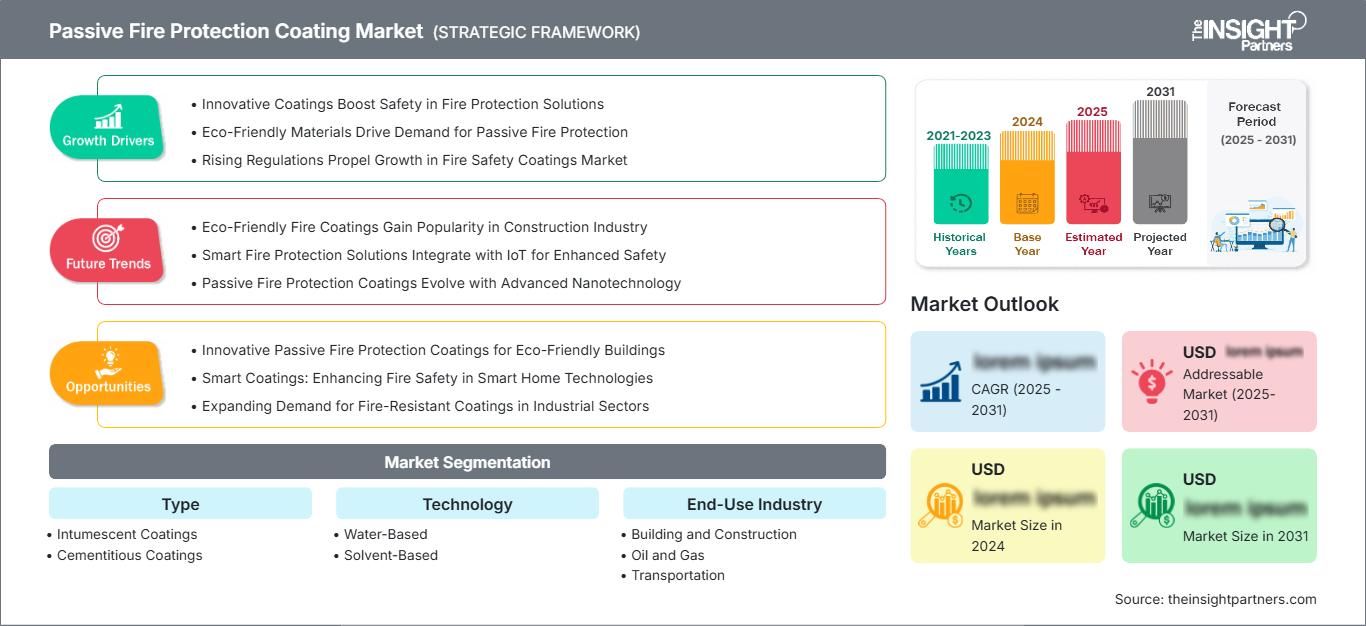
The Passive Fire Protection Coating Market was valued at US$ 4.58 Billion in 2025 and is projected to reach US$ 7.27 Billion by 2034, expanding at a CAGR of 5.27% during 2026–2034. Growing emphasis on structural fire safety, stricter building regulations, and increasing investments in industrial infrastructure are reinforcing demand for advanced passive fire protection solutions across commercial buildings, energy facilities, transportation assets, and manufacturing environments.
North America remains a significant contributor to market expansion, with the regional market anticipated to register a CAGR of approximately 5.0%–5.4% through 2034. Growth is supported by modernization of aging infrastructure, heightened compliance requirements for fire-resistant construction materials, and sustained investments in industrial facilities where asset protection, business continuity, and personnel safety remain operational priorities.
Passive Fire Protection Coating Market Assessment and Insights
- North America: North America accounted for 34–38% market share in 2025 and is projected to expand at a CAGR of 4.8%–5.3% during 2026–2034. Growth is driven by stringent building regulations, sustained infrastructure modernization, and increasing adoption of advanced fire protection solutions across commercial and industrial applications.
- U.S.: The U.S. represented 80–84% of the North American market in 2025 and is anticipated to register a CAGR of 4.9%–5.4% during 2026–2034, supported by rigorous fire safety standards, ongoing infrastructure investments, and rising demand for protective coatings in construction and industrial sectors.
- Europe: Europe held 27–31% of the Passive Fire Protection Coating market share in 2025 and is expected to grow at a CAGR of 4.7%–5.2% during 2026–2034. Germany, the United Kingdom, and France remain the leading regional markets, supported by advanced construction standards and increasing investments in industrial safety.
- Asia Pacific: Asia Pacific accounted for 24–28% market share in 2025 and is forecast to expand at a CAGR of 6.1%–6.7% during 2026–2034. China, India, and Japan drive regional growth through rapid infrastructure development, expanding manufacturing activities, and increasing implementation of fire safety regulations.
- Largest Segment – Building and Construction: The building and construction segment represented the largest market segment and is expected to grow at a CAGR of 5.3%–5.8% during 2026–2034, driven by increasingly stringent fire safety regulations for residential, commercial, and public infrastructure projects.
- High Growth Segment – Water-Based Technology: The water-based technology segment is projected to register the fastest growth with a CAGR of 5.9%–6.5% during 2026–2034, supported by environmental compliance requirements and growing preference for low-VOC coating formulations.
- Key companies analyzed in detail: Akzo Nobel N.V.; Carboline Company; Hempel A/S; Jotun A/S; Kansai Paint Co., Ltd.; PPG Industries, Inc.; Promat International NV; Teknos Group Oy; The Sherwin-Williams Company; Tremco CPG Inc.
Source: The Insight Partners' analysis based on proprietary research, government publications, company annual reports, investor presentations, industry databases, and expert interviews.
The Passive Fire Protection Coating Market has evolved from a compliance-driven segment into a critical component of integrated risk management strategies. Advances in coating chemistry, testing standards, and fire-resistance performance have improved product reliability across commercial, industrial, and infrastructure applications. End users increasingly prioritize solutions that combine fire protection, corrosion resistance, durability, and environmental compliance.
Market prospects remain favorable as governments and private asset owners strengthen fire safety frameworks. Urbanization, energy investments, transportation modernization, and industrial expansion continue to create demand for certified coating systems. Technological improvements focused on reducing application thickness, faster curing, and lower environmental impact are expected to influence purchasing decisions throughout the forecast period.
Passive Fire Protection Coating Market Report Scope
| Report Attribute | Details |
|---|---|
| Market size in 2025 | US$ 4.58 Billion |
| Market Size by 2034 | US$ 7.27 Billion |
| Global CAGR (2026 - 2034) | 5.27% |
| Historical Data | 2021-2024 |
| Forecast period | 2026-2034 |
Passive Fire Protection Coating Market Analysis
Demand for passive fire protection coatings is influenced by increasingly stringent building codes and heightened awareness of fire-related risks across critical infrastructure. Intumescent and cementitious coating systems are indispensable for ensuring structural safety during fires by controlling temperatures in steel and concrete structures. Such coatings are increasingly used in commercial high-rise buildings, transport and storage facilities, oil refineries, and offshore installations.
The value chain includes raw material providers, formulation companies, certifying authorities, engineering consultants, construction contractors, and end users. Compliance with regulatory standards and third-party testing is essential for participating in the market. Product certification standards pose barriers to market entry but encourage consistent investment in performance validation and product development.
Competition is characterized by established coatings manufacturers with extensive technical expertise and global distribution networks. Companies such as Akzo Nobel N.V., Carboline, Hempel A/S, Jotun, Kansai Paint, PPG Industries, Inc., Promat International, Teknos Group, The Sherwin-Williams Company, and TREMCO ILLBRUCK compete through product innovation, certification breadth, technical support capabilities, and project-specific engineering services.
Investment activity increasingly targets environmentally responsible formulations, digital specification tools, and enhanced fire-testing capabilities, supporting long-term Passive Fire Protection Coating market size expansion. Strategic positioning is also influenced by partnerships with engineering firms, construction contractors, and industrial asset owners. Market participants are prioritizing solutions that meet evolving sustainability expectations while maintaining superior fire resistance and lifecycle performance.
● REPORT CUSTOMIZATION
Tailor This Report To Align With Your Specific Business Requirements
This report can be customized to align precisely with your business objectives, scope, and target markets. Customization options include tailored segmentation, geography, competitive analysis, and strategic insights to support informed decision-making.
Customize This Report →WHAT YOU CAN ADJUST
- ● Segmentations
- ● Geography
- ● Competitive Analysis
- ● Language Preferences
Passive Fire Protection Coating Market: Strategic Insights
Regional Insights
North America Passive Fire Protection Coating Market
North America accounts for a substantial Passive Fire Protection Coating market share and is projected to grow at approximately 5.0%–5.4% CAGR through 2034. Stringent fire safety regulations, widespread adoption of performance-based building standards, and large-scale infrastructure investments support market demand. Commercial construction, industrial facilities, and transportation projects continue to require advanced fire-resistant coating systems.
The region also benefits from strong certification frameworks and the presence of leading manufacturers. Asset owners increasingly favor coatings capable of delivering fire protection while supporting sustainability objectives through lower VOC emissions and improved application efficiency.
U.S. Passive Fire Protection Coating Market
The U.S. represents roughly 70%–75% of the North American market and is expected to record a CAGR near 5.2% during the forecast period. Regulatory compliance requirements, industrial safety standards, and extensive investments in commercial and industrial infrastructure underpin demand for passive fire protection technologies.
Major suppliers maintain strong operational and distribution footprints throughout the country. Demand is expanding across logistics facilities, data centers, manufacturing plants, energy infrastructure, and institutional buildings. Water-based intumescent coatings are gaining traction due to environmental compliance requirements, while advanced fire protection systems are increasingly incorporated during early project design phases.
Europe Passive Fire Protection Coating Market
Europe accounts for approximately 25%–30% of global market revenue and is expected to expand at a CAGR of around 4.8%–5.2%. The region's growth is supported by stringent fire safety directives, renovation activities, and increasing focus on sustainable construction materials. Demand remains strong across commercial buildings, transportation infrastructure, and industrial facilities.
The region's mature regulatory framework encourages the adoption of certified fire protection solutions. Manufacturers continue investing in water-based technologies and enhanced testing capabilities to satisfy evolving environmental and safety requirements.
Germany remains the leading country market due to its extensive industrial base and engineering-intensive construction sector. The country benefits from strong demand across manufacturing facilities, logistics centers, and transportation infrastructure requiring high-performance passive fire protection systems.
The UK, France, Italy, and Spain collectively contribute significant market demand through commercial construction modernization and infrastructure upgrades. Fire safety compliance remains a major purchasing factor, while increasing adoption of advanced intumescent coatings supports long-term market development.
APAC Passive Fire Protection Coating Market
Asia-Pacific is projected to be the fastest-growing regional Passive Fire Protection Coating market, expanding at a CAGR of approximately 6.2%–6.8%. The region currently accounts for around 22%–27% of global revenue and benefits from rapid urbanization, industrialization, and infrastructure development across major economies.
China leads regional demand owing to extensive commercial construction activity, industrial expansion, and ongoing investments in transportation networks. Large-scale infrastructure projects continue to generate significant requirements for certified fire protection systems.
Japan, South Korea, India, and Australia are also experiencing growing adoption of passive fire protection coatings. Government safety regulations, industrial modernization initiatives, and increasing awareness of structural fire risks are accelerating market penetration across both public and private sector projects.
Middle East & Africa Passive Fire Protection Coating Market
The Middle East & Africa market is anticipated to register a CAGR of approximately 5.5%–6.0% throughout the Passive Fire Protection Coating market forecast period. Demand is largely influenced by investments in energy infrastructure, petrochemical facilities, transportation projects, and commercial developments requiring advanced fire protection measures.
Saudi Arabia represents the largest regional market, supported by industrial diversification programs, large-scale construction projects, and ongoing investments in oil and gas infrastructure. Passive fire protection remains essential for safeguarding critical assets and maintaining operational resilience.
The UAE, South Africa, and other MEA countries continue to strengthen fire safety requirements across commercial and industrial sectors. Infrastructure modernization and energy sector expansion are expected to sustain demand for both intumescent and cementitious coating technologies throughout the forecast period.
Segmentation Analysis
Type
- Intumescent Coatings – These coatings dominate market demand due to their lightweight characteristics, aesthetic finish, and ability to expand under heat exposure, creating an insulating barrier that protects structural steel in commercial and industrial environments.
- Cementitious Coatings – Widely utilized in heavy industrial facilities, tunnels, and energy infrastructure, cementitious coatings provide robust fire resistance and cost-effective protection where appearance is secondary to long-term performance.
Technology
- Water-Based – Water-based coatings are gaining market preference because of lower VOC emissions, simplified application processes, and increasing alignment with sustainability requirements in modern construction and industrial projects.
- Solvent-Based – Solvent-based technologies remain important in demanding environments requiring superior durability, weather resistance, and application flexibility under challenging operational and climatic conditions.
End-Use Industry
- Building and Construction – The largest end-use segment, supported by commercial complexes, high-rise structures, institutional facilities, and infrastructure projects requiring compliance with increasingly rigorous fire safety standards.
- Oil and Gas – Critical facilities, including refineries, offshore platforms, terminals, and processing plants, rely on advanced passive fire protection systems to mitigate hydrocarbon fire risks and protect assets.
- Transportation – Growing investments in rail networks, airports, marine infrastructure, and transit facilities are encouraging broader adoption of certified fire-resistant coating technologies.
Opportunity Snapshot
| End-Use Industry | Revenue Contribution | Trend Tag | Adoption Stage |
| Building and Construction | High | Code Compliance | Mature |
| Oil and Gas | Medium | Asset Safety | Mature |
| Transportation | Medium | Infrastructure Modernization | Scaling |
Passive Fire Protection Coating Market Growth Drivers and Impact Analysis
Stricter Global Fire Safety Regulations and Building Codes
Regulatory frameworks governing fire protection have become increasingly comprehensive across developed and emerging economies. Governments, insurers, and industry associations are strengthening standards for structural fire resistance in commercial buildings, industrial facilities, and critical infrastructure. These evolving requirements encourage project developers to integrate passive fire protection systems during planning and construction phases rather than treating them as secondary considerations.
The impact extends throughout the Passive Fire Protection Coating market ecosystem. Manufacturers benefit from increased demand for certified products, while engineering firms and contractors experience greater involvement in specification and compliance activities. Regulatory tightening also encourages investment in product testing, certification, and innovation. As authorities continue emphasizing occupant safety and asset resilience, passive fire protection coatings are becoming an essential component of modern construction and industrial risk management strategies.
Expansion of Industrial and Energy Infrastructure Projects
Rapid industrialization and investments in the energy sector are creating substantial opportunities for passive fire protection coating suppliers. Refineries, petrochemical complexes, LNG facilities, power plants, and manufacturing sites require reliable fire protection systems that maintain structural stability during emergencies. The increasing complexity and value of industrial assets further elevate the importance of comprehensive fire protection measures.
The solution is being pursued by developing protective coatings tailored for industrial use, particularly in harsh environments such as hydrocarbon fires and corrosion. Large-scale infrastructure projects in the Asia-Pacific region, the Middle East, and other developing markets have continued to provide pipeline opportunities. In line with efforts to protect their assets, there will be an increasing need for passive fire protection.
Growing Adoption of Sustainable and Water-Based Coating Technologies
Environmental considerations are reshaping purchasing decisions across construction and industrial markets. Project owners increasingly seek products that support sustainability objectives without compromising performance. Water-based passive fire protection coatings meet these requirements by reducing VOC emissions while delivering effective fire resistance and efficient application.
This shift is impacting research and development strategies employed by large producers. Manufacturers are allocating their resources to formulations that comply with environmental standards and are durable and fire-resistant. This shift also opens up possibilities for competitive advantage. As demands for sustainability are incorporated into procurement processes and building rating systems, the uptake of advanced water-based technology is bound to increase.
Passive Fire Protection Coating Market Future Trends
Integration of Multi-Functional Protective Coating Systems
Future coating systems are expected to combine passive fire protection with additional performance characteristics such as corrosion resistance, weather durability, and aesthetic enhancement. Asset owners increasingly seek solutions that reduce maintenance requirements while meeting multiple operational objectives with a single coating system.
Manufacturers are investing in solutions that provide full security without complicating the application process. This could reduce costs throughout the project life cycle. In the next ten years, we might see multi-function systems become more popular within the commercial building and transportation construction sectors, as industries where asset preservation remains a priority.
Greater Emphasis on Digital Specification and Performance Verification
Digitalization is increasingly changing the way that fire protection systems are designed, verified, and monitored. Building Information Modeling, digital design platforms, and documentation are contributing to greater transparency throughout the entire project lifecycle. This will assist stakeholders in assessing performance criteria and staying up to date on compliance issues.
The development trend will also improve cooperation between architects, engineers, builders, and paint manufacturers. Digital validation can also lead to more effective maintenance and asset management systems. With the continued adoption of digital work processes in the construction and industrial industries, fire protection paint manufacturers that can offer technical support will be in a better position.
Passive Fire Protection Coating Market Opportunities
Infrastructure Modernization Across Emerging Economies
Emerging-economy countries will continue to invest significantly in infrastructure such as roadways, rail systems, industrial facilities, public amenities, and urban expansion programs. This provides numerous opportunities for providers of passive fire protection coatings who can meet regional building codes and the stringent specification requirements on particular project sites.
Manufacturers will likely have opportunities to expand distribution, enhance their technical service infrastructure, build relationships with local engineering consultants, and, in some instances, establish local manufacturing and certification to secure project acceptance. Those manufacturers that position themselves effectively through the infrastructure build-out cycle are well-positioned for long-term growth, as the emphasis on safety will only continue to increase throughout the developing world.
Advanced Fire Protection Solutions for Data Centers and Critical Facilities
Emerging Passive Fire Protection Coating market trends show that rapidly evolving digital infrastructure is driving demand for advanced fire protection solutions. Highly reliable systems are needed to maintain operational continuity and structural safety when a fire breaks out in data centers, telecom infrastructure, and critical sites.
This industry provides some promising prospects for technology-based enterprises. The creation of products designed for fast installation, minimal maintenance requirements, and compatibility with newly built structures may become a competitive advantage. In light of the rapid pace of investment in digital infrastructure worldwide, passive fire protection systems can become a highly sought-after sector.
Recent Developments
- February, 2026: PPG Industries, Inc. introduced PPG STEELGUARD 652, a water-based intumescent coating designed for interior structural steel applications. The product delivers up to two hours of fire protection, features low VOC content, and expands PPG’s passive fire protection portfolio for North American construction projects.
- November, 2025: International, AkzoNobel’s protective coatings brand, launched Chartek 2218E, the next generation of its epoxy passive fire protection (PFP) solution, at ADIPEC 2025 in Abu Dhabi.
- November, 2025: Jotun announced the launch of Jotachar 1709 XT, the latest innovation to its industry-leading Jotachar range of trusted intumescent fire protection coatings for the oil and gas industry. Engineered for fire performance in the most demanding environments, delivering competitive loadings and installation cost, Jotachar 1709 XT is optimised for UL1709 projects and strengthens the recognised Jotachar range with now products suited for all types of project scenarios.
Frequently Asked Questions

- Comprehensive Market Sizing and Forecast Analysis
- Detailed Segmentation Analysis
- In-Depth Market Dynamics Assessment
- Regional and Country-Level Insights
- Competitive Landscape and Company Benchmarking
- Strategic Business Intelligence
Recent Reports
Testimonials

The Insight Partners provided valuable market intelligence that supported our global go-to-market strategy. Their team was professional, responsive, and attentive to our feedback, providing thoughtful analysis and helpful methodological clarifications throughout the project.
Junmo Kim Chief Financial Officer (CFO), Enertech Co., Ltd.
The Insight Partners' SCADA System Market report is comprehensive, with valuable insights on current trends and future forecasts. The team was highly professional, responsive, and supportive throughout. We are very satisfied and highly recommend their services.
RAN KEDEM Partner, Reali Technologies LTDs
I requested a report on a very specific software market and the team produced the report in a few days. The information was very relevant and well presented. I then requested some changes and additions to the report. The team was again very responsive and I got the final report in less than a week.
JEAN-HERVE JENN Chairman, Future Analytica
We worked with The Insight Partners for an important market study and forecast. They gave us clear insights into opportunities and risks, which helped shape our plans. Their research was easy to use and based on solid data. It helped us make smart, confident decisions. We highly recommend them.
PIYUSH NAGPAL Sr. Vice President, High Beam Global
The Insight Partners delivered insightful, well-structured market research with strong domain expertise. Their team was professional and responsive throughout. The user-friendly website made accessing industry reports seamless. We highly recommend them for reliable, high-quality research services
YUKIHIKO ADACHI CEO, Deep Blue, LLC.
This is the first time I have purchased a market report from The Insight Partners.While I was unsure at first, I visited their web site and felt more comfortable to take the risk and purchase a market report.I am completely satisfied with the quality of the report and customer service. I had several questions and comments with the initial report, but after a couple of dialogs over email with their analyst I believe I have a report that I can use as input to our strategic planning process.Thank you so much for taking the extra time and making this a positive experience.I will definitely recommend your service to others and you will be my first call when we need further market data.
JOHN SUZUKI President and Chief Executive Officer, Board Director, BK Technologies
I wish to appreciate your support and the professionalism you displayed in the course of attending to my request for information regarding to infectious disease IVD market in Nigeria. I appreciate your patience, your guidance, and the fact that you were willing to offer a discount, which eventually made it possible for us to close a deal. I look forward to engaging The Insight Partners in the future, all thanks to the impression you have created in me as a result of this first encounter.
DR CHIJIOKE ONYIA MANAGING DIRECTOR, PineCrest Healthcare Ltd.Reason to Buy
- Informed Decision-Making
- Understanding Market Dynamics
- Competitive Analysis
- Identifying Emerging Markets
- Customer Insights
- Market Forecasts
- Risk Mitigation
- Boosting Operational Efficiency
- Strategic Planning
- Investment Justification
- Tracking Industry Innovations
- Aligning with Regulatory Trends





 Get Free Sample for