
Performance Additives Market Size, Share & Demand by 2034
Coverage: by Type (Ink Additives, Paints and Coating Additives, Pigment Additives, Plastic Additives, Rubber Additives); End User (Automotive, Construction, Household Goods, Industrial, Packaging, Wood and Furniture, Other End Users) , and Geography (North America, Europe, Asia Pacific, and South and Central America)
- Status : Data Released
- Report Code : TIPRE00006891
- Category : Chemicals and Materials
- No. of Pages : 150
- Available Report Formats :


- Last update date : July 08, 2026


2025 Market Size
US$ 2.45 Bn
Base year value
2034 Forecast
US$ 4.22 Bn
Projected by 2034
CAGR 2026-2034
6.23 %
Growth rate
Addressable Market
US$ 30.19 Bn
(2026-2034)
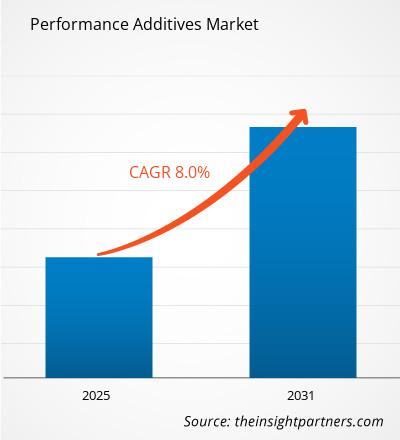
The global Performance Additives market was valued at US$ 2.45 billion in 2025 and is expected to reach US$ 4.22 billion by 2034; it is estimated to record a CAGR of 6.23% during 2026-2034.
Performance Additives Market Assessment and Insights
- North America: North America accounted for 33–37% market share in 2025 and is projected to expand at a CAGR of 6.6%–7.0% during 2026–2034. Growth is supported by automotive innovation, specialty polymer development, sustainable formulations, and ongoing industrial modernization, driving additive consumption.
- U.S.: The U.S. represented 82–86% of the North American market in 2025 and is anticipated to register a CAGR of 6.7%–7.1% during 2026–2034, driven by strong demand from automotive, packaging, and industrial manufacturing sectors alongside increasing adoption of advanced specialty additives.
- Europe: Europe held 26–30% market share in 2025 and is expected to grow at a CAGR of 6.5%–6.9% during 2026–2034. Germany, France, and the United Kingdom remain the leading markets, supported by advanced manufacturing ecosystems and stringent sustainability regulations.
- Asia Pacific: Asia Pacific accounted for 30–34% share in 2025 and is forecast to expand at a CAGR of 7.8%–8.2% during 2026–2034. China, India, and Japan continue to drive regional growth through rapid industrialization, expansion of electronics manufacturing, and strong automotive production.
- Largest Segment: Product Type – Plastic Additives represented the largest market segment and is expected to grow at a CAGR of 7.3%–7.7% during 2026–2034, supported by increasing engineering plastics production and rising demand for lightweight materials in automotive and packaging industries.
- High Growth Segment: Product Type – Surfactant Additives is projected to register the fastest growth with a CAGR of 7.6%–8.0% during 2026–2034, driven by expanding specialty chemical applications and rising demand for premium personal care formulations.
- Key companies analyzed in detail: BASF SE; Dow Inc.; Evonik Industries AG; Clariant AG; Syensqo SA; Lubrizol Corporation; Arkema S.A.; Air Products and Chemicals, Inc.; Afton Chemical Corporation; and Croda International Plc.
Source: The Insight Partners' analysis based on proprietary research, government publications, company annual reports, investor presentations, industry databases, and expert interviews.
Performance additives have evolved from being supplementary formulation ingredients to becoming critical components that determine product functionality, processability, longevity, and regulatory compliance. Advances in material science have enabled the development of additives that simultaneously improve mechanical properties, thermal resistance, surface quality, and environmental performance. This transformation has increased performance additives market share across industries ranging from automotive manufacturing to personal care.
The market outlook remains favorable as industries seek higher-performing materials capable of meeting demanding operational conditions and sustainability objectives. Ongoing industrial modernization, electrification trends, lightweight material adoption, and stricter emissions standards are encouraging greater use of advanced additive technologies. Market participants are increasingly investing in application-specific solutions that address evolving customer requirements while maintaining cost competitiveness and environmental responsibility.
Performance Additives Market Report Scope
| Report Attribute | Details |
|---|---|
| Market size in 2025 | US$ 2.45 Billion |
| Market Size by 2034 | US$ 4.22 Billion |
| Global CAGR (2026 - 2034) | 6.23% |
| Historical Data | 2021-2024 |
| Forecast period | 2026-2034 |
Performance Additives Market Analysis
The Performance Additives market is influenced by growing industrial demand for enhanced material characteristics, improved manufacturing efficiency, and extended product lifecycles. End users increasingly require additives that deliver multiple functional benefits within a single formulation, including stabilization, lubrication, flame retardancy, corrosion resistance, and process optimization. Such requirements are encouraging innovation across specialty chemical portfolios and creating opportunities for differentiated product offerings.
The market ecosystem encompasses raw material suppliers, specialty chemical manufacturers, compounders, formulators, distributors, and end-use industries. Collaboration between additive developers and downstream manufacturers has become increasingly important as customers seek customized solutions tailored to specific performance requirements. According to the performance additives market report, technical service capabilities and formulation expertise are emerging as key competitive differentiators throughout the value chain.
This involves constant product innovation, sustainability-driven research, and strategic growth in application areas. Some of the leading players within the industry are BASF SE, The Dow Chemical Company, Evonik Industries AG, Clariant International Ltd, Solvay S.A., Lubrizol Corporation, Arkema S.A., Air Products and Chemicals Inc, Afton Chemical Corporation, and Croda International Plc, who are currently focusing on developing their specialty additive range.
The investment trend is increasingly moving towards advanced manufacturing facilities, bio-based chemistry, and compliant additive technologies. Organizations are working hard through partnerships, capacity building, and research efforts to achieve circular economy goals and minimize their environmental footprint. Positioning is increasingly being influenced by innovation competency, application expertise, supply chain reliability.
● REPORT CUSTOMIZATION
Tailor This Report To Align With Your Specific Business Requirements
This report can be customized to align precisely with your business objectives, scope, and target markets. Customization options include tailored segmentation, geography, competitive analysis, and strategic insights to support informed decision-making.
Customize This Report →WHAT YOU CAN ADJUST
- ● Segmentations
- ● Geography
- ● Competitive Analysis
- ● Language Preferences
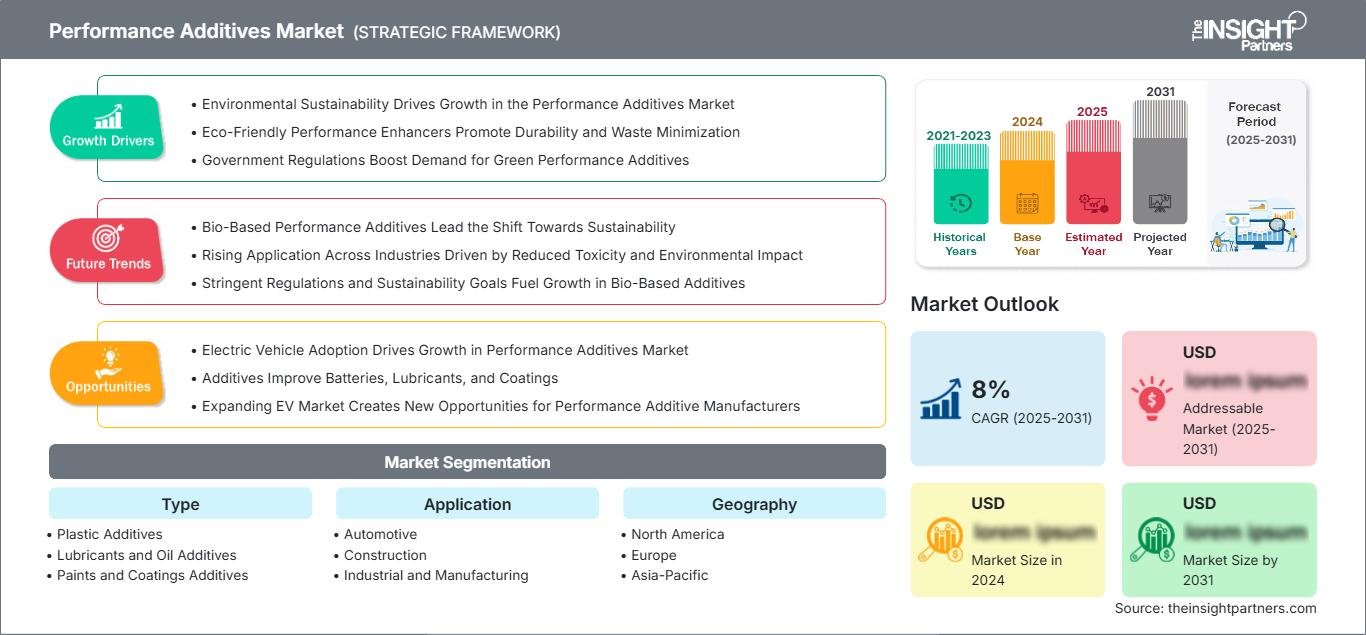
Performance Additives Market: Strategic Insights
Regional Insights
North America Performance Additives Market
North America accounts for a significant share of the global Performance Additives market, supported by advanced manufacturing infrastructure, robust research capabilities, and widespread adoption of specialty materials. The regional market is expected to expand at an estimated CAGR of approximately 6.6% through 2034. Demand remains strong across automotive, industrial manufacturing, coatings, construction, and energy applications where product performance and compliance standards are particularly stringent.
The region also benefits from substantial investments in sustainable materials development and advanced chemical processing technologies. Growing requirements for lightweight vehicle components, durable infrastructure materials, and environmentally responsible formulations are creating opportunities for innovative additive suppliers. Regulatory frameworks encouraging emissions reduction and improved product safety continue to shape purchasing decisions across key industries.
U.S. Performance Additives Market
The United States represents the largest market within North America and is projected to record a CAGR of nearly 6.5% during the forecast period. The country contributes approximately 70–75% of regional market revenue, supported by its extensive industrial base, advanced chemical manufacturing ecosystem, and high demand for specialty performance-enhancing formulations, as indicated in the performance additives market forecast.
The presence of major industry participants, including The Dow Chemical Company, Lubrizol Corporation, Air Products and Chemicals Inc, and Afton Chemical Corporation, strengthens domestic innovation and supply capabilities. Demand is expanding across automotive components, advanced coatings, industrial lubricants, electronics manufacturing, and construction materials. Increasing investments in energy efficiency, infrastructure modernization, and high-performance polymers are expected to sustain long-term market growth.
Europe Performance Additives Market
Europe maintains an important position in the Performance Additives market, accounting for an estimated 25–30% share of global revenue. The region is anticipated to grow at a CAGR of approximately 6.7% through 2034, supported by stringent environmental regulations, advanced manufacturing capabilities, and increasing adoption of sustainable materials. Demand is particularly strong for additives that improve recyclability, reduce emissions, and enhance energy efficiency across industrial applications.
Germany is still the market leader in Europe because of its automotive, machinery industry, and specialty chemicals market. Companies in the region keep innovating in terms of using additives that fit into the circular economy concept and also comply with new regulations. Demand for innovation is fueling growth in coatings, plastics, adhesives, and lubricants markets.
The UK market is positively impacted by the investment in specialty chemicals, coatings, and other advanced manufacturing materials. The demand for additives that comply with environmental regulations is increasing.
The United States represents the largest market within North America and is projected to record a CAGR of nearly 6.5% during the forecast period. The country contributes approximately 70–75% of regional market revenue, supported by its extensive industrial base, advanced chemical manufacturing ecosystem, and high demand for specialty performance-enhancing formulations, contributing significantly to the performance additives market size.
France, Italy, and Spain collectively contribute to regional growth through expanding construction activity, industrial modernization, and increasing adoption of advanced coatings and polymer solutions. Manufacturers across these countries are emphasizing performance enhancement and sustainability-driven product innovation.
APAC Performance Additives Market
Asia Pacific is projected to be the fastest-growing regional market, expanding at an estimated CAGR exceeding 8.0% through 2034. The region accounts for approximately 30–35% of global market revenue and benefits from rapid industrialization, expanding manufacturing output, and growing investments in infrastructure development. Demand is increasing across plastics, coatings, automotive components, electronics, and industrial applications, reflecting key performance additives market trends.
China continues to be the dominant force in the region due to its manufacturing prowess, its capacity for producing chemicals, and its high levels of consumption. Government programs aimed at developing industries and advanced materials have made it easier for companies to incorporate advanced additive technologies into various industries.
Japan and South Korea continue to fuel demand in their markets owing to their electronics, cars, and advanced manufacturing practices. India is becoming an important source of growth because of increased industrial production, construction, and consumption of specialty materials. Australia adds to the demand by virtue of its mining, construction, and maintenance needs.
Middle East & Africa Performance Additives Market
The Middle East & Africa market is expected to experience steady expansion with a CAGR approaching 6.8% through 2034. Growth is supported by infrastructure development programs, industrial diversification initiatives, and expanding downstream chemical industries. Increasing demand for durable construction materials, industrial lubricants, and advanced coatings is supporting additive consumption throughout the region.
Saudi Arabia represents the leading market due to substantial investments in petrochemical production, industrial development, and manufacturing diversification. The country’s focus on value-added chemical products is creating opportunities within the performance additives market for specialty additive suppliers serving multiple industrial sectors.
Construction, development of advanced manufacturing, and industry-related activities are currently bringing benefits to the UAE. Meanwhile, South Africa continues to be one of the major markets for mining, industrial, and infrastructure applications. In the wider region, investments and developments in the energy sector are creating demand for additives.
Segmentation Analysis
Type
- Plastic Additives: Enhance polymer durability, processability, flame resistance, UV stability, and mechanical performance. Strong demand from the packaging, automotive, electronics, and construction sectors makes this the leading segment within the global performance additives market.
- Lubricants & Oil Additives: Enhance viscosity, oxidation resistance, anti-wear properties, and overall efficiency. Rising demands for high-end equipment for industry and transportation further fuel the acceptance rate in mature and developing economies.
- Paints & Coating Additives: Provide better adhesion, dispersibility, weatherability, abrasion resistance, and appearance quality. The growing need for coating products across various industrial and infrastructural applications drives the segment growth.
- Adhesive & Sealant Additives: Enhance adhesion, flexibility, durability, and environmental resistance properties. Acceptance rate in the segment continues to rise due to use in automotive assembly, construction activities, and electronic manufacturing operations.
- Fuel and Gas Additives: Increase efficiency in combustion, emissions, stability in storage, and protection for equipment. The pressure to have a cleaner fuel system and efficient operation keeps driving market growth.
- Rubber Additives: Provide better flexibility, heat resistance, durability, aging, and processing performance. This product's demand is directly associated with the use of automotive tires, industrial machinery, and other infrastructure rubber products.
- Surfactant Additives: Help in wetting, dispersion, emulsification, and surface modification. The increasing application in the industrial process, coatings, personal care formulation, and specialty chemicals production ensures consistent demand.
Application
- Automotive: Utilizes performance additives within the performance additives market to improve vehicle durability, fuel efficiency, lightweight material performance, lubrication efficiency, and advanced coating protection across conventional and electric vehicle platforms.
- Construction: Relies on additives to enhance material longevity, weather resistance, structural integrity, and application efficiency in coatings, sealants, plastics, adhesives, and infrastructure materials.
- Industrial and Manufacturing: Represents a major consumption segment due to broad requirements for lubrication, process optimization, corrosion protection, equipment reliability, and material performance enhancement.
- Agriculture: Uses additives in chemical formulations, equipment lubricants, coatings, and specialty materials to improve operational efficiency, durability, and environmental performance under demanding field conditions.
- Electronics: Requires advanced additives that support thermal management, insulation performance, miniaturization, durability, and precision manufacturing across increasingly sophisticated electronic products.
- Personal Care and Cosmetics: Employs specialty additives for texture modification, stabilization, emulsification, sensory enhancement, and formulation performance in premium personal care products.
- Textiles: Utilizes additives to improve fabric durability, processing efficiency, appearance retention, functional performance, and resistance to environmental and operational stresses.
Opportunity Snapshot
| Application | Revenue Contribution | Trend Tag | Adoption Stage |
| Automotive | High | Lightweighting | Mature |
| Construction | High | Durability | Mature |
| Industrial and Manufacturing | High | Process Efficiency | Mature |
| Agriculture | Medium | Equipment Protection | Scaling |
| Electronics | Medium | Miniaturization | Scaling |
| Personal Care and Cosmetics | Medium | Formulation Science | Scaling |
| Textiles | Low | Functional Fabrics | Emerging |
Performance Additives Market Growth Drivers and Impact Analysis
Rising Demand for High-Performance Materials Across Industrial Sectors
The growing use of advanced materials in automotive, construction, electronics, and industrial manufacturing is a major driver for the performance additives market. Manufacturers increasingly require materials capable of delivering superior durability, thermal stability, corrosion resistance, weatherability, and processing efficiency. Performance additives enable these enhancements without requiring significant redesign of existing production systems, making them an attractive solution for manufacturers seeking cost-effective performance improvements.
Additives play a crucial role in automotive applications where lightweight polymers and engineered materials have to be used to gain strength and durability. Additives that ensure good bonding, weatherability, and longevity are required for construction purposes. Additives are also required in electronics because of their growing demand in the field of thermal management and protection. The industrial equipment segment also uses additives for lubricants.
The effects of this driver can be felt through the whole value chain in demand for ever more complex additive formulations. Manufacturers of such additives are answering to this demand with multifunctional additives that deliver many advantages at once – stability improvement, processing efficiency, and even sustainability. This development helps promote premium additives and increase their strategic role.
Expansion of Sustainability and Regulatory Compliance Requirements
Environmental regulations and sustainability initiatives are significantly influencing additive selection and product development strategies within the performance additives market. Governments and industry organizations are introducing stricter requirements related to emissions reduction, recyclability, product safety, and chemical sustainability. As a result, manufacturers are seeking additive solutions that support compliance while maintaining or enhancing product performance.
Environmental additives such as bio-based additives, low-emission products, non-PFAS compounds, additives for recyclable materials, and eco-friendly dispersants have increased in popularity in the market. In the coatings, plastics, lubricants, and agriculture formulators industries, more emphasis is being placed on products that can help reduce the environmental impact.
The effect on the market can be seen in terms of increased investment in sustainable chemistry solutions and circular economy strategies. Additive suppliers that have the capability to deliver environmentally beneficial and technically effective solutions are gaining competitiveness. Compliance has moved from a buying criterion to a key factor for determining future product viability, thus promoting next-generation additivities.
Growth of Advanced Lubricants, Fuels, and Specialty Formulations
Increasing performance requirements for lubricants, fuels, and specialty chemical formulations are creating sustained demand for advanced additive technologies within the performance additives market. Modern engines, industrial machinery, and process equipment operate under increasingly demanding conditions, requiring additives that enhance efficiency, reduce wear, improve oxidation resistance, and extend service intervals.
Fuel additives are increasingly becoming necessary due to growing demands for increased efficiency and effectiveness of combustion processes and emissions in both transportation and industrial applications. This trend can be seen in specialized products such as coatings, adhesives, sealants, and processing agents.
This driver is influencing market growth by encouraging continuous innovation and premiumization. Customers are increasingly willing to adopt higher-value additive technologies when measurable operational benefits can be demonstrated. The resulting emphasis on performance optimization is supporting long-term investment in research, formulation science, and specialized manufacturing capabilities across the Performance Additives market.
Performance Additives Market Future Trends
Transition Toward Multifunctional and Smart Additive Technologies
A significant future trend within the performance additives market is the development of multifunctional additive systems capable of delivering multiple performance enhancements through a single formulation. Traditional additive strategies often relied on combining several separate ingredients to achieve desired outcomes. Emerging technologies increasingly integrate stabilization, processing improvement, durability enhancement, and sustainability benefits within a single product platform.
Advances in the fields of materials science, nanotechnology, and formulation science are leading to the development of complex additive architectures. There is a need for systems that decrease formulation complexity and increase consistency and efficiency. Smart additives that react to changes in the environment, increase the versatility of materials, and prolong product lifetime will likely gain prominence in the future.
The long-term implications of this trend are substantial for the performance additives market. Suppliers with strong research capabilities are likely to gain competitive advantages through differentiated product portfolios. Customers may benefit from simplified supply chains, improved manufacturing efficiency, and enhanced end-product performance. As industries continue prioritizing productivity and sustainability simultaneously, multifunctional additive technologies are expected to become a central focus of innovation strategies.
Increasing Adoption of Circular Economy-Compatible Additives
The shift toward circular economy principles is expected to reshape additive development priorities over the coming decade. Industries are under growing pressure to improve recyclability, reduce waste generation, and increase the use of sustainable raw materials. Performance additives will play a critical role in enabling recycled materials to meet demanding technical specifications.
Additive innovations in the future are expected to revolve around better utilization of recycled polymers, improved materials processing techniques, efficient deinking and separation, and closed-loop manufacturing systems. It will prove advantageous to ensure performance properties alongside recycling capabilities within the packaging, automotive, construction, and consumer goods industries.
This trend is set to encourage major investments in sustainable chemistry platforms and collaboration-based innovation schemes. Those businesses that succeed in matching additive technologies to the principles of the circular economy stand a good chance of capitalizing on new opportunities in the coming years. With continuing changes in regulations and customer demands, circular additives could become one of the fastest-growing segments of the market in the future.
Performance Additives Market Opportunities
Expanding Demand from Electric Vehicles and Advanced Mobility Systems
The rapid evolution of electric mobility presents a substantial opportunity for performance additive manufacturers. Electric vehicles require specialized materials capable of supporting lightweighting, thermal management, battery protection, durability enhancement, and advanced electronics integration. These requirements create demand for highly engineered additive formulations across multiple vehicle components within the performance additives market.
Battery systems, charging infrastructure, lightweight polymer components, thermal interface materials, and protective coatings all rely on advanced additive technologies. As electric vehicle production expands globally, suppliers capable of addressing these technical requirements are expected to benefit from sustained growth opportunities. Additives that improve fire resistance, heat dissipation, and material longevity are particularly well positioned.
From an investment perspective, companies focusing on mobility-oriented additive platforms within the performance additives market may gain access to high-growth end markets with strong long-term demand fundamentals. Strategic partnerships with automotive manufacturers, battery producers, and materials developers can further strengthen market positioning. The convergence of electrification and advanced materials innovation creates a compelling opportunity landscape for industry participants.
Development of Bio-Based and Low-Carbon Additive Portfolios
Increasing focus on sustainability is presenting many business opportunities for the suppliers offering bio-based, sustainable, and low-carbon additive solutions. The end users from various industrial sectors are seeking solutions that will help in reducing the carbon footprint without impacting the technical performance. This trend is creating several opportunities for innovating new products and product variants.
Bio-based dispersants, renewable feedstock-based coating additives, green surfactants, and sustainable components of lubricants are becoming commercially significant. The companies operating in these sectors can help in meeting the changing demands of the customers and contribute to the decarbonization efforts. The supportive regulatory environment for sustainable materials is anticipated to create further business opportunities during the forecast period.
The opportunities created through such investments are based on increasing inclination towards incorporating sustainability into decision-making for purchasing decisions. The companies with the capability to develop sustainable and high-performing products will be able to derive benefits from increasing demand. With the rising importance of sustainability among customers, the low-carbon additiver range is likely to present major business opportunities.
Recent Developments
- October, 2025: LANXESS AG launched a sustainable version of its Additin RC 2515 lubricant additive, designed for extreme-pressure applications. The ISCC PLUS-certified product uses more than 80% renewable or sustainable raw materials and delivers a ~34% reduction in product carbon footprint while maintaining high lubricity and performance. The development highlights the shift toward low-carbon, high-performance lubricant additives aligned with sustainability goals in industrial and automotive applications.
- June, 2025: BASF completed the transition to bio-based Ethyl Acrylate (EA) for its Rheovis range, manufactured at Ludwigshafen and Bradford sites. The Rheovis range has a 14C-traceable biogenic content of up to 35% according to the ASTM D6866-18 analytical standard and a reduced Product Carbon Footprint (PCF1) of up to 30% compared to versions based on fossil feedstock. This development underlines BASF’s commitment to support customers in achieving their sustainability goals. The chemical composition and technical specifications of the new bio-based products remain unchanged.
- March, 2025: BASF SE announced an investment to expand aminic antioxidant production capacity at its Puebla facility in Mexico. This expansion underscores BASF's commitment as a dedicated supplier of components for the lubricant industry, addressing the growing demand for antioxidant additives, driven by increasing stability requirements in lubricating oils and the growing number of vehicles on the road.
Frequently Asked Questions

- Comprehensive Market Sizing and Forecast Analysis
- Detailed Segmentation Analysis
- In-Depth Market Dynamics Assessment
- Regional and Country-Level Insights
- Competitive Landscape and Company Benchmarking
- Strategic Business Intelligence
Recent Reports
Testimonials

The Insight Partners' SCADA System Market report is comprehensive, with valuable insights on current trends and future forecasts. The team was highly professional, responsive, and supportive throughout. We are very satisfied and highly recommend their services.
RAN KEDEM Partner, Reali Technologies LTDs
I requested a report on a very specific software market and the team produced the report in a few days. The information was very relevant and well presented. I then requested some changes and additions to the report. The team was again very responsive and I got the final report in less than a week.
JEAN-HERVE JENN Chairman, Future Analytica
We worked with The Insight Partners for an important market study and forecast. They gave us clear insights into opportunities and risks, which helped shape our plans. Their research was easy to use and based on solid data. It helped us make smart, confident decisions. We highly recommend them.
PIYUSH NAGPAL Sr. Vice President, High Beam Global
The Insight Partners delivered insightful, well-structured market research with strong domain expertise. Their team was professional and responsive throughout. The user-friendly website made accessing industry reports seamless. We highly recommend them for reliable, high-quality research services
YUKIHIKO ADACHI CEO, Deep Blue, LLC.
This is the first time I have purchased a market report from The Insight Partners.While I was unsure at first, I visited their web site and felt more comfortable to take the risk and purchase a market report.I am completely satisfied with the quality of the report and customer service. I had several questions and comments with the initial report, but after a couple of dialogs over email with their analyst I believe I have a report that I can use as input to our strategic planning process.Thank you so much for taking the extra time and making this a positive experience.I will definitely recommend your service to others and you will be my first call when we need further market data.
JOHN SUZUKI President and Chief Executive Officer, Board Director, BK Technologies
I wish to appreciate your support and the professionalism you displayed in the course of attending to my request for information regarding to infectious disease IVD market in Nigeria. I appreciate your patience, your guidance, and the fact that you were willing to offer a discount, which eventually made it possible for us to close a deal. I look forward to engaging The Insight Partners in the future, all thanks to the impression you have created in me as a result of this first encounter.
DR CHIJIOKE ONYIA MANAGING DIRECTOR, PineCrest Healthcare Ltd.Reason to Buy
- Informed Decision-Making
- Understanding Market Dynamics
- Competitive Analysis
- Identifying Emerging Markets
- Customer Insights
- Market Forecasts
- Risk Mitigation
- Boosting Operational Efficiency
- Strategic Planning
- Investment Justification
- Tracking Industry Innovations
- Aligning with Regulatory Trends





 Get Free Sample for