
Color Masterbatch Market Size, Trends & Demand by 2034
Color Masterbatch Market Size and Forecasts (2021–2034), Global and Regional Share, Trends, and Growth Opportunity Analysis Report Coverage : by Color Type (White Masterbatch, Black Masterbatch, Transparent Masterbatch, Color Pigment Masterbatch); Polymer Type (Polyethylene, Polypropylene, Polyvinyl Chloride, Polyethylene Terephthalate, Polystyrene); End-Use Industry (Packaging, Automotive, Consumer Goods, Textiles, Construction, Agriculture, Electronics); and Geography (North America, Europe, Asia Pacific, and South and Central America)
- Status : Data Released
- Report Code : TIPRE00040565
- Category : Chemicals and Materials
- No. of Pages : 150
- Available Report Formats :


- Last update date : August 13, 2026


2025 Market Size
US$ 6.45 Bn
Base year value
2034 Forecast
US$ 10.32 Bn
Projected by 2034
CAGR 2026-2034
6.05 %
Growth rate
Addressable Market
US$ 78.77 Bn
(2026-2034)
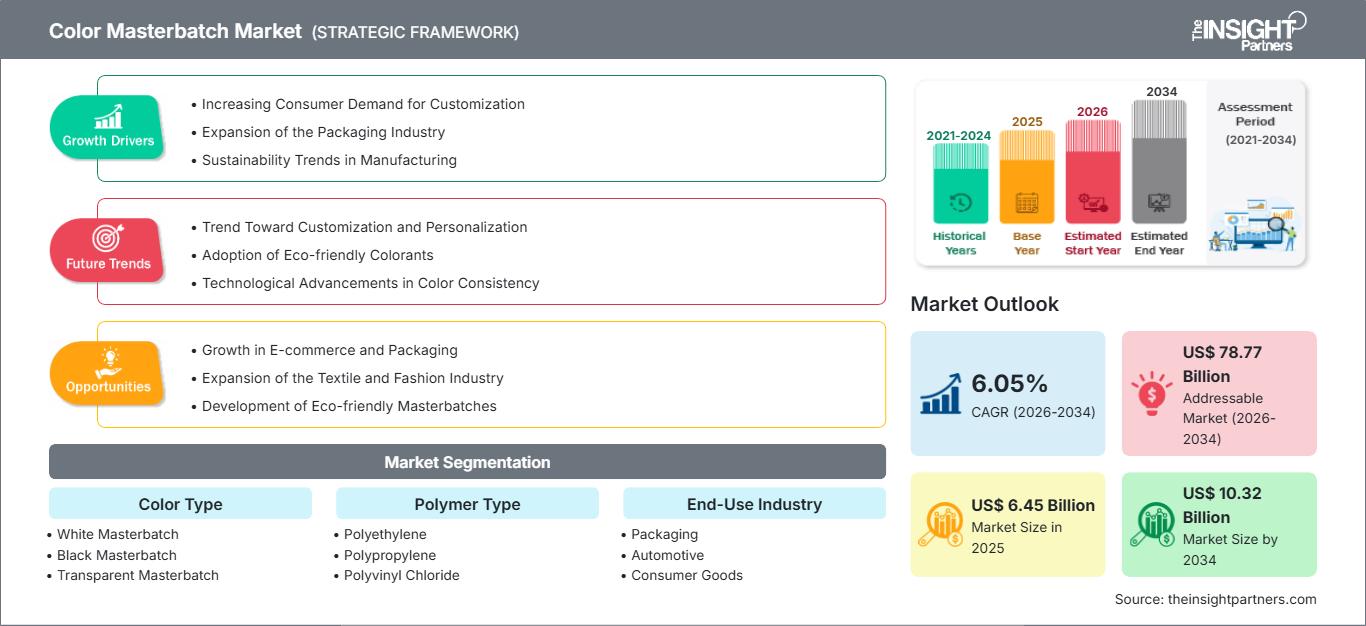
The Color Masterbatch Market was valued at US$ 6.45 Billion in 2025 and is projected to reach US$ 10.32 Billion by 2034, registering a CAGR of 6.05% during 2026–2034. The market continues to expand as manufacturers increasingly adopt color masterbatches to improve product appearance, processing efficiency, and color consistency across plastic products. Rising demand from packaging, automotive, consumer goods, construction, and electronics industries, together with continuous innovation in pigment dispersion technologies, is supporting long-term market development across both mature and emerging manufacturing economies.
Supported by an advanced plastics processing ecosystem, North America remains one of the most established regional markets. The Color Masterbatch Market size in the region is driven by increasing consumption of sustainable packaging materials, rising adoption of recycled polymers, and continuous technological advancements in polymer compounding. Investments in lightweight automotive plastics, premium consumer products, and food-contact compliant masterbatch formulations are expected to support regional expansion at a CAGR of 5.3–5.9% during 2026–2034.
Color Masterbatch Market Assessment and Insights
- North America: North America accounted for 30–33% Color Masterbatch Market share in 2025 and is projected to register a CAGR of 5.3–5.9% during 2026–2034. Strong demand from packaging, automotive, consumer products, and specialty plastics manufacturing continues to support stable regional market expansion.
- US: The US represented 75–79% of the North American market in 2025 and is anticipated to grow at a CAGR of 5.4–6.0% during 2026–2034, supported by extensive plastics processing capacity, innovation in polymer compounds, and increasing demand for sustainable packaging.
- Europe: Europe held 25–28% share in 2025 and is expected to expand at a CAGR of 5.1–5.7% during 2026–2034. Germany, Italy, France, and the UK continue to lead regional demand through advanced polymer processing, automotive manufacturing, and circular economy initiatives.
- Asia Pacific: Asia Pacific captured 35–38% share in 2025 and is forecast to record the fastest growth at a CAGR of 6.5–7.1% during 2026–2034. China, India, Japan, and South Korea remain major manufacturing centers supported by expanding plastics production and packaging industries.
- Largest Segment: Packaging accounted for a market share of 42–46% in 2025 and is expected to grow at a CAGR of 6.0–6.5% during 2026–2034, driven by increasing consumption of flexible packaging, rigid packaging, and recyclable plastic products.
- High Growth Segment: Polyethylene accounted for a market share of 30–34% in 2025 and is projected to register the highest CAGR of 6.6–7.2% during 2026–2034, supported by its extensive use in packaging films, containers, and industrial plastic applications.
- Key companies analyzed in detail: Ampacet Corporation, Clariant AG, SABIC, Avient Corporation, BASF SE, Heubach GmbH, Plastiblends India Ltd., Oerlikon Balzers, Chromaflo Technologies, GCR Group, Dainichiseika Color & Chemicals Mfg. Co., Ltd., Sudarshan Chemical Industries Ltd., Alok Masterbatches Ltd., Jiangsu Jinhui Zhaolong High-tech Co., Ltd.
Source: The Insight Partners' analysis based on proprietary research, government publications, company annual reports, investor presentations, industry databases, and expert interviews.
With rapid advancements in the fields of pigments dispersion technology, polymer compatibility, and compounding, the industry has been greatly impacted. Increasing emphasis is being placed on tailor-made masterbatch that will offer excellent color consistency, ultraviolet resistance, thermal stability, and efficiency during the compounding of engineering plastics and recycled polymers. Compounding automation, color matching using digital processes, and quality assurance measures contribute towards increasing manufacturing efficiencies while minimizing raw material wastage and production inconsistencies.
In terms of future prospects, the industry is forecasted to see growing investments in polymer sustainability, biodegradable plastics, and the circular economy concept across both mature and emerging economies. The region of Asia Pacific is expected to dominate the production process via capacity expansion, while the regions of North America and Europe will continue their role as centers of innovation and development due to advanced manufacturing facilities, strict environmental laws, and increased demand for specialty masterbatch.
Color Masterbatch Market Report Scope
| Report Attribute | Details |
|---|---|
| Market size in 2025 | US$ 6.45 Billion |
| Market Size by 2034 | US$ 10.32 Billion |
| Global CAGR (2026 - 2034) | 6.05% |
| Historical Data | 2021-2024 |
| Forecast period | 2026-2034 |
Color Masterbatch Market Analysis
The rising growth in the plastics processing industry, the increased use of visually distinct products, and higher demand for recyclable packaging have driven Color Masterbatch Market growth in key economies. Growing consumption of lightweight polymer-based materials in the production of automobiles, durable consumer goods, agriculture films, and electricals has contributed to this demand. With increased focus on aesthetics and color uniformity, converters have started using superior quality masterbatch products that help improve pigment dispersibility, efficiency, and durability without adversely affecting the performance of the polymers.
In terms of the value chain, the participants include pigment suppliers, additive suppliers, polymer resin suppliers, compounders, masterbatch suppliers, distributors, and plastic processors. Increased collaboration between raw material suppliers and compounders has resulted in better formulation practices and lower lead times. The rising use of recycled polymers has motivated suppliers to provide masterbatch products that help rectify color inconsistencies of the recycled plastic products.
The competitive rivalry will keep on rising as the global players will develop more production capabilities, establish application development centers, and launch their sustainable range of products. The above Color Masterbatch Market report reveals that the top companies are concentrating on customized formulation, regulation adherence, and superior quality specialty products to enhance their relationship with customers from packaging, automotive, electronic, and industrial sectors. Investments made in research and development are helping the manufacturers to meet increasing needs for recyclable and bio-based polymer products.
Top players such as Ampacet Corporation, Clariant AG, SABIC, Avient Corporation, BASF SE, Heubach GmbH, Plastiblends India Ltd., Chromaflo Technologies, GCR Group, Dainichiseika Color & Chemicals Mfg. Co., Ltd., Sudarshan Chemical Industries Ltd., Alok Masterbatches Ltd., Jiangsu Jinhui Zhaolong High-tech Co., Ltd., and Oerlikon Balzers are continuously concentrating on product innovations, geographic diversification, and customer-oriented color solutions. Strategic partnerships with the packaging converters, polymer makers, and automotive producers are making sure of their better penetration in the market along with commercializing sustainable masterbatch technology.
● REPORT CUSTOMIZATION
Tailor This Report To Align With Your Specific Business Requirements
This report can be customized to align precisely with your business objectives, scope, and target markets. Customization options include tailored segmentation, geography, competitive analysis, and strategic insights to support informed decision-making.
Customize This Report →WHAT YOU CAN ADJUST
- ● Segmentations
- ● Geography
- ● Competitive Analysis
- ● Language Preferences
Color Masterbatch Market: Strategic Insights
Regional Insights
North America Color Masterbatch Market
North America accounted for 30-33% share of the Color Masterbatch Market in 2025 and is expected to exhibit a CAGR of 5.3-5.9% between 2026-2034. The presence of strong plastics manufacturing base, high usage of specialty polymers and demand for sustainable packaging material is fueling the growth of the North American market. Investments in recycled resin processing and compounding technology are contributing towards maintaining the competitive edge of the North American players in consumer packaging, healthcare products and industrial plastic applications.
Advancements in technologies and regulatory initiatives for recyclable packaging materials are helping in driving market growth in the long term. Manufacturers are making continuous investment in automation, digital color matching technology and specialty additives. The demand from food packaging applications, building materials, automotive interior and consumer appliances is expected to be high owing to consistent industrial production and investments in polymer manufacturing plants.
U.S. Color Masterbatch Market
The United States represented 75–79% of the North American market in 2025 and is projected to register a CAGR of 5.4–6.0% till 2034. The United States is home to many of the world's masterbatch producers, pigment suppliers, and polymer processors who constantly innovate and work towards increasing the efficiency of manufacturing processes and using sustainable materials. High domestic demand in packaging applications, medical products, and engineering plastics aids constant consumption in many industrial sectors.
Increasing investments in food-grade packaging, electric vehicles, consumer electronics, and light weight plastic parts will keep creating opportunities in premium color masterbatch products. Formulations that are compatible with both recycled and bio-based polymers are being developed in compliance with stringent environmental legislations.
Europe Color Masterbatch Market
Europe had 25–28% of the market share in 2025 and is expected to grow at a CAGR of 5.1–5.7% in 2026–2034. Environmental regulations, high usage of recycled plastics, and technological advancements in polymer processing remain the key factors contributing to the growth of regional demand. The largest regional market is Germany, while the UK, France, Italy, and Spain are making significant contributions through diversified manufacturing activities and sustainable packaging innovations.
Germany holds leadership in the regional consumption due to strong industries for automotive, packaging, and engineering plastics. Major regional players keep on developing advanced compounding and recycling technologies in line with EU sustainability goals. Innovations in specialty pigments and additives further enhance the dominant position of the region as the regional leader in polymer production.
The UK shows steady demand from the packaging industry and manufacturing of consumer goods and pharmaceuticals. France benefits from innovations in sustainable consumer packaging, while Italy remains one of the leaders in the development of the plastic and industrial manufacturing industry. Spain experiences growing demand because of packaging production, agriculture, and construction industries.
APAC Color Masterbatch Market
Asia Pacific captured 35–38% of the global market in 2025 and is anticipated to record the fastest expansion at a CAGR of 6.5–7.1% during 2026–2034. China remains the largest producer and consumer, followed by India, Japan, and South Korea, supported by expanding plastics processing industries, rapid industrialization, and growing investments in polymer manufacturing.
Government initiatives promoting domestic manufacturing, increasing packaging consumption, and expanding automotive production continue to stimulate regional demand. Australia contributes through specialty plastics and food packaging applications, while India records strong growth owing to rising consumer goods production and infrastructure development.
Middle East & Africa Color Masterbatch Market
The Middle East & Africa market is expected to grow at a CAGR of 5.4–6.0% during 2026–2034. Saudi Arabia remains the largest regional market because of its integrated petrochemical industry and expanding polymer production capacity. The UAE continues strengthening its plastics conversion sector through investments in packaging, logistics, and industrial manufacturing.
South Africa remains an important consumer market for packaging and consumer products, while the Rest of the Middle East & Africa benefits from growing construction activities, agricultural film demand, and infrastructure development. Increasing polymer production and diversification strategies across Gulf countries are expected to create new opportunities for color masterbatch manufacturers.
Segmentation Analysis
Color Type
The Color Type segment is projected to register a CAGR of 6.0–6.5% during 2026–2034. The Color Masterbatch Market scope continues to expand with increasing demand for customized coloration, enhanced UV stability, and improved processing efficiency across packaging, automotive, and consumer products. Continuous innovation in pigment technology and regulatory-compliant formulations is supporting wider adoption across multiple polymer applications.
- White Masterbatch: Widely used in packaging, household products, and construction materials because of its excellent opacity, brightness, and titanium dioxide-based performance, making it one of the most demanded product categories.
- Black Masterbatch: Extensively utilized in automotive components, agricultural films, pipes, and industrial products owing to superior UV protection, conductivity options, and durability under demanding environmental conditions.
- Transparent Masterbatch: Gains traction in premium packaging and consumer goods by preserving product visibility while improving gloss, appearance, and processing consistency for clear polymer applications.
- Color Pigment Masterbatch: Supports customized branding, product differentiation, and aesthetic enhancement across packaging, consumer goods, electronics, and industrial plastics through a broad range of standardized and customized color formulations.
Polymer Type
The Polymer Type segment is anticipated to grow at a CAGR of 6.2–6.8% during 2026–2034. Growing consumption of engineering plastics, flexible packaging materials, and lightweight automotive components continues to increase demand for polymer-specific masterbatch formulations that provide excellent compatibility, color dispersion, and processing performance.
- Polyethylene: The leading polymer owing to extensive utilization in flexible packaging, shopping bags, films, bottles, and industrial containers requiring consistent coloration and processing stability.
- Polypropylene: Widely adopted across automotive parts, rigid packaging, consumer goods, and household appliances because of its excellent mechanical properties and processing flexibility.
- Polyvinyl Chloride: Maintains stable demand in pipes, window profiles, flooring, cables, and construction materials where long-term color stability and weather resistance are essential.
- Polyethylene Terephthalate: Increasingly used in beverage bottles, food packaging, and textile fibers requiring transparent, vibrant, and food-contact-compliant color solutions.
- Polystyrene: Supports applications in disposable products, consumer electronics, and packaging where cost-effective coloration and attractive appearance remain important purchasing factors.
End-Use Industry
The End-Use Industry segment is projected to register a CAGR of 6.1–6.7% during 2026–2034. Growing consumption of colored plastic materials across packaging, transportation, infrastructure, agriculture, electronics, and consumer products continues to strengthen demand for high-performance masterbatch formulations. Increasing adoption of recyclable polymers and sustainable manufacturing practices is encouraging producers to develop application-specific color solutions that improve aesthetics, processability, and regulatory compliance.
- Packaging: The largest application segment, supported by strong demand for flexible packaging, rigid containers, food and beverage packaging, pharmaceutical packaging, and e-commerce shipments requiring consistent coloration and high-quality visual appeal.
- Automotive: Increasing use of lightweight polymer components, electric vehicle interiors, under-the-hood applications, and exterior trim continues to drive demand for durable, heat-resistant, and UV-stable masterbatch formulations.
- Consumer Goods: Household appliances, furniture, toys, personal care products, and lifestyle accessories increasingly utilize customized color solutions to improve product differentiation, brand identity, and premium product positioning.
- Textiles: Synthetic fibers, nonwoven fabrics, industrial textiles, and technical fabrics continue to adopt color masterbatch products because they provide uniform coloration, improved production efficiency, and long-lasting color performance.
- Construction: Pipes, fittings, roofing sheets, insulation materials, window profiles, and flooring products require weather-resistant masterbatch formulations capable of maintaining long-term color stability under harsh environmental conditions.
- Agriculture: Greenhouse films, irrigation systems, mulch films, and protective nets increasingly utilize specialized masterbatch formulations that enhance UV resistance, durability, and crop productivity.
- Electronics: Consumer electronics housings, connectors, cable insulation, and electrical components require precision color matching, flame-retardant compatibility, and superior processing characteristics for high-volume production.
Opportunity Snapshot
| End-Use Industry | Revenue Contribution | Trend Tag | Adoption Stage |
|---|---|---|---|
| Packaging | High | Recyclable Packaging | Mature |
| Automotive | Medium | Lightweight Plastics | Scaling |
| Consumer Goods | High | Premium Design | Mature |
| Textiles | Medium | Solution Dyeing | Scaling |
| Construction | Medium | UV Protection | Mature |
| Agriculture | Low | Smart Films | Emerging |
| Electronics | Medium | Miniaturization | Scaling |
Color Masterbatch Market Growth Drivers and Impact Analysis
Growing demand for sustainable and recyclable plastic packaging
Color masterbatch will continue to be consumed by the packaging industry at a high rate as brand owners look for packages made from recyclable and mono-material plastic packaging. The trend in North America, Europe, and Asia-Pacific, where governments are encouraging circular economy initiatives, has pushed manufacturers into investing more in color masterbatch formulations that will be in tandem with recycled polyethylene and polypropylene. Through the use of advanced masterbatch, manufacturers are able to ensure that the recycled plastic looks good while remaining efficient in processing and meeting regulation requirements in consumer and food packaging.
Expansion of lightweight polymer applications across automotive industries
Manufacturers in the automotive industry keep substituting traditional metal parts with polymers in order to make vehicles lighter, more efficient and to facilitate electric vehicle manufacturing. As a result of this trend, the demand for high-performance color masterbatches that provide thermal stability, protection from ultraviolet radiation, scratch resistance and longevity of materials keeps growing. Interior and exterior parts, light fixtures, batteries, and engine bay parts have a greater need for masterbatches that will ensure that the material maintains its color under harsh operating conditions. Development of electric mobility in Asia Pacific, Europe and North America will drive the demand for masterbatches during the forecast period.
Advancements in polymer compounding and digital color technologies
Continuous innovation in polymer compounding equipment, pigment dispersion technologies, and automated color matching systems is improving manufacturing efficiency throughout the plastics value chain. Artificial intelligence-assisted formulation development, digital spectrophotometry, and automated dosing technologies enable manufacturers to deliver highly customized color solutions with improved batch consistency and lower production waste. These technological improvements also shorten product development cycles while supporting increasingly complex customer specifications. As industries seek greater manufacturing precision and operational efficiency, investments in advanced compounding technologies are expected to further strengthen market competitiveness and product differentiation.
Color Masterbatch Market Future Trends
Increasing adoption of sustainable pigment technologies
Manufacturers are increasingly developing environmentally responsible formulations using bio-based carrier resins, low-carbon additives, and pigments compatible with recycled plastics. These Color Masterbatch Market trends are being driven by stricter environmental regulations, corporate sustainability commitments, and growing customer preference for recyclable packaging materials. Companies are investing in research to improve pigment dispersion, reduce processing energy consumption, and eliminate substances of concern while maintaining product performance across diverse polymer applications.
Growing demand for customized specialty masterbatches
End users are seeking application-specific formulations that combine coloration with functional properties such as UV protection, antimicrobial performance, laser marking capability, flame retardancy, and antistatic characteristics. Manufacturers are therefore expanding customized masterbatch offerings to address specialized requirements across healthcare, automotive, consumer electronics, packaging, and industrial applications. This transition toward multifunctional products is expected to generate additional value throughout the plastics processing industry.
Color Masterbatch Market Opportunities
Expanding opportunities in recycled polymer processing
Growing investments in plastic recycling infrastructure are creating favorable conditions for advanced masterbatch manufacturers. Color Masterbatch Market Forecasts indicate that increasing recycled resin utilization will require innovative color solutions capable of masking polymer variability while maintaining consistent product appearance. Companies that develop formulations optimized for mechanically and chemically recycled plastics are expected to strengthen competitive positioning across packaging, consumer goods, and construction applications while supporting global circular economy initiatives.
Rising investments in emerging manufacturing economies
Rapid industrialization across Southeast Asia, Latin America, the Middle East, and Africa continues to increase demand for polymer compounds and value-added masterbatch products. Expanding packaging production, infrastructure development, automotive manufacturing, and consumer goods industries create attractive opportunities for both regional producers and multinational suppliers. Companies investing in local manufacturing facilities, technical service centers, and customized product development are expected to improve market penetration while strengthening long-term customer relationships across high-growth economies.
Recent Developments
- May 2026: LyondellBasell (LYB) signed an agreement with Interpolimeri Spa, a leading distributor of plastic materials in Europe, to expand distribution of LYB masterbatches and custom performance colors into Germany and Austria.
- December 2025: Formerra, a leader in performance materials distribution, announced the addition of Techmer PM color masterbatches, high-performance additives, and pre-colored compounds to its expansive portfolio of materials. With this partnership, Formerra advances its application-specific lineup, aligning its material portfolio to customers’ evolving needs across North America.
Frequently Asked Questions

- Comprehensive Market Sizing and Forecast Analysis
- Detailed Segmentation Analysis
- In-Depth Market Dynamics Assessment
- Regional and Country-Level Insights
- Competitive Landscape and Company Benchmarking
- Strategic Business Intelligence
Recent Reports
Testimonials

The Insight Partners' SCADA System Market report is comprehensive, with valuable insights on current trends and future forecasts. The team was highly professional, responsive, and supportive throughout. We are very satisfied and highly recommend their services.
RAN KEDEM Partner, Reali Technologies LTDs
I requested a report on a very specific software market and the team produced the report in a few days. The information was very relevant and well presented. I then requested some changes and additions to the report. The team was again very responsive and I got the final report in less than a week.
JEAN-HERVE JENN Chairman, Future Analytica
We worked with The Insight Partners for an important market study and forecast. They gave us clear insights into opportunities and risks, which helped shape our plans. Their research was easy to use and based on solid data. It helped us make smart, confident decisions. We highly recommend them.
PIYUSH NAGPAL Sr. Vice President, High Beam Global
The Insight Partners delivered insightful, well-structured market research with strong domain expertise. Their team was professional and responsive throughout. The user-friendly website made accessing industry reports seamless. We highly recommend them for reliable, high-quality research services
YUKIHIKO ADACHI CEO, Deep Blue, LLC.
This is the first time I have purchased a market report from The Insight Partners.While I was unsure at first, I visited their web site and felt more comfortable to take the risk and purchase a market report.I am completely satisfied with the quality of the report and customer service. I had several questions and comments with the initial report, but after a couple of dialogs over email with their analyst I believe I have a report that I can use as input to our strategic planning process.Thank you so much for taking the extra time and making this a positive experience.I will definitely recommend your service to others and you will be my first call when we need further market data.
JOHN SUZUKI President and Chief Executive Officer, Board Director, BK Technologies
I wish to appreciate your support and the professionalism you displayed in the course of attending to my request for information regarding to infectious disease IVD market in Nigeria. I appreciate your patience, your guidance, and the fact that you were willing to offer a discount, which eventually made it possible for us to close a deal. I look forward to engaging The Insight Partners in the future, all thanks to the impression you have created in me as a result of this first encounter.
DR CHIJIOKE ONYIA MANAGING DIRECTOR, PineCrest Healthcare Ltd.Reason to Buy
- Informed Decision-Making
- Understanding Market Dynamics
- Competitive Analysis
- Identifying Emerging Markets
- Customer Insights
- Market Forecasts
- Risk Mitigation
- Boosting Operational Efficiency
- Strategic Planning
- Investment Justification
- Tracking Industry Innovations
- Aligning with Regulatory Trends





 Get Free Sample for