
Pesticide Inert Ingredients Market Size, Growth & Demand by 2034
Coverage: by Type (Emulsifiers, Solvents, Carriers, Others); Sources (Synthetic, Bio-Based); Form (Dry, Liquid, Others); Pesticides Type (Herbicides, Insecticides, Fungicides, Rodenticides, Others) , and Geography (North America, Europe, Asia Pacific, and South and Central America)
- Status : Data Released
- Report Code : TIPRE00005112
- Category : Chemicals and Materials
- No. of Pages : 150
- Available Report Formats :


- Last update date : July 08, 2026


2025 Market Size
US$ 6.26 Bn
Base year value
2034 Forecast
US$ 9.23 Bn
Projected by 2034
CAGR 2026-2034
4.41 %
Growth rate
Addressable Market
US$ 70.34 Bn
(2026-2034)
The pesticide inert ingredients market represents a critical component of modern crop protection formulations, supporting the performance, stability, application efficiency, and shelf life of pesticide products. Valued at US$ 6.26 Billion in 2025, the market is projected to reach US$ 9.23 Billion by 2034, expanding at a CAGR of 4.41% during 2026–2034. Growing demand for advanced agricultural formulations, increasing focus on sustainable farming practices, and the development of high-performance adjuvant systems continue to shape market expansion across both developed and emerging agricultural economies.
North America remains one of the most influential regional markets, supported by an estimated CAGR of approximately 4.0%–4.3% through the forecast period. The region benefits from extensive adoption of precision agriculture, widespread use of specialty crop protection products, and stringent regulatory requirements that encourage formulation innovation. Rising demand for bio-based inert ingredients and improved pesticide efficacy across large-scale farming operations further strengthens the pesticide inert ingredients market share.
Pesticide Inert Ingredients Market Assessment and Insights
- North America: North America accounted for 33–37% share in 2025 and is projected to expand at a CAGR of 4.0%–4.5% during 2026–2034. Growth is supported by advanced crop protection manufacturing capabilities and continuous formulation innovation across agrochemical value chains.
- U.S.: The U.S. represented 83–86% of the North American market in 2025 and is anticipated to grow at a CAGR of 4.1%–4.6% during 2026–2034, driven by strong R&D investments, technological advancements in crop protection products, and established agrochemical production infrastructure.
- Europe: Europe held 24–28% market share in 2025 and is expected to register a CAGR of 3.8%–4.3% during 2026–2034. Germany, France, and the United Kingdom remain key markets, supported by sustainable agriculture initiatives and continued formulation innovation.
- Asia Pacific: Asia Pacific accounted for 28–32% share in 2025 and is forecast to grow at a CAGR of 5.0%–5.6% during 2026–2034. China, India, and Japan continue to drive regional growth through expanding agrochemical production capacity and ongoing agricultural modernization efforts.
- Largest Segment: Product Type – Synthetic represented the largest market segment and is expected to record a CAGR of 4.2%–4.7% during 2026–2034, supported by broad formulation compatibility and well-established manufacturing infrastructure.
- High Growth Segment: Product Type – Bio-Based is projected to grow at a CAGR of 5.8%–6.4% during 2026–2034, driven by sustainability initiatives and increasing regulatory preference for environmentally friendly alternatives.
- Key companies analyzed in detail: BASF SE; Akzo Nobel N.V.; Clariant AG; Croda International Plc; Dow Inc.; Eastman Chemical Company; Huntsman Corporation; LyondellBasell Industries N.V.; Solvay SA; and Stepan Company
Source: The Insight Partners' analysis based on proprietary research, government publications, company annual reports, investor presentations, industry databases, and expert interviews.
The pesticide inert ingredients market has evolved from a largely functional additives segment into a strategic component of pesticide formulation technology. Manufacturers increasingly focus on ingredients that enhance active ingredient dispersion, improve spray coverage, reduce environmental impact, and support regulatory compliance. The growing complexity of pesticide formulations has elevated the importance of inert ingredients in achieving consistent field performance.
Future market development will be influenced by sustainability priorities, stricter environmental standards, and the commercialization of biological crop protection products. As agricultural producers seek higher productivity with lower environmental footprints, suppliers are investing in multifunctional inert ingredients capable of improving formulation efficiency while aligning with evolving regulatory expectations, supporting the pesticide inert ingredients market forecast across major agricultural regions.
Pesticide Inert Ingredients Market Report Scope
| Report Attribute | Details |
|---|---|
| Market size in 2025 | US$ 6.26 Billion |
| Market Size by 2034 | US$ 9.23 Billion |
| Global CAGR (2026 - 2034) | 4.41% |
| Historical Data | 2021-2024 |
| Forecast period | 2026-2034 |
Pesticide Inert Ingredients Market Analysis
Growing pressure to maximize agricultural yields while minimizing resource consumption continues to strengthen demand for advanced pesticide formulations. Inert ingredients such as emulsifiers, solvents, and carriers play a vital role in ensuring formulation stability, improving active ingredient delivery, and enhancing field performance. Increased cultivation of high-value crops and the expansion of integrated pest management programs further support market demand.
The value chain encompasses specialty chemical producers, formulation developers, pesticide manufacturers, distributors, and agricultural end users. Innovation increasingly focuses on improving compatibility with biological pesticides, reducing volatility, and enhancing environmental profiles. As regulatory scrutiny expands globally, formulation performance and sustainability are becoming equally important purchasing criteria, according to the pesticide inert ingredients market report.
The nature of competition involves a combination of multinational firms dealing in chemicals and firms dealing in formulations of ingredients. Firms such as Akzo Nobel N.V., BASF SE, Clariant AG, Croda International Plc., DowDuPont Inc., Eastman Chemical Company, Huntsman Corporation, LyondellBasell Industries Holdings B.V., Solvay S.A., and Stepan Company keep adding value to their portfolios through new products and partnerships.
Investment activity increasingly targets renewable feedstocks, biodegradable surfactants, and formulation technologies supporting biological crop protection products. Market participants are prioritizing research programs focused on regulatory compliance, reduced environmental persistence, and enhanced formulation efficiency. This strategic positioning is expected to create competitive differentiation and expand the pesticide inert ingredients market size as sustainability requirements become more influential in procurement decisions.
● REPORT CUSTOMIZATION
Tailor This Report To Align With Your Specific Business Requirements
This report can be customized to align precisely with your business objectives, scope, and target markets. Customization options include tailored segmentation, geography, competitive analysis, and strategic insights to support informed decision-making.
Customize This Report →WHAT YOU CAN ADJUST
- ● Segmentations
- ● Geography
- ● Competitive Analysis
- ● Language Preferences
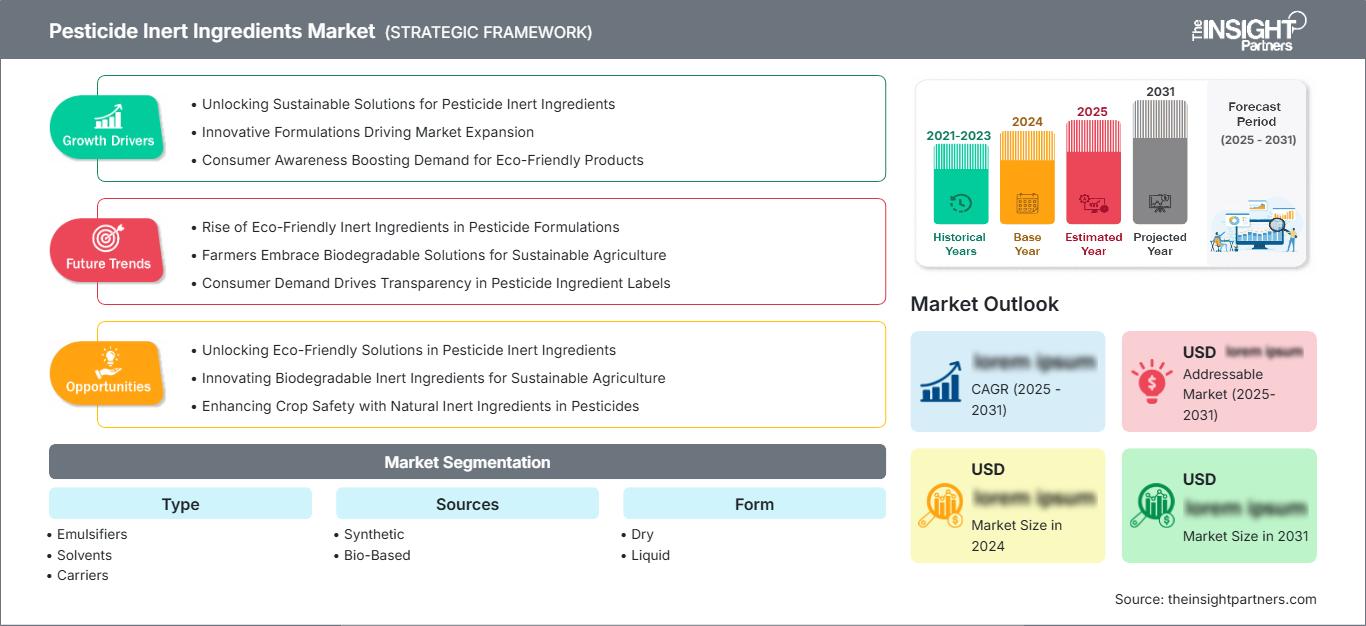
Pesticide Inert Ingredients Market: Strategic Insights
Regional Insights
North America Pesticide Inert Ingredients Market
North America is expected to record a CAGR of approximately 4.1% during the forecast period. The market is driven by high agricultural productivity requirements, extensive use of advanced crop protection technologies, and high research investments. The region's regulatory framework spurs innovation in safer and more environmentally responsible inert ingredient formulations.
Demand is particularly strong for high-performance emulsifiers and solvents used in herbicide and fungicide formulations. Growing interest in bio-based alternatives and increasing adoption of pesticide inert ingredients market solutions alongside precision agriculture technologies further stimulate the development of specialized inert ingredient systems capable of enhancing pesticide efficiency while reducing environmental exposure.
U.S. Pesticide Inert Ingredients Market
The U.S. accounts for an estimated 75–80% share of the North American pesticide inert ingredients market and is expected to record a CAGR near 4.2% through 2034. Large-scale commercial farming operations, extensive crop protection usage, and continuous innovation in pesticide formulation technologies contribute to sustained market demand.
The presence of large chemical companies and formulators ensures a well-established ecosystem for innovation in products. The trend in demand is moving towards inert ingredients that ensure greater compatibility with biological products and less drift and spray retention. The use of herbicides is especially important, and the development of specialized crops still presents an avenue for custom formulation additives.
Europe Pesticide Inert Ingredients Market
Europe represents approximately 24–29% of global market demand and is anticipated to expand at a CAGR of around 4.0%. Sustainability initiatives, regulatory oversight, and increasing adoption of environmentally preferable agricultural inputs continue to shape market development. Germany remains the leading country market due to its advanced chemical manufacturing base and strong agricultural technology sector.
Because the region focuses on reducing its environmental footprint, there is increased uptake of biodegradable and renewable source inert ingredients. Formulation technologies that enhance the efficacy of pesticides while ensuring compliance with regulatory standards have become priorities for manufacturers.
The increasing use of biological pesticides is resulting in further demand for unique carriers, emulsifiers, and formulation aids. These trends are prompting suppliers to develop unique inert ingredients to facilitate both traditional and biological pesticides.
The UK market benefits from strong agricultural innovation and an increasing focus on sustainable crop protection practices. Demand for advanced formulation technologies within the pesticide inert ingredients market is expanding as growers seek higher efficiency and improved environmental performance. The country is expected to maintain steady growth throughout the forecast period. Germany leads the European market, supported by its robust specialty chemicals industry and extensive agricultural research capabilities. Strong investment in sustainable formulation technologies and regulatory compliance initiatives within the pesticide inert ingredients market continues to support market advancement.
France, Italy, and Spain are witnessing rising demand for advanced pesticide formulations across cereals, fruits, vegetables, and vineyard applications. Growing emphasis on resource efficiency and integrated pest management practices supports broader adoption of specialized inert ingredient technologies.
APAC Pesticide Inert Ingredients Market
Asia Pacific is expected to record the fastest CAGR of approximately 5.3%–5.8% through 2034 while accounting for roughly 30–35% of global demand. Expanding agricultural production, increasing pesticide consumption, and rising food security concerns continue to drive market growth across the region.
China represents the leading country market due to its substantial agrochemical manufacturing capacity and extensive agricultural activities. Continued modernization of farming practices and growing emphasis on formulation performance within the pesticide inert ingredients market support demand for high-quality inert ingredients.
India, Japan, South Korea, and Australia are also playing their role in expanding the market. The government’s efforts in improving the productivity of agriculture, along with the adoption of new technology and sustainability, are leading to innovations in the formulation additive industry.
Middle East & Africa Pesticide Inert Ingredients Market
The Middle East & Africa market is forecast to grow at a CAGR of approximately 4.8%. Agricultural modernization programs, food security initiatives, and increasing investment in crop productivity improvements within the pesticide inert ingredients market support regional demand. South Africa remains the leading market due to its relatively advanced agricultural sector and established agrochemical industry.
The use of technology in agricultural practices to enhance resource efficiency in adverse climatic conditions is an area that Saudi Arabia and the UAE are focusing on. This has raised the need for highly performing pesticide formulations, which can deliver effective performance consistently.
Infrastructural developments, increased irrigation, and commercial agricultural operations in parts of Africa have created a platform for suppliers of pesticide formulations. The industry is progressively marketing its products on the continent for improved pesticide performance in diverse environments.
Segmentation Analysis
Type
- Emulsifiers: Essential for maintaining uniform distribution of active ingredients in liquid formulations, emulsifiers improve spray consistency, enhance coverage characteristics, and support compatibility between oil- and water-based pesticide components.
- Solvents: The largest category within the market, solvents facilitate active ingredient dissolution, improve formulation stability, and influence application performance across herbicide, insecticide, and fungicide products.
- Carriers: Carriers support ingredient transport, dilution, and delivery efficiency while contributing to product handling characteristics and storage stability across diverse pesticide formulations.
Sources
- Synthetic: Synthetic inert ingredients continue to dominate due to established performance profiles, cost competitiveness, formulation flexibility, and broad compatibility with conventional crop protection products.
- Bio-Based: Bio-based alternatives are gaining momentum as agricultural stakeholders prioritize sustainability, biodegradability, and regulatory compliance while seeking environmentally responsible formulation solutions.
Form
- Dry: Dry formulations offer advantages in storage stability, transportation efficiency, and compatibility with specific agricultural applications requiring granular or powder-based delivery systems.
- Liquid: Liquid formulations maintain widespread adoption because of application convenience, rapid mixing characteristics, and suitability for large-scale agricultural spraying operations.
Pesticides Type
- Herbicides: Herbicide formulations represent the largest application segment, driven by extensive weed management requirements across major agricultural crops worldwide.
- Insecticides: Insecticide applications rely on specialized inert ingredients to improve coverage, penetration, and effectiveness against diverse pest populations affecting crop productivity.
- Fungicides: Fungicide formulations increasingly utilize advanced inert ingredients to optimize retention, spreadability, and performance in disease management programs.
- Rodenticides: Rodenticide products require carefully selected inert ingredients to ensure formulation stability, handling safety, and effective delivery characteristics.
Opportunity Snapshot
| Pesticides Type | Revenue Contribution | Trend Tag | Adoption Stage |
| Herbicides | High | Weed Control | Mature |
| Insecticides | High | Resistance Management | Scaling |
| Fungicides | Medium | Disease Protection | Scaling |
| Rodenticides | Low | Storage Safety | Mature |
Pesticide Inert Ingredients Market Growth Drivers and Impact Analysis
Expansion of Sustainable and Precision Agriculture Practices
Precision agriculture is transforming crop management strategies across major farming regions. Farmers increasingly seek products that maximize efficacy while minimizing chemical usage and environmental exposure. This shift places greater importance on inert ingredients within the pesticide inert ingredients market that are capable of improving spray coverage, retention, penetration, and overall pesticide performance. Advanced emulsifiers, surfactants, and carriers help optimize application efficiency, supporting more targeted crop protection programs.
With the adoption of sustainable agricultural practices, there will be an increased need for additives that are biodegradable and environmentally friendly formulations. There are many initiatives from regulatory bodies and stakeholders in agriculture urging the utilization of products that minimize the environmental persistence of these products while meeting their required performance standards. With advancements in technology related to precision agriculture, there will be a huge increase in demand for ingredients that facilitate application accuracy and formulation efficiency.
Growing Demand for High-Performance Crop Protection Formulations
There is constant pressure on agricultural producers to ensure crop safety from pests, weeds, and diseases, yet still remain profitable. Formulations that offer high performance must contain additives that can enhance the effectiveness of the active ingredients by providing stability and better delivery systems. The additives will significantly affect the effectiveness of the pesticides and their performance in the fields.
The complexity of formulation continues to rise since the products developed should be able to handle diverse agronomic environments. Additives have become an essential component within the pesticide inert ingredients market, not only facilitating formulations but also providing performance differentiation. The rising need for product reliability and efficiency will continue to drive innovation in formulation technologies.
Regulatory Pressure Supporting Safer Ingredient Development
The regulatory structures in agricultural markets have become more geared towards environmental preservation, chemical safety, and sustainability. This trend has led to a push by the producers to incorporate new elements in their formulations in place of those elements that had been used before.
This development has led to the increased focus on the use of biodegradable materials, dispersants, and formulation additives that have a lower impact on the environment. This has enabled the firms that have adopted the same to enjoy a competitive advantage because of increased access to the markets and strong client relationships.
Pesticide Inert Ingredients Market Future Trends
Acceleration of Bio-Based Formulation Technologies
The increasing trend towards renewable and environmental agriculture inputs is driving the development of bio-based inert ingredients. The manufacturers are making use of plant-based feedstock and biodegradable chemical compounds to develop products that are able to satisfy both performance and environmental criteria.
Future product lines will include a wide variety of bio-based emulsifiers, carriers, and solvents suitable for use in both conventional and biological crop protection products. Further developments in green chemistry and renewable material processing within the pesticide inert ingredients market can help improve cost-effectiveness, further boosting market penetration. Early investments in bio-based technologies will result in advantageous positions for companies due to increasing environmental demands.
Integration with Biological Crop Protection Platforms
The development of biological insecticides is becoming increasingly relevant to integrated crop management programs. Biological products usually differ from conventional formulations in the need for specific inert ingredients to preserve the product's viability and stability. This opens up opportunities for ingredient manufacturers and introduces new formulation requirements.
The future research and development will include inert ingredients that would help ensure microbial viability, increase delivery efficiency, and facilitate compatibility of biologically active agents within the pesticide inert ingredients market. As more biological crop protection products are accepted in practice, the need for specially formulated products is anticipated to rise. Manufacturers able to meet the special needs of biological products are poised to gain a competitive advantage.
Pesticide Inert Ingredients Market Opportunities
Commercialization of Biodegradable Adjuvant and Carrier Systems
Potential for investments is becoming apparent in biodegradable adjuvant technologies that would allow obtaining high agronomic efficacy while decreasing persistence in the environment. Sustainability is a key criterion now in the choice of agricultural solutions; hence, pesticides with high efficacy but environmentally friendly technology of action are gaining popularity among agricultural producers and regulators.
Firms involved in the development of biodegradable carriers, dispersants, and emulsifiers have an opportunity to become leaders in the market as more and more pesticide firms require their products due to regulations. Joint ventures of specialty chemical firms and agrochemical companies may promote the successful implementation of these innovations.
Growth Potential in Emerging Agricultural Economies
The rapid industrialization of agriculture in Asia, Latin America, the Middle East, and even in some parts of Africa offers significant potential for companies in the field of providing inert ingredients. The growth in crop protection usage, increased activity of commercial farms, and the use of improved agricultural technology contribute to demand growth.
In order to capitalize on the opportunity, the businesses should consider setting up their manufacturing capacity in the region, increasing their technical services, and creating special products that will match the local agronomic conditions. Strategic investments in formulating and educating customers are expected to increase the business presence.
Recent Developments
- March, 2026: Syensqo announced the launch of Geropon D2566, a next-generation dispersant designed for suspension concentrate (SC) crop protection formulations. Geropon D2566 tackles key challenges in crop protection by delivering outstanding crystal growth inhibition, stability, versatility, and cost-efficiency, even in the most demanding formulations. By eliminating the need for co-dispersants, Geropon D2566 streamlines formulation development and reduces the number of required additives.
- April, 2025: BASF SE launched Sokalan CP 301, a readily biodegradable dispersant for agricultural formulations. The product was developed to address growing regulatory and market demand for sustainable formulation additives while maintaining storage stability and dispersing performance. The launch highlights increasing innovation around environmentally responsible inert ingredients used in crop protection formulations.
- April, 2025: Nouryon launched Adsee Flex 960, an advanced tank-mix adjuvant designed to enhance pesticide performance through improved deposition, adhesion, and rainfastness. The formulation combines surfactants and colloidal silica and is compliant with global regulations (TSCA, REACH)
Frequently Asked Questions

- Comprehensive Market Sizing and Forecast Analysis
- Detailed Segmentation Analysis
- In-Depth Market Dynamics Assessment
- Regional and Country-Level Insights
- Competitive Landscape and Company Benchmarking
- Strategic Business Intelligence
Recent Reports
Testimonials

The Insight Partners' SCADA System Market report is comprehensive, with valuable insights on current trends and future forecasts. The team was highly professional, responsive, and supportive throughout. We are very satisfied and highly recommend their services.
RAN KEDEM Partner, Reali Technologies LTDs
I requested a report on a very specific software market and the team produced the report in a few days. The information was very relevant and well presented. I then requested some changes and additions to the report. The team was again very responsive and I got the final report in less than a week.
JEAN-HERVE JENN Chairman, Future Analytica
We worked with The Insight Partners for an important market study and forecast. They gave us clear insights into opportunities and risks, which helped shape our plans. Their research was easy to use and based on solid data. It helped us make smart, confident decisions. We highly recommend them.
PIYUSH NAGPAL Sr. Vice President, High Beam Global
The Insight Partners delivered insightful, well-structured market research with strong domain expertise. Their team was professional and responsive throughout. The user-friendly website made accessing industry reports seamless. We highly recommend them for reliable, high-quality research services
YUKIHIKO ADACHI CEO, Deep Blue, LLC.
This is the first time I have purchased a market report from The Insight Partners.While I was unsure at first, I visited their web site and felt more comfortable to take the risk and purchase a market report.I am completely satisfied with the quality of the report and customer service. I had several questions and comments with the initial report, but after a couple of dialogs over email with their analyst I believe I have a report that I can use as input to our strategic planning process.Thank you so much for taking the extra time and making this a positive experience.I will definitely recommend your service to others and you will be my first call when we need further market data.
JOHN SUZUKI President and Chief Executive Officer, Board Director, BK Technologies
I wish to appreciate your support and the professionalism you displayed in the course of attending to my request for information regarding to infectious disease IVD market in Nigeria. I appreciate your patience, your guidance, and the fact that you were willing to offer a discount, which eventually made it possible for us to close a deal. I look forward to engaging The Insight Partners in the future, all thanks to the impression you have created in me as a result of this first encounter.
DR CHIJIOKE ONYIA MANAGING DIRECTOR, PineCrest Healthcare Ltd.Reason to Buy
- Informed Decision-Making
- Understanding Market Dynamics
- Competitive Analysis
- Identifying Emerging Markets
- Customer Insights
- Market Forecasts
- Risk Mitigation
- Boosting Operational Efficiency
- Strategic Planning
- Investment Justification
- Tracking Industry Innovations
- Aligning with Regulatory Trends





 Get Free Sample for