
Pheromones Market Size, Trends & Demand by 2034
Coverage: by Crop Type (Field Crops, Fruits and Nuts, Vegetable Crops); Function (Mating Disruption, Mass Trapping, Detection and Monitoring); Mode of Application (Traps, Dispensers, Sprays) , and Geography (North America, Europe, Asia Pacific, and South and Central America)
- Status : Data Released
- Report Code : TIPRE00007991
- Category : Chemicals and Materials
- No. of Pages : 150
- Available Report Formats :


- Last update date : July 08, 2026


2025 Market Size
US$ 3.77 Bn
Base year value
2034 Forecast
US$ 7.01 Bn
Projected by 2034
CAGR 2026-2034
7.13 %
Growth rate
Addressable Market
US$ 48.64 Bn
(2026-2034)
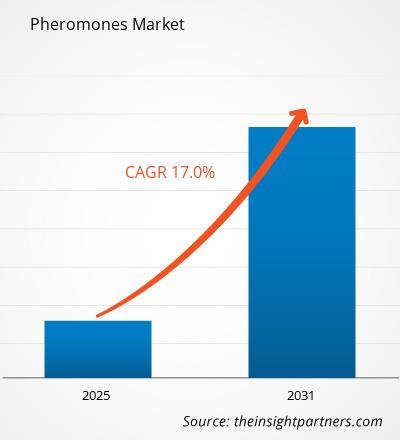
The Pheromones Market has emerged as a critical component of sustainable crop protection strategies, driven by the growing preference for environmentally responsible pest management solutions. Valued at US$ 3.77 Billion in 2025, the market is projected to reach US$ 7.01 Billion by 2034, expanding at a CAGR of 7.13% during 2026–2034. Increasing restrictions on conventional pesticides, coupled with rising adoption of integrated pest management practices, continue to strengthen commercial demand for pheromone-based technologies across agricultural ecosystems.
North America remains a highly influential region within the Pheromones Market and is anticipated to record a CAGR of approximately 7.0% through 2034. Strong regulatory support for biological crop protection, widespread adoption of precision agriculture, and increasing investments in sustainable farming practices are encouraging growers to integrate pheromone-based monitoring and mating disruption solutions. The region also benefits from a mature agricultural biotechnology ecosystem and active participation from leading market participants.
Pheromones Market Assessment and Insights
- North America: North America accounted for 28–32% share in 2025 and is anticipated to expand at a CAGR of 6.5%–7.5% during 2026–2034. Increasing adoption of integrated pest management (IPM), growing demand for sustainable farming practices, and rising preference for environmentally friendly crop protection solutions continue to support regional market growth.
- U.S.: The U.S. represented 70–75% of the North American market in 2025 and is projected to register a CAGR of 6.5%–7.5% during 2026–2034, supported by expanding IPM adoption, increasing use of biological pest control solutions, and strong focus on sustainable agriculture.
- Europe: Europe held 30–34% market share in 2025 and is expected to grow at a CAGR of 7.0%–8.0% during 2026–2034. Germany, France, and the United Kingdom remain the leading regional markets due to supportive sustainable agriculture policies and increasing adoption of biological crop protection technologies.
- Asia Pacific: Asia Pacific accounted for 24–28% of the Pheromones market share in 2025 and is forecast to expand at a CAGR of 8.0%–9.0% during 2026–2034. China, Japan, and India continue to drive regional growth through agricultural modernization, increasing crop protection awareness, and expanding adoption of integrated pest management practices.
- Largest Segment: Application – Mating Disruption represented the largest market segment and is expected to record a CAGR of 7.5%–8.5% during 2026–2034, reflecting increasing demand for chemical-free pest control approaches and sustainable crop management practices.
- High Growth Segment: Application – Mass Trapping is projected to grow at a CAGR of 8.0%–9.0% during 2026–2034, driven by growing adoption of precision pest monitoring technologies and integrated crop protection strategies.
- Key companies analyzed in detail: BASF SE; Suterra LLC; Russell IPM Ltd; Shin-Etsu Chemical Co., Ltd.; Koppert Biological Systems; Isagro S.p.A.; Biobest Group NV; ISCA Technologies; Certis Europe BV; and International Pheromone Systems Ltd.
Source: The Insight Partners' analysis based on proprietary research, government publications, company annual reports, investor presentations, industry databases, and expert interviews.
The Pheromones Market has evolved from a niche biological control category into a mainstream crop protection tool. Advancements in synthesis technologies, improved dispenser systems, and growing awareness of pesticide resistance have accelerated adoption among fruit, vegetable, and specialty crop producers. Market participants increasingly focus on developing species-specific solutions that minimize ecological impact while maintaining crop productivity.
Future market development will be shaped by regulatory encouragement of sustainable agriculture and growing pressure to reduce chemical residues in food production. Enhanced compatibility with integrated pest management programs, expanding use across developing agricultural economies, and ongoing innovation in delivery mechanisms are expected to support broader commercialization opportunities throughout the forecast period.
Pheromones Market Report Scope
| Report Attribute | Details |
|---|---|
| Market size in 2025 | US$ 3.77 Billion |
| Market Size by 2034 | US$ 7.01 Billion |
| Global CAGR (2026 - 2034) | 7.13% |
| Historical Data | 2021-2024 |
| Forecast period | 2026-2034 |
Pheromones Market Analysis
Growing concerns regarding pesticide resistance and environmental sustainability are reinforcing demand for pheromone-based crop protection systems. Agricultural producers are increasingly utilizing pheromones for pest monitoring, mating disruption, and mass trapping applications due to their species-specific action and favorable environmental profile. Climate variability and changing pest migration patterns are also creating demand for more targeted pest management solutions.
The value chain encompasses pheromone synthesis, formulation development, dispenser manufacturing, distribution networks, agricultural advisory services, and end-user deployment. Collaboration between technology providers, agricultural cooperatives, and crop protection specialists continues to enhance product accessibility and field performance across diverse crop categories.
Competition within the Pheromones Market is characterized by innovation-focused strategies, regulatory expertise, and strong distribution capabilities. Major participants, including BASF SE, Suterra LLC, Russell IPM Ltd, Shin-Etsu Chemical Co., Ltd., Koppert Biological Systems, Isagro Group, Biobest Group NV, ISCA Technologies, Certis Europe BV, and International Pheromone Systems Ltd, are strengthening portfolios through research and product diversification.
Investment activity increasingly targets controlled-release technologies, automated pest monitoring platforms, and biologically integrated crop protection systems, strengthening long-term Pheromones market size. Strategic partnerships between agricultural technology providers and pheromone manufacturers are improving market penetration while supporting the development of scalable solutions for large commercial farming operations.
● REPORT CUSTOMIZATION
Tailor This Report To Align With Your Specific Business Requirements
This report can be customized to align precisely with your business objectives, scope, and target markets. Customization options include tailored segmentation, geography, competitive analysis, and strategic insights to support informed decision-making.
Customize This Report →WHAT YOU CAN ADJUST
- ● Segmentations
- ● Geography
- ● Competitive Analysis
- ● Language Preferences
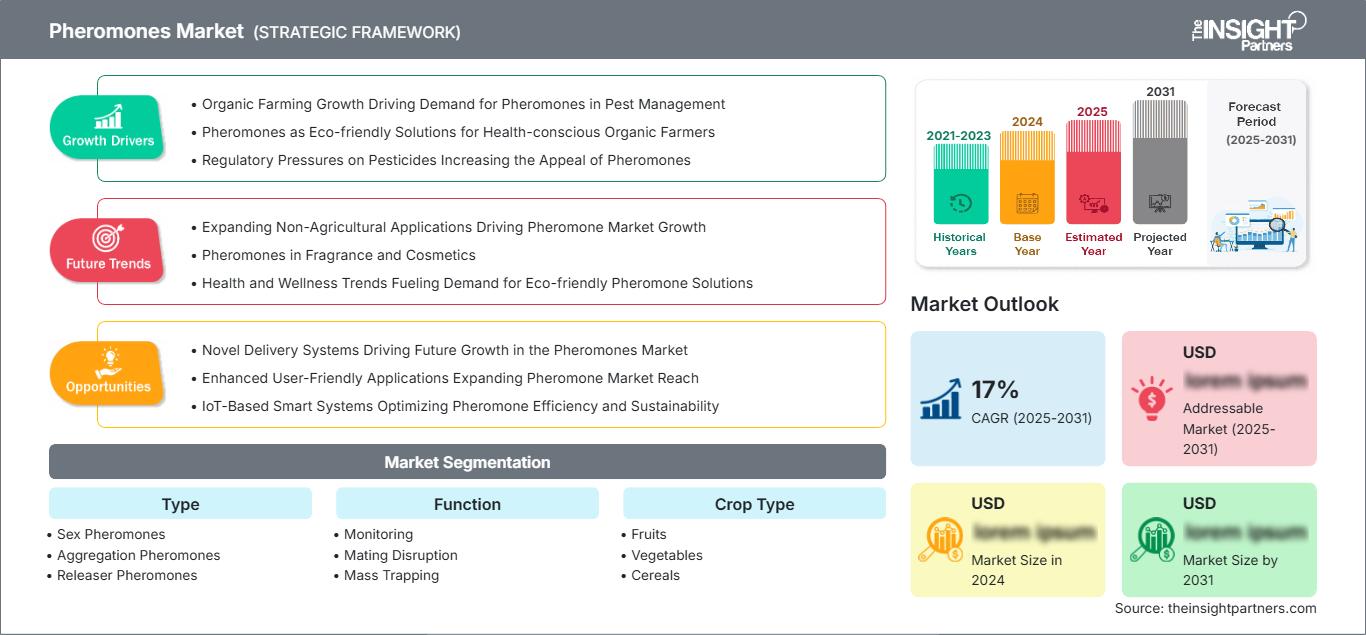
Pheromones Market: Strategic Insights
Regional Insights
North America Pheromones Market
North America accounts for a significant share of the global Pheromones Market and is projected to grow at approximately 7.0% CAGR through 2034. The region benefits from advanced farming practices, strong adoption of integrated pest management programs, and increasing demand for residue-free agricultural production. Regulatory scrutiny of conventional pesticides further encourages adoption of biological alternatives.
The region also hosts several established market participants and research institutions focused on pheromone technologies. Applications in fruit orchards, vineyards, field crops, and forestry continue to expand as growers seek sustainable methods to improve pest control efficiency while reducing environmental impact.
U.S. Pheromones Market
The United States represents roughly 70–75% of the North American market and is anticipated to maintain a CAGR of approximately 7.1% through 2034. Extensive cultivation of fruits, vegetables, grapes, and specialty crops creates favorable conditions for pheromone deployment. Adoption is particularly strong in pest monitoring and mating disruption applications targeting economically significant insect species.
The presence of companies such as Suterra LLC and ISCA Technologies supports technological innovation and commercialization activities. Increasing use of digital agriculture platforms integrated with pheromone traps is enhancing pest surveillance capabilities, enabling growers to make more precise crop protection decisions while reducing unnecessary pesticide applications.
Europe Pheromones Market
Europe holds approximately 28–32% of the global Pheromones Market and is expected to expand at a CAGR of nearly 6.8% through 2034. Strict environmental regulations, strong organic farming adoption, and ambitious sustainability objectives continue to support market growth. Demand remains particularly strong for pheromone solutions that help reduce chemical pesticide dependence.
The UK demonstrates growing adoption of pheromone-based monitoring systems across horticulture and protected agriculture. Increasing consumer preference for sustainably produced food and expanding integrated pest management programs are supporting continued market development across commercial farming operations.
Germany remains the leading European Pheromones market due to its advanced agricultural technologies, strong environmental policies, and active investment in biological crop protection. Research collaborations between agricultural institutions and industry participants further strengthen product innovation and deployment.
France, Italy, and Spain collectively represent important demand centers, particularly for vineyards, fruit orchards, and vegetable cultivation. Favorable climatic conditions for specialty crops and increasing regulatory pressure on conventional pesticides continue to encourage wider utilization of pheromone-based pest management systems.
APAC Pheromones Market
Asia-Pacific is projected to be the fastest-growing regional Pheromones market, expanding at approximately 8.2% CAGR through 2034 while accounting for roughly 22–27% of global revenue. Rapid agricultural modernization, rising food security concerns, and government initiatives promoting sustainable farming practices are driving adoption across the region.
China leads the regional market due to its large agricultural sector and growing focus on environmentally responsible crop protection. Government support for reduced pesticide usage and increasing investments in biological agriculture solutions are accelerating pheromone adoption across diverse crop categories.
Japan, South Korea, India, and Australia are witnessing increasing utilization of pheromone technologies in horticulture, fruit cultivation, and integrated pest management programs. Growing awareness among farmers regarding residue management and export quality standards further contributes to the Pheromones market expansion throughout the region.
Middle East & Africa Pheromones Market
The Middle East & Africa Market is expected to register a CAGR of approximately 6.5% throughout the Pheromones market forecast period. While adoption levels remain comparatively lower than developed regions, increasing investments in agricultural productivity and food security initiatives are creating new opportunities for pheromone suppliers.
Saudi Arabia and the UAE are investing in advanced agricultural systems, greenhouse cultivation, and water-efficient farming methods. These developments support demand for precision pest management technologies that align with sustainability objectives and resource optimization goals.
South Africa remains the leading market within the region due to its established horticulture sector and export-oriented agricultural production. Growing awareness of integrated pest management principles and increasing access to biological crop protection products are expected to strengthen long-term market development.
Segmentation Analysis
Type
- Sex Pheromones: Widely utilized for mating disruption and insect population control, this segment benefits from proven effectiveness across fruit and vegetable crops and remains the dominant commercial category within agricultural pheromone applications.
- Aggregation Pheromones: Increasingly adopted for attracting both male and female insects into traps, supporting monitoring and mass trapping programs in commercial farming environments requiring targeted pest management.
- Releaser Pheromones: Used to trigger immediate behavioral responses among insects, these products support specialized pest management strategies and are gaining attention in precision agriculture programs.
- Primer Pheromones: Although relatively niche, primer pheromones offer long-term physiological influence on insect populations and continue to attract research interest for future agricultural applications.
Function
- Monitoring: Essential for pest surveillance, monitoring applications help growers identify infestation levels and optimize intervention timing while supporting integrated pest management frameworks.
- Mating Disruption: The largest functional segment, driven by widespread adoption in high-value crops where reduction of insect reproduction directly improves yield protection and product quality.
- Mass Trapping: Growing deployment across commercial agriculture reflects demand for non-chemical pest reduction methods that support sustainable crop protection objectives.
Crop Type
- Fruits: Represents the leading crop segment due to extensive use in orchards, vineyards, citrus production, and other high-value fruit cultivation systems vulnerable to insect infestations.
- Vegetables: Increasing adoption reflects rising demand for residue-free produce and effective pest monitoring solutions across protected and open-field vegetable farming.
- Cereals: Adoption continues to expand as large-scale producers evaluate pheromone technologies for monitoring and controlling economically significant pest populations.
Opportunity Snapshot
| Crop Type | Revenue Contribution | Trend Tag | Adoption Stage |
| Fruits | High | Orchard Protection | Mature |
| Vegetables | Medium | Residue Control | Scaling |
| Cereals | Low | Field Monitoring | Emerging |
Pheromones Market Growth Drivers and Impact Analysis
Expansion of Integrated Pest Management Programs
Integrated pest management has now gained prominence as a core part of sustainable agriculture in developed and developing economies alike. Farmers are constantly looking for ways in which their reliance on pesticides can be diminished, but crop productivity and profitability remain intact. Pheromones offer very selective pest management techniques that fit well within the concept of integrated pest management through monitoring, trapping, and mating disruption without hurting the beneficial organisms.
The practical benefits are not limited to environment-friendly practices alone. Growers will be able to benefit from improved pest information, which will help them take appropriate measures at the right time and reduce the cost of inputs. Even the regulatory authorities promote integrated pest management practices through policies supporting biological control of crops. With the increasing adoption of integrated pest management in fruit and vegetable and cereal farming, pheromone demand is bound to grow.
Rising Restrictions on Conventional Chemical Pesticides
Governments around the world are adopting regulations relating to pesticide residues, environmental pollution, and protection of pollinators. This development is presenting substantial business opportunities for pheromones since they are able to provide an alternative means of pest control that does not have many of the environmental issues linked to broad-spectrum chemicals.
The implications of regulation are especially felt in the export-driven agriculture sector, where it is important to adhere to internationally recognized residue levels. Producers are increasingly using pheromone technologies to ensure their ability to retain access to markets even as they meet sustainability demands from retail and consumer markets.
Growing Demand for Sustainable and Residue-Free Food Production
Consumer awareness regarding food safety and environmental sustainability continues to influence agricultural production practices. Retailers, food processors, and exporters increasingly encourage farmers to adopt crop protection systems that minimize chemical residues and support responsible farming standards.
Pheromone technologies directly address these expectations by providing species-specific pest management solutions that leave a minimal environmental footprint. Their adoption contributes to certification programs, organic farming objectives, and sustainability commitments throughout agricultural value chains. As consumer-driven sustainability priorities become more influential, pheromone-based products are expected to capture a growing share of crop protection expenditures.
Pheromones Market Future Trends
Integration of Digital Monitoring and Smart Trap Technologies
Current Pheromones market trends show that the integration of pheromones with digital agriculture applications is changing pest management methodologies. Smart traps fitted with sensors, imaging technology, and remote monitoring are helping to monitor pests in real time. The systems save on manpower while offering increased precision.
In future applications, it is anticipated that these systems will adopt predictive modeling and AI techniques that detect infestations before any economic loss is incurred. With advancements in connectivity networks within agricultural sectors, digital monitoring systems will become increasingly crucial for optimal pheromone management.
Advancement of Controlled-Release Pheromone Formulations
Companies are making substantial investments into next-generation delivery systems that increase longevity, environmental stability, and applicability of pheromones. The controlled-release system ensures that a stable level of pheromone emissions occurs over long periods of time, requiring fewer replacements and simplifying the process.
Further development will provide an opportunity to extend the list of species and types of agricultural areas in which the use of pheromones can be effective. Improved formulations will increase efficiency and adoption among large-scale commercial farms seeking scalable biological pest management alternatives.
Pheromones Market Opportunities
Expansion into Emerging Agricultural Economies
The growing number of developing economies in Asia, Latin America, and some parts of Africa represents an enormous market with great growth potential for the company because of the rising level of agricultural modernization and an increased consciousness of sustainable agriculture practices.
Possible investments can be represented by regional manufacturing, partnerships with distributors, farmer education programs, and the development of crop-related solutions to solve the problem of local pests. Those companies that will succeed in establishing their presence on the local market by proving economic benefits will surely gain from rapid adoption.
Development of Multi-Pest and Multi-Crop Solutions
The present uses of pheromones in agriculture frequently concentrate on individual insects, allowing room for further development in product lines. The pursuit of studies into the integration of several pheromone components into an effective delivery system would help broaden the applications of pheromones across different types of farming systems.
This technology may simplify the implementation process for farmers and maximize profits through pest control investment. Those who manage to market flexible and multi-crop products stand to gain from increased competitive advantage.
Recent Developments
- December, 2025: Syngenta and Provivi, leading agricultural innovation and technology companies, announced an exclusive distribution agreement to introduce a new generation of sprayable pheromone formulation for Fall Armyworm (FAW - Spodoptera frugiperda) control in row crop farms in Brazil. This strategic partnership aims to provide Brazilian farmers with a critical, sustainable tool to combat one of the world's most destructive agricultural pests.
- October, 2025: FMC Corporation, a leading agricultural sciences company, announced it has received registration for Sofero® Frugi pheromone in Côte d'Ivoire, marking the first introduction of the company’s novel, sprayable pheromones portfolio into the European, Middle East and Africa (EMEA) region. Sofero® Frugi will provide farmers with a new tool for the sustainable management of fall armyworm (Spodoptera frugiperda) in corn. Fall armyworm poses a major threat to food security in West Africa, particularly in corn production, where infestations can result in significant yield losses and economic hardship for farmers.
- July, 2025: Bayer signed a development and distribution agreement with French pheromones expert company M2i Group for the exclusive distribution of pheromone gels for the Asia-Pacific as well as the Latin America region and the United States, building on its successful collaboration and related product launches in Europe and Africa.
Frequently Asked Questions

- Comprehensive Market Sizing and Forecast Analysis
- Detailed Segmentation Analysis
- In-Depth Market Dynamics Assessment
- Regional and Country-Level Insights
- Competitive Landscape and Company Benchmarking
- Strategic Business Intelligence
Recent Reports
Testimonials

The Insight Partners' SCADA System Market report is comprehensive, with valuable insights on current trends and future forecasts. The team was highly professional, responsive, and supportive throughout. We are very satisfied and highly recommend their services.
RAN KEDEM Partner, Reali Technologies LTDs
I requested a report on a very specific software market and the team produced the report in a few days. The information was very relevant and well presented. I then requested some changes and additions to the report. The team was again very responsive and I got the final report in less than a week.
JEAN-HERVE JENN Chairman, Future Analytica
We worked with The Insight Partners for an important market study and forecast. They gave us clear insights into opportunities and risks, which helped shape our plans. Their research was easy to use and based on solid data. It helped us make smart, confident decisions. We highly recommend them.
PIYUSH NAGPAL Sr. Vice President, High Beam Global
The Insight Partners delivered insightful, well-structured market research with strong domain expertise. Their team was professional and responsive throughout. The user-friendly website made accessing industry reports seamless. We highly recommend them for reliable, high-quality research services
YUKIHIKO ADACHI CEO, Deep Blue, LLC.
This is the first time I have purchased a market report from The Insight Partners.While I was unsure at first, I visited their web site and felt more comfortable to take the risk and purchase a market report.I am completely satisfied with the quality of the report and customer service. I had several questions and comments with the initial report, but after a couple of dialogs over email with their analyst I believe I have a report that I can use as input to our strategic planning process.Thank you so much for taking the extra time and making this a positive experience.I will definitely recommend your service to others and you will be my first call when we need further market data.
JOHN SUZUKI President and Chief Executive Officer, Board Director, BK Technologies
I wish to appreciate your support and the professionalism you displayed in the course of attending to my request for information regarding to infectious disease IVD market in Nigeria. I appreciate your patience, your guidance, and the fact that you were willing to offer a discount, which eventually made it possible for us to close a deal. I look forward to engaging The Insight Partners in the future, all thanks to the impression you have created in me as a result of this first encounter.
DR CHIJIOKE ONYIA MANAGING DIRECTOR, PineCrest Healthcare Ltd.Reason to Buy
- Informed Decision-Making
- Understanding Market Dynamics
- Competitive Analysis
- Identifying Emerging Markets
- Customer Insights
- Market Forecasts
- Risk Mitigation
- Boosting Operational Efficiency
- Strategic Planning
- Investment Justification
- Tracking Industry Innovations
- Aligning with Regulatory Trends





 Get Free Sample for