
Phosphate Market Size, Share & Demand by 2034
Phosphate Market Size and Forecasts (2021–2034), Global and Regional Share, Trends, and Growth Opportunity Analysis Report Coverage : by Type (Ammonium/Phosphoric Acid, Calcium, Potassium, Sodium); Application (Fertilizers, Detergents, Food & Beverages, Water Treatment Chemicals, Metal Treatment, Cosmetic & Personal Care, Pharmaceuticals); and Geography (North America, Europe, Asia Pacific, and South and Central America)
- Status : Data Released
- Report Code : TIPRE00040480
- Category : Chemicals and Materials
- No. of Pages : 150
- Available Report Formats :


- Last update date : July 08, 2026


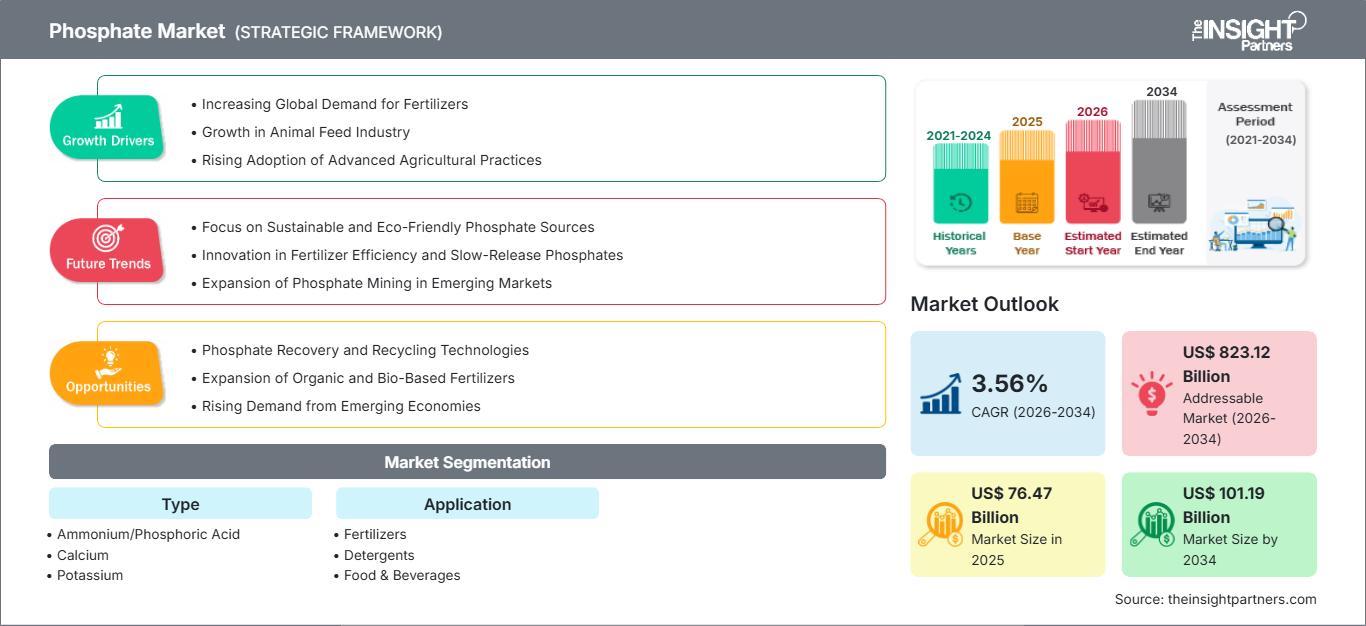
2025 Market Size
US$ 76.47 Bn
Base year value
2034 Forecast
US$ 101.19 Bn
Projected by 2034
CAGR 2026-2034
3.56 %
Growth rate
Addressable Market
US$ 823.12 Bn
(2026-2034)
The Phosphate Market remains a foundational component of global agricultural and industrial supply chains, supported by its indispensable role in crop nutrition, food processing, water treatment, detergents, pharmaceuticals, and specialty chemicals. Valued at US$ 76.47 Billion in 2025, the market is projected to reach US$ 101.19 Billion by 2034, advancing at a CAGR of 3.56% during 2026–2034. Demand stability across multiple end-use sectors and ongoing investments in phosphate extraction, beneficiation, and downstream processing continue to reinforce the market’s long-term growth trajectory.
North America represents a mature yet strategically significant region within the Phosphate Market, anticipated to expand at an estimated CAGR of around 3.1% through 2034. Growth is primarily supported by sustained fertilizer consumption, increasing emphasis on food security, and rising investments in water treatment infrastructure. The region also benefits from technological advancements in phosphate processing and strong integration between mining, chemical manufacturing, and agricultural industries.
Phosphate Market Assessment and Insights
- North America: North America accounted for 18–22% share in 2025 and is anticipated to expand at a CAGR of 2.8%–3.4% during 2026–2034. Fertilizer modernization initiatives and expanding industrial applications continue to support regional market growth.
- U.S.: The U.S. represented 75–80% of the North American market in 2025 and is projected to register a CAGR of 2.7%–3.3% during 2026–2034, supported by advancements in fertilizer efficiency technologies and growing industrial demand for phosphate-based products.
- Europe: Europe held 20–24% market share in 2025 and is expected to grow at a CAGR of 2.5%–3.1% during 2026–2034. Germany, France, and the United Kingdom remain the leading regional markets due to fertilizer efficiency initiatives and strong chemical processing demand.
- Asia Pacific: Asia Pacific accounted for 42–46% of the Phosphate Market share in 2025 and is forecast to expand at a CAGR of 4.0%–4.6% during 2026–2034. China, India, and Japan continue to drive regional growth through agricultural expansion and increasing phosphate consumption across industrial applications.
- Largest Segment: Application – Fertilizers represented the largest market segment and is expected to record a CAGR of 3.8%–4.4% during 2026–2034, reflecting rising global food production needs and increasing demand for soil nutrient management solutions.
- High Growth Segment: Application – Water Treatment Chemicals is projected to grow at a CAGR of 4.2%–4.8% during 2026–2034, driven by infrastructure development and increasing wastewater management requirements.
- Key companies analyzed in detail: The OCP Group; The Mosaic Company; EuroChem Group AG; Jordan Phosphate Mines Company PLC; ICL Group Ltd.; PhosAgro PJSC; Nutrien Ltd.; Ma’aden (Saudi Arabian Mining Company); Yara International ASA; Innophos Holdings, Inc.; and Yunnan Phosphate Haikou Co., Ltd.
Source: The Insight Partners' analysis based on proprietary research, government publications, company annual reports, investor presentations, industry databases, and expert interviews.
The Phosphate Market has evolved from a predominantly fertilizer-focused industry into a diversified ecosystem serving multiple industrial applications. Producers increasingly focus on operational efficiency, resource optimization, and downstream integration to capture higher-value opportunities. Expanding demand from water treatment, food processing, and pharmaceutical manufacturing has strengthened market resilience against cyclical agricultural fluctuations.
Future development is expected to be shaped by resource security strategies, environmental compliance requirements, and technological upgrades across mining and processing facilities throughout the Phosphate market forecast period. Industry participants are pursuing capacity expansion, beneficiation improvements, and specialty phosphate production to enhance profitability while responding to evolving regulatory and sustainability expectations.
Phosphate Market Report Scope
| Report Attribute | Details |
|---|---|
| Market size in 2025 | US$ 76.47 Billion |
| Market Size by 2034 | US$ 101.19 Billion |
| Global CAGR (2026 - 2034) | 3.56% |
| Historical Data | 2021-2024 |
| Forecast period | 2026-2034 |
Phosphate Market Analysis
Growing global food requirements continue to support phosphate consumption, particularly through phosphate fertilizers that improve crop yields and soil productivity. Population growth, changing dietary patterns, and shrinking arable land availability have increased pressure on agricultural systems, reinforcing the importance of phosphate-based nutrients across major farming economies.
The market ecosystem encompasses phosphate rock mining, beneficiation, phosphoric acid production, fertilizer manufacturing, industrial chemical processing, distribution networks, and end-user industries. Vertical integration remains a critical competitive advantage, allowing producers to secure raw materials, manage costs, and improve supply chain reliability amid fluctuating commodity conditions.
Competition within the Phosphate Market is characterized by large integrated producers and regionally focused manufacturers. Companies such as The OCP Group, The Mosaic Company, EuroChem Group AG, Jordan Phosphate Mines Co., ICL Group Ltd, PhosAgro, Nutrien Ltd, Ma’aden-Saudi Arabian Mining Company, Yara International ASA, Innophos Holding Inc., and Yunnan Phosphate Haikou Co., Ltd maintain strong positions through resource ownership, production scale, and global distribution networks.
Investment activity increasingly targets processing efficiency, sustainability initiatives, specialty phosphate products, and export-oriented capacity expansion, strengthening long-term Phosphate market size. Strategic partnerships, logistics improvements, and digital technologies are becoming essential tools for strengthening market positioning while addressing evolving customer requirements across agricultural and industrial sectors.
● REPORT CUSTOMIZATION
Tailor This Report To Align With Your Specific Business Requirements
This report can be customized to align precisely with your business objectives, scope, and target markets. Customization options include tailored segmentation, geography, competitive analysis, and strategic insights to support informed decision-making.
Customize This Report →WHAT YOU CAN ADJUST
- ● Segmentations
- ● Geography
- ● Competitive Analysis
- ● Language Preferences
Phosphate Market: Strategic Insights
Regional Insights
North America Phosphate Market
North America maintains a well-established phosphate industry supported by advanced agricultural practices and significant fertilizer consumption. The region is expected to register a CAGR of approximately 3.1% through 2034. Strong crop production, extensive farming operations, and modernization of municipal water treatment facilities continue to generate steady demand for phosphate products.
Industrial applications further support regional consumption, particularly in food processing, pharmaceuticals, and specialty chemicals. Investments in domestic mineral security and nutrient supply chains are encouraging greater attention toward phosphate resource development and processing capabilities, enhancing long-term market stability.
U.S. Phosphate Market
The U.S. accounts for roughly 70–75% of North American phosphate consumption and production, supported by large agricultural regions and a mature fertilizer manufacturing base. The market is forecast to expand at a CAGR near 3.0% through 2034 as crop nutrient requirements remain fundamental to agricultural productivity.
The presence of major companies, including The Mosaic Company and Nutrien Ltd, strengthens domestic supply capabilities. Fertilizer applications remain dominant, although water treatment chemicals, food additives, and pharmaceutical ingredients represent increasingly important demand centers. Regulatory emphasis on water quality management and nutrient efficiency is also encouraging innovation across phosphate processing and application technologies.
Europe Phosphate Market
Europe represents approximately 20–25% Phosphate market share and is expected to expand at a CAGR of around 3.0% during the forecast period. The region's market is influenced by agricultural productivity goals, environmental regulations, and growing interest in phosphate recovery and circular economy initiatives. Germany remains the leading country due to its industrial strength and advanced chemical manufacturing sector.
The United Kingdom continues to witness stable phosphate demand from agriculture, food processing, and water treatment sectors. Infrastructure modernization and environmental compliance requirements support phosphate consumption in municipal and industrial treatment applications while encouraging resource efficiency initiatives.
Germany leads regional phosphate utilization owing to its extensive chemical, pharmaceutical, and industrial manufacturing activities. The country's emphasis on sustainable production technologies and nutrient management practices contributes to steady market expansion and supports higher-value phosphate applications.
France, Italy, and Spain collectively represent important agricultural markets where phosphate fertilizers remain essential for crop productivity. Demand is further supported by food processing industries, specialty chemicals manufacturing, and increasing adoption of advanced nutrient management solutions across farming operations.
APAC Phosphate Market
Asia Pacific commands approximately 40–45% of global market demand and remains the leading regional market. The region is anticipated to achieve a CAGR of roughly 4.1% through 2034, supported by rapid agricultural intensification, industrial growth, and rising food consumption. China maintains the dominant position due to its extensive fertilizer manufacturing and phosphate processing capacity.
China continues to influence global phosphate trade through production volumes, export policies, and downstream processing investments. Government initiatives focused on agricultural productivity and resource efficiency support sustained market activity across the value chain.
India, Japan, South Korea, and Australia collectively contribute significant demand growth. India benefits from expanding fertilizer requirements, while Japan and South Korea emphasize specialty industrial applications. Australia supports demand through agricultural production and mining-related activities, creating a diverse regional consumption profile.
Middle East & Africa Phosphate Market
The Middle East & Africa region is projected to record one of the fastest growth rates globally, with an estimated CAGR exceeding 4.5% through 2034. Large phosphate reserves, expanding fertilizer production facilities, and strategic export investments are strengthening the region's position within global supply chains.
Saudi Arabia serves as the leading Phosphate market due to integrated mining and fertilizer production operations. Continued investments in industrial diversification, mining infrastructure, and export-oriented phosphate projects support regional competitiveness and long-term capacity expansion.
The UAE, South Africa, and other MEA countries are increasing phosphate utilization through agricultural modernization, industrial development, and water treatment infrastructure projects. Rising energy sector investments and logistics improvements further enhance regional opportunities across the phosphate value chain.
Segmentation Analysis
Type
- Ammonium/Phosphoric Acid: Forms the backbone of phosphate fertilizer production, supported by large-scale agricultural demand, integrated processing facilities, and expanding global nutrient requirements across major crop-producing regions.
- Calcium: Widely utilized in animal nutrition, food processing, and specialty fertilizer applications, benefiting from increasing focus on balanced nutrient formulations and agricultural productivity enhancement.
- Potassium: Serves specialized industrial and agricultural functions where phosphate-potassium combinations improve nutrient delivery efficiency and support high-value crop cultivation practices.
- Sodium: Extensively employed in detergents, water treatment chemicals, food additives, and industrial processing applications, supported by broad functionality and established manufacturing demand.
Application
- Fertilizers: Represents the largest application segment due to phosphate’s critical role in plant growth, soil fertility enhancement, and agricultural productivity improvement across global farming systems.
- Detergents: Maintains relevance in industrial and institutional cleaning formulations where phosphate compounds contribute to water softening and cleaning performance characteristics.
- Food & Beverages: Supports demand through food-grade phosphates used in preservation, texture improvement, acidity regulation, and processing efficiency enhancement.
- Water Treatment Chemicals: Experiences growing adoption as municipalities and industries invest in water quality management, corrosion control, and infrastructure modernization initiatives.
- Metal Treatment: Utilized in surface preparation, corrosion resistance, and industrial finishing processes where phosphate coatings improve material performance and durability.
- Cosmetic & Personal Care: Gains traction through specialty phosphate ingredients incorporated into formulation stabilization, texture enhancement, and product performance optimization.
- Pharmaceuticals: Supports production of excipients, mineral supplements, and specialized formulations requiring high-purity phosphate compounds for therapeutic and manufacturing applications.
Opportunity Snapshot
| Application | Revenue Contribution | Trend Tag | Adoption Stage |
| Fertilizers | High | Crop Nutrition | Mature |
| Detergents | Medium | Water Softening | Mature |
| Food & Beverages | Medium | Food Processing | Scaling |
| Water Treatment Chemicals | Medium | Water Security | Scaling |
| Metal Treatment | Low | Surface Protection | Mature |
| Cosmetic & Personal Care | Low | Formulation Stability | Emerging |
| Pharmaceuticals | Medium | High Purity | Scaling |
Phosphate Market Growth Drivers and Impact Analysis
Rising Global Food Production Requirements
The growing need to increase agricultural output remains the most significant driver for the Phosphate Market. Expanding populations, urbanization, and changing dietary preferences are increasing pressure on global food systems to deliver higher productivity from limited agricultural land. Phosphate-based fertilizers play a critical role in root development, energy transfer, and crop yield optimization, making them indispensable for modern farming.
Developing countries are still increasing fertilizer use to enhance agricultural efficiency and mitigate food security threats. In addition, governments are encouraging fertilizer management programs and agricultural development programs to boost the agricultural capacity in their countries. This has a direct impact on phosphate consumption in agriculture.
This effect is not limited to fertilizer manufacturers. The phosphate industry, including mining firms, phosphoric acid producers, transportation firms, and agricultural input providers, is also positively affected by this trend.
Expansion of Water Treatment Infrastructure
Growing concerns regarding water quality and infrastructure resilience are increasing phosphate demand in water treatment applications. Municipalities and industrial facilities rely on phosphate-based chemicals for corrosion control, scale prevention, and distribution system maintenance. Population growth and urban expansion continue to create additional requirements for water treatment investments.
Developing regions are allocating substantial resources toward expanding access to clean water and improving wastewater treatment capacity. At the same time, aging infrastructure in developed countries needs to be upgraded along with improved chemical treatments. This provides a stable demand base to complement agricultural consumption.
Market effects encompass the diversity of income generation from phosphate, which is not reliant on agricultural cycles. Producers who can offer specialized phosphate formulas gain higher margins and greater involvement in growth associated with infrastructure development.
Integrated Mining and Downstream Processing Investments
Increasing investments in vertically integrated phosphate operations are strengthening supply security and improving operational efficiency. Major producers are expanding mining activities while simultaneously investing in phosphoric acid, fertilizer, and specialty phosphate production facilities. This strategy enables better cost management and greater resilience against commodity price volatility.
The phosphate-rich nations are emphasizing the development of phosphate as part of the diversified industrialization process. The new infrastructure, logistics chains, and processing facilities have enabled these producers to gain more value from their economies and increase their export efficiency.
Thus, the impact on the market is illustrated by growth in production capabilities, the reliability of supply chains, and the availability of high-quality phosphate products. Integrated firms tend to be better equipped to deal with market uncertainties and emerging customer needs.
Phosphate Market Future Trends
Growing Focus on Sustainable Phosphate Production
Current Phosphate market trends indicate that ecological concerns are increasingly shaping phosphate extraction and refining approaches. Producers are introducing eco-friendly technologies and adopting energy- and water-saving techniques to ensure compliance with the emerging sustainability trends. Growing demands in terms of regulation and social responsibility are further motivating the implementation of sustainable production processes.
Utilization of phosphate in wastewater and crop residues is currently receiving much attention as an additional source of phosphate. The concept of circular economy may help to decrease reliance on raw phosphate sources while achieving nutrient security goals.
Moving forward, it is predicted that sustainability will serve as a competitive advantage. The ability to minimize environmental impact and increase resource efficiency can bring about strong customer and regulatory relations.
Expansion of Specialty and High-Purity Phosphate Products
Growing demand for specialized phosphate formulations is seen in sectors including pharmaceuticals, the food industry, personal care, and innovative industrial uses. Such products usually need a higher level of purity as well as more complex production methods compared to normal fertilizer products.
Producers are taking up initiatives by making selective investments in downstream production and product development. There are possibilities of improved profit margins along with a lesser impact on volatile commodity markets through high-performance phosphate products.
Over the coming decade, specialty phosphate segments are expected to represent an increasingly important growth avenue. Producers with advanced processing expertise and strong technical capabilities are likely to capture a larger share of value-added market opportunities.
Phosphate Market Opportunities
Development of Phosphate Recovery Technologies
There is tremendous potential in phosphate recovery from wastewater treatment plants, industrial effluents, and agricultural waste. Resource recovery solutions not only solve the problem of sustainability but also provide additional sources that could help complement mining operations.
Governments and utilities have been turning towards nutrient recovery solutions in order to optimize their performance and minimize their reliance on imported raw materials. Technical advancements keep improving both the feasibility and economic efficiency of the process.
Early engagement in this nascent market provides opportunities for investors and technology providers. Strategic collaboration with municipalities, industries, and agriculture could become a sustainable source of income.
Capacity Expansion in Emerging Agricultural Economies
High rates of growth in agriculture in Asia, Africa, and certain countries in Latin America have created great potential for both phosphate suppliers and downstream companies. Increasing fertilizer usage, infrastructural development, and government programs related to food security further support demand fundamentals in the region.
Many emerging economies remain underpenetrated in terms of nutrient application rates compared to the developed agricultural regions. As farmers’ practices become more advanced and productivity goals increase, the consumption of phosphate should grow consistently.
Local production, distribution, and cooperation with partners will help to enhance the global phosphate market penetration and minimize risks associated with the supply chain. Early investments in growing agricultural economies can create great profits due to increasing demand.
Recent Developments
- June, 2026: Arianne Phosphate Inc a development-stage phosphate mining company advancing its Lac à Paul project in Quebec’s Saguenay-Lac-Saint-Jean region, announced that it has completed the production of purified phosphoric acid (“PPA”) with its partner Travertine Technologies. The companies partnered by way of an MoU to test the ability of producing PPA by combining Travertine’s proprietary process with Arianne’s high-purity phosphate concentrate and, subsequently, signed the joint-venture framework agreement earlier this month
- April, 2026: The OCP Group raised US$1.5 billion through its first international hybrid bond issuance. The financing supports strategic phosphate and fertilizer investments while strengthening long-term capital availability. OCP also highlighted plans to increase production of triple superphosphate products, reflecting evolving market demand and supply-chain considerations.
- December, 2025: Mosaic announced phosphate production curtailments in Brazil. Mosaic's operations in Brazil play a critical role in supporting reliable fertilizer availability and global food security.
Frequently Asked Questions

- Comprehensive Market Sizing and Forecast Analysis
- Detailed Segmentation Analysis
- In-Depth Market Dynamics Assessment
- Regional and Country-Level Insights
- Competitive Landscape and Company Benchmarking
- Strategic Business Intelligence
Recent Reports
Testimonials

The Insight Partners' SCADA System Market report is comprehensive, with valuable insights on current trends and future forecasts. The team was highly professional, responsive, and supportive throughout. We are very satisfied and highly recommend their services.
RAN KEDEM Partner, Reali Technologies LTDs
I requested a report on a very specific software market and the team produced the report in a few days. The information was very relevant and well presented. I then requested some changes and additions to the report. The team was again very responsive and I got the final report in less than a week.
JEAN-HERVE JENN Chairman, Future Analytica
We worked with The Insight Partners for an important market study and forecast. They gave us clear insights into opportunities and risks, which helped shape our plans. Their research was easy to use and based on solid data. It helped us make smart, confident decisions. We highly recommend them.
PIYUSH NAGPAL Sr. Vice President, High Beam Global
The Insight Partners delivered insightful, well-structured market research with strong domain expertise. Their team was professional and responsive throughout. The user-friendly website made accessing industry reports seamless. We highly recommend them for reliable, high-quality research services
YUKIHIKO ADACHI CEO, Deep Blue, LLC.
This is the first time I have purchased a market report from The Insight Partners.While I was unsure at first, I visited their web site and felt more comfortable to take the risk and purchase a market report.I am completely satisfied with the quality of the report and customer service. I had several questions and comments with the initial report, but after a couple of dialogs over email with their analyst I believe I have a report that I can use as input to our strategic planning process.Thank you so much for taking the extra time and making this a positive experience.I will definitely recommend your service to others and you will be my first call when we need further market data.
JOHN SUZUKI President and Chief Executive Officer, Board Director, BK Technologies
I wish to appreciate your support and the professionalism you displayed in the course of attending to my request for information regarding to infectious disease IVD market in Nigeria. I appreciate your patience, your guidance, and the fact that you were willing to offer a discount, which eventually made it possible for us to close a deal. I look forward to engaging The Insight Partners in the future, all thanks to the impression you have created in me as a result of this first encounter.
DR CHIJIOKE ONYIA MANAGING DIRECTOR, PineCrest Healthcare Ltd.Reason to Buy
- Informed Decision-Making
- Understanding Market Dynamics
- Competitive Analysis
- Identifying Emerging Markets
- Customer Insights
- Market Forecasts
- Risk Mitigation
- Boosting Operational Efficiency
- Strategic Planning
- Investment Justification
- Tracking Industry Innovations
- Aligning with Regulatory Trends





 Get Free Sample for