
Piping System and Piping Spools Market Trends, Size & Forecast by 2034
Coverage: By Material (Stainless Steel, Carbon Steel, Alloy Steel, Others); End-user (Power Plant, Petroleum Refineries, Offshore, Shipbuilding and Marine, Chemical and Fertilizers, Pharmaceuticals, Others) , and Geography (North America, Europe, Asia Pacific, and South and Central America)
- Status : Data Released
- Report Code : TIPRE00018580
- Category : Manufacturing and Construction
- No. of Pages : 150
- Available Report Formats :


- Last update date : September 30, 2026


2025 Market Size
US$ 74.26 Bn
Base year value
2034 Forecast
US$ 116.24 Bn
Projected by 2034
CAGR 2026-2034
5.11 %
Growth rate
Addressable Market
US$ 864.58 Bn
(2026-2034)
The Piping System and Piping Spools Market size was valued at US$ 74.26 Billion in 2025 and is projected to reach US$ 116.24 Billion by 2034, registering a CAGR of 5.11% from 2026 to 2034. The market covers engineered piping networks and prefabricated piping spools used to convey fluids, gases, and process media across industrial facilities, segmented by material into stainless steel, carbon steel, and alloy steel and by end user across power, refining, offshore, marine, chemical, fertilizer, and pharmaceutical applications.
North America is estimated to account for 24.0% of the global market in 2025 and is projected to expand at a 4.60% CAGR through 2034. Established refinery, chemical, power, and LNG infrastructure supports recurring fabrication demand, while replacement of aging process equipment sustains procurement. The region's mature engineering and fabrication ecosystem, combined with stringent process-piping requirements, favors prefabricated spool production that reduces field welding, inspection complexity, and installation time.
Piping System and Piping Spools Market Assessment and Insights
- North America: North America is estimated to represent 24.0% of the global Piping System and Piping Spools Market share in 2025 and grow at 4.60% through 2034, supported by established process infrastructure, maintenance spending, and demand for code-compliant fabricated piping in refining, chemicals, power, and LNG projects.
- U.S.: The U.S. is estimated to represent 72.0% of North America's market in 2025 and expand at 4.50%, reflecting its large refining, chemical, power, water, and industrial maintenance base and sustained investment in domestic energy infrastructure.
- Europe: Europe is estimated at 22.0% of the global market in 2025 and is projected to grow at 4.70%, with Germany, Italy, France, the UK, and Spain supported by process-industry modernization, energy infrastructure upgrades, stringent fabrication requirements, and localized engineering capabilities.
- Asia Pacific: Asia Pacific is estimated to hold 32.0% of the global market in 2025 and grow at 6.00%, led by China and supported by India, Japan, and South Korea through refinery, chemicals, power, shipbuilding, and industrial-capacity additions.
- Largest Segment: Carbon Steel is the largest main material segment and is projected to grow at 4.82% from 2026 to 2034 because of its cost efficiency, structural strength, broad specification coverage, and extensive use in conventional process and utility piping.
- High Growth Segment: Alloy Steel is the fastest-growing main material segment at a 6.31% CAGR from 2026 to 2034, driven by high-temperature, high-pressure, corrosion-resistant applications where standard carbon steel cannot provide the required operating performance.
- Key companies analyzed in detail: Arabian International Company for Steel (AIC Steel); CCI Leidingsystemen B.V.; TMK PJSC, including ChelPipe operations; Çimtaş Pipe Fabrication and Trading Ltd. Co.; Cogbill Construction, LLC; DEE Development Engineers Limited; Metal Forge India; Prosaic Steel & Alloys; U.S. Pipe; YENA Engineering B.V.
Source: The Insight Partners' analysis based on proprietary research, government publications, company annual reports, investor presentations, industry databases, and expert interviews.
The industry is shifting towards engineered prefabrication, modular assembly, strict welding, and digital coordination of projects. The 2024 ASME B31.3 specification edition will still give specifications for the design, material, fabrication, assembly, examination, inspection, and testing of the process piping systems of use in the refineries, chemicals, pharmaceuticals, power, hydrogen, semiconductors, and cryogenic facilities. This underscores the preference by buyers for fabrication with a traceable record, qualification for the welding processes, dimensionally accurate, and quality assurance.
The forecasted future looks more favorable for suppliers who have locations near the industrial construction complexes and exporting ports. Capital investments in the refining, chemicals, power plants, maritime structures, and process facilities will be increasing demands for higher quality pipes while supply chain localization is driving local fabrication. In India, DEE Development Engineers added fabrication capacity for process pipes in their Anjar facility in September 2025.
Piping System and Piping Spools Market Report Scope
| Report Attribute | Details |
|---|---|
| Market size in 2025 | US$ 74.26 Billion |
| Market Size by 2034 | US$ 116.24 Billion |
| Global CAGR (2026 - 2034) | 5.11% |
| Historical Data | 2021-2024 |
| Forecast period | 2026-2034 |
Piping System and Piping Spools Market Analysis
Demand is generated through new process facilities, brownfield modifications, plant maintenance, and aged piping replacement. Expansion of refinery or chemical projects drives engineering and procurement activities, leading to the creation of demand for pipe, fittings, flanges, bends, welding, NDE, coating, and pre-fab spools. Fabrication moves the repetitive processes of welding and inspection from limited construction sites to controlled fabrication yards, thus helping improve schedule co-ordination and field interface management. The end result is that there is an increase in demand for suppliers who are able to provide material procurement, fabrication, quality documentation, and logistics services besides pipe products.
The value chain includes steel producers and distributors, engineering firms, EPC companies, fabricators, equipment manufacturers, NDE organizations, and plant owners/operators. Availability of material impacts spool programs since each grade has a different welding procedure, heat treatment, test program, and traceability. This has been illustrated by the recent expansion of DEE Development Engineers at Anjar.
The Piping System and Piping Spools Market forecast shows that competition is fragmented among integrated fabricators, specialty spool producers, steel distributors, and engineering-oriented suppliers. Arabian International Company for Steel is an example of a company that integrates steel fabrication with pipe-spool capacity in their factories located in Saudi Arabia and UAE, while Çimtaş Pipe Fabrication and Trading Ltd. Co. is an example of a company that has integrated LSAW pipe, fittings, and spool production in its Bursa factory.
Suppliers are increasingly investing in automation, local capacity, special welding, heavy wall processing, and integrated fabrication. Examples include DEE Development Engineers' Anjar process-piping capacity expansion in the case of specialized applications and YENA Engineering's provision of prefabricated spools and skids along with engineering services and logistics internationally. Such business models suggest a trend towards higher value-added project packages where dimensions, certifications, and technical compliance in addition to price become factors in supplier selection.
● REPORT CUSTOMIZATION
Tailor This Report To Align With Your Specific Business Requirements
This report can be customized to align precisely with your business objectives, scope, and target markets. Customization options include tailored segmentation, geography, competitive analysis, and strategic insights to support informed decision-making.
Customize This Report →WHAT YOU CAN ADJUST
- ● Segmentations
- ● Geography
- ● Competitive Analysis
- ● Language Preferences
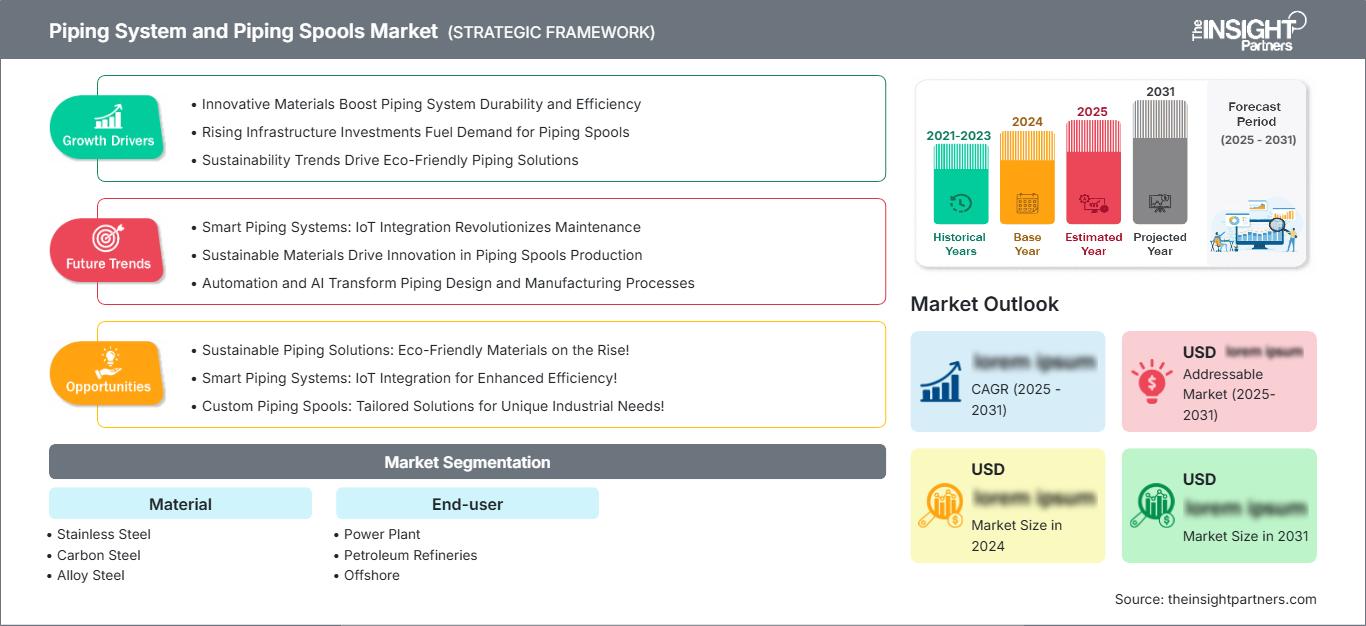
Piping System and Piping Spools Market: Strategic Insights
Regional Insights
North America Piping System and Piping Spools Market
North America is estimated to hold 24.0% of the global market in 2025 and grow at 4.60% through 2034. The U.S. dominates regional demand because of its extensive refining, petrochemical, power-generation, water, and industrial processing infrastructure. Replacement projects and brownfield modifications generate recurring requirements for fabricated sections where shutdown schedules make field productivity particularly important.
Specialization of supply in the region is ensured through specialized fabricating industries and existing engineering practices. The services offered by Cogbill Construction, LLC, include pipe-spool fabrication and piping accessories for industrial and petrochemical clients that use carbon steel, stainless steel, aluminum, and various alloy types in their operations.
U.S. Piping System and Piping Spools Market
According to the Piping System and Piping Spools Market report, the U.S. is estimated to represent 72.0% of North America's market in 2025 and expand at 4.50%. The demand for our product exists in refineries, chemical plants, power generation units, industrial processes, water systems, and maintenance activities. The presence of an established and installed base generates repeat purchase opportunities for us, whereas more complicated brownfield projects require prefabrication and faster installation within short plant shut-down periods.
There are water pipe manufacturers in addition to the industrial spool suppliers. U.S. Pipe, a subsidiary of QUIKRETE, provides ductile iron pipes and fittings, along with other related water and sewer systems.
Europe Piping System and Piping Spools Market
Europe is estimated to account for 22.0% of the global market in 2025 and grow at 4.70%. Germany leads the way with its process engineering and fabrication capacity, whereas Italy and France have an advantage with machinery, chemical, energy, and fabrication industries. The UK holds its ground due to energy and process infrastructure, while Spain has refining, chemicals, energy, and marine business. European consumption varies due to the need for engineering documentation, environmental specifications, and controlled fabrication.
The German and Italian markets are strong in industrial fabrication, while France and the UK have large energy and process industry needs. Spain is lucky to have refineries and industrial clusters along with marine business. CCI Leidingsystemen B.V. demonstrates the special nature of the region through its combination of steel and GRP pipelines, prefabrication, coatings, linings, and industrial pipelines, while YENA Engineering offers prefabricated carbon, alloy, duplex, and stainless-steel spools according to the European and international standards.
APAC Piping System and Piping Spools Market
Asia Pacific is estimated to represent 32.0% of the global market in 2025 and grow at 6.00%, making it the largest regional market and the fastest-growing major geography. China leads because of its large industrial, refining, chemical, power, and shipbuilding base. India is expanding rapidly through process-industry investment and domestic fabrication, while Japan and South Korea contribute advanced engineering and marine capabilities.
China's scale supports large-volume procurement, whereas Japan and South Korea emphasize precision, quality, and specialized industrial and marine applications. India is becoming increasingly important as domestic fabrication capacity expands. DEE Development Engineers' Anjar investment and Metal Forge India's pipe-spool and fittings capabilities illustrate the strengthening Indian supply base and its ability to serve domestic and export customers.
Middle East & Africa Piping System and Piping Spools Market
Middle East & Africa is estimated to account for 13.0% of the global market in 2025 and grow at 5.70%. Saudi Arabia and the UAE lead regional demand because refinery, petrochemical, gas-processing, infrastructure, and industrial projects require large volumes of engineered piping. South Africa contributes through mining, chemicals, power, and industrial maintenance.
Regional differentiation comes from large energy projects, localization initiatives, and proximity to fabrication yards. AIC Steel operates fabrication facilities in Saudi Arabia and the UAE and maintains dedicated pipe-spool capabilities, supporting shorter logistics routes for GCC projects. Across the rest of the region, imported engineering materials remain important, increasing the value of suppliers that can integrate procurement, fabrication, documentation, and delivery.
South & Central America Piping System and Piping Spools Market
South & Central America is estimated to represent 9.0% of the global market in 2025 and grow at 5.20%. Brazil leads because of its oil and gas, petrochemical, mining, power, and marine activity, while Argentina benefits from energy and industrial development. Regional procurement is influenced by imported specialty materials and the availability of local fabrication.
Brazil's large industrial base supports integrated fabrication, whereas Argentina's energy projects create demand for process and transmission-related piping. Other markets across the region remain smaller but can generate project-based demand from mining, utilities, chemicals, and infrastructure. Suppliers able to manage international material certification and delivery schedules are better positioned where local specialty-grade availability is constrained.
Segmentation Analysis
Material
The material segment covers stainless steel, carbon steel, and alloy steel used for piping systems and prefabricated spools. Carbon steel remains the largest main segment and is projected to grow at a 4.82% CAGR through 2034 because of broad industrial use and cost efficiency. Alloy steel is expanding faster where high temperature, pressure, and corrosion resistance justify higher material costs.
- Stainless Steel: Supports corrosive, hygienic, and high-purity applications in chemicals, pharmaceuticals, food processing, and specialized process systems, with material selection driven by corrosion resistance and cleanliness requirements.
- Carbon Steel: Serves mainstream utility, process, power, refinery, and industrial piping because of its weldability, structural strength, broad availability, and favorable project economics.
- Alloy Steel: Addresses elevated-temperature and high-pressure services where enhanced mechanical performance is required, making welding control, heat treatment, inspection, and material traceability central procurement considerations.
End-user
The end-user segment includes power plants, petroleum refineries, offshore facilities, shipbuilding and marine operations, chemical and fertilizer facilities, and pharmaceuticals. Pharmaceutical applications have the highest projected main-segment CAGR at 6.20% through 2034 because controlled environments and hygienic process requirements favor engineered, traceable, high-quality piping assemblies.
- Power Plant: Requires pressure, steam, feedwater, cooling, and auxiliary piping, with reliability, thermal performance, welding quality, and outage scheduling shaping procurement.
- Petroleum Refineries: Generate extensive process-piping requirements around crude processing, utilities, hydrogen, fuel systems, and maintenance shutdowns, emphasizing code compliance and rapid installation.
- Offshore: Prioritizes compact, corrosion-resistant, weight-conscious piping assemblies capable of performing under demanding marine conditions and constrained installation environments.
- Shipbuilding and Marine: Requires class-compliant piping, modular fabrication, precise routing, and coordinated delivery to shipyards, with schedule synchronization strongly influencing supplier selection.
- Chemical and Fertilizers: Uses piping for aggressive chemicals, process fluids, steam, utilities, and high-temperature services, increasing demand for appropriate metallurgy and controlled fabrication.
- Pharmaceuticals: Emphasizes hygienic design, surface quality, cleanability, documentation, and controlled welding for process and utility systems, supporting specialized high-value fabrication.
Opportunity Snapshot
| End Users | Revenue Contribution | Trend Tag | Adoption Stage |
| Power Plant | High | Retrofit Focus | Mature |
| Petroleum Refineries | High | Shutdown Fabrication | Mature |
| Offshore | Medium | Corrosion Control | Scaling |
| Shipbuilding and Marine | Medium | Modular Piping | Scaling |
| Chemical and Fertilizers | High | Process Upgrades | Mature |
| Pharmaceuticals | Medium | Hygienic Systems | Scaling |
Piping System and Piping Spools Market Growth Drivers and Impact Analysis
Expansion and modernization of process infrastructure
Industrial expansion and brownfield modernization are strengthening demand for engineered piping because new process units and plant modifications require coordinated networks of pipes, fittings, valves, supports, and prefabricated assemblies. The mechanism is direct: refinery, chemical, power, and industrial investment increases engineering quantities, which raises procurement of fabricated spools and associated materials. Maintenance projects reinforce the effect because shutdown windows favor off-site fabrication and pretested assemblies that reduce field work. Recent capacity additions by DEE Development Engineers in Gujarat demonstrate how fabricators are responding to sustained requirements from oil and gas, power, chemicals, and process industries. The implication is greater value for suppliers with scalable fabrication, engineering, inspection, and logistics capabilities.
Shift toward prefabricated and modular piping execution
The increasing use of prefabricated piping transfers welding, dimensional control, inspection, coating, and documentation into controlled workshop environments. The mechanism begins with EPC contractors seeking predictable installation schedules, which encourages spoolization and modular assembly; fabricators then invest in welding technology, CNC cutting, automated handling, quality systems, and project tracking. This approach is particularly valuable where construction sites face congestion, skilled-labor shortages, or restricted shutdown windows. Çimtaş Pipe Fabrication and Trading Ltd. Co. operates dedicated spool works and integrated pipe and fitting capabilities, illustrating the competitive advantage of consolidating fabrication steps. The market implication is a gradual shift from commodity pipe supply toward engineered assemblies and integrated project packages.
Rising technical requirements for critical-service piping
Higher operating pressures, temperatures, corrosive media, and tighter safety requirements increase the technical content of piping procurement. ASME B31.3 covers process piping across refineries, chemical and pharmaceutical facilities, power generation, hydrogen, semiconductor, and cryogenic applications, including design, fabrication, inspection, and testing requirements. The mechanism is that stricter service conditions require appropriate metallurgy, qualified welding, heat treatment, examination, and traceability, increasing the role of specialized fabricators. Suppliers capable of handling stainless and alloy steels, advanced welding procedures, non-destructive testing, and complete quality documentation can address more technically demanding projects. The strategic implication is stronger differentiation based on engineering and quality capability rather than fabrication volume alone.
Piping System and Piping Spools Market Future Trends
Digitalized fabrication and higher automation
The Piping System and Piping Spools Market trends show that piping fabrication is moving toward greater automation and digitally coordinated production, particularly where projects require large quantities of repeatable spools and precise documentation. The change is driven by pressure to reduce rework, manage skilled-welding constraints, and synchronize fabrication with EPC schedules. Fabricators are increasingly combining CNC cutting, controlled welding, digital project management, inspection records, and production planning. Customers affected include EPC contractors, plant owners, and equipment manufacturers seeking predictable installation sequences. The likely implication is a competitive advantage for suppliers that can connect engineering data with shop-floor execution, reduce manual interfaces, and provide traceable quality records without compromising customization for complex process systems.
Localization of specialized piping supply chains
Industrial project owners are increasingly balancing global sourcing with regional fabrication to improve schedule resilience and reduce logistics exposure. The trend is particularly visible in India, the Middle East, and other industrializing regions where new fabrication capacity is being positioned near ports, energy corridors, and process-industry clusters. Suppliers with local manufacturing combined with international material sourcing can address both cost and certification requirements. DEE Development Engineers' expanded Anjar facility and AIC Steel's multi-country fabrication footprint illustrate this movement toward capacity closer to end users. The implication is a more regionalized competitive structure in which proximity, delivery reliability, technical certification, and material availability increasingly influence sourcing decisions.
Piping System and Piping Spools Market Opportunities
Specialized high-alloy and critical-service fabrication
Specialized fabrication for high-temperature, high-pressure, corrosive, and hygienic services offers an attractive opportunity for suppliers serving chemical, pharmaceutical, hydrogen, advanced power, and selected refining applications. Customers require tighter control of metallurgy, welding, heat treatment, inspection, and documentation than standard utility piping. Europe, North America, and advanced Asian manufacturing clusters provide technically demanding customer bases, while emerging industrial projects create new demand. The principal barrier is the cost of qualified equipment, skilled personnel, and certification. Suppliers can capture value by developing specialized welding capabilities, validated procedures, material traceability, and integrated testing rather than competing solely on fabrication price.
Integrated spool, skid, and engineering packages
Combining pipe-spool fabrication with skid assembly, engineering, fittings, supports, testing, coating, and logistics can address EPC customers seeking fewer project interfaces. The opportunity is particularly relevant to modular process plants, offshore projects, chemical facilities, and compact industrial installations where installation sequencing affects project economics. European and Middle Eastern suppliers can leverage export-oriented fabrication, while Indian suppliers can combine lower-cost manufacturing with growing engineering capabilities. The unmet need is dependable coordination between engineering data, material procurement, fabrication, inspection, and delivery. Companies that provide a complete package can reduce handoffs for buyers and create stronger project relationships without relying exclusively on commodity pipe margins.
Frequently Asked Questions

- Comprehensive Market Sizing and Forecast Analysis
- Detailed Segmentation Analysis
- In-Depth Market Dynamics Assessment
- Regional and Country-Level Insights
- Competitive Landscape and Company Benchmarking
- Strategic Business Intelligence
Recent Reports
Testimonials

The Insight Partners provided valuable market intelligence that supported our global go-to-market strategy. Their team was professional, responsive, and attentive to our feedback, providing thoughtful analysis and helpful methodological clarifications throughout the project.
Junmo Kim Chief Financial Officer (CFO), Enertech Co., Ltd.
The Insight Partners' SCADA System Market report is comprehensive, with valuable insights on current trends and future forecasts. The team was highly professional, responsive, and supportive throughout. We are very satisfied and highly recommend their services.
RAN KEDEM Partner, Reali Technologies LTDs
I requested a report on a very specific software market and the team produced the report in a few days. The information was very relevant and well presented. I then requested some changes and additions to the report. The team was again very responsive and I got the final report in less than a week.
JEAN-HERVE JENN Chairman, Future Analytica
We worked with The Insight Partners for an important market study and forecast. They gave us clear insights into opportunities and risks, which helped shape our plans. Their research was easy to use and based on solid data. It helped us make smart, confident decisions. We highly recommend them.
PIYUSH NAGPAL Sr. Vice President, High Beam Global
The Insight Partners delivered insightful, well-structured market research with strong domain expertise. Their team was professional and responsive throughout. The user-friendly website made accessing industry reports seamless. We highly recommend them for reliable, high-quality research services
YUKIHIKO ADACHI CEO, Deep Blue, LLC.
This is the first time I have purchased a market report from The Insight Partners.While I was unsure at first, I visited their web site and felt more comfortable to take the risk and purchase a market report.I am completely satisfied with the quality of the report and customer service. I had several questions and comments with the initial report, but after a couple of dialogs over email with their analyst I believe I have a report that I can use as input to our strategic planning process.Thank you so much for taking the extra time and making this a positive experience.I will definitely recommend your service to others and you will be my first call when we need further market data.
JOHN SUZUKI President and Chief Executive Officer, Board Director, BK Technologies
I wish to appreciate your support and the professionalism you displayed in the course of attending to my request for information regarding to infectious disease IVD market in Nigeria. I appreciate your patience, your guidance, and the fact that you were willing to offer a discount, which eventually made it possible for us to close a deal. I look forward to engaging The Insight Partners in the future, all thanks to the impression you have created in me as a result of this first encounter.
DR CHIJIOKE ONYIA MANAGING DIRECTOR, PineCrest Healthcare Ltd.Reason to Buy
- Informed Decision-Making
- Understanding Market Dynamics
- Competitive Analysis
- Identifying Emerging Markets
- Customer Insights
- Market Forecasts
- Risk Mitigation
- Boosting Operational Efficiency
- Strategic Planning
- Investment Justification
- Tracking Industry Innovations
- Aligning with Regulatory Trends





 Get Free Sample for