
Plant Activators Market Size, Share & Demand by 2034
Coverage: By Source (Biological, Chemical); Form (Powder, Granules, Liquid); Crop Type (Fruits and Vegetables, Cereals and Grains, Oilseeds and Pulses, Others); Mode of Application (Foliar, Soil Treatment, Others) , and Geography (North America, Europe, Asia Pacific, and South and Central America)
- Status : Data Released
- Report Code : TIPRE00018476
- Category : Chemicals and Materials
- No. of Pages : 150
- Available Report Formats :


- Last update date : June 23, 2026


2025 Market Size
US$ 962.01 Mn
Base year value
2034 Forecast
US$ 1,662.78 Mn
Projected by 2034
CAGR 2026-2034
6.27 %
Growth rate
Addressable Market
US$ 11,879.98 Mn
(2026-2034)
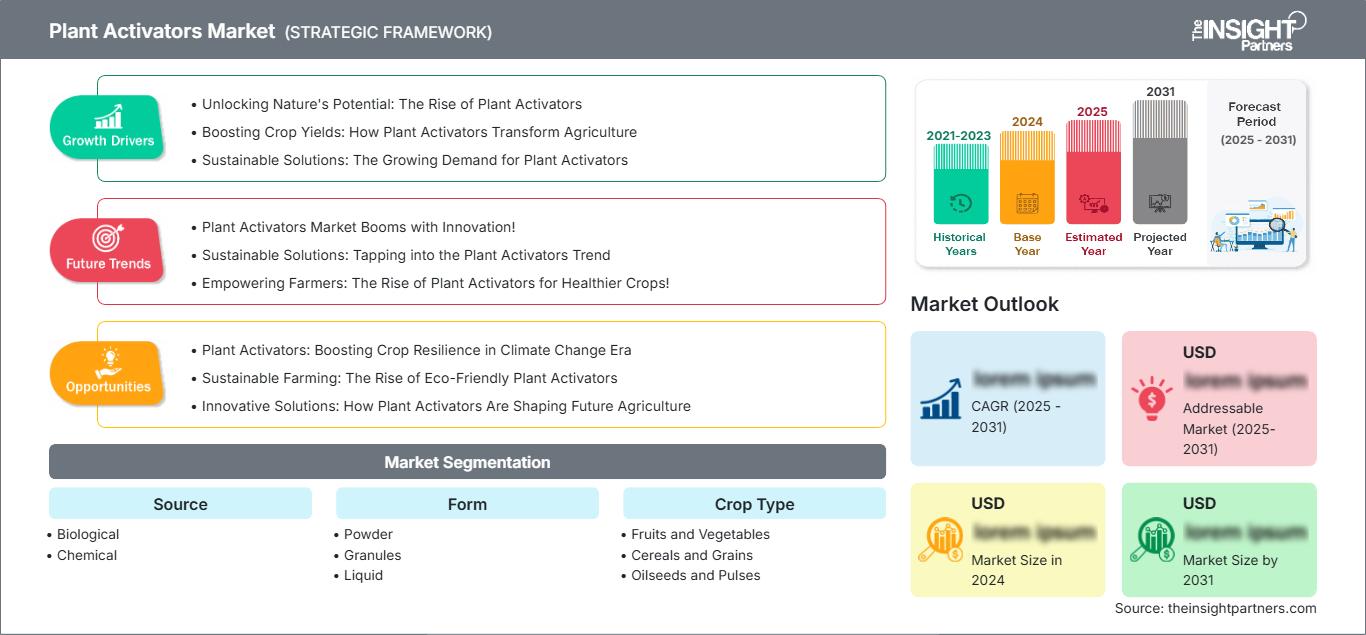
The global plant activators market was valued at US$ 962.01 Million in 2025 and is projected to reach US$ 1,662.78 Million by 2034, advancing at a CAGR of 6.27% during 2026–2034. Market expansion is being supported by the increasing need for sustainable crop protection solutions, rising concerns regarding pest resistance, and the growing adoption of integrated crop management practices. Plant activators are increasingly recognized for their ability to enhance natural plant defense mechanisms without directly targeting pathogens.
North America represents a key revenue-generating region and is anticipated to register a CAGR of approximately 5.8%–6.2% through 2034. Growth is being driven by the widespread adoption of precision agriculture, increasing demand for residue-free crop protection technologies, and expanding investments in biological and environmentally responsible agricultural inputs. Regulatory support for sustainable farming practices further strengthens regional demand.
Plant Activators Market Assessment and Insights
- Market Size (2025): US$ 962.01 Million
- Market Size (2034): US$ 1,662.78 Million
- CAGR (2026–2034): 6.27%
- Leading Region: North America
- Fastest-Growing Region: Asia Pacific
- Leading Segment: Fruits and Vegetables
- Key Innovation / Competitive Trend: Integration of biological plant activators with regenerative agriculture programs
Source: The Insight Partners' analysis based on proprietary research, government publications, company annual reports, investor presentations, industry databases, and expert interviews.
The plant activators market has evolved from a niche crop protection category into an important component of modern sustainable agriculture. Growers increasingly seek alternatives that enhance plant immunity while reducing dependence on conventional chemical crop protection products. As agricultural systems face growing pressure from climate variability, disease outbreaks, and stricter environmental regulations, plant activators have emerged as valuable tools for improving crop resilience.
Future market development will be influenced by advancements in biological formulations, expanding regulatory acceptance, and increasing awareness among growers regarding preventive crop health management. Companies such as Syngenta, Isagro, Arysta LifeScience, NutriAg, Futureco Bioscience S.A., Meiji Seika, Certis USA L.L.C., Gowan, Eagle Plant Protect Pvt. Ltd., and Jaivik Crop Care LLP continue strengthening product portfolios to address changing agricultural requirements across diverse crop systems.
Plant Activators Market Report Scope
| Report Attribute | Details |
|---|---|
| Market size in 2025 | US$ 962.01 Million |
| Market Size by 2034 | US$ 1,662.78 Million |
| Global CAGR (2026 - 2034) | 6.27% |
| Historical Data | 2021-2024 |
| Forecast period | 2026-2034 |
Plant Activators Market Analysis
Agricultural producers worldwide are facing increasing pressure to improve yields while reducing environmental impacts associated with conventional crop protection practices. Plant activators support these objectives by stimulating natural defense pathways that help crops withstand disease pressure and abiotic stress. Their compatibility with integrated pest management programs has strengthened adoption across commercial farming operations.
The market value chain includes raw material suppliers, biotechnology developers, formulation specialists, distributors, agronomists, and farming enterprises. Biological research institutions and agricultural technology companies play an important role in identifying active compounds capable of triggering systemic acquired resistance and improving plant health. Continuous innovation is expanding product efficacy across multiple crop categories.
Competition is characterized by a combination of multinational agricultural input suppliers and specialized biological solution providers. Product differentiation increasingly focuses on crop-specific performance, compatibility with existing farming programs, and environmental credentials. Companies are investing in field validation programs to demonstrate measurable benefits under diverse climatic and agronomic conditions.
Investment activity remains concentrated in biological research, microbial technologies, and advanced formulation platforms. Strategic collaborations between biotechnology firms and agricultural input manufacturers are accelerating product commercialization. Companies are also strengthening regional distribution networks and technical advisory capabilities to improve farmer adoption and market penetration.
● REPORT CUSTOMIZATION
Tailor This Report To Align With Your Specific Business Requirements
This report can be customized to align precisely with your business objectives, scope, and target markets. Customization options include tailored segmentation, geography, competitive analysis, and strategic insights to support informed decision-making.
Customize This Report →WHAT YOU CAN ADJUST
- ● Segmentations
- ● Geography
- ● Competitive Analysis
- ● Language Preferences
Plant Activators Market: Strategic Insights
Regional Insights
North America Plant Activators Market
North America is expected to maintain a prominent position in the global plant activators market, recording a CAGR of approximately 6.0% during the forecast period. The region benefits from advanced farming practices, strong agricultural research infrastructure, and growing demand for sustainable crop management solutions. Increasing adoption of biological inputs across specialty crops and row crops continues to create favorable market conditions.
The focus of regulatory authorities on minimizing the effects of environmental degradation from crop farming has encouraged farmers to adopt plant activators in their overall crop management approaches. Increased investment in the area of precision agriculture has facilitated the growth of this market through effective application processes.
U.S. Plant Activators Market
The U.S. accounts for approximately 75%–80% of the North American market and is projected to expand at a CAGR of around 6.1% through 2034. The country's large-scale commercial agriculture sector provides a strong foundation for adoption. Demand is particularly evident in fruits, vegetables, specialty crops, and high-value agricultural production systems where crop quality and disease management remain critical priorities.
Several global and regional agricultural technology companies maintain active commercial operations within the U.S. market. Farmers are now using plant activators alongside biopesticides and precision agriculture. The rising trend in regenerative agriculture and reduced residue programs will only serve to further boost their use.
Europe Plant Activators Market
Europe represents approximately 28%–32% of global market demand and is forecast to grow at a CAGR of nearly 6.0% through 2034. This region is favored by rigorous environmental regulations, backing for sustainable farming, and tighter controls on some crop protection chemicals. This will drive the adoption of bio-crop solutions and immunity-boosting crop treatments.
Germany remains the leading national market as a result of its developed agricultural industry, presence of a well-established biotechnology environment, and growing importance of sustainable crop management. Activities in research in relation to plant health technology and biological input keep expanding the market in commercial farming facilities.
The UK, France, Italy, and Spain are witnessing increasing use of plant activators in horticulture, vineyards, cereals, and specialty crop production. Regulatory frameworks promoting reduced pesticide dependence and improved environmental performance are creating opportunities for product adoption. Growing consumer demand for sustainably produced food further supports long-term market growth.
APAC Plant Activators Market
Asia Pacific is projected to be the fastest-growing regional market, advancing at a CAGR exceeding 7.0% while accounting for approximately 25%–30% of global demand. Rapid agricultural modernization, rising food security concerns, and increasing awareness of sustainable farming practices are contributing to market development.
China leads the regional market owing to its extensive agricultural production base and increasing investments in biological agricultural technologies. Government initiatives promoting efficient resource utilization and environmentally responsible farming practices continue to strengthen demand for plant activators.
Japan, South Korea, India, and Australia are also experiencing growing adoption. Farmers increasingly utilize plant activators to improve crop resilience against climate-related stresses and disease outbreaks. Expanding agricultural extension programs and supportive policy frameworks are expected to accelerate market penetration throughout the forecast period.
Middle East & Africa Plant Activators Market
The Middle East & Africa market is expected to record a CAGR of approximately 6.3% during the forecast period. Agricultural production challenges associated with water scarcity, temperature extremes, and soil degradation are encouraging interest in technologies that improve crop resilience and productivity.
Saudi Arabia represents the leading market in the region due to ongoing investments in agricultural modernization and food security initiatives. Controlled-environment agriculture, greenhouse cultivation, and sustainable farming programs are creating favorable conditions for plant activator adoption.
The UAE, South Africa, and other regional markets are increasingly exploring biological crop enhancement solutions. Investments in irrigation infrastructure, protected agriculture, and advanced farming technologies are expected to support future demand. As regional governments prioritize agricultural productivity and resource efficiency, adoption opportunities are likely to expand further.
Segmentation Analysis
Source
- Biological: Derived from naturally occurring microorganisms, plant extracts, or biological compounds that activate plant defense responses while aligning with sustainable and environmentally responsible agricultural practices.
- Chemical: Formulated using synthetic active ingredients designed to trigger systemic resistance mechanisms and improve crop protection performance across various farming systems and environmental conditions.
Form
- Powder: Favored for extended shelf life, transportation efficiency, and compatibility with diverse application methods across commercial agriculture and specialty crop production systems.
- Granules: Utilized primarily in soil-based applications where controlled release characteristics and ease of handling support efficient field-level deployment and crop establishment.
- Liquid: Widely adopted due to application convenience, rapid absorption, compatibility with spraying equipment, and suitability for precision agriculture programs.
Crop Type
- Fruits and Vegetables: Represents the leading segment due to high disease management requirements, quality standards, and increasing demand for residue-conscious production practices.
- Cereals and Grains: Adoption is expanding as growers seek cost-effective methods to improve crop resilience, yield stability, and resistance to environmental stress factors.
- Oilseeds and Pulses: Growing awareness of sustainable crop protection approaches and increasing cultivation areas support demand within this segment.
Mode of Application
- Foliar: Dominates market adoption due to targeted delivery, rapid plant response, and compatibility with integrated crop management practices.
- Soil Treatment: Gains traction through root-zone activation benefits and integration with broader soil health management programs.
Opportunity Snapshot
| Crop Type | Revenue Contribution | Trend Tag | Adoption Stage |
| Fruits and Vegetables | High | Residue Control | Mature |
| Cereals and Grains | Medium | Yield Stability | Scaling |
| Oilseeds and Pulses | Medium | Stress Defense | Scaling |
Plant Activators Market Growth Drivers and Impact Analysis
Rising Demand for Sustainable Crop Protection Solutions
Agricultural producers are increasingly seeking alternatives to conventional crop protection strategies due to regulatory pressures, environmental concerns, and consumer preferences for sustainably produced food. Plant activators provide a unique approach by strengthening a plant's inherent defense mechanisms rather than directly targeting pathogens. This capability aligns with broader agricultural sustainability objectives while helping farmers maintain productivity under changing regulatory conditions.
This transition towards IPM systems has led to growing attention being given to plant activators. These substances serve as complements to biologicals, biostimulants, and regular crop protection agents, thus enabling farmers to diversify their approach to managing plant diseases. The reduced need for reapplication of chemicals is also environmentally friendly.
Market implications can be seen in horticulture, specialty crops, and commercial agriculture. With increased focus on sustainability factors and residue handling by retailers and food processors, there is a growing need for plant activators in the crop production process. This trend is expected to remain a fundamental driver of market expansion.
Increasing Disease Resistance Challenges in Agriculture
Pathogen resistance to traditional crop protection products has become a major concern for growers worldwide. Continuous exposure to specific active ingredients can reduce treatment effectiveness, creating challenges for disease management and crop productivity. Plant activators offer an alternative mechanism of action by stimulating plant defense pathways rather than directly attacking pathogens.
This characteristic makes plant activators valuable components of resistance management programs. By diversifying crop protection approaches, growers can reduce selection pressure on pathogens while improving long-term disease control outcomes. The approach is particularly relevant for high-value crops where disease outbreaks can significantly affect profitability.
There are implications in fruits, vegetables, grains, and specialty crops. Agricultural experts have been recommending a comprehensive approach where plant activators are combined with other approaches, like biologicals and conventional ones. With rising resistance issues around the globe, there will be an increased need for complementary products.
Expansion of Organic and Regenerative Agriculture Practices
Organic and regenerative agriculture systems are gaining momentum as stakeholders across the food value chain prioritize environmental performance and soil health. Plant activators fit well within these systems because they support crop resilience while minimizing reliance on conventional chemical interventions. Their compatibility with sustainability-focused farming programs enhances market attractiveness.
With more farmers adopting regenerative agricultural methods, there is an increased demand for solutions that help in increasing biological strength and crop efficiency under stress conditions. Plant activators contribute by enhancing defense responses and supporting overall plant vigor. Such applications correspond greatly to the regenerative agriculture model.
The resulting market impact extends beyond certified organic production. Conventional growers implementing sustainability initiatives are also incorporating plant activators into crop management programs. The expanding influence of regenerative agriculture is therefore creating opportunities across multiple agricultural production models.
Plant Activators Market Future Trends
Integration of Plant Activators with Biological Agriculture Platforms
The boundary between plant activators, biostimulants, and biological crop protection products is becoming increasingly interconnected. Manufacturers are developing integrated solutions that combine multiple biological mechanisms to improve crop health, stress tolerance, and productivity. This trend reflects growing demand for comprehensive crop management tools capable of addressing complex agricultural challenges.
Future innovation is likely to focus on multi-functional products delivering both preventive and performance-enhancing benefits. Companies investing in biological research platforms may gain competitive advantages through differentiated product portfolios. As adoption expands, integrated biological programs are expected to become more common across commercial agriculture.
Data-Driven Application Strategies and Precision Farming Adoption
Digital agriculture technologies are transforming how crop inputs are evaluated and applied. Plant activators increasingly benefit from precision agriculture systems capable of identifying stress conditions, disease risks, and crop performance variability. This allows growers to optimize application timing and improve return on investment.
Advancements in remote sensing, artificial intelligence, and predictive analytics are expected to improve decision-making related to plant activator use. Future adoption may be supported by digital platforms that recommend targeted interventions based on field-specific conditions. Such developments could significantly enhance product effectiveness and market acceptance.
Plant Activators Market Opportunities
Expansion into Climate-Resilient Crop Production Programs
Climate variability continues to challenge agricultural productivity worldwide. Drought, heat stress, irregular rainfall patterns, and emerging disease pressures create significant uncertainty for growers. Plant activators offer an opportunity to strengthen crop resilience by enhancing natural defense and stress response mechanisms.
Manufacturers can capitalize on this opportunity by developing products specifically designed for climate-related challenges. Strategic collaborations with agricultural research institutions may accelerate innovation and validation efforts. Companies capable of demonstrating measurable resilience benefits are likely to secure stronger market positions as climate adaptation becomes a priority for agricultural stakeholders.
Growth Potential Across Emerging Agricultural Economies
Emerging agricultural markets in Asia, Latin America, Africa, and parts of the Middle East represent significant untapped opportunities for plant activator suppliers. Rising food demand, increasing agricultural modernization, and expanding awareness of sustainable farming practices are creating favorable market conditions.
Investments in local delivery infrastructure, agronomic training programs, and demonstration projects could be used to hasten uptake. Companies that focus on developing crop and farm-specific products will likely experience more commercial success. With governments focusing on increasing food security and productivity, plant activators are poised for increasing importance in agricultural development plans.
Recent Developments
- January, 2025: Syngenta Crop Protection AG entered a collaboration with TraitSeq to apply artificial intelligence in the development of next-generation biostimulants. The partnership aims to identify plant biomarkers that can improve crop responses to abiotic stress and enhance the performance of biological agricultural solutions.
- June, 2025: Syngenta Crop Protection AG announced expanded investments in agricultural biologicals, including strengthened manufacturing capacity and an expanded innovation pipeline focused on biological solutions, biostimulants, and nutrient-use-efficiency products. The company highlighted increasing farmer adoption of sustainable crop inputs and projected strong long-term growth for agricultural biologicals.
- August, 2025: Bayer CropScience and Sumitomo Chemical expanded their distribution and formulation strategy for Isotianil, a prominent non-fungicidal plant defense activator. The compound works strictly as a plant defense inducer by stimulating the crop's internal systemic acquired resistance (SAR) to combat diseases like rice blast. The updated global initiatives focus on specialized liquid combinations to maximize adhesion and cellular uptake across varying regional climates.
Frequently Asked Questions

- Comprehensive Market Sizing and Forecast Analysis
- Detailed Segmentation Analysis
- In-Depth Market Dynamics Assessment
- Regional and Country-Level Insights
- Competitive Landscape and Company Benchmarking
- Strategic Business Intelligence
Recent Reports
Testimonials

The Insight Partners provided valuable market intelligence that supported our global go-to-market strategy. Their team was professional, responsive, and attentive to our feedback, providing thoughtful analysis and helpful methodological clarifications throughout the project.
Junmo Kim Chief Financial Officer (CFO), Enertech Co., Ltd.
The Insight Partners' SCADA System Market report is comprehensive, with valuable insights on current trends and future forecasts. The team was highly professional, responsive, and supportive throughout. We are very satisfied and highly recommend their services.
RAN KEDEM Partner, Reali Technologies LTDs
I requested a report on a very specific software market and the team produced the report in a few days. The information was very relevant and well presented. I then requested some changes and additions to the report. The team was again very responsive and I got the final report in less than a week.
JEAN-HERVE JENN Chairman, Future Analytica
We worked with The Insight Partners for an important market study and forecast. They gave us clear insights into opportunities and risks, which helped shape our plans. Their research was easy to use and based on solid data. It helped us make smart, confident decisions. We highly recommend them.
PIYUSH NAGPAL Sr. Vice President, High Beam Global
The Insight Partners delivered insightful, well-structured market research with strong domain expertise. Their team was professional and responsive throughout. The user-friendly website made accessing industry reports seamless. We highly recommend them for reliable, high-quality research services
YUKIHIKO ADACHI CEO, Deep Blue, LLC.
This is the first time I have purchased a market report from The Insight Partners.While I was unsure at first, I visited their web site and felt more comfortable to take the risk and purchase a market report.I am completely satisfied with the quality of the report and customer service. I had several questions and comments with the initial report, but after a couple of dialogs over email with their analyst I believe I have a report that I can use as input to our strategic planning process.Thank you so much for taking the extra time and making this a positive experience.I will definitely recommend your service to others and you will be my first call when we need further market data.
JOHN SUZUKI President and Chief Executive Officer, Board Director, BK Technologies
I wish to appreciate your support and the professionalism you displayed in the course of attending to my request for information regarding to infectious disease IVD market in Nigeria. I appreciate your patience, your guidance, and the fact that you were willing to offer a discount, which eventually made it possible for us to close a deal. I look forward to engaging The Insight Partners in the future, all thanks to the impression you have created in me as a result of this first encounter.
DR CHIJIOKE ONYIA MANAGING DIRECTOR, PineCrest Healthcare Ltd.Reason to Buy
- Informed Decision-Making
- Understanding Market Dynamics
- Competitive Analysis
- Identifying Emerging Markets
- Customer Insights
- Market Forecasts
- Risk Mitigation
- Boosting Operational Efficiency
- Strategic Planning
- Investment Justification
- Tracking Industry Innovations
- Aligning with Regulatory Trends





 Get Free Sample for