
Plasma Cutting Machine Market Growth, Share & Trends by 2034
Coverage: by Type (Single Folw Plasma, Duel Folw Plasma); Control (Manual, CNC); Industrial Vertical (Automotive, Aerospace, Industrial Manufacturing, HVAC, Others) , and Geography (North America, Europe, Asia Pacific, and South and Central America)
- Status : Data Released
- Report Code : TIPRE00009574
- Category : Manufacturing and Construction
- No. of Pages : 150
- Available Report Formats :


- Last update date : September 29, 2026


2025 Market Size
US$ 781.04 Mn
Base year value
2034 Forecast
US$ 1,173.2 Mn
Projected by 2034
CAGR 2026-2034
4.62 %
Growth rate
Addressable Market
US$ 8,870.30 Mn
(2026-2034)
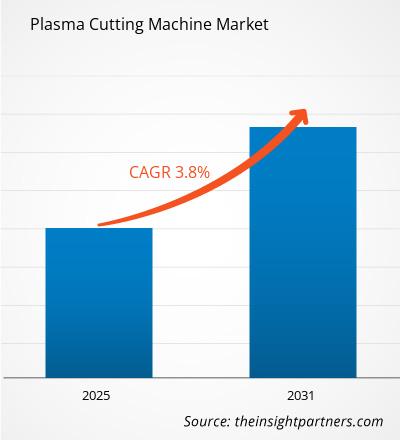
The plasma cutting machine market size was valued at US$ 781.04 Million in 2025 and is projected to reach US$ 1,173.2 Million by 2034, expanding at a CAGR of 4.62% during 2026-2034. The market covers equipment used to thermally cut electrically conductive metals through plasma arcs, including single-flow and dual-flow plasma configurations, manual and CNC controls, and applications across automotive, aerospace, industrial manufacturing, HVAC, and other industrial verticals.
North America represented an estimated 30% of the global plasma cutting machine market in 2025 and is projected to expand at a 4.70% CAGR through 2034. Demand is supported by metal fabrication, structural steel processing, automotive production, and replacement of labor-intensive cutting equipment. The region's established CNC ecosystem and increasing integration of automated material handling, nesting software, and plasma power sources are reinforcing demand for higher-throughput cutting platforms.
Plasma Cutting Machine Market Assessment and Insights
- North America: North America accounted for an estimated 30% of the global plasma cutting machine market share in 2025 and is projected to grow at a 4.70% CAGR during 2026-2034. Established fabrication capacity, automation adoption, and equipment replacement support its durable position.
- U.S.: The U.S. represented an estimated 79% of North America's market in 2025 and is projected to expand at a 4.80% CAGR. Automotive, structural fabrication, defense-related manufacturing, and CNC modernization sustain equipment demand.
- Europe: Europe held an estimated 25% of the global market in 2025 and is projected to grow at a 4.30% CAGR. Germany, Italy, France, the UK, and Spain benefit from advanced metalworking ecosystems, automation, and energy-efficiency requirements.
- Asia Pacific: Asia Pacific accounted for an estimated 31% of the global market in 2025 and is projected to register a 5.00% CAGR. China, Japan, South Korea, and India benefit from concentrated manufacturing, infrastructure fabrication, and expanding industrial automation.
- Largest Segment: CNC is the largest Control segment and is projected to grow at a 5.25% CAGR during 2026-2034, supported by automated nesting, repeatable cutting quality, reduced operator intervention, and integration with broader fabrication workflows.
- High Growth Segment: Dual Folw Plasma is projected to record a 5.10% CAGR during 2026-2034, supported by demand for controlled plasma and shielding gas arrangements that improve cut consistency across demanding metal fabrication applications.
- Key companies analyzed in detail: AJAN Elektronik, C&G Systems Corporation, Esprit Automation Ltd., Hornet Cutting Systems, Miller Electric Mfg. LLC, MultiCam Inc., SICK AG, Spiro International SA, The Lincoln Electric Company, Voortman Steel
Source: The Insight Partners' analysis based on proprietary research, government publications, company annual reports, investor presentations, industry databases, and expert interviews.
The plasma cutting machine market is evolving towards an integration of plasma cutters into complete CNC manufacturing systems with plasma power source, motion system, CAD/CAM nesting, beveling, drilling, marking, material handling, and process monitoring functions. The most recent innovations in equipment have focused on torch height control, efficient consumption of consumables, smart nesting, collision avoidance, and unattended operations. With each update in 2024 and future product introductions, equipment manufacturers put greater emphasis on controls and process correction, as required by buyers looking for solutions to minimize setup time, waste and scrap, and operator dependency.
In the coming ten years, manufacturers offering combined plasma sources with software and automation will outperform those offering just plasma cutting equipment. As fabrication is becoming more geographically dispersed and new industrial centers arise in India, Southeast Asia, the Middle East, and Latin America, manufacturers may find opportunities for equipment implementation in such locations. More flexible equipment capable of handling various materials and thicknesses is in demand. Workplace safety regulations, fume extraction requirements, energy efficiency, and product quality will contribute to updating of existing equipment, while the availability of local services and consumables will affect purchase decisions.
Plasma Cutting Machine Market Report Scope
| Report Attribute | Details |
|---|---|
| Market size in 2025 | US$ 781.04 Million |
| Market Size by 2034 | US$ 1,173.2 Million |
| Global CAGR (2026 - 2034) | 4.62% |
| Historical Data | 2021-2024 |
| Forecast period | 2026-2034 |
Plasma Cutting Machine Market Analysis
The demand for plasma cutting machines is highly dependent on the processing of steel, stainless steel, aluminum, and other electrically conductive metals in an industrial environment. Manufacturers looking for rapid cutting result in investments in CNC tables, plasma power supplies, torches, and software. The result is a growth of demand in the supply chain including consumables, CAD/CAM systems, extraction equipment, automation components, maintenance services, and spare parts. The commercial benefits are especially pronounced in cases where plate thickness, cutting speed, and operating cost make the process of plasma cutting better suited compared to other thermal processes. The platform products offered by Voortman demonstrate how these factors are taken into consideration in integrating the process of plasma cutting, drilling, marking, milling, beveling, and automated material handling into one unit.
Competition in the supply side in the plasma cutting machine market is organized increasingly based on production solutions. Machine manufacturers try to differ based on such features as gantry rigidity, motion accuracy, torch-height control, nesting, bevel, consumable management, and service capabilities. It is still strategically important for plasma power source manufacturers to maintain their position as a part of the production process as the stability of the arc and gas control impact edge quality and operating cost.
The competitive environment includes companies specializing in plasma technology, CNC cutting machine, welding equipment, and special fabrication systems. Hypertherm Associates offers competition in terms of plasma sources, CNC controls, software and consumables, while ESAB competes by combining plasma with CNC, automation process tools, beveling and connected manufacturing technologies. The Lincoln Electric Company expands its products range to include plasma systems, CNC cutting, motion control, pipe cutting, structural fabrication and automation technologies. Voortman Steel Machinery specializes in integrating plate and profile fabrication in which plasma cutting goes together with drilling, milling, marking and material handling.
The plasma cutting machine market trends show that increasing amounts of investment go into automation and integration of processes and not only in increased power of the technology. MultiCam CNC system connects plasma with laser, waterjet, routing and software solutions, while C&G Systems offers configurable precision plasma and oxy-fuel technology. Esprit Automation concentrates on turnkey CNC cutting systems with plasma, CAD/CAM, filtration, installation and services, while Hornet Cutting Systems is focused on industrial CNC plasma tables and pipe fabrication systems. This clearly shows that competitive strategy changes towards productivity, flexibility, digital workflow integration and lifecycle solutions.Plasma Cutting Machine Regional Insights
● REPORT CUSTOMIZATION
Tailor This Report To Align With Your Specific Business Requirements
This report can be customized to align precisely with your business objectives, scope, and target markets. Customization options include tailored segmentation, geography, competitive analysis, and strategic insights to support informed decision-making.
Customize This Report →WHAT YOU CAN ADJUST
- ● Segmentations
- ● Geography
- ● Competitive Analysis
- ● Language Preferences
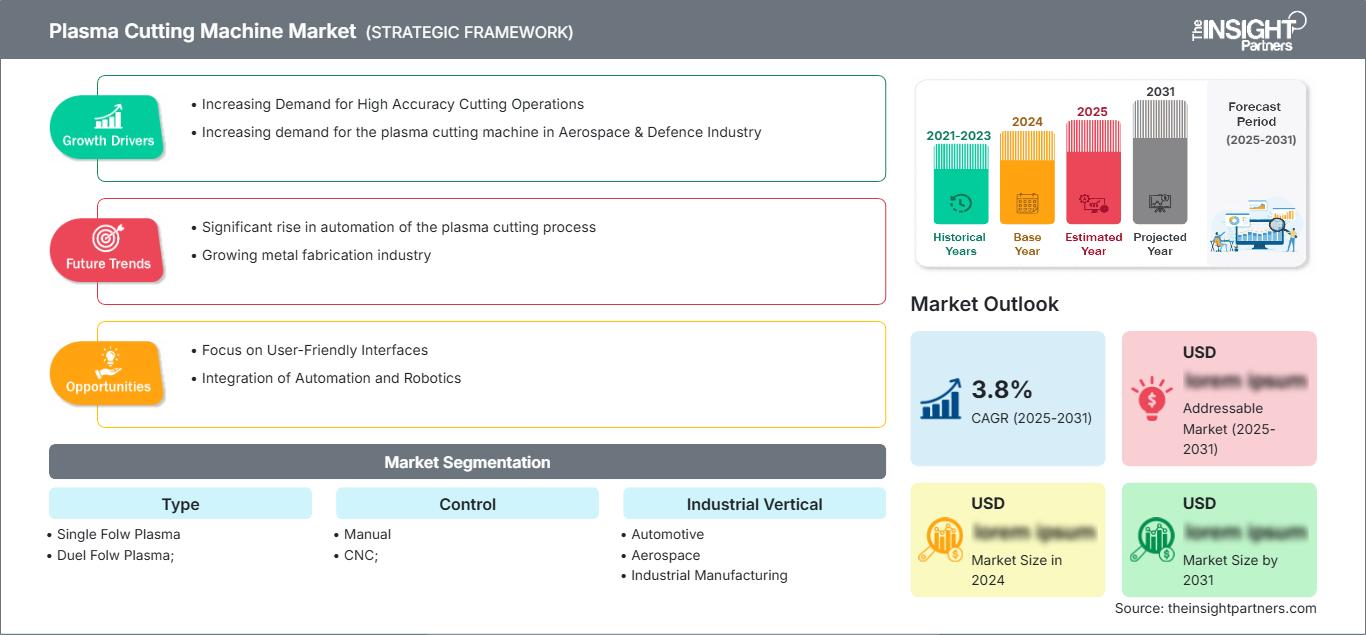
Plasma Cutting Machine Market: Strategic Insights
Regional Insights
North America Plasma Cutting Machine Market
North America accounted for an estimated 30% of the global plasma cutting machine market growth in 2025 and is projected to expand at a 4.70% CAGR through 2034. Demand is centered in the US and Canada due to structural steel fabrication, automotive fabrication, heavy equipment, HVAC fabrication, shipbuilding, and general metal fabrication needs to cut plate and profiles. The CNC upgrade is especially important for those fabricators who want to increase production levels without proportionally increasing labor force.
Regional suppliers include machine builders, plasma system manufacturers, welding equipment manufacturers, and CNC integrators. C&G Systems produces configurable plasma and oxy-fuel systems, Hornet Cutting Systems specializes in industrial CNC plasma and pipe cutting systems, and Miller Electric Mfg. LLC offers extensive range of plasma equipment. Product development trends emphasize automation, computerization, software integration, and more efficient use of consumables.
U.S. Plasma Cutting Machine Market
The plasma cutting machine market report shows that the U.S. represented an estimated 79% of the North American market in 2025 and is projected to grow at a 4.80% CAGR through 2034. Applications of automotive, aerospace, structural steel, military hardware, agricultural machinery, heavy equipment, and HVAC fabrication create diversified demand. Local machine producers and foreign companies fight on the market in terms of CNC automation, performance of plasma source, software and services.
A distinctive feature of this market is the development level of the industrial automation infrastructure in the United States. Lincoln Electric combines plasma cutting with motion control, robotics, structural fabrication, and material handling while MultiCam Inc. specializes in CNC cutting technologies including plasma, laser, waterjet, and software. In decision-making considerations of investment more weight is given to such factors as labor savings, production consistency, nesting, and ability to link cutting machines with welding and assembly.
Europe Plasma Cutting Machine Market
Europe represented an estimated 25% of the global market in 2025 and is projected to expand at a 4.30% CAGR. Germany is still one of the key industrial centers due to its strong base in machinery, automotive, steel processing, and engineering industry. Italy is represented by metal working machines and industrial equipment manufacturing, whereas France covers the need in aerospace, transport, energy, and engineering industry. The UK has a specialized ecosystem for CNC cutting machines, and Spain gets benefit from automotive, construction equipment, and metal working.
European demand is characterized by high levels of automation, the focus on process quality, as well as an increased interest in energy and workplace conditions. Esprit Automation provides services for the UK in CNC plasma and flame cutting machines, and Voortman offers automated plate and profile processing machines for European fabrication markets. Spiro International SA represents the specific niche in HVAC sheet metal processing with its plasma cutting machines based on duct production processes.
APAC Plasma Cutting Machine Market
APAC accounted for an estimated 31% of the global market in 2025 and is projected to register a 5.00% CAGR. China represents the leading country because of its extensive steel fabrication, machinery manufacturing, construction equipment, shipbuilding, and automotive production base. Japan and South Korea add demand from precision manufacturing, automotive production, shipbuilding, and industrial equipment, while India is developing a broader CNC fabrication ecosystem supported by manufacturing localization.
Australia contributes through mining equipment, structural fabrication, infrastructure, and resource-related manufacturing. Across APAC, suppliers increasingly compete on automation, local service capability, consumable availability, and integration with production software. The region's combination of established high-volume manufacturing and developing industrial capacity supports replacement demand in mature economies while creating new equipment opportunities in rapidly industrializing markets.
Middle East & Africa Plasma Cutting Machine Market
The Middle East and Africa accounted for an estimated 7% of global demand in 2025 and are projected to grow at a 5.30% CAGR. Saudi Arabia and the UAE are important demand centers because industrial diversification, infrastructure programs, energy projects, and fabrication requirements are creating broader demand for CNC metal-processing equipment. South Africa contributes through mining equipment, engineering, construction, and industrial fabrication.
The region is characterized by a combination of imported equipment, local fabrication, and growing requirements for service and technical support. Buyers increasingly favor systems capable of operating with limited manual intervention because skilled labor availability can vary by project location. Localization of industrial production, fabrication capacity, and maintenance capabilities should gradually strengthen demand for automated plasma cutting platforms.
South & Central America Plasma Cutting Machine Market
The plasma cutting machine market forecast shows that South and Central America represented the remaining estimated 7% of global demand in 2025 and are projected to grow at a 4.20% CAGR. Brazil leads regional demand through automotive manufacturing, agricultural machinery, steel fabrication, infrastructure, and general industrial production. Argentina has a more specialized demand profile centered on agricultural equipment, metal fabrication, automotive activity, and machinery.
The remainder of the region is characterized by smaller fabrication bases and greater dependence on imported machinery, components, and consumables. Brazil's larger manufacturing ecosystem supports broader adoption of CNC equipment, while other markets tend to favor flexible machines serving multiple applications. Regional investment should increasingly focus on equipment that improves material utilization and reduces labor-intensive cutting and secondary processing.
Segmentation Analysis
Type
The Type segment comprises Single Folw Plasma and Duel Folw Plasma configurations. Type-level demand is shaped by required cut quality, material thickness, gas-management requirements, operating environment, and total equipment cost. Dual Folw Plasma is projected to grow at a 5.10% CAGR during 2026-2034 as industrial users seek improved process control across demanding fabrication tasks, while single-flow configurations remain important where straightforward cutting economics and ease of operation are priorities.
- Single Folw Plasma: Provides a straightforward plasma configuration suited to routine metal cutting where equipment simplicity, operating accessibility, and dependable cutting performance are important purchasing considerations.
- Duel Folw Plasma: Uses differentiated gas-flow arrangements to support process control and cut quality, making it relevant to fabricators handling varied materials and demanding production requirements.
Control
The Control segment consists of Manual and CNC systems. CNC is projected to record a 5.25% CAGR during 2026-2034 because automated motion, nesting, torch-height control, and repeatable programming directly address throughput and labor constraints. Manual systems remain relevant for maintenance, repair, mobile fabrication, smaller workshops, and irregular cutting tasks where flexibility and lower equipment complexity outweigh the productivity advantages of automation.
- Manual: Supports direct operator-controlled cutting for repair, maintenance, field fabrication, and smaller workshops where mobility and straightforward operation are central purchasing considerations.
- CNC: Automates machine movement and cutting programs while supporting nesting, repeatability, process control, and integration with broader fabrication workflows, making it strategically important for production environments.
Industrial Vertical
The Industrial Vertical segment includes Automotive, Aerospace, Industrial Manufacturing, HVAC, and Others. Industrial Manufacturing is projected to grow at a 4.55% CAGR during 2026-2034 because fabrication shops require flexible equipment for diverse steel and nonferrous components. Automotive and aerospace benefit from automation and quality requirements, while HVAC relies on specialized sheet-metal workflows and integrated cutting software.
- Automotive: Uses plasma cutting for vehicle structures, fixtures, equipment, repair work, and fabricated components, with automation supporting repeatable production and efficient material utilization.
- Aerospace: Requires controlled cutting of specialized metals and fabricated structures, making precision, process consistency, traceability, and integration with downstream manufacturing particularly important.
- Industrial Manufacturing: Represents diverse metal-processing requirements across machinery, heavy equipment, structural components, and fabricated assemblies, favoring flexible CNC systems and integrated processing.
- HVAC: Uses plasma systems for sheet-metal and duct-related fabrication, with specialized software and automated cutting helping manufacturers manage repeatable shapes and customized production.
- Others: Covers marine, construction equipment, energy, agricultural machinery, repair, and other fabrication applications where material thickness, production volume, and equipment flexibility determine technology selection.
Opportunity Snapshot
| Industrial Vertical | Revenue Contribution | Trend Tag | Adoption Stage |
| Automotive | High | Automated Cells | Mature |
| Aerospace | Medium | Precision Cutting | Scaling |
| Industrial Manufacturing | High | Flexible CNC | Mature |
| HVAC | Medium | Digital Ducting | Scaling |
| Others | Low | Mixed Applications | Emerging |
Plasma Cutting Machine Market Growth Drivers and Impact Analysis
Automation to Reduce Operator Dependence
Automation is a primary growth driver because fabricators increasingly need consistent cutting quality while managing skilled-labor constraints. CNC motion control, automatic torch-height adjustment, nesting software, collision protection, and automated material handling allow production teams to reduce repetitive operator tasks and improve machine utilization. The mechanism is straightforward: higher automation reduces setup and intervention requirements, which increases productive cutting time and makes repeatable production economically attractive. Equipment suppliers are therefore integrating plasma sources with CAD/CAM, drilling, marking, beveling, and material-handling functions. The measurable implication is stronger demand for CNC platforms and integrated production cells, particularly among medium and large fabrication operations seeking to increase throughput without proportionally increasing labor requirements.
Demand for Faster Heavy-Metal Processing
The continued need to process medium and heavy metal plate efficiently supports plasma adoption where cutting speed and operating economics are more important than the extreme precision associated with some alternative processes. Plasma remains particularly relevant for structural steel, heavy equipment, industrial machinery, shipbuilding, and fabrication applications where material thickness can make other cutting technologies less economical. The market mechanism links rising fabrication requirements with investment in higher-capacity plasma sources, multi-torch configurations, and automated plate processing. Manufacturers such as Voortman integrate plasma with drilling, milling, marking, and material handling to reduce production transfers. The strategic implication is a shift from purchasing plasma equipment solely for cutting toward purchasing integrated systems designed to optimize the entire plate-processing sequence.
Integration of Cutting With Digital Production Workflows
Digital integration is strengthening the economic case for modern plasma cutting equipment. Fabricators increasingly require CAD/CAM nesting, job management, machine monitoring, process data, and production planning to operate within connected manufacturing environments. Integrated software can optimize cutting paths and material utilization while machine controls can coordinate torch parameters, height sensing, bevel operations, and automated handling. The mechanism extends beyond the plasma arc itself because better data flow reduces programming errors, unnecessary movement, scrap, and production interruptions. Suppliers including ESAB, Hypertherm Associates, MultiCam, and Voortman are increasingly positioning software and automation alongside hardware. The implication is greater replacement demand for legacy machines that cannot communicate effectively with modern production-management systems.
Plasma Cutting Machine Market Future Trends
Connected CNC Cutting and Smart Process Control
The plasma cutting machine market trends indicate that plasma cutting is moving toward connected CNC platforms that combine process monitoring, digital job transfer, automated parameter selection, and machine-performance feedback. The change is occurring because fabricators need greater production visibility and consistent results across different operators, shifts, and material batches. Buyers increasingly evaluate cutting systems as connected manufacturing assets rather than isolated machines. Suppliers are responding through integrated CAD/CAM, cloud-connected monitoring, automated gas management, process databases, and remote diagnostics. The implication is that future competitive differentiation will depend increasingly on software and data architecture as well as plasma power. Equipment capable of generating actionable production information can support preventive maintenance, quality control, and faster troubleshooting, improving lifecycle economics for industrial users.
Multi-Process Platforms and Automated Material Handling
Plasma cutting platforms are increasingly incorporating drilling, milling, marking, beveling, loading, unloading, and material-handling functions within a coordinated workflow. This trend is driven by fabricators seeking to reduce part transfers, floor-space requirements, manual handling, and non-cutting production time. Steel processors are particularly affected because a plate may require several operations before reaching welding or assembly. Integrated machines can sequence these operations using common digital part data, reducing opportunities for alignment errors and manual reprogramming. The implication is stronger demand for multifunctional systems from high-volume fabricators and steel processors. Suppliers that combine plasma with robotic handling and secondary processes can differentiate through total production-cell productivity rather than isolated cutting performance.
Plasma Cutting Machine Market Opportunities
Automated Plate Processing for Emerging Manufacturing Hubs
An important opportunity exists in automated plate-processing systems for India, Southeast Asia, the Middle East, and other manufacturing hubs where fabrication capacity is expanding and producers are seeking higher productivity. Target customers include structural steel processors, heavy-equipment manufacturers, shipyards, infrastructure suppliers, and industrial fabrication contractors. The principal barrier is the capital cost and technical complexity of integrated CNC equipment, particularly for smaller workshops. Suppliers can address this gap through modular machines, scalable automation, localized service, operator training, and financing structures. Companies that combine plasma cutting with drilling, marking, nesting, and material handling can capture demand from buyers seeking to modernize several production stages through a coordinated investment rather than replacing individual machines separately.
Specialized HVAC and Profile Cutting Solutions
Specialized plasma systems for HVAC fabrication and structural profiles provide an opportunity for suppliers to move beyond generalized plate-cutting applications. HVAC manufacturers require repeatable cutting of duct components and customized shapes, while structural fabricators increasingly seek automated processing of beams, channels, tubes, and complex profiles. The unmet need is equipment that combines application-specific software with reliable plasma performance and simplified programming. Spiro International SA demonstrates the specialization potential in HVAC-oriented plasma cutting, while Voortman addresses profile processing through automated robotic plasma systems. Strategic suppliers can benefit by developing application-specific software, automated loading and unloading, and turnkey process packages that reduce engineering effort for customers and accelerate deployment.
Frequently Asked Questions

- Comprehensive Market Sizing and Forecast Analysis
- Detailed Segmentation Analysis
- In-Depth Market Dynamics Assessment
- Regional and Country-Level Insights
- Competitive Landscape and Company Benchmarking
- Strategic Business Intelligence
Recent Reports
Testimonials

The Insight Partners' SCADA System Market report is comprehensive, with valuable insights on current trends and future forecasts. The team was highly professional, responsive, and supportive throughout. We are very satisfied and highly recommend their services.
RAN KEDEM Partner, Reali Technologies LTDs
I requested a report on a very specific software market and the team produced the report in a few days. The information was very relevant and well presented. I then requested some changes and additions to the report. The team was again very responsive and I got the final report in less than a week.
JEAN-HERVE JENN Chairman, Future Analytica
We worked with The Insight Partners for an important market study and forecast. They gave us clear insights into opportunities and risks, which helped shape our plans. Their research was easy to use and based on solid data. It helped us make smart, confident decisions. We highly recommend them.
PIYUSH NAGPAL Sr. Vice President, High Beam Global
The Insight Partners delivered insightful, well-structured market research with strong domain expertise. Their team was professional and responsive throughout. The user-friendly website made accessing industry reports seamless. We highly recommend them for reliable, high-quality research services
YUKIHIKO ADACHI CEO, Deep Blue, LLC.
This is the first time I have purchased a market report from The Insight Partners.While I was unsure at first, I visited their web site and felt more comfortable to take the risk and purchase a market report.I am completely satisfied with the quality of the report and customer service. I had several questions and comments with the initial report, but after a couple of dialogs over email with their analyst I believe I have a report that I can use as input to our strategic planning process.Thank you so much for taking the extra time and making this a positive experience.I will definitely recommend your service to others and you will be my first call when we need further market data.
JOHN SUZUKI President and Chief Executive Officer, Board Director, BK Technologies
I wish to appreciate your support and the professionalism you displayed in the course of attending to my request for information regarding to infectious disease IVD market in Nigeria. I appreciate your patience, your guidance, and the fact that you were willing to offer a discount, which eventually made it possible for us to close a deal. I look forward to engaging The Insight Partners in the future, all thanks to the impression you have created in me as a result of this first encounter.
DR CHIJIOKE ONYIA MANAGING DIRECTOR, PineCrest Healthcare Ltd.Reason to Buy
- Informed Decision-Making
- Understanding Market Dynamics
- Competitive Analysis
- Identifying Emerging Markets
- Customer Insights
- Market Forecasts
- Risk Mitigation
- Boosting Operational Efficiency
- Strategic Planning
- Investment Justification
- Tracking Industry Innovations
- Aligning with Regulatory Trends





 Get Free Sample for