
Pneumatic Tube System Market Demand, Trends & Forecast by 2034
Coverage: by Type (Single Phase, Three-Phase); Configuration (Point-To-Point System, Single-Line System, Multiline System); Function (Semi-Automatic, Fully Automatic); End User (Industrial, Medical and Healthcare, Commercial, Others) , and Geography (North America, Europe, Asia Pacific, and South and Central America)
- Status : Data Released
- Report Code : TIPRE00007102
- Category : Manufacturing and Construction
- No. of Pages : 150
- Available Report Formats :


- Last update date : September 07, 2026


2025 Market Size
US$ 2.7 Bn
Base year value
2034 Forecast
US$ 4.42 Bn
Projected by 2034
CAGR 2026-2034
6.33 %
Growth rate
Addressable Market
US$ 33.44 Bn
(2026-2034)
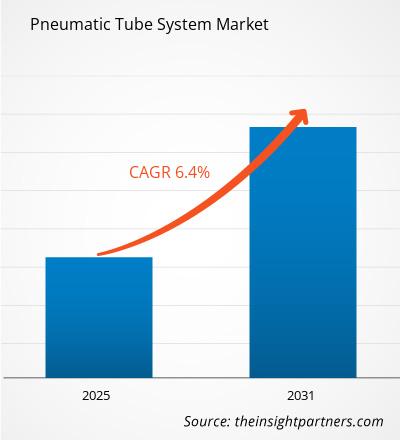
The Pneumatic tube system market growth is being driven by the increasing automation of critical item movement inside large facilities. The market was valued at US$ 2.7 Billion in 2025 and is projected to reach US$ 4.42 Billion by 2034, registering a CAGR of 6.33% during 2026–2034. Growth is supported by healthcare automation, commercial cash handling, industrial sample transfer, and secure point-to-point logistics.
North America remains a high-value regional base as hospitals, laboratories, retail banks, warehouses, and public facilities modernize internal transport. The pneumatic tube system market size in the region is supported by healthcare staffing pressure, faster diagnostic turnaround requirements, and upgrades to older tube networks with tracking, routing, and cybersecurity features. Adoption is expected to advance at a measured CAGR range as replacement projects complement new installations.
Pneumatic Tube System Market Assessment and Insights
- North America: North America accounted for 34–37% share in 2025 and is projected to grow at a CAGR of 5.8–6.4% during 2026–2034, led by hospital logistics modernization and secure commercial transport.
- US: The US represented 74–78% of North America in 2025 and is expected to grow at a CAGR of 5.9–6.5%, supported by hospital campus upgrades and retail banking adoption.
- Europe: Europe held 26–29% share in 2025 and is forecast to grow at 5.4–6.0%, with Germany, the UK, France, Italy, and Spain leading demand across healthcare and commercial facilities.
- Asia Pacific: Asia Pacific accounted for 22–25% share in 2025 and is projected to grow at 6.8–7.5%, supported by China, Japan, South Korea, India, and Australia.
- Largest Segment: Medical and Healthcare held 47–51% market share in 2025 and is expected to grow at 6.5–7.1% due to specimen, medication, and blood product transport needs.
- High Growth Segment: Fully Automatic systems held 38–42% share in 2025 and are projected to grow at 7.0–7.8% as facilities demand routing intelligence, tracking, and lower manual intervention.
- Key companies analyzed in detail: Aerocom Systems, Inc., Eagle Pneumatic, Inc., Gunnebo AB, Kelly Systems, Inc., Pevco Systems International, Inc., Quirepace Limited, SIEBTECHNIK TEMA GmbH, Swisslog Holding AG, Telecom Tube Systems, and Zip Pneumatics, Inc.
Source: The Insight Partners' analysis based on proprietary research, government publications, company annual reports, investor presentations, industry databases, and expert interviews.
Facility logistics has evolved from simple carrier movement toward connected transport networks that integrate routing software, station controls, RFID tracking, and maintenance analytics. The pneumatic tube system market is moving beyond legacy hospital installations, with new demand from laboratories, secure retail environments, manufacturing quality rooms, and large commercial buildings. Buyers increasingly evaluate uptime, station density, route complexity, noise control, carrier safety, and software resilience.
The future market demand would depend on healthcare infrastructure investment, automation in the retail sector and industrial campuses, and security of operational technology. The new hospitals in the Asia Pacific and Middle Eastern regions are implementing material transport automation systems in their development phase, whereas mature markets are working on the upgradation of existing systems. Companies that have engineering expertise, service capabilities, and digital monitoring capabilities can win the business.
Pneumatic Tube System Market Report Scope
| Report Attribute | Details |
|---|---|
| Market size in 2025 | US$ 2.7 Billion |
| Market Size by 2034 | US$ 4.42 Billion |
| Global CAGR (2026 - 2034) | 6.33% |
| Historical Data | 2021-2024 |
| Forecast period | 2026-2034 |
Pneumatic Tube System Market Analysis
Demand is anchored in applications where speed, chain of custody, and reduced labor movement matter. The pneumatic tube system market growth is strongest in hospitals, where carriers move blood samples, lab specimens, medications, documents, and small supplies between departments. The commercial users need a secure transit between counters, vaults, cash offices, and service areas, while the industrial users use systems for samples, documentation, and light loads inside their facilities.
The value chain consists of tube networks, diverters, blowers, carriers, stations, control software, sensors, installation engineering, and maintenance services. The design of the system depends on the facility layout, distance, load type, number of stations, and complexity of the route. The software has become more significant because users need priority routing, logging of usage, alarm management, and integration into building technologies standards.
The pneumatic tube system market analysis shows a competitive field led by specialist providers with installation experience and long-term service relationships. Swisslog Holding AG, Pevco Systems International, Inc., Aerocom Systems, Inc., Eagle Pneumatic, Inc., and Quirepace Limited compete strongly in healthcare and commercial systems. Gunnebo AB, Kelly Systems, Inc., Telecom Tube Systems, Zip Pneumatics, Inc., and SIEBTECHNIK TEMA GmbH strengthen market coverage through niche transport, service, and industrial capabilities.
The current trend in investments is moving towards fully automated networks, multiple lines installations and system modernization that adds to the system life without completely replacing the old one. Hospitals are emphasizing cyber security, redundancy and tracking of the movement of the carriers, whereas the commercial sector is concentrating on speed in transporting the counter to the secure room.
● REPORT CUSTOMIZATION
Tailor This Report To Align With Your Specific Business Requirements
This report can be customized to align precisely with your business objectives, scope, and target markets. Customization options include tailored segmentation, geography, competitive analysis, and strategic insights to support informed decision-making.
Customize This Report →WHAT YOU CAN ADJUST
- ● Segmentations
- ● Geography
- ● Competitive Analysis
- ● Language Preferences
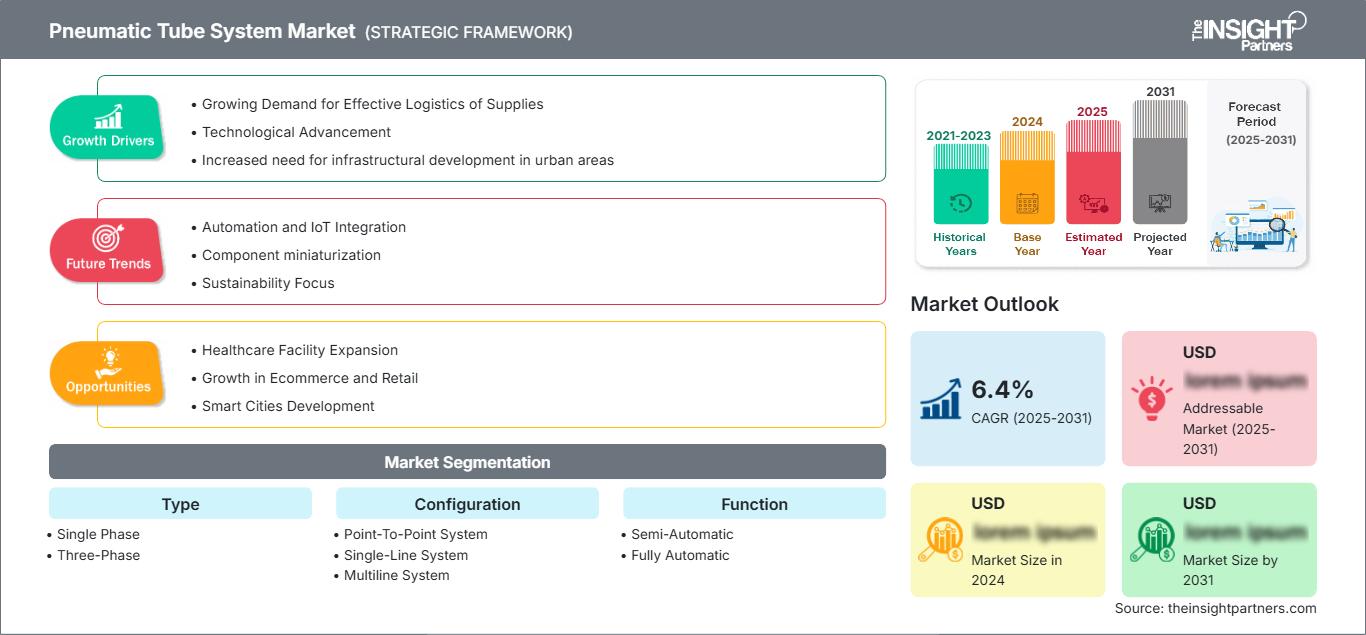
Pneumatic Tube System Market: Strategic Insights
Regional Insights
North America pneumatic tube system market
North America accounted for 34–37% pneumatic tube system market share in 2025 and is projected to grow at 5.8–6.4% during 2026–2034. Demand is still greatest from hospitals due to specimen delivery, pharmacy logistics, and the need to decrease nonclinical personnel traffic. Additional demand comes from commercial applications in banking, retail, casinos, and government buildings through retrofit applications.
Modernization is the key theme in the region. A lot of facilities have old pneumatic tube systems that require system upgrades, including software, control boards, rerouting, and preventive maintenance. New hospital construction is another reason for adoption since automated transport systems can be incorporated into the building layout in advance of departments opening.
U.S. pneumatic tube system Market
The U.S. represented 74–78% of North America in 2025 and is forecast to grow at 5.9–6.5% during 2026–2034. Big hospitals, university hospitals, laboratory complexes, airports, banks, and distribution campuses are the sources of wide-ranging demand. Facilities are evaluated based on their uptime capabilities, security, documentation, and capability to handle critical routing.
Company representation is comprehensive, including Swisslog’s TransLogic subsidiary, Pevco Systems International, Inc., Aerocom Systems, Inc., Eagle Pneumatic, Inc., Kelly Systems, Inc., and Zip Pneumatics, Inc., addressing clients in the healthcare and commercial sectors. The United States market demand enjoys the benefits of retrofitting, station enlargement, and maintenance services that assist the operators in preserving their investment.
Europe pneumatic tube system Market
Europe held 26–29% share in 2025 and is expected to expand at 5.4–6.0%. Germany leads due to advanced hospital construction, laboratory automation, and industrial engineering capability. The United Kingdom has replacement needs in hospitals as well as safe commercial establishments, while France, Italy, and Spain provide sustained adoption through improvements in healthcare facilities and infrastructural improvements in the public domain.
Local buyers focus on dependability, silent operation, safety features, and installation within the facility itself. The companies Gunnebo AB, Quirepace Limited, Swisslog Holding AG, Aerocom Systems, Inc., and SIEBTECHNIK TEMA GmbH cater to different purposes that include logistics in health care, commercial, and industrial conveyance.
APAC pneumatic tube system Market
Asia Pacific accounted for 22–25% share in 2025 and is projected to grow at 6.8–7.5%. The main contributor to the market is China, where hospital construction and urban healthcare development play an important role. Japan and South Korea prioritize automation, reliability, and small-scale facility logistics, while in India and Australia, the demand is driven by healthcare developments and commercial modernization.
Market growth is driven by hospital construction, diagnostic labs, public health facilities, and smart buildings. Consumers in this region are increasingly choosing scalable networks that can be expanded in future wings or campus constructions. The companies that have local partners for installation and service in complex multistep construction projects are more competitive.
Middle East & Africa pneumatic tube system Market
The Middle East and Africa are expected to grow at 5.7–6.3% during 2026–2034. Saudi Arabia and the UAE drive demand through hospitals, medical cities, airports, and premium commercial developments. South Africa is contributing by way of hospital upgrades, private healthcare developments, and transportation requirements within commercial settings.
Adoption is driven largely by project implementations, with pneumatic tube systems being specified for new installations or large-scale renovations. Operating temperatures, reliability of service, and campus distance all play a part in the choice. International vendors with a strong program for commissioning, training, and support are well-positioned in this market.
Segmentation Analysis
Type
Type is expected to grow at a CAGR of 6.0–6.6% during 2026–2034. The pneumatic tube system market scope by type reflects facility preference for reliable carrier movement, power efficiency, and network complexity. Single-phase systems remain suitable for smaller or moderate-load facilities, while three-phase systems support larger networks with higher station counts, longer tube runs, and stronger blower performance requirements.
- Single Phase: Single-phase systems are preferred in smaller clinics, retail sites, laboratories, and commercial facilities where moderate carrier traffic, simpler installation, and lower electrical infrastructure needs are important.
- Three-Phase: Three-phase systems are strategically important in hospitals, industrial campuses, and high-throughput facilities requiring stronger blower capacity, longer operating cycles, and dependable performance across complex networks.
Configuration
Configuration is projected to grow at a CAGR of 6.2–6.8% during 2026–2034. The pneumatic tube system market report highlights that point-to-point, single-line, and multiline systems address different facility layouts. Hospitals and commercial campuses increasingly favor multiline designs where multiple departments, laboratories, cash rooms, or service points require flexible routing, queue management, and prioritized movement across several destinations.
- Point-To-Point System: Point-to-point systems serve direct transfer needs between two locations, making them useful for retail cash movement, small laboratories, and focused department-to-department logistics.
- Single-Line System: Single-line systems support simple network expansion with controlled routing across limited stations, giving small hospitals and commercial facilities a balance between cost and operational utility.
- Multiline System: Multiline systems provide higher routing flexibility, station density, and traffic management, making them vital for large hospitals, airports, government buildings, campuses, and secure commercial facilities.
Function
Function is forecast to grow at a CAGR of 6.4–7.1% during 2026–2034. Semi-automatic systems remain relevant where operations are predictable and routing complexity is limited. Fully automatic systems are gaining preference because they reduce user steps, improve traceability, manage priority routes, and support digital facility management in high-throughput environments.
- Semi-Automatic: Semi-automatic systems suit lower-complexity settings where users can control destination selection manually while still benefiting from faster transfer and reduced walking time.
- Fully Automatic: Fully automatic systems support sophisticated routing, destination recognition, tracking, and workflow integration, making them important for hospitals, laboratories, and large commercial sites seeking operational control.
End User
End User is projected to grow at a CAGR of 6.3–7.0% during 2026–2034. Medical and Healthcare leads demand because urgent specimen and medication transfer directly affects clinical workflow. Industrial and commercial users remain important as secure internal logistics, sample movement, and cash handling automation continue to support broader market adoption.
- Industrial: Industrial users deploy systems to move samples, documents, tools, and small components across plants, laboratories, testing areas, and quality control rooms with lower internal transport time.
- Medical and Healthcare: Medical and healthcare facilities rely on tube systems for specimens, medications, blood products, and documents, strengthening workflow speed, chain of custody, and staff productivity.
- Commercial: Commercial users adopt systems in banks, retail stores, casinos, airports, offices, and public buildings where secure, fast, and traceable movement improves service operations.
Opportunity Snapshot
| End User | Revenue Contribution | Trend Tag | Adoption Stage |
| Industrial | Medium | Sample Transfer | Scaling |
| Medical and Healthcare | High | Specimen Flow | Mature |
| Commercial | Medium | Secure Cash | Mature |
Pneumatic Tube System Market Growth Drivers and Impact Analysis
Hospital Automation and Faster Clinical Logistics
Hospitals are under pressure to reduce turnaround time for laboratory samples, medications, and blood products while preserving the chain of custody. Pneumatic tube networks help move items between emergency departments, laboratories, pharmacies, wards, and blood banks without relying fully on manual couriers. This driver has a strong market impact because transport delays can affect diagnostic speed, clinician productivity, and patient throughput. Systems with priority routing, tracking, and secure carrier design are especially valuable in large hospitals where departments operate across several floors or buildings.
Modernization of Aging Facility Transport Networks
Many hospitals and commercial buildings continue to operate legacy tube systems that require software upgrades, new routing controls, station replacement, or cybersecurity improvements. Modernization projects are attractive because they can improve reliability without requiring a full redesign of the installed tube infrastructure. This creates recurring revenue for suppliers through audits, retrofits, service contracts, and phased technology upgrades. The impact is strongest in North America and Europe, where installed bases are mature and facility managers are focused on uptime, safety, and operational technology resilience.
Secure Internal Transfer Across Commercial Facilities
Commercial users are adopting pneumatic tube systems to move cash, documents, small packages, and service materials between customer-facing areas and secure back-office locations. Banks, retail chains, casinos, airports, and public facilities use these networks to reduce staff travel, improve auditability, and limit exposure during transfer. The driver broadens the market beyond healthcare and supports demand for compact, durable, and easy-to-maintain systems. Suppliers that offer tailored station design, access control, and service support can capture projects in both new and refurbished buildings.
Pneumatic Tube System Market Future Trends
Connected Monitoring and Predictive Maintenance
One of the most important pneumatic tube system market trends is the shift toward connected monitoring. Facilities want visibility into carrier movement, station use, faults, blower performance, and route congestion. Predictive maintenance tools can help teams identify repeated blockages, declining component performance, or abnormal usage before service disruption occurs. This trend will increase demand for sensor-enabled stations, dashboards, secure software updates, and vendor support models that convert maintenance from reactive repair into planned performance management.
Cybersecure Operational Technology Upgrades
As tube systems become digitally connected, cybersecurity is moving from an IT concern to a procurement requirement. Hospitals and commercial facilities need control software, firmware, and networked components that can be updated and protected throughout the system lifecycle. Future purchasing decisions will place greater weight on secure architecture, access controls, documentation, and compatibility with facility technology policies. This trend supports modernization spending because older systems may lack the security features required in connected healthcare and public infrastructure environments.
Pneumatic Tube System Market Opportunities
Design-Assist Services for New Hospital Construction
New hospital projects create an attractive opportunity because tube networks perform best when stations, blowers, routes, and service access are planned early. Pneumatic tube system market Forecasts indicate that vendors offering design-assist services can influence layout decisions, reduce future retrofit complexity, and improve long-term maintenance access. Early involvement also helps align transport routes with pharmacy, laboratory, emergency, and ward workflows. This opportunity is strongest in large hospitals, medical campuses, and emerging market healthcare projects where automation is being specified from the start.
Aftermarket Service and Lifecycle Extension
Installed systems require periodic inspection, carrier replacement, software updates, blower servicing, control upgrades, and operator training. This creates a recurring opportunity for suppliers that provide structured maintenance and lifecycle extension programs. Facilities benefit because they can improve uptime and safety while deferring full replacement. Vendors can strengthen customer retention through remote diagnostics, preventive maintenance schedules, spare parts availability, and modernization roadmaps that prioritize the most critical upgrades first.
Frequently Asked Questions

- Comprehensive Market Sizing and Forecast Analysis
- Detailed Segmentation Analysis
- In-Depth Market Dynamics Assessment
- Regional and Country-Level Insights
- Competitive Landscape and Company Benchmarking
- Strategic Business Intelligence
Recent Reports
Testimonials

The Insight Partners' SCADA System Market report is comprehensive, with valuable insights on current trends and future forecasts. The team was highly professional, responsive, and supportive throughout. We are very satisfied and highly recommend their services.
RAN KEDEM Partner, Reali Technologies LTDs
I requested a report on a very specific software market and the team produced the report in a few days. The information was very relevant and well presented. I then requested some changes and additions to the report. The team was again very responsive and I got the final report in less than a week.
JEAN-HERVE JENN Chairman, Future Analytica
We worked with The Insight Partners for an important market study and forecast. They gave us clear insights into opportunities and risks, which helped shape our plans. Their research was easy to use and based on solid data. It helped us make smart, confident decisions. We highly recommend them.
PIYUSH NAGPAL Sr. Vice President, High Beam Global
The Insight Partners delivered insightful, well-structured market research with strong domain expertise. Their team was professional and responsive throughout. The user-friendly website made accessing industry reports seamless. We highly recommend them for reliable, high-quality research services
YUKIHIKO ADACHI CEO, Deep Blue, LLC.
This is the first time I have purchased a market report from The Insight Partners.While I was unsure at first, I visited their web site and felt more comfortable to take the risk and purchase a market report.I am completely satisfied with the quality of the report and customer service. I had several questions and comments with the initial report, but after a couple of dialogs over email with their analyst I believe I have a report that I can use as input to our strategic planning process.Thank you so much for taking the extra time and making this a positive experience.I will definitely recommend your service to others and you will be my first call when we need further market data.
JOHN SUZUKI President and Chief Executive Officer, Board Director, BK Technologies
I wish to appreciate your support and the professionalism you displayed in the course of attending to my request for information regarding to infectious disease IVD market in Nigeria. I appreciate your patience, your guidance, and the fact that you were willing to offer a discount, which eventually made it possible for us to close a deal. I look forward to engaging The Insight Partners in the future, all thanks to the impression you have created in me as a result of this first encounter.
DR CHIJIOKE ONYIA MANAGING DIRECTOR, PineCrest Healthcare Ltd.Reason to Buy
- Informed Decision-Making
- Understanding Market Dynamics
- Competitive Analysis
- Identifying Emerging Markets
- Customer Insights
- Market Forecasts
- Risk Mitigation
- Boosting Operational Efficiency
- Strategic Planning
- Investment Justification
- Tracking Industry Innovations
- Aligning with Regulatory Trends





 Get Free Sample for