
Point Of Entry Water Treatment Systems Market Share, Growth & Demand by 2034
Coverage: By Technology (Water Softening, Filtration, Reverse Osmosis (RO), Disinfection, Others); Application (Residential, Commercial, Industrial) , and Geography (North America, Europe, Asia Pacific, and South and Central America)
- Status : Data Released
- Report Code : TIPRE00022496
- Category : Manufacturing and Construction
- No. of Pages : 150
- Available Report Formats :


- Last update date : September 07, 2026


2025 Market Size
US$ 10.6 Bn
Base year value
2034 Forecast
US$ 15.59 Bn
Projected by 2034
CAGR 2026-2034
4.38 %
Growth rate
Addressable Market
US$ 118.93 Bn
(2026-2034)
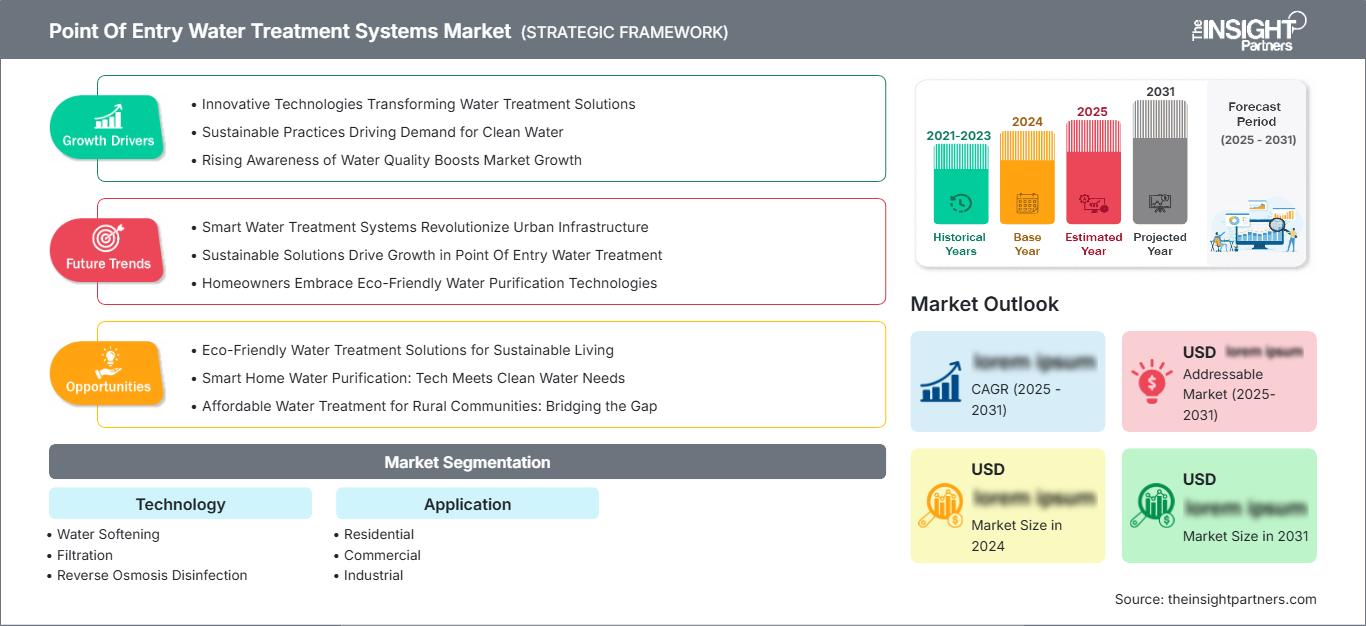
The Point Of Entry Water Treatment Systems market was valued at US$ 10.6 billion in 2025 and is expected to reach US$ 15.59 billion by 2034; it is estimated to record a CAGR of 4.38% during 2026-2034.
Point Of Entry Water Treatment Systems Market Assessment and Insights
- North America: North America accounted for 34–37% share in 2025 and is projected to grow at a CAGR of 4.4–5.0% during 2026–2034, supported by residential water quality awareness.
- US: The US represented 74–78% of North America in 2025 and is expected to grow at 4.5–5.1%, led by replacement demand, private wells, and commercial building upgrades.
- Europe: Europe held 25–28% share in 2025 and is forecast to grow at 4.1–4.7%, with Germany, the UK, France, Italy, and Spain supporting steady adoption.
- Asia Pacific: Asia Pacific accounted for 24–27% share in 2025 and is projected to grow at 5.5–6.2%, led by China, India, Japan, South Korea, and Australia.
- Largest Segment: Filtration held 41–45% market share in 2025 and is expected to grow at 4.6–5.2% due to broad use for sediment, chlorine, odor, and contaminant reduction.
- High Growth Segment: Reverse osmosis disinfection held 17–21% share in 2025 and is projected to grow at 5.7–6.5% as high-purity and microbial-risk applications expand.
- Key companies analyzed in detail: 3M Company, Honeywell International Inc., General Electric Company, BWT Holding GmbH, Calgon Carbon Corporation, Pentair plc, The Dow Chemical Company, Danaher Corporation, Watts Water Technologies, Inc., and Culligan International.
Source: The Insight Partners' analysis based on proprietary research, government publications, company annual reports, investor presentations, industry databases, and expert interviews.
The market has advanced from simple whole-house softeners to multi-step treatment plants that incorporate filtration media, softening, reverse osmosis, UV purification, and intelligent monitoring. Producers are enhancing cartridges, valves, membranes, and alerts for minimizing maintenance uncertainties and providing proof of water quality performance. The production process is also characterized by an increasing specialization of distribution channels, where plumbers, dealers, retailers, and facility integrators influence purchasing decisions.
The future demand will depend on emerging urban residential buildings, refurbishment of commercial buildings, industrial water recycling, and increasing focus on such contaminants as chlorine, PFAS, heavy metals, and microorganisms. The investment will go towards the development of modular solutions, connected services, and treatment trains. The producers that offer water testing services, certification information, and consumables replenishing services can benefit from ongoing payments.
Point Of Entry Water Treatment Systems Market Report Scope
| Report Attribute | Details |
|---|---|
| Market size in 2025 | US$ 10.6 Billion |
| Market Size by 2034 | US$ 15.59 Billion |
| Global CAGR (2026 - 2034) | 4.38% |
| Historical Data | 2021-2024 |
| Forecast period | 2026-2034 |
Point Of Entry Water Treatment Systems Market Analysis
Concerns over taste, odor, scale, microbial contamination, and dissolved solids are driving the point of entry water treatment systems market growth across homes, hotels, offices, schools, clinics, and industrial sites. The ecosystem spans media suppliers, membrane producers, valve manufacturers, system assemblers, plumbing distributors, installers, and service providers. Buyers increasingly evaluate whole-building protection, operating cost, cartridge life, certification, and maintenance visibility before selecting technology.
Supply dynamics are shaped by the need to match systems to source-water chemistry. Hard-water regions favor softening, municipal users often prioritize carbon filtration, and facilities with process sensitivity require reverse osmosis or disinfection. The point of entry water treatment systems market analysis shows that vendors compete through contaminant-removal breadth, installation simplicity, smart controls, and service availability.
Competition involves diverse industrial segments and specialized water segments. Some of the companies include 3M Company, Pentair plc, Watts Water Technologies, Inc., Culligan International, BWT Holding GmbH, Calgon Carbon Corporation, and Danaher Corporation, with wide product lines, and General Electric Company, Honeywell International Inc., and The Dow Chemical Company bring in branding, materials, control or water technology solutions for related markets.
Trends include connected monitoring, cartridge subscription, higher capacity filtration, and combination packages of softening and filtration systems. Strategic positioning involves certification, distribution channels, and the ability to offer products to both residential and commercial customers. Those companies that integrate the sale of equipment, consumables, and services through dealers will do much better in terms of profitability.
● REPORT CUSTOMIZATION
Tailor This Report To Align With Your Specific Business Requirements
This report can be customized to align precisely with your business objectives, scope, and target markets. Customization options include tailored segmentation, geography, competitive analysis, and strategic insights to support informed decision-making.
Customize This Report →WHAT YOU CAN ADJUST
- ● Segmentations
- ● Geography
- ● Competitive Analysis
- ● Language Preferences
Point Of Entry Water Treatment Systems Market: Strategic Insights
Regional Insights
North America point of entry water treatment systems market
North America accounted for 34–37% point of entry water treatment systems market share in 2025 and is forecast to grow at 4.4–5.0% during 2026–2034. Residential well-water treatment, hard-water mitigation, chlorine removal, and concern over emerging contaminants support adoption in single-family homes and multifamily buildings.
Commercial demand comes from hospitality, schools, healthcare facilities, offices, and foodservice locations that require consistent water quality for appliances, bathing, cleaning, and customer experience. Retrofit demand is strong because older softeners and filters need replacement with systems offering better efficiency, monitoring, and easier service access.
U.S. point of entry water treatment systems Market
The U.S. represented 74–78% of North America in 2025 and is projected to grow at 4.5–5.1%. The large number of houses, hard water in the region, dependence on wells, and increased awareness of the dangers of lead, PFAS, chlorine, bacteria, and sediment favor whole-house treatment system installation.
The company has wide geographical coverage through Pentair plc, Culligan International, Watts Water Technologies, Inc., 3M Company, Calgon Carbon Corporation, and Danaher Corporation. The demand for the product is also aided by the plumbing companies, dealerships, and water treatment companies, who advertise filter replacements, water softening systems, reverse osmosis kits, and service contracts.
Europe point of entry water treatment systems Market
Europe held 25–28% share in 2025 and is expected to grow at 4.1–4.7%. German dominance results from high consumer awareness regarding residential water treatment systems, appliance protection requirements, and high standards in plumbing. Hard water management, improvement of rental property, and renovation of the hospitality industry in the United Kingdom create demand.
In addition to this, France, Italy and Spain create consistent demand via hotels, private homes, restaurants, and commercial properties in need of scale control, filtration and taste enhancement. The regional relevance of BWT Holding GmbH is very high; however, global vendors are competing based on certified performance, compact design and distribution networks.
APAC point of entry water treatment systems Market
Asia Pacific accounted for 24–27% share in 2025 and is projected to grow at 5.5–6.2%. China leads demand through urban housing, commercial buildings, and industrial water quality concerns, while India expands through rising income, contamination awareness, and commercial infrastructure upgrades.
Japan, South Korea, and Australia support adoption through advanced plumbing standards, premium residential products, and commercial water quality expectations. Policy focus on safe water access, industrial compliance, and urban development strengthen demand for filtration, softening, reverse osmosis, and disinfection technologies.
Middle East & Africa point of entry water treatment systems Market
The Middle East and Africa is expected to grow at 4.8–5.5% during 2026–2034. Saudi Arabia and the UAE lead demand owing to desalinated water distribution, hospitality projects, villas, commercial properties, and scale-control requirements in high-mineral water conditions.
South Africa contributes through residential filtration, commercial buildings, and water reliability concerns. The rest of MEA demand remains project-led but improves where hotels, hospitals, industrial users, and premium housing require whole-building treatment for taste, odor, sediment, hardness, and microbial risk management.
Segmentation Analysis
Technology
Technology is expected to grow at a CAGR of 4.8–5.4% during 2026–2034. The point of entry water treatment systems market scope by technology reflects source-water variability, building size, contaminant mix, and maintenance preference. Water softening addresses hardness, filtration remains the mainstream baseline, and reverse osmosis disinfection serves higher-purity and microbial-risk settings.
- Water Softening: Water softening systems remain important in hard-water regions because they reduce scale, protect appliances, improve plumbing efficiency, and support residential as well as hospitality water quality expectations.
- Filtration: Filtration is the largest technology because it addresses sediment, chlorine, taste, odor, and selected contaminants with relatively simple installation, broad applicability, and recurring cartridge replacement demand.
- Reverse Osmosis Disinfection: Reverse osmosis disinfection is gaining strategic importance where users need higher contaminant reduction, microbial control, and consistent quality for sensitive residential, commercial, or industrial processes.
Application
Application is projected to grow at a CAGR of 4.7–5.3% during 2026–2034. Residential installations dominate volume, while commercial users raise average system value through larger capacities and service requirements. Industrial users adopt point-of-entry systems where inlet water quality affects equipment, pretreatment, product consistency, or compliance.
- Residential: Residential users install whole-house treatment to improve drinking, bathing, laundry, plumbing protection, and appliance life, especially where hard water, chlorine, sediment, or well-water contaminants affect daily use.
- Commercial: Commercial facilities require reliable water quality for hotels, restaurants, schools, offices, clinics, and retail properties where taste, odor, scale, equipment protection, and customer experience influence purchase decisions.
- Industrial: Industrial users deploy inlet treatment as pretreatment for process water, boilers, cooling systems, manufacturing lines, and cleaning operations where consistency and contaminant control affect productivity.
Opportunity Snapshot
| Segment Name | Revenue Contribution | Trend Tag | Adoption Stage |
| Residential | High | Whole Home | Mature |
| Commercial | Medium | Facility Quality | Scaling |
| Industrial | Medium | Process Inlet | Scaling |
Point Of Entry Water Treatment Systems Market Growth Drivers and Impact Analysis
Rising Concern Over Whole-building Water Quality
There is a growing demand for whole building filtration in addition to point-of-use treatment in kitchens. There are worries regarding sediment, chlorine, taste and odor, hardness, bacteria, heavy metals, and other emerging contaminants affecting various aspects of water use. It creates the greatest effect in households that use private wells, buildings with old piping, and commercial facilities where water quality plays a significant role in establishing the reputation of a business. The value of systems is increased by providing services on an ongoing basis.
Hard-water Management and Appliance Protection
Scale formation is an effect caused by hard water, resulting in the need for more energy and higher costs of maintaining these appliances. Softening and filtering water kits are used to prevent damage to home appliances, increase the durability of plumbing, and decrease cleaning expenses. This factor is economically relevant since consumers have the opportunity to relate the cost of treatment directly to saving money from equipment maintenance and repairs. Hotels, restaurants, laundries, apartment buildings, and healthcare facilities are particularly vulnerable to downtime caused by scaling.
Regulatory and Health Attention to Contaminants
Public debates over lead, PFAS, microbiological contamination, disinfection by-products, nitrates, and other contaminants from industry raise demand for water purification solutions that have been validated. While municipal systems will continue to play an important role in the provision of potable water for public use, building-level solutions can be used to provide an extra layer of security in case of contamination through distribution pipelines, wells, or other contaminants. The demand will foster the development of market demand for solutions based on filtration, carbon media, reverse osmosis, and ultraviolet disinfection.
Point Of Entry Water Treatment Systems Market Future Trends
Smart Monitoring and Service-linked Systems
One of the strongest point of entry water treatment systems market trends is the shift toward connected controls, leak alerts, flow tracking, filter-life indicators, and remote service notifications. These features reduce uncertainty for homeowners and facility managers by showing when maintenance is required. Dealers can also use usage data to schedule cartridge replacement, media changes, and system inspections. Smart systems will not replace core treatment chemistry, but they will differentiate premium products by improving uptime, protecting plumbing, and turning maintenance into a predictable service relationship.
Integrated Multi-stage Treatment Packages
Future systems will have increased combinations of sediment filters, activated carbon, softening, reverse osmosis, and ultraviolet light purification all in one package, based on water test results. This system caters to a wider range of contaminants without over-purifying the water. Business and premium residential consumers will favor systems that scale with time based on changes in building occupancy and water quality. Companies that make water treatment easier to specify, install, and maintain will have an advantage in capturing premium market segments.
Point Of Entry Water Treatment Systems Market Opportunities
Dealer-led Replacement and Subscription Programs
Replacement cycles create a major opportunity because installed softeners, filters, valves, membranes, and media require periodic service. Point of entry water treatment systems market Forecasts indicate that vendors can improve recurring revenue by bundling equipment with filter subscriptions, water testing, remote alerts, and scheduled maintenance. Dealer-led programs also reduce customer hesitation by converting technical upkeep into a managed service. This model is attractive in residential, hospitality, healthcare, and commercial buildings where consistent water quality matters but users prefer predictable cost and service accountability.
Commercial Water Quality Upgrades
Hotel facilities, restaurants, educational institutions, health care centers, offices, and apartment buildings present an opportunity that is capable of expansion since water quality influences maintenance costs, the image of the business, system longevity, and even its continuity. Large structures require bigger systems, redundancy, and professional maintenance, increasing the value of the installation beyond that of residential projects. The vendors can sell their solutions to these people using testing-based offers, smaller skid models, combined water softening and filtration solutions, and maintenance agreements.
Frequently Asked Questions

- Comprehensive Market Sizing and Forecast Analysis
- Detailed Segmentation Analysis
- In-Depth Market Dynamics Assessment
- Regional and Country-Level Insights
- Competitive Landscape and Company Benchmarking
- Strategic Business Intelligence
Recent Reports
Testimonials

The Insight Partners provided valuable market intelligence that supported our global go-to-market strategy. Their team was professional, responsive, and attentive to our feedback, providing thoughtful analysis and helpful methodological clarifications throughout the project.
Junmo Kim Chief Financial Officer (CFO), Enertech Co., Ltd.
The Insight Partners' SCADA System Market report is comprehensive, with valuable insights on current trends and future forecasts. The team was highly professional, responsive, and supportive throughout. We are very satisfied and highly recommend their services.
RAN KEDEM Partner, Reali Technologies LTDs
I requested a report on a very specific software market and the team produced the report in a few days. The information was very relevant and well presented. I then requested some changes and additions to the report. The team was again very responsive and I got the final report in less than a week.
JEAN-HERVE JENN Chairman, Future Analytica
We worked with The Insight Partners for an important market study and forecast. They gave us clear insights into opportunities and risks, which helped shape our plans. Their research was easy to use and based on solid data. It helped us make smart, confident decisions. We highly recommend them.
PIYUSH NAGPAL Sr. Vice President, High Beam Global
The Insight Partners delivered insightful, well-structured market research with strong domain expertise. Their team was professional and responsive throughout. The user-friendly website made accessing industry reports seamless. We highly recommend them for reliable, high-quality research services
YUKIHIKO ADACHI CEO, Deep Blue, LLC.
This is the first time I have purchased a market report from The Insight Partners.While I was unsure at first, I visited their web site and felt more comfortable to take the risk and purchase a market report.I am completely satisfied with the quality of the report and customer service. I had several questions and comments with the initial report, but after a couple of dialogs over email with their analyst I believe I have a report that I can use as input to our strategic planning process.Thank you so much for taking the extra time and making this a positive experience.I will definitely recommend your service to others and you will be my first call when we need further market data.
JOHN SUZUKI President and Chief Executive Officer, Board Director, BK Technologies
I wish to appreciate your support and the professionalism you displayed in the course of attending to my request for information regarding to infectious disease IVD market in Nigeria. I appreciate your patience, your guidance, and the fact that you were willing to offer a discount, which eventually made it possible for us to close a deal. I look forward to engaging The Insight Partners in the future, all thanks to the impression you have created in me as a result of this first encounter.
DR CHIJIOKE ONYIA MANAGING DIRECTOR, PineCrest Healthcare Ltd.Reason to Buy
- Informed Decision-Making
- Understanding Market Dynamics
- Competitive Analysis
- Identifying Emerging Markets
- Customer Insights
- Market Forecasts
- Risk Mitigation
- Boosting Operational Efficiency
- Strategic Planning
- Investment Justification
- Tracking Industry Innovations
- Aligning with Regulatory Trends





 Get Free Sample for