
Point-of-Use Water Treatment Systems Market Size, Trends & Growth by 2034
Coverage: By System (Tabletop pitchers, Faucet-mounted filters, Under-the-sink Filters, Counter-top Unit, Others); Technology (Reverse Osmosis, Ultra-filtration, Ion-Exchange, Distillation, Disinfection, Filtration, Others); Application (Residential, Non-residential) , and Geography (North America, Europe, Asia Pacific, and South and Central America)
- Status : Data Released
- Report Code : TIPRE00007474
- Category : Manufacturing and Construction
- No. of Pages : 150
- Available Report Formats :


- Last update date : September 07, 2026


2025 Market Size
US$ 35.83 Bn
Base year value
2034 Forecast
US$ 65.09 Bn
Projected by 2034
CAGR 2026-2034
7.75 %
Growth rate
Addressable Market
US$ 477.10 Bn
(2026-2034)
The point-of-use water treatment systems market was valued at US$ 35.83 Billion in 2025 and is projected to reach US$ 65.09 Billion by 2034, registering a CAGR of 7.75% during 2026–2034. Demand is supported by household concern over drinking-water safety, compact purifier adoption, urban plumbing limitations, and wider use of countertop, faucet-mounted, under-the-sink, and pitcher-based treatment formats.
North America remains a durable demand base as consumers seek drinking-water treatment at the point where water is consumed. The point-of-use water treatment systems market size in the region is supported by concern over lead, PFAS, chlorine taste, aging pipes, and replacement filters. Regional demand is expected to grow at 6.8–7.4% during 2026–2034, helped by smart appliance integration and dealer-led service models.
Point-of-Use Water Treatment Systems Market Assessment and Insights
- North America: North America accounted for 28–31% share in 2025 and is projected to grow at a CAGR of 6.8–7.4% during 2026–2034, supported by under-sink upgrades and certified filtration demand.
- US: The US represented 76–80% of North America in 2025 and is expected to grow at 6.9–7.5%, led by contaminant-specific filter claims and residential replacement cycles.
- Europe: Europe held 22–25% share in 2025 and is forecast to grow at 6.3–6.9%, with the UK, Germany, France, Italy, and Spain supporting steady adoption.
- Asia Pacific: Asia Pacific accounted for 38–42% share in 2025 and is projected to grow at 8.2–8.9%, led by China, India, Japan, South Korea, and Australia.
- Largest Segment: Reverse Osmosis held 30–34% market share in 2025 and is expected to grow at 7.7–8.4% during 2026–2034 due to dissolved-solids and heavy-metal reduction needs.
- High Growth Segment: Under-the-sink Filters held 24–28% share in 2025 and are projected to grow at 8.4–9.1% as compact kitchens favor hidden, high-capacity systems.
- Key companies analyzed in detail: 3M Company, A. O. Smith Corporation, WestAqua Distribution OU Limited, Culligan International, Eureka Forbes Limited, GE Appliances, KENT RO Systems Ltd., Kinetico Incorporated, New Wave Enviro Products, Inc., and Whirlpool Corporation.
Source: The Insight Partners' analysis based on proprietary research, government publications, company annual reports, investor presentations, industry databases, and expert interviews.
Market trends have changed from taste-and-odor filtering to certified and multistage filters that target particular contaminants like lead, PFAS, bacteria, microplastics, and dissolved minerals. Product innovation has also shifted from filter media, reverse osmosis membranes, UV technology, cartridge monitors, and compact installation systems. There are also changes happening in the production dynamics through competition among appliance makers, filtration companies, and regional purifiers by way of design, certification, replacement, and customer care in the digital era.
Future growth trends will include households in the Asia Pacific region, replacement filters in North America, sustainable needs in Europe, and affordable, safe water access in emerging economies. Investments will probably go to smart purification systems, reverse osmosis with minimal waste, replacement cartridges, and proven reductions of contaminants. Government regulation on drinking water standards and consumer education on certification will support premium products, but also allow pitchers and faucet filters to remain important.
Point-of-Use Water Treatment Systems Market Report Scope
| Report Attribute | Details |
|---|---|
| Market size in 2025 | US$ 35.83 Billion |
| Market Size by 2034 | US$ 65.09 Billion |
| Global CAGR (2026 - 2034) | 7.75% |
| Historical Data | 2021-2024 |
| Forecast period | 2026-2034 |
Point-of-Use Water Treatment Systems Market Analysis
Growing distrust in tap-water quality, smaller kitchens, and rising awareness of waterborne disease risks are supporting point-of-use water treatment systems market growth across households and light commercial locations. The ecosystem includes membrane producers, carbon media suppliers, cartridge assemblers, appliance brands, plumbers, e-commerce platforms, retailers, and service networks.
Demand differs by water chemistry and user budget. Reverse osmosis is preferred where dissolved solids, arsenic, lead, and heavy metals are concerns, while filtration and faucet-mounted products serve taste, odor, chlorine, and sediment reduction. The point-of-use water treatment systems market analysis shows that consumers increasingly compare contaminant certifications, cartridge cost, installation effort, storage footprint, water efficiency, and service support before purchase.
Competitive firms range from global conglomerates to regional experts. Firms like 3M Company, A. O. Smith Corporation, Culligan International, Whirlpool Corporation, and GE Appliances focus on building brand reputation and deep distribution channels. However, firms like KENT RO Systems Ltd., Eureka Forbes Limited, WestAqua Distribution OU Limited, Kinetico Incorporated, and New Wave Enviro Products, Inc., cater to regional markets and specialties.
Emerging investment trends include smart monitoring, application-based filter reminders, small tanks using tankless reverse osmosis, and media that can handle emerging contaminants. Strategic positioning is now increasingly reliant on post-purchase revenue rather than the device purchase itself. Firms that sell both hardware and cartridges and also provide reminders can secure long-term relationships and margins in competitive categories.
● REPORT CUSTOMIZATION
Tailor This Report To Align With Your Specific Business Requirements
This report can be customized to align precisely with your business objectives, scope, and target markets. Customization options include tailored segmentation, geography, competitive analysis, and strategic insights to support informed decision-making.
Customize This Report →WHAT YOU CAN ADJUST
- ● Segmentations
- ● Geography
- ● Competitive Analysis
- ● Language Preferences
Point-of-Use Water Treatment Systems Market: Strategic Insights
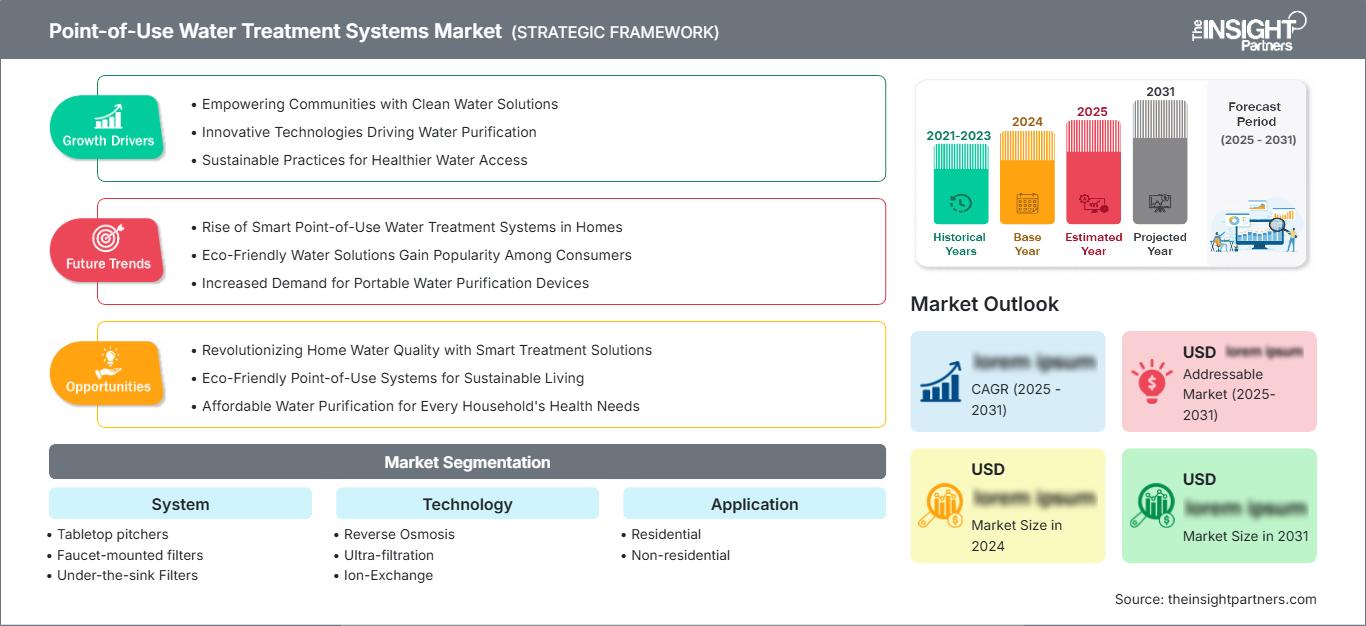
Regional Insights
North America point-of-use water treatment systems market
North America accounted for 28–31% point-of-use water treatment systems market share in 2025 and is expected to grow at 6.8–7.4% during 2026–2034. Demand is driven by household concern over lead, PFAS, chlorine taste, microbial risk, and aging municipal distribution pipes.
Replacement filters, subscription cartridges, and certified under-sink systems support recurring sales. Consumers increasingly seek NSF-verified claims, water-quality testing, and convenient installation. Non-residential demand comes from offices, clinics, schools, hospitality, and small foodservice sites needing point-level drinking-water treatment without whole-building retrofits.
U.S. point-of-use water treatment systems Market
The U.S. represented 76–80% of North America in 2025 and is projected to grow at 6.9–7.5% during 2026–2034. Demand is supported by contaminant awareness, hard-to-replace plumbing, and preference for under-sink reverse osmosis, countertop units, faucet filters, and refrigerator-integrated filtration.
3M Company, A. O. Smith Corporation, Culligan International, GE Appliances, Whirlpool Corporation, Kinetico Incorporated, and New Wave Enviro Products, Inc. maintain strong channel presence. The U.S. is also important for certified filter claims and subscription replacement adoption.
Europe point-of-use water treatment systems Market
Europe held 22–25% share in 2025 and is forecast to grow at 6.3–6.9%. Demand in the UK is created by the need to address hard water taste issues and reduce kettle scaling. On the other hand, certified machines that are sustainable and long-lasting are preferred in Germany. The French, Italians, and Spanish create demand from bottled water replacement, hospitality, and home filtration applications.
Compactness, recyclability of cartridges, and validated contaminants reduction form part of the preferences of European consumers. Competitors of WestAqua Distribution OU Limited include 3M Company, Culligan International, and Whirlpool Corporation, using retail, ecommerce, and appliance routes to market. Growth in premium is tied to under-sink and countertop units that perform well and use fewer plastic bottles.
APAC point-of-use water treatment systems Market
Asia Pacific accounted for 38–42% share in 2025 and is projected to grow at 8.2–8.9%. China leads regional demand, while India is the fastest-scaling high-volume market due to urbanization, variable source-water quality, and strong RO purifier penetration.
Japan, South Korea, and Australia support premium filtration, compact design, and connected appliance adoption. KENT RO Systems Ltd., Eureka Forbes Limited, A. O. Smith Corporation, and international brands compete through localized purifier models, service networks, and financing options.
Middle East & Africa point-of-use water treatment systems Market
The Middle East and Africa is expected to grow at 7.2–7.9% during 2026–2034. Saudi Arabia and the UAE lead premium demand because desalinated and stored water often requires taste polishing, remineralization, and final-stage filtration.
South Africa contributes through household filtration and water-reliability concerns. The rest of MEA demand remains uneven but improves where urban households, hotels, clinics, and offices require affordable point-level purification. Countertop and under-sink systems are favored where plumbing flexibility and bottled-water replacement are key considerations.
Segmentation Analysis
System
System is expected to grow at a CAGR of 7.4–8.1% during 2026–2034. The point-of-use water treatment systems market scope by system reflects different installation needs, price points, and maintenance habits. Pitchers and faucet filters remain accessible entry products, while under-the-sink filters and countertop units offer stronger capacity, better aesthetics, and higher recurring cartridge revenue.
- Tabletop pitchers: Tabletop pitchers remain popular for low-cost entry, renters, and small households needing basic taste, odor, and chlorine reduction without plumbing changes or professional installation.
- Faucet-mounted filters: Faucet-mounted filters provide convenient tap-level treatment for households seeking quick installation, moderate flow, and visible cartridge replacement without sacrificing counter space.
- Under-the-sink Filters: Under-the-sink Filters are gaining strategic value because they hide equipment, support higher-capacity cartridges, and pair well with dedicated drinking-water taps.
- Counter-top Unit: Counter-top Unit formats suit renters, small offices, and users seeking stronger treatment than pitchers while avoiding permanent plumbing modifications and complex installation.
Technology
Technology is projected to grow at a CAGR of 7.6–8.3% during 2026–2034. Technology selection depends on contaminant targets, water pressure, maintenance tolerance, and household budget. Reverse osmosis dominates high-performance installations, filtration remains the broadest everyday need, and disinfection, ultrafiltration, ion-exchange, and distillation serve targeted use cases.
- Reverse Osmosis: Reverse Osmosis is preferred where dissolved solids, heavy metals, nitrates, arsenic, and taste issues require deeper reduction through membrane-based treatment.
- Ultra-filtration: Ultra-filtration serves households and light commercial sites needing particle, turbidity, and microbial barrier performance without the wastewater profile associated with reverse osmosis.
- Ion-Exchange: Ion-Exchange supports selective reduction of hardness, metals, and charged contaminants, particularly where targeted media can improve taste and protect small appliances.
- Distillation: Distillation remains a niche option for users seeking broad contaminant separation, though slower output and energy use limit mass-market uptake.
- Disinfection: Disinfection technologies, especially ultraviolet systems, are used where microbial risk, intermittent supply, or secondary contamination after storage influences purchase decisions.
- Filtration: Filtration remains a mainstream technology for chlorine, odor, sediment, particulates, and selected chemical contaminants, supporting high cartridge replacement frequency.
Application
Application is expected to grow at a CAGR of 7.5–8.2% during 2026–2034. Residential demand leads adoption because consumers directly manage drinking-water quality at kitchen taps, refrigerators, pitchers, and countertop units. Non-residential users add value through higher usage density and service requirements in hospitality, offices, clinics, schools, cafés, and small institutional facilities.
- Residential: Residential users dominate demand as households use point-level devices to reduce taste concerns, contaminants, bottled-water dependence, and uncertainty around local distribution quality.
- Non-residential: Non-residential adoption is rising in offices, hospitality, clinics, schools, and foodservice locations that need reliable drinking-water points without whole-building treatment investment.
Opportunity Snapshot
| Application | Revenue Contribution | Trend Tag | Adoption Stage |
| Residential | High | Home Purity | Mature |
| Non-residential | Medium | Workplace Hydration | Scaling |
Point-of-Use Water Treatment Systems Market Growth Drivers and Impact Analysis
Rising Household Focus on Drinking-water Risk
Increasingly, consumers are treating water at the point of use owing to varying levels of quality in the distribution process that are dependent on the age of the pipes, storage processes, and source water composition. Issues of lead, PFAS, microplastics, chlorination by-products, microbial growth, and dissolved solids are pushing purchases away from being an option and into becoming a necessity for water purification. The reason is very impactful in terms of marketing because it creates demand for different pricing levels and recurring revenue through test kits and filters.
Urbanization and Compact Installation Needs
The urban homes, rental housing, and commercial units demand small-scale units that don’t involve any change in the building’s plumbing system. The solution to this driver lies in faucet-mounted units, countertop units, and undersink units, as such units filter drinking water at the place of consumption. This driver increases the size of the target market in crowded cities where kitchen space is limited and consumers do not have control over the plumbing system of the building.
Replacement Cartridge Economics and Service Models
Continued replacement of cartridges, membranes, and UV lamps becomes an extremely strong business case since the performance of water treatment depends on regular maintenance. Manufacturers have opportunities to ensure customers' loyalty via notifications on filter replacement, delivery subscriptions, app tracking quality of water, and dealer calls. In this way, the market transforms from being single-buying to lifetime purchasing. It affects especially under-sink devices, reverse osmosis, fridge filters, and intelligent water purifiers.
Point-of-Use Water Treatment Systems Market Future Trends
Smart Purifiers with Verified Performance Alerts
One of the most important point-of-use water treatment systems market trends is the move toward connected devices that track filter life, flow, leakage, mineral levels, and service timing. Smart alerts will help users avoid overdue cartridges and reduce uncertainty about water quality. Premium systems are likely to combine app notifications, automatic flushing, digital taps, and performance dashboards. This trend will be particularly visible in Asia Pacific urban homes and North American under-sink installations where consumers expect appliance-like convenience.
Lower-waste Reverse Osmosis and Hybrid Filtration
Improvements in reverse osmosis systems are being achieved through advancements in membrane technology, tankless design, higher efficiency of recovery, and the combination of carbon and/or ultraviolet polishing units. Buyers in the future will evaluate the product not just by its ability to reduce contaminants but also by its ratio of wastewater, space occupied, balanced minerals, and cost of changing cartridges. The development of hybrid systems makes it possible to solve the issues of taste, microorganisms, and dissolved minerals more effectively.
Point-of-Use Water Treatment Systems Market Opportunities
Subscription Filters and Water Testing Bundles
Point-of-use water treatment systems market Forecasts indicate a strong opportunity in bundling devices with water testing, cartridge subscriptions, and app-based maintenance schedules. The lack of knowledge of filter exhaustion makes consumers wait to replace them. Brands can help this problem by using usage-driven prompts, automated shipment of cartridge refills, and testing kits for determining the right technology. Such an approach increases retention, builds confidence, and assists dealers in turning indecisiveness into continuous service revenue.
Affordable Purifiers for Emerging Urban Households
Newly formed families in urban areas would be looking for safe, small, and inexpensive products that can provide adequate purification despite varying water quality without being expensive to install. The companies could take advantage of this by producing modular countertop water filtration devices, faucet filters, reverse osmosis water filtration systems, and developing partnerships within their services. The countries that present an opportunity include India, Southeast Asia, certain regions of Africa, and the Middle East, where bottled water is expensive.
Frequently Asked Questions

- Comprehensive Market Sizing and Forecast Analysis
- Detailed Segmentation Analysis
- In-Depth Market Dynamics Assessment
- Regional and Country-Level Insights
- Competitive Landscape and Company Benchmarking
- Strategic Business Intelligence
Recent Reports
Testimonials

The Insight Partners' SCADA System Market report is comprehensive, with valuable insights on current trends and future forecasts. The team was highly professional, responsive, and supportive throughout. We are very satisfied and highly recommend their services.
RAN KEDEM Partner, Reali Technologies LTDs
I requested a report on a very specific software market and the team produced the report in a few days. The information was very relevant and well presented. I then requested some changes and additions to the report. The team was again very responsive and I got the final report in less than a week.
JEAN-HERVE JENN Chairman, Future Analytica
We worked with The Insight Partners for an important market study and forecast. They gave us clear insights into opportunities and risks, which helped shape our plans. Their research was easy to use and based on solid data. It helped us make smart, confident decisions. We highly recommend them.
PIYUSH NAGPAL Sr. Vice President, High Beam Global
The Insight Partners delivered insightful, well-structured market research with strong domain expertise. Their team was professional and responsive throughout. The user-friendly website made accessing industry reports seamless. We highly recommend them for reliable, high-quality research services
YUKIHIKO ADACHI CEO, Deep Blue, LLC.
This is the first time I have purchased a market report from The Insight Partners.While I was unsure at first, I visited their web site and felt more comfortable to take the risk and purchase a market report.I am completely satisfied with the quality of the report and customer service. I had several questions and comments with the initial report, but after a couple of dialogs over email with their analyst I believe I have a report that I can use as input to our strategic planning process.Thank you so much for taking the extra time and making this a positive experience.I will definitely recommend your service to others and you will be my first call when we need further market data.
JOHN SUZUKI President and Chief Executive Officer, Board Director, BK Technologies
I wish to appreciate your support and the professionalism you displayed in the course of attending to my request for information regarding to infectious disease IVD market in Nigeria. I appreciate your patience, your guidance, and the fact that you were willing to offer a discount, which eventually made it possible for us to close a deal. I look forward to engaging The Insight Partners in the future, all thanks to the impression you have created in me as a result of this first encounter.
DR CHIJIOKE ONYIA MANAGING DIRECTOR, PineCrest Healthcare Ltd.Reason to Buy
- Informed Decision-Making
- Understanding Market Dynamics
- Competitive Analysis
- Identifying Emerging Markets
- Customer Insights
- Market Forecasts
- Risk Mitigation
- Boosting Operational Efficiency
- Strategic Planning
- Investment Justification
- Tracking Industry Innovations
- Aligning with Regulatory Trends





 Get Free Sample for