
Pond Liners Market Size, Growth & Demand by 2034
Coverage: By Raw Material (Polyvinyl Chloride, Butyl Rubber, Polyester, Polyethylene, Others); End-User (Potable Water, Floating Baffles, Others) , and Geography (North America, Europe, Asia Pacific, and South and Central America)
- Status : Data Released
- Report Code : TIPRE00022240
- Category : Chemicals and Materials
- No. of Pages : 150
- Available Report Formats :


- Last update date : July 03, 2026


2025 Market Size
US$ 3.76 Bn
Base year value
2034 Forecast
US$ 5.28 Bn
Projected by 2034
CAGR 2026-2034
4.34 %
Growth rate
Addressable Market
US$ 42.10 Bn
(2026-2034)
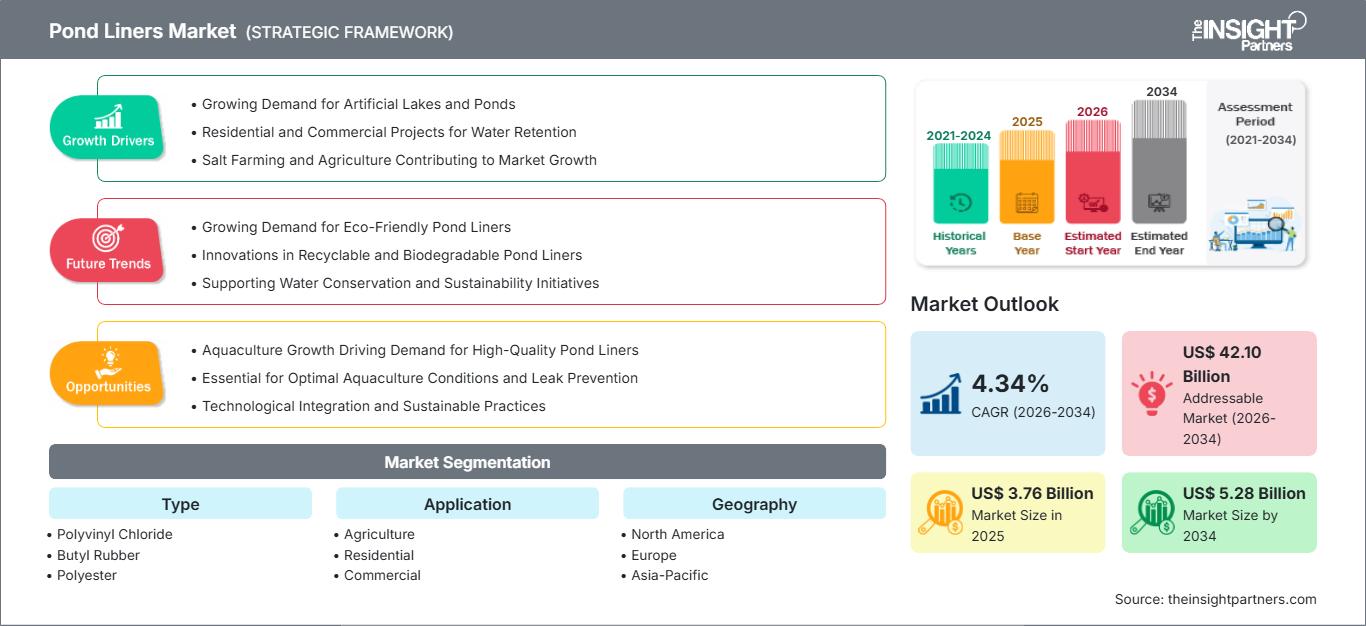
The pond liners market was valued at US$ 3.76 Billion in 2025 and is projected to reach US$ 5.28 Billion by 2034, registering a CAGR of 4.34% during 2026–2034. Market expansion is supported by increasing investments in water conservation infrastructure, aquaculture, agricultural irrigation, and engineered containment systems. Growing adoption of durable geomembrane materials across residential landscaping and commercial water management applications is further strengthening long-term demand across developed and emerging economies.
North America is expected to remain one of the leading regional markets, advancing at an estimated CAGR of 3.8–4.3% during 2026–2034. Demand is supported by expanding irrigation modernization projects, increasing investments in wastewater containment infrastructure, and stringent environmental regulations governing industrial and municipal water storage. Agricultural efficiency programs and rising adoption of engineered geomembranes for recreational ponds also continue to reinforce regional market expansion.
Pond Liners Market Assessment and Insights
- North America: North America accounted for 32–35% share in 2025 and is anticipated to grow at a CAGR of 3.8–4.3% during 2026–2034. Strong environmental compliance, advanced irrigation practices, and widespread use of engineered geomembranes in municipal and commercial applications continue to support regional demand.
- U.S.: The U.S. represented 76–80% of the North American market in 2025 and is projected to expand at a CAGR of 3.9–4.4% during 2026–2034, supported by agricultural water conservation, stormwater management, and industrial containment investments.
- Europe: Europe captured 26–29% share in 2025 and is expected to register a CAGR of 3.7–4.2% during 2026–2034. Germany, the UK, and France remain leading contributors due to established environmental regulations, water infrastructure modernization, and increasing adoption of sustainable water storage solutions.
- Asia Pacific: Asia Pacific held 28–31% share in 2025 and is forecast to record the fastest regional expansion with a CAGR of 5.2–5.7% during 2026–2034. China, India, Japan, and Australia are driving investments in irrigation, aquaculture, mining, and wastewater management projects.
- Largest Segment: Polyethylene accounted for a market share of 37–41% in 2025 and is projected to grow at a CAGR of 4.6–5.1% during 2026–2034, supported by excellent chemical resistance, durability, and cost-effective deployment across large-scale containment applications.
- High Growth Segment: Waste Management represented a market share of 18–22% in 2025 and is anticipated to expand at a CAGR of 5.4–5.9% during 2026–2034, driven by stricter landfill regulations, leachate containment requirements, and investments in environmental protection infrastructure.
- Key companies analyzed in detail: AGRU Kunststofftechnik GmbH, Carlisle Companies Incorporated, Carlisle Emmbi Industries Limited, Firestone Building Products, GSE Environmental LLC, HongXiang New Geo-Material Co., Ltd., Huadun Snowflake, Reef Industries, Inc., Stephens Industries Limited, Western Environmental Liner, and BTL Liners.
Source: The Insight Partners' analysis based on proprietary research, government publications, company annual reports, investor presentations, industry databases, and expert interviews.
The consistent advancement in the field of polymer engineering has revolutionized pond liners by developing materials that not only hold water but also offer enhanced puncture resistance, UV stability, and increased lifespan. There has been a growing trend among producers of adopting advanced polyethylene and geomembrane systems for easy installation and better performance of the liners. Moreover, the widening scope of their applications across sectors, including agriculture, mining, industrial wastewater, and landscaping, has created new opportunities for material and manufacturing developments worldwide.
Future growth will be driven by increasing market demand in Asia Pacific, the Middle East, and certain African countries as governments prioritize sustainable infrastructure and water security. Growing investments in precision agriculture, climate-resilient projects, and wastewater treatment plants will be key drivers of market demand for pond liners. The increasing emphasis on groundwater protection, landfill containment, and water resource management through regulations will encourage manufacturers to produce recyclable materials and high-performance geomembranes.
Pond Liners Market Report Scope
| Report Attribute | Details |
|---|---|
| Market size in 2025 | US$ 3.76 Billion |
| Market Size by 2034 | US$ 5.28 Billion |
| Global CAGR (2026 - 2034) | 4.34% |
| Historical Data | 2021-2024 |
| Forecast period | 2026-2034 |
Pond Liners Market Analysis
Increasing concerns regarding water scarcity, agricultural productivity, and environmental protection continue to strengthen demand for engineered pond liners across multiple end-use industries. Expanding irrigation infrastructure, aquaculture development, industrial wastewater management, and landfill containment projects are creating sustained opportunities for high-performance geomembrane materials. The growing emphasis on reducing seepage losses and improving long-term water storage efficiency has encouraged the adoption of polyethylene, polyvinyl chloride, and butyl rubber liners in both developed and emerging economies. Consequently, the pond liners market growth remains supported by infrastructure modernization, climate adaptation initiatives, and stricter environmental compliance requirements.
The industry value chain has become increasingly integrated, beginning with polymer resin manufacturers, followed by geomembrane producers, fabricators, distributors, engineering contractors, and installation specialists. Raw material price fluctuations continue to influence production costs; however, technological advancements in extrusion, multilayer manufacturing, and reinforced polymer formulations are improving product durability and lifecycle performance. These developments are expanding the pond liners market scope across agriculture, municipal water management, mining, and commercial landscaping while supporting greater operational efficiency and sustainability objectives.
Competition within the global market is characterized by continuous product innovation, regional manufacturing expansion, and strategic investments in advanced geomembrane technologies. AGRU Kunststofftechnik GmbH, GSE Environmental LLC, Carlisle Companies Incorporated, Firestone Building Products, and Reef Industries, Inc. maintain strong market positions through diversified product portfolios, engineering expertise, and extensive distribution capabilities. Regional manufacturers such as HongXiang New Geo-Material Co., Ltd., Huadun Snowflake, Carlisle Emmbi Industries Limited, Stephens Industries Limited, Western Environmental Liner, and BTL Liners continue strengthening competitiveness by addressing application-specific requirements and expanding local customer support.
Investments are being made in sustainable manufacturing processes, in geomembrane materials that can be recycled, and in polymers with higher performance levels for resistance to harsh environmental conditions. Firms are increasing their manufacturing capacity to meet rising demand in the water conservation, mining, and waste management segments, while also improving installation and technical consulting services. Digital monitoring systems, automated welding systems, and tailored containment systems are helping to distinguish market leaders in the pond liners industry. It is evident that the pond liners market share is slowly consolidating among firms that manufacture reliable, environmentally friendly product lines.
● REPORT CUSTOMIZATION
Tailor This Report To Align With Your Specific Business Requirements
This report can be customized to align precisely with your business objectives, scope, and target markets. Customization options include tailored segmentation, geography, competitive analysis, and strategic insights to support informed decision-making.
Customize This Report →WHAT YOU CAN ADJUST
- ● Segmentations
- ● Geography
- ● Competitive Analysis
- ● Language Preferences
Pond Liners Market: Strategic Insights
Regional Insights
North America Pond Liners Market
North America accounted for around 32–35% of the global market in 2025 and is expected to grow at a CAGR of 3.8–4.3% between 2026 and 2034. The region will witness strong demand driven by increased use of geomembrane liners in agriculture, municipal water reservoirs, stormwater management, mining activities, and landfill applications. Environmental laws and regulations governing groundwater protection and wastewater management are driving the replacement of traditional linings with robust polymer-based geomembrane liners.
Increasing investments in irrigation infrastructure and in building resilient water infrastructure are bolstering the market's long-term growth prospects. Pond liners are used extensively by public organizations and private landowners to reduce water loss from seepage in irrigation systems. Increasing adoption in recreational ponds, aquaculture farms, and industrial uses further propels regional demand. Technological advancements in high-density polyethylene and reinforced geomembrane liners are enhancing the performance of these products.
U.S. Pond Liners Market
The U.S. held a 76%-80% share of the North American market in 2025 and is projected to witness a CAGR of 3.9%-4.4% during 2026-2034. Active farming activities, growing investments in wastewater treatment facilities, and increasing construction of containment structures across industries will continue to boost demand for engineered pond liners. Irrigation reservoirs and water storage ponds for cattle are further contributing to the growth in demand for the product across multiple states.
The availability of well-established players along with engineering and installation services providers will help the market to remain innovative and competitive. Landscaping services, golf courses, aqua farms, and stormwater management facilities are adopting high-quality geomembrane solutions to enhance their performance. Continuous investments in sustainable water management are expected to keep the country dominant in the regional market.
Europe Pond Liners Market
Europe held a market share of 26-29% in 2025 and is expected to register a 3.7-4.2% CAGR during the forecast period 2026-2034. The region is well-positioned by strong environmental regulations, developed water infrastructure, and increasing investments in sustainable farming practices. Germany leads due to its developed manufacturing facilities and extensive use of geomembrane products across industry, agriculture, and municipalities.
The United Kingdom has been witnessing a steady growth due to increasing efforts towards water conservation through stormwater management and environmental restoration initiatives. High-end polymer lining materials are increasingly used in the construction of agricultural reservoirs, commercial landscape applications, and landfills.
France, Italy, and Spain together account for a sizable share of regional demand for geomembrane products due to increasing efforts in irrigation modernization, vineyard water management, wastewater treatment, and the development of renewable energy infrastructure. Pressures over water supplies in Southern Europe are driving the usage of engineered pond liners.
APAC Pond Liners Market
Asia Pacific held 28–31% of the global market in 2025 and is forecast to record the fastest regional growth at a CAGR of 5.2–5.7% during 2026–2034. China leads regional demand through extensive investments in irrigation, aquaculture, mining, and environmental infrastructure.
India is witnessing accelerating adoption as agricultural modernization and water conservation programs expand, while Japan and South Korea continue investing in advanced industrial containment and wastewater treatment systems.
Australia also contributes significantly through mining operations, agricultural reservoirs, and environmental protection initiatives, supporting broader regional demand for durable geomembrane technologies.
Middle East & Africa Pond Liners Market
The Middle East & Africa are expected to register a CAGR of 4.8–5.3% during 2026–2034, supported by increasing investments in water security, desalination support infrastructure, and agricultural irrigation projects. Saudi Arabia remains the largest regional market.
The United Arab Emirates continues expanding water storage and landscaping infrastructure, while industrial development creates additional demand for engineered containment systems across commercial and municipal applications.
South Africa and the Rest of the Middle East & Africa are experiencing growing adoption across mining, agriculture, and wastewater management sectors, supported by infrastructure development and rising emphasis on sustainable water resource management.
Segmentation Analysis
Type
The Type segment is projected to grow at a CAGR of 4.3–4.8% during 2026–2034. Material selection depends on application requirements, installation conditions, chemical resistance, durability, and lifecycle costs. Growing demand for long-lasting geomembranes across agriculture, waste management, mining, and commercial water storage continues to encourage manufacturers to introduce enhanced polymer formulations with improved ultraviolet resistance, flexibility, and puncture strength while meeting increasingly stringent environmental standards.
- Polyvinyl Chloride (PVC): PVC liners remain widely adopted for decorative ponds, residential landscaping, and small commercial water features because of their flexibility, ease of installation, and competitive pricing. Demand remains stable where moderate chemical resistance and installation convenience are primary purchasing considerations.
- Butyl Rubber: Butyl rubber liners are preferred for premium landscaping, ornamental ponds, and ecological restoration projects due to their exceptional flexibility, long service life, and ability to withstand temperature fluctuations, making them suitable for complex pond shapes and challenging environmental conditions.
- Polyester: Polyester-reinforced liners provide improved tensile strength and dimensional stability, making them suitable for commercial water containment, aquaculture, and industrial applications where enhanced mechanical performance and durability are required under continuous operational stress.
- Polyethylene: Polyethylene remains the dominant material because it combines excellent chemical resistance, high puncture strength, ultraviolet stability, and cost efficiency. These advantages support extensive adoption across agricultural reservoirs, mining projects, wastewater treatment facilities, and landfill containment applications.
Application
The Application segment is expected to expand at a CAGR of 4.5–5.0% during 2026–2034. Rising investments in efficient water management, environmental protection, and sustainable infrastructure continue to diversify application areas. Increasing awareness regarding water conservation and regulatory compliance encourages broader adoption of engineered pond liners across both public and private sectors, supporting long-term market expansion in developed and emerging economies.
- Agriculture: Agriculture represents the largest application owing to the increasing construction of irrigation reservoirs, rainwater harvesting systems, livestock ponds, and water conservation infrastructure. Farmers continue investing in durable liners to reduce seepage losses and improve irrigation efficiency under changing climatic conditions.
- Residential: Residential demand is supported by expanding landscaping activities, ornamental gardens, backyard ponds, and rainwater harvesting installations. Consumers increasingly prefer durable, low-maintenance geomembranes that provide reliable water retention while enhancing outdoor aesthetics and environmental sustainability.
- Commercial: Commercial applications include golf courses, recreational parks, hotels, aquaculture facilities, and industrial water storage systems. Growing investments in water-efficient infrastructure and environmental compliance continue to support steady demand from institutional and private commercial users.
- Waste Management: Waste management is the fastest-growing application as landfill operators, wastewater treatment facilities, and industrial containment projects increasingly deploy high-performance geomembranes to prevent leachate migration, protect groundwater resources, and comply with evolving environmental regulations.
Opportunity Snapshot
| Application | Revenue Contribution | Trend Tag | Adoption Stage |
| Agriculture | High | Precision Irrigation | Mature |
| Residential | Medium | Rainwater Harvesting | Scaling |
| Commercial | Medium | Water Reuse | Scaling |
| Waste Management | High | Leachate Control | Scaling |
Pond Liners Market Growth Drivers and Impact Analysis
Expansion of Water Conservation and Irrigation Infrastructure
The growing concern about freshwater availability is prompting many governments and landowners to invest in efficient water-containment facilities for both agricultural and domestic use. Pond liners are extremely important for reducing leakage losses, improving reservoir efficiency, and facilitating year-round irrigation. The increased use of rainwater harvesting, precision irrigation, and climate-adapted agriculture is boosting demand for reliable geomembrane products. In developing nations, the spread of irrigation systems is being used to enhance food security, while in developed nations, water infrastructure is being upgraded through containment technology.
Stringent Environmental Regulations Supporting Engineered Containment
Environmental agencies in the world’s leading countries continue to enact tougher laws governing the operation of landfills, sewage treatment plants, mining projects, and industrial water storage facilities. These laws have been driving increased use of pond liners to prevent groundwater contamination and leachate migration. There is a shift across industries from traditional containment materials to certified geomembrane systems, which offer better durability and chemical resistance. The growing need for sustainable waste management practices and environmental cleanup will further increase demand.
Advancements in Polymer Materials and Installation Technologies
Continuous innovations in polymer technology have greatly enhanced the longevity, elasticity, and lifespan of present-day pond liners. Modern polyethylene (high-density), reinforced polyethylene, and composites exhibit greater resistance to ultraviolet radiation, punctures, chemical attack, and temperature variations than previous-generation lining materials. In addition, automation in welding systems and digital quality control are helping to reduce project time and improve performance. Such technological advancements reduce lifecycle costs and increase user acceptance across agricultural, mining, sewage treatment, landscaping, and containment applications, driving market growth until 2034.
Pond Liners Market Future Trends
Growing Adoption of Sustainable and Recyclable Geomembrane Materials
Sustainability goals are projected to play an important role in driving material development in the pond liner industry over the coming years. Manufacturers are developing reusable polymer compositions, low-emission technologies, and long-life-span products, in line with increasingly stringent sustainability demands. Requests from infrastructure projects and environmentally conscious business entities are contributing to the development of durable, recyclable geomembranes. Lifecycle analysis is playing an increasingly important role in purchasing decisions, especially for water storage and waste management projects in municipalities. Companies that incorporate sustainable manufacturing methods alongside good material properties are likely to benefit from improved competitiveness.
Integration of Smart Monitoring and Digital Asset Management
Digital technologies are expected to play a greater role in the operation and maintenance of water-containment infrastructure. There is increasing interest among asset owners in monitoring systems that can detect leaks, assess liner condition, and provide predictive maintenance. These technologies will enhance operational efficiency while reducing maintenance costs and potential environmental hazards. Large-scale agricultural reservoirs, mining sites, municipal wastewater projects, and industrial containment projects are likely to drive this trend. With the increasing global digital infrastructure, smart monitoring is anticipated to become an integral part of the value-added product line for pond liners.
Pond Liners Market Opportunities
Expanding Opportunities in Climate-Resilient Agricultural Infrastructure
Variability in climate and changes in precipitation, together with increasing water scarcity, are prompting governments and agricultural operators to build water storage structures that are resilient to these conditions. There is an enormous business opportunity in manufacturing robust liner products for irrigation water storage systems, rainwater harvesting systems, and animal water storage systems. The emerging economies are constantly growing their agricultural development projects geared towards efficient use of water resources and higher agricultural yields, while developed economies are modernizing their existing irrigation structures with innovative geomembranes.
Increasing Investment in Industrial and Municipal Wastewater Projects
The increasing trends of urbanization and compliance with environmental regulations have continued to lead to the construction of more wastewater treatment plants, landfills, and industrial containment structures. This will provide excellent business prospects for producers of geomembrane liners who can supply high-quality geomembranes that can withstand the harsh conditions in these industries. An increasing number of mining companies, chemical firms, energy corporations, and municipal utility firms will demand better chemically resistant and long-lasting geomembrane liners to ensure effective containment. Business relationships with engineering, environmental consulting, and infrastructure development firms will provide additional advantages.
Recent Developments
- December 2025: AGRU America, Inc. announced the appointment of a new business unit manager for its Fluoropolymers and Semi-Finished Products division to strengthen product development, technical support, and customer engagement. The move aligns with the company's long-term strategy to expand its engineering plastics portfolio, supporting geomembrane, lining, and industrial containment applications across North America.
- December 2025: RENOLIT has extended its successful collaboration with APPL Industries as part of the joint venture APPL GOR India Plastics Pvt. Ltd. for another 15 years. This decision underscores RENOLIT's commitment to the Indian market and our expansion strategy in Asia.
- April 2025: RENOLIT SE announced plans to construct a new manufacturing facility in Pune, India, dedicated to geomembranes for civil engineering projects. Commercial production is scheduled to begin in 2026, strengthening regional supply capabilities for water containment, environmental protection, and infrastructure applications across the Asia-Pacific market.
Frequently Asked Questions

- Comprehensive Market Sizing and Forecast Analysis
- Detailed Segmentation Analysis
- In-Depth Market Dynamics Assessment
- Regional and Country-Level Insights
- Competitive Landscape and Company Benchmarking
- Strategic Business Intelligence
Recent Reports
Testimonials

The Insight Partners' SCADA System Market report is comprehensive, with valuable insights on current trends and future forecasts. The team was highly professional, responsive, and supportive throughout. We are very satisfied and highly recommend their services.
RAN KEDEM Partner, Reali Technologies LTDs
I requested a report on a very specific software market and the team produced the report in a few days. The information was very relevant and well presented. I then requested some changes and additions to the report. The team was again very responsive and I got the final report in less than a week.
JEAN-HERVE JENN Chairman, Future Analytica
We worked with The Insight Partners for an important market study and forecast. They gave us clear insights into opportunities and risks, which helped shape our plans. Their research was easy to use and based on solid data. It helped us make smart, confident decisions. We highly recommend them.
PIYUSH NAGPAL Sr. Vice President, High Beam Global
The Insight Partners delivered insightful, well-structured market research with strong domain expertise. Their team was professional and responsive throughout. The user-friendly website made accessing industry reports seamless. We highly recommend them for reliable, high-quality research services
YUKIHIKO ADACHI CEO, Deep Blue, LLC.
This is the first time I have purchased a market report from The Insight Partners.While I was unsure at first, I visited their web site and felt more comfortable to take the risk and purchase a market report.I am completely satisfied with the quality of the report and customer service. I had several questions and comments with the initial report, but after a couple of dialogs over email with their analyst I believe I have a report that I can use as input to our strategic planning process.Thank you so much for taking the extra time and making this a positive experience.I will definitely recommend your service to others and you will be my first call when we need further market data.
JOHN SUZUKI President and Chief Executive Officer, Board Director, BK Technologies
I wish to appreciate your support and the professionalism you displayed in the course of attending to my request for information regarding to infectious disease IVD market in Nigeria. I appreciate your patience, your guidance, and the fact that you were willing to offer a discount, which eventually made it possible for us to close a deal. I look forward to engaging The Insight Partners in the future, all thanks to the impression you have created in me as a result of this first encounter.
DR CHIJIOKE ONYIA MANAGING DIRECTOR, PineCrest Healthcare Ltd.Reason to Buy
- Informed Decision-Making
- Understanding Market Dynamics
- Competitive Analysis
- Identifying Emerging Markets
- Customer Insights
- Market Forecasts
- Risk Mitigation
- Boosting Operational Efficiency
- Strategic Planning
- Investment Justification
- Tracking Industry Innovations
- Aligning with Regulatory Trends





 Get Free Sample for