
Porous Concrete and Asphalt Market Trends, Demand & Growth by 2034
Coverage: By Type (Pervious Concrete, Porous Asphalt); Application (Municipal Infrastructure, Commercial Infrastructure), and Geography (North America, Europe, Asia Pacific, and South and Central America)
- Status : Data Released
- Report Code : TIPRE00014027
- Category : Chemicals and Materials
- No. of Pages : 150
- Available Report Formats :


- Last update date : July 03, 2026


2025 Market Size
US$ 16.02 Bn
Base year value
2034 Forecast
US$ 26.06 Bn
Projected by 2034
CAGR 2026-2034
5.55 %
Growth rate
Addressable Market
US$ 190.73 Bn
(2026-2034)
The porous concrete and asphalt market was valued at US$ 16.02 Billion in 2025 and is projected to reach US$ 26.06 Billion by 2034, expanding at a CAGR of 5.55% during 2026–2034. Market expansion is supported by rising investment in sustainable urban infrastructure, the increasing implementation of stormwater management regulations, and the broader adoption of permeable pavement systems for transportation and municipal projects. Continuous product innovation in high-performance binders and concrete admixtures is further strengthening long-term commercial adoption across developed and emerging economies.
North America remains a strategically important market owing to mature infrastructure replacement programs, stringent environmental regulations, and increasing deployment of green construction materials. The regional market is anticipated to register a CAGR of 4.8–5.4% during 2026–2034, supported by investments in resilient transportation networks, low-impact development practices, and municipal initiatives to reduce urban flooding and improve groundwater recharge through permeable pavement technologies.
Porous Concrete and Asphalt Market Assessment and Insights
- North America: Accounted for 34–38% share in 2025 and is expected to grow at a CAGR of 4.8–5.4% during 2026–2034, supported by municipal infrastructure modernization, environmental compliance, and extensive adoption of sustainable pavement technologies across transportation and commercial developments.
- U.S.: Represented 76–80% of the North American market in 2025 and is projected to expand at a CAGR of 4.9–5.5% during 2026–2034, driven by federal infrastructure investments and growing implementation of stormwater management regulations.
- Europe: Held 27–31% share in 2025 and is forecast to register a CAGR of 5.1–5.7% during 2026–2034. Germany, the UK, and France continue to lead in adoption through sustainable construction policies, urban redevelopment projects, and circular economy initiatives.
- Asia Pacific: Captured 24–28% share in 2025 and is anticipated to record the highest CAGR of 6.3–6.9% during 2026–2034, led by China, Japan, India, and South Korea through rapid urbanization, transportation expansion, and smart city investments.
- Largest Segment: Municipal Infrastructure accounted for 58–62% of the market share in 2025 and is projected to grow at a CAGR of 5.6–6.1% during 2026–2034, supported by ongoing investments in roads, sidewalks, drainage systems, and other public infrastructure.
- High Growth Segment: Porous Asphalt accounted for 42–46% of the market share in 2025 and is expected to expand at a CAGR of 6.0–6.6% during 2026–2034, benefiting from highway rehabilitation projects and rising demand for noise-reducing pavement solutions.
- Key companies analyzed in detail: BASF SE, Boral Limited, CEMEX, S.A.B. de C.V., Chaney Enterprises, China State Construction Engineering Corporation Limited, China National Building Material Group Co., Ltd., CRH plc, Holcim Ltd., Sika AG, and U.S. Concrete, Inc.
Source: The Insight Partners' analysis based on proprietary research, government publications, company annual reports, investor presentations, industry databases, and expert interviews.
The growing emphasis on climate-resilient infrastructure has transformed production priorities in the porous concrete and asphalt markets. Manufacturers increasingly focus on optimized aggregate gradation, advanced admixture technologies, polymer-modified binders, and durable pavement formulations that maintain permeability under heavy traffic. Improvements in manufacturing efficiency and digital quality monitoring have also enhanced product consistency while reducing lifecycle maintenance requirements. These developments continue to strengthen the outlook for growth in the porous concrete and asphalt market across both mature and developing construction industries.
The future holds promising times for Asia Pacific countries, the Middle East, and certain economies in Latin America, particularly in infrastructure investment; there will be significant potential for companies involved in permeable pavements. Government incentives for sustainable drainage infrastructure, along with public-private partnerships and the need for green building standards, will further drive the adoption of innovative pavement materials. This implies that the market for porous concrete and asphalt will expand beyond municipal applications.
Porous Concrete and Asphalt Market Report Scope
| Report Attribute | Details |
|---|---|
| Market size in 2025 | US$ 16.02 Billion |
| Market Size by 2034 | US$ 26.06 Billion |
| Global CAGR (2026 - 2034) | 5.55% |
| Historical Data | 2021-2024 |
| Forecast period | 2026-2034 |
Porous Concrete and Asphalt Market Analysis
Growing urbanization and increasing climate adaptation initiatives continue to strengthen demand for permeable pavement systems worldwide. Municipal authorities increasingly prioritize stormwater infiltration, groundwater recharge, and flood mitigation while replacing aging transportation infrastructure. Simultaneously, commercial developers seek sustainable construction materials that contribute toward environmental certification standards and reduce long-term drainage costs. These factors collectively support the steady expansion of the porous concrete and asphalt market size across developed and emerging economies.
The market value chain continues evolving through stronger collaboration among cement producers, admixture manufacturers, aggregate suppliers, contractors, engineering consultants, and municipal agencies. Technological improvements in mix design optimization, recycled aggregates, polymer modifiers, and permeability testing have enhanced product durability without compromising structural performance. Stable availability of raw materials in major producing regions further supports supply continuity despite fluctuations in construction activity.
Competition within the market is characterized by continuous product innovation, regional capacity expansion, sustainability initiatives, and strategic infrastructure partnerships. Companies including BASF SE, Holcim Ltd., Sika AG, CRH plc, and CEMEX, S.A.B. de C.V. continue investing in advanced construction chemicals, low-carbon cement technologies, and integrated infrastructure solutions. Meanwhile, China National Building Material Group Co., Ltd. and China State Construction Engineering Corporation Limited strengthen regional supply capabilities through large-scale infrastructure execution and manufacturing integration.
Investment activity increasingly focuses on environmentally sustainable construction technologies that align with evolving government regulations and green infrastructure objectives. Leading manufacturers continue expanding production capabilities while improving operational efficiency through automation, digital quality control, and lower-carbon manufacturing processes. These initiatives reinforce competitive positioning while supporting long-term analysis of the porous concrete and asphalt markets, increased infrastructure resilience, and broader adoption across municipal and commercial construction projects.
● REPORT CUSTOMIZATION
Tailor This Report To Align With Your Specific Business Requirements
This report can be customized to align precisely with your business objectives, scope, and target markets. Customization options include tailored segmentation, geography, competitive analysis, and strategic insights to support informed decision-making.
Customize This Report →WHAT YOU CAN ADJUST
- ● Segmentations
- ● Geography
- ● Competitive Analysis
- ● Language Preferences
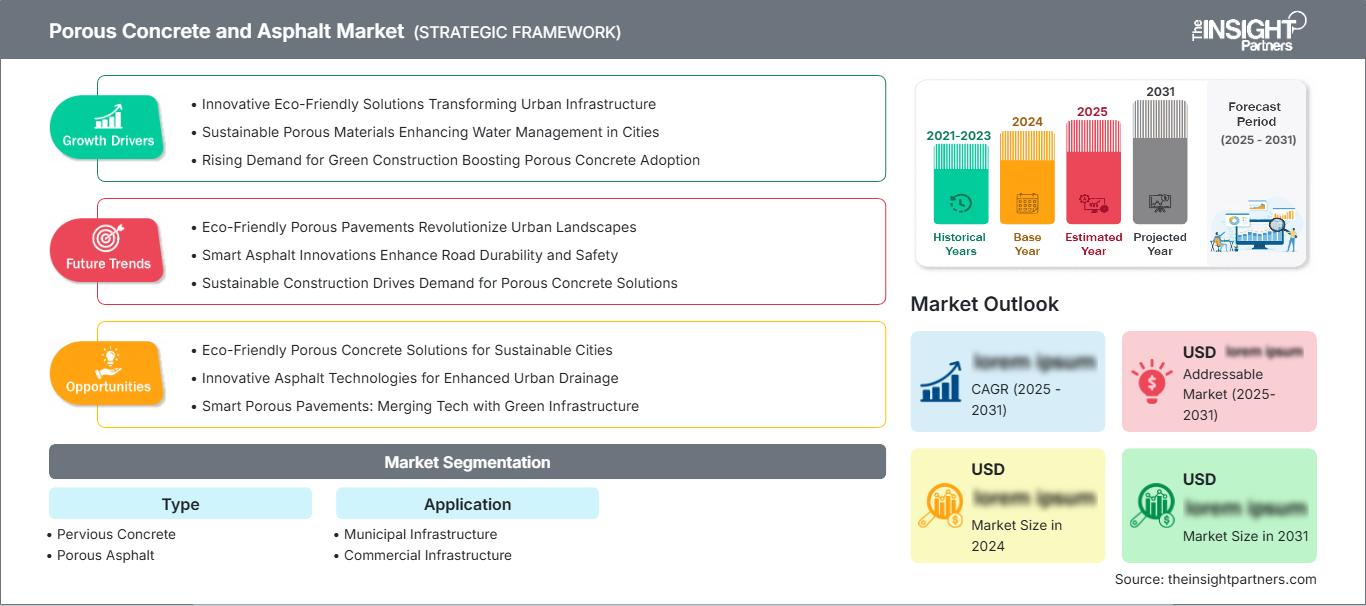
Porous Concrete and Asphalt Market: Strategic Insights
Regional Insights
North America Porous Concrete and Asphalt Market
North America accounted for 34-38% of the global market in 2025 and is estimated to grow at a CAGR of 4.8-5.4% from 2026 to 2034. Growth in the region will be driven by major investments in replacing aging infrastructure, growing demand for sustainable stormwater management strategies, and strict environmental regulations. There will be increased use of permeable concrete and asphalt due to federal and state-level infrastructure funding.
There will be increased use of permeable pavements to mitigate urban flooding, prevent runoff pollution, and replenish groundwater, as municipal agencies specify the use of permeable paving materials. Commercial buildings, colleges and universities, airports, and industrial facilities will also see significant integration of permeable pavements due to compliance with sustainability guidelines and reduced drainage infrastructure costs.
U.S. Porous Concrete and Asphalt Market
The United States accounted for 76–80% of the North American market in 2025 and is projected to register a CAGR of 4.9–5.5% from 2026 to 2034. High government investment in transportation infrastructure, state-level regulation of stormwater management, and rising rehabilitation of highway, municipal roadway, and commercial infrastructure fuel growth. Higher adoption of low-impact development principles also aids the adoption of permeable pavement systems.
Leading companies in the industry have strong production and research capabilities in the country, which helps the rapid adoption of new pavement technologies. Municipal infrastructure constitutes the major application segment; however, commercial real estate, logistics infrastructure, educational infrastructure, and recreational facilities are increasingly employing porous pavement systems.
Europe Porous Concrete and Asphalt Market
Europe held 27–31% of the global market share in 2025 and is expected to register a CAGR of 5.1–5.7% during 2026–2034. Sustainable construction regulations, circular economy initiatives, and significant investments in resilient transport infrastructure continue driving regional adoption. Germany remains the leading national market owing to extensive implementation of green infrastructure and advanced pavement engineering practices.
The United Kingdom continues to expand the adoption of permeable pavement through urban regeneration projects, sustainable drainage system requirements, and local government investments in climate-resilient infrastructure. Increasing redevelopment of commercial districts, residential communities, and public transportation facilities supports consistent demand for porous concrete and asphalt solutions while encouraging contractors to adopt environmentally responsible construction methods.
France, Italy, and Spain are collectively strengthening regional market expansion through transportation modernization, smart city development, and increasing investment in flood mitigation infrastructure. France emphasizes sustainable urban planning, Italy continues upgrading municipal transportation assets, and Spain invests in resilient public infrastructure suited to changing climatic conditions. These combined initiatives contribute to stable long-term demand across Southern Europe while reinforcing regional sustainability objectives.
APAC Porous Concrete and Asphalt Market
Asia Pacific accounted for 24–28% of the global market share in 2025 and is forecast to register the highest CAGR of 6.3–6.9% during 2026–2034. China leads regional demand through large-scale transportation and urban infrastructure development supported by government investment.
Japan and South Korea continue to adopt advanced permeable pavement technologies to improve urban water management and infrastructure durability. Mature engineering capabilities and environmental regulations support the steady implementation of projects across commercial and municipal sectors.
India and Australia are experiencing rising adoption owing to expanding smart city initiatives, highway construction, and sustainable urban development policies. Increasing investment in resilient infrastructure and climate adaptation measures is expected to accelerate market expansion throughout the forecast period.
Middle East & Africa Porous Concrete and Asphalt Market
The Middle East & Africa are anticipated to record a CAGR of 5.4–6.0% during 2026–2034, supported by growing investments in urban infrastructure, transportation networks, and sustainable construction practices. Saudi Arabia remains the leading regional market, driven by extensive infrastructure megaprojects and city development initiatives.
The United Arab Emirates continues to expand the implementation of green building across commercial developments and mixed-use urban projects. Sustainable drainage systems and resilient transportation infrastructure are becoming increasingly important within large-scale construction activities.
South Africa and the Rest of the Middle East & Africa are gradually increasing adoption through municipal infrastructure modernization and commercial construction investments. Although penetration remains comparatively lower than in other regions, improving regulatory frameworks and long-term infrastructure development plans are expected to create favorable opportunities for porous pavement technologies.
Segmentation Analysis
Type
The Type segment is projected to expand at a CAGR of 5.5–6.0% during 2026–2034. Application requirements, hydraulic performance, durability expectations, maintenance costs, and climatic conditions primarily influence product selection. Continuous advancements in aggregate gradation, binder technologies, and admixture formulations are improving pavement permeability and service life. As governments continue to emphasize sustainable stormwater management and resilient transportation infrastructure, both porous concrete and porous asphalt are expected to see steady adoption across municipal and commercial projects.
- Pervious Concrete: Widely adopted for sidewalks, parking areas, pedestrian pathways, and low-volume roads due to its excellent water infiltration capability, structural stability, and compatibility with sustainable urban drainage systems that support groundwater recharge.
- Porous Asphalt: Increasingly preferred for highways, airport pavements, commercial parking facilities, and road rehabilitation projects because of its superior driving comfort, reduced tire noise, efficient stormwater drainage, and relatively faster installation process.
Application
The Application segment is anticipated to register a CAGR of 5.6–6.1% during 2026–2034. Growing investments in resilient infrastructure, urban redevelopment, and environmental compliance continue driving demand across public and private construction projects. Municipal authorities remain the primary consumers owing to continuous investment in roads and drainage systems, while commercial developers increasingly adopt permeable pavements to improve sustainability performance and reduce lifecycle drainage costs.
- Municipal Infrastructure: Represents the dominant application, supported by extensive investments in roads, sidewalks, bicycle lanes, public parking areas, drainage improvements, and flood mitigation projects designed to enhance urban resilience and comply with environmental regulations.
- Commercial Infrastructure: Demand continues to rise across shopping centers, corporate campuses, industrial parks, educational institutions, healthcare facilities, and logistics hubs seeking durable, permeable pavements that contribute to sustainable development certifications and lower maintenance requirements.
Opportunity Snapshot
| Segment Name | Revenue Contribution | Trend Tag | Adoption Stage |
| Municipal Infrastructure | High | Stormwater Control | Mature |
| Commercial Infrastructure | Medium | Green Buildings | Scaling |
Porous Concrete and Asphalt Market Growth Drivers and Impact Analysis
Expansion of Sustainable Urban Stormwater Management Programs
Flooding in urban environments and increasing stress on traditional drainage systems are prompting governments to invest in permeable pavement infrastructure. The use of permeable concrete and asphalt allows rainwater to seep into the ground, increasing groundwater recharge without putting stress on municipal drainage systems. Increasing regulations for sustainable drainage systems in urban environments have facilitated the rapid adoption of these paving materials in the infrastructure development of roads, walkways, parking facilities, universities, and recreational parks. As cities move ahead with implementing measures to adapt to climate change, permeable pavement is becoming an essential part of city infrastructure development plans.
Rising Infrastructure Modernization and Transportation Investments
Large investments in transportation infrastructure are setting the stage for advanced pavement materials with an array of functionalities, including structural strength and environmental advantages. Many transportation projects, including highway rehabilitation, airport development, logistics facilities, and the construction of municipal roads, use permeable pavements where there is a need to manage stormwater runoff. Engineering consulting companies also promote the use of porous materials in transportation infrastructure projects that aim to manage stormwater, improve pavement safety, and increase resistance to various weather conditions. Large investments in resilient infrastructure in developed nations, along with rapid urban growth in developing countries, will boost procurement activity during the forecast period.
Advancements in Construction Materials and Low-Carbon Technologies
There is continuous improvement in the development of innovative chemistries for cement, polymer-modified binders, supplementary cementitious materials, recycled aggregates, and specialty admixtures, which is improving the mechanical properties and longevity of porous pavements. The development of such technologies will enable manufacturers to create materials that retain their porosity while improving clog resistance, freeze-thaw resistance, and load-bearing capacity. This development will lead to a reduced need for maintenance throughout the pavement lifecycle and increased trust in infrastructure owners and consulting engineers. At the same time, there is an ongoing industry effort to reduce embodied carbon through sustainable manufacturing processes, enabling purchase decisions based on environmental objectives.
Porous Concrete and Asphalt Market Future Trends
Digital Technologies Supporting Smart Pavement Asset Management
The need for digitalization is becoming increasingly pronounced in transportation infrastructure, enabling the implementation of porosity in pavement systems and intelligent asset management. Infrastructure owners use sensors, geographic information systems, and predictive maintenance solutions to track aspects of pavement, such as permeability, drainage system effectiveness, strength, and lifespan. The above-mentioned technologies allow municipalities to plan their maintenance activities optimally and ensure that pavements last longer and that operational costs decrease. With the worldwide spread of smart cities, demand for intelligent pavement materials is likely to increase.
Expansion of Low-Carbon Construction Material Portfolios
Manufacturing companies are now making efforts to adopt environmentally friendly production technologies that minimize greenhouse gas emissions while ensuring pavement quality remains high. The use of more recycled aggregates, supplementary cementitious materials, warm mix asphalt technologies, and alternative binders is likely to influence future pavement manufacturing trends. Policies that emphasize minimizing carbon throughout the lifecycle of pavements can lead to wider adoption of such products by municipalities and corporations alike. Manufacturing companies that can deliver low-carbon porous pavements that have proved to be durable and effective hydrologically are expected to gain a competitive edge in the marketplace.
Porous Concrete and Asphalt Market Opportunities
Growing Investment in Climate-Resilient Urban Infrastructure
The growing phenomenon of urbanization, along with rising occurrences of extreme precipitation, is pushing governments to invest more money in developing resilient infrastructure to mitigate the risks of flooding. The use of porous pavement technology is a promising approach because it increases infiltration rates and reduces dependence on traditional drainage systems. Public agencies are using permeable pavements in transport networks, urban development, and public areas to improve climate resilience. Manufacturers that can increase their production capacity, build stronger ties with contractors, and create regional products are likely to benefit from this trend.
Commercial Development and Sustainable Real Estate Projects
Environmental sustainability is becoming more common in the development of construction materials for the commercial sector to meet regulatory requirements and obtain green building certification. There is growing use of pervious pavement in shopping centers, logistics parks, office parks, hospitals, schools, and mixed-use developments to enhance water management while reducing maintenance costs. This would present an opportunity for manufacturers to produce specific pervious concrete and asphalt materials that are aesthetically pleasing, durable, and perform well throughout their lifecycles.
Recent Developments
- March 2026: Sika AG entered into a commercial partnership with Giatec Scientific Inc. to accelerate the adoption of digital and AI-driven concrete technologies across global construction projects. The collaboration integrates smart sensors and analytics to optimize concrete performance, including permeability, durability, and sustainability, supporting the development of advanced porous and permeable concrete systems.
- June 2025: Sika AG inaugurated a new admixture manufacturing facility in Morocco to strengthen regional supply capacity for construction chemicals used in concrete infrastructure projects across Africa and surrounding markets, supporting sustainable construction and expanding customer proximity.
- June 2025: Holcim Ltd. announced the acquisition of Langley Concrete Group Inc. to strengthen its infrastructure and drainage solutions portfolio across North America. The transaction expands Holcim's capabilities in precast concrete and sustainable infrastructure applications, complementing its broader low-carbon construction strategy.
Frequently Asked Questions

- Comprehensive Market Sizing and Forecast Analysis
- Detailed Segmentation Analysis
- In-Depth Market Dynamics Assessment
- Regional and Country-Level Insights
- Competitive Landscape and Company Benchmarking
- Strategic Business Intelligence
Recent Reports
Testimonials

The Insight Partners' SCADA System Market report is comprehensive, with valuable insights on current trends and future forecasts. The team was highly professional, responsive, and supportive throughout. We are very satisfied and highly recommend their services.
RAN KEDEM Partner, Reali Technologies LTDs
I requested a report on a very specific software market and the team produced the report in a few days. The information was very relevant and well presented. I then requested some changes and additions to the report. The team was again very responsive and I got the final report in less than a week.
JEAN-HERVE JENN Chairman, Future Analytica
We worked with The Insight Partners for an important market study and forecast. They gave us clear insights into opportunities and risks, which helped shape our plans. Their research was easy to use and based on solid data. It helped us make smart, confident decisions. We highly recommend them.
PIYUSH NAGPAL Sr. Vice President, High Beam Global
The Insight Partners delivered insightful, well-structured market research with strong domain expertise. Their team was professional and responsive throughout. The user-friendly website made accessing industry reports seamless. We highly recommend them for reliable, high-quality research services
YUKIHIKO ADACHI CEO, Deep Blue, LLC.
This is the first time I have purchased a market report from The Insight Partners.While I was unsure at first, I visited their web site and felt more comfortable to take the risk and purchase a market report.I am completely satisfied with the quality of the report and customer service. I had several questions and comments with the initial report, but after a couple of dialogs over email with their analyst I believe I have a report that I can use as input to our strategic planning process.Thank you so much for taking the extra time and making this a positive experience.I will definitely recommend your service to others and you will be my first call when we need further market data.
JOHN SUZUKI President and Chief Executive Officer, Board Director, BK Technologies
I wish to appreciate your support and the professionalism you displayed in the course of attending to my request for information regarding to infectious disease IVD market in Nigeria. I appreciate your patience, your guidance, and the fact that you were willing to offer a discount, which eventually made it possible for us to close a deal. I look forward to engaging The Insight Partners in the future, all thanks to the impression you have created in me as a result of this first encounter.
DR CHIJIOKE ONYIA MANAGING DIRECTOR, PineCrest Healthcare Ltd.Reason to Buy
- Informed Decision-Making
- Understanding Market Dynamics
- Competitive Analysis
- Identifying Emerging Markets
- Customer Insights
- Market Forecasts
- Risk Mitigation
- Boosting Operational Efficiency
- Strategic Planning
- Investment Justification
- Tracking Industry Innovations
- Aligning with Regulatory Trends





 Get Free Sample for