
Portable Spectrometers Market Size, Share & Trends by 2034
Coverage: By Type (Optical Spectrometer, Mass Spectrometer, Others); Technology (FTIR, MIR, NIR, Others); Application (Nanotechnology, Life Sciences, Forensic Science, Others); End-user (Research, Healthcare and Pharmaceutical, Chemicals, Others) , and Geography (North America, Europe, Asia Pacific, and South and Central America)
- Status : Data Released
- Report Code : TIPRE00006307
- Category : Manufacturing and Construction
- No. of Pages : 150
- Available Report Formats :


- Last update date : September 08, 2026


2025 Market Size
US$ 15.21 Bn
Base year value
2034 Forecast
US$ 30.52 Bn
Projected by 2034
CAGR 2026-2034
8.05 %
Growth rate
Addressable Market
US$ 205.65 Bn
(2026-2034)
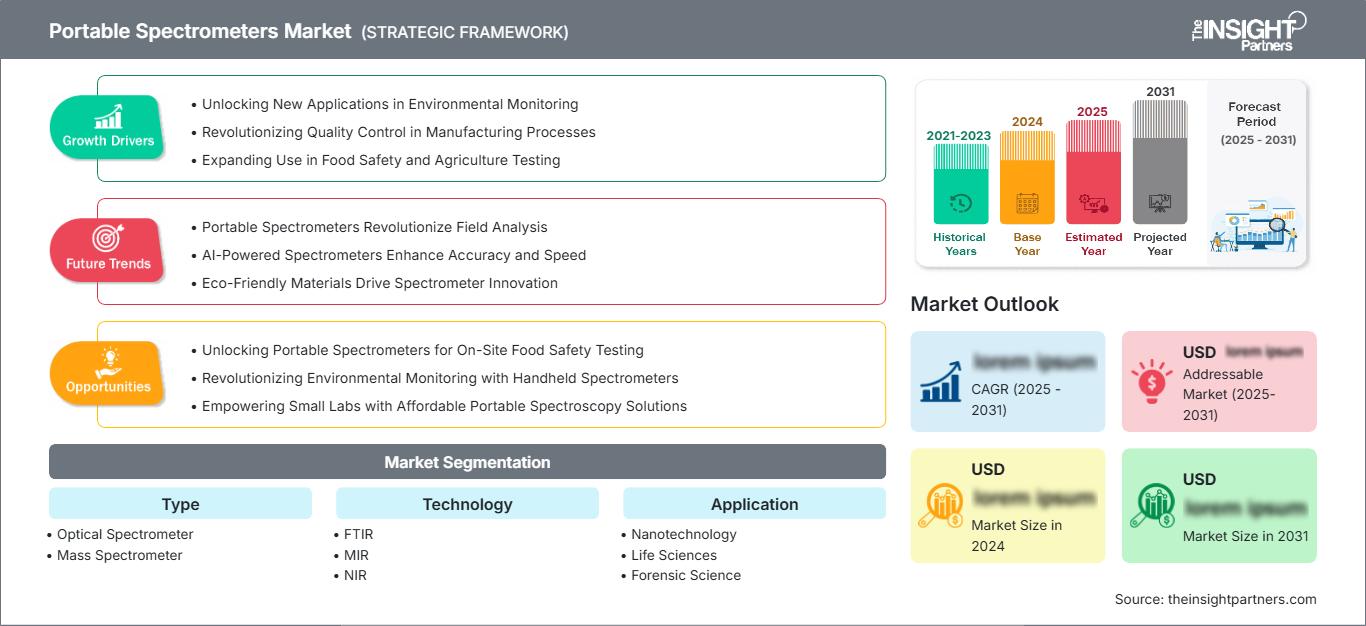
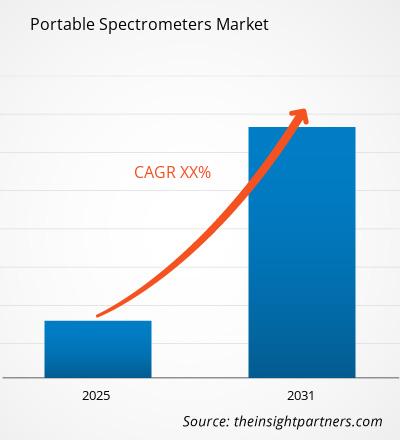
The portable spectrometers market is projected to grow from US$ 15.21 Billion in 2025 to US$ 30.52 Billion by 2034, registering a CAGR of 8.05% during 2026–2034. The market covers optical spectrometers and mass spectrometers using FTIR, MIR, and NIR technologies across nanotechnology, life sciences, forensic science, research, healthcare and pharmaceutical, and chemicals end-user environments.
North America portable spectrometers market size is expanding as laboratories, first responders, pharmaceutical plants, and industrial quality teams shift analytical decisions closer to the sample. The region is expected to grow at a CAGR range of 7.4–8.1% during 2026–2034, supported by field-based material identification, regulated pharmaceutical verification, and stronger investment in portable optical and mass analysis workflows.
Portable Spectrometers Market Assessment and Insights
- North America: The region accounted for 31–34% share in 2025 and is projected to grow at a CAGR range of 7.4–8.1% during 2026–2034, driven by pharmaceutical compliance, forensic testing, and industrial field analysis.
- US: The U.S. represented 78–82% of North America demand in 2025 and is expected to grow at a CAGR range of 7.5–8.2% through 2034.
- Europe: Europe held 24–27% share in 2025 and is likely to expand at a CAGR range of 7.0–7.7%, led by Germany, the UK, France, Italy, and Spain.
- Asia Pacific: Asia Pacific accounted for 32–36% share in 2025 and is forecast to grow at 8.6–9.4% CAGR, with China, India, Japan, South Korea, and Australia leading adoption.
- Largest Segment: Optical spectrometers held 61–65% market share in 2025 and are expected to grow at a 7.7–8.4% CAGR because handheld Raman, NIR, FTIR, and XRF platforms dominate field workflows.
- High Growth Segment: FTIR held 22–26% share in 2025 and is projected to grow at 8.8–9.6% CAGR as portable molecular identification gains wider use in safety, recycling, pharma, and chemicals.
- Key companies analyzed in detail: Agilent Technologies, Inc., Anton Paar GmbH, ATOMTEX, B&W Tek, Bruker Corporation, Hitachi High-Tech Analytical Science Ltd., JASCO Corporation, PerkinElmer, Inc., Thermo Fisher Scientific Inc., and X-Rite, Incorporated.
Source: The Insight Partners' analysis based on proprietary research, government publications, company annual reports, investor presentations, industry databases, and expert interviews.
Technology development in the portable spectrometers market is shifting analytical work from central laboratories to production lines, warehouses, customs points, crime scenes, and field research sites. Small-scale detector devices, enhanced chemometrics, cloud-based libraries, battery performance, and simpler interfaces are lowering the expertise required to perform spectroscopy. The manufacturing process will thus shift its focus from mobility of the device to durability of the housing, reliable calibration, data security, and process workflow tailored to each particular application.
In the future, the most successful regions will be those that manage to combine regulated manufacturing capabilities, development of the life sciences sector, and scientific research. In the Asia-Pacific region, rapid implementation will result from the growing manufacture of pharmaceuticals, electronic materials, and environmental monitoring. North American and European countries will need to ensure validation, regulatory compliance, and audit trails.
Portable Spectrometers Market Report Scope
| Report Attribute | Details |
|---|---|
| Market size in 2025 | US$ 15.21 Billion |
| Market Size by 2034 | US$ 30.52 Billion |
| Global CAGR (2026 - 2034) | 8.05% |
| Historical Data | 2021-2024 |
| Forecast period | 2026-2034 |
Portable Spectrometers Market Analysis
Growth in the market is being fuelled by the requirements of quick, non-destructive and independent analysis. Customers require molecular, elemental and mass spectroscopy without having to wait for long sample transfer times. The value chain comprises the suppliers of detectors, optics manufacturers, software firms, providers of calibration libraries, distributors, and training firms that teach the user how to operate the equipment under regulation and field conditions.
According to the market analysis, consumers are now considering parameters such as sensitivity, spectrum range, sample compatibility, library depth, compliance with regulations, battery performance and security of data. The need for quick analysis is greater where the delays in testing create risks for production processes, dangers for safety, or difficulties in handling evidence.
The competition is mainly between diversified analytics equipment providers and specialized spectroscopy brands. Thermo Fisher Scientific Inc., Agilent Technologies, Inc., Bruker Corporation, PerkinElmer, Inc., and Hitachi High-Tech Analytical Science Ltd. operate with a broad range strategy, while Anton Paar GmbH, JASCO Corporation, B&W Tek, ATOMTEX, and X-Rite, Incorporated gain a competitive advantage by focusing on optical, radiation, color measurement, and application-specific devices.
Positioning is becoming more oriented towards the integration of workflow processes. The vendors are combining portable or mobile devices with cloud-based libraries, compliant software solutions, maintenance services, and application kits. Thus, the users get an opportunity to go from sporadic measurements to a standardized workflow process and data recording in field conditions.
● REPORT CUSTOMIZATION
Tailor This Report To Align With Your Specific Business Requirements
This report can be customized to align precisely with your business objectives, scope, and target markets. Customization options include tailored segmentation, geography, competitive analysis, and strategic insights to support informed decision-making.
Customize This Report →WHAT YOU CAN ADJUST
- ● Segmentations
- ● Geography
- ● Competitive Analysis
- ● Language Preferences
Portable Spectrometers Market: Strategic Insights
Regional Insights
North America portable spectrometers market
North America accounted for 31–34% share in 2025 and is projected to expand at a CAGR range of 7.4–8.1% during 2026–2034. The region benefits from pharmaceutical quality assurance, public safety budgets, research laboratories, oil and gas inspection, and industrial material verification. The portable spectrometers market share is supported by rapid raw material identification and field screening.
Adoption is also helped by strong instrument service networks and user demand for validated methods. Forensic agencies use portable Raman and FTIR for substance screening, while manufacturers use NIR, MIR, and XRF platforms to reduce batch delays and incoming goods bottlenecks.
U.S. portable spectrometers Market
The U.S. represented 78–82% of North America's demand in 2025 and is expected to grow at a CAGR range of 7.5–8.2% during the forecast period. Demand exists in pharmaceutical production, biotechnology, forensics, chemistry, military applications, recycling, and process control.
Thermo Fisher Scientific Inc., Agilent Technologies, Inc., Bruker Corporation, PerkinElmer, Inc., and Hitachi High-Tech Analytical Science Ltd. have substantial market share through their marketing efforts and dealerships. Users from the United States place high importance on quick analysis, secure data transfer, validated libraries, and instruments that function well in uncontrolled environments.
Europe portable spectrometers Market
Europe held 24–27% share in 2025 and is forecast to grow at a CAGR range of 7.0–7.7%. The leadership of Germany is in the adoption of spectrometers in chemicals, pharmaceuticals, materials science, recycling, and quality control in industries. The United Kingdom contributes to demand creation in security, life sciences, and forensic laboratories.
France, Italy, and Spain create demand in pharmaceutical inspections, food tests, heritage sciences, and environmental monitoring. Customers in Europe focus on data integrity, CE compliance, method validation, and safety hardware. Bruker Corporation, Anton Paar GmbH, JASCO Corporation, Thermo Fisher Scientific Inc., and PerkinElmer, Inc. are strategically positioned in the market.
APAC portable spectrometers Market
APAC accounted for 32–36% share in 2025 and is projected to grow at a CAGR range of 8.6–9.4%. China leads regional demand due to pharmaceutical production, electronics materials, environmental enforcement, and industrial testing. Japan and South Korea support premium optical and mass analysis adoption.
India is expanding its use in pharma quality, academic research, and forensic labs, while Australia adds mining, environmental, and food safety applications. Regional portable spectrometers market trends include wider adoption of handheld NIR, Raman, and FTIR platforms, plus increasing demand for local calibration support.
Middle East & Africa portable spectrometers Market
The Middle East and Africa are expected to grow at a CAGR range of 7.2–8.0% during 2026–2034. Saudi Arabia and the UAE lead demand through petrochemicals, environmental monitoring, customs screening, and industrial inspection. Oil, gas, and chemicals require rapid material verification.
South Africa and the rest of MEA contribute through mining, university research, food testing, and public safety needs. Growth is project-led, but demand is improving as portable systems reduce reliance on centralized labs and enable faster decisions in remote operating environments.
Segmentation Analysis
Type
Type is expected to grow at a CAGR range of 7.8–8.5% during 2026–2034. The market scope includes optical and mass spectrometers that address different sample forms, sensitivity needs, and operational environments. Optical systems dominate routine field identification, while transportable mass systems support deeper molecular analysis.
- Optical Spectrometer: Optical spectrometers are widely used because Raman, FTIR, NIR, XRF, and UV-visible approaches can deliver rapid, often non-destructive identification in field, production, and quality settings.
- Mass Spectrometer: Portable or transportable mass spectrometers serve high-specificity applications where trace detection, complex mixture analysis, or confirmatory molecular information is needed beyond optical screening capability.
Technology
Technology is expected to grow at a CAGR range of 8.0–8.8%. FTIR, MIR, and NIR platforms are selected according to molecular information depth, sample preparation needs, result speed, and operator skill. Demand is strongest where spectroscopy reduces sampling time and improves process confidence.
- FTIR: FTIR systems are gaining adoption for substance identification, polymer analysis, chemical verification, and forensic workflows where robust molecular fingerprints support fast decisions at the point of need.
- MIR: MIR platforms provide strong molecular absorption information for chemicals, coatings, and materials analysis, making them useful where functional group identification supports quality and safety decisions.
- NIR: NIR instruments support high-speed screening of pharmaceuticals, agriculture, food, polymers, and process materials because they can often operate with minimal sample preparation.
Application
Application is expected to grow at a CAGR range of 7.9–8.7%. Life sciences contribute broad demand through biomolecular analysis and research workflows, while forensic science values field identification. Nanotechnology adoption is increasing as researchers need faster material characterization outside traditional laboratory sequences.
- Nanotechnology: Nanotechnology users rely on portable platforms to support material screening, surface characterization, and rapid verification during synthesis, scale-up, and field research workflows.
- Life Sciences: Life sciences applications benefit from fast molecular, protein, metabolite, and raw material analysis supporting research, bioprocess development, and pharmaceutical quality workflows.
- Forensic Science: Forensic science uses portable spectroscopy for rapid presumptive identification of unknown substances, explosives, narcotics, fibers, and evidence materials while reducing sample handling delays.
End-user
End-user is expected to grow at a CAGR range of 8.1–8.9%. Research users require flexible platforms for varied samples, healthcare and pharmaceutical users prioritize compliance and traceability, and chemicals users focus on material verification, safety, and process quality.
- Research: Research institutions adopt portable instruments to accelerate experiments, enable field sampling, and support multi-site studies where rapid screening can guide deeper laboratory analysis.
- Healthcare and Pharmaceutical: Healthcare and pharmaceutical users require validated libraries, audit trails, and reliable raw material verification to support quality assurance and regulated manufacturing decisions.
- Chemicals: Chemical companies use portable platforms for incoming material checks, process troubleshooting, hazardous substance identification, and faster decisions in warehouses, plants, and field service settings.
Opportunity Snapshot
| End-user | Revenue Contribution | Trend Tag | Adoption Stage |
| Research | High | Field Science | Scaling |
| Healthcare and Pharmaceutical | High | Batch Release | Mature |
| Chemicals | Medium | Material ID | Scaling |
Portable Spectrometers Market Growth Drivers and Impact Analysis
Shift Toward On-Site Analytical Decision-Making
The need for analytical answers at the point where the material is received, made, inspected, or examined is rising among users. Portable instrumentation allows for the reduction of delay due to laboratory queue and sample transport, an issue that matters in drug release, forensics, quality assurance, and field work. The consequence is the revision of the workflow to include the rapid decision process, escalation, and minimal movement of the samples. This driver will promote the use of Raman, near-infrared, Fourier transform infrared, and X-ray fluorescence technology platforms.
Compliance Pressure in Pharmaceutical and Safety Applications
Identification and traceability have to be defended in regulated industries. In pharmaceuticals, it means proving that the ingredients were identified prior to manufacture. Public authorities need quick identification of dangerous or unknown substances. The use of portable spectrometers helps users to fulfill such needs by providing quick results via controlled methods and digital recording. The effect on the market will be higher demand for validation of devices, locking workflow, authentication of the user and software prepared for audits.
Miniaturization of Detectors, Optics, and Embedded Software
Advances in detectors, light sources, battery systems, optical components, and embedded algorithms are making portable instruments more robust and easier to operate. These improvements reduce earlier trade-offs between portability and analytical confidence. Instruments can now support rugged field use, simplified workflows, faster scan times, and improved connectivity for data transfer. The impact is wider adoption among non-specialist users and multi-site organizations. As usability improves, portable platforms become practical in warehouses, production lines, field labs, and emergency response vehicles rather than remaining niche specialist tools.
Portable Spectrometers Market Future Trends
AI-Assisted Spectral Interpretation
Future portable spectrometers market trends will include stronger use of AI-assisted spectral interpretation to reduce operator dependence and improve confidence in complex samples. Algorithms will help identify mixtures, flag uncertain results, recommend confirmatory methods, and learn from expanding libraries. This will be valuable in pharmaceuticals, forensics, chemicals, and food testing, where non-expert users need consistent decisions. Suppliers will differentiate through validated models, transparent confidence scoring, and secure cloud-library updates that fit regulated workflows.
Integrated Field-to-Lab Data Workflows
Portable instruments will increasingly feed data directly into laboratory information systems, quality management software, and chain-of-custody platforms. This trend will reduce manual transcription, improve auditability, and connect screening results with confirmatory testing. Field teams will benefit from standardized reports, remote expert review, and faster escalation of suspicious samples. The result will be a stronger value for instruments that combine measurement speed with secure connectivity, data integrity, and enterprise-level workflow compatibility.
Portable Spectrometers Market Opportunities
Validated Libraries for Regulated End Users
portable spectrometers market Forecasts indicate a strong opportunity in validated spectral libraries and workflow packages for pharmaceutical, forensic, and chemical users. Many buyers need more than hardware; they need defensible methods, locked procedures, training materials, and documentation for audits or legal scrutiny. Suppliers can create recurring revenue through library subscriptions, method validation, software updates, and technical support. This opportunity is attractive because it increases switching costs and converts instrument sales into long-term workflow relationships.
Portable Mass Spectrometry for Complex Field Samples
Transportable mass spectrometry creates an opportunity where optical screening is insufficient for complex mixtures, trace contaminants, or high-specificity identification. Applications include environmental testing, security response, drug monitoring research, and advanced life sciences workflows. Vendors can target premium use cases by improving ruggedness, maintenance simplicity, sample introduction, and software-guided operation. Growth will depend on lowering operational barriers while preserving analytical depth, especially for agencies and laboratories that need confirmatory information closer to the field.
Frequently Asked Questions

- Comprehensive Market Sizing and Forecast Analysis
- Detailed Segmentation Analysis
- In-Depth Market Dynamics Assessment
- Regional and Country-Level Insights
- Competitive Landscape and Company Benchmarking
- Strategic Business Intelligence
Recent Reports
Testimonials

The Insight Partners provided valuable market intelligence that supported our global go-to-market strategy. Their team was professional, responsive, and attentive to our feedback, providing thoughtful analysis and helpful methodological clarifications throughout the project.
Junmo Kim Chief Financial Officer (CFO), Enertech Co., Ltd.
The Insight Partners' SCADA System Market report is comprehensive, with valuable insights on current trends and future forecasts. The team was highly professional, responsive, and supportive throughout. We are very satisfied and highly recommend their services.
RAN KEDEM Partner, Reali Technologies LTDs
I requested a report on a very specific software market and the team produced the report in a few days. The information was very relevant and well presented. I then requested some changes and additions to the report. The team was again very responsive and I got the final report in less than a week.
JEAN-HERVE JENN Chairman, Future Analytica
We worked with The Insight Partners for an important market study and forecast. They gave us clear insights into opportunities and risks, which helped shape our plans. Their research was easy to use and based on solid data. It helped us make smart, confident decisions. We highly recommend them.
PIYUSH NAGPAL Sr. Vice President, High Beam Global
The Insight Partners delivered insightful, well-structured market research with strong domain expertise. Their team was professional and responsive throughout. The user-friendly website made accessing industry reports seamless. We highly recommend them for reliable, high-quality research services
YUKIHIKO ADACHI CEO, Deep Blue, LLC.
This is the first time I have purchased a market report from The Insight Partners.While I was unsure at first, I visited their web site and felt more comfortable to take the risk and purchase a market report.I am completely satisfied with the quality of the report and customer service. I had several questions and comments with the initial report, but after a couple of dialogs over email with their analyst I believe I have a report that I can use as input to our strategic planning process.Thank you so much for taking the extra time and making this a positive experience.I will definitely recommend your service to others and you will be my first call when we need further market data.
JOHN SUZUKI President and Chief Executive Officer, Board Director, BK Technologies
I wish to appreciate your support and the professionalism you displayed in the course of attending to my request for information regarding to infectious disease IVD market in Nigeria. I appreciate your patience, your guidance, and the fact that you were willing to offer a discount, which eventually made it possible for us to close a deal. I look forward to engaging The Insight Partners in the future, all thanks to the impression you have created in me as a result of this first encounter.
DR CHIJIOKE ONYIA MANAGING DIRECTOR, PineCrest Healthcare Ltd.Reason to Buy
- Informed Decision-Making
- Understanding Market Dynamics
- Competitive Analysis
- Identifying Emerging Markets
- Customer Insights
- Market Forecasts
- Risk Mitigation
- Boosting Operational Efficiency
- Strategic Planning
- Investment Justification
- Tracking Industry Innovations
- Aligning with Regulatory Trends





 Get Free Sample for